

What Is a Growth Mindset and How Does It Work?
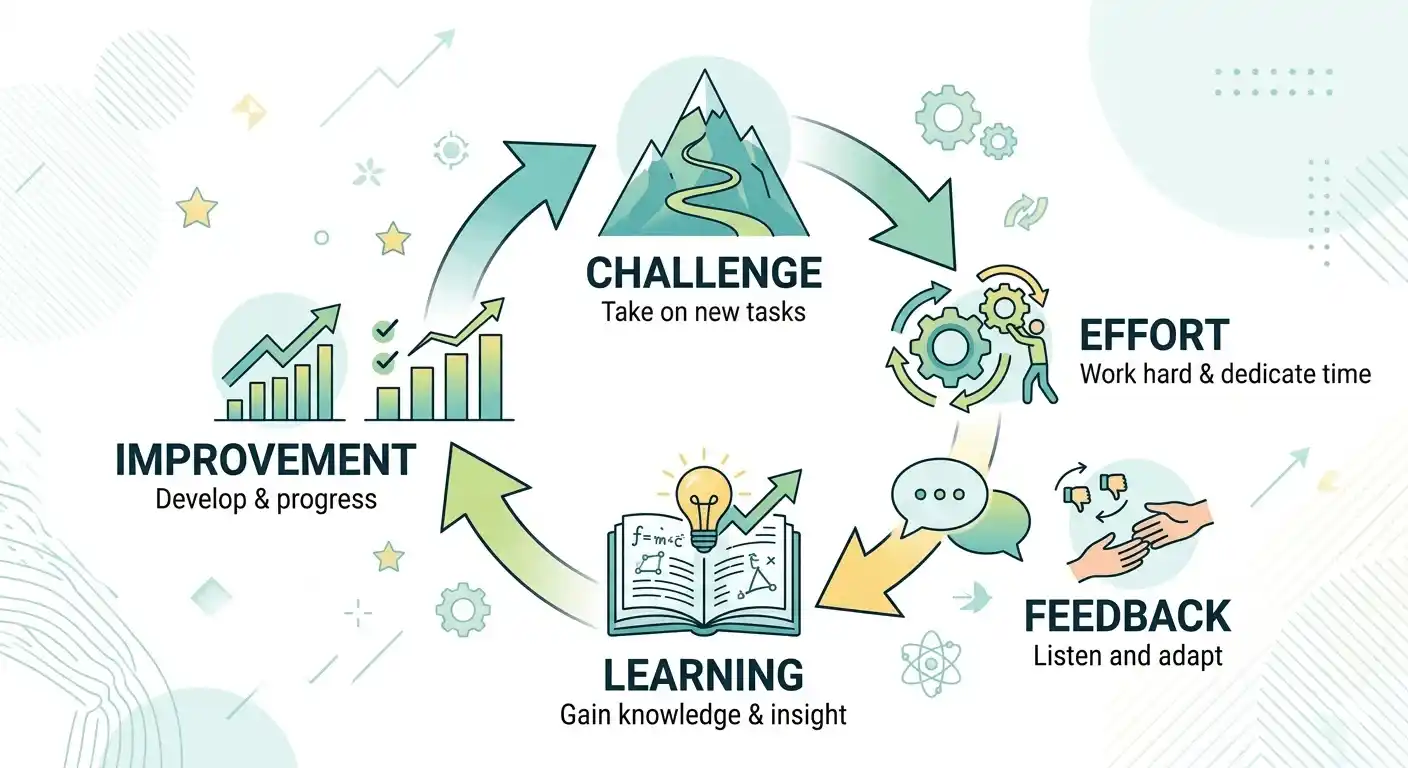
A growth mindset is the belief that abilities and intelligence can develop through practice, learning, feedback, and persistence. It does not mean everyone can achieve anything instantly; it means improvement is possible when people use effective methods and continue developing their skills.
The concept was introduced through the research of Carol Dweck, who studied how beliefs about intelligence influence motivation and achievement.
A growth mindset works by changing the way people interpret experiences:
- Challenges become opportunities to learn.
- Mistakes become information for improvement.
- Feedback becomes a tool for development.
- Effort becomes part of the learning process.
This mental model affects behavior because beliefs influence choices. Someone who believes skills can improve is more likely to practice, seek feedback, and continue after setbacks.
Why Is Growth Mindset Important for Personal Development?
A growth mindset is important for personal development because it helps people replace limiting beliefs with improvement-focused behaviors. When individuals believe they can grow, they are more likely to set meaningful goals, build better habits, and take consistent action.
Developing a growth mindset is often connected with building stronger systems and routines. Learning how to build discipline without motivation can help people continue improving even when they do not feel inspired.
Many people struggle with personal growth because they view current abilities as permanent. This creates avoidance patterns:
- Avoiding difficult tasks.
- Giving up after early failure.
- Comparing progress with others.
- Seeking immediate results.
A growth mindset changes this pattern by focusing attention on progress rather than perfection.
For example, instead of thinking:
“I am not disciplined.”
A growth-oriented approach asks:
“What systems can help me become more disciplined?”
This shift creates a problem-solving mindset that supports behavior change.
Why Is Growth Mindset Important for Students?
A growth mindset is important for students because it encourages active learning, persistence, and better responses to academic challenges. Students who believe they can improve are more likely to practice skills, ask questions, and use feedback.
Growth mindset supports education by helping students understand that ability develops over time.
Examples include:
- A student struggling with mathematics practicing different problem-solving methods.
- A writer improving through repeated drafts.
- A learner using mistakes from exams to identify weak areas.
Students with a growth mindset often focus on learning goals rather than only performance goals.
| Performance Focus | Growth Focus |
| “I need to prove I am smart.” | “I need to improve my skills.” |
| Avoids difficult tasks | Accepts challenges |
| Fears mistakes | Learns from mistakes |
| Focuses on results only | Focuses on progress |
Why Is Growth Mindset Important for Adults?
A growth mindset is important for adults because personal and professional success often requires adapting to change, learning new skills, and overcoming uncertainty.
Adults may develop fixed beliefs because of past experiences:
- Previous failures.
- Negative feedback.
- Fear of starting something new.
- Belief that learning becomes harder with age.
A growth mindset helps adults approach challenges differently. It encourages continuous learning, career development, and personal improvement.
In the workplace, a growth mindset can improve:
- Problem-solving.
- Collaboration.
- Leadership skills.
- Adaptability.
For example, an employee learning new technology does not view difficulty as evidence of inability. Instead, they identify what skills need improvement and create a learning plan.
Growth Mindset vs Fixed Mindset: Understanding the Difference
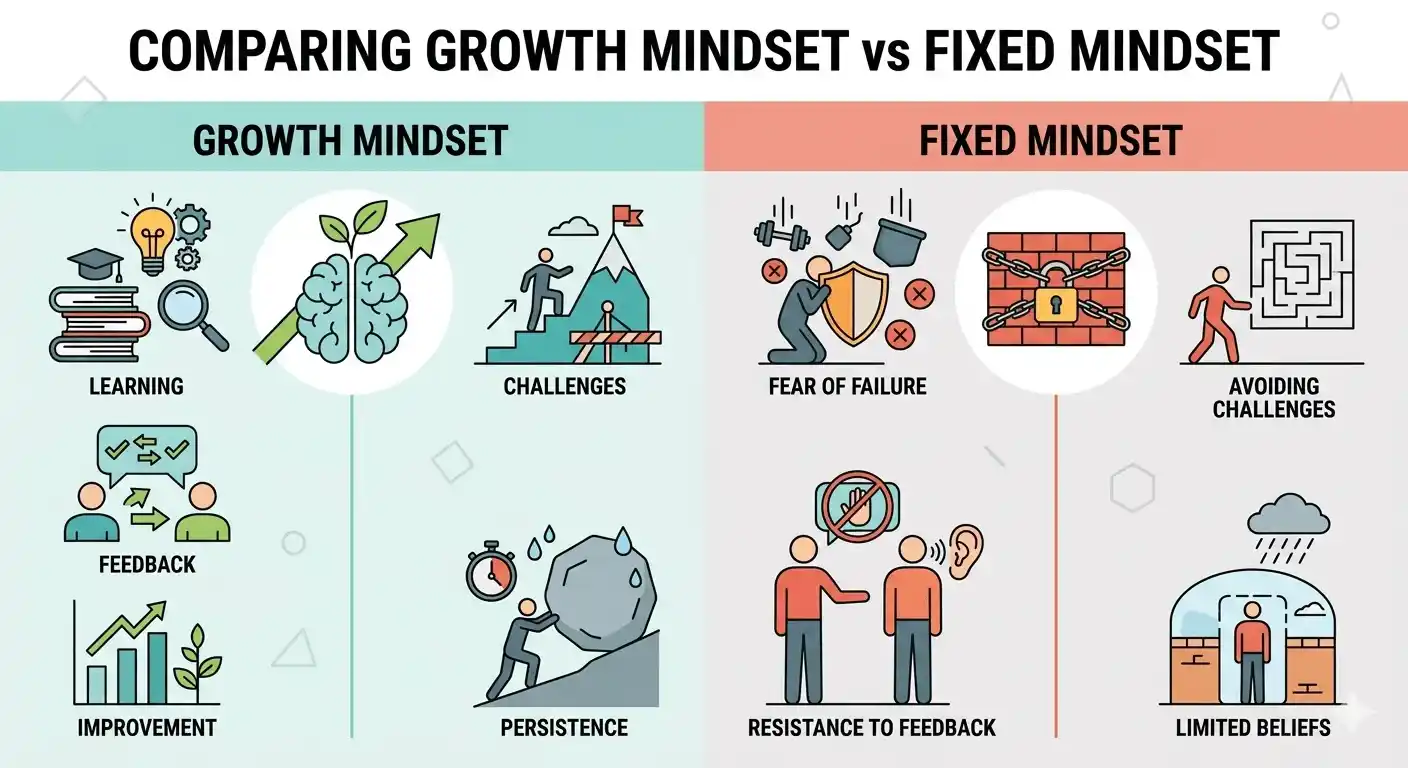
The difference between a growth mindset and a fixed mindset is how people view abilities and challenges.
| Growth Mindset | Fixed Mindset |
| Abilities can improve | Abilities are mostly permanent |
| Challenges create learning opportunities | Challenges feel threatening |
| Feedback supports growth | Feedback feels like criticism |
| Failure provides useful information | Failure feels like personal defeat |
| Effort supports improvement | Effort may seem pointless |
A fixed mindset can limit progress because people may avoid situations where they could fail. A growth mindset encourages experimentation, learning, and persistence.
What Are the Main Benefits of Having a Growth Mindset?
A growth mindset provides several psychological and behavioral benefits because it changes how people approach improvement.
Increased motivation and persistence
People are more likely to continue working toward goals when they believe progress is possible.
A growth mindset supports motivation by focusing on:
- Improvement instead of perfection.
- Learning instead of proving ability.
- Long-term progress instead of immediate results.
Better problem-solving and adaptability
Growth-oriented thinkers are more likely to search for solutions because they believe challenges can be overcome through learning.
This improves adaptability in areas such as:
- Career development.
- Relationships.
- Health habits.
- Skill development.
Stronger confidence through progress
Confidence becomes more realistic when it is built through evidence. Small improvements create proof that effort and strategies can produce change.
How to Develop a Growth Mindset in Daily Life
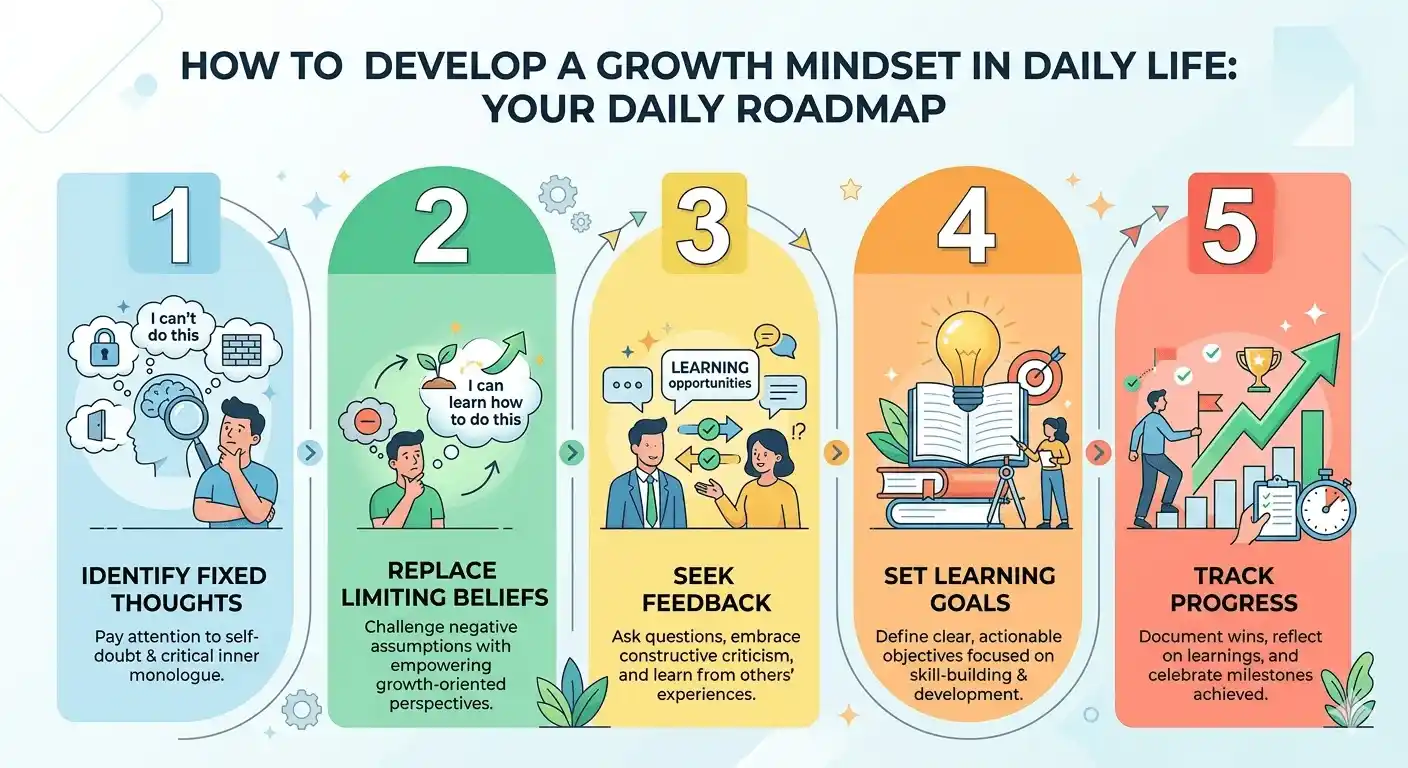
Developing a growth mindset requires changing both thinking patterns and daily behaviors.
Changing these internal beliefs requires awareness and intentional practice. Learning how to change your thoughts can help people replace limiting patterns with more productive ways of thinking.
Practical steps include:
- Identify fixed mindset thoughts.
- Notice statements like “I am bad at this.”
- Replace them with “I can improve with practice.”
- Focus on strategies, not only effort.
- Hard work matters, but effective methods matter too.
- Treat feedback as useful information.
- Use criticism to identify areas for improvement.
- Create learning-based goals.
- Focus on what skills you want to develop.
- Track progress regularly.
- Measuring improvement reinforces motivation.
A growth mindset develops through repeated actions, not a single decision.
10 Ways to Develop a Growth Mindset Through Habits and Actions
Building a growth mindset becomes easier when it is connected to daily routines.
- Practice skills consistently.
- Reflect on lessons from mistakes.
- Replace negative self-talk.
- Ask for constructive feedback.
- Set realistic improvement goals.
- Learn from people with more experience.
- Focus on progress tracking.
- Accept temporary discomfort.
- Build routines that support learning.
- Celebrate small improvements.
These habits work because repeated behaviors reinforce new beliefs.
Because beliefs become stronger through repeated behavior, developing supportive routines is essential. Following a structured approach like how to build good habits in 30 days can help turn growth mindset principles into long-term habits.
Common Barriers That Prevent People From Developing a Growth Mindset
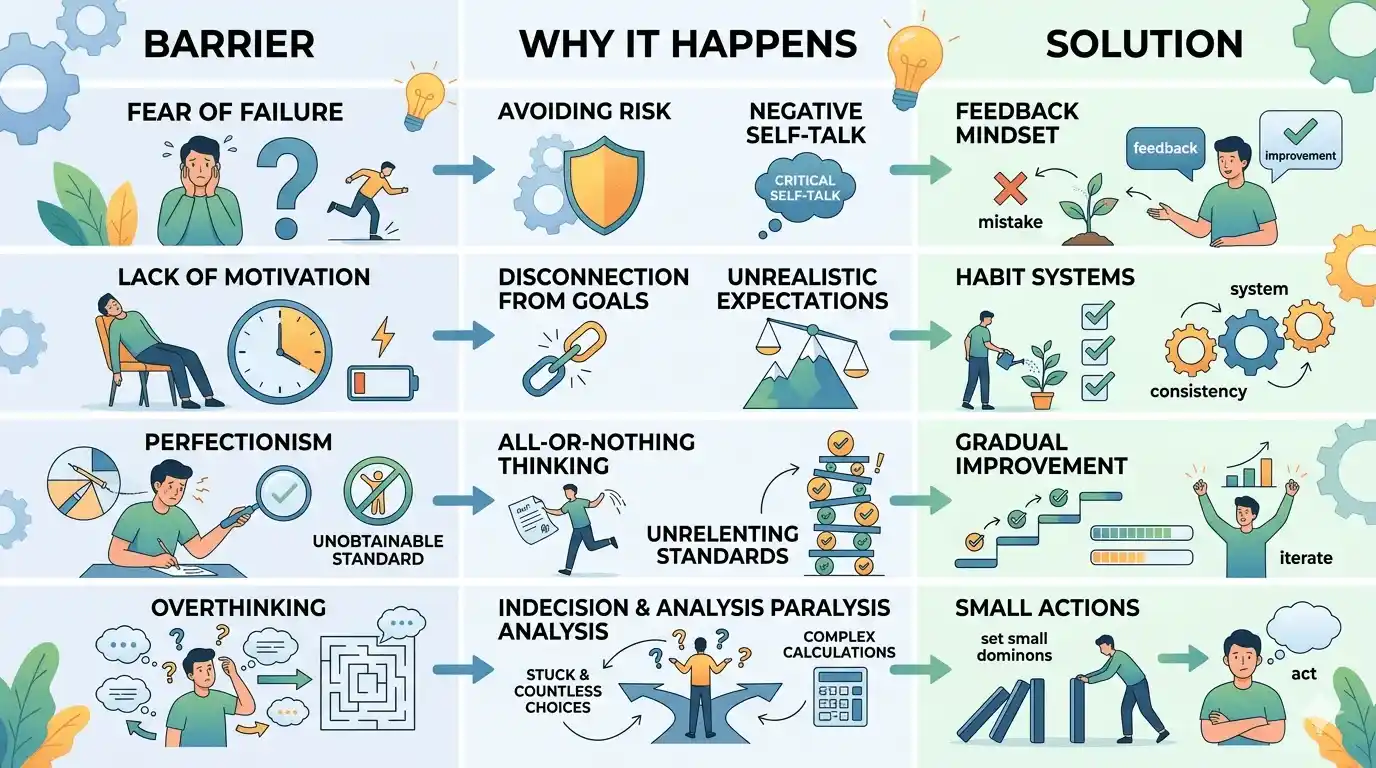
Many people understand growth mindset concepts but struggle to apply them consistently.
| Barrier | Why It Happens | Solution |
| Fear of failure | Mistakes feel like personal judgment | Treat failure as feedback |
| Lack of motivation | Waiting for the perfect feeling before acting | Build systems and routines |
| Perfectionism | Expecting immediate success | Focus on gradual improvement |
| Overthinking | Fear of making wrong decisions | Take small learning-focused actions |
Burnout can also prevent growth. When people create unrealistic expectations, they may push too hard, lose motivation, and abandon their goals.
Sustainable progress requires balance between ambition and recovery.
Growth Mindset Examples in Real Life
A growth mindset appears in everyday decisions.
Many people reinforce these beliefs through intentional self-talk. Using growth mindset affirmations can help create reminders that support persistence and continuous improvement.
Learning a new skill
Fixed mindset:
“I am naturally bad at this.”
Growth mindset:
“I need more practice and better strategies.”
Improving health habits
Fixed mindset:
“I always fail at routines.”
Growth mindset:
“I need a better system that fits my lifestyle.”
Career development
Fixed mindset:
“I cannot learn this technology.”
Growth mindset:
“I can develop this skill through practice and guidance.”
What Science and Research Suggest About Growth Mindset
Research on mindset suggests that beliefs about ability influence motivation, effort, and persistence. People who believe improvement is possible often engage more actively with challenges.
However, growth mindset is not simply positive thinking. Effective growth requires:
- Realistic goals.
- Consistent practice.
- Useful feedback.
- Effective learning strategies.
The strongest results come when mindset is combined with practical systems and behaviors.
Growth Mindset Myths: What Actually Works vs What Sounds Good
| Myth | Reality |
| Growth mindset means believing anything is possible instantly | Growth requires time, effort, and effective strategies |
| Effort alone guarantees success | Effort must be combined with learning and adjustment |
| Failure should always feel positive | Failure can be difficult while still being useful |
| Motivation creates progress automatically | Systems and habits create consistent progress |
A growth mindset is not about ignoring limitations. It is about finding ways to improve within real conditions.
Conclusion
Understanding why is growth mindset important reveals how beliefs shape learning, resilience, habits, and personal growth. A growth mindset helps people approach challenges with curiosity instead of fear and focus on improvement rather than perfection.
The most effective mindset shift is moving from “I cannot do this” to “I can improve through learning, practice, and better strategies.” When combined with consistent habits and realistic goals, a growth mindset becomes a foundation for lifelong development.
FAQs
Why do I struggle with consistency even when I want to improve?
People often struggle with consistency because they rely on motivation instead of building systems. Creating small routines, reducing friction, and tracking progress can make improvement easier.
How do I stay disciplined when motivation disappears?
Discipline improves when actions are connected to routines and clear goals. Relying only on motivation makes progress inconsistent because motivation naturally changes.
What happens if I do not have a growth mindset?
Without a growth mindset, people may avoid challenges, fear mistakes, reject feedback, and underestimate their ability to improve.
How do I develop a growth mindset?
You can develop a growth mindset by changing limiting beliefs, practicing new skills, accepting feedback, learning from mistakes, and focusing on gradual improvement.
Is a growth mindset the same as positive thinking?
No. A growth mindset is different from simple positive thinking because it requires action, learning strategies, effort, and adapt










13 Responses