

Introduction
The gladiator mindset is a mental framework built around resilience, discipline, courage, and perseverance in the face of adversity. It draws its name and imagery from the historical gladiator — someone who trained relentlessly and faced high-stakes challenges without flinching — but the modern interpretation has nothing to do with aggression or violence. Instead, it centers on mental toughness, self-discipline, and purpose-driven living. This mindset has gained traction across sports psychology, leadership development, and personal growth communities because it offers a practical way to build resilience and a growth mindset while navigating pressure, setbacks, and uncertainty.
Quick Summary
- The gladiator mindset emphasizes resilience, discipline, and unwavering focus during adversity.
- It helps individuals overcome setbacks by prioritizing long-term growth over short-term comfort.
- The mindset can be developed through consistent habits, emotional control, and purposeful action.
- While inspired by gladiators, the modern interpretation centers on mental strength rather than combat.
What Is the Gladiator Mindset?
Simple Definition
The gladiator mindset meaning refers to a psychological approach that combines discipline, emotional control, and courage to face difficulty head-on rather than avoiding it. In modern psychological terms, it functions as a performance mindset: a set of internalized beliefs and habits that help a person stay composed, take responsibility, and keep moving forward when circumstances become demanding. It overlaps with concepts such as mental toughness and grit, but places particular emphasis on discipline as the foundation for everything else. This raises a common question — is self-discipline a skill or an inborn trait? Research suggests it’s very much trainable, which is central to how the gladiator mindset works.
Why Is It Called the Gladiator Mindset?
The name draws on historical symbolism rather than literal combat. Gladiators trained for years under strict discipline, faced high-pressure situations with limited certainty of outcome, and relied on mental endurance as much as physical skill. Four elements of that symbolism carry over into the modern mindset:
- Courage under pressure — facing difficult situations without retreating.
- Discipline despite uncertainty — maintaining structure even when outcomes are unclear.
- Mental endurance over physical strength — treating resilience as a trainable internal skill, not just a physical trait.
- Preparation as confidence — readiness built through repetition, not luck.
Core Principles of the Gladiator Mindset
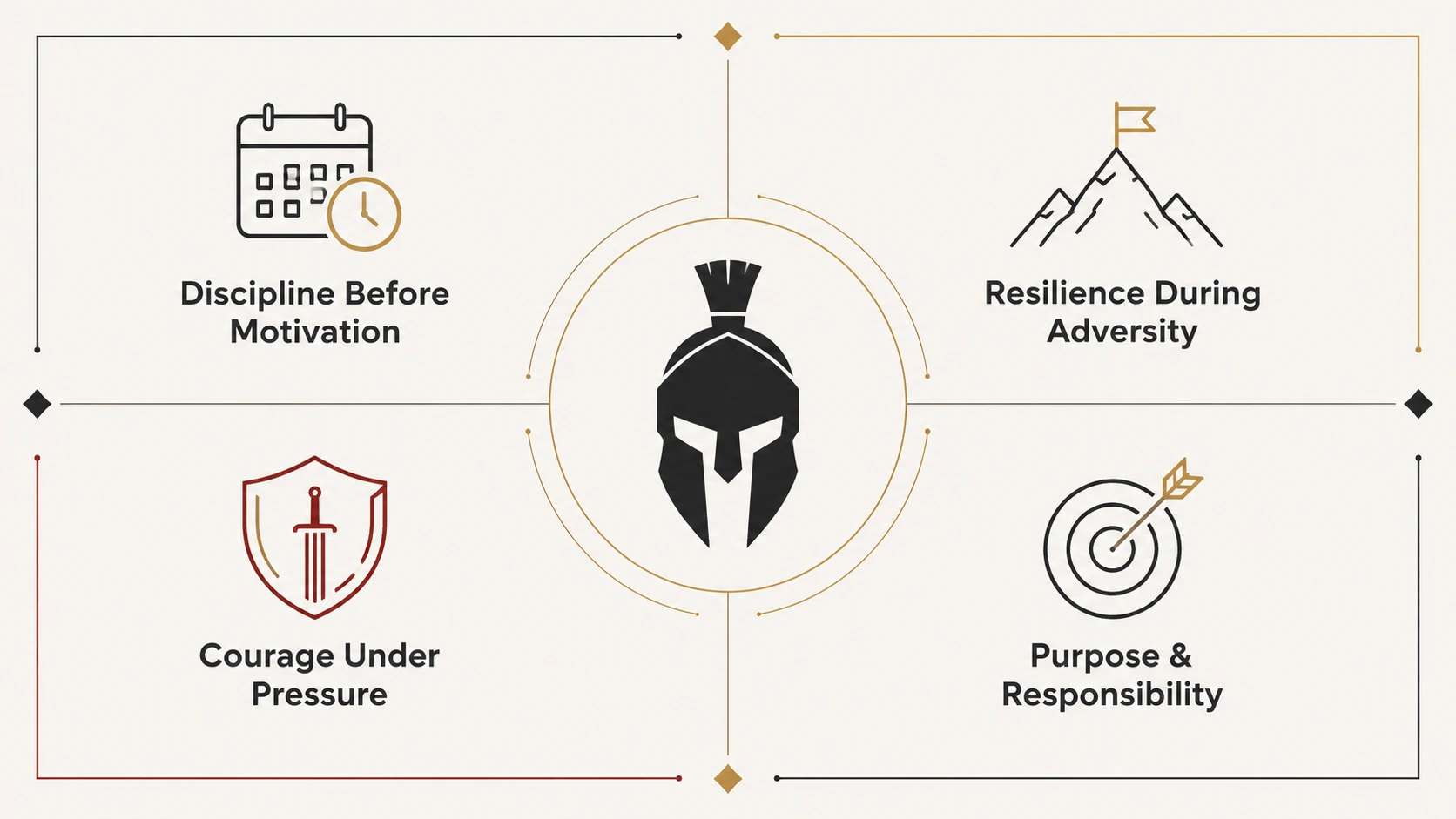
Discipline Before Motivation
Discipline is the operating principle behind the gladiator mindset because motivation is inconsistent, while discipline can be built into routine. This principle relies on:
- Building routines that don’t depend on how a person feels that day.
- Consistency over intensity, since small repeated actions compound over time.
- Delayed gratification — choosing long-term benefit over short-term comfort.
- Personal accountability, taking ownership of actions and outcomes rather than assigning blame externally. If motivation feels inconsistent right now, our guide on how to build discipline without motivation breaks down exactly how to keep showing up on the days you don’t feel like it.
Resilience During Adversity
Resilience is the capacity to recover functionally after a setback rather than avoiding setbacks altogether. Within the gladiator mindset, resilience is practiced through:
- Responding to setbacks with problem-solving instead of avoidance.
- Learning from failure by extracting specific, actionable lessons.
- Allowing for emotional recovery rather than suppressing difficult emotions.
- Maintaining long-term focus even when short-term results are discouraging.
Courage Under Pressure
Courage under pressure is about making sound decisions despite incomplete information or high stakes. Preparation plays a central role here: confidence is generally the product of repeated exposure and practice, not the absence of fear. This principle covers facing uncertainty directly, making decisions under stress without freezing, and building genuine confidence through preparation rather than bravado.
Purpose and Personal Responsibility
A gladiator mindset is anchored by purpose — a personal mission that provides direction when discipline alone isn’t enough. This includes taking ownership of one’s choices, relying on internal motivation rather than external validation, and practicing self-leadership: managing one’s own behavior, standards, and follow-through without needing constant outside supervision.
Characteristics of Someone With a Gladiator Mindset
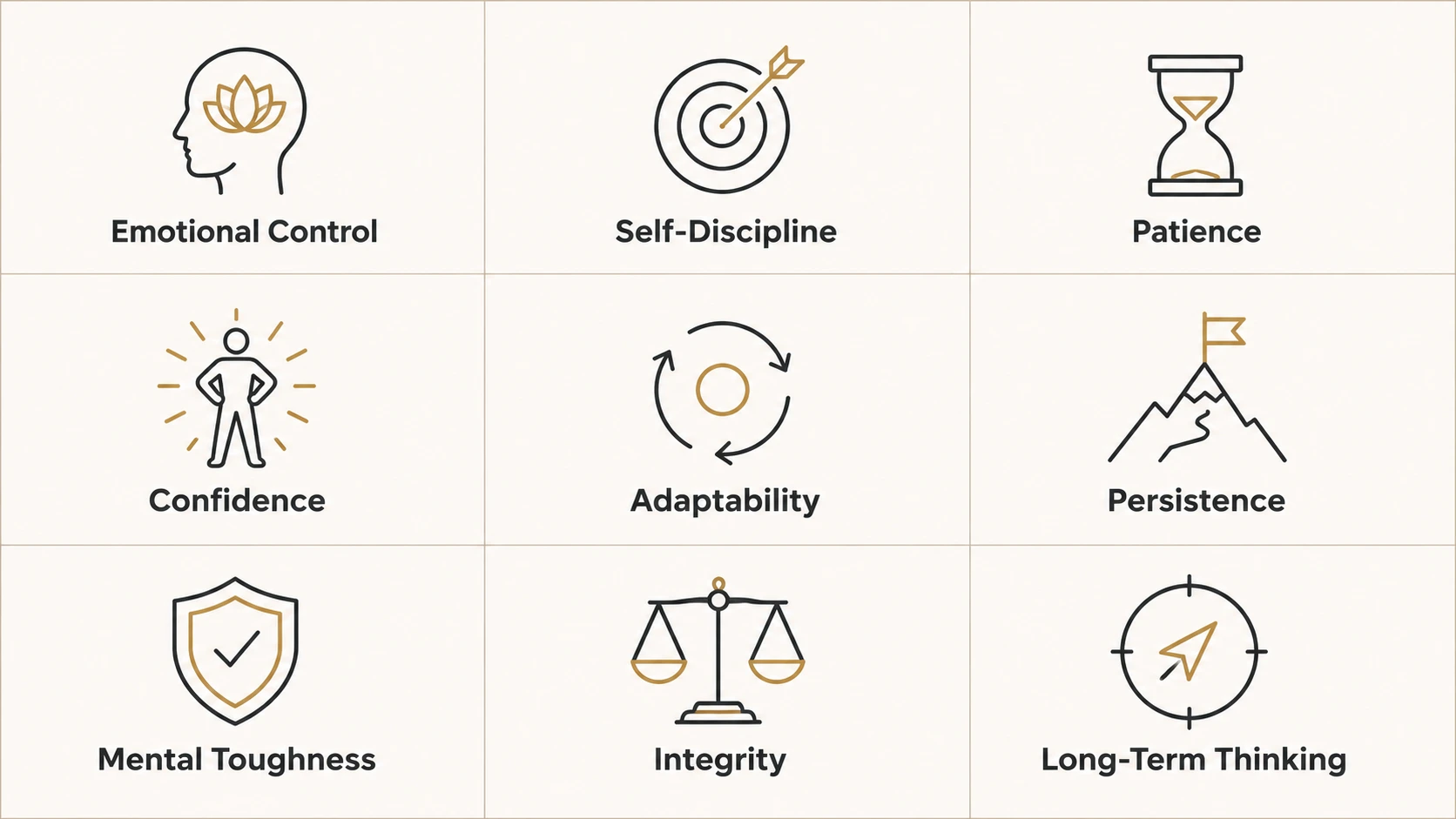
People who consistently apply this mindset tend to share a recognizable set of traits:
- Emotional control
- Self-discipline
- Patience
- Confidence
- Adaptability
- Persistence
- Mental toughness
- Integrity
- Long-term thinking
These characteristics reinforce one another. For example, emotional control supports better decision-making under pressure, while persistence and patience allow long-term thinking to translate into visible results.
Why the Gladiator Mindset Matters in Everyday Life
Personal Growth
Applied to personal development, the gladiator mindset provides a structure for setting goals, tolerating discomfort, and staying consistent through plateaus — periods when progress isn’t yet visible but effort still matters.
Career Success
In professional settings, this mindset supports handling criticism constructively, staying composed during high-pressure projects, and maintaining consistent output rather than relying on short bursts of motivation.
Education and Learning
Students benefit from the discipline component in particular, since consistent study habits and resilience after poor results (such as a failed exam or setback) tend to produce better long-term outcomes than talent alone.
Sports Performance
In athletic contexts, the mindset supports training consistency, recovery from competitive losses, and composure during high-stakes performance moments — one reason it is frequently discussed in sports psychology circles.
Relationships
Emotional control and personal responsibility — two core traits of the mindset — also support healthier relationships by reducing reactive conflict and encouraging accountability during disagreements.
The Gladiator Mindset vs Similar Mindsets
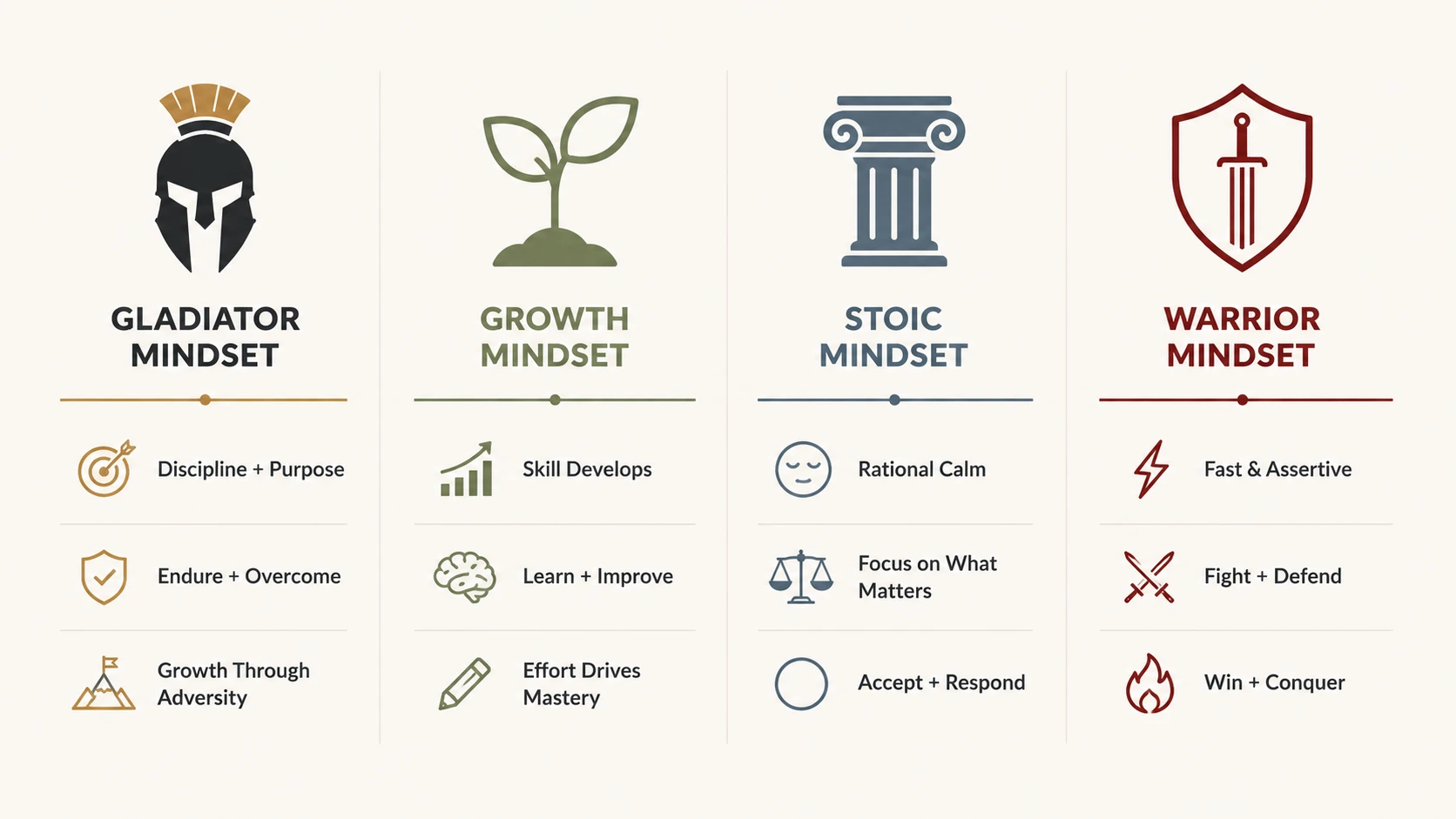
The gladiator mindset shares overlap with other well-known frameworks but is distinct in its combined emphasis on discipline, purpose, and resilience together.
| Comparison Factor | Gladiator Mindset | Growth Mindset | Stoic Mindset | Warrior Mindset |
|---|---|---|---|---|
| Primary Focus | Discipline, resilience, and purpose combined | Belief that abilities can be developed | Rational acceptance and emotional control | Aggressive competitiveness and dominance |
| Response to Failure | Treated as a learning input for growth | Treated as evidence of developing skill | Accepted calmly as outside one’s control | Often treated as something to overcome forcefully |
| Emotional Control | High, but emotions are processed, not suppressed | Moderate; focus is on mindset, not emotion | Very high; central to the philosophy | Variable; can lean toward intensity over composure |
| Long-Term Perspective | Central — purpose-driven and future-focused | Present in the belief that skill develops over time | Present through acceptance of long-term outcomes | Often more short-term and competition-focused |
| Decision-Making | Deliberate, prepared, composed under pressure | Exploratory and learning-oriented | Rational and detached from emotional reactivity | Fast, assertive, sometimes reactive |
| Personal Responsibility | Strongly emphasized | Emphasized through effort and self-belief | Central — focus on what is within one’s control | Present, but often framed around winning |
How to Build the Gladiator Mindset
Develop Daily Discipline
Daily discipline works because it removes the need to rely on motivation. The practical implementation is to choose one or two non-negotiable habits and perform them at the same time each day. The main obstacle is inconsistency in the first two to three weeks; the long-term benefit is that discipline eventually requires less conscious effort.
Strengthen Emotional Control
Emotional control allows for clearer decisions under stress. It can be practiced through brief pause techniques before reacting, and through regular reflection on emotional triggers. The common obstacle is reacting impulsively under pressure; the benefit is more consistent decision-making over time.
Embrace Discomfort
Deliberately choosing manageable discomfort — a harder workout, a difficult conversation, an unfamiliar task — builds tolerance for larger challenges later. The obstacle is the instinct to avoid discomfort altogether; the long-term benefit is a wider capacity for handling stress without becoming overwhelmed.
Set Meaningful Goals
Goals tied to genuine purpose sustain effort longer than goals chosen for external approval. Implementation involves defining a specific, personally meaningful outcome and breaking it into smaller milestones. The obstacle is setting vague or externally motivated goals; the benefit is sustained motivation through difficult periods.
Learn From Failure
Treating failure as data rather than identity protects long-term motivation. In practice, this means reviewing what happened, identifying one specific adjustment, and applying it going forward. The obstacle is dwelling on failure emotionally without extracting a lesson; the benefit is faster recovery and continuous improvement.
Practice Consistency
Consistency compounds small actions into meaningful results over time. It is best implemented through simple tracking (a checklist or journal) and realistic weekly targets rather than perfection. The obstacle is all-or-nothing thinking after a missed day; the benefit is durable, long-term progress.
Daily Habits That Reinforce the Gladiator Mindset
Certain daily habits consistently reinforce the principles above and are easy to build into most schedules:
- Morning routines that create early structure
- Physical exercise to build discipline and resilience
- Reading for continued growth and perspective
- Journaling to process setbacks and progress
- Daily reflection on decisions and emotional responses
- Regular goal review to stay aligned with purpose
- Meditation or mindfulness for emotional control
- Ongoing skill development in a chosen area
- Limiting distractions to protect focus and consistency
Common Challenges When Developing the Gladiator Mindset
Losing Motivation
Motivation naturally fluctuates because it is tied to mood and energy levels rather than commitment. It typically happens after the initial excitement of a new goal fades. The fix is relying on pre-built routines rather than daily motivation, and reviewing personal purpose regularly. Prevention involves designing habits that require minimal willpower to start. If this pattern feels familiar, it’s worth reading why do I lack motivation to understand the deeper causes before applying the fixes below.
Fear of Failure
Fear of failure often stems from tying self-worth to outcomes rather than effort. It can be addressed by redefining failure as feedback and by setting process-based goals rather than only outcome-based ones. Prevention involves normalizing setbacks as part of any long-term pursuit.
Overthinking
Overthinking usually occurs when uncertainty is high and preparation feels incomplete. It can be reduced through decision deadlines and by focusing on the next actionable step rather than the entire outcome. Prevention involves building confidence through preparation and practice.
Burnout
Burnout results from sustained effort without adequate recovery. It is addressed through scheduled rest, realistic workloads, and recognizing early warning signs such as persistent fatigue or irritability. Prevention involves treating recovery as part of discipline, not a departure from it.
Negative Self-Talk
Negative self-talk often develops from repeated self-criticism after setbacks. It can be addressed by consciously replacing critical internal language with accurate, constructive language. Prevention involves tracking progress objectively so self-assessment is based on evidence rather than emotion alone.
Beginner Mistakes to Avoid
Several avoidable mistakes commonly derail early progress:
- Confusing discipline with perfection, which leads to unnecessary self-criticism
- Ignoring rest and recovery in pursuit of constant effort
- Expecting quick transformation instead of gradual change
- Comparing personal progress with other people’s timelines
- Relying only on motivation instead of building supporting routines
- Setting unrealistic goals that are difficult to sustain
In our experience helping readers build better habits, the beginners who progress fastest are the ones who prioritize consistency over intensity from the very first week.
Practical Ways to Apply the Gladiator Mindset in Different Situations
Students
Students can apply the mindset through consistent study schedules, treating poor grades as feedback rather than failure, and building resilience around exam pressure.
Professionals
Professionals benefit from applying discipline to daily output, maintaining composure during high-pressure projects, and taking ownership of mistakes rather than deflecting responsibility.
Athletes
Athletes apply the mindset most directly through structured training, mental preparation before competition, and resilience after losses or injuries.
Entrepreneurs
Entrepreneurs rely on the mindset to manage uncertainty, recover from setbacks such as failed launches, and maintain long-term focus despite inconsistent short-term results.
Parents
Parents apply the mindset through patience under daily stress, modeling emotional control for children, and maintaining consistency in routines and expectations.
Difficulty & Time Investment
The gladiator mindset is beginner-friendly at its core, since it starts with small, repeatable habits rather than dramatic change. Typical effort level is moderate: most people can begin with 15–30 minutes of focused daily practice (such as a morning routine or journaling) and build from there. Daily consistency — more than intensity — is what produces results. Difficulty can be affected by existing stress levels, available time, and support systems. Beginners generally focus on foundational habits like routine-building and emotional awareness, while more advanced practice includes deliberately embracing discomfort and mentoring others through the same process.
Results Timeline
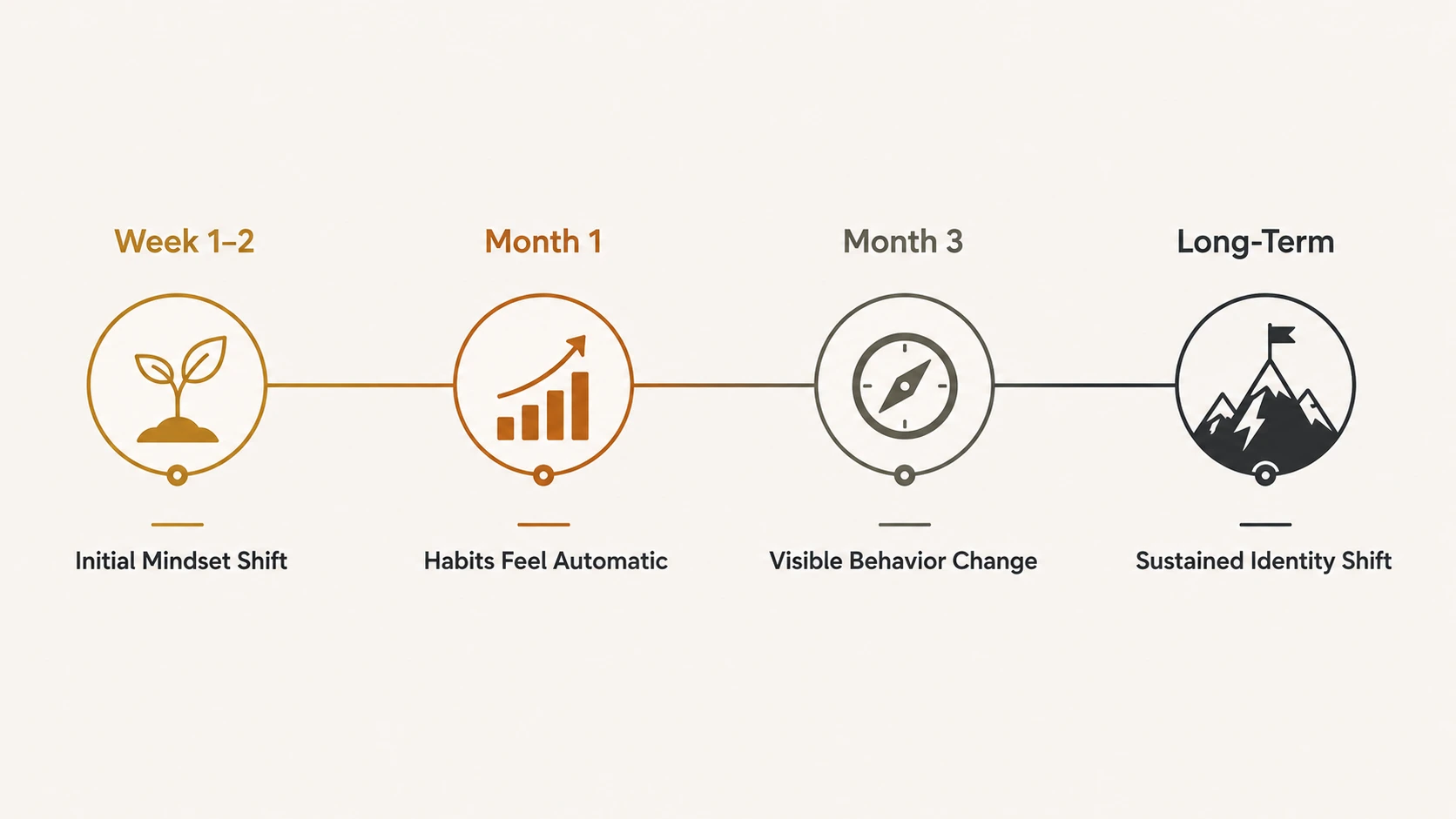
Your Daily Thrive recommends approaching this as a gradual process rather than expecting immediate transformation. Early results tend to be internal — a shift in perspective — before they become externally visible.
| Time Period | Typical Progress |
|---|---|
| Week 1–2 | Initial mindset shifts; increased self-awareness of habits and reactions |
| Month 1 | Early routines begin to feel more automatic; noticeable improvement in consistency |
| Month 3 | Visible behavioral changes; better emotional control and resilience under stress |
| Long-term | Sustained discipline becomes part of identity; measurable improvement across goals |
Progress speed is influenced by starting habits, consistency, life circumstances, and the presence of setbacks along the way. As of 2026, self-improvement research increasingly emphasizes identity-based habit formation — the idea that consistent small actions reshape self-perception over time — as a more durable path to lasting change than short-term intensity.
Practice Guide
Daily Routine
A simple daily routine — a fixed wake time, a short physical activity, and a few minutes of reflection — creates the structural foundation for the mindset.
Weekly Review
A short weekly review of goals, wins, and setbacks keeps effort aligned with purpose and highlights adjustments needed for the following week.
Tracking Progress
Simple tracking methods, such as a habit checklist or journal, provide objective evidence of consistency and help sustain motivation during slower periods.
Staying Consistent
Consistency is best maintained through accountability methods such as sharing goals with another person, scheduling fixed practice times, and setting realistic, sustainable targets.
Adjusting During Difficult Periods
During high-stress periods, the mindset calls for scaling effort down rather than abandoning it entirely — maintaining a minimum consistent habit rather than aiming for an all-or-nothing standard.
Popular Interpretations and Cultural References
Why the Phrase Became Popular Online
The phrase has spread widely across social media and self-improvement content because it condenses several respected psychological concepts — discipline, resilience, purpose — into a single, memorable image.
The Gladiator Mindset in Sports
The concept is closely associated with high-performance sports psychology. Notably, British Olympic swimmer <cite index=”5-1″>Adam Peaty, a multiple Olympic and World champion in the 100m breaststroke</cite>, published a book titled The Gladiator Mindset, which explores mental strategies used by elite athletes to handle pressure and setbacks. The book’s popularity has contributed to wider public discussion of the gladiator mindset as a framework for high-performance psychology, though the broader concept extends well beyond any single athlete or publication.
Frequently Misunderstood Ideas About the Gladiator Mindset
Several misconceptions persist around this concept and are worth clarifying directly:
- It’s not about aggression. The mindset emphasizes composure and discipline, not hostility toward others.
- It’s not about ignoring emotions. Emotional control means processing emotions constructively, not suppressing them.
- It’s not about never failing. Failure is treated as expected and useful, not as something to avoid entirely.
- It isn’t toxic masculinity. The mindset applies equally across genders and centers on resilience and purpose, not dominance.
- It emphasizes resilience with wisdom. Sustainable practice includes rest, reflection, and self-awareness alongside effort.
Conclusion
The gladiator mindset is a practical framework for building resilience, discipline, courage, and purpose-driven living. Its core principles — discipline before motivation, resilience during adversity, courage under pressure, and purpose-driven responsibility — apply across personal growth, career, education, sports, and relationships. Developing this mindset does not require dramatic transformation; it requires consistent daily habits, honest self-reflection, and a willingness to treat setbacks as information rather than failure. Readers exploring the gladiator mindset are best served by gradual, sustainable practice rather than expecting instant results, since lasting resilience is built through repetition over time.
Frequently Asked Questions (FAQs)
What is the gladiator mindset in simple terms?
The gladiator mindset is a mental framework focused on discipline, resilience, courage, and purpose, helping individuals face challenges directly rather than avoiding them.
What are the main characteristics of a gladiator mindset?
Common characteristics include emotional control, self-discipline, patience, confidence, adaptability, persistence, mental toughness, integrity, and long-term thinking.
How can I develop a gladiator mindset every day?
It can be developed through consistent daily routines, emotional control practices, embracing manageable discomfort, meaningful goal-setting, and regular reflection on setbacks and progress.
Is the gladiator mindset the same as mental toughness?
The gladiator mindset overlaps with mental toughness but is broader, combining mental toughness with discipline, purpose, and personal responsibility into one integrated framework.
Can the gladiator mindset improve confidence and resilience?
Yes, consistent practice of its core principles — particularly preparation and learning from failure — tends to build both confidence and resilience over time.
Is the gladiator mindset suitable for students and professionals?
Yes, the mindset applies broadly and is commonly adapted for students, professionals, athletes, entrepreneurs, and parents through context-specific routines and priorities.
How does the gladiator mindset differ from a growth mindset?
A growth mindset centers on the belief that abilities can be developed through effort, while the gladiator mindset combines that belief with discipline, purpose, and resilience under pressure as a more complete behavioral framework.