

Introduction
Self-discipline is the ability to regulate thoughts, emotions, and actions in pursuit of long-term goals. It helps people do what needs to be done even when they do not feel motivated. Many people wonder whether self-discipline is a skill, a quality, a habit, or a personality trait. In reality, it includes aspects of all four. Self-discipline is not something that only a few people are born with. Instead, it develops through learned behaviors, mental processes, repeated practice, and consistent action. Understanding how self-discipline works is important because it affects productivity, personal growth, emotional control, health, relationships, and long-term success.
Quick Summary Block
- Self-discipline is primarily a skill that can be developed through practice and repetition.
- It also functions as a habit, personal characteristic, and valuable life skill over time.
- Strong self-discipline helps people stay consistent even when motivation decreases.
- Developing self-discipline improves goal achievement, emotional control, and long-term success.
- Sustainable systems and routines make discipline easier to maintain.
Is Self-Discipline a Skill, a Quality, or a Characteristic?
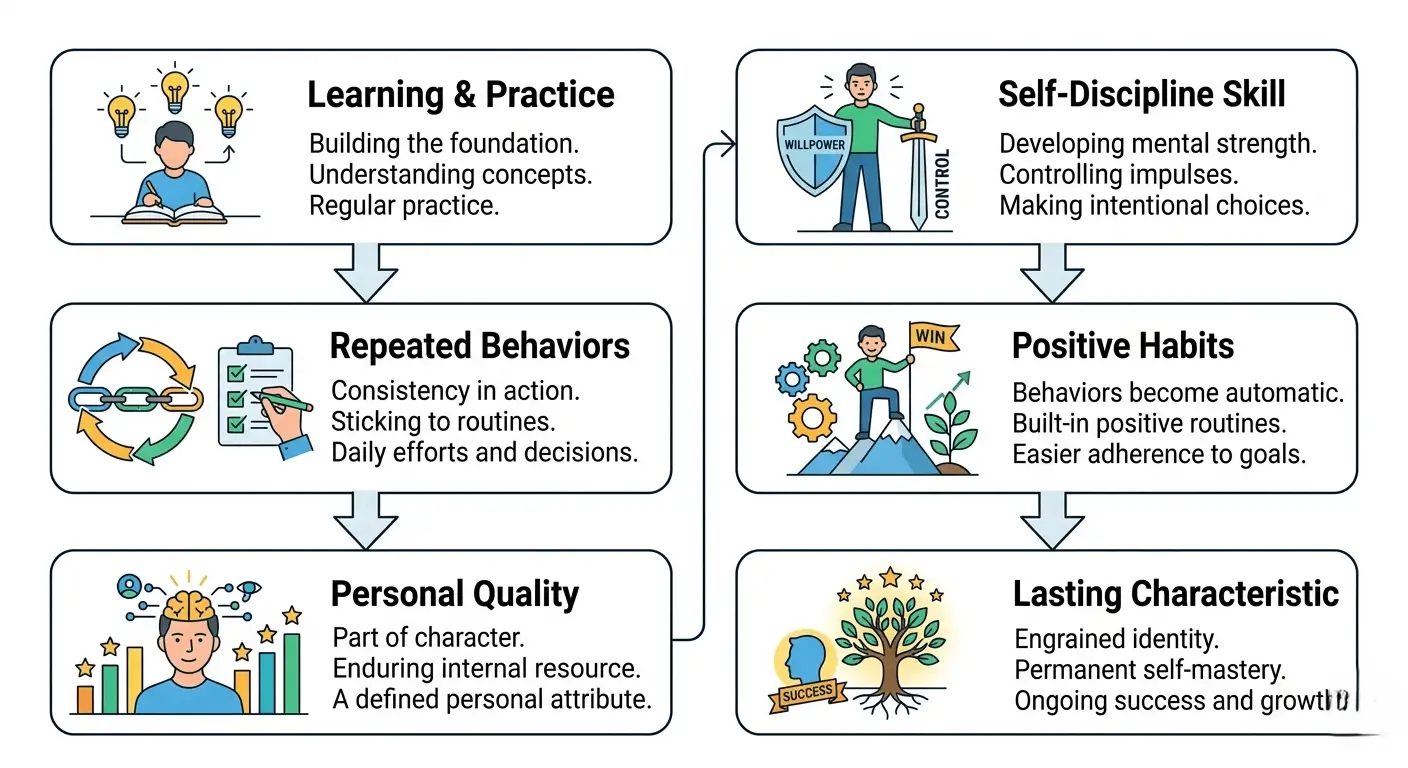
Self-discipline is often described in different ways because it overlaps several categories. Understanding these distinctions helps explain why discipline can be learned and strengthened over time.
A skill is something that can be improved through practice. A quality is a positive attribute that people notice in someone’s behavior. A characteristic is a consistent pattern that becomes part of a person’s identity. A trait is often considered a stable tendency or natural disposition.
Self-discipline shares elements of all these concepts. However, it is most accurately understood as a skill that gradually develops into a quality and characteristic through repeated behavior.
Why Self-Discipline Is Considered a Skill
Self-discipline is considered a skill because it improves with repetition and deliberate practice.
Examples include:
- Following a study schedule
- Exercising regularly
- Managing distractions
- Saving money consistently
- Completing important tasks on time
Just as people improve communication or leadership skills through practice, they can improve discipline through repeated action. The more often individuals follow through on commitments, the stronger their discipline becomes.
How Self-Discipline Functions as a Personal Quality
Consistent behavior eventually becomes visible to others.
People who repeatedly demonstrate self-control, reliability, and commitment are often described as disciplined individuals. Their actions create a reputation that reflects positive personal qualities.
In this way, discipline becomes a quality because it is expressed through behavior that others can observe.
Can Self-Discipline Become a Characteristic?
Yes. Long-term habits can become lasting characteristics.
When disciplined behavior is repeated for months or years, it becomes part of a person’s identity. Someone who consistently follows through on goals may naturally be viewed as disciplined because their behavior has become predictable and reliable.
Consistency transforms repeated actions into enduring character traits.
Is Self-Discipline a Soft Skill and Life Skill?
Self-discipline is both a soft skill and a life skill because it improves performance in professional and personal situations.
Why Self-Discipline Is Considered a Soft Skill
Soft skills involve behavior, interpersonal effectiveness, and workplace performance rather than technical knowledge.
Self-discipline supports:
- Time management
- Reliability
- Accountability
- Focus
- Follow-through
- Professional consistency
Employees who demonstrate discipline often perform better because they can manage responsibilities without constant supervision.
Why Self-Discipline Is a Life Skill
Self-discipline influences many aspects of daily life.
It helps people:
- Maintain healthy habits
- Manage personal finances
- Control emotional reactions
- Continue learning and improving
- Achieve meaningful goals
Because it affects long-term well-being and decision-making, discipline is considered an essential life skill.
Is Self-Discipline Valuable on a Resume?
Yes. Employers value discipline because it contributes to productivity and dependability.
However, discipline is best demonstrated through accomplishments rather than stated directly.
Examples include:
- Consistently meeting deadlines
- Completing certifications
- Managing multiple projects successfully
- Maintaining strong performance records
These achievements provide evidence of disciplined behavior.
Is Discipline a Habit or a Skill?
Discipline is both a skill and a habit. The skill enables productive choices, while habits make those choices easier to repeat.
How Skills Create Habits
Every habit starts as a deliberate action.
The process often follows this pattern:
- Learning a behavior
- Practicing it repeatedly
- Strengthening the behavior pattern
- Making the behavior automatic
Over time, disciplined actions become habits that require less conscious effort.
How Habits Strengthen Self-Discipline
Habits reduce reliance on willpower.
Benefits include:
- Fewer decisions
- Reduced mental resistance
- Greater consistency
- Improved efficiency
The more automatic a behavior becomes, the easier it is to maintain.
What Happens When Discipline Becomes Automatic?
When discipline becomes automatic, people experience less internal conflict.
They no longer debate whether to perform a positive behavior because it has become part of their routine.
This leads to:
- Reduced procrastination
- More consistency
- Better long-term results
- Stronger identity alignment
Is Consistency a Skill and How Does It Relate to Discipline?
Consistency is the repeated execution of behaviors over time. It is closely connected to discipline because long-term progress depends on repeated action.
The Difference Between Consistency and Discipline
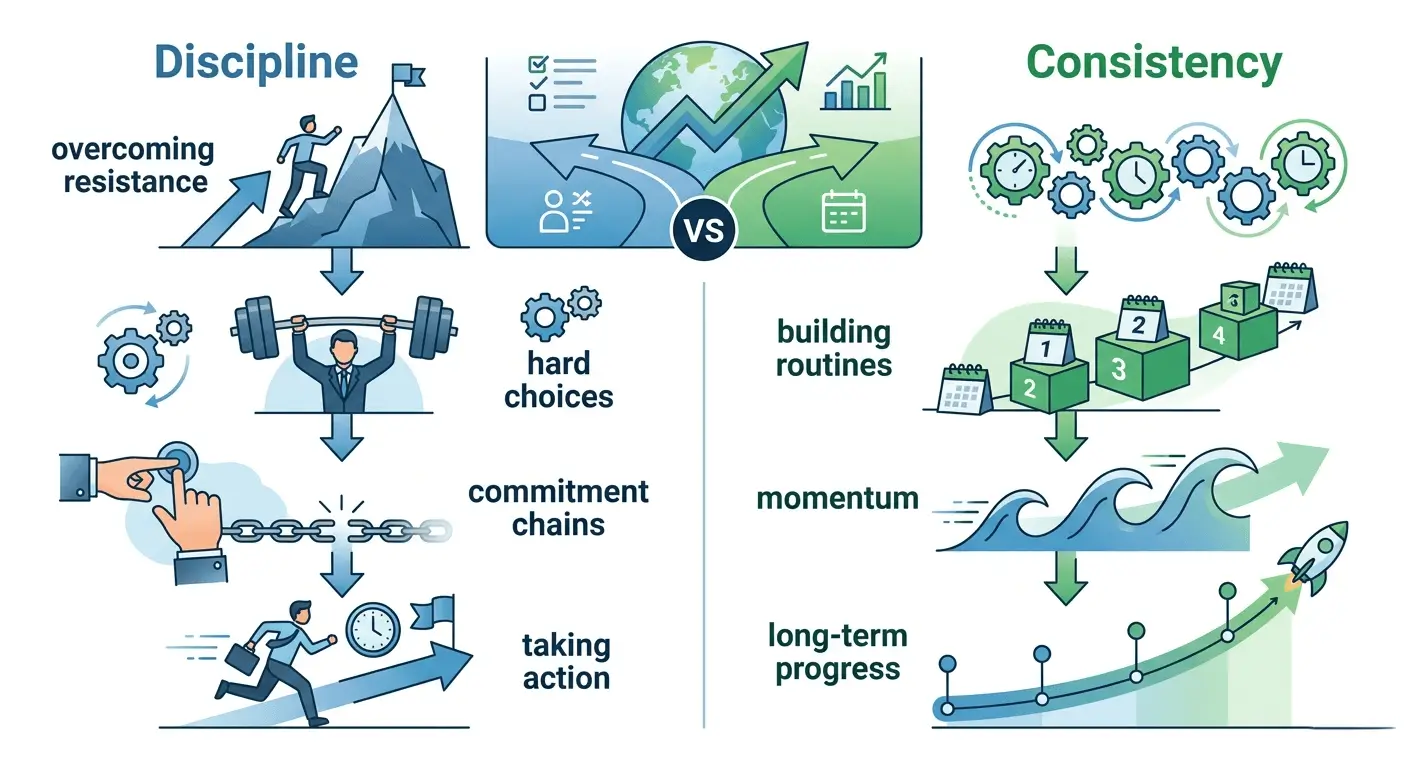
Discipline helps people start and continue difficult actions. Consistency helps those actions become regular over time.
| Discipline | Consistency |
|---|---|
| Helps you act despite resistance | Helps you repeat actions over time |
| Supports difficult decisions | Builds reliable routines |
| Often requires effort initially | Becomes easier through repetition |
| Drives commitment | Creates momentum |
Both are necessary because discipline initiates action while consistency sustains progress.
Is Discipline Better Than Motivation?
Yes, discipline is generally more reliable than motivation for long-term success.
Why Motivation Often Fades
Motivation is influenced by emotions, energy levels, circumstances, and changing priorities.
Common reasons motivation declines include:
- Stress
- Fatigue
- Distractions
- Unexpected challenges
- Emotional fluctuations
Because motivation is temporary, it cannot always be relied upon.
Why Discipline Produces More Reliable Results
Discipline encourages action regardless of mood.
Benefits include:
- Consistent progress
- Better goal achievement
- Greater reliability
- Reduced dependence on emotions
People who rely on discipline continue moving forward even when motivation disappears.
The Ideal Combination
The best approach combines both.
- Use motivation to start.
- Use discipline to continue.
- Use systems to make both easier.
Comparison Block: Discipline vs Motivation
| Discipline | Motivation |
| More stable | Often temporary |
| Based on commitment | Based on feelings |
| Supports long-term goals | Useful for getting started |
| Less dependent on emotions | Highly influenced by emotions |
Why Do People Struggle With Self-Discipline?
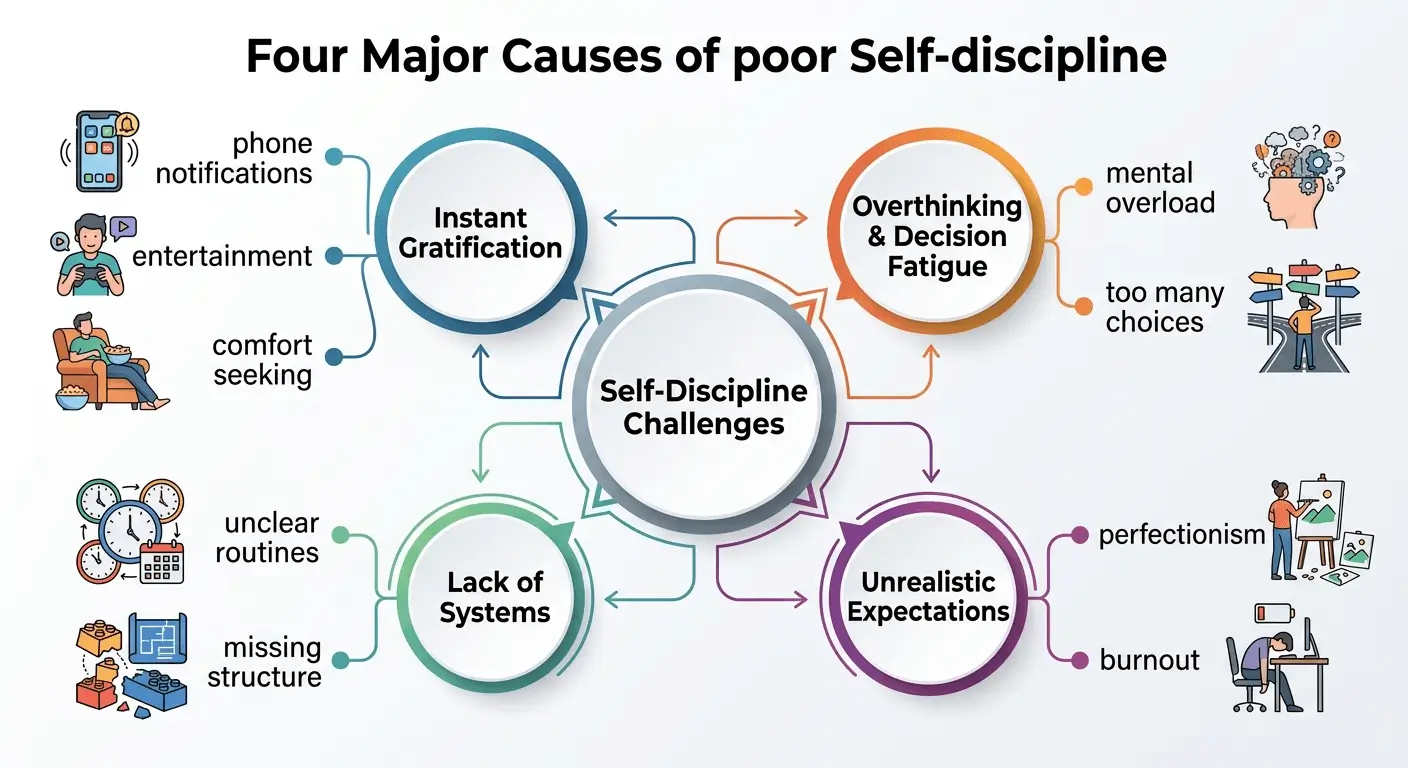
Many discipline challenges are rooted in psychology rather than a lack of ability.
Instant Gratification vs Long-Term Rewards
The brain naturally favors immediate rewards.
Examples include:
- Watching videos instead of studying
- Spending money instead of saving
- Eating unhealthy foods instead of preparing healthy meals
Long-term rewards require delayed gratification, which can be difficult.
Overthinking and Decision Fatigue
Too many decisions consume mental energy.
As mental fatigue increases:
- Self-control decreases
- Focus declines
- Procrastination becomes more likely
This can make disciplined behavior harder to maintain.
Lack of Clear Systems
Goals without systems often fail.
For example:
- Goal: Exercise regularly
- System: Exercise every morning at 7 a.m.
Systems provide structure and reduce uncertainty.
Unrealistic Expectations
Many people attempt drastic lifestyle changes.
Common examples include:
- Perfectionism
- Excessive workloads
- Unsustainable routines
- All-or-nothing thinking
These approaches often lead to burnout and inconsistency.
Can You Get Better at Discipline?
Yes. Self-discipline improves through practice, repetition, and behavioral conditioning.
How the Brain Adapts Through Repetition
Repeated behaviors strengthen neural pathways.
As behaviors are repeated:
- Resistance decreases
- Habits strengthen
- Actions become easier
This process supports long-term behavioral change.
Small Actions That Build Discipline
Small actions are easier to sustain than major changes.
Examples include:
- Reading five pages daily
- Exercising for ten minutes
- Writing one paragraph
- Planning tomorrow’s tasks
Consistency is more important than intensity.
Identity-Based Self-Discipline
People often maintain behaviors more effectively when those behaviors align with their identity.
Examples include:
- “I am someone who exercises regularly.”
- “I am someone who follows through.”
- “I am someone who keeps commitments.”
Identity-based habits create stronger long-term discipline.
Practical Ways to Build Self-Discipline
Create Systems Instead of Relying on Willpower
Willpower is limited, but systems are repeatable.
Useful systems include:
- Environment design
- Habit stacking
- Time blocking
- Removing distractions
Good systems reduce the need for constant self-control.
Focus on One Discipline Habit at a Time
Trying to change everything at once often creates overwhelm.
A better approach is:
- Choose one habit.
- Build consistency.
- Stabilize the behavior.
- Add another habit.
Track Progress and Celebrate Consistency
Tracking behavior creates awareness and accountability.
Methods include:
- Habit trackers
- Journals
- Checklists
- Weekly reviews
Celebrating progress reinforces positive behavior.
Make Difficult Actions Easier to Start
Lowering the barrier to action reduces resistance.
Examples include:
- Read one page.
- Do one push-up.
- Write one sentence.
- Study for two minutes.
Starting is often the hardest part.
Common Myths About Self-Discipline
Myth: Disciplined People Never Feel Unmotivated
Everyone experiences resistance, fatigue, and low motivation.
The difference is that disciplined individuals continue taking action despite those feelings.
Myth: Discipline Is Something You’re Born With
Discipline is largely learned.
Through repetition, habit formation, and environmental design, people can strengthen discipline regardless of their starting point.
Myth: More Discipline Means Working Harder
Working harder is not always the solution.
Often, smarter systems, better routines, and reduced friction produce better results than simply increasing effort.
Real-Life Examples of Self-Discipline in Action
Self-Discipline in Health and Fitness
Examples include:
- Following workout schedules
- Maintaining nutrition habits
- Prioritizing sleep
- Attending training sessions consistently
Self-Discipline in Work and Productivity
Examples include:
- Completing important tasks before distractions
- Meeting deadlines consistently
- Practicing deep work
- Managing time effectively
Self-Discipline in Personal Growth
Examples include:
- Reading daily
- Learning new skills
- Practicing reflection
- Working toward long-term goals
Table-Friendly Section — Self-Discipline Challenges and Solutions
| Challenge | Why It Happens | Practical Solution |
| Procrastination | Seeking immediate comfort | Break tasks into smaller steps |
| Lack of motivation | Emotional fluctuations | Use routines and systems |
| Inconsistency | No structured habits | Schedule behaviors |
| Overthinking | Fear of mistakes | Focus on action over perfection |
| Burnout | Unsustainable effort | Prioritize recovery and balance |
| Fear of failure | Avoidance behavior | Adopt a learning mindset |
Most discipline challenges can be reduced by creating supportive environments, maintaining realistic expectations, and focusing on gradual improvement rather than perfection.
What Actually Works for Building Long-Term Self-Discipline
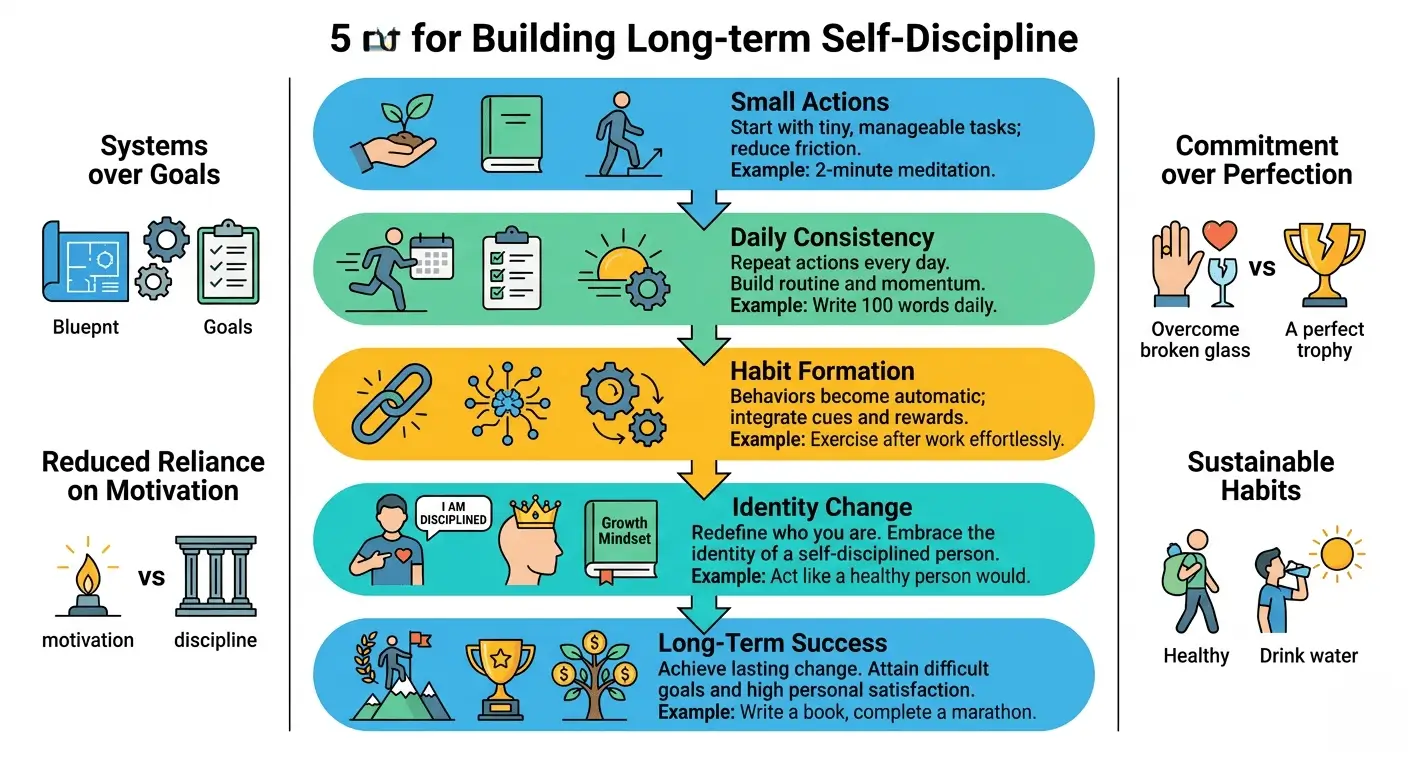
Long-term discipline is built through sustainable behaviors rather than extreme effort.
Sustainable Habits vs Extreme Challenges
Extreme challenges often create short-term results but are difficult to maintain.
Sustainable habits provide:
- Better consistency
- Reduced burnout
- Long-term success
- Greater adaptability
Moderation usually outperforms intensity over time.
Systems vs Goals
Goals provide direction, but systems create results.
| Goals | Systems |
| Define desired outcomes | Define daily actions |
| Focus on results | Focus on processes |
| Provide motivation | Create consistency |
| Set direction | Produce progress |
Successful people focus heavily on systems because systems drive repeatable behavior.
Commitment Over Perfection
Perfection is not required for progress.
The most successful individuals recover quickly from setbacks and continue moving forward.
Key principles include:
- Missing one day is not failure.
- Progress matters more than perfection.
- Consistency compounds over time.
- Commitment builds resilience.
Conclusion
Self-discipline is best understood as a skill that can be learned, strengthened, and maintained through consistent practice. While it can become a personal quality, characteristic, habit, and life skill, its foundation lies in repeated behavior and intentional action. Long-term success depends less on motivation and more on building systems that make disciplined actions easier to repeat. The most effective approach is to focus on small, sustainable improvements that gradually strengthen self-discipline over time.
FAQs
Is self-discipline a skill or something you’re born with?
Self-discipline is primarily a learnable skill. While some personality traits may influence behavior, discipline develops through practice, repetition, and habit formation.
Can self-discipline be learned at any age?
Yes. People can improve self-discipline at any age because the brain continues adapting and learning throughout life.
Is self-discipline more important than motivation?
For long-term success, self-discipline is generally more important because it supports action even when motivation decreases.
How long does it take to develop self-discipline?
There is no fixed timeline. Discipline strengthens gradually through repeated behavior and consistent practice over weeks, months, and years.
Why do I struggle with consistency even when I have goals?
Many people focus on goals without creating systems. Lack of routines, decision fatigue, and unrealistic expectations often reduce consistency.
Is self-discipline considered a soft skill in the workplace?
Yes. Self-discipline supports accountability, reliability, time management, and productivity, making it a highly valued workplace skill.
Can habits improve self-discipline over time?
Yes. Habits automate behaviors and reduce reliance on willpower, making disciplined actions easier to maintain.
What is the difference between self-control and self-discipline?
Self-control focuses on resisting immediate impulses, while self-discipline focuses on consistently taking actions that support long-term goals.
How can I stay disciplined when I lose motivation?
Use systems, routines, habit tracking, and environmental design to support behavior even when motivation is low.
What are the most effective ways to build self-discipline daily?
Start small, focus on consistency, build supportive systems, track progress, reduce distractions, and develop identity-based habits that reinforce positive behavior.









3 Responses