

Introduction
Mindset journaling is the practice of writing with the specific goal of shaping how you think, not just recording what happened during your day. Unlike a traditional diary, a mindset journal is built around structured reflection: identifying thought patterns, challenging unhelpful beliefs, and reinforcing intentional, constructive thinking. Journaling to change your mindset works because repeated, focused reflection strengthens self-awareness and gradually shifts the mental habits that shape behavior. This guide breaks down what a mindset journal is, what mindset it develops, and how to build a sustainable journaling habit as a beginner. For a structured approach to building this consistency, see our guide on how to build good habits in 30 days.
Quick Summary
- Mindset journaling helps you recognize thought patterns and develop healthier perspectives.
- Consistent journaling can support both a positive mindset and a growth mindset through regular self-reflection.
- Beginners can start with simple prompts rather than writing lengthy journal entries.
- A structured journaling habit is often more effective than writing only when inspired.
- Most people notice measurable shifts in thinking within one to three months of consistent practice.
What Is Mindset Journaling?
Mindset journaling is a structured writing practice focused on examining and intentionally shaping thought patterns, beliefs, and emotional responses rather than simply logging daily events. A mindset journal serves as a tool for reflection, not documentation — its purpose is to help the writer notice recurring thoughts, question limiting beliefs, and reinforce more constructive ways of thinking over time.
How a Mindset Journal Differs From a Personal Diary
A personal diary typically records what happened in a day: events, conversations, and observations. A mindset journal goes a step further by asking why those events matter and how they were interpreted. Key distinctions include:
- Intentional thinking — entries are guided by specific prompts rather than free-form recollection.
- Goal-oriented reflection — writing connects back to personal growth objectives.
- Emotional awareness — entries explore feelings behind events, not just the events themselves.
- Learning from experiences — each entry looks for a lesson or takeaway, rather than just a record.
What Mindset Does Journaling Develop?
Journaling primarily develops a combination of self-awareness, resilience, optimism, accountability, and emotional regulation. Regular reflective writing trains the brain to notice thought patterns as they occur, which makes it easier to interrupt unhelpful thinking and reinforce more constructive responses to challenges.
Developing a Growth Mindset Through Reflection
Mindset journaling supports a growth mindset — the belief that abilities can be developed through effort — by encouraging:
- Learning from mistakes rather than avoiding them.
- Viewing challenges as opportunities for skill development.
- Tracking improvement over time through written evidence.
- Long-term thinking that favors progress over instant results.
Building a Positive Mindset Through Daily Awareness
A positive mindset is reinforced through consistent, small-scale reflection rather than forced optimism. Daily journaling supports this through:
- Gratitude practices that highlight what is already working.
- Positive reframing of setbacks into learning moments.
- Recognizing progress that might otherwise go unnoticed.
- Appreciating small wins as part of a larger pattern of growth.
Benefits of Mindset Journaling

Mindset journaling offers both psychological and practical benefits that build over time with consistent practice. Short-term effects often include reduced stress and improved clarity, while long-term practice supports more durable shifts in thinking and behavior. Common benefits include:
- Improved self-awareness
- Better emotional regulation
- Increased confidence
- Greater resilience
- Better decision-making
- Stronger motivation
- Clearer goals
- Reduced negative thinking
Positive Mindset Journaling
Positive mindset journaling is the practice of using written reflection to intentionally notice and reinforce constructive, optimistic thinking. It does not mean ignoring problems or forcing false positivity — it means changing the lens through which challenges and daily events are interpreted, so that setbacks are processed alongside evidence of progress and capability.
Positive Mindset Journaling Prompts
Beginners can use simple, repeatable prompts to build this habit, such as: If these prompts resonate with you, explore our full list of journaling prompts for self growth for more ways to deepen your reflection practice.
- What went well today?
- What challenge taught me something valuable?
- What am I grateful for?
- What strength did I use today?
- What can I improve tomorrow?
Growth Mindset Journaling
Growth mindset journaling applies the psychological concept of a growth mindset — popularized through research on ability and effort — directly to daily reflection. Rather than treating skills and intelligence as fixed, this style of journaling reinforces the idea that consistent effort and learning drive improvement, making it especially useful for goal-setting and skill development. Pairing journaling with growth mindset affirmations can reinforce these beliefs between writing sessions.
Growth Mindset Journaling Prompts
Effective growth mindset prompts focus on learning and progress rather than outcomes alone:
- What mistake helped me learn?
- What challenge stretched my abilities?
- What skill improved this week?
- What can I practice next?
Journaling to Change Your Mindset
Journaling to change your mindset works through repeated exposure to structured reflection, which gradually reshapes automatic thought patterns and behavioral responses. This process draws on principles similar to cognitive reframing, where writing down and re-examining a thought reduces its automatic emotional weight and creates space for a more balanced interpretation.
Why Mindset Change Takes Time
Mindset shifts are rarely immediate. In our experience helping readers build better habits, the most common reason people give up early is expecting fast results. Sustainable change depends on:
- Small, consistent improvements rather than dramatic breakthroughs.
- Habit reinforcement through repeated practice.
- Pattern recognition that only emerges after multiple entries.
- Realistic expectations about the pace of change.
How to Start Mindset Journaling

Starting a mindset journal does not require special tools or extensive writing experience. The process works best when it is simple, repeatable, and low-pressure, especially for beginners learning how to start journaling their thoughts for the first time.
A Simple Beginner Routine
- Choose a notebook or digital journal.
- Write for 5–10 minutes.
- Focus on one question.
- Reflect instead of judging yourself.
- End with one actionable takeaway.
Choosing Between Paper and Digital Journaling
Both formats support mindset journaling effectively, but they offer different advantages depending on personal preference and lifestyle.
| Paper Journal | Digital Journal |
|---|---|
| Handwritten reflection | Easy searching |
| Fewer distractions | Sync across devices |
| More mindful writing | Faster note-taking |
Daily Mindset Journaling Routine
Consistency is what transforms occasional journaling into a lasting mindset-building habit. Daily journaling works best when it is tied to a specific time of day, such as morning or evening, so it becomes an automatic part of the routine rather than an optional task.
Morning Journaling
Morning entries typically focus on setting the tone for the day, including:
- Intentions for the day ahead
- Priorities that matter most
- Motivation and mindset for upcoming tasks
Evening Journaling
Evening entries support processing and closure, including:
- Reflection on the day’s events
- Lessons learned from challenges
- Gratitude for positive moments
- Emotional processing before rest
Tips for Effective Mindset Journaling
Your Daily Thrive recommends focusing on quality of reflection over quantity of writing. Practical tips for journaling include:
- Be honest.
- Avoid perfectionism.
- Write consistently.
- Focus on progress.
- Review previous entries.
- Ask reflective questions.
- Keep entries concise.
- Celebrate improvements.
Common Beginner Mistakes and How to Avoid Them

Several predictable mistakes cause beginners to abandon mindset journaling before it produces results.
Expecting Immediate Results
Many beginners expect noticeable mindset shifts within days. This happens because early progress is often internal and hard to notice. The fix is tracking small changes over weeks rather than judging results daily.
Writing Without Reflection
Some entries simply describe events without exploring their meaning. This occurs when prompts are too open-ended. Using specific reflective questions prevents journaling from becoming passive documentation.
Skipping Journaling After Busy Days
Busy or stressful days are often when journaling gets skipped, even though these are the moments it is most useful. Keeping a short, one-line fallback entry option prevents broken streaks from ending the habit entirely.
Comparing Your Journal to Others’
Comparing personal entries to journaling examples online can create pressure toward a “correct” format. Mindset journaling has no fixed standard — the format should serve the writer’s own reflection needs, not an external template.
Mindset Journaling vs Other Types of Journaling
Mindset journaling overlaps with other journaling styles but maintains a distinct focus on thought patterns rather than events or health tracking.
| Type | Primary Focus | Best For |
|---|---|---|
| Mindset Journaling | Thought patterns | Personal growth |
| Life Journaling | Recording experiences | Memories |
| Daily Journaling | Daily events and reflection | Habit building |
| Journaling for Health | Physical and emotional wellness | Overall well-being |
When Mindset Journaling Works Best
Mindset journaling tends to be most effective during periods of change or growth, including:
- During major life changes
- Building new habits
- Managing stress
- Recovering from setbacks
- Career development
- Academic growth
- Personal goal setting
Difficulty & Time Investment
Mindset journaling has a low barrier to entry, making it accessible for beginners regardless of writing experience. A typical session takes 5–15 minutes, and effort level can range from a single-sentence reflection to a more detailed entry, depending on available time. Consistency matters more than session length — writing briefly every day produces better results than writing extensively once a week. Factors that affect ease of adoption include existing routines, available quiet time, and comfort with self-reflection.
Results Timeline
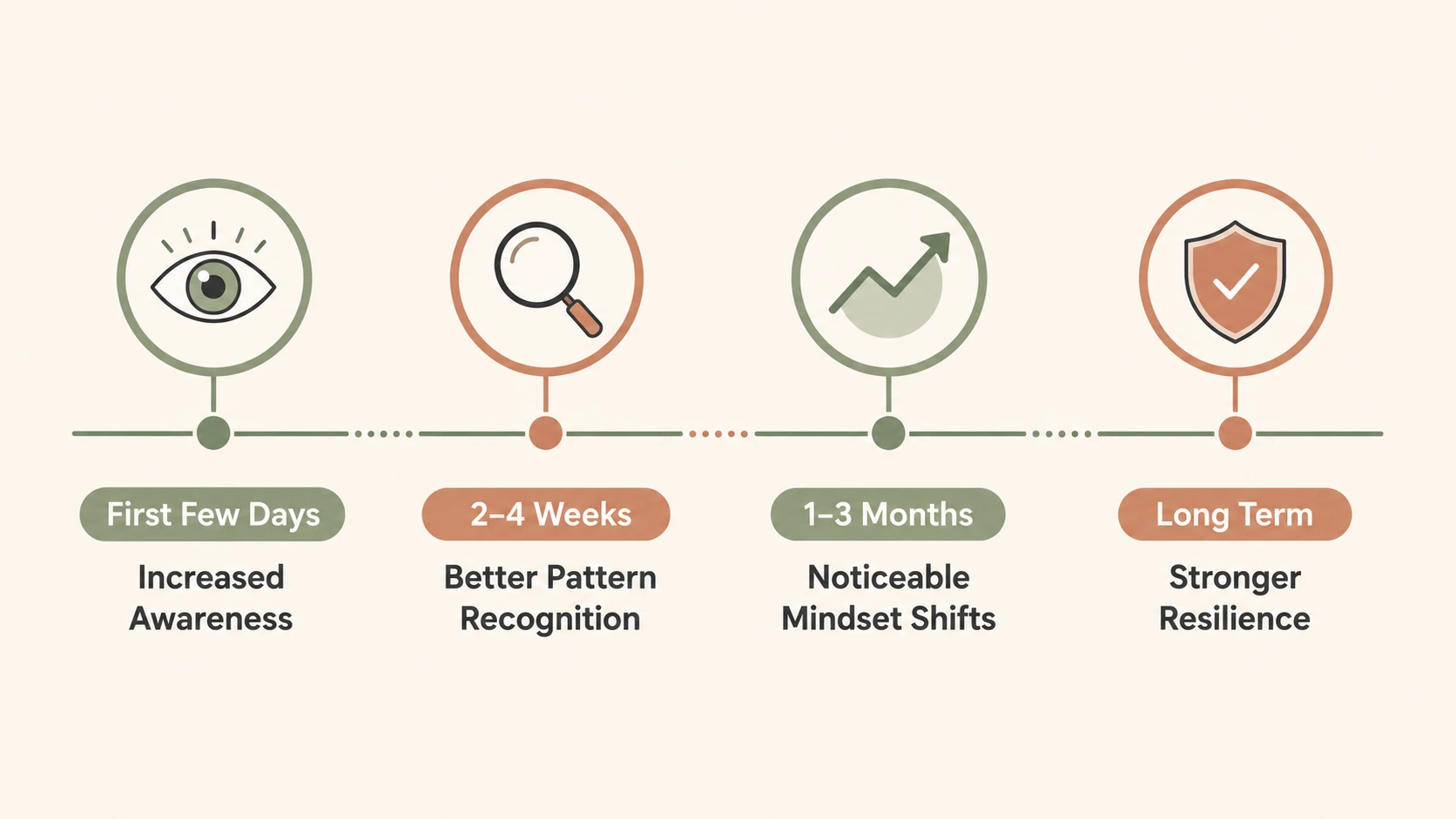
Progress from mindset journaling typically follows a gradual pattern rather than a sudden shift.
- First few days: Increased awareness of thought patterns.
- 2–4 weeks: Better recognition of recurring thoughts and triggers.
- 1–3 months: Noticeable mindset shifts in daily thinking and reactions.
- Long term: Stronger resilience and a durable self-reflection habit.
Practice Guide
Daily Practice
A sustainable mindset journaling practice generally includes:
- Morning reflection to set intentions.
- Evening review to process the day.
- A weekly review session to identify broader patterns.
Staying Consistent
Consistency strategies that support long-term adherence include:
- Habit stacking, such as journaling after brushing teeth.
- Calendar reminders to protect journaling time.
- Tracking progress to visualize consistency over time.
- Accountability strategies, such as sharing goals with a friend or coach.
Adapting Journaling to Different Lifestyles
Mindset journaling can be adapted to fit varied schedules:
- Students can journal around study sessions to process academic stress.
- Professionals can use short entries during commutes or breaks.
- Parents can journal in small windows, such as after children are asleep.
- Busy schedules benefit from one-line or single-prompt entries.
- Frequent travelers can use digital journals for consistency across time zones.
Mindset Journaling and Broader Personal Growth
Mindset journaling connects directly to broader areas of personal development, including habit formation, goal setting, and productivity. As of 2026, evolving approaches to self-improvement increasingly treat journaling as a foundational tool for emotional intelligence and resilience, rather than a standalone activity. It also supports continuous learning and self-awareness, reinforcing the same psychological mechanisms used in structured behavioral science frameworks for personal growth.
Conclusion
Mindset journaling is a practical, low-barrier tool for building both a positive mindset and a growth mindset through consistent, intentional reflection. Rather than simply recording daily events, a mindset journal helps identify thought patterns, reframe challenges, and reinforce constructive thinking over time. The most important factor for success is not writing perfectly or extensively — it is showing up consistently, even with brief entries. Anyone starting mindset journaling as a beginner can begin with just a few minutes of daily reflection and build from there.
Frequently Asked Questions
What is mindset journaling?
Mindset journaling is a structured writing practice focused on examining and intentionally shaping thought patterns, beliefs, and emotional responses, rather than simply recording daily events.
What mindset does journaling develop?
Journaling primarily develops self-awareness, resilience, optimism, accountability, and emotional regulation by helping writers notice and adjust recurring thought patterns.
How do I start mindset journaling as a beginner?
Beginners can start by choosing a notebook or digital journal, writing for 5–10 minutes, focusing on one reflective question, and ending each entry with one actionable takeaway.
What are the best mindset journaling prompts?
Effective prompts include questions like “What went well today?”, “What challenge taught me something valuable?”, and “What skill improved this week?”
What is the difference between positive mindset journaling and growth mindset journaling?
Positive mindset journaling focuses on gratitude and reframing daily experiences, while growth mindset journaling focuses on learning from mistakes and tracking skill development over time.
How long should I journal each day?
Most effective mindset journaling sessions last between 5 and 15 minutes, with consistency mattering more than entry length.
Can journaling help change negative thinking patterns?
Yes, repeated reflective journaling can gradually reduce negative thinking patterns by increasing awareness of automatic thoughts and reinforcing more balanced interpretations over time.
Is digital journaling as effective as writing by hand?
Both formats can be equally effective; paper journaling often supports more mindful writing, while digital journaling offers easier searching and syncing across devices.