

Introduction
How to journal for self-growth means using writing as a structured tool to understand your thoughts, emotions, behaviors, goals, and patterns so you can make intentional changes in your life. Unlike casual diary writing, self-growth journaling focuses on reflection, self-discovery, emotional awareness, habit tracking, and practical action. Journaling supports personal development because it slows down your thinking, makes hidden patterns visible, and helps you connect daily choices with long-term outcomes. When used consistently, a self-improvement journal can help you clarify goals, manage anxiety, process emotions, build discipline, and develop healthier routines.
Quick Summary
- Journaling for self-growth is the practice of writing to understand yourself and improve your habits, mindset, emotions, and decisions.
- The most effective journaling combines reflection, honest self-observation, and small action steps.
- Journal prompts for self-growth and self-discovery help reveal patterns you may not notice in daily life.
- Consistency matters more than writing perfectly or journaling for a long time.
- A self-growth journal becomes useful when reflection leads to action.
What Is Self-Growth Journaling?
Self-growth journaling is intentional writing used to understand your thoughts, emotions, habits, reactions, goals, and repeated personal patterns. It is different from diary writing because it does not simply record what happened during the day. It asks what the experience means, what it reveals, and what you can do differently.
A self improvement journal, self development journal, or self growth journal is focused on personal development. Instead of writing only about events, you reflect on your inner responses and behavior. This makes journaling for self improvement more structured than casual writing.
Self-growth journaling focuses on:
- Thoughts you repeat often
- Feelings you struggle to understand
- Habits that help or hurt you
- Goals you want to clarify
- Reactions you want to change
- Personal patterns that keep showing up
Journaling self improvement works because it turns vague emotions into clear information. For example, “I feel stuck” becomes more useful when you write, “I feel stuck because I keep avoiding the same decision, and the avoidance is creating stress.”
This awareness matters because behavior change usually starts before action. First, you notice the pattern. Then you understand the cause. After that, you can choose a better response.
Why Journaling Helps With Self-Improvement
Journaling helps with self-improvement because it slows down reactive thinking, improves emotional awareness, and helps you connect your actions with their results. When thoughts remain only in your mind, they can feel scattered, exaggerated, or difficult to manage.
Writing creates cognitive clarity. It gives your thoughts a visible structure. This makes it easier to separate facts from assumptions, emotions from reactions, and problems from possible solutions.
Journaling for self improvement also supports self-monitoring. In behavioral psychology, self-monitoring means observing your own actions, emotions, or patterns. When you track your behavior, you begin to notice what triggers your choices.
Self improvement journaling helps through:
- Emotional regulation: Naming emotions makes them easier to process.
- Self-monitoring: Tracking behavior reveals patterns.
- Cognitive clarity: Writing organizes scattered thoughts.
- Reflection: Looking back helps connect actions with consequences.
- Feedback: Reviewing entries shows what is improving and what needs adjustment.
A journal for self improvement creates a simple feedback loop. You notice behavior, understand the cause, choose a better response, and review progress. This is why journaling can support personal growth when it is done consistently.
The Behavior Change Loop
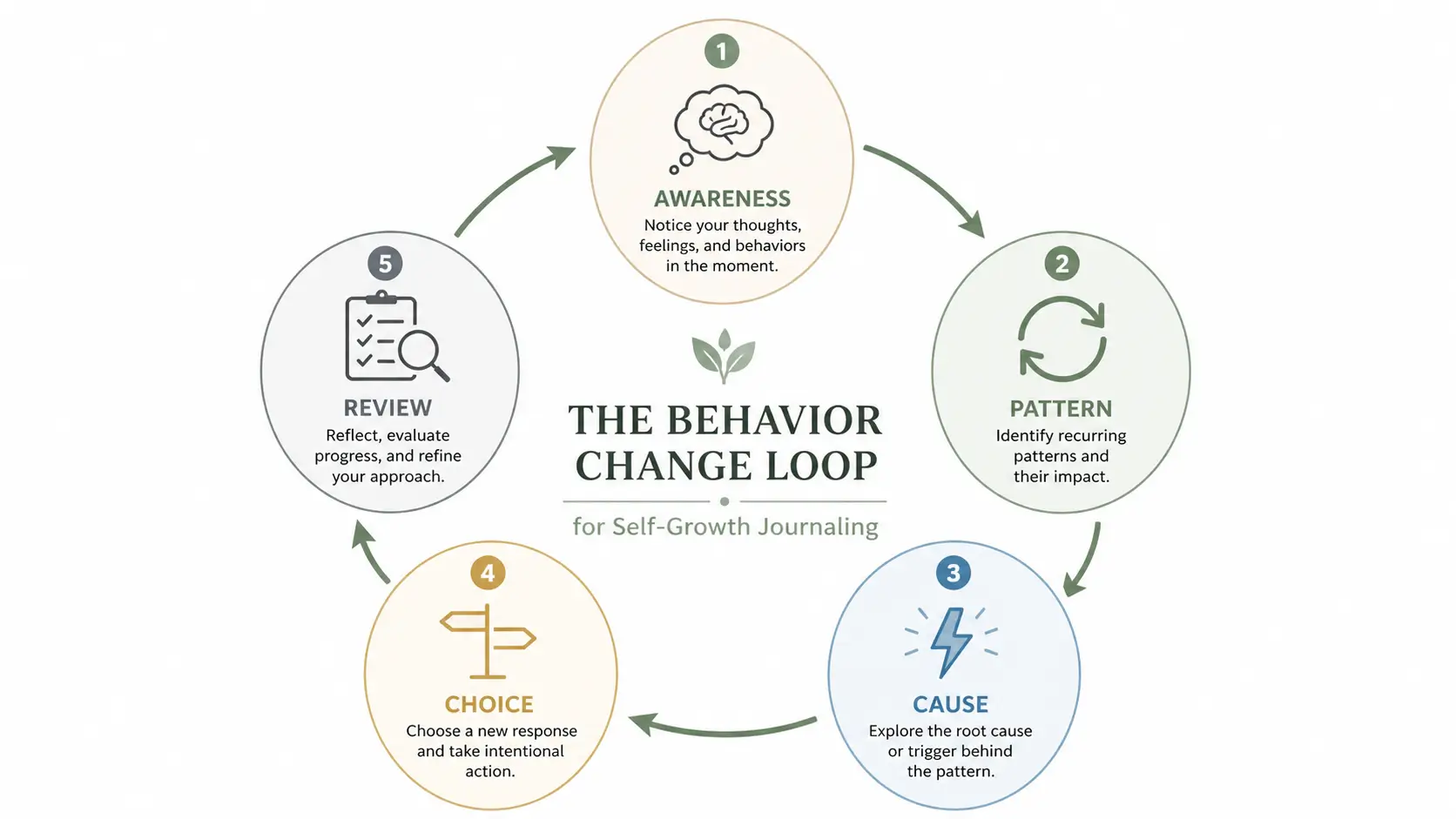
| Step | Question | Purpose |
|---|---|---|
| Awareness | What am I thinking or feeling? | Identifies your current state |
| Pattern | Where does this keep showing up? | Reveals repeated behavior |
| Cause | What triggers this reaction? | Finds the source of the pattern |
| Choice | What can I do differently? | Creates a better response |
| Review | Did the change help? | Measures progress and learning |
This loop turns journaling into a practical behavior change tool instead of a passive writing habit.
How to Start Journaling for Self-Growth
To start journaling for self-growth, choose a simple format, pick one journaling goal, write for 5–10 minutes, use prompts when needed, and end with one small action. The best way to learn how to journal is to make the practice simple enough to repeat.
Many beginners overcomplicate journaling. They think they need a perfect notebook, a long routine, or deep insights every day. This creates pressure and makes the habit harder to maintain.
A practical journaling guide should reduce friction, not increase it.
1. Choose a Simple Format
You can use:
- A notebook
- A notes app
- A digital document
- A guided journal structure
The tool matters less than the habit. Choose the format you are most likely to use regularly.
2. Pick One Journaling Goal
Before you begin, decide why you want to journal. Your goal may be to:
- Understand emotions
- Improve habits
- Reduce anxiety
- Track goals
- Build self-awareness
- Reflect on decisions
- Develop discipline
One clear goal gives your writing direction.
3. Write for 5–10 Minutes
Start small. Writing for 5–10 minutes reduces resistance and makes journaling feel manageable. This is one of the most useful journaling tips because consistency becomes easier when the task feels light.
Avoid making journaling feel like another demanding responsibility. The goal is not to write a perfect entry. The goal is to create a regular space for reflection.
4. Use Prompts When You Feel Stuck
Prompts give structure when you do not know what to write. They reduce overthinking and help you focus on the part of your life you want to understand.
Useful journal tips include:
- Write honestly, not perfectly.
- Use short entries when tired.
- Focus on one issue at a time.
- End with a practical next step.
- Review your entries weekly.
5. End With One Action
Ask: “What is one small thing I can do differently today?”
This question connects reflection with behavior change. Without action, journaling can become repeated thinking. With action, it becomes self-growth.
What to Write in a Self-Improvement Journal
In a self-improvement journal, write about your thoughts, feelings, triggers, habits, goals, lessons, decisions, and identity. The purpose is not to document every detail of your life. The purpose is to understand what affects your behavior and growth.
If you are learning how to journal your thoughts and feelings, use clear categories instead of writing randomly.
| Category | Question | How It Supports Growth |
|---|---|---|
| Thoughts | What have I been thinking about repeatedly? | Reveals mental patterns |
| Feelings | What emotion is strongest today? | Builds emotional awareness |
| Triggers | What caused my reaction? | Helps identify causes |
| Habits | What behavior helped or hurt me today? | Tracks useful and harmful patterns |
| Goals | What progress did I make? | Keeps priorities visible |
| Lessons | What did today teach me? | Turns experience into learning |
| Decisions | What choice am I avoiding? | Reduces avoidance |
| Identity | Who am I becoming through my daily actions? | Connects behavior with self-image |
Journaling prompts and self growth journal prompts are useful because they make reflection specific. A specific question leads to a clearer answer.
A Simple Daily Self-Growth Journal Structure
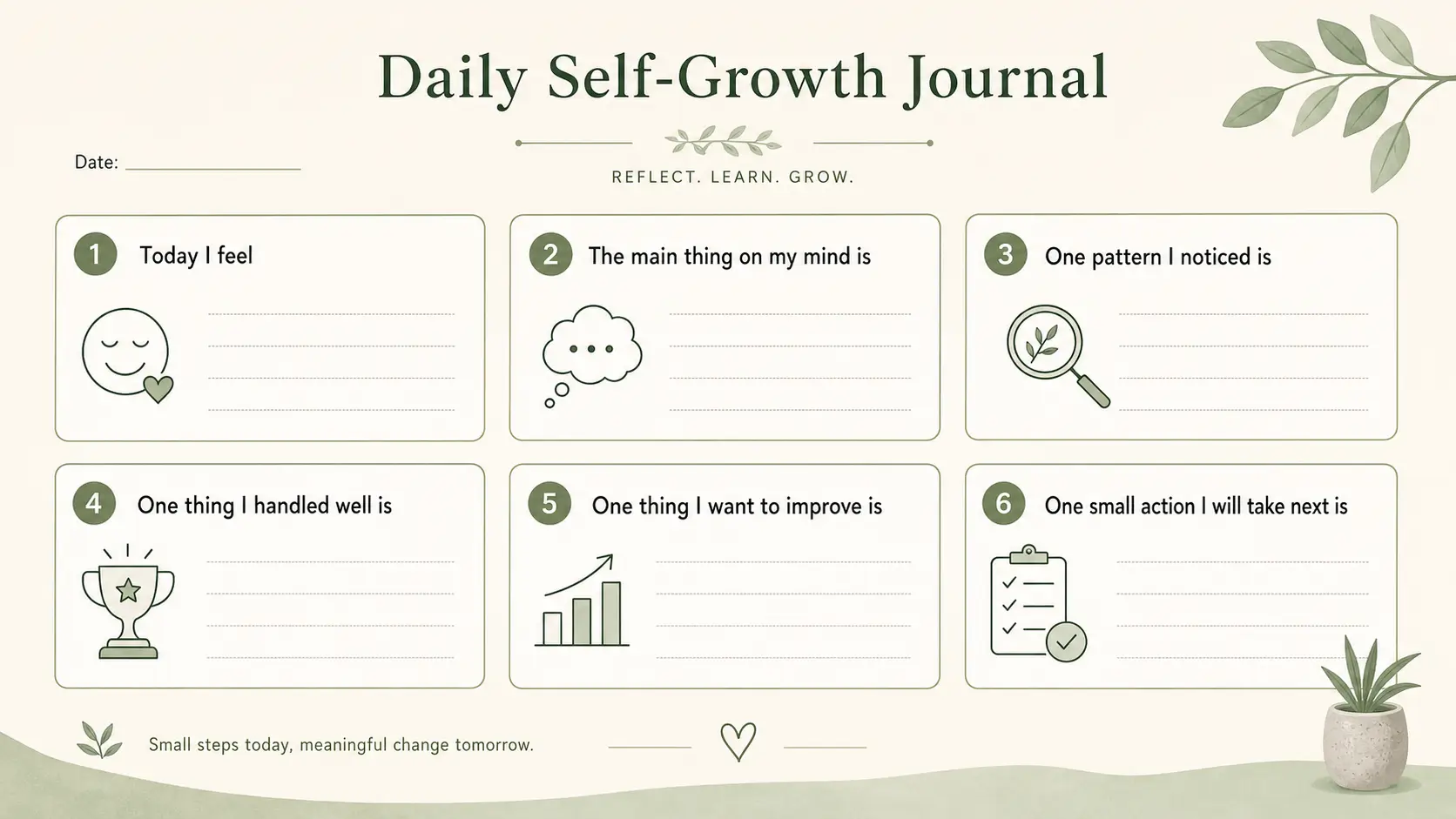
Use this format:
- Today I feel:
- The main thing on my mind is:
- One pattern I noticed is:
- One thing I handled well is:
- One thing I want to improve is:
- One small action I will take next is:
This structure works because it includes emotional awareness, pattern recognition, self-compassion, improvement, and action.
Best Journal Prompts for Self-Growth and Self-Discovery
The best journal prompts for self-growth and self-discovery help you understand your beliefs, emotions, habits, goals, and identity. Strong prompts do not only ask what happened. They ask why it matters and what it reveals.
Journaling prompts for self discovery are useful when you feel stuck, unclear, or disconnected from yourself. Journal prompts for self growth are useful when you want to change behavior and build better routines.
Self-Discovery Journal Prompts
Use these self discovery journal prompts to understand yourself more clearly:
- What do I keep avoiding, and why?
- What drains my energy the most?
- What gives me a sense of purpose?
- What belief about myself might be limiting me?
- What do I need to accept about this season of life?
These prompts help reveal emotional needs, values, fears, and repeated patterns.
Self-Growth Journal Prompts
Use these self-growth prompts when you want practical improvement:
- What habit would improve my life if I practiced it daily?
- What did I learn from a recent mistake?
- What is one behavior I want to repeat?
- What is one behavior I want to change?
- What does my future self need from me today?
These prompts connect reflection to behavior change. They help you move from awareness to action.
Emotional Awareness Prompts
Use these emotional awareness prompts when your feelings are intense or unclear:
- What emotion am I feeling, and where do I feel it in my body?
- What triggered this emotion?
- What story am I telling myself about this situation?
- Is this thought helpful, accurate, or exaggerated?
- What would be a calmer response?
These journaling prompts for self discovery help separate feelings from assumptions. That separation creates emotional control.
How to Journal for Mental Health and Emotional Clarity
Journaling for mental health means using writing to organize difficult emotions, identify stress patterns, and respond more calmly. It can support emotional clarity, but it is not a replacement for therapy, medical care, or crisis support.
Mental health journaling helps because emotions often feel heavier when they remain vague. Writing gives them shape. When you name what you feel and identify what caused it, the emotion becomes easier to understand.
Journaling mental health practices can help you:
- Organize overwhelming thoughts
- Reduce rumination
- Identify emotional triggers
- Notice recurring stress patterns
- Prepare thoughts to discuss in therapy
- Understand what support you need
A journal for mental health or diary for mental health should create clarity, not self-punishment. The purpose is not to criticize yourself. The purpose is to understand what is happening inside you.
Diary mental health writing can become harmful if it turns into repeated negative thinking without reflection. If writing makes distress worse, use grounding prompts or seek professional support.
Mental Health Journaling Structure
Use this format:
- What am I feeling right now?
- What happened before this feeling?
- What thought is making this worse?
- What do I need in this moment?
- What is one safe, helpful next step?
This structure helps you move from emotional overwhelm to a calmer next action.
How to Journal for Anxiety
Journaling for anxiety means writing down anxious thoughts, separating facts from fears, and identifying what is within your control. Anxiety often grows when thoughts remain vague, repetitive, and unchallenged.
Anxiety journaling works because it makes fear visible. When worries stay in your mind, they can feel like facts. When you write them down, you can examine them more clearly.
Journaling and anxiety should be handled with structure. The goal is not to repeat the same fear again and again. The goal is to question it, reduce its intensity, and choose a grounded response.
Anxiety Journaling Framework
Use this structure:
| Step | Question |
|---|---|
| Worry | What am I worried about? |
| Worst-case thought | What is the worst-case thought? |
| Evidence for | What evidence supports this fear? |
| Evidence against | What evidence challenges it? |
| Balanced thought | What is a more balanced thought? |
| Control | What action is within my control? |
This journal for anxiety helps you move from fear to clarity. It does not remove all anxiety, but it can reduce the mental loop that keeps anxiety active.
What to Avoid When Journaling for Anxiety
Avoid:
- Repeating the same fear without reflection
- Writing only worst-case scenarios
- Using journaling to punish yourself
- Turning journaling into over-analysis
Better approach:
- Name the fear.
- Challenge the thought.
- Identify one grounded action.
When you journal about anxiety, the purpose is to create distance from anxious thoughts, not to strengthen them.
Journaling for Anxiety and Depression: What Helps and What to Watch For
Journaling for anxiety and depression can help identify mood patterns, reduce emotional confusion, and support small steps during low-energy periods. It works best when prompts are gentle, realistic, and focused on awareness rather than self-criticism.
For anxiety, journaling can help organize racing thoughts and separate fear from fact. For depression, journaling can help track mood, energy, sleep, behavior, and small signs of progress.
Low-energy days require shorter prompts. A person experiencing low motivation may not benefit from long entries or complex reflection. A short, compassionate prompt is often more realistic.
Helpful prompts include:
- What is one thing I did today despite feeling low?
- What thought has been repeating lately?
- What small action would support me right now?
- What do I need to stop expecting myself to do perfectly?
Gratitude, evidence-based reframing, and mood tracking can help when used carefully. The goal is not forced positivity. The goal is balanced awareness.
Watch for these signs:
- Journaling increases distress.
- You only criticize yourself.
- You repeat negative thoughts without questioning them.
- You feel more hopeless after writing.
- You avoid getting support when you need it.
Professional support may be needed if anxiety or depression affects daily functioning, sleep, relationships, safety, or basic responsibilities.
Motivation vs Discipline in Journaling
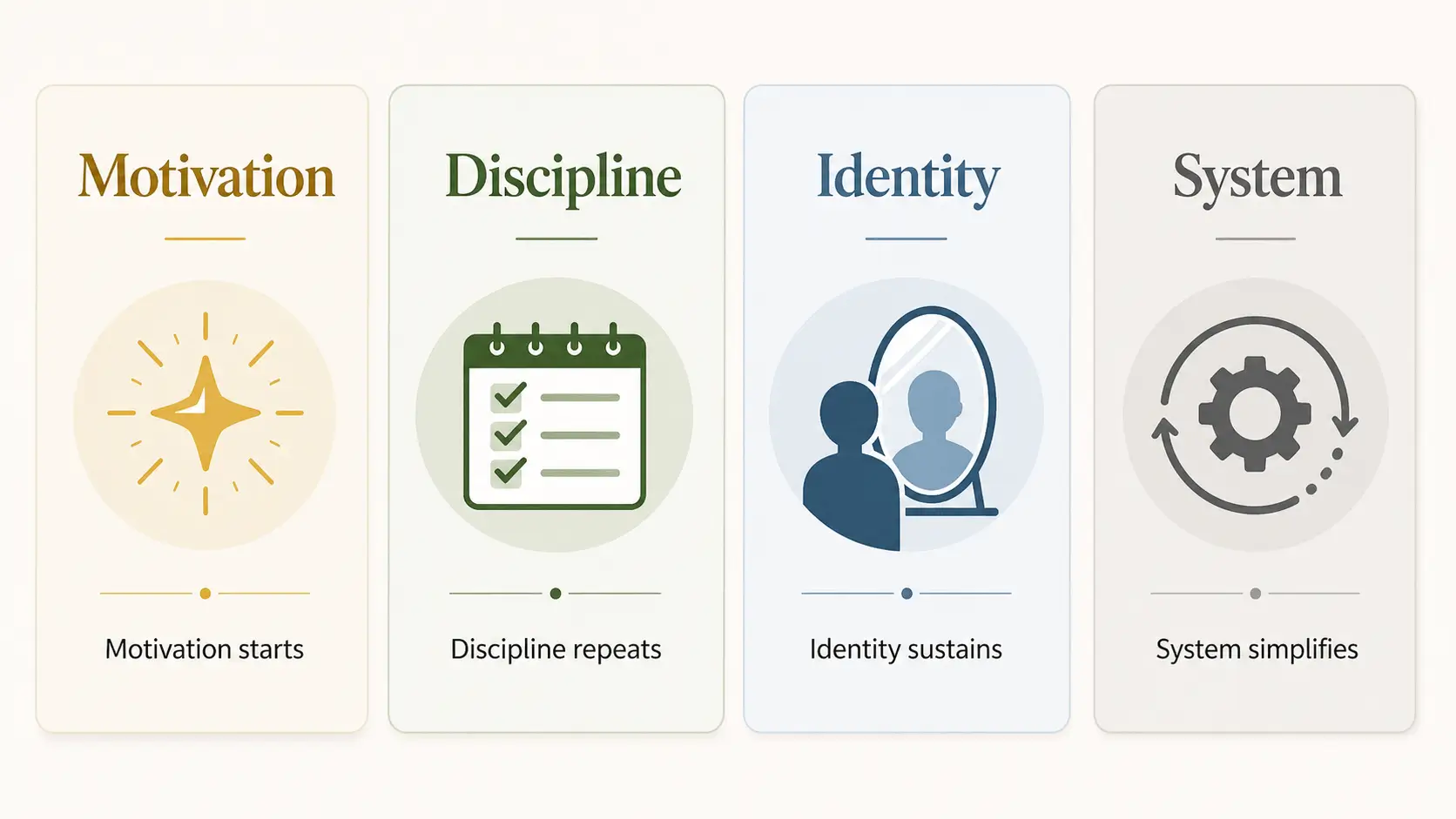
Motivation helps you start journaling, but discipline helps you continue when the habit feels ordinary. Many people struggle with consistency because they rely on inspiration instead of building a repeatable system.
| Concept | What It Means | How It Affects Journaling | Better Approach |
|---|---|---|---|
| Motivation | Feeling inspired to write | Comes and goes | Use it when it appears, but do not rely on it |
| Discipline | Writing even when it feels ordinary | Builds consistency | Keep sessions short and repeatable |
| Identity | Seeing yourself as someone who reflects and improves | Makes journaling part of who you are | Connect journaling to your future self |
| System | A repeatable routine | Reduces decision fatigue | Journal at the same time or after the same habit |
Key takeaway:
- Motivation starts journaling.
- Discipline repeats journaling.
- Identity sustains journaling.
This matters because journaling will not always feel meaningful in the moment. Some entries will feel simple. Some will feel repetitive. The value comes from returning to the practice and using it to understand yourself over time.
Consistency vs Intensity: Why Short Journaling Works Better
Short journaling works better than intense journaling because it lowers starting friction and makes the habit easier to repeat. Many people fail by trying to journal too much too soon.
| Approach | Short-Term Result | Long-Term Result |
|---|---|---|
| Journaling for 45 minutes once a week | Feels productive | Easy to abandon |
| Journaling for 5 minutes daily | Feels simple | Builds consistency |
| Writing only when emotional | Helps in crisis | May miss patterns |
| Writing as a routine | Creates awareness | Supports lasting growth |
Consistency works because:
- It lowers starting friction.
- It builds trust with yourself.
- It helps you notice patterns over time.
- It makes journaling part of your routine instead of a rare emotional outlet.
Intensity often feels more impressive, but consistency is more sustainable. A short entry repeated regularly builds self-awareness better than a long entry written only when life feels overwhelming.
Common Problems Journaling Can Help Solve
Journaling can help solve common personal growth problems by making hidden patterns visible. It is especially useful for procrastination, lack of motivation, inconsistency, overthinking, burnout, and fear of failure.
| Problem | Why It Happens | How Journaling Helps | Prevention Strategy |
|---|---|---|---|
| Procrastination | Avoidance, fear, unclear next steps | Reveals what you are avoiding | End each entry with one small action |
| Lack of motivation | Goals feel disconnected from values | Reconnects actions to purpose | Write about your “why” weekly |
| Inconsistency | Routine is too demanding | Makes progress visible | Use a 5-minute minimum |
| Overthinking | Thoughts stay circular | Turns thoughts into clear language | Separate facts from assumptions |
| Burnout | Too many demands, no recovery | Shows energy patterns | Track stress and rest |
| Fear of failure | Self-worth tied to outcomes | Reframes mistakes as feedback | Write lessons after setbacks |
Journaling helps most when it leads to a prevention strategy. Writing about a problem is useful, but identifying one next step makes it practical.
Science-Backed Reasons Journaling Supports Personal Growth
Journaling supports personal growth because it uses psychological mechanisms such as emotional processing, self-regulation, cognitive restructuring, and habit tracking. These mechanisms help you understand your inner experience and adjust your behavior.
Core insights include:
- Expressive writing can help process emotional experiences.
- Self-monitoring increases awareness of behavior patterns.
- Cognitive reframing helps challenge distorted thoughts.
- Goal reflection improves clarity and follow-through.
- Emotional labeling can reduce the intensity of overwhelming feelings.
The cause-effect relationship is direct:
- When you write about a thought, you create distance from it.
- When you track a habit, you see patterns more objectively.
- When you reflect on mistakes, you convert failure into feedback.
- When you name emotions, you respond with more control.
Journaling does not create change by itself. It supports the mental clarity needed to change. The growth comes when reflection leads to better choices.
Real-Life Journaling Examples for Self-Growth
Real-life journaling examples show how writing can turn everyday struggles into practical insight. A useful entry identifies the situation, emotion, pattern, and next step.
Beginner Example
Situation: You feel unmotivated after work.
Journal entry structure:
- What happened today?
- What emotion am I feeling?
- What do I usually do when I feel this way?
- What small action would help me feel better?
- What can I make easier tomorrow?
Example:
“I felt drained after work and wanted to scroll on my phone. I usually avoid my evening routine when I feel tired. One small action would be changing clothes, drinking water, and doing five minutes of stretching before sitting down. Tomorrow, I can make this easier by leaving my workout clothes ready.”
This beginner example works because it focuses on one emotion, one pattern, and one small action.
Advanced Example
Situation: You keep repeating the same self-sabotaging habit.
Journal entry structure:
- What trigger appeared before the habit?
- What emotion did I want to escape?
- What reward did the habit give me?
- What healthier replacement could meet the same need?
- What system can I build to reduce the trigger?
Example:
“I procrastinate every time a task feels uncertain. The trigger is not laziness; it is ambiguity. I feel anxious because I do not know where to begin. The reward of procrastination is temporary relief. A healthier replacement is writing the first physical action required. The system I can build is a five-minute planning step before starting difficult work.”
This advanced example works because it identifies the trigger, emotional reward, replacement behavior, and system.
Common Myths About Journaling for Self-Growth
Common myths make journaling feel more difficult than it needs to be. Effective self-growth journaling is usually simple, honest, and repeatable.
| Myth | What Actually Works |
|---|---|
| You need to write every page perfectly | Messy, honest writing is more useful |
| You must journal every day | Consistency matters, but recovery days are normal |
| Journaling should always feel deep | Simple reflection often creates the most insight |
| You need long entries | Short entries are easier to sustain |
| Journaling fixes everything | Journaling supports growth, but action creates change |
The goal is not to create a perfect record of your life. The goal is to understand yourself clearly enough to make better choices.
What Actually Works vs What Sounds Good
What sounds good often creates pressure, while what actually works creates consistency. Journaling for self-growth should fit your real life, not an ideal routine you cannot maintain.
What sounds good:
- Buying a beautiful journal
- Writing long emotional entries
- Waiting for inspiration
- Copying complex routines
- Trying to become a completely new person overnight
What actually works:
- Writing honestly for a few minutes
- Asking better questions
- Tracking repeated patterns
- Taking one small action after reflection
- Reviewing entries weekly
- Building a routine that fits your real life
The practical version works because it survives busy schedules, low motivation, emotional resistance, and imperfect days.
How to Build a Sustainable Journaling Routine
A sustainable journaling routine is built by connecting writing to daily life, keeping entries short, and reviewing patterns regularly. The goal is to build a system, not rely on willpower.
Daily Routine
Use journaling:
- In the morning for intention setting
- During stress for emotional regulation
- At night for reflection
- After setbacks for learning
A daily routine works best when journaling is attached to an existing habit. For example, write after morning coffee, after brushing your teeth, or before closing your laptop at night.
Weekly Review
Ask:
- What pattern showed up this week?
- What improved?
- What drained my energy?
- What habit needs adjustment?
- What is one priority for next week?
A weekly review helps you see patterns that may not be obvious from one entry.
Monthly Self-Growth Review
Reflect on:
- Goals
- Habits
- Emotional patterns
- Relationships
- Energy levels
- Personal values
- Lessons learned
A monthly review helps you understand whether your current routines match the person you want to become.
A Simple Self-Growth Journaling Framework
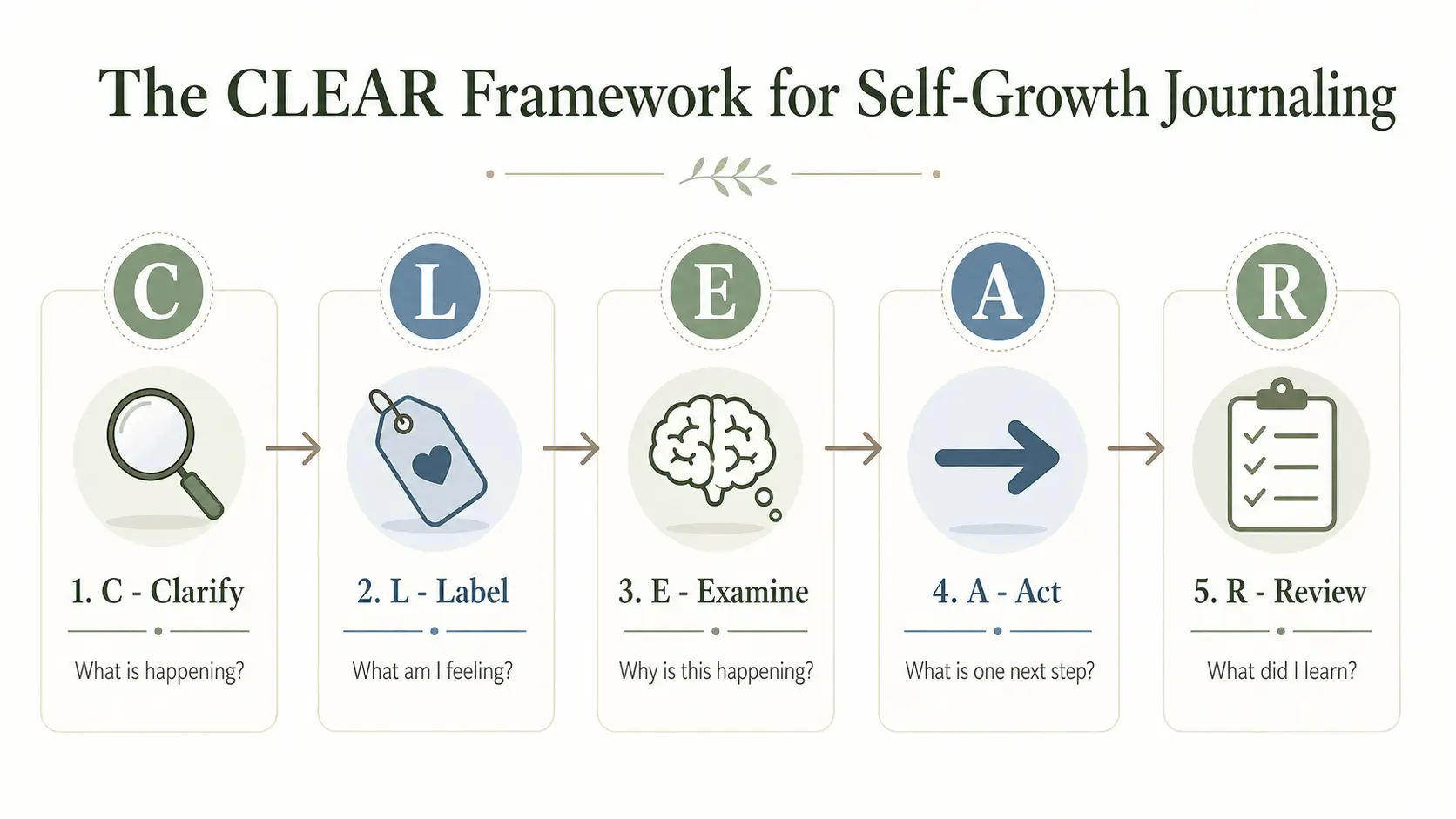
A simple self-growth journaling framework helps you move from vague reflection to clear action. The CLEAR Framework gives your entries structure.
| Step | Meaning | Journal Question |
|---|---|---|
| C | Clarify | What is really happening? |
| L | Label | What am I feeling or thinking? |
| E | Examine | Why might this be happening? |
| A | Act | What is one small next step? |
| R | Review | What did I learn from the result? |
Why it works:
- It prevents vague reflection.
- It connects emotion with action.
- It turns journaling into a behavior change tool.
- It supports long-term self-awareness.
Example:
“I keep delaying an important task. I feel anxious and uncertain. This may be happening because the task is too vague. One small next step is to write the first three actions. After trying that, I will review whether the task feels easier to start.”
This framework is effective because it turns awareness into a practical next step.
How to Know If Journaling Is Working
Journaling is working if you understand your emotions faster, notice repeated patterns, react less impulsively, and take more intentional action. Progress may be subtle at first, but it becomes clearer through repeated reflection.
Signs journaling is helping:
- You understand your emotions faster.
- You notice repeated patterns.
- You react less impulsively.
- You make clearer decisions.
- You take more intentional action.
- You recover from setbacks more quickly.
- You feel more honest with yourself.
Signs your method needs adjustment:
- Journaling increases rumination.
- You only criticize yourself.
- You never turn reflection into action.
- You avoid important topics.
- You make the routine too complicated.
If journaling is not working, simplify it. Use fewer prompts, shorter sessions, and more action-focused questions. A good journal method should help you feel clearer, not more trapped in your thoughts.
FAQ About How to Journal for Self-Growth
How do I journal for self-growth as a beginner?
Start with 5 minutes a day and answer three simple questions: What am I feeling? What pattern am I noticing? What is one small action I can take? This keeps journaling simple, practical, and focused on growth.
Why do I struggle with consistency in journaling?
Most people struggle because they make journaling too long, too perfect, or too dependent on motivation. A shorter routine works better because it reduces friction and builds the habit gradually.
What should I write in a self-improvement journal?
Write about your thoughts, emotions, habits, goals, triggers, lessons, and decisions. The goal is not to record everything but to understand what affects your behavior and growth.
Can journaling help with anxiety?
Yes, journaling can help with anxiety by organizing racing thoughts, separating facts from fears, and identifying what is within your control. It works best when you challenge anxious thoughts instead of repeating them without reflection.
Is journaling healthy for mental health?
Journaling can be healthy when it helps you process emotions, identify patterns, and respond more calmly. However, if journaling increases distress or rumination, it may help to use structured prompts or seek professional support.
What if I lose motivation to journal?
Lower the difficulty. Write one sentence, use one prompt, or journal only for two minutes. The goal is to keep the habit alive, not to produce a perfect entry.
How often should I journal for self-growth?
You can journal daily, a few times a week, or during important emotional moments. For self-growth, consistency matters more than frequency, so choose a rhythm you can realistically maintain.
What is the best time to journal?
Morning journaling helps with intention and focus, while evening journaling helps with reflection and emotional processing. The best time is the one you can repeat consistently.
Conclusion
Learning how to journal for self-growth is about using writing to understand yourself more clearly and act more intentionally. The most effective journaling practice does not require perfect writing, long entries, or constant motivation. It requires honesty, reflection, consistency, and a willingness to turn insight into small behavior changes.
A self-growth journal works best when it helps you notice patterns, process emotions, clarify goals, and take practical action. Start small, use prompts when needed, and review your entries regularly so journaling becomes more than self-expression—it becomes a system for personal growth.










13 Responses