

Introduction
The mindset of a sales warrior is a mental framework built on resilience, confidence, discipline, adaptability, and continuous improvement. It shapes how a sales professional thinks, reacts to setbacks, and approaches every customer interaction. This article explains the underlying philosophy behind this mindset — not a specific book or product — so readers can understand and apply the concept in their own work. The mindset of a sales warrior draws on principles found in sales psychology, growth mindset research, emotional resilience training, and customer-focused selling. Understanding these connections helps clarify why mindset, not just technique, often determines long-term sales success.
Quick Summary
- A sales warrior mindset combines resilience, discipline, confidence, and continuous learning to improve sales performance.
- Successful sales professionals focus on solving customer problems instead of simply closing deals.
- Developing a strong sales mindset requires consistent habits, emotional control, and adaptability.
- The principles apply to beginners and experienced sales professionals across different industries.
What Is the Mindset of a Sales Warrior?
Definition of a Sales Warrior Mindset
The mindset of a sales warrior is a disciplined mental approach that treats setbacks as feedback rather than failure. In our experience helping readers build better habits, the clearest way to understand this warrior mindset meaning is to separate it from selling techniques: techniques are what a salesperson does, while mindset is how they think before, during, and after doing it. So, what is a sales mindset in this context? It is the internal set of beliefs and attitudes — confidence, patience, and problem-solving orientation — that determines how consistently someone applies good technique under pressure.
Why the “Warrior” Analogy Is Used in Sales
The warrior analogy is used because sales, like combat readiness, rewards preparation over improvisation. Sales professionals who adopt this framing tend to build several traits in common:
- Persistence — continuing to prospect and follow up despite setbacks
- Courage — initiating difficult conversations and asking for the sale
- Accountability — owning outcomes rather than blaming circumstances
- Adaptability — adjusting approach based on the customer and market
- Mental toughness — staying composed through rejection and pressure
- Ethical competitiveness — pursuing results without compromising integrity
What Is a Warrior Mindset?
Core Characteristics
A warrior mindset, independent of sales, is defined by discipline, emotional resilience, confidence, focus, accountability, and long-term thinking. These characteristics function together: discipline sustains daily habits, emotional resilience protects against burnout, and long-term thinking keeps short-term losses in perspective. Understanding what is a warrior mindset at this general level makes it easier to see how it translates specifically into sales contexts, where daily rejection and unpredictable outcomes test each of these traits repeatedly. Understanding the broader concept of a warrior mindset makes it easier to see how it translates specifically into sales contexts, where daily rejection and unpredictable outcomes test each trait repeatedly.
Warrior Mindset vs Aggressive Selling
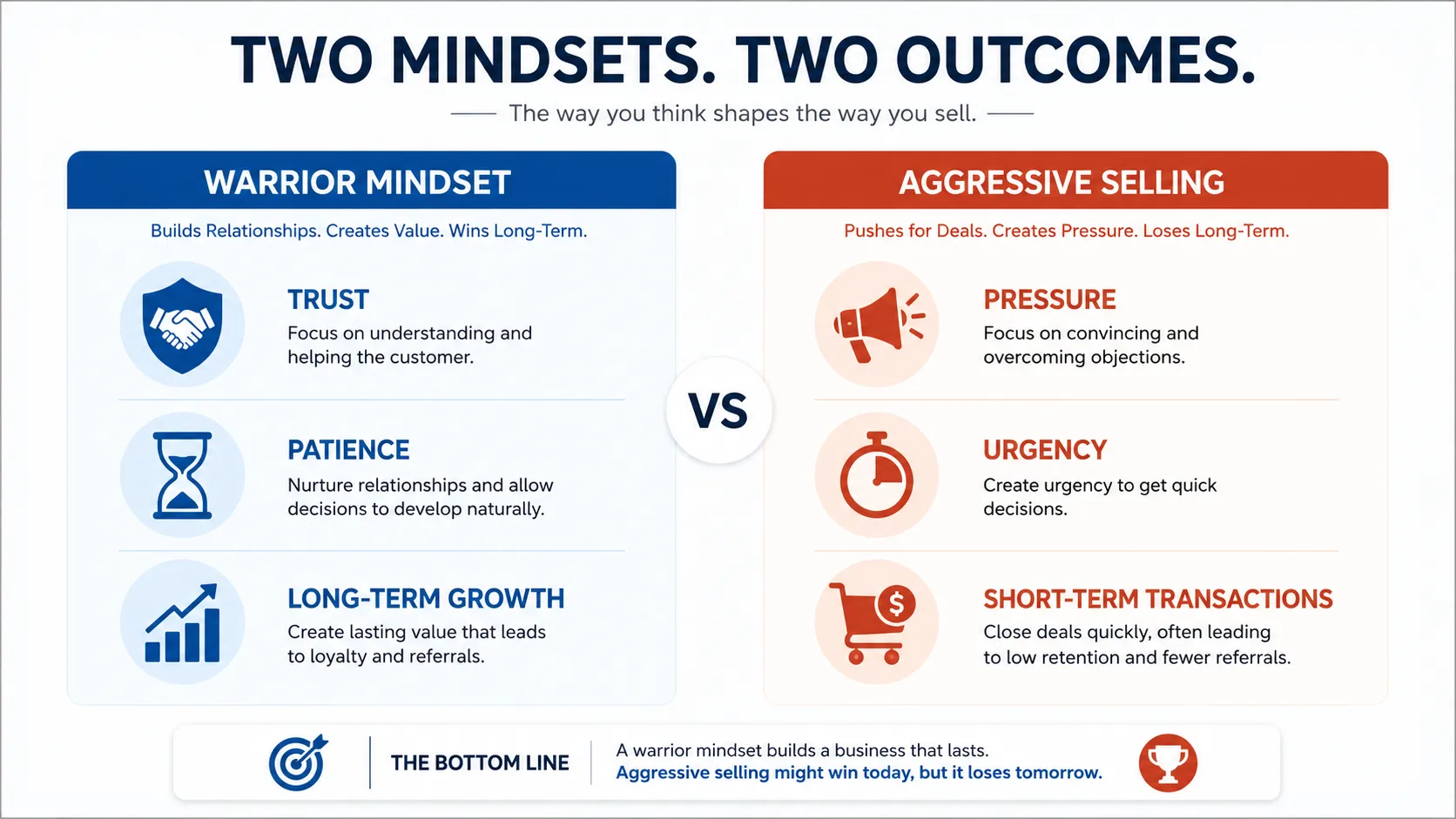
A common misconception equates a warrior mindset with aggressive or pushy selling. In reality, the two differ sharply in focus and outcome.
| Warrior Mindset | Aggressive Selling |
|---|---|
| Customer-focused | Seller-focused |
| Long-term trust | Short-term gain |
| Emotional discipline | Emotional pressure |
| Value creation | Transaction focus |
Resilience and persistence — hallmarks of the warrior mindset — are about staying engaged with a customer’s actual needs over time. Pressure tactics, by contrast, prioritize closing a single transaction regardless of fit, which tends to damage trust and reduce repeat business.
What Is a Sales Mindset?
Definition and Importance
A sales mindset is the combination of beliefs, attitudes, and decision-making patterns that shape how a person approaches selling. It includes confidence in one’s value proposition and genuine empathy for the customer’s problem. Answering what is a sales mindset in practical terms: it is the internal filter through which a salesperson interprets objections, rejection, and opportunity.
How Sales Mindset Influences Performance
Mindset shapes performance across every stage of the sales process, including:
- Prospecting — a resilient mindset sustains outreach volume despite low response rates
- Handling rejection — a growth-oriented mindset treats “no” as information, not identity
- Negotiations — confidence without arrogance allows firm, fair positioning
- Closing — clarity of purpose reduces hesitation at the decision point
- Relationship building — customer-first thinking strengthens long-term retention
Core Principles of the Mindset of a Sales Warrior
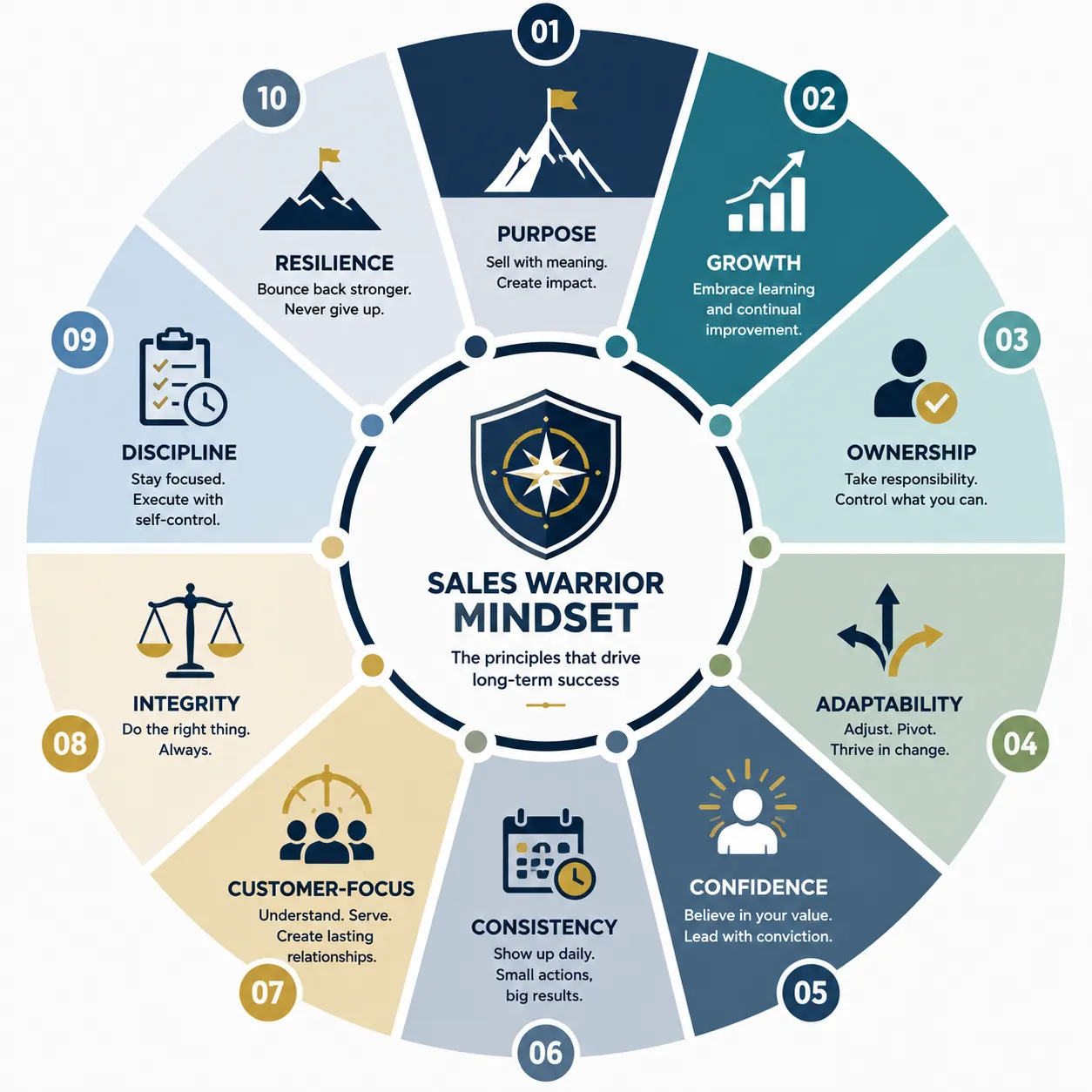
The mindset of a sales warrior rests on several core principles that reinforce one another: Self-discipline — following through on habits without external enforcement — is often debated as either an innate trait or a skill that can be built, and treating it as the latter is what makes consistent sales performance possible.
- Purpose-driven selling — connecting daily activity to a larger goal
- Continuous improvement — treating every interaction as a learning opportunity
- Ownership — taking responsibility for results, not excuses
- Adaptability — adjusting strategy to the customer and situation
- Confidence without arrogance — trusting one’s value without dismissing the customer’s perspective
- Consistency — showing up with the same discipline regardless of mood or streak
- Customer-first thinking — prioritizing the customer’s problem over the seller’s quota
- Integrity — maintaining honesty even when a shortcut is available
- Self-discipline — following through on habits without external enforcement
- Resilience after rejection — recovering quickly and re-engaging productively
How to Develop a Sales Mindset
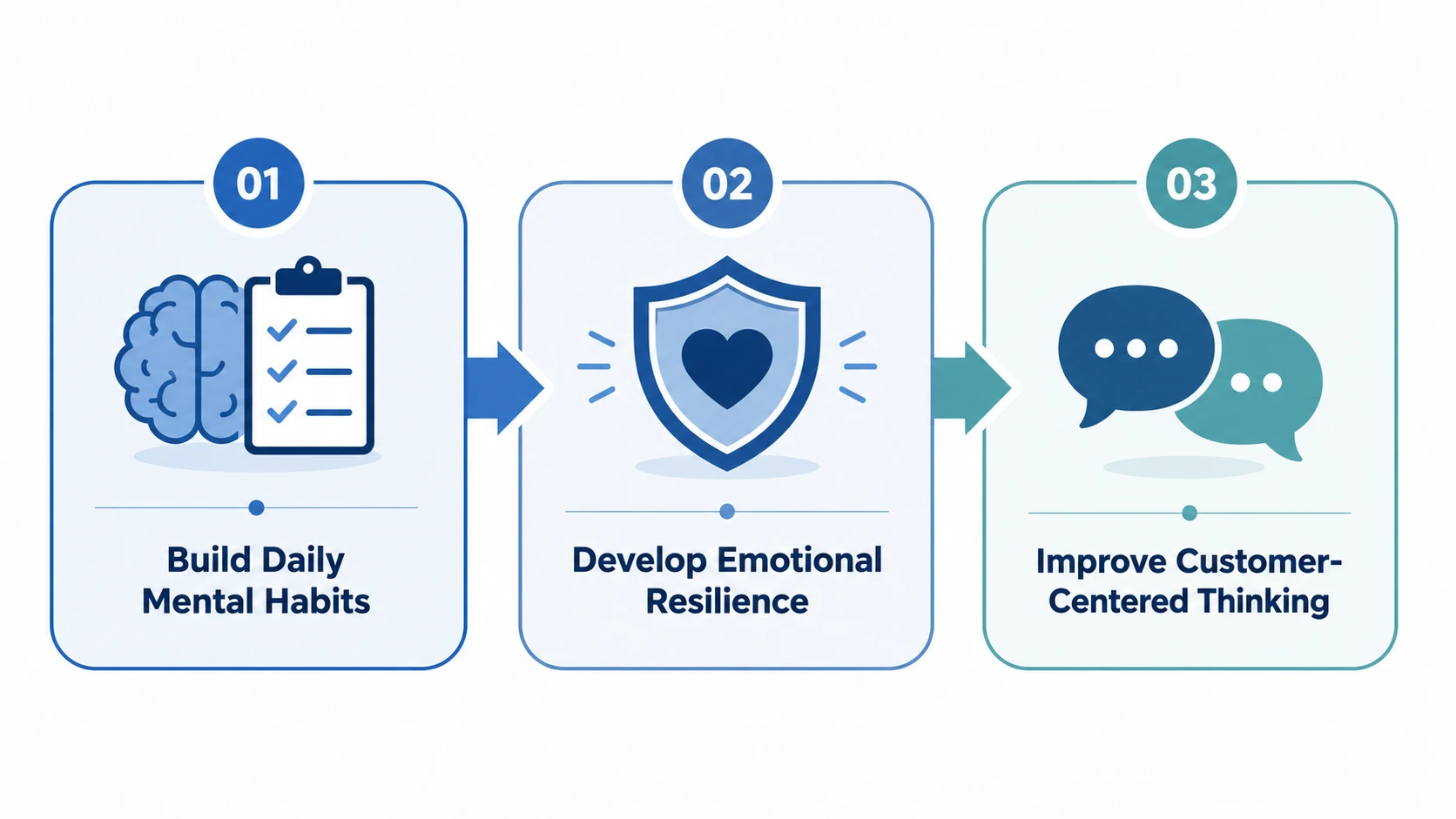
Build Daily Mental Habits
Learning how to develop a sales mindset starts with small, repeatable daily habits: goal setting, visualization of key conversations, pre-call preparation, end-of-day reflection, and deliberate learning from each interaction. These habits compound; a salesperson who reflects daily identifies patterns in objections and adjusts faster than one who does not. These habits compound over time, which matters most on days when motivation is low — see our guide on how to build discipline without motivation for a deeper breakdown.
Develop Emotional Resilience
Emotional resilience is built through structured rejection recovery, active emotional regulation, positive self-talk, and honest post-mortems on failed deals. Your Daily Thrive recommends treating each rejection as a single data point rather than a verdict on ability, which prevents cumulative discouragement from affecting future calls.
Improve Customer-Centered Thinking
Customer-centered thinking depends on active listening, genuine empathy, well-timed questions, and clear communication of value rather than features. Sales professionals who ask more questions than they answer in early conversations typically uncover needs that generic pitches miss.
Habits Shared by High-Performing Sales Professionals
High performers across industries tend to share a consistent set of habits:
- Continuous learning about products, markets, and buyer psychology
- Deep product knowledge that supports confident, accurate answers
- Consistency in outreach and follow-up, even during slow periods
- Follow-up discipline that prevents leads from going cold
- Strong time management across prospecting, meetings, and admin work
- Adaptability to different buyer types and communication styles
- Confidence grounded in preparation rather than bravado
- Curiosity about customer problems beyond the immediate sale
These habits are the practical expression of mindset selling — mindset shapes behavior, and consistent behavior produces results.
Mindset Selling: Focusing on Relationships Instead of Transactions
What Mindset Selling Means
Mindset selling refers to a consultative approach where trust, long-term relationships, and customer success take priority over closing any single transaction. It reframes the salesperson’s role from persuader to advisor.
Benefits of a Customer-Focused Mindset
A customer-focused mindset produces measurable advantages:
- Better customer retention over time
- More referrals from satisfied customers
- A stronger professional and company reputation
- Improved conversion quality, not just volume
Common Challenges When Developing a Sales Warrior Mindset
Fear of Rejection
Fear of rejection often stems from treating “no” as personal failure. Overcoming it involves reframing rejection as a normal, expected part of the process and reviewing objective data on outreach ratios rather than dwelling on individual outcomes.
Low Confidence
Low confidence frequently results from insufficient preparation or unclear value messaging. Building product knowledge and rehearsing key conversations helps prevent it before it undermines performance.
Inconsistent Motivation
Inconsistent motivation typically arises when goals are vague or too distant. Breaking larger targets into daily and weekly milestones creates more frequent feedback and sustains momentum.
Burnout
Burnout develops from unsustainable pace or unclear boundaries between work and recovery. Prevention includes scheduled rest, realistic activity targets, and monitoring workload trends over time.
Negative Self-Talk
Negative self-talk compounds after a string of losses and can become a self-fulfilling pattern. Structured reflection and deliberately reframing setbacks as learning data help interrupt this cycle.
Beginner Mistakes That Slow Mindset Development
Common early mistakes include:
- Chasing quick wins instead of building sustainable habits
- Relying only on scripts instead of adapting to the conversation
- Avoiding feedback that could reveal weaknesses
- Fearing failure to the point of reduced activity
- Neglecting customer relationships after the initial sale
- Maintaining inconsistent habits that prevent skill compounding
Comparing Different Sales Mindset Approaches
| Mindset | Primary Focus | Strength | Limitation |
|---|---|---|---|
| Growth Mindset | Learning and improvement | Adapts well over time | Can lack short-term urgency |
| Warrior Mindset | Resilience and discipline | Sustains performance under pressure | Requires ongoing self-management |
| Fixed Mindset | Innate ability | Confidence in known strengths | Struggles to adapt to setbacks |
| Customer-First Mindset | Customer needs | Builds trust and retention | Can slow decisive closing if overapplied |
Applying a Sales Warrior Mindset in Different Situations
Beginners
Beginners benefit most from building foundational habits — preparation, reflection, and basic resilience — before focusing heavily on advanced technique.
Experienced Sales Professionals
Experienced professionals apply the mindset by refining consistency and mentoring others, using established resilience to handle larger or more complex deals.
Remote Sales
Remote sales requires additional discipline around structure and communication, since fewer environmental cues reinforce daily habits.
B2B Sales
B2B sales rewards patience and long-term relationship building, since decision cycles are longer and involve multiple stakeholders.
B2C Sales
B2C sales rewards quicker emotional resilience and adaptability, since interactions are often shorter and higher in volume.
Difficulty and Time Investment
Developing a sales warrior mindset has a moderate learning curve for beginners and a refinement curve for experienced professionals. Daily effort typically involves short reflection and preparation routines rather than lengthy exercises. Emotional resilience and consistent customer-centered thinking tend to take longer to develop than basic habits like goal setting. Personal factors — prior sales exposure, natural disposition toward rejection, and available support or mentorship — all influence how quickly progress occurs.
Results Timeline
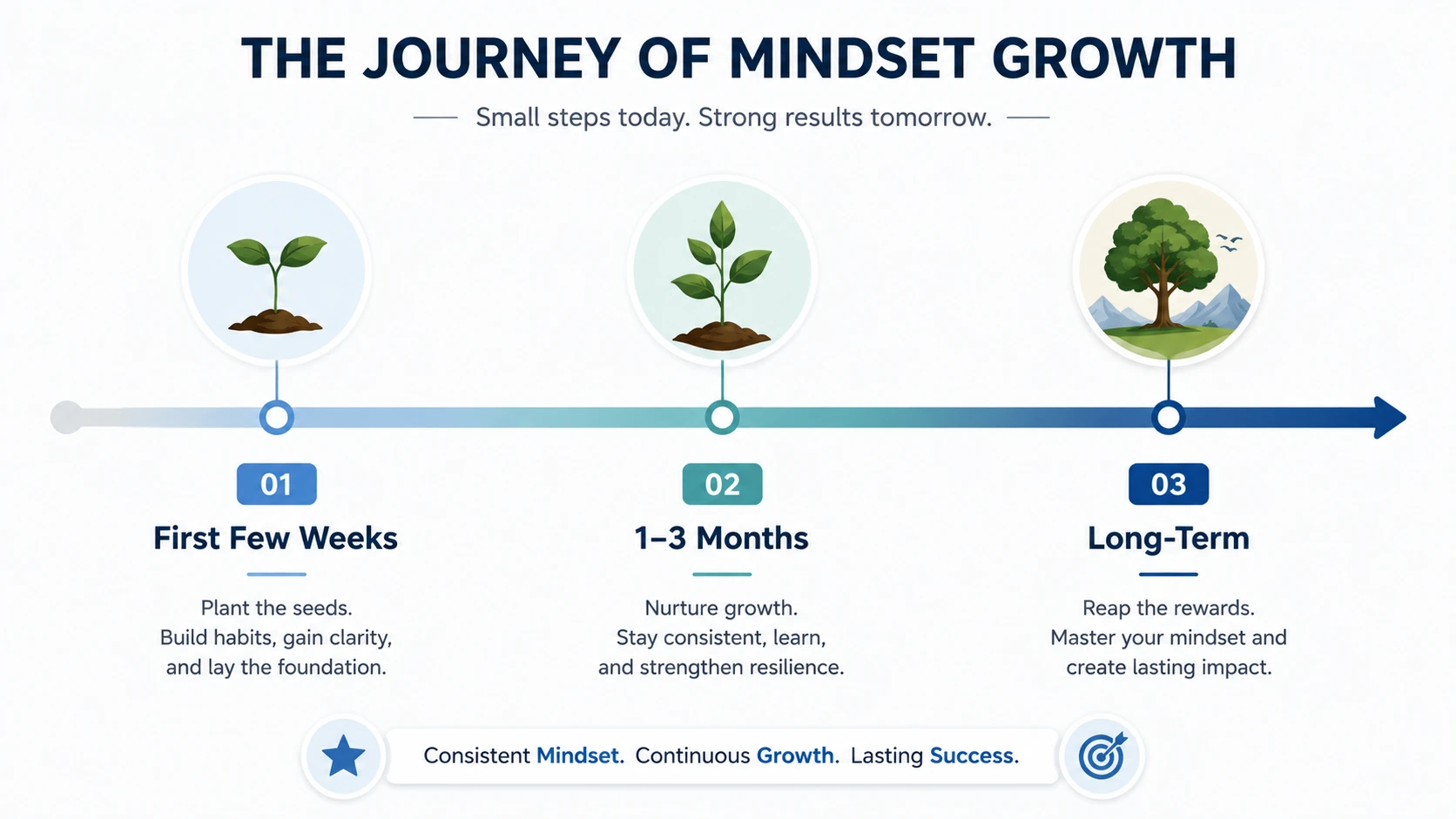
In the first few weeks, most people notice small shifts in how they react to rejection and how consistently they follow routines. Between one and three months, habits typically become more automatic, and confidence in handling objections improves noticeably. Long-term development — deeper emotional resilience and refined customer-centered thinking — usually continues over many months or years of consistent practice. Individual differences, including starting confidence level and consistency of practice, affect how quickly these stages unfold.
Practice Guide for Building a Sales Warrior Mindset
Daily Routine
A simple daily routine includes brief goal review, pre-call preparation, and short end-of-day reflection on what worked and what didn’t.
Weekly Reflection
Weekly reflection involves reviewing patterns across multiple interactions — common objections, response rates, and emotional reactions — to spot trends that daily reflection misses.
Goal Tracking
Tracking goals with simple metrics, such as outreach volume or follow-up completion, provides objective feedback that counteracts emotional highs and lows.
Motivation and Accountability
External accountability, such as a mentor, peer, or manager check-in, helps sustain motivation during periods when internal drive is lower.
Long-Term Sustainability
Long-term sustainability depends on pacing effort to avoid burnout, periodically revisiting goals, and adjusting routines as skill level and circumstances change.
Inspirational Warrior Mindset Quotes and Lessons
Motivational quotes on warrior mindset can reinforce resilience and discipline, but they work best as reminders of principles already being practiced, not as substitutes for daily habits. A quote about persistence, for example, is most useful right before a challenging call, where it reinforces a decision already made to follow through rather than replacing the preparation behind that decision.
Frequently Discussed Book: Mindset of a Sales Warrior
What Readers Typically Learn
Readers of books on this topic typically encounter themes of resilience, discipline, confidence, customer focus, and personal growth as they relate to sales performance. This overview describes commonly discussed themes rather than reproducing any specific book’s content.
Key Ideas and Practical Takeaways
At a high level, the key ideas commonly associated with this topic include treating mindset as trainable rather than fixed, prioritizing customer problems over personal targets, and building resilience through consistent practice rather than motivation alone. Readers interested in the full material should consult the original source directly for complete details.
Conclusion
The mindset of a sales warrior is defined by resilience, discipline, confidence, and a genuine focus on the customer’s problem rather than the transaction itself. Sustainable sales success depends less on any single technique and more on consistent habits, emotional regulation, and adaptability across different situations and buyer types. Readers looking to build this mindset should focus on steady, repeatable practice — daily preparation, honest reflection, and customer-centered thinking — rather than expecting quick results. Over time, these consistent habits compound into the kind of durable performance associated with a true sales warrior mindset.
Frequently Asked Questions
What is the mindset of a sales warrior?
The mindset of a sales warrior is a mental framework combining resilience, discipline, confidence, and continuous improvement, applied consistently to sales performance and customer relationships.
What is a warrior mindset in sales?
A warrior mindset in sales refers to mental toughness and discipline applied to selling — staying composed under pressure, recovering quickly from rejection, and maintaining consistent effort.
How can someone develop a stronger sales mindset?
A stronger sales mindset develops through daily habits like preparation, reflection, and goal tracking, combined with deliberate practice in emotional resilience and customer-centered thinking.
What habits do successful sales professionals have in common?
Successful sales professionals typically share continuous learning, consistent follow-up, strong time management, adaptability, and genuine curiosity about customer needs.
How is a warrior mindset different from aggressive selling?
A warrior mindset is customer-focused and built on long-term trust, while aggressive selling is seller-focused and relies on short-term pressure tactics.
Why is resilience important in sales?
Resilience is important because sales involves frequent rejection; the ability to recover quickly and stay engaged directly affects long-term consistency and results.
Can beginners build a sales warrior mindset?
Yes. Beginners can build this mindset by starting with basic daily habits — preparation, reflection, and goal setting — before layering on advanced emotional resilience techniques.
Does mindset matter more than sales techniques?
Mindset and technique both matter, but mindset determines how consistently and effectively a person applies technique, especially under pressure or after setbacks.