
Introduction
An investor’s mindset is the pattern of thinking that shapes how a person evaluates risk, makes financial decisions, and responds to market changes over time. It is not the same as investment knowledge — a person can understand financial products in detail and still make poor decisions if their mindset is reactive rather than disciplined. This article focuses on the psychological principles behind successful investing, not specific investment products or strategies. Understanding an investor’s mindset helps explain why two people with the same information often get very different financial outcomes.
Quick Summary
- An investor’s mindset emphasizes long-term thinking, disciplined decision-making, and emotional control.
- Successful investors rely on structured processes instead of reacting to short-term market movements.
- Developing an investment mentality involves continuous learning, patience, and effective risk management.
- Anyone can strengthen an investor’s mindset through consistent habits and informed decision-making.
What Is an Investor’s Mindset?
An investor’s mindset is a way of thinking that prioritizes long-term financial goals, disciplined evaluation of risk, and rational decision-making over emotional reactions to short-term events. It represents an investment mentality — a consistent approach to money that stays stable even when markets are volatile.
This mindset differs from investment knowledge and technical skills in an important way. Knowledge refers to understanding what to do — how markets work, how to read financial statements, or how compounding functions. Mindset refers to how a person applies that knowledge under real conditions, including stress, uncertainty, and temptation.
Investor psychology plays a central role here. It examines how emotions, biases, and mental shortcuts influence financial choices, often more than raw information does. A person with strong investor psychology tends to:
- Approach decisions with long-term thinking rather than short-term impulse
- Base financial decision-making on evidence rather than emotion
- Treat setbacks as data points rather than personal failures
In short, an investor’s mindset is the psychological foundation that determines whether financial knowledge gets applied effectively or gets overridden by fear, excitement, or impatience.
Why an Investor’s Mindset Matters
Mindset matters because financial outcomes are rarely determined by information alone. Two investors can have access to identical data and still produce very different results, largely because of how they think and behave under pressure.
How Mindset Influences Financial Decisions
Emotional decision-making is one of the most common reasons investment plans fail. When fear or excitement takes over, people often abandon well-reasoned strategies in favor of impulsive action. This is where the distinction between discipline versus impulsiveness becomes critical: disciplined investors follow a predetermined process, while impulsive investors react to whatever is happening in the moment.
This connects directly to behavioral finance, a field of study that examines how psychological factors affect financial decisions. Behavioral finance research consistently shows that emotional reactions — not lack of information — are a leading cause of poor investment outcomes.
Long-Term Thinking Versus Short-Term Reactions
Patience is a defining trait of a strong investor’s mindset. This includes practicing delayed gratification — prioritizing future financial security over immediate comfort or excitement — and maintaining consistency during market fluctuations rather than abandoning a strategy at the first sign of volatility.
A long-term orientation typically produces:
- Better risk assessment
- Reduced emotional investing
- Improved consistency
- Stronger financial confidence
What Type of Mindset Do Professional Investors Maintain?
Professional investors generally maintain a disciplined, evidence-based mindset that prioritizes process over prediction and long-term outcomes over short-term noise. While no two professionals think identically, most share a recognizable set of psychological traits developed through experience and repeated exposure to market cycles.
Common Characteristics
- Patience
- Discipline
- Continuous learning
- Risk awareness
- Adaptability
- Evidence-based decisions
- Emotional resilience
Habits That Support Professional Thinking
Beyond individual traits, professional investors tend to build habits that reinforce sound thinking over time, including:
- Setting clear, measurable goals
- Reviewing past decisions objectively
- Learning from mistakes rather than avoiding them
- Maintaining a portfolio perspective — evaluating overall performance rather than fixating on individual trades
These professional investing habits create a feedback loop: better habits lead to better decisions, and better decisions reinforce the habits that produced them.
How to Think Like an Investor
Learning how to think like an investor starts with a shift in perspective, not a new set of tools. The following adjustments help build that perspective in practical terms.
Shift from Spending to Investing
This means evaluating money in terms of future value rather than immediate use — asking whether a dollar spent today could instead grow into something more valuable over time.
Focus on Long-Term Value
Investors evaluate assets based on their potential to grow or generate value over years or decades, rather than their short-term price movement.
Separate Emotions from Decisions
Effective investors create distance between how they feel and what they do, often by relying on predetermined rules or checklists instead of in-the-moment judgment.
Evaluate Risk Before Reward
Before considering potential gains, disciplined investors assess what could go wrong and whether they can tolerate that outcome. This mirrors a broader personal growth principle — learning to focus on what you can control — since investors can’t control markets, but they can control their own risk decisions.
Learn Continuously
Markets, tools, and economic conditions change. An investor’s mindset includes an ongoing commitment to updating knowledge rather than relying on outdated assumptions.
Practical habits that support this thinking include:
- Asking better financial questions
- Thinking in probabilities rather than certainties
- Avoiding emotional reactions to short-term news
- Building decision frameworks in advance
- Reviewing outcomes objectively, without hindsight bias
Inside the Investor’s Mind: How Successful Investors Make Decisions
Understanding what happens inside the investor’s mind reveals why experienced investors often make different choices than beginners, even when facing identical circumstances. Understanding what happens inside the investor’s mind connects closely to broader mindset psychology, which explores how thought patterns shape behavior across every area of life, not just finance.
Decision-Making Under Uncertainty
Investing always involves incomplete information. Successful investors accept this uncertainty and make decisions based on probability and available evidence rather than waiting for certainty that will never arrive.
Managing Fear and Greed
Fear and greed are two of the most powerful emotional forces in investing. Fear can cause premature selling during downturns, while greed can cause excessive risk-taking during upswings. Managing both requires awareness and predetermined rules that limit emotional override.
Pattern Recognition and Critical Thinking
Experienced investors develop pattern recognition through repeated exposure to market cycles, but they pair this with critical thinking to avoid assuming that past patterns will always repeat exactly.
The Importance of Patience
Patience allows investors to let strategies play out over the time horizons they were designed for, rather than judging success based on short-term results.
This internal decision-making process is shaped by several recognized concepts in behavioral finance, including risk tolerance (an individual’s capacity to withstand potential losses), confirmation bias (favoring information that supports existing beliefs), loss aversion (the tendency to feel losses more intensely than equivalent gains), and opportunity cost (the value given up by choosing one option over another).
Investor’s Mindset vs Trader’s Mindset
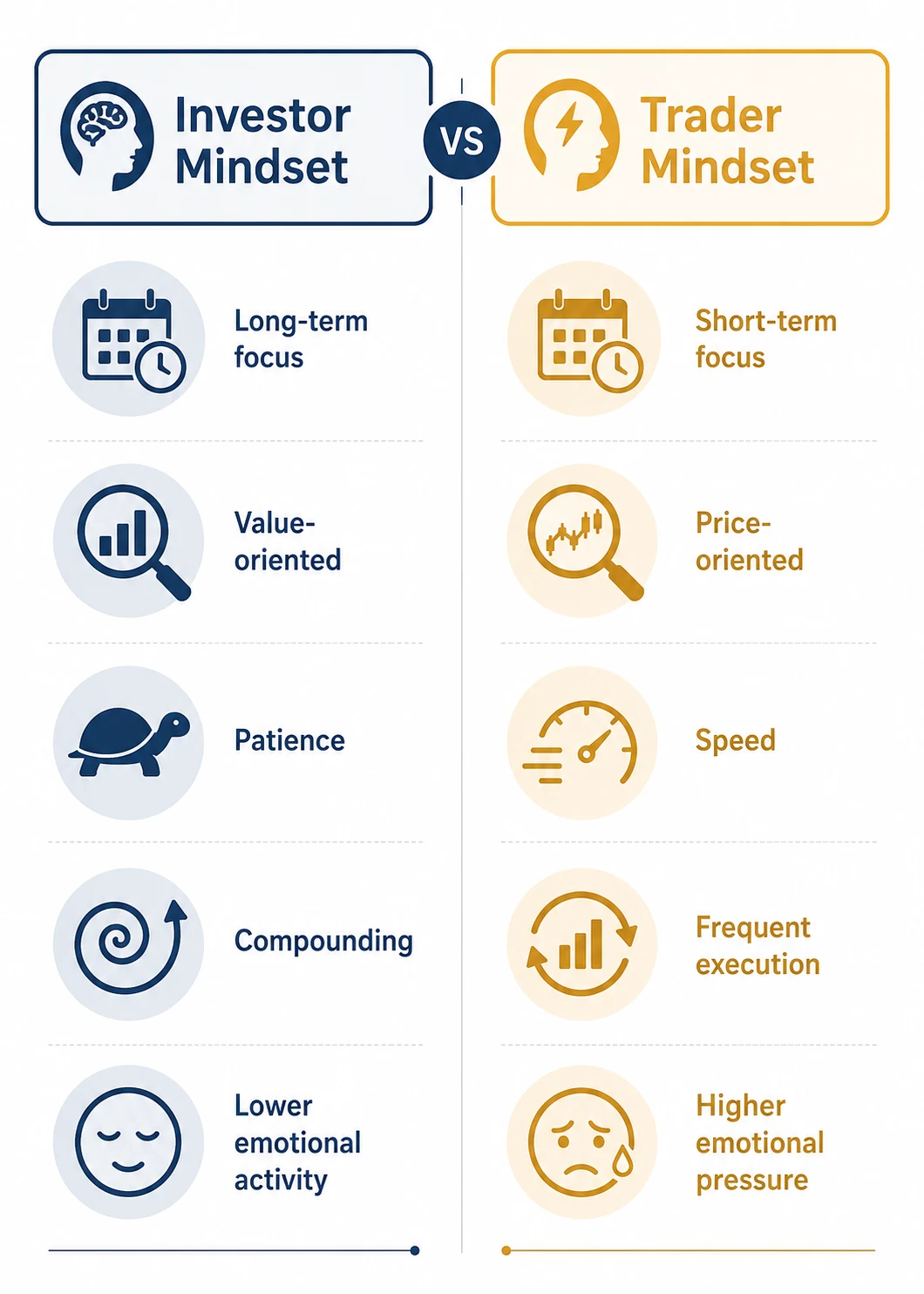
While both investors and traders participate in financial markets, their underlying mindsets differ significantly in focus, time horizon, and emotional demands. Neither approach is universally better — they serve different objectives and suit different personalities and goals.
| Investor Mindset | Trader Mindset |
|---|---|
| Long-term focus | Short-term focus |
| Value-oriented | Price-oriented |
| Patience | Speed |
| Compounding | Frequent execution |
| Lower emotional activity | Higher emotional pressure |
Common Psychological Biases That Affect Investors
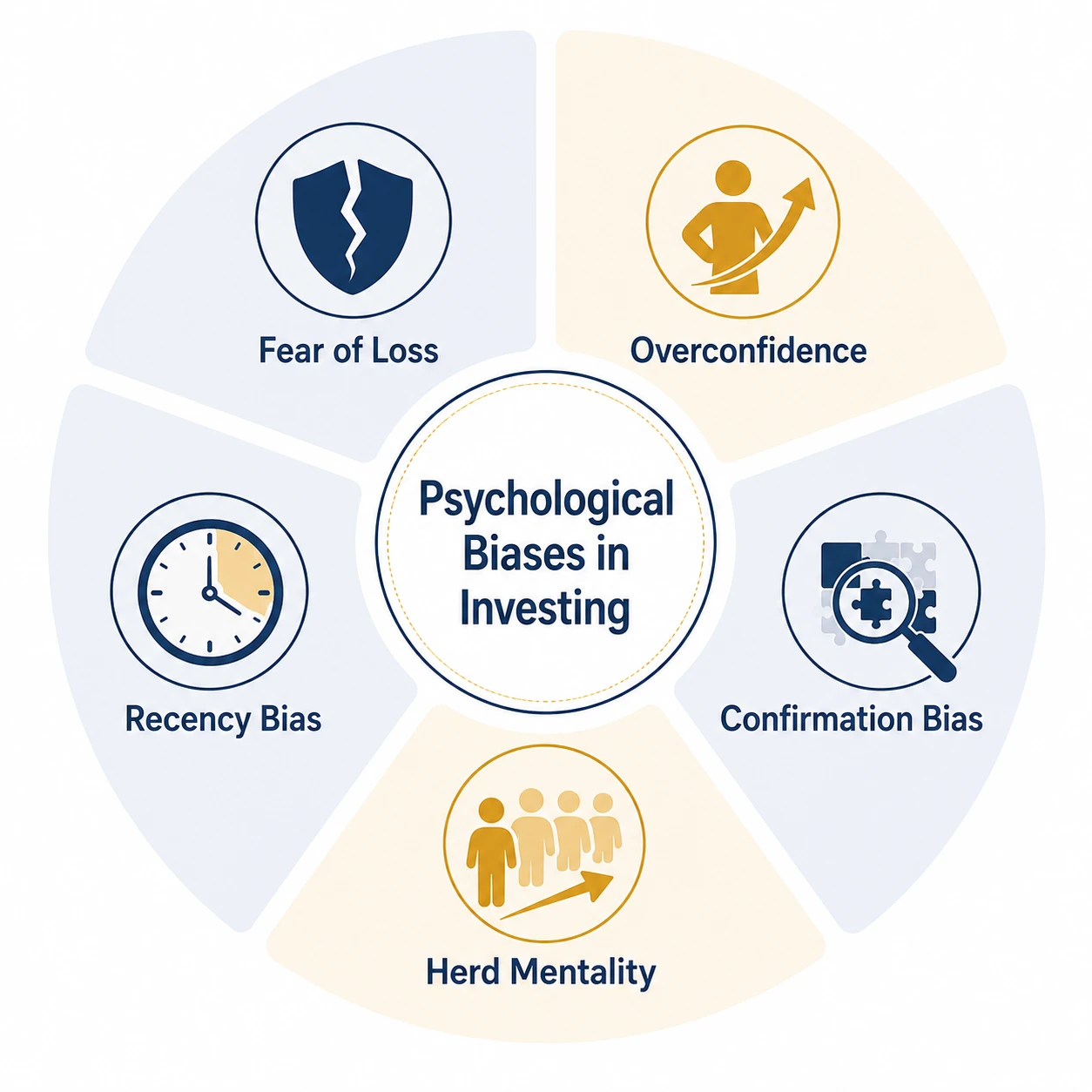
Psychological biases are mental shortcuts that can distort financial judgment. Recognizing them is a key step toward reducing their influence.
Fear of Loss
This bias occurs because losses are felt more intensely than equivalent gains, which can lead to overly cautious decisions or panic selling. Reducing its influence involves focusing on long-term goals rather than short-term price movements.
Overconfidence
Overconfidence arises when past success creates an inflated sense of skill or predictive ability. It can lead to excessive risk-taking. Regularly reviewing decisions against actual outcomes helps keep confidence realistic.
Confirmation Bias
This occurs when investors seek out information that confirms existing beliefs while ignoring contradictory evidence. Deliberately seeking opposing viewpoints helps counteract this tendency.
Herd Mentality
Herd mentality happens when investors follow the crowd rather than independent analysis, often driven by fear of missing out. Relying on a predefined strategy helps resist this pull.
Recency Bias
Recency bias leads investors to give disproportionate weight to recent events, assuming current trends will continue indefinitely. Reviewing long-term historical data helps provide better context.
Building an Investor’s Mindset Step by Step
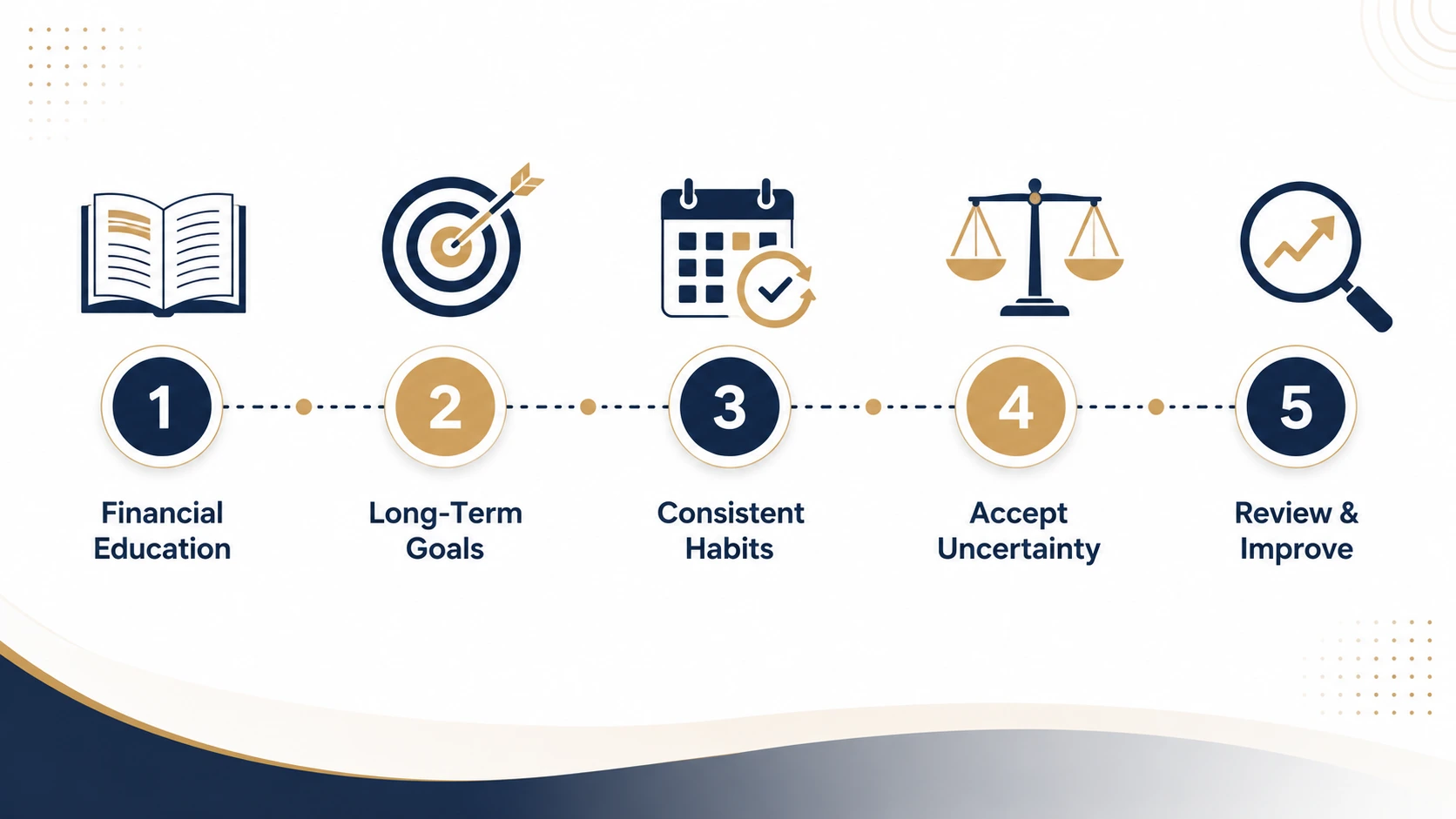
Developing an investor’s mindset is a gradual process rather than an instant transformation. The following roadmap emphasizes steady improvement over quick results.
Start with Financial Education
A foundational understanding of financial concepts supports better decision-making and reduces reliance on guesswork.
Create Long-Term Goals
Clear, specific goals give decisions direction and make it easier to resist short-term distractions.
Develop Consistent Investing Habits
Regular, repeatable actions — rather than sporadic effort — build the discipline that a strong investor’s mindset requires.
Accept Market Uncertainty
Recognizing that uncertainty is a permanent feature of investing, not a temporary obstacle, helps reduce anxiety-driven decisions.
Review and Improve Decisions
Periodically evaluating past decisions, independent of their outcomes, supports continuous psychological growth.
Difficulty and Time Investment
Developing an investor’s mindset is beginner-friendly in structure but requires sustained effort over time, since psychological habits form more slowly than technical knowledge.
- Beginner-friendly expectations: Most people can grasp the core concepts of an investor’s mindset relatively quickly, but applying them consistently under real financial pressure takes longer.
- Typical learning curve: Early progress often focuses on understanding concepts; later progress focuses on applying them consistently during actual market fluctuations.
- Importance of experience: Direct experience with market ups and downs accelerates mindset development in ways that theory alone cannot.
- Factors influencing progress: Personal financial pressure, prior exposure to investing, and individual temperament all affect how quickly someone adapts.
- Time required for disciplined habits: Most people need consistent practice across multiple market cycles before disciplined responses become automatic.
Results Timeline
Mindset development typically follows a gradual pattern rather than a sudden shift, with noticeable progress occurring at different stages.
- Early mindset shifts: In the first few weeks or months, individuals often notice increased awareness of their own emotional reactions to financial news.
- Medium-term habit formation: Over several months, structured habits like reviewing decisions or following a plan tend to become more automatic.
- Long-term confidence development: Over a year or more, sustained practice typically leads to greater confidence and reduced emotional volatility during market swings.
- Why progress varies: Differences in starting knowledge, market exposure, and personal financial circumstances mean that timelines vary meaningfully between individuals.
Practice Guide for Developing an Investor’s Mindset
Building an investor’s mindset benefits from structured, repeatable practices rather than occasional effort.
Daily Practices
Brief daily check-ins on financial news or portfolio performance help maintain awareness without encouraging overreaction.
Weekly Reflection
A short weekly review of decisions and emotional responses helps identify patterns that need adjustment.
Tracking Decisions
Recording the reasoning behind financial decisions — not just the outcomes — creates a clearer picture of decision quality over time.
Building Emotional Discipline
Predetermined rules for buying, selling, or holding reduce the influence of in-the-moment emotion. On days when the market feels discouraging, it helps to remember how to build discipline without motivation — because consistency, not motivation, is what sustains an investor’s mindset long-term.
Maintaining Long-Term Consistency
Sticking to a strategy across multiple market cycles, rather than switching approaches after short-term setbacks, reinforces long-term thinking.
Useful tools for this practice include:
- Investment journal
- Reading schedule
- Goal review
- Portfolio reflection
- Bias awareness checklist
Common Beginner Mistakes
Several psychological mistakes are common among new investors, and recognizing them early helps prevent costly setbacks.
Expecting Quick Profits
This happens because early success or media narratives create unrealistic expectations. It can be addressed by focusing on long-term, evidence-based goals rather than rapid gains, and prevented by setting realistic timelines from the start.
Following Market Hype
Hype-driven decisions often stem from fear of missing out. Fixing this involves relying on independent analysis rather than trends, and prevention comes from having a predefined strategy in place before hype cycles occur.
Ignoring Risk
Beginners sometimes overlook risk because potential rewards are more emotionally compelling. Addressing this requires evaluating downside scenarios before upside potential, and prevention involves routinely assessing risk tolerance.
Investing Without a Plan
This mistake often results from excitement outweighing preparation. It can be corrected by creating clear goals and criteria before making decisions, and prevented by treating planning as a required first step.
Letting Emotions Control Decisions
Emotional control issues typically stem from insufficient awareness of one’s own reactions. This can be improved through journaling and reflection, and prevented by establishing rules that limit impulsive action.
Practical Tips for Different Types of Investors
Life stage significantly influences investment mindset, priorities, and decision-making, since financial goals and risk tolerance naturally shift over time.
Students
At this stage, the priority is typically building financial literacy and developing early habits, since time horizons are long and financial obligations are often limited.
Young Professionals
This group often benefits from focusing on consistent habit-building and long-term goal setting, as income tends to grow while flexibility for risk remains relatively high.
Mid-Career Investors
Individuals at this stage often balance growth-oriented thinking with increasing financial responsibilities, requiring more structured risk management.
Retirement-Focused Investors
As time horizons shorten, mindset often shifts toward capital preservation and stability, with less tolerance for short-term volatility.
Investor’s Mindset Resources and Further Learning
Continued learning reinforces and strengthens an investor’s mindset over time.
Books
Numerous educational books explore investing psychology and long-term financial thinking. One widely referenced example focused specifically on this topic is The Investors Mindset by Ben Le Fort, which is often cited among investors mindset book resources — though it represents just one option among many available works on investment psychology.
Articles, Podcasts, and Courses
Beyond books, readers can explore reputable financial education websites, investing-focused podcasts, and structured online courses covering behavioral finance and long-term investing principles. Choosing resources from established financial educators or accredited institutions helps ensure accuracy.
Conclusion
An investor’s mindset combines long-term thinking, emotional discipline, and continuous learning to support better financial decision-making over time. It is distinct from technical investment knowledge, though the two work best together. Successful investing depends on managing psychological biases, maintaining patience during uncertainty, and building consistent habits rather than reacting to short-term market noise. In our experience helping readers build better financial habits, the most durable progress comes from small, repeatable practices rather than dramatic changes. Anyone can strengthen their investor’s mindset by focusing on gradual, informed improvement rather than seeking quick results.
Frequently Asked Questions (FAQs)
What is an investor’s mindset?
An investor’s mindset is a disciplined way of thinking that prioritizes long-term financial goals, rational risk evaluation, and emotional control over short-term market reactions.
How can beginners develop an investment mentality?
Beginners can develop an investment mentality by starting with basic financial education, setting clear long-term goals, and practicing consistent habits like tracking decisions and reviewing outcomes.
What type of mindset do professional investors maintain?
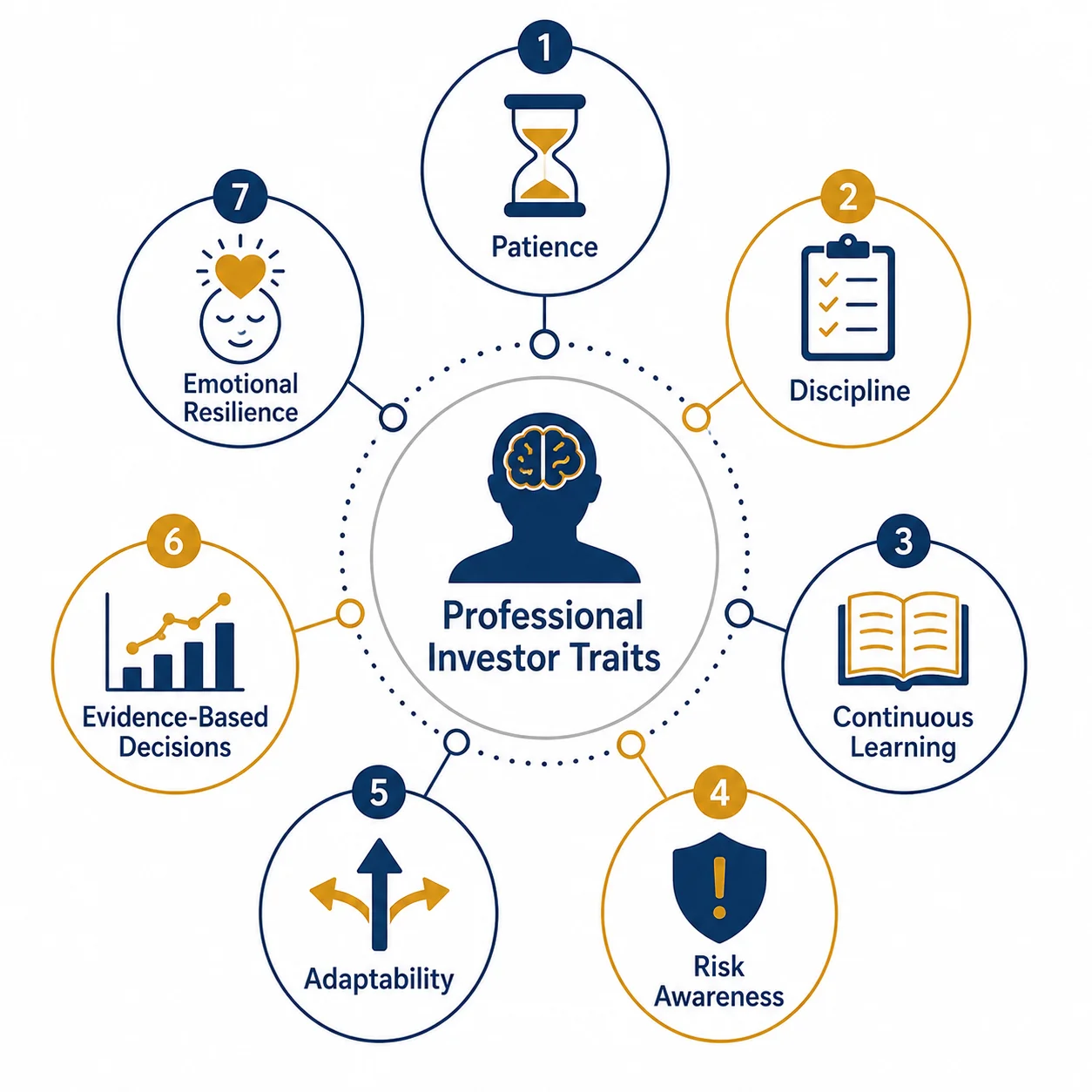
Professional investors typically maintain a disciplined, evidence-based mindset that emphasizes patience, risk awareness, continuous learning, and evaluating overall portfolio performance rather than individual trades.
Why is emotional discipline important in investing?
Emotional discipline is important because unchecked emotions like fear and greed often lead to impulsive decisions that undermine long-term financial strategies.
Can anyone learn to think like an investor?
Yes, anyone can learn to think like an investor by practicing structured decision-making, building financial knowledge, and consistently applying disciplined habits over time.
How long does it take to develop an investor’s mindset?
Developing an investor’s mindset typically takes months to years, since psychological habits form gradually through repeated exposure to real financial decisions and market conditions.
What are the biggest psychological mistakes investors make?
Common psychological mistakes include expecting quick profits, following market hype, ignoring risk, investing without a plan, and letting emotions drive decisions.
How does an investor’s mindset differ from a trader’s mindset?
An investor’s mindset focuses on long-term value and patience, while a trader’s mindset emphasizes short-term price movement and faster decision-making.