

Introduction
Mindset: The New Psychology of Success by Carol S. Dweck is a foundational work on how beliefs about ability shape behavior, learning, and achievement. Searches for mindset the new psychology of success by carol s. dweck quotes usually aim to extract inspiring one-liners, but the real value of the book lies in the framework behind them. This article focuses on the concepts behind the book’s most memorable ideas, using short, properly attributed references rather than reproducing lengthy copyrighted passages. Understanding why beliefs about intelligence, effort, failure, and feedback matter is more useful than memorizing isolated lines pulled out of context.
Quick Summary
- Dweck’s core distinction is between a fixed mindset, which treats abilities as largely static, and a growth mindset, which views abilities as capable of development through effort and strategy.
- The book connects mindset to how people respond to challenges, setbacks, criticism, and success — not just to positive thinking.
- The most useful growth-mindset ideas describe ways of interpreting difficulty and learning from it, rather than functioning as simple motivational slogans.
- Readers who want exact quotations with page numbers should verify wording and pagination against their specific edition, since these can vary between printings.
What Is the Main Idea Behind Mindset: The New Psychology of Success?
A mindset, in Dweck’s research, is the underlying belief a person holds about whether abilities like intelligence, talent, or skill are fixed traits or qualities that can be developed. This single belief shapes how someone interprets almost every situation involving effort, challenge, or evaluation.
People with a fixed mindset tend to see intelligence and talent as relatively unchangeable, which can lead them to avoid challenges that risk exposing perceived limitations. People with a growth mindset tend to see abilities as capable of being cultivated, which can lead them to treat challenges as opportunities to build skill.
A growth mindset does not mean believing anyone can achieve anything regardless of practice, resources, instruction, or realistic constraints. It means believing that ability can improve with the right effort and strategy, not that effort alone erases every limitation. Understanding this distinction matters well beyond the book itself — see why growth mindset is important for how it applies to everyday decision-making.
Fixed Mindset vs. Growth Mindset
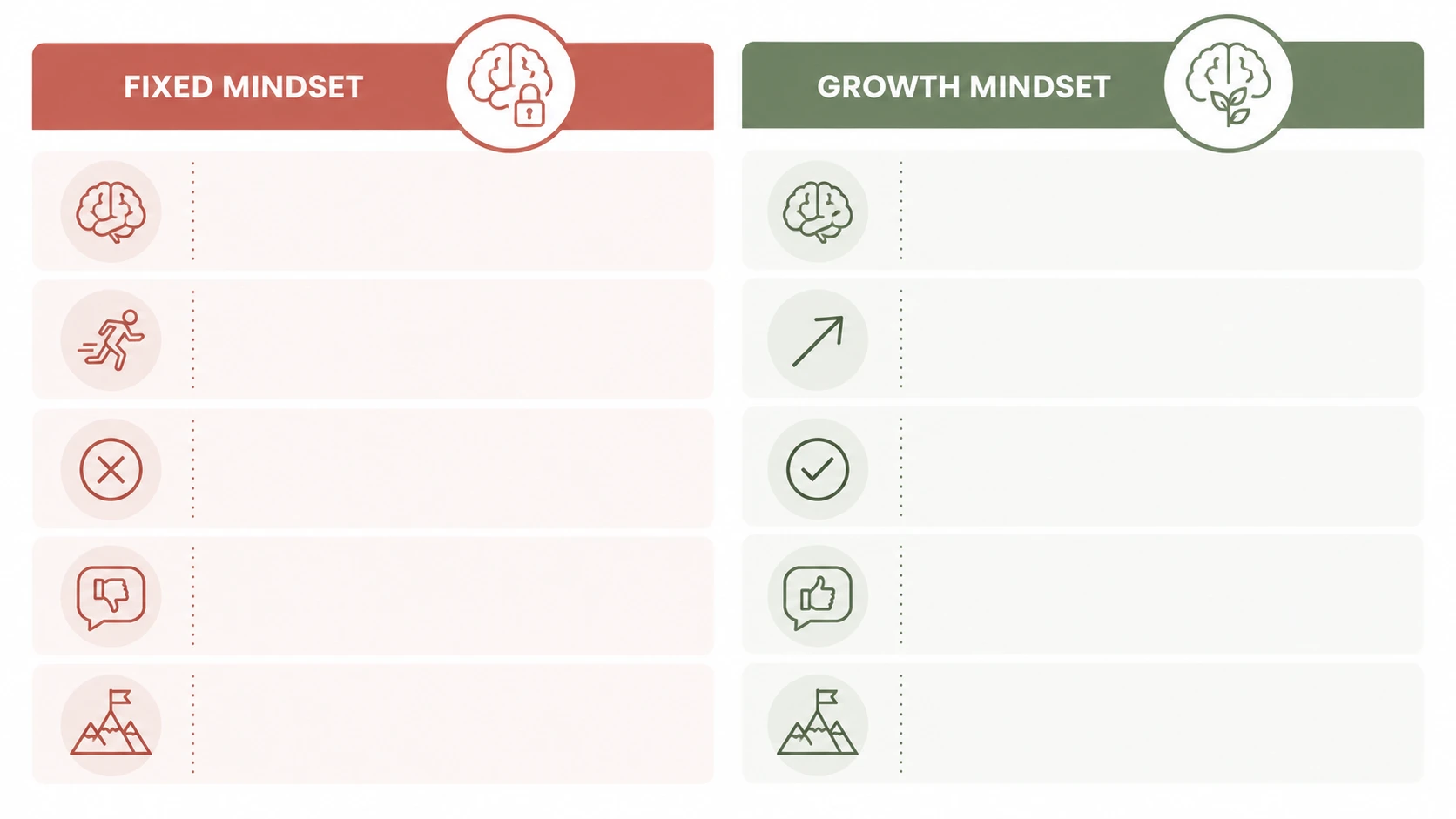
| Dimension | Fixed Mindset | Growth Mindset |
|---|---|---|
| Beliefs about ability | Talent and intelligence are largely stable | Abilities can be developed over time |
| View of effort | Effort is a sign that ability is lacking | Effort is the mechanism for growth |
| Response to mistakes | Mistakes feel threatening or embarrassing | Mistakes are treated as useful information |
| Response to feedback | Criticism can feel like a personal judgment | Feedback is evaluated for what it can improve |
| Response to challenges | Challenges are often avoided to protect self-image | Challenges are approached as learning opportunities |
| View of improvement | Improvement is limited by natural ability | Improvement is possible through strategy and persistence |
The Most Important Ideas Behind the Quotes in Mindset
Rather than listing quotations without context, it helps to organize the book’s key ideas by the psychological principle each one represents.
- Ability and intelligence as developable — the central premise that capability is not fixed at birth.
- The role of effort — effort is reframed as a path to mastery rather than proof of inadequacy.
- Learning from mistakes — errors become data points instead of verdicts on self-worth.
- Responding to criticism and feedback — feedback is treated as actionable information.
- Persistence through difficulty — sustained effort matters more than early natural talent.
- Proving ability vs. developing ability — a growth mindset shifts the goal from demonstrating existing skill to building new skill.
These concepts form the foundation for why certain lines from the book are so often cited as powerful mindset quotes and mindset quotes for success.
Why Effort Matters in a Growth Mindset
Under a fixed mindset, needing to work hard at something can feel like evidence of insufficient talent. Under a growth mindset, effort is understood as the process through which ability is actually built.
It’s worth distinguishing productive effort from simply working harder without changing approach. Productive effort combines:
- Deliberate practice aimed at specific weaknesses
- A strategy that adapts based on results
- Feedback that identifies what to adjust
- Consistent adjustment over time rather than repeating the same method
Effort without strategy or feedback can produce frustration rather than progress, which is why growth mindset thinking pairs effort with reflection and adaptation.
How Failure and Setbacks Are Interpreted
A growth mindset reframes a setback as information about what didn’t work yet, rather than a permanent verdict on capability. This is the practical difference between thinking “I failed this attempt” and concluding “I am incapable of this.”
Interpreting failure as feedback supports resilience: a specific, correctable event is easier to recover from and learn from than a global judgment about identity or worth. Setbacks become part of the learning process instead of a reason to stop trying.
Why Feedback and Criticism Matter
A growth-oriented approach treats feedback as a tool for identifying what can realistically be improved. This does not mean accepting every piece of criticism as accurate or useful.
Evaluating feedback well involves separating the substance of a critique from its delivery, checking whether it comes from someone with relevant expertise, and deciding which specific adjustments are worth making. Feedback is most valuable when it’s specific, actionable, and tied to a clear next step.
Carol Dweck Quotes About Growth Mindset and What They Mean
Because Mindset is a copyrighted work, this section describes the concepts behind well-known lines rather than reproducing extended passages. For each idea below, the underlying concept, attribution, and verification guidance are provided so readers can look up the exact wording in a licensed copy.
- Concept: Ability can be cultivated. Attributed to Carol S. Dweck, Mindset: The New Psychology of Success. This idea illustrates the growth-mindset belief that skill develops through sustained effort rather than being fixed from birth. Readers should verify exact wording in their own copy of the book, since paraphrased summaries online are not a substitute for the original text.
- Concept: Challenges build capability rather than exposing weakness. This idea illustrates why growth-oriented individuals tend to seek out difficulty instead of avoiding it, since difficulty is where skill-building happens.
- Concept: The process matters as much as the outcome. This idea reflects Dweck’s emphasis on effort, strategy, and persistence as the drivers of long-term achievement, rather than treating success or failure as fixed labels.
For the exact original phrasing, consult a printed or licensed digital edition of the book directly.
How to Interpret Dweck’s Growth-Mindset Quotes
Individual lines from the book can lose meaning when separated from the research and examples that originally supported them. A line about embracing challenge, for instance, is grounded in specific studies about how children and adults respond to difficulty — not a universal rule that applies identically to every situation.
Readers get the most value by treating each idea as connected to a specific concept (effort, feedback, failure, persistence) rather than as an isolated, standalone motivational rule.
Growth Mindset Quotes vs. Generic Motivational Quotes

Growth-mindset ideas are grounded in behavioral research about learning, strategy, and adaptation. Generic motivational quotes often rely on general positivity without addressing how change actually happens.
| Aspect | Growth-Mindset Principles | Generic Motivational Quotes |
|---|---|---|
| Basis | Behavioral and psychological research | General inspiration or opinion |
| Focus | Learning, strategy, feedback, adaptation | Feeling motivated or positive |
| Actionability | Tied to specific practices (effort, feedback loops) | Often abstract, with no clear next step |
| Handling failure | Treated as data to learn from | Sometimes glossed over or ignored |
| Risk of misuse | Can be misapplied if taken out of research context | Can promote effort without strategy (“just believe”) |
Mindset Quotes About Success, Achievement, and Personal Growth
The book connects mindset with achievement, but mindset alone does not determine success — it shapes how people respond to the obstacles, choices, and learning opportunities along the way.
What These Quotes Say About Achieving Success
Success in a growth-mindset framework depends on the relationship between goals, effort, learning, and persistence. A useful distinction is pursuing success to prove existing ability versus pursuing success to develop new ability; the second approach tends to sustain motivation through setbacks better than the first.
What These Quotes Say About Personal Growth
Growth mindset ideas connect naturally to broader themes of continuous learning, adaptability, resilience, and self-reflection. Applied outside formal achievement contexts, these ideas support ongoing personal development rather than a fixed endpoint of “arriving” at success.
Mindset Quotes With Page Numbers: How to Verify the Source
Attaching a specific page number to a quotation from Mindset: The New Psychology of Success requires care, because pagination is not consistent across every version of the book.
Why Page Numbers Differ Between Editions
Hardcover, paperback, ebook, international, and revised editions can all use different formatting, margins, and typesetting, which shifts where a given passage falls. A quotation that appears on one page in a hardcover edition may appear on a different page in a paperback or digital version, even though the wording is identical.
How to Cite a Quote From the Book Accurately

- Identify the exact edition (publisher, publication year, format).
- Locate the passage in a physical copy or a licensed digital copy.
- Confirm the exact wording against that copy.
- Record the chapter and, where applicable, the page number.
- Preserve clear attribution to Carol S. Dweck.
Never copy a page number from an unrelated edition or an unverified online list — this is one of the most common sourcing errors in quote collections.
| Excerpt/Concept | Concept Illustrated | Chapter | Edition | Page | Verification Status |
|---|---|---|---|---|---|
| Ability can be developed | Growth mindset foundation | Ch. 1 | Varies by printing | Verify in your copy | Confirm before citing |
| Challenges build skill | Response to difficulty | Ch. 2–3 | Varies by printing | Verify in your copy | Confirm before citing |
| Process over fixed outcome | Effort and persistence | Ch. 4–6 | Varies by printing | Verify in your copy | Confirm before citing |
Powerful Mindset Quotes: What Makes a Quote Actually Useful?
A quote’s usefulness depends on relevance and clarity, not emotional intensity alone. A genuinely useful mindset quotation typically:
- Has a clear connection to a specific learning principle
- Encourages productive reflection rather than vague inspiration
- Directly addresses challenge, effort, or failure
- Supports a concrete, adaptive behavior change
- Can be understood accurately without distorting its original context
How to Apply a Mindset Quote in Real Life
- Identify the difficult situation you’re facing.
- Name the fixed-mindset reaction it triggers (avoidance, defensiveness, giving up).
- Identify what can actually be learned or changed about your approach.
- Choose a more useful, growth-oriented response.
- Review the outcome and adjust your strategy accordingly.
Quotes About Mindset and Attitude: Are They the Same Thing?
Mindset and attitude are related but distinct. Attitude generally refers to a person’s momentary or situational disposition, while mindset refers to a deeper belief about whether ability itself can change. A positive attitude in the moment does not automatically reflect a growth mindset if the underlying belief about ability remains fixed.
Mindset vs. Attitude
| Concept | Definition | Role | Example |
|---|---|---|---|
| Mindset | Core belief about whether ability can develop | Shapes long-term patterns of behavior | Believing skill improves with practice |
| Attitude | Situational disposition or outlook | Can shift day to day or task to task | Feeling upbeat before a specific presentation |
| Belief | A held conviction about how something works | Underlies both mindset and attitude | Believing feedback is generally useful |
| Motivation | The drive to pursue a goal | Can be influenced by mindset | Wanting to improve a specific skill |
| Behavior | Observable action | The outcome mindset and attitude influence | Choosing to practice after a setback |
Common Misunderstandings About Growth Mindset
A growth mindset is frequently oversimplified in generic quote collections. It does not mean:
- Ignoring genuine limitations or constraints
- Assuming every outcome will be positive
- Praising effort regardless of whether it’s effective
- Avoiding constructive criticism
- Believing effort alone guarantees success without strategy, resources, or instruction
Strategy, appropriate resources, quality instruction, deliberate practice, and honest feedback all remain necessary alongside a growth-oriented belief system.
How to Use Growth-Mindset Ideas Without Turning Them Into Empty Motivation
Growth-mindset principles are most useful when translated into concrete behavior rather than left as inspirational language. In our experience helping readers build better habits, the ideas stick best when connected to:
- Goal setting — framing goals around skill development, not just outcomes
- Habit formation — building small, repeatable practices tied to the target skill
- Productivity and time management — allocating focused time to deliberate practice
- Resilience — treating setbacks as expected parts of the learning curve
- Learning and skill development — measuring progress through what’s been learned, not motivation levels
A Simple Reflection Exercise
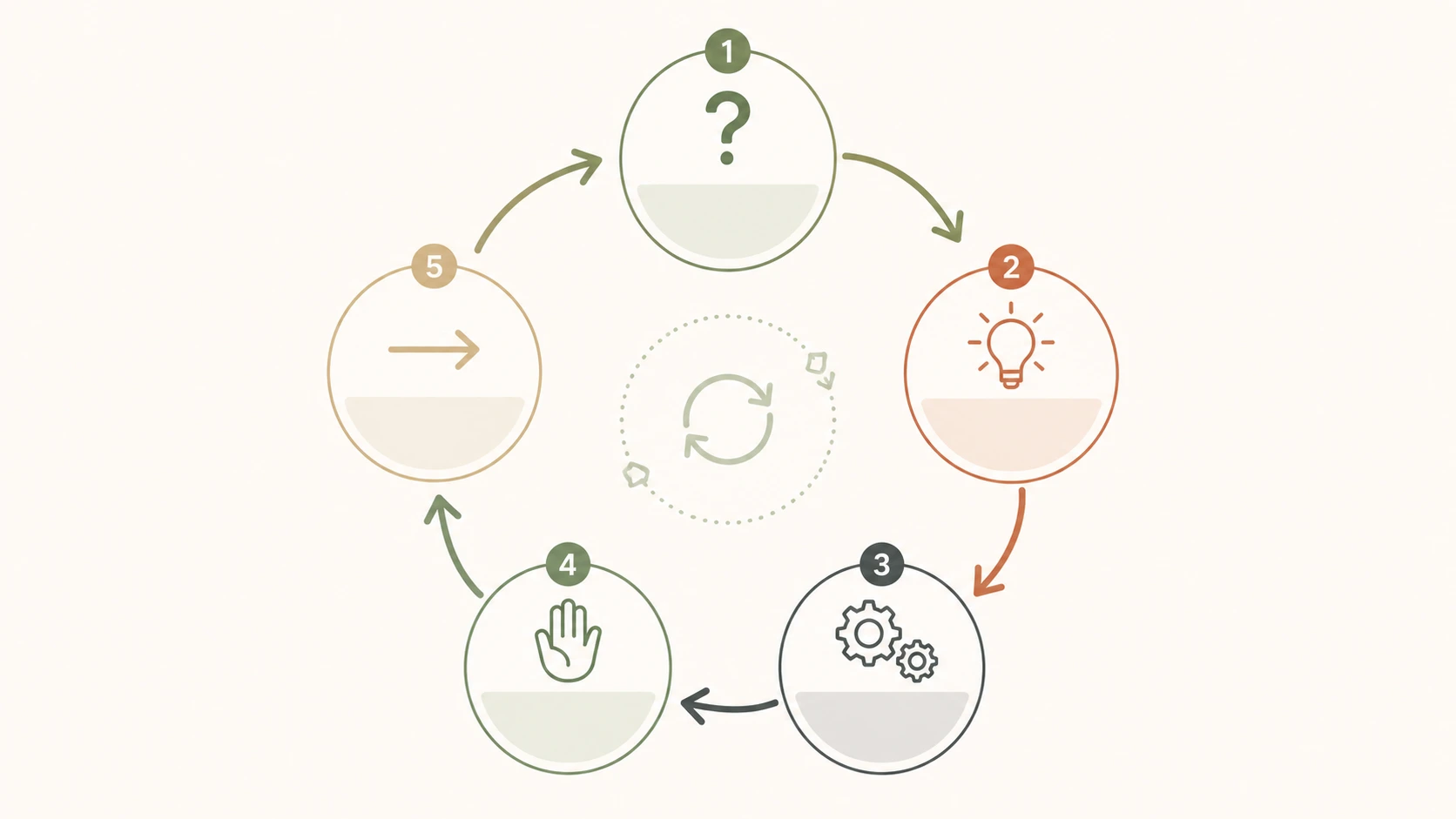
- What happened?
- What assumption am I making about my ability?
- What can I learn from this?
- What strategy could I change?
- What feedback or support would help?
- What is the next small action or experiment?
Beginner Mistakes When Interpreting Mindset Quotes
Your Daily Thrive recommends watching for these common errors when working with growth-mindset ideas:
- Taking quotes out of their original research context
- Confusing growth mindset with simple positive thinking
- Assuming effort automatically produces improvement, regardless of strategy
- Treating every failure as automatically beneficial without reflection
- Substituting motivational quotes for actual behavior change
- Attributing quotes without verifying wording or source
- Citing page numbers without confirming the specific edition
Each of these mistakes can be corrected by returning to the underlying concept, verifying sources carefully, and pairing any quote with a concrete action.
Frequently Asked Questions
What is the main message of Mindset: The New Psychology of Success? The book’s main message is that believing abilities can be developed — a growth mindset — tends to support better responses to challenge, effort, and failure than believing abilities are fixed traits.
What is a famous growth mindset idea from Carol Dweck? One of the most cited ideas is that ability and intelligence can be cultivated through effort and strategy rather than being fixed at birth; for the exact original wording, consult a licensed copy of the book.
What are the best Mindset quotes about success? The strongest selections are those illustrating learning, effort, resilience, and feedback, rather than lines that simply promise success without addressing how it’s achieved.
Where can I find Mindset quotes with page numbers? Readers should consult their own physical or licensed digital edition, since page numbers vary by publisher, format, and printing rather than being consistent across all editions.
Why do Mindset quote page numbers differ? Differences in typesetting, margins, and formatting across hardcover, paperback, ebook, and international editions shift where any given passage falls on the page.
What is the difference between a fixed mindset and a growth mindset? A fixed mindset treats abilities as largely stable, while a growth mindset treats abilities as capable of development through effort, strategy, and feedback.
Are growth mindset quotes the same as motivational quotes? No — growth mindset ideas are grounded in behavioral research about learning and adaptation, while generic motivational quotes often rely on general positivity without a research basis.
Conclusion
Mindset: The New Psychology of Success by Carol S. Dweck offers a research-based framework for understanding how beliefs about ability shape behavior. The most useful mindset quotes are the ones connected to specific concepts — effort, failure, feedback, and persistence — rather than treated as standalone motivational sayings. A growth mindset is best understood as an approach to learning and development, not simply a collection of positive lines. Readers who want to cite the book accurately should always verify quotation wording, attribution, edition, and page number directly against a licensed copy rather than relying on unsourced quote collections online. If this framework resonates, our roundup of the best mindset books covers where to go next after Dweck’s work.