

Introduction
Carol Dweck mindset quotes work best when they’re understood as practical expressions of a research-backed theory, not as isolated motivational sayings. Carol Dweck is a Stanford psychologist whose decades of research on mindset have shaped modern thinking in education, psychology, leadership, and personal development. Her core distinction between a fixed mindset and a growth mindset explains why some people give up after setbacks while others treat difficulty as part of the learning process. This article breaks down what her quotes actually mean, the psychology behind them, and how to turn them into daily habits rather than passive inspiration.
Quick Summary
- Carol Dweck’s mindset quotes emphasize that abilities can improve through effort, learning, and persistence, not just innate talent.
- Growth mindset quotes are most useful when understood alongside the research that produced them, rather than as generic motivation.
- Applying mindset principles consistently — through reflection, feedback, and practice — shapes learning, resilience, and long-term achievement.
- Misreading the context behind a quote is the most common reason growth mindset efforts stall or backfire.
What Is a Growth Mindset According to Carol Dweck?
Carol Dweck’s Definition of Mindset
Mindset, according to Carol Dweck, is the underlying belief a person holds about whether abilities are fixed traits or qualities that can be developed. In her framework, a growth mindset is the belief that intelligence, talent, and skill grow through dedication, effective strategies, and input from others. This is different from a fixed mindset, which treats ability as a static trait you either have or don’t. Dweck’s research, built on studies of students, athletes, and professionals, found that this single belief shapes how people respond to challenge, criticism, and failure.
Fixed Mindset vs. Growth Mindset
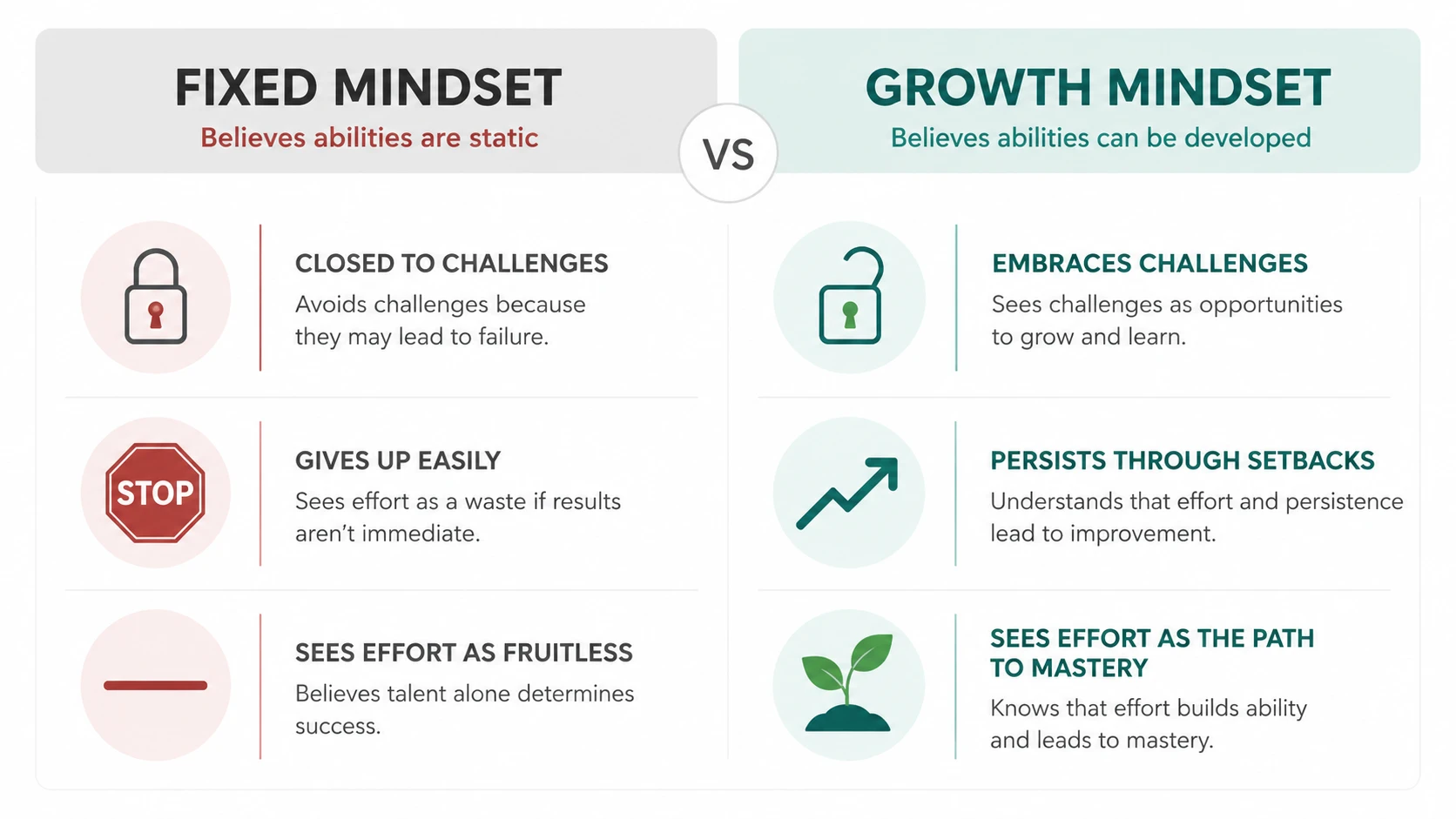
The two mindsets differ across several dimensions: core beliefs, how people respond to learning opportunities, reactions to failure, sources of motivation, and long-term trajectory of development.
| Dimension | Fixed Mindset | Growth Mindset |
|---|---|---|
| Beliefs | Abilities are innate and unchangeable | Abilities can be developed through effort |
| Challenges | Avoided to protect self-image | Seen as opportunities to grow |
| Response to Failure | Failure feels like a verdict on self-worth | Failure is treated as feedback and data |
| Motivation | Driven by proving competence | Driven by learning and mastery |
| Long-Term Development | Growth often plateaus | Growth tends to compound over time |
Why Are Carol Dweck Mindset Quotes So Popular?
Carol Dweck’s mindset quotes resonate widely because they translate a complex psychological framework into language that applies immediately across contexts. In education, they reframe how teachers give feedback. In personal development, they offer a lens for interpreting setbacks. In business and leadership, they support cultures that value learning over blame, and in sports, they explain why some athletes improve faster under pressure than others. Short quotes work because they compress an entire research finding into a memorable phrase, which is also why terms like mindset inspirational quotes and mindset motivational quotes are searched so often — people want the psychological insight without reading the full study. Understanding why growth mindset is important helps explain why these short quotes have stayed relevant across so many fields for over a decade.
The Most Meaningful Carol Dweck Mindset Quotes
Carol Dweck mindset quotes carry more weight when paired with the idea they illustrate, rather than presented as a disconnected list. The sections below group her most cited ideas — often referred to as Carol Dweck growth mindset quotes or quotes from Carol S. Dweck — by theme, along with an explanation of what each concept means in practice.
Quotes About Effort and Learning
Dweck’s research consistently found that praising effort and strategy, rather than innate talent, produces more resilient learners. Her central idea is that sustained effort, not raw ability, is usually the deciding factor in long-term skill development. Readers can apply this by shifting self-talk from “I’m not good at this” to “I haven’t mastered this yet” — a distinction Dweck herself popularized as the power of “yet.”
Quotes About Mistakes and Failure
In Dweck’s framework, mistakes are treated as informative rather than shameful. Her work shows that people with a growth mindset interpret failure as a signal about what to adjust next, not as proof of a fixed limitation. This reframing reduces the fear of trying that often stops people from taking on challenging tasks.
Quotes About Persistence
Persistence, in Dweck’s model, is less about willpower and more about believing that continued effort will eventually pay off. Her studies found that students who believed ability could grow were more likely to keep working through difficult material than students who believed ability was fixed.
Quotes About Intelligence and Improvement
Dweck’s research directly challenged the idea that intelligence is a fixed quantity. Her findings suggest that intelligence functions more like a skill that responds to targeted practice, quality feedback, and exposure to increasingly difficult problems, rather than a ceiling set at birth.
Quotes About Lifelong Learning
Dweck extends the growth mindset beyond school and early career, framing learning as a continuous process that applies at any age or career stage. This idea supports the growing interest in lifelong learning as both a mindset and a practical habit.
What Does Carol Dweck Say About Growth Mindset?
Carol Dweck says growth mindset means believing intelligence and ability can develop through effort, strategy, and feedback rather than being fixed at birth. Her research outlines several mechanisms behind this development:
- Intelligence can develop — cognitive ability responds to practice and learning, similar to a trainable skill.
- Mistakes accelerate learning — errors provide specific information that sharpens future performance.
- Feedback supports improvement — constructive, specific feedback (not just praise) drives measurable progress.
- Practice strengthens ability — deliberate, repeated practice changes performance over time.
Dweck has also worked to correct a common misreading of her research: a growth mindset is not the belief that everyone can achieve anything with enough effort. It’s the belief that most abilities can improve with the right approach, which is a more precise and evidence-based claim.
Powerful Mindset Quotes and What They Mean
Beyond Dweck’s own research, a broader category of powerful mindset quotes has grown around similar psychological themes. These quotes on mindset, whether framed as a mindset quote, quotes about mindset, or quote for mindset, tend to fall into a few recurring categories.
Quotes About Resilience
Resilience-focused quotes highlight the ability to recover from setbacks without losing motivation. Psychologically, resilience is linked to how a person interprets adversity — as temporary and specific, rather than permanent and all-encompassing.
Quotes About Confidence
Confidence-related mindset quotes usually distinguish between confidence built on unearned self-esteem and confidence built through demonstrated competence. Growth mindset research favors the latter, since it holds up under real challenge.
Quotes About Perseverance
Perseverance quotes emphasize continued effort despite obstacles. This connects closely to the concept of “grit,” a related but distinct construct studied by psychologist Angela Duckworth, which combines passion and sustained effort toward long-term goals.
Quotes About Positive Thinking
Positive-thinking quotes are often mistaken for growth mindset quotes, but they aren’t identical. Positive thinking focuses on optimistic outlook, while growth mindset focuses specifically on beliefs about the malleability of ability — a distinction covered further in the misconceptions section below.
Growth Mindset Quotes for Students
Growth mindset quotes matter in education because they shape how students interpret grades, feedback, and academic struggle. Students who adopt a growth mindset are more likely to view a low grade as a starting point rather than a fixed judgment of ability. This applies across age groups — school students building early learning habits, college students managing more independent workloads, and lifelong learners returning to study later in life.
Classroom Applications
Teachers can use growth-mindset-aligned quotes and language to shift feedback from general praise (“You’re so smart”) to process-based feedback (“Your strategy on this problem worked well”), which research links to stronger long-term motivation.
Exam Preparation
During exam preparation, growth mindset framing helps students treat practice tests and mistakes as diagnostic tools rather than sources of anxiety, which can reduce test-related stress and improve retention.
Building Confidence After Setbacks
After a poor grade or failed attempt, growth mindset quotes can help students separate their identity from a single outcome, supporting a quicker return to focused effort instead of avoidance.
Quotes About Mindset and Attitude: What’s the Difference?
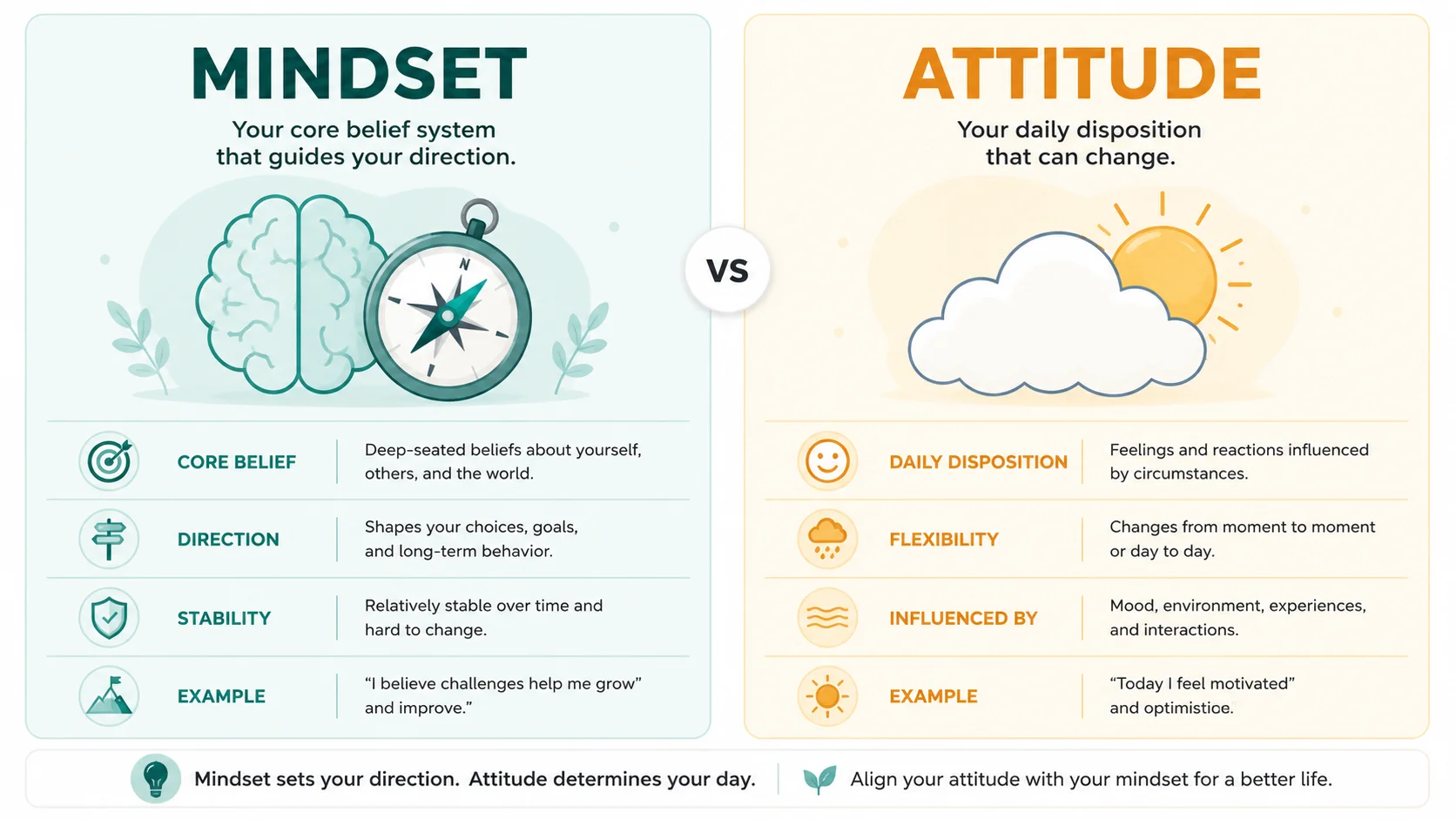
Mindset and attitude are related but distinct concepts. Mindset refers to a person’s underlying beliefs about whether ability is fixed or changeable, while attitude refers to a more general, situational disposition toward a task, person, or circumstance.
| Aspect | Mindset | Attitude |
|---|---|---|
| Definition | Core belief about the nature of ability | General outlook or disposition |
| Purpose | Shapes how challenges and failure are interpreted | Shapes day-to-day mood and reactions |
| Stability | Relatively stable, but can be developed | Can shift quickly with context |
| Scope | Deep, belief-level | Surface-level, situational |
The overlap between the two is that a growth mindset often produces a more constructive attitude toward challenges, but a positive attitude alone doesn’t guarantee a growth mindset — someone can feel upbeat while still believing their abilities are fixed.
Strong and Short Mindset Quotes for Daily Motivation
Short mindset quotes are effective precisely because they are easy to recall under pressure — during a stressful exam, a difficult meeting, or a demotivating setback. Strong, short mindset quotes work well in specific formats:
- Journals — as a daily prompt for reflection.
- Affirmations — repeated to reinforce a specific belief shift.
- Classrooms — displayed as visual reminders during lessons.
- Presentations — used to open a talk on learning or resilience.
- Social media — shared as concise, shareable insight.
The value of a short positive mindset quote comes from consistent use, not a single exposure — repetition is what embeds the underlying belief.
Understanding Mindset: The New Psychology of Success
Key Ideas From the Book
Carol Dweck’s book, often referenced as mindset by Dr. Carol Dweck, introduces the fixed-versus-growth framework through case studies spanning sports, business, relationships, and education. The book argues that the mindset someone holds — more than raw talent — often determines how far they go in a given field, because it shapes their willingness to face difficulty and learn from it. Carol Dweck’s book, often referenced as mindset by Dr. Carol Dweck, remains one of the most cited growth mindset books for anyone starting to explore this framework.
Best Quotes From Mindset
Rather than reproducing lengthy passages, it’s worth noting the book’s throughline Dweck describes a growth mindset as one in which, in her words, “challenges are exciting rather than threatening.” This single idea — that difficulty can be reframed as opportunity rather than danger — is why the book remains widely cited in discussions of Carol S. Dweck quotes and growth mindset Carol Dweck research more than a decade after publication.
Is There a Carol Dweck Growth Mindset PDF?
People searching for a Carol Dweck growth mindset PDF are usually looking for one of a few different resources, and it’s worth distinguishing between them:
- Official educational resources — summaries, worksheets, or guides published by Dweck’s research initiatives or affiliated organizations for classroom use.
- Book previews — publisher-provided excerpts of Mindset: The New Psychology of Success, often available through the publisher’s website or major retailers.
- Research papers — peer-reviewed studies by Dweck and colleagues, typically accessible through academic databases or university library systems.
- Licensed publications — the full book itself, which is copyrighted and should be purchased or borrowed through legitimate channels such as a bookstore, library, or licensed e-book platform.
Unauthorized full-text PDFs of the book raise copyright concerns, since reproducing or distributing the complete work without permission infringes the author’s and publisher’s rights. Readers looking for the full text should use a library, retailer, or official digital edition instead.
How to Apply Growth Mindset Quotes in Everyday Life
Turning growth mindset quotes into real change requires converting inspiration into repeatable action across different areas of life.
At School
Students can apply growth mindset principles by reviewing mistakes on assignments as specific learning targets, rather than moving on without analysis.
At Work
In professional settings, growth mindset shows up as actively seeking feedback before problems escalate, and treating a difficult project as a skill-building opportunity rather than a threat to reputation.
During Challenges
During personal or professional setbacks, growth mindset application means separating the outcome (“this attempt didn’t work”) from identity (“I am incapable”), which keeps motivation intact.
Building Long-Term Habits
Sustainable application depends on a few consistent practices:
- Daily reflection on what was learned, not just what was accomplished.
- Goal setting focused on skill development, not only outcomes.
- Learning from mistakes through specific, written analysis rather than general self-criticism.
- Seeking constructive feedback proactively, rather than waiting for it.
- Developing resilience by tracking recovery from setbacks over time, not just the setbacks themselves.
Common Misunderstandings About Growth Mindset
Several misconceptions have spread as growth mindset language has become mainstream, and addressing them directly improves how the concept is applied.
- Growth mindset is not blind optimism. It’s a belief about the changeability of ability, not a general assumption that things will work out.
- Effort alone is not enough. Dweck’s later research clarified that effort without effective strategy or feedback often fails to produce improvement.
- Strategy and feedback matter as much as effort. Growth requires adjusting approach based on results, not simply trying harder in the same way.
- Progress is gradual. Meaningful mindset shifts typically develop over weeks and months, not after a single quote or pep talk.
Beginner Mistakes When Using Mindset Quotes
People new to growth mindset concepts often make a few predictable errors:
- Reading without applying — treating quotes as passive inspiration instead of prompts for action.
- Misinterpreting motivational quotes — assuming a quote means unlimited potential rather than developable ability.
- Ignoring context — using a quote without understanding the research or nuance behind it.
- Expecting instant results — assuming a mindset shift happens immediately rather than through repeated practice.
- Using quotes instead of developing habits — relying on inspiration in place of concrete routines like reflection or feedback-seeking.
Difficulty & Time Investment
Adopting a growth mindset is an ongoing process rather than a one-time decision, and the effort required varies by individual.
- Beginner stage — requires conscious effort to notice fixed-mindset thoughts and reframe them; this stage is often the most effortful because it involves unlearning automatic reactions.
- Advanced stage — reframing becomes more automatic, though it still requires occasional reinforcement, especially under high stress.
- Personal factors — prior experiences with failure, workplace or classroom culture, and available support systems all influence how quickly the shift takes hold.
Results Timeline
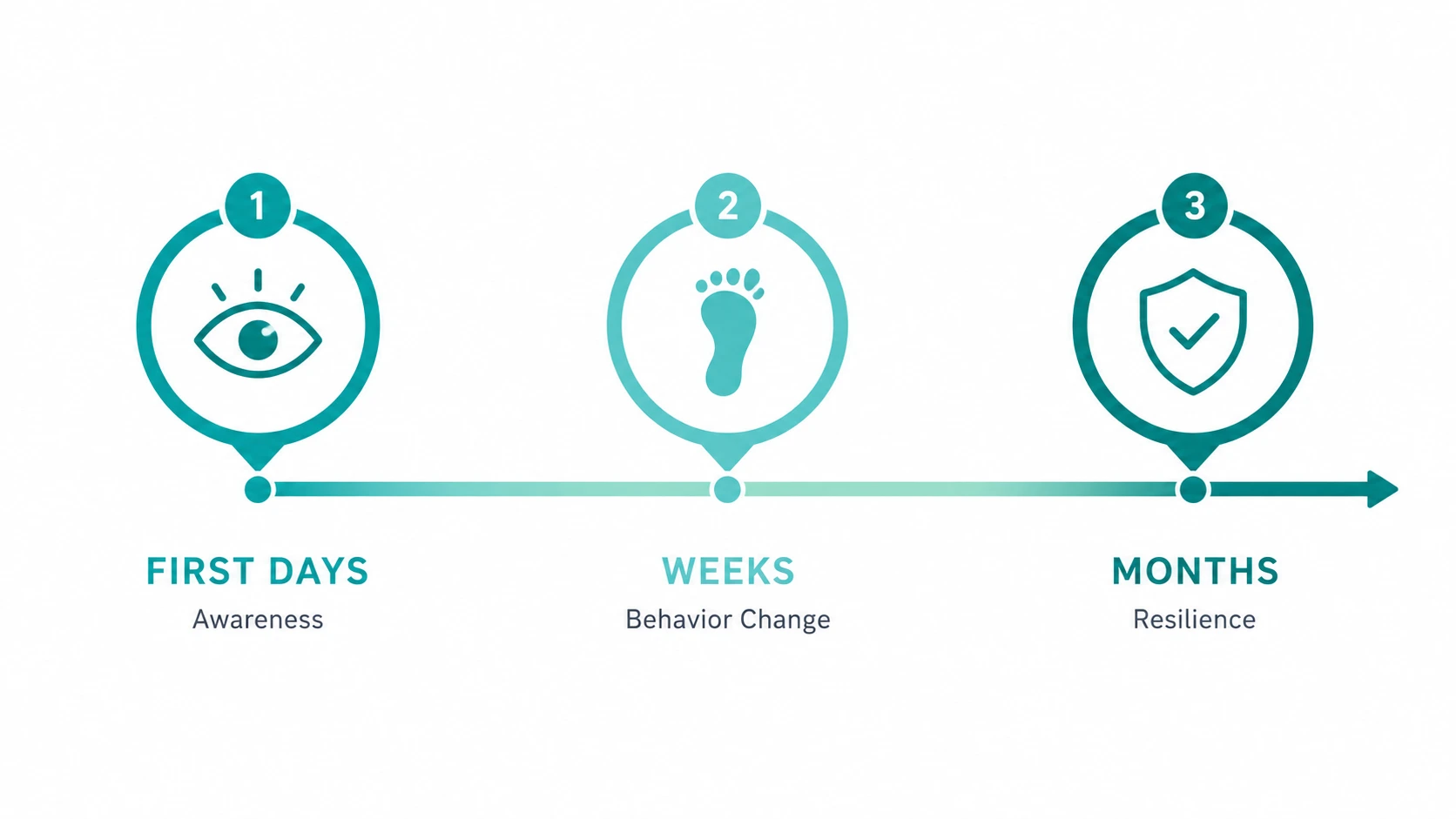
Growth mindset development tends to follow a general pattern, though the exact pace differs by individual and context.
- First days — increased awareness of fixed-mindset thoughts as they occur, without necessarily changing behavior yet.
- Weeks — gradual behavior changes, such as asking for feedback more readily or persisting slightly longer through difficulty.
- Months — stronger resilience and more established learning habits, with setbacks recovered from more quickly.
Progress varies based on how consistently growth mindset practices are applied, the difficulty of the challenges being faced, and the level of support available from teachers, managers, or peers.
Practice Guide
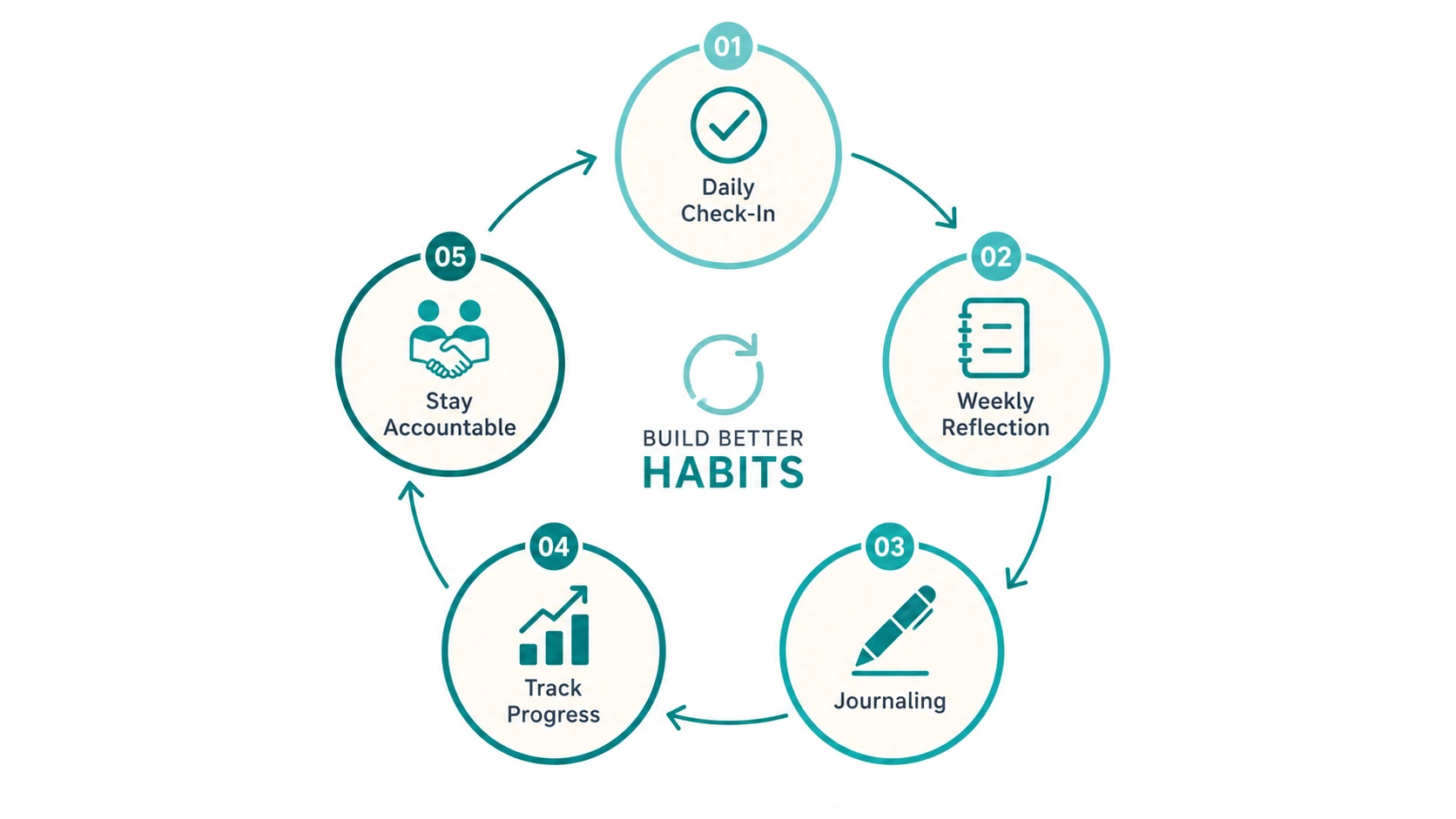
Daily Habits
Short daily check-ins — noting one moment of effort or one mistake and what it taught — build the habit of process-focused thinking.
Weekly Reflection
A weekly review of challenges faced, strategies used, and adjustments made helps translate individual moments into longer-term patterns.
Journaling With Mindset Quotes
Using a quote as a weekly journal prompt (for example, reflecting on a specific quote about effort or failure) can deepen understanding beyond passive reading. If you’re not sure where to start, a set of structured journal prompts for growth mindset can make this weekly reflection habit easier to sustain.
Tracking Personal Growth
Simple tracking — a habit log, skill checklist, or progress notes — provides concrete evidence of development, which reinforces the belief that ability is changeable.
Maintaining Motivation Over Time
Long-term consistency benefits from accountability (a mentor, peer group, or coach), periodic reassessment of goals, and adapting practices to fit changing circumstances such as a new job, school term, or life stage.
Conclusion
Carol Dweck mindset quotes reflect a substantial body of evidence-based research on how beliefs about ability shape learning, resilience, and achievement. The distinction between a fixed mindset and a growth mindset explains why some people avoid challenges while others treat them as opportunities to develop. The real value of these quotes comes not from reading them, but from applying their underlying principles: seeking feedback, learning from mistakes, and viewing effort as a path to improvement rather than a means to prove fixed ability. Used this way, growth mindset quotes become reminders to embrace challenges and keep developing, rather than one-off motivational moments.
Frequently Asked Questions
What is Carol Dweck’s definition of mindset?
Carol Dweck defines mindset as the underlying belief a person holds about whether abilities, like intelligence and talent, are fixed traits or qualities that can be developed through effort and learning.
What is the difference between a growth mindset and a fixed mindset?
A growth mindset is the belief that ability can improve through effort and strategy, while a fixed mindset treats ability as an unchangeable, innate trait.
What are Carol Dweck’s most well-known mindset quotes?
Her most cited ideas center on treating challenges as opportunities, viewing effort as the path to mastery, and using the word “yet” to reframe current limitations as temporary rather than permanent.
Why are growth mindset quotes popular in education?
They give teachers and students a concise way to reframe feedback, grades, and failure as part of an ongoing learning process rather than fixed judgments of ability.
How can students use growth mindset quotes effectively?
Students get the most benefit by pairing quotes with concrete actions, such as reviewing mistakes in detail, seeking specific feedback, and setting skill-based goals rather than only outcome-based ones.
What does Carol Dweck say about intelligence and learning?
Dweck’s research indicates that intelligence functions more like a trainable skill that responds to practice, effective strategies, and quality feedback, rather than a fixed quantity set at birth.
Are mindset quotes scientifically supported?
The underlying growth mindset research is grounded in psychological studies on motivation, learning, and resilience, though individual quotes should be understood within that research context rather than treated as standalone scientific claims.
Where can I find official Carol Dweck resources and books?
Official resources include Dweck’s published book, peer-reviewed research papers available through academic databases, and educational materials from research initiatives affiliated with her work; these are best accessed through libraries, retailers, or licensed academic sources rather than unofficial PDFs.