
Introduction
Many people ask themselves, “why am I only motivated at night?” or “why do I get motivated at night but struggle all day?” The pattern is surprisingly common. Some people feel mentally clear, emotionally energized, and highly productive after dark, yet feel distracted, overwhelmed, or resistant during the morning.
Late-night motivation is often connected to reduced distractions, emotional decompression, mental fatigue patterns, circadian rhythm differences, and psychological resistance built up during the day. In many cases, nighttime feels calmer because external pressure temporarily disappears.
This topic sits at the intersection of productivity psychology, behavioral patterns, habit formation, mental energy management, and environment design.
Quick Summary
- Many people feel motivated at night because distractions, pressure, and decision fatigue are lower.
- Nighttime can create a false sense of unlimited future time, making goals feel emotionally easier to start.
- Some individuals naturally function better at night due to chronotype and brain energy patterns.
- Late-night motivation becomes useful only when paired with sustainable routines and action systems.
- Emotional relief and reduced performance pressure often increase nighttime focus and creativity.
Why Do People Feel More Motivated at Night?
People often feel more motivated at night because the brain experiences less external pressure, fewer distractions, and greater emotional freedom.
Reduced Mental Noise and Fewer Distractions
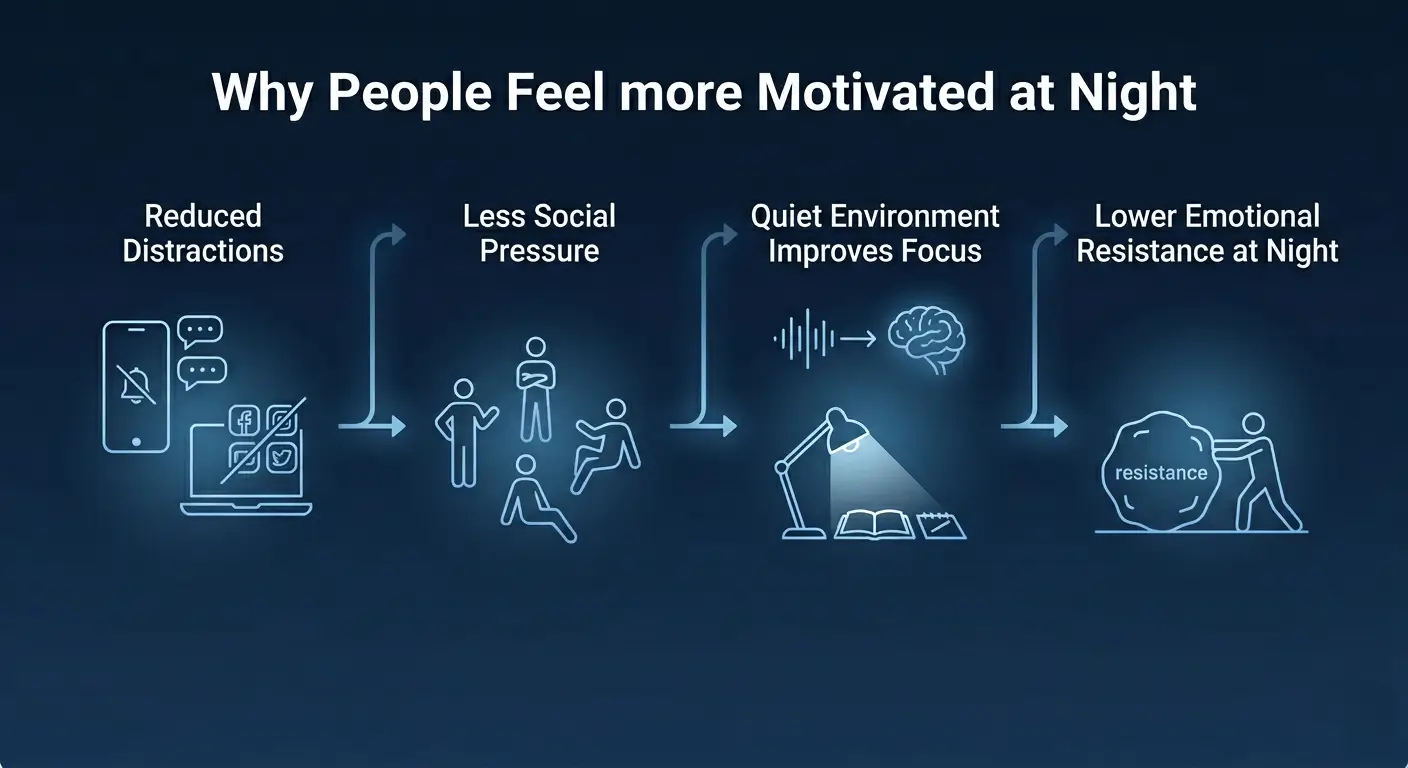
During the day, attention is constantly divided. Notifications, conversations, responsibilities, and decision-making create cognitive overload.
At night:
- Social expectations decrease
- Notifications slow down
- Quiet environments improve concentration
- Fewer interruptions allow deeper focus
This explains why many people wonder, “why do I randomly get motivated at night?” The brain finally experiences enough silence to think clearly.
The Brain Feels “Free” at Night
Nighttime often creates psychological relief.
Responsibilities feel temporarily paused, which lowers stress and resistance. Many people experience less performance anxiety because nobody expects immediate results late at night.
This reduced urgency creates a feeling of emotional freedom. The brain stops defending itself against pressure and becomes more open to action, creativity, and planning.
Night Creates an Illusion of a Fresh Start
Many people who ask “why do I get motivated at 3 am?” experience an emotional reset effect.
At night:
- Tomorrow feels full of possibility
- Goals feel easier emotionally
- There is no immediate execution pressure
- The future feels more controllable
This creates “fantasy productivity,” where motivation feels strong because action can still be delayed until tomorrow.
Why Am I Motivated at Night but Not in the Morning?
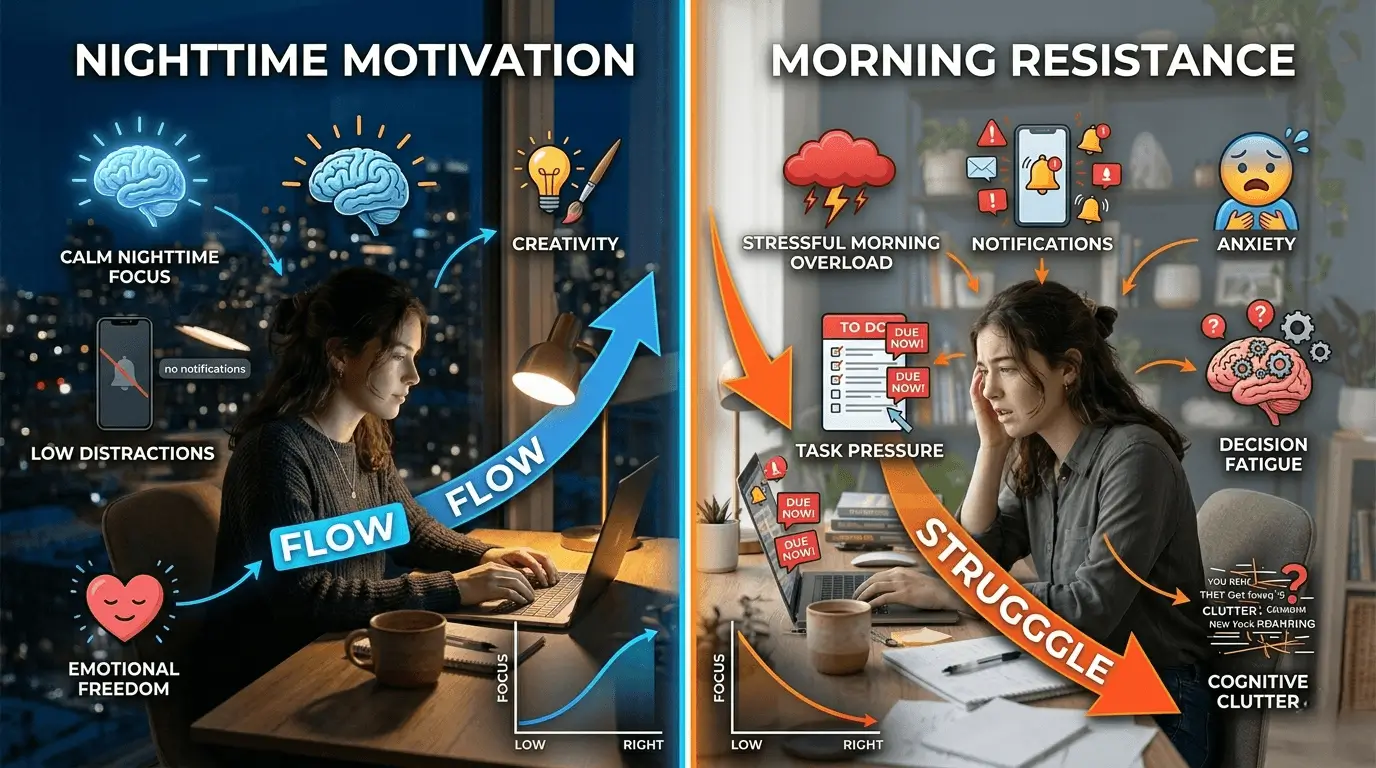
The difference between nighttime motivation and morning resistance is often caused by stress, sleep patterns, and cognitive overload.
Morning Decision Fatigue and Stress
Many people wake up mentally overloaded.
Morning anxiety often includes:
- Unfinished responsibilities
- Fear of failure
- Overwhelming task lists
- Social pressure
- Work or academic stress
Mental clutter reduces action-taking ability. Even simple tasks can feel emotionally heavy early in the day.
Nighttime Removes External Expectations
At night, deadlines and expectations temporarily disappear.
This creates:
- Less fear of judgment
- More internal thinking space
- Lower emotional resistance
- Increased self-reflection
That is why many people search for “why do I feel motivated at night but not in the morning” or discuss being “motivated at night but not in the morning” on forums and Reddit discussions.
Poor Sleep and Energy Cycles
Sleep quality strongly affects daytime cognition.
Inconsistent schedules can cause:
- Brain fog in the morning
- Low emotional regulation
- Reduced concentration
- Delayed alertness
Some people naturally become mentally active later in the day, especially if they have a delayed chronotype.
Signs This Pattern Is Affecting Productivity
- Constant procrastination until evening
- Burst productivity at midnight
- Difficulty starting tasks early
- Feeling mentally awake only after dark
- Irregular sleep patterns
Why Can Some People Only Focus or Work at Night?
Some individuals genuinely perform better at night, while others develop nighttime productivity as a coping mechanism.
Night Owls and Chronotypes
Chronotypes are biological patterns that affect alertness and energy timing.
People who function better at night may naturally experience:
- Higher evening alertness
- Stronger creative thinking
- Improved concentration later in the day
- Delayed mental energy peaks
This explains why some people say, “I can only focus at night.”
The Psychological Safety of Working at Night
Nighttime often feels emotionally safer.
Benefits include:
- Less interruption anxiety
- Fewer obligations
- Reduced social demands
- Greater immersion in deep work
For some individuals, nighttime becomes the only period where they feel psychologically uninterrupted.
Hyperfocus and Emotional Avoidance
Not all nighttime productivity is healthy.
Some people delay tasks because of:
- Fear of failure
- Perfectionism
- Stress avoidance
- Emotional resistance
Then panic-driven productivity appears late at night when urgency becomes unavoidable.
Productive Night Owl vs Procrastination Cycle
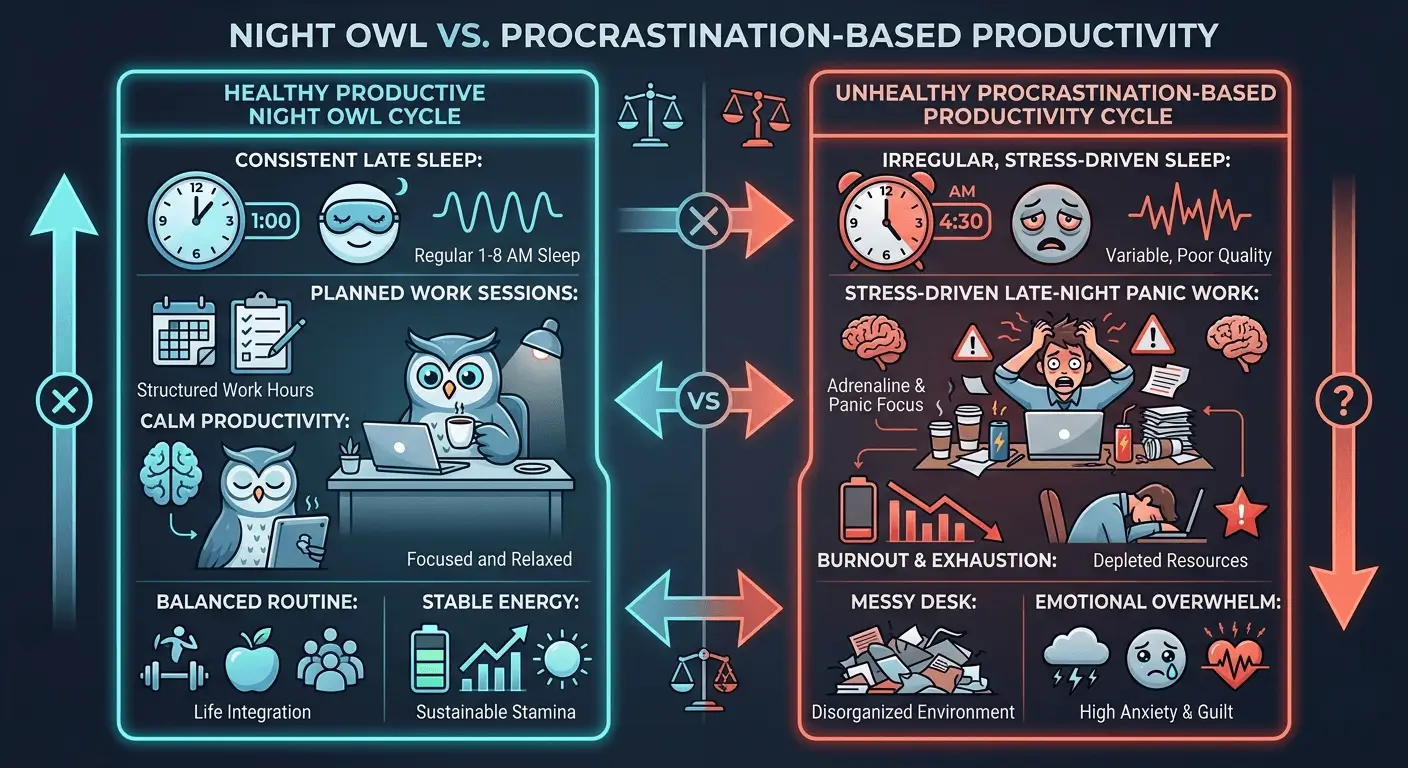
| Productive Night Owl | Avoidance-Based Night Productivity |
|---|---|
| Consistent sleep rhythm | Irregular sleep patterns |
| Planned work sessions | Last-minute panic work |
| Stable energy levels | Emotional stress-driven energy |
| Sustainable habits | Burnout and exhaustion |
The Psychology Behind Late-Night Motivation
Late-night motivation is strongly connected to emotional regulation and behavioral psychology.
Procrastination and Emotional Resistance
Procrastination is often emotional, not laziness.
This pattern is closely connected to broader self-awareness practices often discussed in how to become best version of yourself and how can you grow as a person, where emotional resistance and discipline play a major role in long-term behavior change.
Common causes include:
- Fear of failure
- Perfectionism
- Overthinking
- Avoidance behavior
At night, emotional pressure decreases, making tasks feel psychologically safer.
Why Motivation Feels Stronger When Action Is Delayed
Motivation feels easier when there is no immediate requirement to perform.
This creates:
- Future-self optimism
- Goal idealization
- Fantasy productivity
- Reduced emotional pressure
The brain enjoys imagining success more than confronting difficult action.
Dopamine and Novelty Thinking at Night
Nighttime can increase emotional stimulation and imagination.
The brain often becomes more reflective after dark, leading to:
- Big-picture thinking
- Creative goal planning
- Emotional introspection
- Increased novelty seeking
Common Mental Triggers Behind Night Motivation
- Feeling guilty about wasted time
- Wanting a fresh start
- Fear of falling behind
- Emotional loneliness at night
- Increased self-reflection
This also explains why nighttime motivation often disappears by morning. Reality, deadlines, and stress return.
Why People Struggle to Stay Consistent During the Day
Consistency problems are usually linked to mental overload and unrealistic expectations.
Overloaded Schedules and Cognitive Fatigue
When people lose structure in daily life, they often look for guidance on how do i get my life in order and building systems like a daily routine for self improvement student, which directly improves consistency and reduces decision fatigue.
Modern routines create constant context switching.
People move between:
- Work
- Messages
- Social obligations
- Notifications
- Multitasking
This mental exhaustion reduces motivation and focus.
Unrealistic Productivity Expectations
Many people try to completely change their lives overnight.
This creates:
- All-or-nothing thinking
- Unsustainable routines
- Perfectionism loops
- Motivation crashes
Small consistent actions are psychologically easier to maintain than extreme productivity bursts.
Burnout and Motivation Crashes
Burnout reduces emotional energy and cognitive flexibility.
Common symptoms include:
- Emotional exhaustion
- Chronic stress
- Reduced concentration
- Mental numbness
- Avoidance behavior
Problem–Solution Block
| Problem | Why It Happens | How to Fix It | Prevention Strategy |
| Procrastination | Fear and overwhelm | Start with tiny actions | Reduce task friction |
| Inconsistency | No routine system | Habit stacking | Daily structure |
| Burnout | Unsustainable intensity | Recovery periods | Balanced workload |
| Overthinking | Perfectionism | Action-first mindset | Time-limited decisions |
Is Nighttime Motivation Actually Useful?
Nighttime motivation can be useful, but only if it supports long-term consistency.
Benefits of Working at Night
Night work can improve:
- Quiet concentration
- Creative thinking
- Deep focus sessions
- Reflective planning
For some people, nighttime genuinely matches their biological energy rhythm.
Downsides of Depending on Night Motivation
Relying only on nighttime productivity can create:
- Sleep disruption
- Irregular routines
- Burnout cycles
- Daytime exhaustion
- Inconsistent habits
Short bursts of emotional motivation rarely create sustainable growth alone.
What Actually Works Long-Term
Long-term productivity depends more on systems than emotions.
Motivation vs Discipline
| Motivation | Discipline |
| Emotion-based | System-based |
| Temporary | Sustainable |
| High intensity | Consistent repetition |
| Depends on mood | Depends on routine |
Consistent habits outperform emotional bursts over time.
How to Use Late-Night Motivation Without Destroying Your Routine
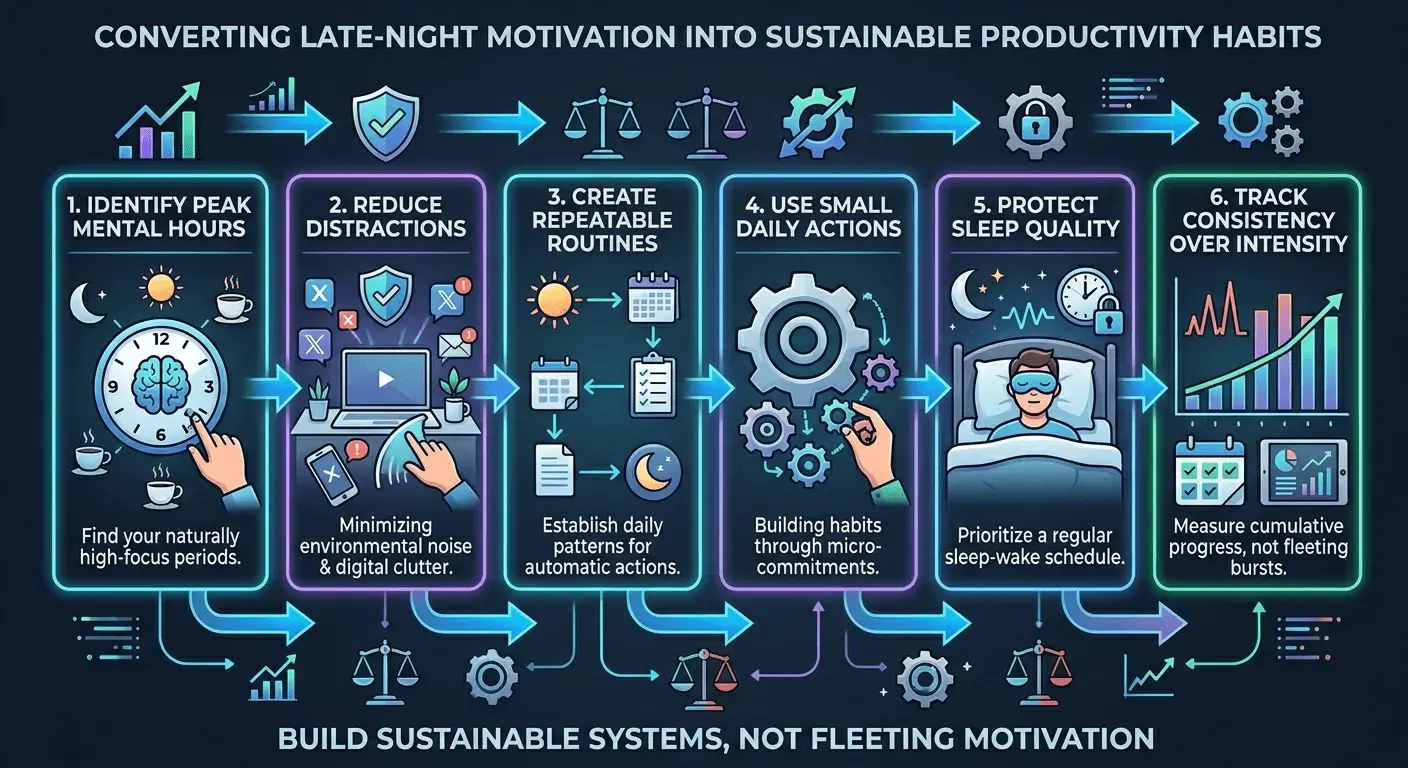
The goal is not to eliminate nighttime motivation. The goal is to use it strategically.
Capture Ideas at Night Instead of Acting on Everything
Instead of starting huge projects at midnight:
- Journal ideas
- Create task lists
- Use brain dump methods
- Plan tomorrow’s priorities
This preserves mental clarity without sacrificing sleep.
Transfer Night Motivation Into Morning Systems
Motivation becomes useful when converted into repeatable systems.
Helpful strategies include:
- Pre-planned routines
- Reduced morning friction
- Habit automation
- Environment design
Prepare tasks in advance so morning action requires less emotional effort.
Build a Sustainable Productivity Schedule
Many of these strategies overlap with structured self-growth systems like how to build discipline without motivation and best ways to achieve personal growth, where systems replace emotional motivation as the primary driver of action.
Productivity should match energy patterns realistically.
Focus on:
- Flexible work blocks
- Energy-based planning
- Realistic consistency goals
- Sleep protection
Step-by-Step Habit Integration Framework
- Identify your peak mental hours
- Reduce distractions during productive periods
- Create repeatable routines
- Use small daily actions
- Protect sleep quality
- Track consistency instead of intensity
This is especially useful for people asking, “why am I only motivated to study at night” or “why am I only motivated to do work at night.”
Common Myths About Nighttime Productivity
“I’m Lazy During the Day”
Daytime struggles are not always laziness.
The real causes may include:
- Mental overload
- Emotional resistance
- Poor sleep
- Energy timing differences
“Motivation Alone Creates Success”
Motivation starts action, but systems sustain progress.
Long-term growth depends on:
- Habit loops
- Routine consistency
- Environmental design
- Reduced friction
“Night Owls Can Never Be Productive Early”
Biology matters, but adaptation is possible.
Many people improve daytime performance by:
- Stabilizing sleep schedules
- Reducing stress
- Creating structured routines
- Improving recovery habits
What Actually Helps
- Consistent sleep timing
- Clear routines
- Lower task resistance
- Better emotional regulation
- Realistic productivity expectations
Real-Life Scenarios and Practical Examples
Student Who Only Feels Motivated to Study at Night
Students often avoid studying during the day because of pressure, distractions, and mental fatigue.
Nighttime provides:
- Quiet focus
- Reduced anxiety
- Delayed pressure
- Better immersion
Remote Worker Who Can Only Focus After Midnight
Remote workers may struggle with constant interruptions and unclear boundaries.
Daytime becomes fragmented by:
- Meetings
- Notifications
- Multitasking
- Social expectations
Nighttime restores uninterrupted thinking.
Creative Thinker With Late-Night Energy Bursts
Creative individuals sometimes experience stronger imagination at night due to emotional stimulation and reflective thinking patterns.
However, creative bursts still require structure and routine to become sustainable output.
Conclusion
Late-night motivation is common and often caused by reduced pressure, emotional decompression, better focus conditions, and circadian rhythm differences.
Many people feel more motivated at night because the brain finally escapes distractions, urgency, and cognitive overload. However, motivation alone does not create long-term productivity.
Sustainable progress comes from systems, consistency, behavioral awareness, and realistic routines.
Late-night motivation is not a flaw — but relying only on emotional bursts instead of structured habits can limit long-term growth, stability, and consistency.
FAQs
Why do I feel motivated at night but not during the day?
Daytime stress, distractions, cognitive overload, and social pressure reduce mental energy. At night, fewer interruptions and lower emotional pressure make focus and motivation feel easier.
Why do I suddenly get motivated at 3 AM?
Late-night motivation often comes from emotional reflection, reduced distractions, dopamine-driven imagination, and future-oriented thinking. Goals feel emotionally lighter when immediate action is not required.
Is it normal to only focus at night?
Yes. Some people naturally function better at night because of chronotype differences, while others develop nighttime focus due to environmental or emotional factors.
Why does my motivation disappear in the morning?
Morning motivation can disappear because of poor sleep, anxiety, decision fatigue, stress, and lack of structured systems that support action-taking.
Can nighttime productivity be healthy?
Nighttime productivity can be healthy if sleep quality, consistency, and recovery remain stable. It becomes harmful when it creates burnout, exhaustion, or irregular routines.
How do I turn late-night motivation into real progress?
Use nighttime energy for planning, journaling, and preparing systems for the next day. Sustainable progress comes from consistent habits and repeatable routines.
Are people who function better at night more productive?
Not necessarily. Productivity depends more on sustainable systems, recovery, consistency, and effective routines than on whether someone prefers mornings or nights.










One Response