
Introduction
Mindset practice is the intentional process of noticing, questioning, and reshaping the thought and behavioral patterns that shape how a person responds to daily life. It is different from simply “having a positive attitude” — mindset practice treats mindset as something observable and trainable, not a fixed trait. The term has two related meanings: it describes a general self-development method that anyone can apply, and it also refers to Mindset Practice, a named digital mindset-development organization founded by Rich Cook. Across both meanings, the core idea is the same: mindset change becomes far more useful once it is translated into repeated behaviors, honest reflection, and deliberate practice, rather than left as positive thinking alone. This article covers growth mindset practice, positive mindset practice, and daily mindset practice as related but distinct concepts.
Quick Summary
- Mindset practice is the deliberate, repeated act of noticing a thought or reaction, questioning it, and choosing a more constructive response.
- It differs from positive thinking because it allows for discomfort and difficult emotions instead of suppressing them.
- The basic cycle is: notice → understand → choose → practice → reflect → repeat.
- Mindset Practice, the organization founded by Rich Cook, frames this work around moving from a “Survival” mindset toward “Growth,” using psychometrics, a digital app, and structured tools.
- Results build gradually through consistency; mindset practice works best combined with supportive environments and, where needed, professional support.
What Is Mindset Practice?
Mindset practice is the deliberate, repeated act of noticing an automatic thought or emotional reaction, understanding what triggered it, and choosing a more constructive response. It is a skill built through repetition, not a one-time realization.
This distinguishes mindset practice from simply “having a positive attitude.” A positive attitude is a general disposition; mindset practice is an active behavior — something a person does, on purpose, in response to specific situations. Because it is a practice rather than a fixed trait, it can be observed, measured, and improved over time, much like a physical skill.
The Relationship Between Thoughts, Feelings, and Behavior
Mindset practice sits at the intersection of several connected elements:
- Thoughts — the interpretations a person makes of a situation
- Feelings — the emotional response those interpretations generate
- Behaviors — the actions taken in response to thoughts and feelings
- Habits — behaviors repeated until they become automatic
- Responses to challenge — how a person reacts under pressure, uncertainty, or criticism
- Self-belief and resilience — the underlying confidence that shapes whether a person tries again after setbacks
Mindset practice works by intervening at the thought-and-behavior level, since that is the point where conscious choice is still possible.
What Does It Mean to Practice a Mindset?
Practicing a mindset means intentionally repeating and reflecting on a chosen response until it becomes more natural. Instead of reacting automatically to setbacks, uncertainty, criticism, or difficult decisions, a person practices pausing and choosing a different response — then reviews how that response worked afterward.
Mindset Practice vs. Positive Thinking
Mindset practice is not the same as forced positivity. It allows for uncomfortable emotions like frustration, doubt, or disappointment rather than suppressing them. The goal is realistic reframing — looking at a situation accurately and identifying a constructive next step — rather than insisting everything is fine when it isn’t.
How Does Mindset Practice Work?
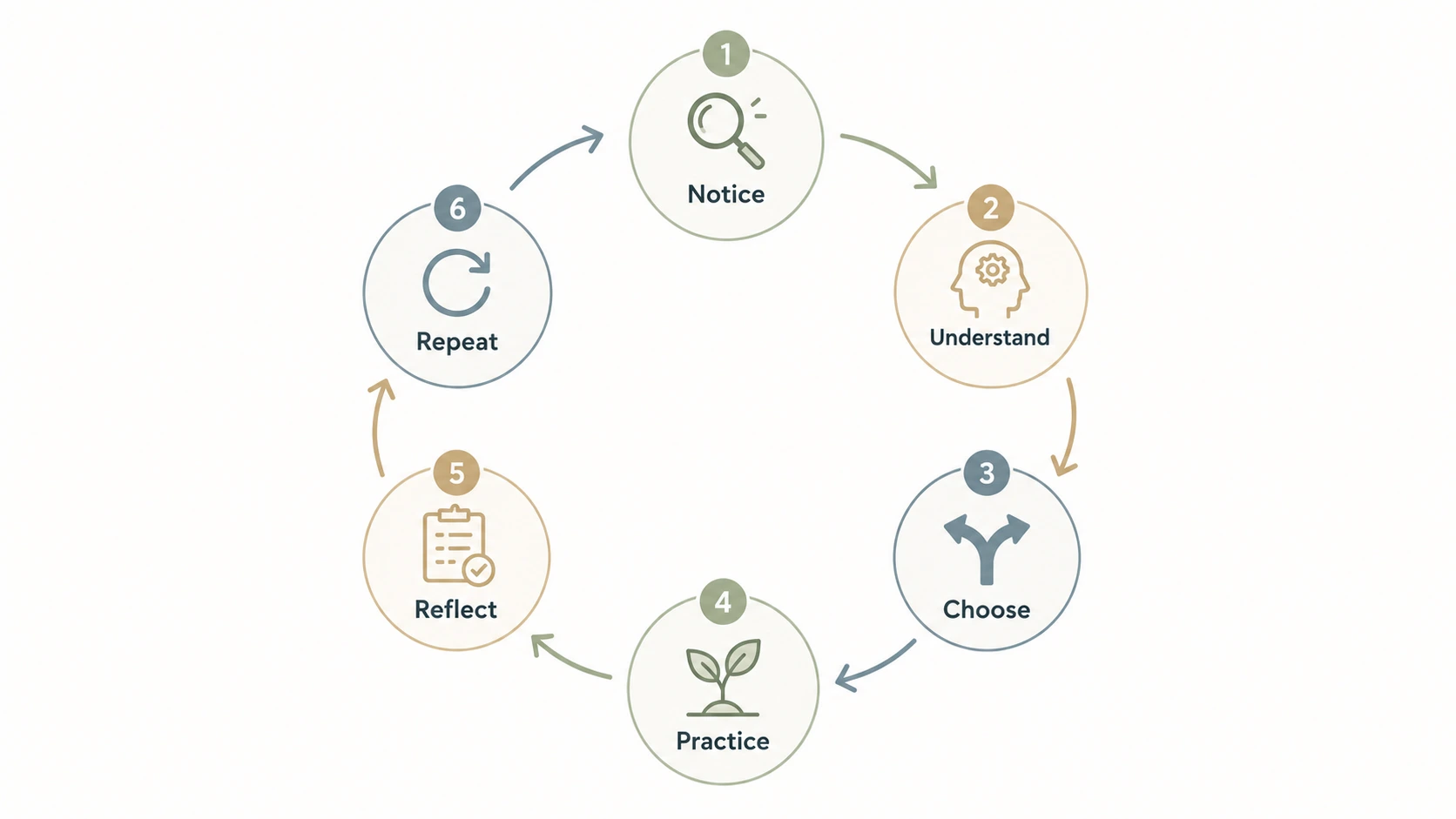
Mindset practice generally follows a simple mechanism: notice → understand → choose → practice → reflect → repeat. Awareness is the first and most important step, because it creates a brief window in which an automatic response can be interrupted before it plays out. Each time a person chooses a different response in that window, the new response becomes slightly more available the next time — gradually shifting from a deliberate choice into a habit.
Context matters. Emotional state, environment, workload, and perceived threat all influence which response feels automatic in a given moment, which is why mindset practice tends to be more effective when it accounts for circumstances rather than treating every situation identically.
Growth Mindset and Survival Responses
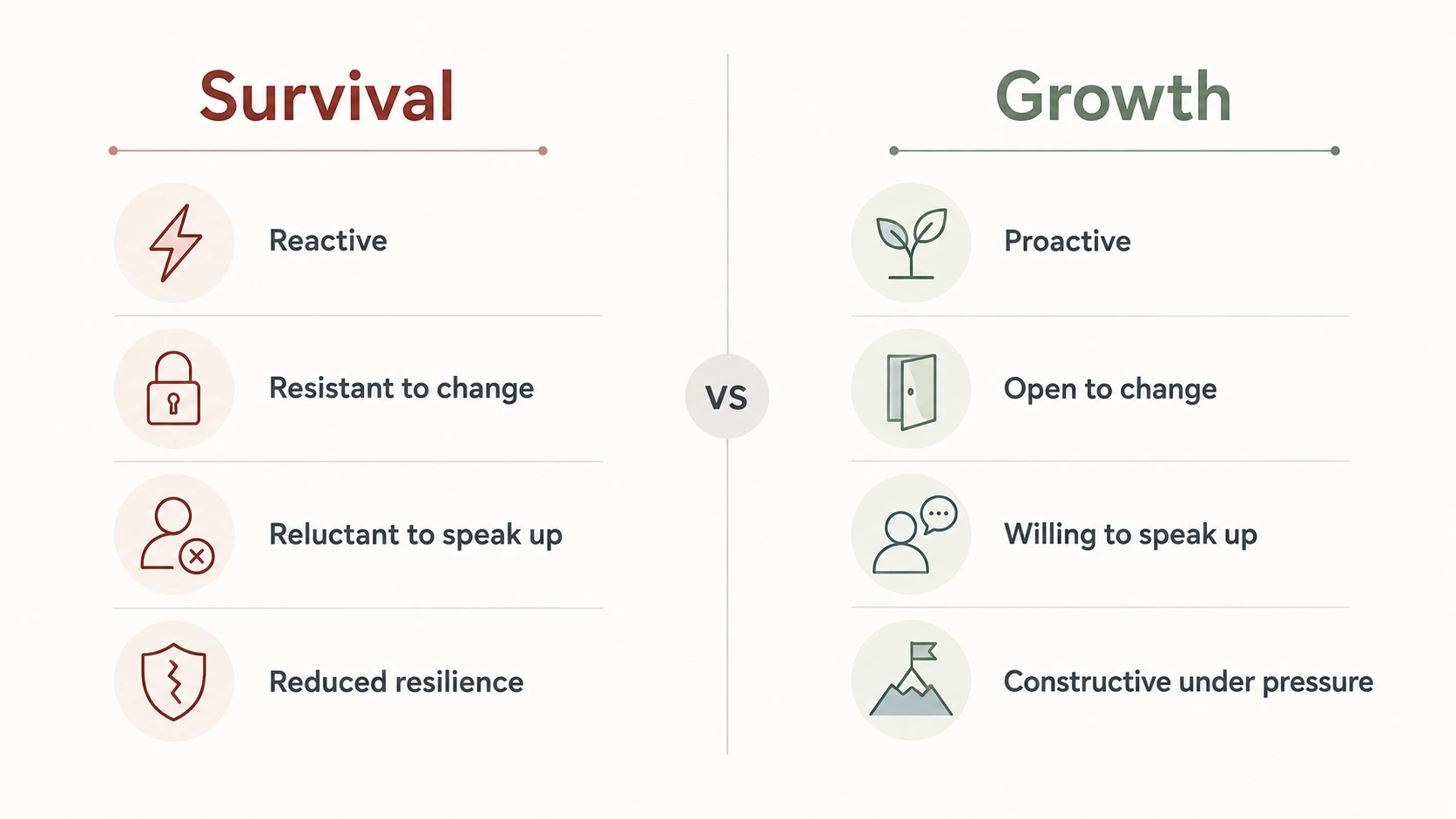
One common framework distinguishes approaching situations from Growth versus reacting from Survival. Survival responses can involve reactivity, resistance to change, reluctance to speak up, or reduced resilience under pressure. A Growth response does not mean ignoring risk or suppressing negative emotions — it means engaging with a challenge deliberately rather than defensively. Mindset Practice describes Survival responses as being reactive rather than proactive, resistant to change, and reluctant to speak up, contrasting this with a mindset of Growth.
The Role of Reflection
Reflection helps identify recurring thought and behavior patterns that would otherwise go unnoticed. Reviewing how a situation was handled — what triggered the reaction, what was chosen, and what the outcome was — builds the self-awareness that underpins emotional intelligence and resilience over time.
How to Practice a Growth Mindset in Everyday Life
Turning mindset principles into observable action requires a repeatable, concrete process rather than a vague intention to “think differently.”
A Simple Daily Mindset Practice
- Identify a challenging situation.
- Notice the automatic thought or emotional response.
- Ask what that response is trying to protect or achieve.
- Consider an alternative interpretation of the situation.
- Choose one constructive action.
- Reflect on what happened afterward.
- Repeat the process in similar situations.
Examples of Growth Mindset Practice
- Responding constructively to failure instead of avoiding it
- Actively asking for feedback rather than waiting for it
- Trying an unfamiliar approach instead of defaulting to habit
- Admitting uncertainty instead of masking it
- Treating mistakes as information rather than as verdicts on ability
- Practicing self-compassion while still maintaining accountability. Pairing these actions with growth mindset affirmations can reinforce the response you’re practicing, though affirmations work best alongside — not instead of — the behavioral steps above
Daily vs. Weekly Mindset Practice
| Practice Type | Frequency | Purpose | Typical Activities | Best Suited To |
|---|---|---|---|---|
| Daily practice | Once or more per day | Build automatic awareness | Short reflection, noticing triggers, brief reframing | People building a new habit |
| Weekly practice | Once per week | Review patterns and progress | Journaling, reviewing recurring triggers, planning adjustments | People consolidating gains |
| Situation-based practice | As needed | Handle specific challenges | Pausing before reacting, choosing a response in the moment | People facing a particular recurring issue |
What Are the Benefits of Regular Mindset Practice?
Regular mindset practice is associated with a range of potential benefits, though outcomes vary by individual and context — mindset practice does not guarantee a specific result. Commonly reported benefits include:
- Greater self-awareness
- Improved resilience
- Greater adaptability to change
- Better emotional awareness
- More constructive responses to setbacks
- Improved collaboration with others
- Greater confidence and self-belief
- More deliberate, less reactive decision-making
How Mindset Practice Can Affect Work and Relationships
Mindset influences how people communicate, give and receive feedback, collaborate, and lead. A person practicing a Growth-oriented mindset is often more willing to raise concerns, admit uncertainty, and support others — behaviors linked to psychological safety within teams. It’s worth distinguishing an individual’s mindset from the wider environment: a supportive team climate can reinforce Growth-oriented behavior, while an unsupportive one can make it harder to sustain, regardless of individual effort.
Mindset Practice Techniques and Tools
Different mindset practice techniques address different problems. Rather than applying one technique universally, it helps to match the tool to the situation.
Self-Reflection Exercises
- Identify recurring reactions to specific situations
- Track triggers over time (people, environments, types of feedback)
- Reflect on the connection between thoughts, feelings, and actions in a given episode
Reframing and Perspective-Taking
- Challenge the assumptions behind an automatic interpretation
- Consider at least one alternative explanation for a situation
- Separate observable facts from personal interpretation. Challenging the assumptions behind an automatic interpretation is the foundation of learning how to change your thoughts in a lasting way, rather than relying on willpower alone.
Emotional Awareness and Presence
- Recognize an emotion before acting on it
- Notice how a given emotional state tends to influence behavior
- Practice staying present rather than reacting from habit
Resilience and Recovery Practices
- Identify early signs of overload or burnout
- Balance sustained effort with recovery time
- Build a strategy for returning to constructive action after a setback
Mindset Practice App: What Does It Do?
The Mindset Practice App is the digital tool connected to the broader Mindset Practice approach. Mindset Practice’s integrated practical tools and psychometrics are housed in a digital learning platform, using an evidence-based, experiential approach that fosters personal awareness of thoughts, feelings, and actions. The app is designed to give users structured access to reflection exercises, mindset assessments, and practical tools rather than functioning as a general wellness or productivity app.
What Features Does the Mindset Practice App Include?
- Reflection activities
- Mindset and Growth/Survival awareness tools
- Resilience-related exercises
- Practices for Growth
- Support for navigating difficult conversations
- Other practical mindset-development tools
Who Can Use the Mindset Practice App?
The app supports both individual and organizational use, but access is not open to the general public by default. Listings for the app indicate that access is currently limited to users whose organization has purchased a license, meaning most individuals encounter the app through an employer, coaching provider, or similar organizational route rather than a direct public download. This article describes the app for informational purposes; it does not provide instructions for obtaining access outside of an organization’s existing license.
How Does Rich Cook’s Mindset Practice Approach Work?
Rich Cook is the founder and Chief Psychologist associated with Mindset Practice. He is a Chartered Occupational Psychologist with over 20 years of experience designing mindset solutions and tools intended to deliver transformational change. His approach draws on applied psychology and emotional intelligence, and it centers on repeated practice rather than one-time learning — the premise being that mindset shifts take hold through consistent behavior change, not a single insight or workshop.
Rich Cook’s Growth vs. Survival Framework
The framework distinguishes Growth-oriented responses from Survival-oriented ones. Left unchecked, most people default to a mindset of Survival — being reactive rather than proactive, resistant to change, and reluctant to speak up. Recognizing a Survival habit in the moment is treated as the opportunity point: once a pattern is noticed, a different response becomes possible.
Mindset Practice’s Six Growth Habits
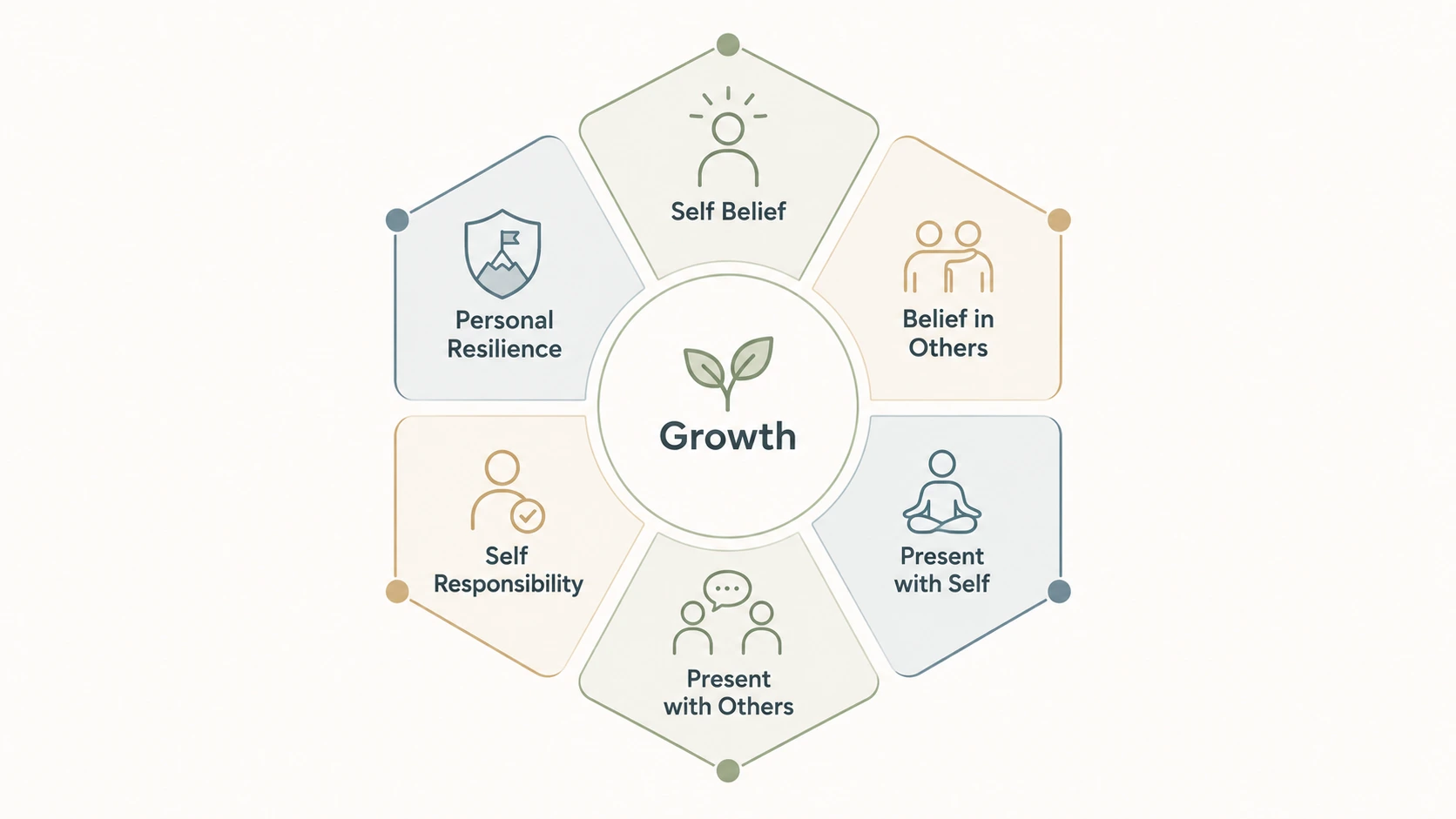
The Growth Indicator, Mindset Practice’s core psychometric tool, provides feedback focused on six key habits that underpin a mindset of Growth.
| Habit | Focus |
|---|---|
| Self Belief | Confidence in one’s own ability to grow and improve |
| Belief in Others | Trust in the potential and intentions of other people |
| Present with Self | Awareness of one’s own thoughts and emotions in the moment |
| Present with Others | Genuine attentiveness in interactions with others |
| Self Responsibility | Ownership of one’s own responses and choices |
| Personal Resilience | Capacity to recover and continue after setbacks |
Mindset Practice vs. Other Mindset Approaches
Mindset-related terms are often used interchangeably, but they refer to distinct emphases.
| Approach | Main Focus | Typical Practice | Best Suited To |
|---|---|---|---|
| Growth mindset practice | Learning and development | Reframing challenges, learning from feedback | Learning and performance contexts |
| Positive mindset practice | Constructive outlook | Positive reframing, attention management | General wellbeing and optimism |
| Daily mindset practice | Consistency | Short, recurring exercises | Habit formation |
| Mindset Practice framework | Growth vs. Survival responses | Reflection, psychometrics, structured tools | Individual and workplace development |
When Should You Use Each Approach?
These approaches overlap rather than being mutually exclusive. A general daily practice can be a useful starting point for building consistency, while a structured framework with assessment tools — such as the Mindset Practice model — may suit someone who wants measurable feedback or is applying mindset development across a team or organization.
Common Mindset Practice Mistakes and How to Fix Them
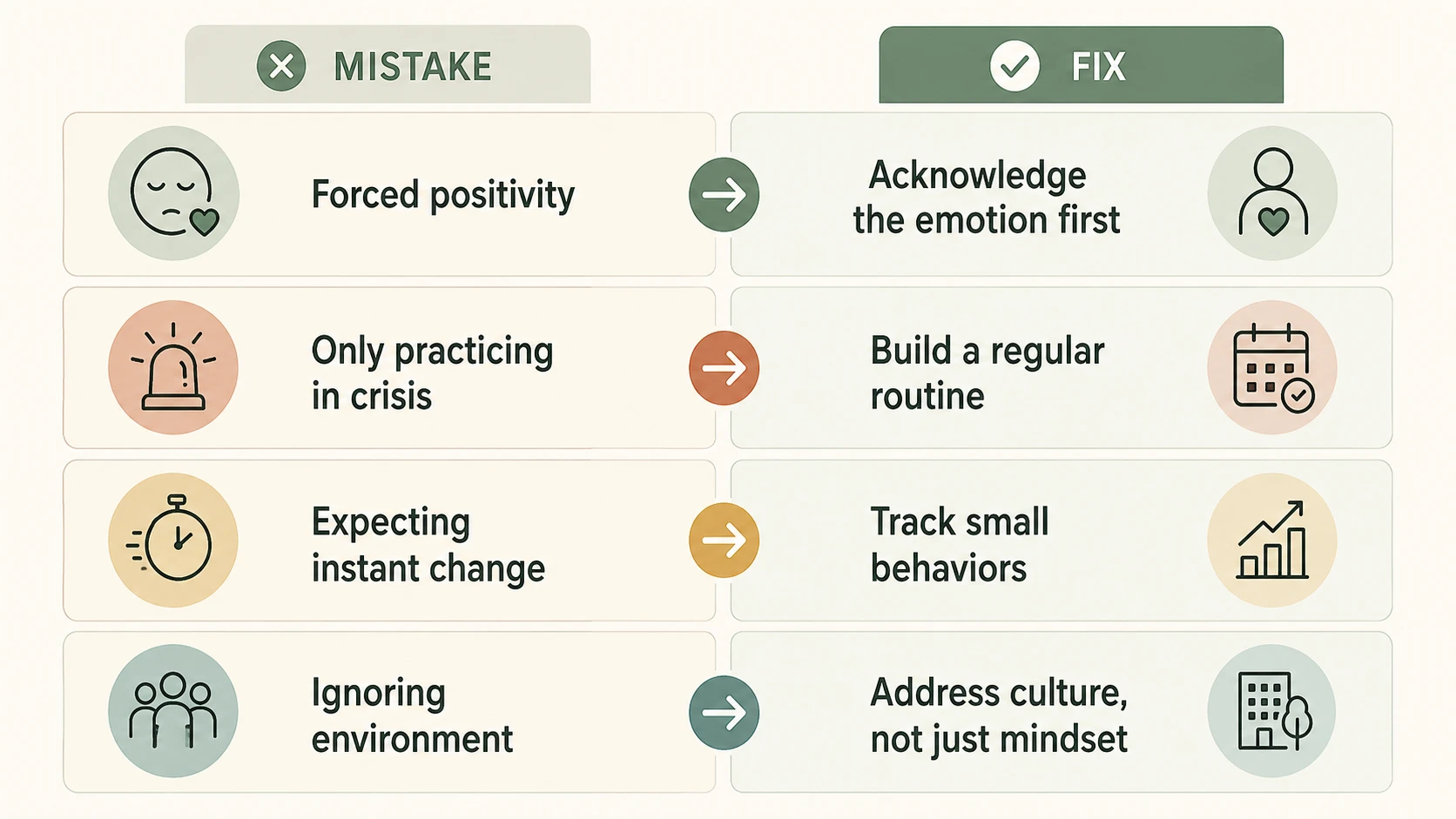
Mistake 1: Treating Mindset Practice as Forced Positivity
Why it happens: Optimism gets confused with emotional awareness. How to fix it: Acknowledge the emotion honestly before choosing a response. How to prevent it: Use realistic reflection rather than relying on affirmations alone.
Mistake 2: Practicing Only When Things Go Wrong
Why it happens: Mindset tools get treated as emergency interventions rather than ongoing practice. How to fix it: Establish a regular practice independent of whether things are going well. How to prevent it: Attach the practice to an existing daily or weekly routine.
Mistake 3: Expecting Immediate Personality Change
Why it happens: Habit formation timelines are underestimated. How to fix it: Measure changes in specific behaviors rather than expecting a wholesale personality shift. How to prevent it: Focus on small, repeated actions rather than dramatic transformation.
Mistake 4: Ignoring Environmental Factors
Why it happens: Mindset gets treated as entirely an individual responsibility. How to fix it: Examine relationships, workload, psychological safety, and organizational culture alongside individual effort. How to prevent it: Combine individual development with supportive environments rather than working on mindset in isolation.
How Long Does Mindset Practice Take to Work?
Difficulty and Time Investment
Mindset practice is generally accessible to beginners, since the basic notice-and-reframe cycle requires no special equipment or training. It becomes more complex when applied to entrenched behavioral patterns built up over years, where short daily exercises may need to be supplemented with structured programmes, coaching, or psychometric tools like those used in the Mindset Practice framework. Consistency, existing habits, environment, and the complexity of the challenge being addressed all affect how much effort is required.
Results Timeline
Mindset changes typically develop through repeated practice rather than a single exercise. Short-term awareness — noticing a pattern for the first time — tends to appear relatively quickly, while more stable behavioral change usually takes sustained repetition over weeks or months. Visible results vary between individuals and contexts, so it is more accurate to describe a progression from awareness to repeated behavior to more stable habits than to promise a fixed timeline.
How to Make Mindset Practice a Sustainable Habit
Build a Simple Routine
- Choose a consistent time or trigger for practice
- Keep initial sessions short to reduce the barrier to starting
- Focus on one behavior at a time rather than several at once
Track Progress Without Becoming Obsessed With Metrics
- Record recurring triggers as they come up
- Note responses that worked well
- Review patterns periodically rather than daily
Adapt the Practice to Your Lifestyle
- Students: apply mindset practice to academic setbacks and performance pressure
- Professionals: apply it to feedback, uncertainty, and workplace change
- Managers: apply it to communication, psychological safety, and team climate
- People experiencing high stress: prioritize realistic, manageable practices over ambitious routines
In our experience helping readers build better habits, the practices that stick are the ones tied to an existing routine rather than added as a separate task — a brief reflection after a daily commute or before a recurring meeting tends to outlast a standalone morning ritual introduced in isolation.
When Mindset Practice May Not Be Enough
Self-guided mindset exercises have limits. They are not a substitute for professional support when someone is dealing with clinical anxiety, depression, trauma, or other conditions that benefit from qualified care. Mindset should also not be used to place blame on people for circumstances outside their control — workload, organizational culture, financial pressure, health conditions, and social context all shape outcomes alongside individual mindset. Where an environment is genuinely unsupportive or unsafe, addressing those structural factors matters as much as, or more than, individual practice.
Frequently Asked Questions About Mindset Practice
What is mindset practice? Mindset practice is the deliberate, repeated process of noticing automatic thoughts and reactions, then choosing more constructive responses — distinct from simply trying to think positively. This distinguishes mindset practice from simply “having a positive attitude” — a distinction worth exploring further if you’re unsure how mindset differs from attitude.
How do I practice a growth mindset every day? Identify a challenging moment, notice your automatic response, consider an alternative interpretation, choose a constructive action, and briefly reflect afterward.
What is the difference between growth mindset and positive mindset practice? Growth mindset practice focuses on learning from challenges and feedback, while positive mindset practice focuses more broadly on maintaining a constructive outlook; the two overlap but are not identical.
Is mindset practice effective? Outcomes depend on the specific practice used, how consistently it is applied, and individual circumstances — it does not guarantee a particular result for everyone.
What is the Mindset Practice App? It is a digital tool from the Mindset Practice organization that provides reflection exercises, mindset assessments, and Growth-focused practices, typically accessed through an organization’s license.
Who is Rich Cook in relation to Mindset Practice? Rich Cook is the founder and Chief Psychologist of Mindset Practice, a Chartered Occupational Psychologist who developed its Growth-versus-Survival approach.
Can mindset practice improve resilience? Increased awareness of automatic reactions, combined with repeated practice of constructive responses, is linked to improved coping and resilience over time.
How long should I practice mindset exercises each day? There is no universal ideal duration; consistency and fit with your routine matter more than an arbitrary number of minutes.
Conclusion
Mindset practice is best understood as the deliberate repetition of awareness, reflection, and constructive response — not a single insight or a permanently fixed trait. It differs from forced positivity because it makes room for difficult emotions rather than suppressing them, and it becomes more durable when tied to daily or weekly routines, honest reflection, and gradual behavioral repetition. The general concept of mindset practice is distinct from Mindset Practice, the organization founded by Rich Cook, which applies these principles through its Growth-versus-Survival framework, the Growth Indicator psychometric tool, and its digital app. Whichever version applies to your situation, the clearest takeaway is the same: mindset becomes far more actionable once it is practiced through observable, repeatable behaviors rather than treated as an abstract belief to hold.