
Introduction
A growth mindset quiz for adults PDF is a printable or downloadable questionnaire that helps adults evaluate whether their beliefs about intelligence, learning, and effort lean toward a growth mindset or a fixed mindset. Rather than measuring skill or intelligence, these self-assessments examine underlying attitudes toward challenges, mistakes, and feedback. Self-assessment matters at any career stage because the beliefs someone holds about their own ability to change directly shape how they approach learning, setbacks, and long-term development. Most growth mindset quizzes trace their theoretical roots to Carol Dweck’s research on mindset, though individual PDFs vary widely in length, question style, scoring method, and intended use — from quick personal reflection tools to more structured research-based scales.
Quick Summary
- A growth mindset quiz helps adults identify beliefs about learning, intelligence, effort, and improvement.
- Most questionnaires are based on growth mindset theory and are meant for self-reflection rather than diagnosis.
- Different PDF quizzes vary in length, scoring methods, and intended audience.
- Understanding your results is only the first step; consistent practice helps develop a stronger growth mindset.
What Is a Growth Mindset Quiz for Adults?
Definition of a Growth Mindset Quiz
A growth mindset quiz for adults PDF is a structured set of statements or questions that respondents rate based on how strongly they agree or disagree, revealing patterns in how they think about ability and effort. Unlike an aptitude test, a growth mindset questionnaire for adults does not measure what someone knows or can do — it measures what they believe about whether those things can change. A basic growth mindset quiz typically asks respondents to reflect on reactions to failure, feedback, and challenge, then aggregates responses into a general orientation toward either a growth or fixed mindset.
Why Adults Use Growth Mindset Questionnaires
Adults turn to these questionnaires for several practical reasons tied to ongoing development rather than one-time evaluation.
- Personal development — identifying blind spots in how they respond to setbacks
- Career advancement — understanding whether fixed beliefs are limiting growth opportunities
- Leadership — modeling and coaching growth-oriented thinking in teams
- Workplace learning — supporting training programs and skill-building initiatives
- Coaching — giving coaches a starting point for goal-setting conversations
- Lifelong education — reinforcing openness to new skills and knowledge later in life
Understanding Growth Mindset and Fixed Mindset
What Is a Growth Mindset?
A growth mindset is the belief that abilities and intelligence can be developed over time through effort, strategy, and persistence rather than remaining fixed traits. This concept, closely associated with psychologist Carol Dweck, is often linked to neuroplasticity — the brain’s capacity to reorganize and strengthen connections through learning and practice. People with a stronger learning mindset tend to view setbacks as informative rather than final, treating them as part of the process of building competence. This concept, closely associated with psychologist Carol Dweck — see Carol Dweck mindset quotes for some of her most cited insights on the topic — is often linked to neuroplasticity.
What Is a Fixed Mindset?
A fixed mindset is the belief that intelligence and talent are static traits that cannot meaningfully change. This often produces a fear of failure, since mistakes feel like evidence of a permanent limitation rather than a normal part of learning. As a result, people with a stronger fixed mindset frequently avoid challenges that might expose gaps in ability, favoring situations where success is more certain.
Growth Mindset vs Fixed Mindset (Comparison)
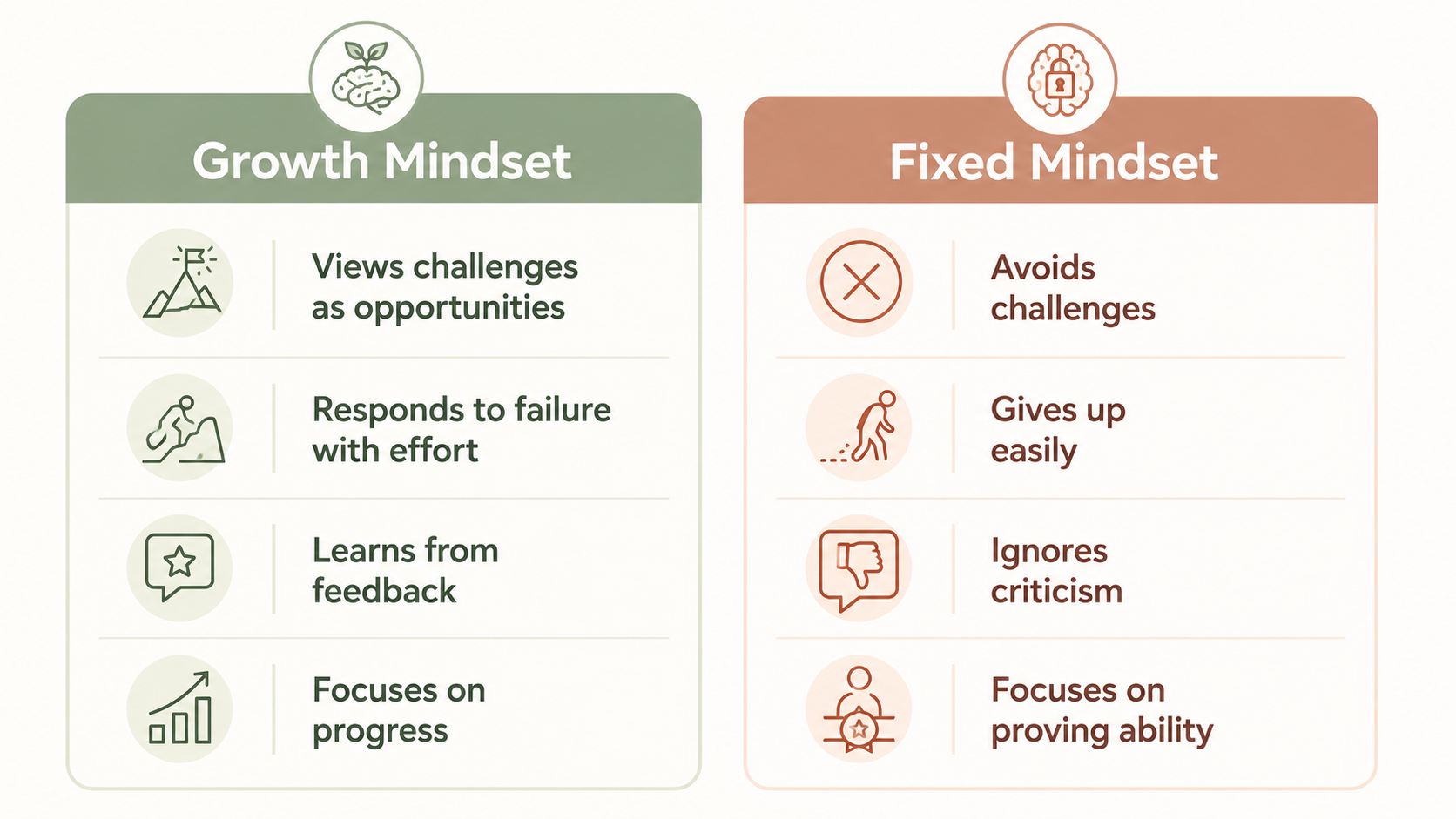
| Growth Mindset | Fixed Mindset |
|---|---|
| Views challenges as opportunities | Avoids challenges to prevent failure |
| Responds to setbacks with renewed effort | Gives up easily after failure |
| Learns from feedback and criticism | Ignores or resents criticism |
| Focuses on progress over time | Focuses on proving existing ability |
Many educators and coaches use a growth mindset and fixed mindset diagram alongside this type of comparison to visually reinforce how these two orientations diverge in everyday decision-making.
Types of Growth Mindset Questionnaires
Short Self-Assessment Quizzes
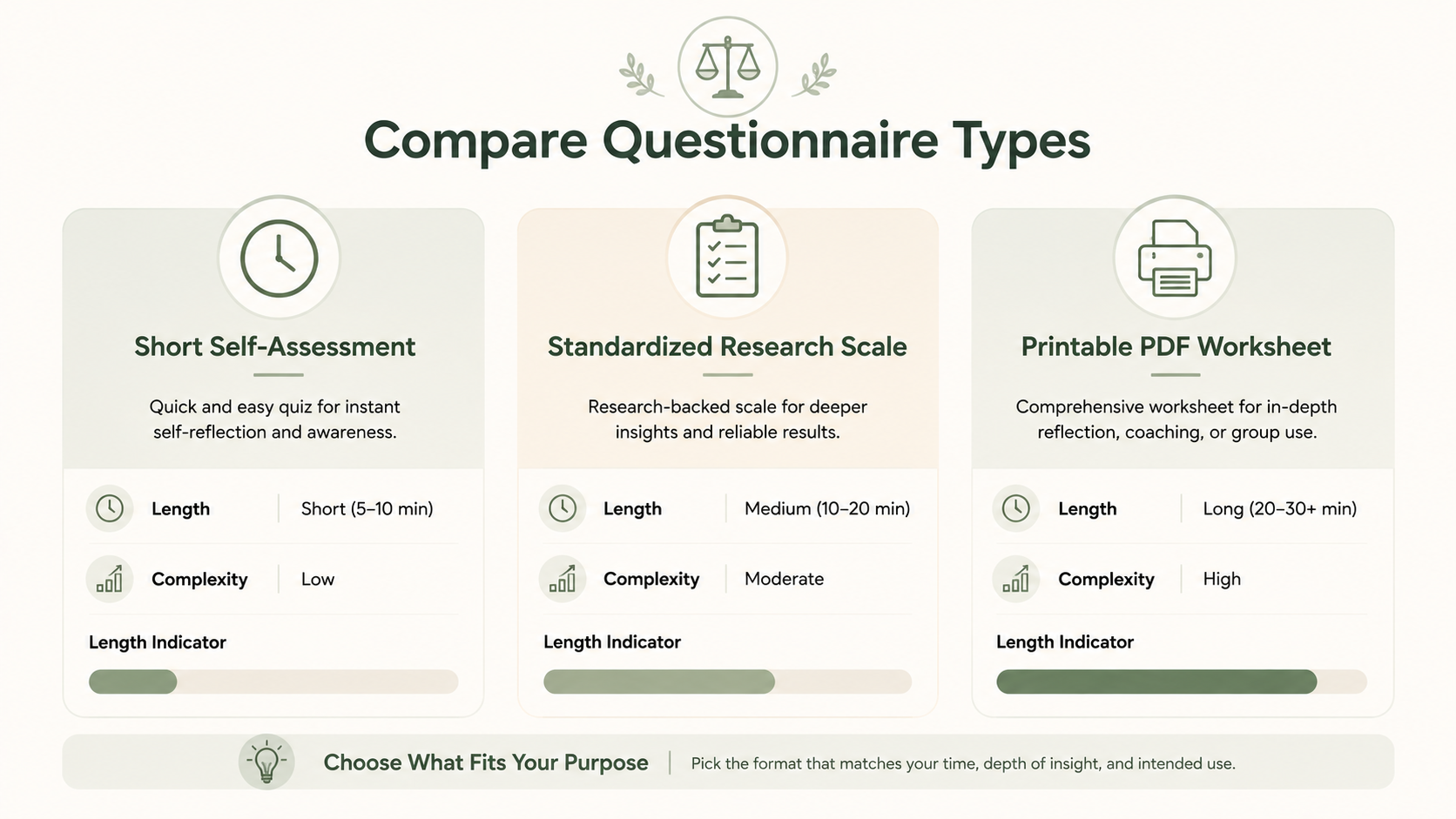
Short quizzes are designed for quick screening and everyday reflection rather than formal evaluation. These typically include five to ten statements and are meant to raise general awareness of mindset tendencies rather than produce a precise score.
Standardized Research Questionnaires
More formal instruments are grounded in behavioral science research and are used in academic or organizational settings. The Dweck Mindset Questionnaire PDF and the 8-item Growth Mindset Scale questionnaire PDF are commonly referenced examples, both designed to measure implicit beliefs about the fixed or malleable nature of intelligence using validated statement sets.
Printable PDF Versions
Printable formats make growth mindset assessments practical for settings where digital tools aren’t ideal.
- Printable worksheets for individual use
- Classroom handouts for group discussion
- Coaching session materials
- Personal journals for ongoing reflection
A growth mindset quiz for adults PDF download is often preferred in these contexts because it allows offline completion, easy sharing, and repeated use over time.
What Questions Are Typically Included?
Growth mindset questions generally probe how someone interprets ability, effort, and setbacks rather than testing factual knowledge. Common mindset questions address:
- Beliefs about intelligence
- Views on learning ability
- Reactions to mistakes
- Openness to feedback
- Attitudes toward effort
- Willingness to take on challenges
- Persistence through difficulty
- Reactions to other people’s success
How Growth Mindset Quizzes Are Scored
Common Rating Scales
Most questionnaires use Likert scales, where respondents rate agreement with each statement on a numeric range, often from strongly disagree to strongly agree. Some items use reverse scoring, meaning agreement with a fixed-mindset statement lowers the overall growth mindset score rather than raising it.
How to Interpret Results
Results generally fall into a few broad patterns. A high growth mindset score suggests a strong tendency to view abilities as improvable through effort. A mixed mindset profile indicates that beliefs vary by context — for example, a growth orientation toward career skills but a more fixed view of personal relationships. A strong fixed mindset tendency suggests abilities are generally seen as unchangeable. These categories describe general tendencies, not fixed personality types, and results can shift with reflection and practice.
How Accurate Are Growth Mindset Assessments?
Growth mindset assessments are useful reflection tools, but their accuracy is limited by self-report bias, since respondents may answer based on how they want to see themselves rather than how they consistently behave. Honesty of responses, current mood, and situational context can all influence results on a given day. There is also a meaningful difference between educational and clinical use: these quizzes are designed for general self-awareness and are not diagnostic instruments. For that reason, results should be treated as a starting point for reflection rather than a definitive or permanent measurement of ability.
How to Develop a Growth Mindset After Taking the Quiz
Daily Habits That Encourage Growth
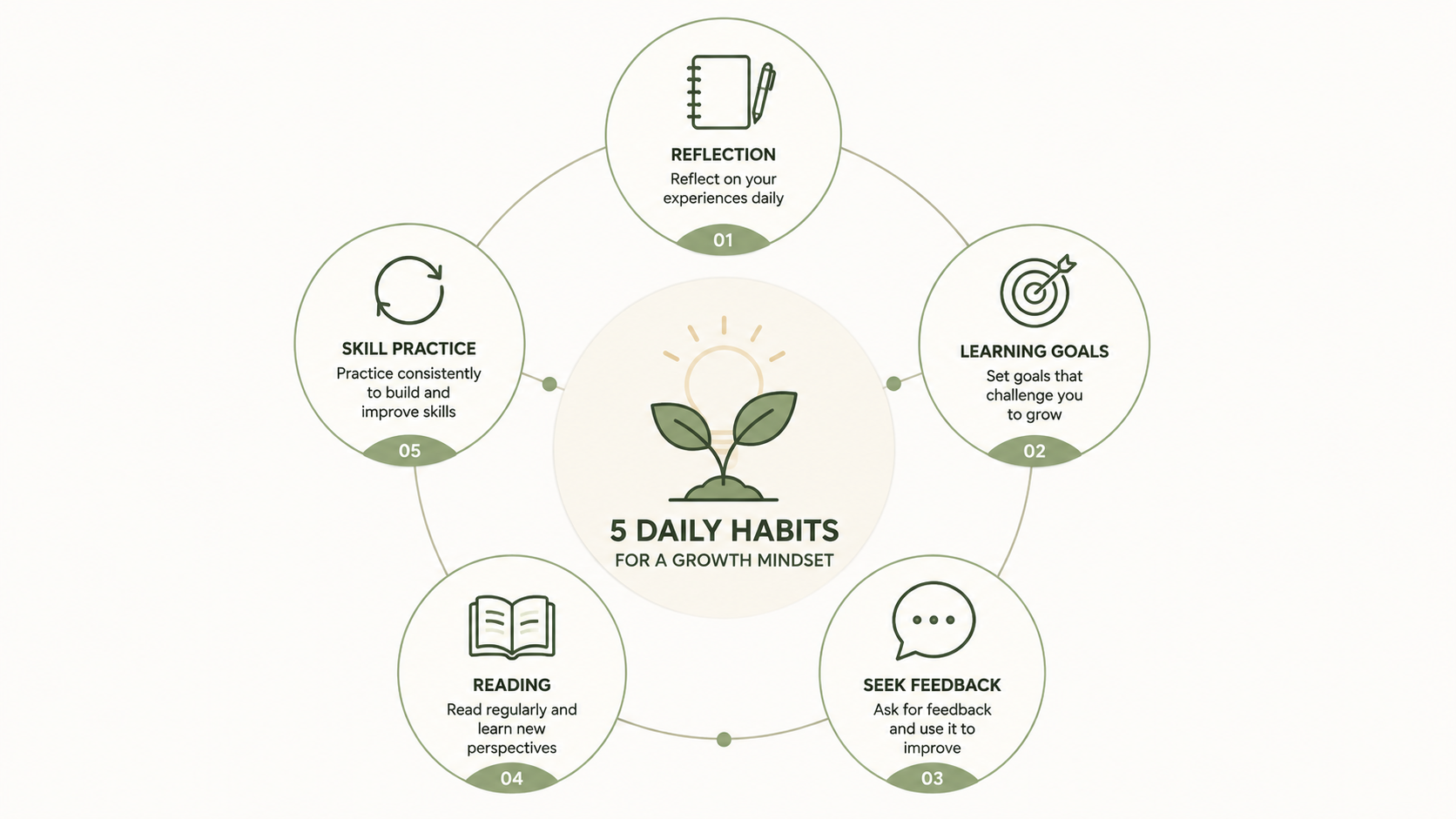
Building a stronger growth mindset in adults typically involves consistent, small practices rather than a single decision. Regular reflection on recent challenges and responses to them — journal prompts for growth mindset can make this easier to start.
- Regular reflection on recent challenges and responses to them
- Setting specific learning goals rather than only outcome goals
- Actively seeking feedback instead of avoiding it
- Reading about new subjects outside current expertise
- Deliberate practice of a skill over time
In our experience helping readers build better habits, the adults who see the clearest shifts are the ones who track small wins consistently rather than waiting for a major breakthrough.
Replacing Fixed Mindset Thoughts
Small language shifts can reinforce a growth orientation in daily thinking.
- Replace “I can’t” with a more specific, addressable statement
- Add “yet” to statements about current limitations
- Treat mistakes as information rather than failure
- Deliberately celebrate progress, not just final outcomes
Growth Mindset in Different Areas of Adult Life
Career and Workplace
A growth-oriented approach at work often supports readiness for promotions, effective leadership, and sustained engagement in continuous learning. Growth mindset questions for employees are increasingly used in performance reviews and development conversations to open dialogue about learning goals rather than only past results.
Education and Lifelong Learning
Growth mindset principles benefit college students navigating unfamiliar subjects, adult learners returning to education later in life, and professionals pursuing certifications, since all three groups benefit from viewing early struggle as a normal part of mastering new material.
Personal Relationships
A growth mindset also extends beyond formal learning into communication, resilience during conflict, and emotional intelligence, since viewing relational skills as improvable — rather than fixed personality traits — supports more constructive responses to disagreement.
Activities That Strengthen a Growth Mindset
Several practices reinforce growth-oriented thinking over time.
- Journaling about challenges and lessons learned
- Structured reflection exercises after setbacks
- Taking on deliberate learning challenges
- Reading books or articles outside a comfort zone
- Working with a coach or mentor
- Peer discussions that normalize struggle and feedback
Your Daily Thrive recommends pairing these activities with occasional use of growth mindset games for adults and growth mindset quotes for adults as lightweight reminders that reinforce the habit without requiring significant time investment. Reading books or articles outside a comfort zone — our best growth mindset books roundup is a good starting point.
Common Mistakes When Using Growth Mindset Quizzes
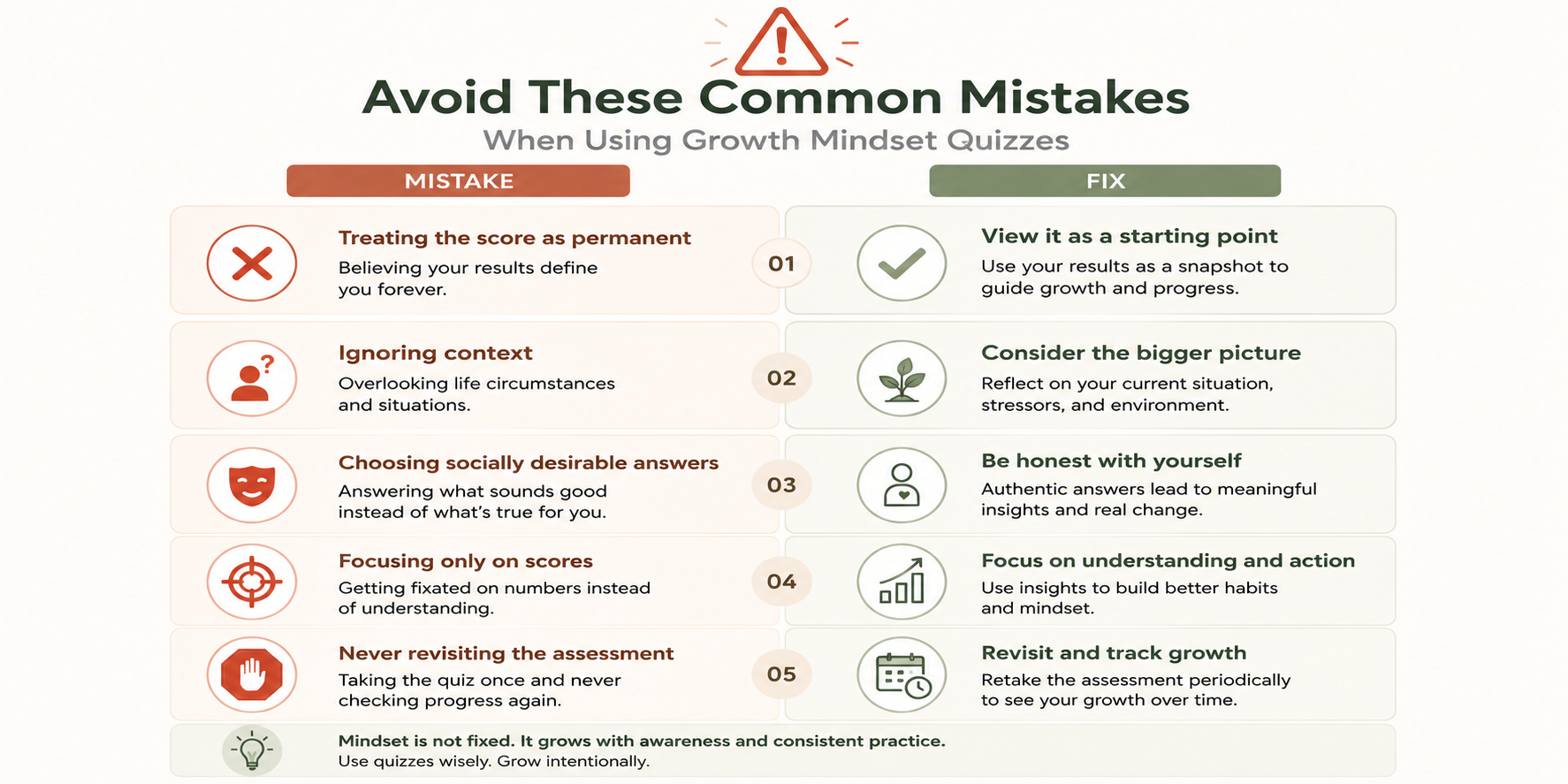
Several recurring mistakes reduce the value of a growth mindset assessment.
- Treating the score as permanent — happens when a single result is mistaken for a fixed trait; fixed by retaking the assessment periodically and tracking change over time
- Ignoring context — happens when one score is applied across all areas of life; fixed by considering different domains, such as career versus relationships, separately
- Choosing socially desirable answers — happens when respondents answer how they think they should, rather than honestly; prevented by completing quizzes privately and without pressure
- Focusing only on scores — happens when the numeric result overshadows the reflection process; fixed by reviewing individual question responses, not just the total
- Never revisiting the assessment — happens when the quiz is treated as a one-time event; prevented by scheduling periodic re-assessment, such as every few months
Choosing the Right Growth Mindset PDF Questionnaire
| Questionnaire Type | Best For | Length | Scoring | Printable |
|---|---|---|---|---|
| Self-reflection quiz | General personal insight | Short | Simple Likert scale | Yes |
| Research scale (e.g., 8-item scale) | Structured, validated measurement | Short to medium | Standardized scoring | Often |
| Coaching worksheet | Guided development conversations | Medium | Discussion-based | Yes |
| Workplace assessment | Team or organizational development | Medium to long | Aggregated/group scoring | Sometimes |
The best growth mindset quiz for adults PDF depends on the goal: a short self-reflection quiz suits personal use, while a standardized scale is better suited to research, coaching, or workplace development where consistency across respondents matters.
Frequently Asked Questions About Growth Mindset PDFs
Before turning to the FAQ section below, it’s worth addressing a few common concerns directly. Printable quizzes are generally reliable as reflection tools rather than precise measurements, so results should be interpreted as directional rather than exact. Most adults benefit from retaking an assessment every few months to track shifts in mindset over time. These questionnaires are broadly suitable for coaching, education, and workplace development, provided they’re used to guide conversation and goal-setting rather than as formal evaluation.
Conclusion
A growth mindset quiz for adults PDF measures beliefs about learning, effort, and ability rather than testing knowledge or skill, offering a structured way to reflect on how challenges and feedback are typically approached. Printable PDF questionnaires make this kind of self-assessment accessible for personal use, coaching, education, and workplace development, and honest, unpressured responses produce the most useful results. Ultimately, a growth mindset questionnaire for adults is only a starting point — real change comes from applying the insights through consistent reflection, feedback-seeking, and deliberate practice over time.
FAQs
What is a growth mindset quiz for adults PDF?
A growth mindset quiz for adults PDF is a printable questionnaire that assesses beliefs about intelligence, effort, and learning to indicate a general tendency toward a growth or fixed mindset.
Is a growth mindset questionnaire scientifically based?
Many questionnaires, including the Dweck Mindset Questionnaire and the 8-item Growth Mindset Scale, are based on established behavioral science research, though results should be treated as reflective rather than diagnostic.
How often should adults retake a growth mindset assessment?
Retaking a growth mindset assessment every few months is a reasonable interval for tracking meaningful shifts in beliefs without over-focusing on short-term fluctuations.
Can a growth mindset be developed after taking the quiz?
Yes, a growth mindset can be strengthened over time through consistent habits such as reflection, feedback-seeking, deliberate practice, and reframing setbacks as learning opportunities.
What is the difference between the Dweck Mindset Questionnaire and other growth mindset quizzes?
The Dweck Mindset Questionnaire is a research-based standardized instrument, while many other quizzes are shorter, informal tools designed primarily for quick personal reflection.
Are printable PDF mindset quizzes suitable for workplace training?
Yes, printable PDF quizzes are commonly used in workplace training and coaching to open discussions about learning orientation and development goals among employees.
How long does a typical growth mindset questionnaire take to complete?
Most short self-assessment quizzes take five to ten minutes, while longer standardized research questionnaires may take fifteen to twenty minutes to complete.