

Introduction
Growth mindset quotes from Carol Dweck have become some of the most widely referenced ideas in modern psychology, education, and personal development. Dweck, a Stanford University psychologist, introduced the concept of the growth mindset to describe the belief that abilities can be developed through effort, strategy, and learning. Her work has shaped how teachers approach classrooms, how leaders coach teams, and how individuals respond to setbacks. This article goes beyond simply listing quotes — it explains the meaning behind them, where they came from, and how to apply the underlying principles in real situations, whether you’re a student, professional, parent, or athlete.
Quick Summary
- Carol Dweck’s growth mindset theory holds that abilities can improve through effort, learning, and persistence rather than being fixed at birth.
- Her most cited ideas encourage embracing challenges, treating mistakes as information, and viewing failure as part of the learning process.
- Growth mindset principles apply broadly — to students, professionals, athletes, parents, and lifelong learners alike.
- Understanding the reasoning behind the quotes produces more lasting change than memorizing the quotes themselves.
What Is a Growth Mindset According to Carol Dweck?
Carol Dweck’s Definition of a Growth Mindset
A growth mindset, as defined by Carol Dweck, is the belief that intelligence and talent are starting points that can be developed over time through dedication, effective strategies, and input from others. In her research, Dweck contrasts this with a fixed mindset, in which people believe their abilities are static traits they either have or lack.
According to Dweck, what matters most is not raw talent but how a person interprets challenges and setbacks. Someone with a growth mindset views a difficult task as an opportunity to build skill, while someone with a fixed mindset may see the same task as a threat to their self-image. Dr. Carol Dweck’s mindset framework emphasizes that beliefs about ability directly shape motivation, effort, and long-term achievement — a concept she developed over decades of behavioral research and later expanded in her widely known book on mindset theory.
Growth Mindset vs Fixed Mindset (Comparison)
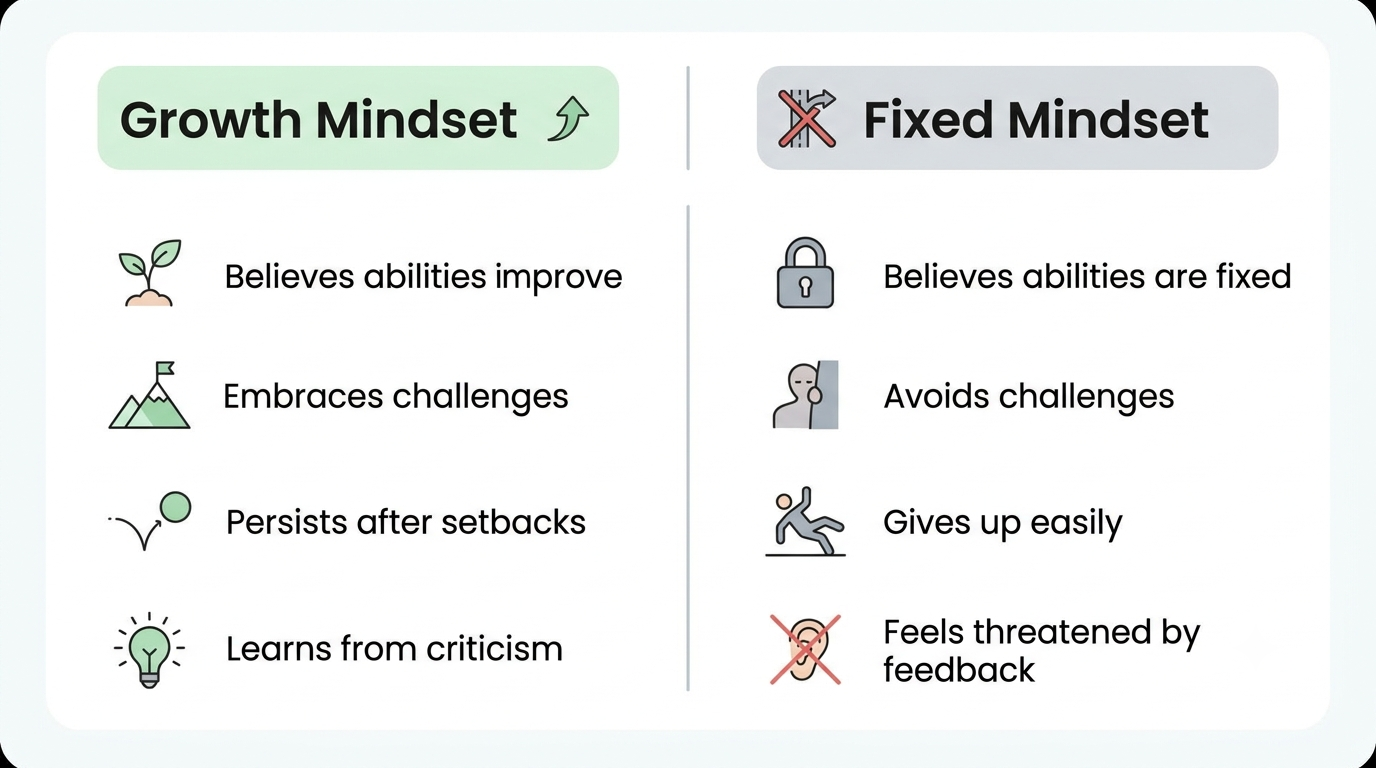
Understanding the contrast between these two mindsets clarifies why the distinction matters so much in learning and performance contexts.
| Growth Mindset | Fixed Mindset |
|---|---|
| Believes abilities improve with effort | Believes abilities are fixed traits |
| Learns from mistakes | Avoids failure and risk |
| Welcomes feedback | Takes criticism personally |
| Values persistence | Gives up easily |
| Sees challenges as opportunities | Sees challenges as threats |
A common misconception is that mindset is an either/or personality trait. In reality, most people show a mix of both mindsets depending on the domain — someone might have a growth mindset toward their career but a fixed mindset toward creative skills like drawing or public speaking. Recognizing this nuance is the first step toward intentionally shifting toward growth-oriented thinking in specific areas.
Who Is Carol Dweck and Why Are Her Quotes So Influential?
Carol Dweck is a professor of psychology at Stanford University whose research since the 1970s has focused on motivation, achievement, and self-belief. Her growth mindset theory emerged from studies observing how children responded differently to failure — some grew discouraged, while others became more engaged and determined.
This research eventually reached far beyond academic psychology. Schools adopted growth mindset principles to reshape how teachers give feedback and how students approach setbacks. Businesses applied the framework to leadership development and team culture, encouraging managers to reward effort and learning rather than only innate talent. Coaches and sports psychologists have used Dweck’s concepts to help athletes recover from losses and injuries with resilience. Parents have applied her ideas to praise effort and process instead of only outcomes, which research suggests builds more durable confidence in children over time.
Because Dweck’s work is grounded in peer-reviewed research rather than general motivational advice, her quotes carry a level of credibility that has made them a reference point across education, business, and self-improvement writing.
The Best Growth Mindset Quotes by Carol Dweck
Most Famous Carol Dweck Growth Mindset Quotes

Among Dweck’s most recognized ideas is her description of failure not as a fixed identity but as an event to learn from — the notion that a person is “not yet” good at something, rather than permanently unable to be. This distinction reframes struggle as a temporary stage in learning rather than a verdict on ability.
Another central idea in her work is that true confidence comes from the willingness to change, grow, and confront challenges directly — not from certainty about one’s fixed talents. This reflects Dweck’s broader argument that resilience is built through the process of trying, not through avoiding failure altogether.
When people ask what Carol Dweck’s best-known growth mindset quote is, most references point to her “not yet” reframe, because it captures the entire theory in a single, memorable shift in language.
Powerful Growth Mindset Quotes Explained
Beyond her most famous line, Dweck’s broader body of work includes several other influential ideas:
- On effort: Dweck consistently argues that effort is what activates ability — talent alone rarely produces mastery without sustained practice.
- On failure: She frames setbacks as data points that reveal what to adjust, not as evidence of inadequacy.
- On praise: Dweck’s research shows that praising process and strategy, rather than only outcomes or intelligence, encourages more resilient effort in the future.
Each of these ideas applies in different contexts: the “effort” principle applies when starting something new and unfamiliar, the “failure as data” principle applies after a setback, and the “process praise” principle applies when giving feedback to others, including children or team members.
Growth Mindset Quotes for Students
Why Students Benefit from a Growth Mindset
A growth mindset supports students in several concrete ways. It helps normalize struggling with new material, reduces anxiety around exams, and encourages persistence with difficult subjects. Students who adopt this mindset are more likely to see a poor grade as information about where to focus study efforts, rather than as proof they are “bad” at a subject. This shift also improves classroom participation, since students become more willing to ask questions and risk being wrong in front of others.
Growth Mindset Quotes Students Can Apply Daily
Growth mindset ideas can be organized around common academic situations:
- Before exams: Reframe nervousness as a sign of caring about the outcome, and focus on preparation strategies rather than predicting failure.
- After failure: Treat a low grade as feedback on specific skills to improve, not as a permanent label.
- Building confidence: Recognize progress in small increments rather than comparing yourself only to top performers.
- Developing resilience: View setbacks as expected parts of learning difficult material, not exceptions to avoid.
- Learning difficult subjects: Apply the “not yet” reframe — you have not mastered it yet, rather than you cannot do it.
Growth mindset quotes for students work best when tied directly to a specific study habit or emotional response, rather than treated as general encouragement.
Mindset Quotes for Success and Personal Growth
Quotes About Mindset and Attitude
Mindset shapes far more than academic performance — it influences daily habits, decision-making, emotional regulation, and leadership style. A person’s underlying beliefs about whether they can improve directly affect how they respond to feedback, handle conflict, and set goals. Quotes about mindset and attitude generally emphasize that consistent, small shifts in perspective compound into significant behavioral change over time.
Mindset Quotes for Success
Dweck’s research reframes success as an ongoing process rather than a fixed destination. Mindset quotes for success typically highlight:
- Perseverance: Sustained effort matters more than early talent in most long-term achievements.
- Consistency: Small, repeated actions build competence more reliably than occasional bursts of motivation.
- Lifelong learning: Treating skill development as a continuous process, not something completed after formal education.
- Discipline: Following through on effort even when motivation is low.
- Adaptability: Adjusting strategies based on feedback rather than repeating the same approach after failure.
Short Positive Mindset Quotes for Daily Motivation
Strong Mindset Quotes (Short)
Short mindset quotes are useful for journals, affirmations, presentations, and social media because they are easy to remember and apply in the moment. Effective short quotes typically distill one growth mindset principle — such as effort, learning, or persistence — into a single memorable line that can serve as a quick mental reset during a challenging moment.
Short Positive Mindset Quotes
Short positive quotes can be grouped by the specific quality they reinforce:
- Confidence: Reminders that ability grows with practice, not that it must already be present.
- Learning: Reminders to focus on what a mistake teaches rather than the mistake itself.
- Courage: Reminders that discomfort is often a sign of growth, not danger.
- Persistence: Reminders to continue after setbacks rather than treating one failure as final.
- Optimism: Reminders that most skills are trainable over time with the right approach.
- Self-belief: Reminders that self-worth is not determined by a single outcome or performance.
How to Apply Carol Dweck’s Growth Mindset in Everyday Life
Practical Habits That Reinforce a Growth Mindset
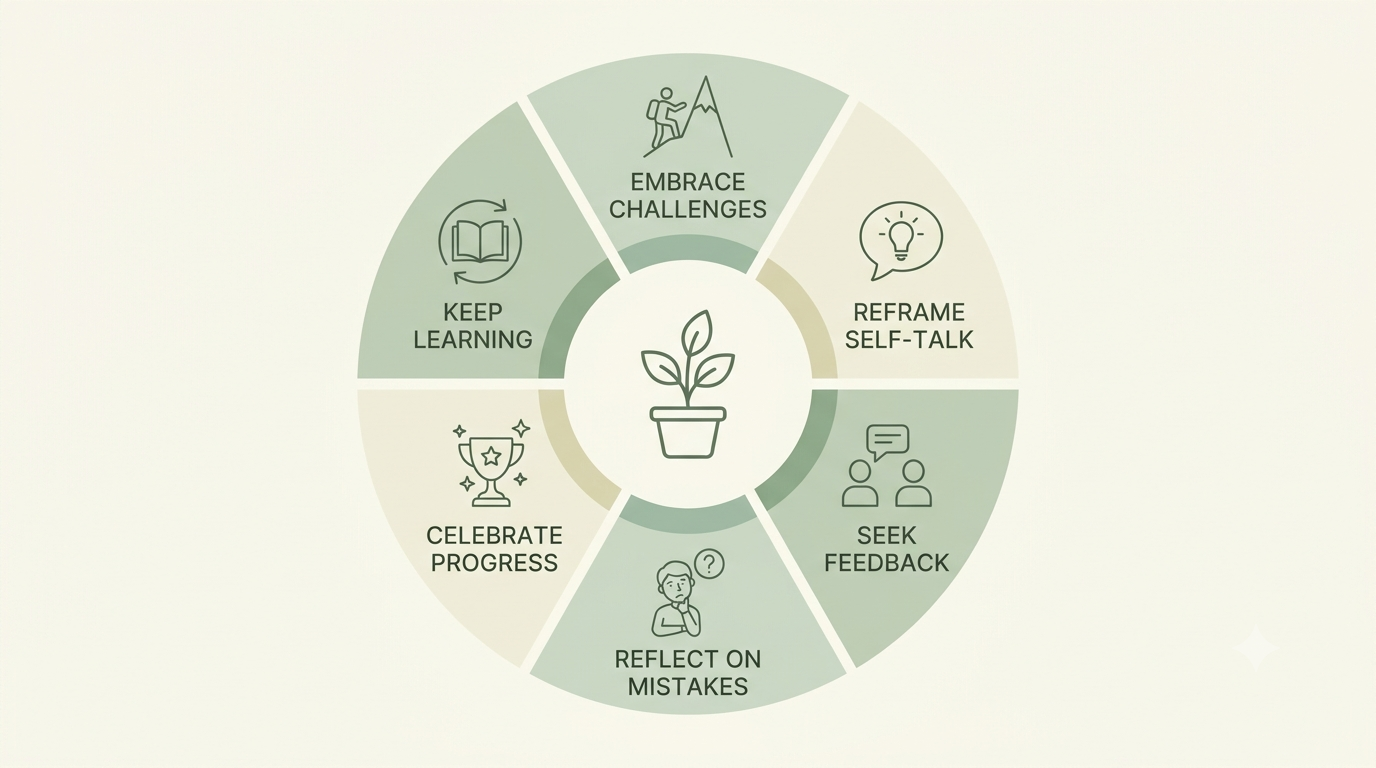
Applying growth mindset principles consistently requires specific habits rather than general intention:
- Embracing challenges: Deliberately choosing tasks slightly beyond your current skill level.
- Replacing negative self-talk: Substituting fixed statements (“I can’t do this”) with growth-oriented ones (“I can’t do this yet”).
- Seeking feedback: Actively requesting input rather than avoiding it out of fear of criticism.
- Reflecting on mistakes: Reviewing what specifically went wrong and what to adjust next time.
- Celebrating progress: Acknowledging incremental improvement rather than only final results.
- Lifelong learning: Treating skill-building as ongoing rather than something finished after a course or milestone.
Examples from Real-Life Situations
- Students: Reviewing a failed test to identify specific weak areas rather than concluding the subject is “not for them.”
- Professionals: Asking a manager for direct feedback after a project instead of assuming performance is fixed.
- Entrepreneurs: Treating a failed product launch as market data to refine the next attempt.
- Parents: Praising a child’s effort and strategy on a task rather than only praising the result.
- Athletes: Reviewing game footage after a loss to identify adjustments rather than attributing the loss to lack of natural talent.
In our experience helping readers build better habits, the growth mindset principles that stick long-term are the ones tied to a specific, repeatable behavior — such as a weekly reflection habit — rather than a general commitment to “think positively.”
Common Misunderstandings About Growth Mindset
Several misconceptions have grown around Dweck’s work as it has become more widely popularized:
- Growth mindset is not the same as simply “thinking positively” — it involves specific beliefs about how ability develops, not general optimism.
- Effort alone is not sufficient without effective strategies; Dweck’s later research clarified that unproductive effort does not lead to improvement.
- Failure is valuable primarily when it is followed by reflection and adjustment, not simply endured.
- A growth mindset requires ongoing persistence and adaptation — it is not a one-time realization but a continuing practice.
Beginner Mistakes When Trying to Develop a Growth Mindset
Common early mistakes include:
- Expecting instant change: Mindset shifts happen gradually through repeated practice, not overnight. This is best addressed by tracking small wins over weeks rather than expecting immediate transformation.
- Avoiding constructive criticism: Beginners often still interpret feedback personally. This improves by intentionally requesting feedback in low-stakes situations first.
- Confusing motivation with discipline: Relying on feeling motivated rather than building consistent habits. This is prevented by scheduling specific practice times regardless of mood.
- Comparing yourself to others: Measuring progress against other people rather than your own baseline. This is addressed by tracking personal progress metrics instead.
- Fearing mistakes: Avoiding challenging tasks to prevent visible failure. This is countered by deliberately choosing tasks with some risk of failure.
- Giving up after setbacks: Treating one failure as proof the goal is unreachable. This is prevented by building a habit of reviewing setbacks for specific lessons before deciding whether to continue.
Growth Mindset in Different Areas of Life
Education
Growth mindset principles support students by reframing grades and feedback as tools for improvement rather than fixed judgments of ability.
Career
In professional settings, growth mindset supports skill development, adaptability to new roles, and resilience after setbacks like a missed promotion or a difficult project.
Leadership
Leaders who apply growth mindset principles tend to reward effort and learning within their teams, which research links to higher long-term engagement and innovation.
Parenting
Parents who emphasize effort and strategy over fixed praise (“you’re so smart”) tend to raise children who persist longer through difficult tasks.
Sports
Athletes benefit from growth mindset by treating losses and injuries as part of a longer development process rather than as fixed limitations.
Personal Development
Beyond formal domains, growth mindset supports habit-building, creative pursuits, and general lifelong learning by keeping focus on process over fixed identity.
Difficulty & Time Investment
Developing a growth mindset is generally considered beginner-friendly, since it does not require special tools, training, or prior expertise — only consistent self-reflection and behavior change. That said, the pace and difficulty vary by individual. People with deeply ingrained fixed-mindset habits, often built over years, may find the shift more gradually than someone encountering the concept for the first time. Consistency matters more than intensity: brief, regular reflection tends to produce more durable change than occasional, intense effort. Personal factors — such as past experiences with failure, current stress levels, and environment — also influence how quickly the shift takes hold, so realistic expectations are important from the outset.
Results Timeline
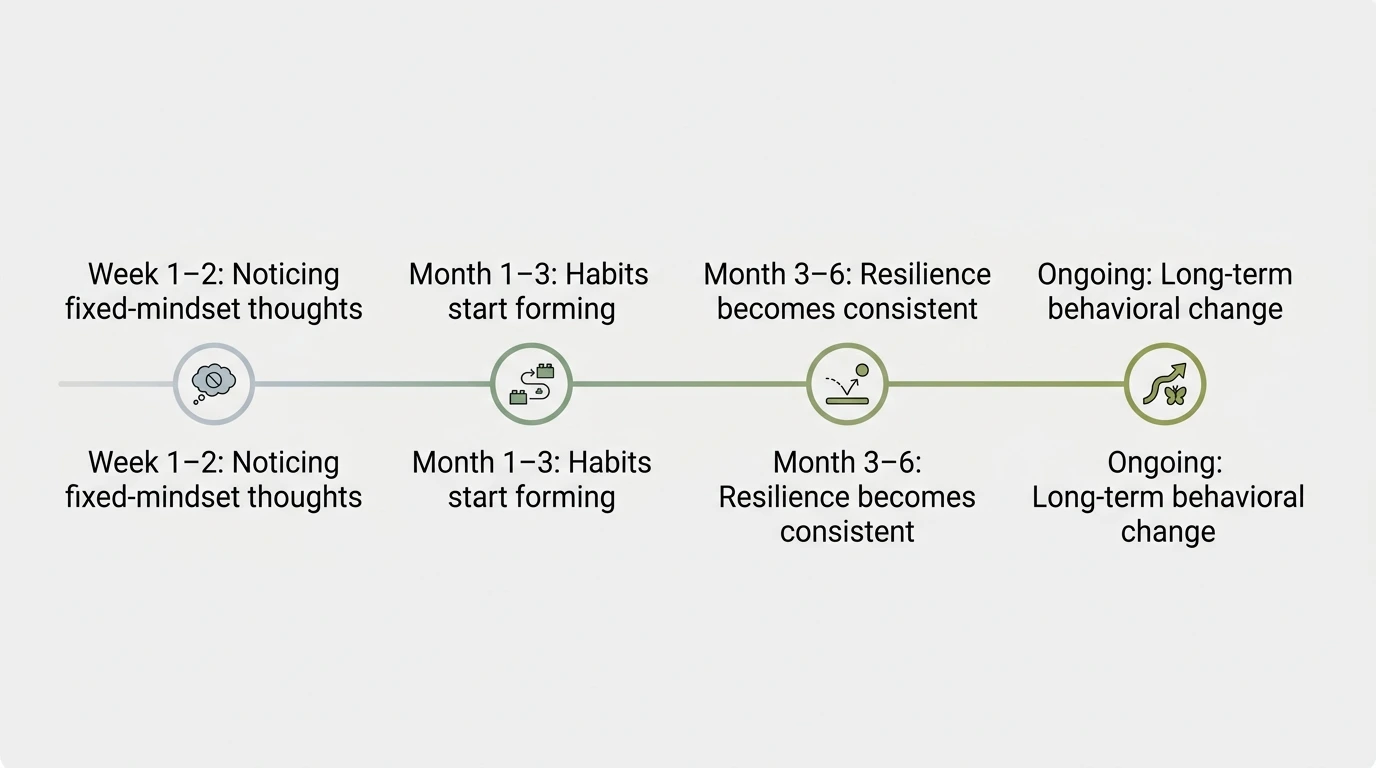
Growth mindset shifts typically unfold in stages rather than all at once. Early changes often appear within the first few weeks as small shifts in self-talk — noticing and reframing fixed-mindset thoughts as they occur. Behavioral habits, such as consistently seeking feedback or reflecting on setbacks, tend to solidify over one to three months of regular practice. Long-term changes in resilience and confidence, particularly in high-stakes areas like career or academic performance, often take several months to become consistent. Progress is rarely linear — setbacks and lapses into fixed-mindset thinking are common and do not indicate failure of the process. Factors such as environment, support systems, and how often a person practices reflection all influence how quickly progress becomes noticeable.
Practice Guide
Building and sustaining a growth mindset benefits from structured practices:
- Daily reflection prompts: Briefly reviewing one challenge faced that day and how it was approached.
- Journaling: Recording setbacks alongside specific lessons learned from them.
- Goal setting: Framing goals around skill development rather than only fixed outcomes.
- Reading habits: Regularly engaging with material on psychology or behavioral science to reinforce concepts.
- Feedback routines: Scheduling regular check-ins with a mentor, manager, or peer to request input.
- Weekly progress reviews: Assessing what worked, what didn’t, and what to adjust going forward.
- Accountability strategies: Sharing goals with another person to maintain consistency.
- Maintaining motivation over time: Revisiting the reasons behind a goal during periods of low motivation, rather than relying solely on initial enthusiasm.
Your Daily Thrive recommends starting with just one of these practices — such as a short weekly review — before adding others, since sustainable habit change tends to build more reliably from a single consistent behavior.
Conclusion
Growth mindset quotes by Carol Dweck are most valuable not as standalone inspiration but as reminders of a research-backed framework: that abilities develop through effort, reflection, and persistence rather than being fixed from birth. The core lessons across her work consistently point in the same direction — learning matters more than perfection, persistence matters more than raw talent, and personal progress matters more than comparison to others. Applying these principles consistently, through specific habits like reflection and feedback-seeking, produces far more durable change than simply memorizing the quotes themselves. The lasting takeaway from Dweck’s growth mindset theory is straightforward: how you interpret challenges shapes how far you’re able to grow from them.
Frequently Asked Questions (FAQ)
What does Carol Dweck say about a growth mindset?
Carol Dweck describes a growth mindset as the belief that abilities and intelligence can be developed through effort, learning, and effective strategies, rather than being fixed traits.
How does Carol Dweck define a growth mindset?
Dweck defines it as a belief system in which challenges, effort, and feedback are viewed as opportunities to build ability, contrasted with a fixed mindset that treats talent as unchangeable.
What is the difference between a growth mindset and a fixed mindset?
A growth mindset views abilities as improvable through effort and learning, while a fixed mindset views abilities as static traits that cannot meaningfully change.
What is Carol Dweck’s most famous growth mindset quote?
Her most widely referenced idea reframes failure using the concept of “not yet,” suggesting that not mastering something today doesn’t mean it can’t be mastered with continued effort.
Why are growth mindset quotes helpful for students?
They help students reframe setbacks, exams, and difficult subjects as opportunities to improve specific skills rather than evidence of fixed limitations.
Can adults develop a growth mindset?
Yes. Growth mindset principles apply at any age and are commonly used in career development, parenting, leadership, and personal growth contexts, not only in childhood education.
How can I practice a growth mindset every day?
Daily practice includes reflecting on challenges, replacing fixed self-talk with growth-oriented language, seeking feedback, and reviewing mistakes for specific lessons rather than avoiding them.
How does growth mindset influence success and resilience?
It supports success and resilience by encouraging persistence after setbacks, treating feedback as useful information, and focusing on long-term skill development rather than short-term outcomes.










4 Responses