

Introduction
A resolute mindset is the capacity to stay firmly committed to a goal or value, even when obstacles, doubt, or discomfort appear. Rather than depending on temporary motivation, this mindset relies on consistent judgment and a clear sense of purpose. Understanding the resolute mindset meaning helps clarify what does resolute mindset mean in practical terms: it is a pattern of thought and behavior, not a fixed personality trait. The resolute meaning centers on firmness, determination, and unwavering commitment. This quality matters across personal growth, relationships, careers, and long-term goals, because sustained progress rarely comes from bursts of enthusiasm alone — it comes from steady, deliberate follow-through.
Quick Summary
- A resolute mindset is the ability to stay determined and committed despite challenges or setbacks.
- It combines clear purpose, resilience, consistency, and disciplined decision-making.
- Developing a resolute mindset involves strengthening habits, emotional control, and long-term thinking.
- Unlike scarcity thinking, a resolute mindset focuses on purposeful action rather than fear or limitation.
What Is a Resolute Mindset?
Resolute Mindset Meaning
The resolute mindset meaning refers to a way of thinking defined by steady commitment to goals, values, or decisions, regardless of short-term difficulty. What does resolute mindset mean in daily practice? It means choosing consistent action over fluctuating motivation. A mindset is a mental framework that shapes how a person interprets challenges, while personality reflects broader, more stable traits. A resolute mindset can be intentionally built, whereas personality tends to shift more slowly. A common misunderstanding is equating resolve with rigidity — a resolute mindset still allows for adaptation, as long as the underlying commitment to the goal remains intact.
Resolute Meaning Explained
The resolute definition, drawn from standard dictionary usage, describes someone admirably purposeful, determined, and unwavering in their decisions. Resoluteness definition centers on firmness of character and steadiness under pressure. Resolutely meaning refers to acting in a determined, unhesitating manner. Meaning of resolutely and meaning of resolute both point to the same core idea: committing fully to a course of action and following through despite resistance. This adjective applies directly to behavior — a resolute decision is one made with clarity and carried out with consistency, not one abandoned at the first sign of difficulty.
Core Characteristics of a Resolute Mindset
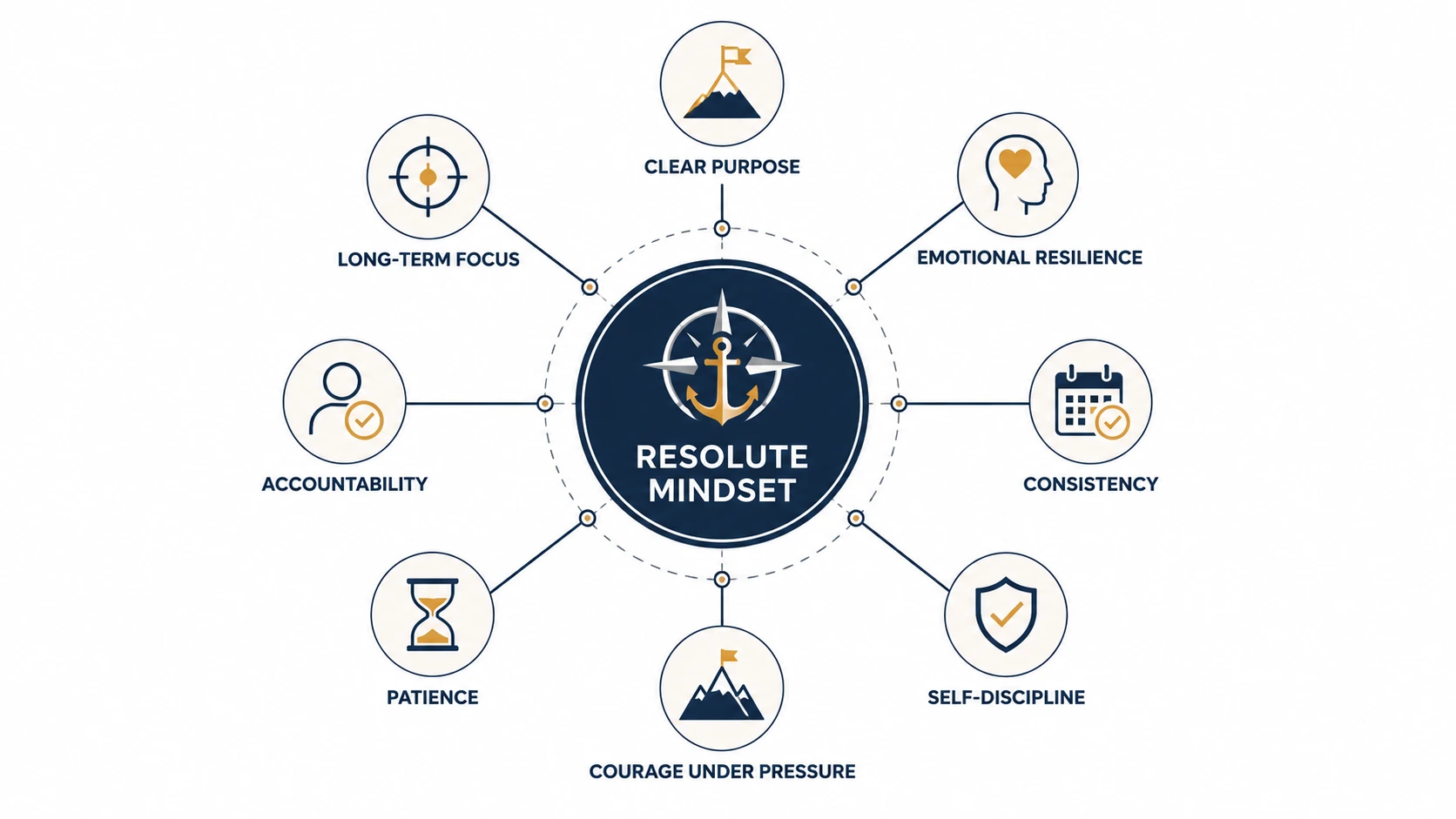
Psychological and behavioral research on determination and goal pursuit points to several recurring traits associated with a resolute mindset:
- Clear purpose — a well-defined sense of what matters and why
- Emotional resilience — the ability to recover from setbacks without abandoning goals
- Consistency — repeated action over time, rather than sporadic effort
- Self-discipline — the capacity to act according to intention rather than impulse
- Courage under pressure — willingness to make difficult decisions when needed
- Patience — tolerance for delayed results
- Accountability — ownership of outcomes and decisions
- Long-term focus — prioritizing sustained progress over immediate comfort
These traits work together; resoluteness definition in practice is less about a single quality and more about how these behaviors reinforce one another.
Why a Resolute Mindset Matters
Personal Growth
A resolute mindset supports personal growth by building confidence through repeated follow-through on commitments. It improves decision-making, since choices are guided by clear priorities rather than momentary emotion. It also improves emotional stability, as setbacks are processed as temporary rather than defining. Add this sentence: “These compounding effects are part of a broader picture of how you can grow as a person over time.
Professional Success
In professional contexts, resolve underlies effective leadership, since leaders who demonstrate steady commitment tend to earn greater trust. Persistence through difficult projects and setbacks is closely tied to long-term goal achievement, particularly in competitive or high-pressure environments.
Relationships
In relationships, a resolute mindset shows up as commitment to shared goals, reliability in following through on promises, and trust built through consistent behavior. It also supports healthy communication, since resolved individuals are less likely to avoid difficult conversations out of short-term discomfort.
Resolute Mindset vs Scarcity Mindset
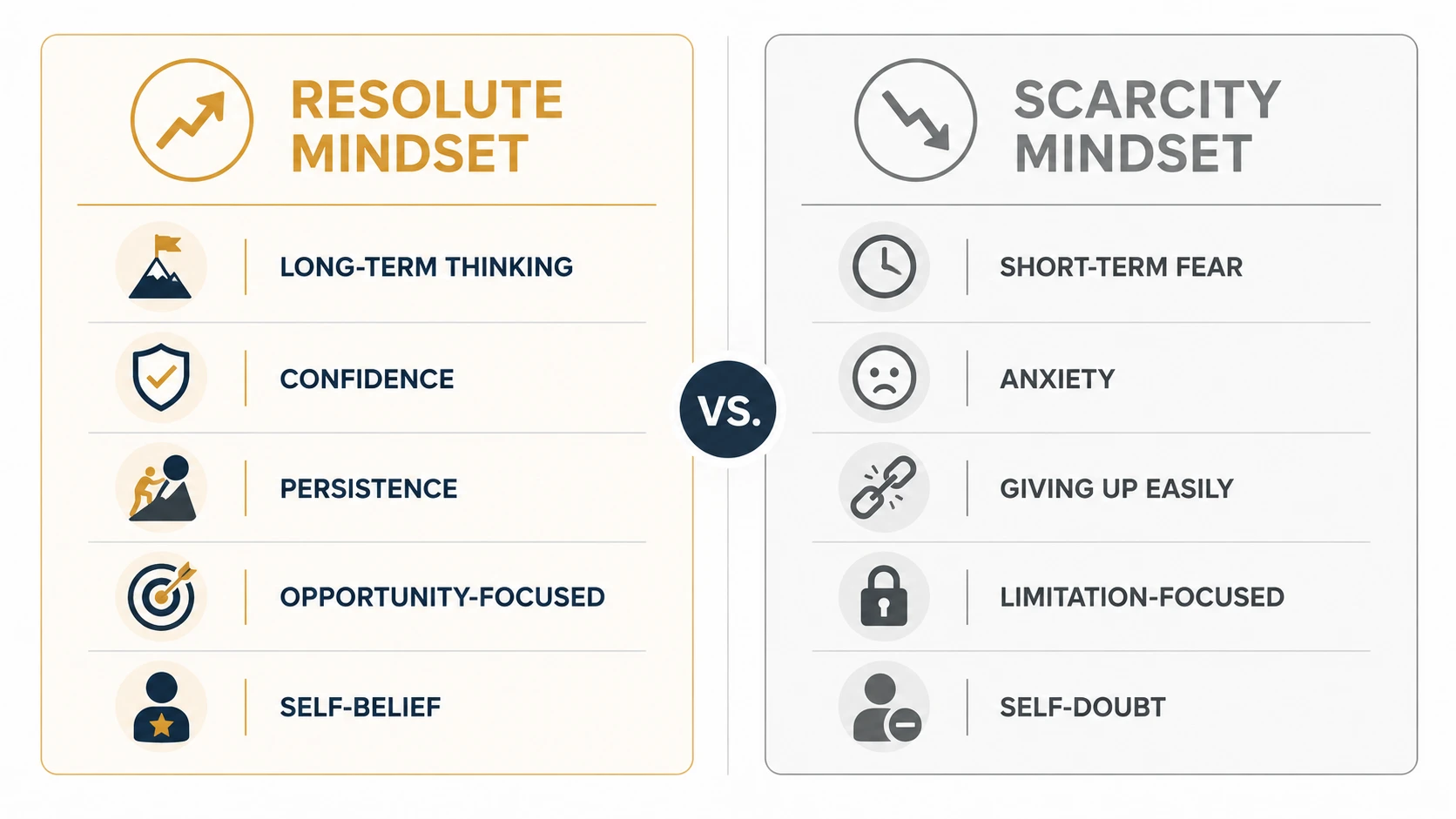
A resolute mindset and a scarcity mindset lead to very different patterns of decision-making, confidence, and opportunity recognition. Scarcity mindset vs abundance mindset comparisons often highlight fear-based thinking versus growth-based thinking; a resolute mindset aligns closely with the growth-oriented side of that spectrum. What causes scarcity mindset patterns often includes past financial hardship, chronic stress, or repeated experiences of loss, which can condition the brain to focus on limitation. Understanding why do I have a scarcity mindset is often the first step toward change. Learning how to stop having a scarcity mindset and how to change scarcity mindset typically involves deliberately shifting focus toward long-term opportunity and reinforcing consistent, purposeful action — the same behaviors that build a resolute mindset.
| Resolute Mindset | Scarcity Mindset |
|---|---|
| Long-term thinking | Short-term fear |
| Confidence | Anxiety |
| Persistence | Giving up easily |
| Opportunity-focused | Limitation-focused |
| Self-belief | Self-doubt |
How to Develop a Resolute Mindset
Build Clear Goals
Start with a defined vision of the desired outcome, then break it into priorities and daily focus areas. Clarity reduces hesitation, which is a common barrier to consistent action. For readers who struggle with inconsistent drive, learning how to build discipline without motivation is often the more sustainable path than waiting to feel inspired.
Strengthen Self-Discipline
Self-discipline develops through habit formation, practicing delayed gratification, and maintaining consistency even when motivation is low. In our experience helping readers build better habits, discipline grows fastest when tied to small, repeatable daily actions rather than large, infrequent efforts.
Improve Emotional Resilience
Resilience is strengthened by learning to manage setbacks constructively, handle criticism without abandoning goals, and recover from failure through reflection rather than avoidance.
Develop Positive Self-Talk
Internal dialogue shapes confidence. Replacing self-critical language with constructive, growth-oriented self-talk reinforces a growth mindset and supports sustained effort over time.
Commit to Continuous Learning
Ongoing reflection, openness to feedback, and adaptability allow a resolute mindset to remain effective rather than rigid. Your Daily Thrive recommends scheduling regular check-ins to assess what is working and adjust accordingly.
Common Challenges When Building a Resolute Mindset
Several factors commonly interfere with building mental resolve:
- Fear of failure, which discourages taking necessary risks
- Lack of consistency, which undermines habit formation
- Self-doubt, which weakens follow-through
- Procrastination, which delays meaningful action
- Negative environments, which reduce motivation and reinforce old patterns
- Unrealistic expectations, which lead to discouragement when progress is gradual
Practical Daily Habits That Strengthen Mental Resolve
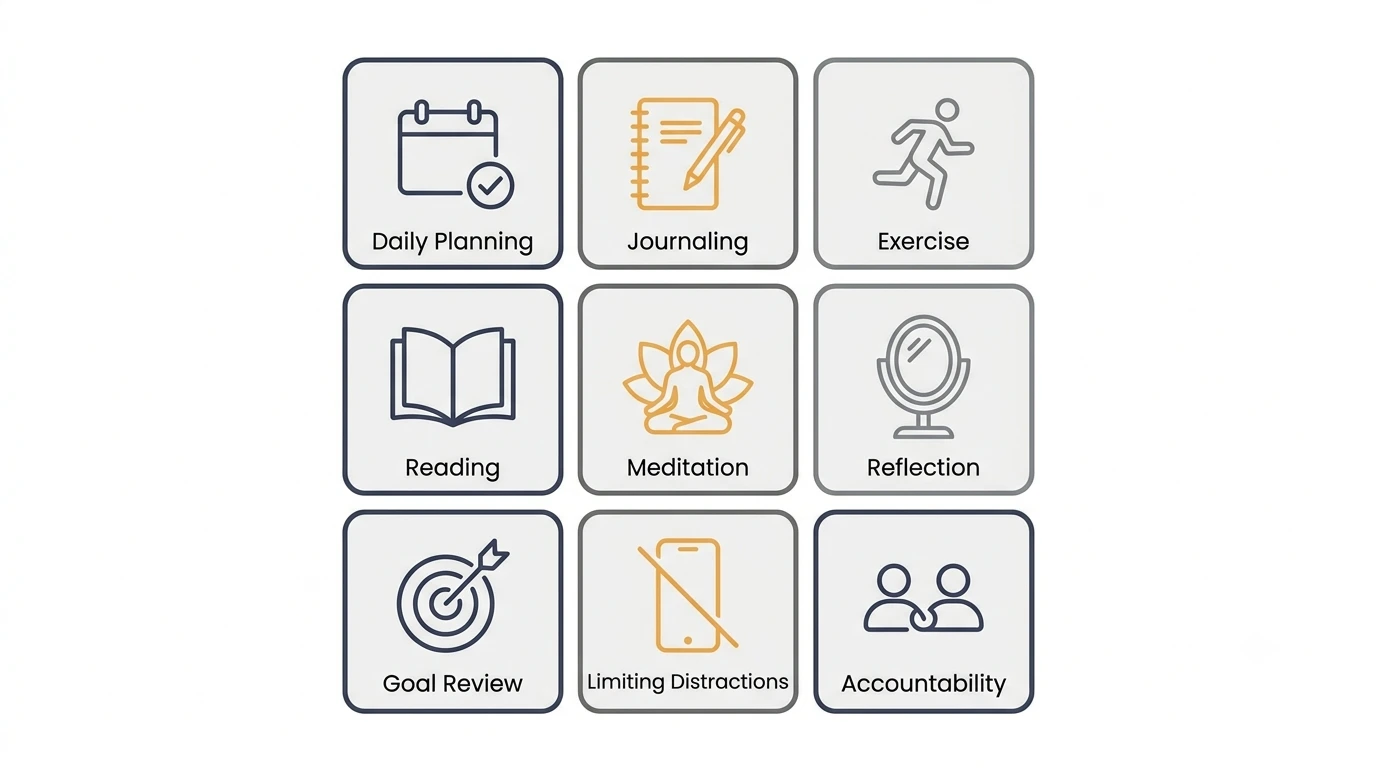
- Daily planning
- Journaling
- Regular exercise
- Reading
- Meditation
- Reflection
- Goal review
- Limiting distractions
- Accountability systems
Consistent use of these habits, even in small amounts, tends to build resolve more effectively than occasional intense effort. Many readers find that these small habits that changed my life-style shifts compound faster than large, infrequent efforts.
Beginner Mistakes That Prevent a Resolute Mindset
Common early mistakes include confusing determination with stubbornness, which prevents necessary adaptation. Other frequent errors include setting unrealistic goals, ignoring rest and recovery, seeking motivation instead of building discipline, comparing personal progress with others, and quitting after temporary setbacks rather than treating them as expected parts of the process.
Different Ways a Resolute Mindset Applies in Everyday Life
Career and Work
Resolve supports steady performance, persistence through challenging projects, and long-term career advancement.
Education
In academic settings, a resolute mindset helps sustain focus through difficult coursework and long study timelines.
Health and Fitness
Consistency in exercise and nutrition habits depends heavily on resolve, particularly when visible results are delayed.
Marriage and Relationships
A resolute marriage mindset reflects sustained commitment, consistent effort, and reliability, all of which support long-term relationship stability.
Personal Development
Across personal development efforts, resolve provides the consistency needed to translate intentions into lasting change.
Related Personality Traits Often Associated With a Resolute Mindset
These traits are related to, but not identical to, a resolute mindset:
- Resolute personality meaning — a general tendency toward firmness and determination across situations
- Resolute and confident personality meaning — combining steady resolve with self-assurance in decision-making
- Faithful and helping personality meaning — reliability and supportiveness toward others, often paired with commitment
- Consistent and correct personality meaning — steady, principled behavior over time
- Social and cheerful personality meaning — a positive, engaged disposition, which is distinct from resolve but can coexist with it
Resolute Mindset vs Determination, Discipline, and Resilience
| Concept | Primary Focus | Best Used When |
|---|---|---|
| Resolute mindset | Long-term commitment | Major goals |
| Determination | Immediate effort | Difficult tasks |
| Discipline | Consistent action | Daily habits |
| Resilience | Recovery | Setbacks |
Difficulty & Time Investment
Building a resolute mindset is beginner-friendly at the starting point but requires moderate long-term commitment to become habitual. Consistency matters more than intensity — small daily actions compound more effectively than occasional large efforts. Individual differences in learning speed and lifestyle factors, such as workload, stress levels, and support systems, also influence how quickly progress occurs.
Results Timeline
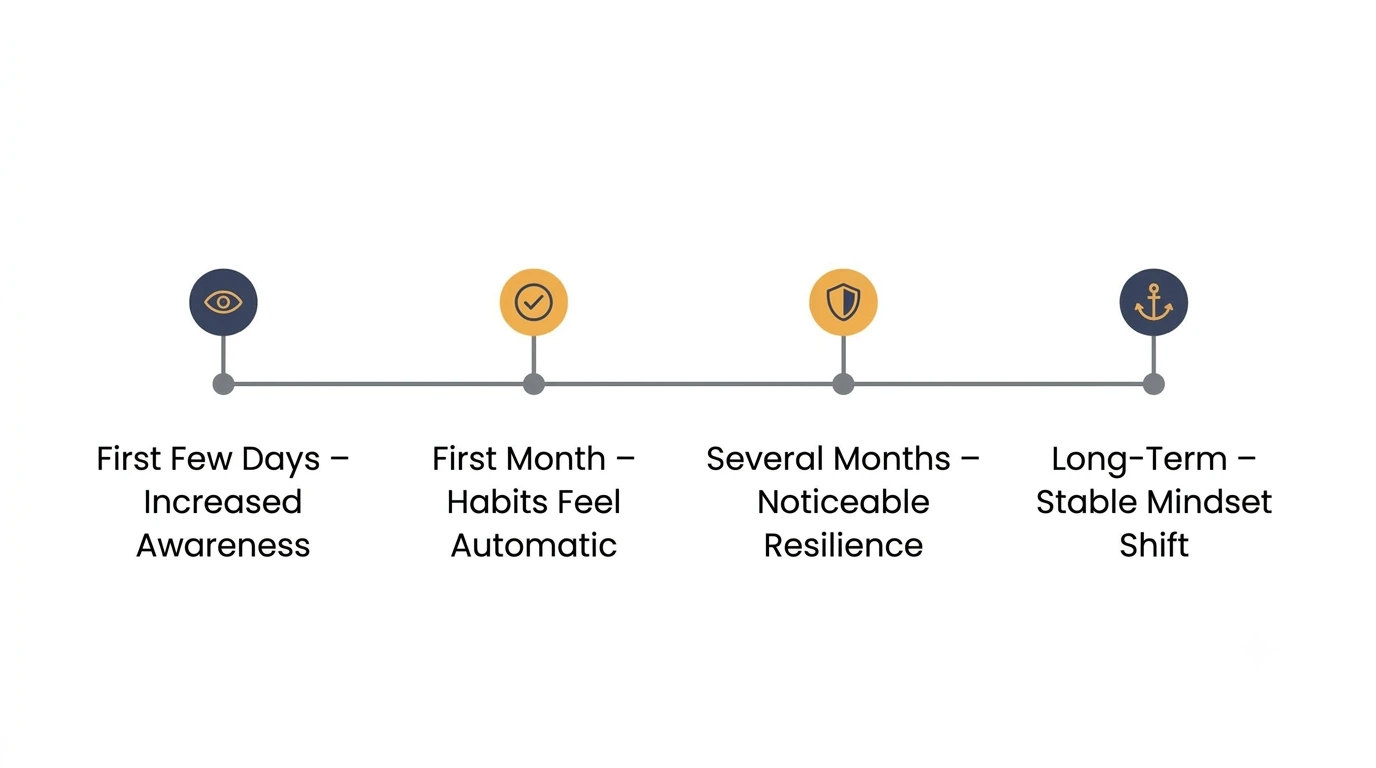
In the first few days, initial changes typically involve increased awareness of decision-making patterns. Within the first month, small habits often begin to feel more automatic. Over several months, noticeable improvements in consistency and emotional resilience commonly appear. Long-term personality development, including a more stable resolute mindset, generally takes sustained effort over a year or more. Progress varies depending on existing habits, environment, and consistency.
Practice Guide
Effective practice for building a resolute mindset includes:
- Daily routines built around clear priorities
- Weekly reviews to assess progress
- Goal tracking to maintain visibility
- Journaling to process setbacks and insights
- Reflection exercises to reinforce learning
- Accountability partners to support consistency
- Motivation strategies for lower-energy periods
- Sustainable long-term habits rather than short-term intensity
- Adjustments for different lifestyles and schedules
Frequently Overlooked Factors That Influence Mental Resolve
Several underlying factors significantly affect a person’s capacity for resolve, yet are often overlooked:
- Sleep quality, which directly affects self-control and decision-making
- Physical health, which influences energy and consistency
- Emotional regulation, which supports steady responses under stress
- Social environment, which can reinforce or undermine commitment
- Stress management, since chronic stress depletes willpower
- Identity and self-belief, which shape whether goals feel achievable
- Decision fatigue, which reduces the quality of choices later in the day
As of 2026, behavioral science increasingly emphasizes these environmental and physiological factors alongside traditional willpower-based approaches to building resolve.
Conclusion
A resolute mindset is the ability to remain committed to meaningful goals despite obstacles, discomfort, or setbacks. It matters across personal growth, career development, and relationships because sustained progress depends on consistency rather than fleeting motivation. Building this mindset involves clear goal-setting, self-discipline, emotional resilience, positive self-talk, and ongoing learning. Consistency over perfection remains the most reliable path forward — small, repeated actions build lasting resolve more effectively than occasional bursts of effort. Readers looking to strengthen their own resolute mindset can begin with deliberate daily practice, using the habits and strategies outlined above.
Frequently Asked Questions
What does a resolute mindset mean?
A resolute mindset means staying firmly committed to goals or values despite challenges, relying on consistent action rather than fluctuating motivation.
How is a resolute mindset different from a growth mindset?
A resolute mindset focuses on sustained commitment and follow-through, while a growth mindset centers on the belief that abilities can improve through effort; the two often work together but describe different aspects of thinking.
Can anyone develop a resolute mindset?
Yes, a resolute mindset can be developed by anyone through consistent habits, clear goal-setting, and deliberate practice over time, rather than requiring a fixed personality type.
What habits strengthen a resolute mindset the fastest?
Daily planning, goal tracking, journaling, and accountability systems tend to build resolve most quickly when practiced consistently.
How long does it take to build a resolute mindset?
Initial changes often appear within a month, while stable, lasting resolve generally develops over several months to a year of consistent practice.
Is being resolute the same as being stubborn?
No, resolve involves firm commitment while remaining open to adjustment, whereas stubbornness involves resisting change even when it would be beneficial.
How does a resolute mindset help during difficult times?
A resolute mindset provides emotional stability and clear direction during setbacks, allowing individuals to recover and continue working toward goals rather than abandoning them.
Can a resolute mindset improve relationships and career success?
Yes, resolve supports reliability, trust, and follow-through, which strengthen both personal relationships and professional performance over time.