
Introduction
The comparison of mindset vs attitude comes up often in conversations about learning, careers, and personal development, and the two words are frequently used as if they mean the same thing. They don’t. A mindset is the underlying mental framework a person uses to interpret challenges, effort, and growth, while attitude is the emotional stance someone takes toward a specific situation, person, or experience in the moment. Understanding what is a mindset and what is attitude — and how they differ — matters because each one shapes behavior, motivation, and decision-making in distinct ways. Grasping the mindset definition and the attitude meaning gives a clearer foundation for improving both.
Quick Summary
- Mindset is the underlying way a person thinks and interprets challenges, learning, and growth.
- Attitude is a person’s emotional outlook or response toward a situation, person, or experience.
- A mindset tends to be deeper and longer-lasting, while attitudes often change depending on circumstances.
- Developing both a growth-oriented mindset and a positive attitude supports better learning, resilience, and decision-making.
What Is a Mindset?
Mindset Definition
A mindset is the core set of beliefs and thinking patterns a person uses to interpret ability, effort, and challenges. This is the clearest way to define mindset: it is not a passing feeling but a mental framework that stays relatively stable across many situations. The mindset definition matters because it shapes how someone reacts to failure, feedback, and new information — someone who sees ability as fixed will respond very differently to a setback than someone who sees ability as something that can be developed. Mindset meaning, in practical terms, comes down to the internal “operating system” behind decision-making. Because a mindset is deeply rooted in belief, it tends to influence long-term behavior more than any single emotional reaction does. Understanding this distinction also explains why a growth mindset is important for long-term learning and resilience.
How Mindsets Develop
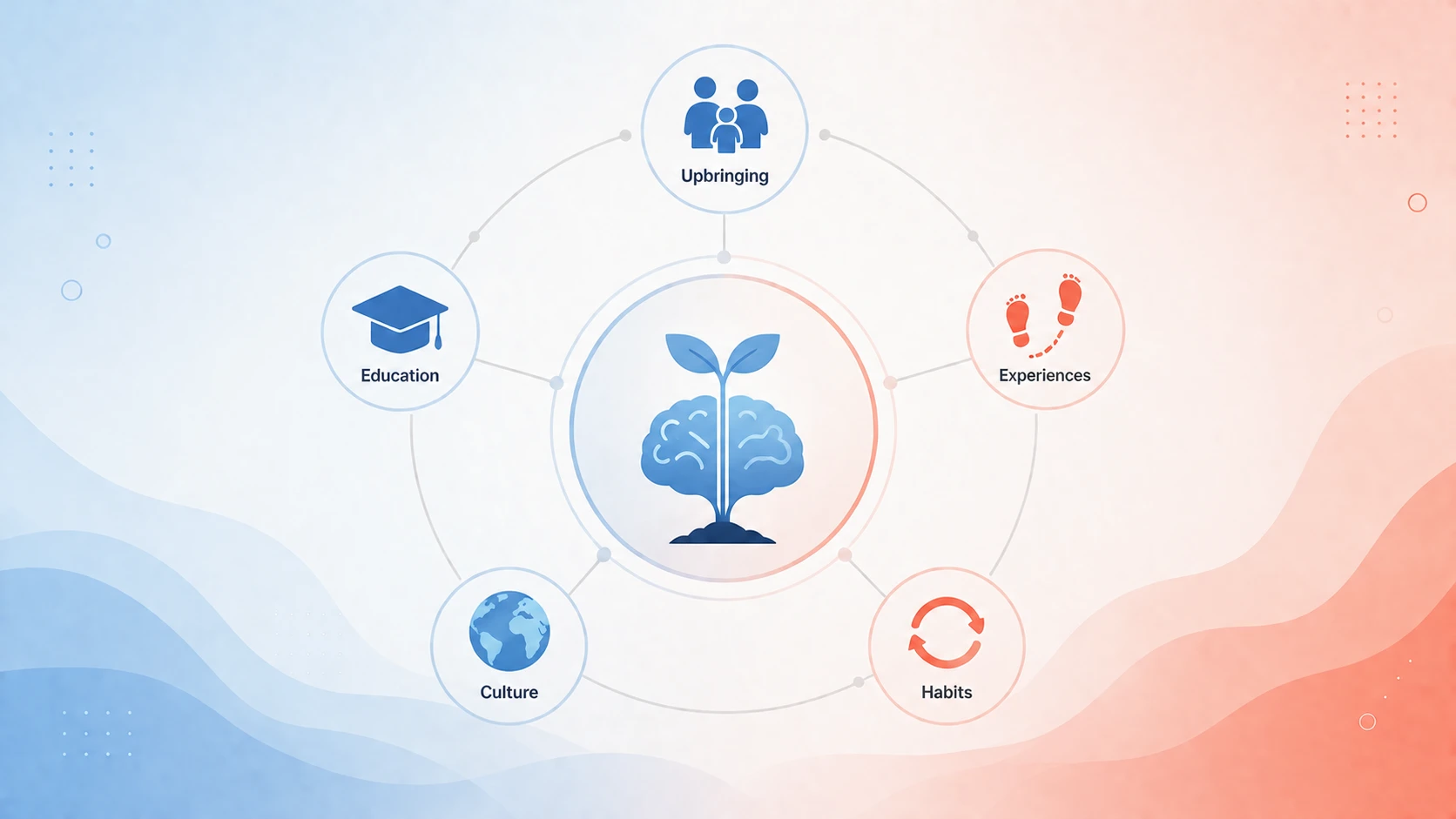
Mindsets form gradually, shaped by several long-term influences:
- Upbringing — early messages about intelligence, effort, and failure from parents or caregivers
- Education — how teachers respond to mistakes and effort versus results
- Experiences — patterns of success, failure, and recovery over time
- Culture — societal beliefs about ability, status, and achievement
- Repeated habits — consistent ways of responding to challenges that eventually become automatic
Because mindsets are built through repetition and reinforcement, they can also be reshaped through the same process. Learning new information, reflecting on past reactions, and consciously practicing different responses to setbacks can shift a mindset over time, even though the process is typically slower than changing an attitude.
What Is an Attitude?
Attitude Definition
Attitude meaning centers on a person’s evaluative or emotional response to something specific — a task, a person, an event, or a moment in time. To define attitude simply: it is how someone currently feels about a situation, and that feeling can shift based on context. What is attitude, in practice? It is closer to a mood or stance than a deep belief system. Attitudes are shaped by immediate circumstances and can differ from one situation to the next, which is why a person might have a positive attitude at work but a frustrated attitude in traffic on the same day. When these situational triggers go unmanaged, they can develop into a recurring attitude problem rather than a one-off reaction.
How Attitudes Are Formed
Attitudes are shaped by more immediate and situational factors, including:
- Personal experiences with a specific person, task, or environment
- Existing beliefs that get triggered by a particular context
- Emotional state at the time (stress, fatigue, excitement)
- Social influences, including the mood of people nearby
Because attitudes are tied closely to circumstances and emotions, they tend to change more quickly than mindsets. A single conversation, piece of feedback, or change in environment can shift an attitude almost immediately, while a mindset usually requires sustained effort to change.
Mindset vs Attitude: What Is the Difference?
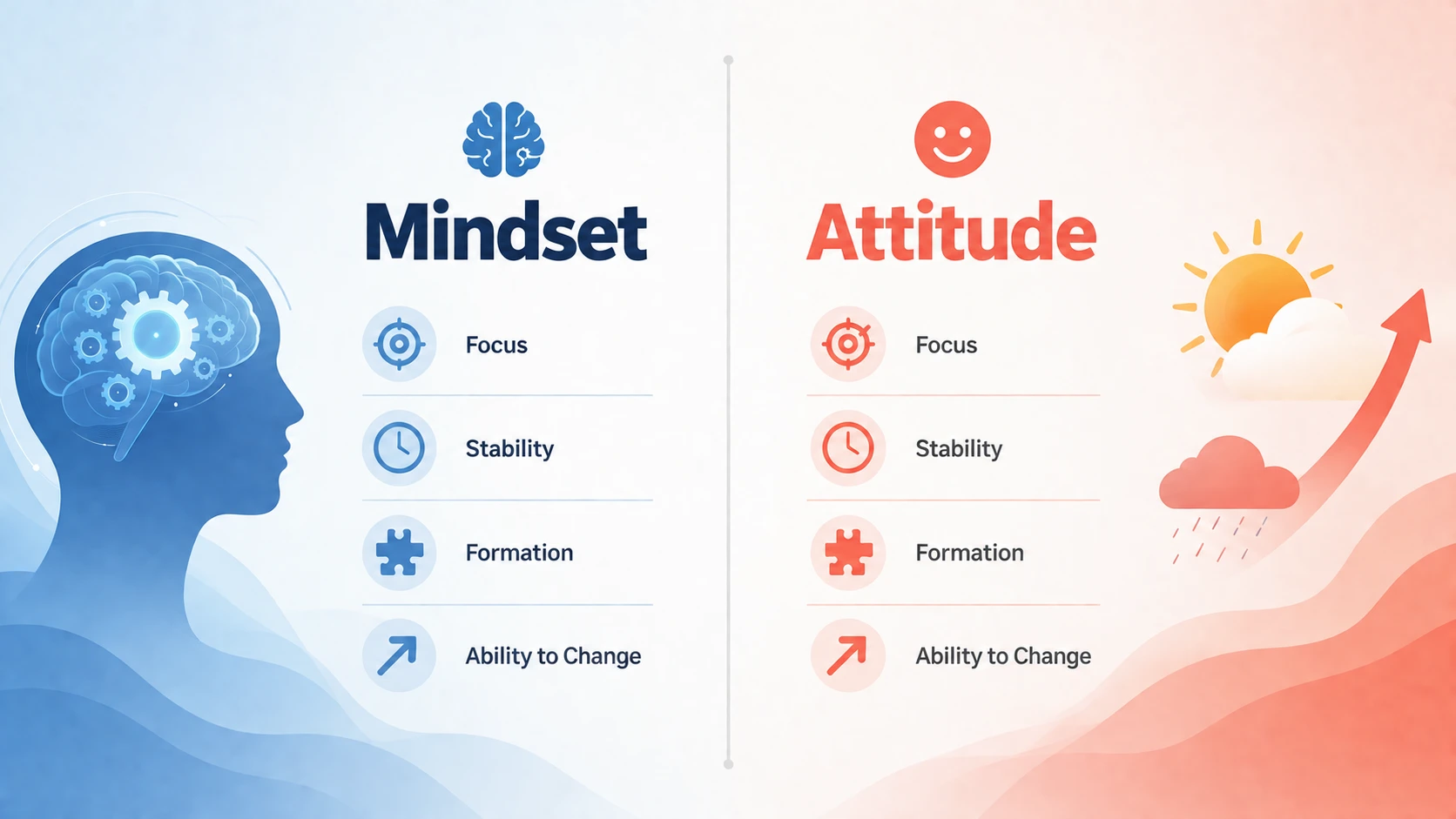
The mindset vs attitude difference comes down to depth and stability. Mindset is a long-term belief system about ability and growth, while attitude is a short-term emotional response to a specific situation. Mindset vs attitude definition comparisons consistently point to this same core distinction: mindset shapes how someone interprets challenges over time, and attitude shapes how someone reacts in the moment.
Side-by-Side Comparison
| Feature | Mindset | Attitude |
|---|---|---|
| Definition | A person’s underlying belief system about ability and growth | A person’s emotional or evaluative response to a situation |
| Focus | Long-term thinking patterns | Immediate feelings and reactions |
| Stability | Relatively stable over time | Can shift quickly with context |
| Formation | Upbringing, education, culture, repeated experience | Immediate experiences, mood, social influence |
| Influence on Behavior | Shapes overall approach to challenges and learning | Shapes reactions to specific events or people |
| Ability to Change | Changes gradually through sustained effort and reflection | Can change rapidly with a shift in perspective or circumstances |
| Typical Examples | Believing skills can be developed through effort | Feeling optimistic about a specific meeting or task |
Mindset vs Mentality vs Attitude
These three terms are often confused because they all describe internal states that influence behavior, but each has a distinct scope. Mindset refers to a person’s overall belief system about growth and ability. Mentality is broader and often reflects a shared way of thinking within a group or community, such as a “team mentality” or a “scarcity mentality.” Attitude is the most situational of the three, describing an emotional response to a specific moment. The difference between attitude and mentality is that mentality usually reflects a collective or habitual way of thinking, while attitude reflects an individual’s response to a single context.
When Each Term Is Most Appropriate
- Everyday conversation: “attitude” is used casually to describe someone’s mood or demeanor
- Psychology: “mindset” is used to describe cognitive frameworks, such as fixed vs. growth mindset
- Education: “mindset” is common when discussing student motivation and learning approaches
- Professional settings: “attitude” often describes workplace conduct, while “mindset” describes long-term career approach
Mindset and Attitude Examples
Everyday Life Examples
- School: A student with a growth mindset views a failed test as a learning opportunity, while their attitude that day might still be frustration or disappointment.
- Work: An employee may have a strong professional mindset about long-term skill-building while having a tired or short-tempered attitude during a stressful week.
- Sports: An athlete with a resilient mindset keeps training after a loss, even if their attitude in the moment is disappointment.
- Relationships: A person with a mindset focused on growth may approach conflict as an opportunity to understand a partner better, even when their immediate attitude is frustration.
- Learning new skills: Someone with a growth mindset expects early struggle as part of the process, while their attitude toward a specific difficult lesson might be temporary irritation.
Positive vs Negative Examples
A mindset and attitude example that illustrates the difference clearly: a person can maintain a stable, growth-oriented mindset while their attitude fluctuates from one day to the next due to stress, sleep, or circumstances. Conversely, someone can display a consistently positive attitude in social settings while still holding a fixed mindset that limits how they respond to setbacks. These scenarios show that mindset remaining stable while attitude shifts — or attitude staying upbeat while mindset stays rigid — are both common and important distinctions to recognize.
Positive Mindset vs Positive Attitude
A positive mindset and a positive attitude are related but not interchangeable. A positive mindset means believing that abilities and circumstances can improve through effort and learning. A positive attitude means approaching a specific situation with optimism, energy, or good humor. The similarity is that both contribute to resilience and well-being. The key difference in the positive attitude vs positive mindset comparison is durability: a positive attitude can appear even without a positive mindset (someone can smile through a bad day without believing they can improve), and a positive mindset doesn’t guarantee a positive attitude in every single moment. Having one does not automatically produce the other.
Which Has the Greater Long-Term Impact?
- Learning: Mindset has a stronger long-term effect, since it shapes how a person responds to repeated challenges.
- Career: Mindset tends to influence long-term skill development, while attitude affects day-to-day workplace relationships.
- Relationships: Both matter — mindset shapes how conflict is approached over time, while attitude affects daily interactions.
- Personal growth: Mindset generally has the greater long-term impact, since it determines whether setbacks are seen as permanent or temporary.
Why Mindset and Attitude Influence Personal Growth
Mindset and attitude both play a role in shaping personal growth, though through different mechanisms. Mindset affects motivation by determining whether effort feels worthwhile, and it affects resilience by shaping how setbacks are interpreted. Attitude affects confidence in specific situations and influences decision-making in the moment, particularly under stress. Both concepts also shape problem-solving and learning: a growth-oriented mindset supports persistence through difficulty, while a constructive attitude supports clearer thinking during challenges. In our experience helping readers build better habits, the readers who make the most consistent progress are the ones who work on both — reshaping long-term beliefs about growth while also managing their day-to-day emotional responses.
Can You Change Your Mindset and Attitude?
Changing Your Mindset
Mindset change is gradual and typically involves: Much of this process starts with learning how to change your thoughts around failure and effort.
- Self-awareness — noticing automatic thoughts about ability and failure
- Learning — exposure to new information that challenges fixed beliefs
- Reflection — reviewing past reactions to setbacks and identifying patterns
- Habit building — consistently practicing growth-oriented responses
- Feedback — using external input to adjust self-perception over time
Improving Your Attitude
Attitude change tends to happen more quickly and can be supported through:
- Emotional regulation — managing immediate reactions before responding
- Gratitude — shifting focus toward positive aspects of a situation
- Perspective shifts — reframing a challenge as temporary or manageable
- Stress management — reducing the emotional load that shapes reactions
- Daily choices — intentionally choosing a constructive response in the moment
Common Misconceptions About Mindset and Attitude
- “They mean exactly the same thing.” Mindset and attitude describe different psychological processes — one long-term, one situational.
- “Positive thinking alone changes mindset.” Mindset change requires sustained behavior and belief shifts, not just optimistic self-talk.
- “Attitudes never change.” Attitudes are actually among the more flexible aspects of behavior and can shift with context.
- “Mindsets are permanent.” Research on growth mindset shows that mindsets can shift with sustained effort and new experiences.
- “One is more important than the other.” Both play distinct, complementary roles in behavior and well-being.
Common Mistakes When Trying to Develop a Better Mindset
- Expecting immediate change: Mindset shifts happen gradually; expecting overnight results often leads to giving up too soon. The fix is tracking small shifts in thinking rather than looking for instant transformation.
- Ignoring habits: A mindset is reinforced by daily behavior, so focusing only on beliefs without adjusting habits limits progress. Building small, repeatable routines helps translate belief into behavior.
- Confusing optimism with growth mindset: Being upbeat is not the same as believing ability can be developed through effort. Distinguishing the two prevents surface-level change that doesn’t hold up under pressure.
- Focusing only on motivation: Motivation is temporary, while mindset requires consistent practice regardless of how someone feels that day. Building systems and routines reduces dependence on motivation alone.
- Neglecting self-reflection: Without reviewing past reactions to setbacks, it’s difficult to notice patterns that need to change. Regular reflection — through journaling or review — helps identify where fixed thinking still shows up.
Practical Ways to Build a Healthy Mindset and Positive Attitude
Daily Practices
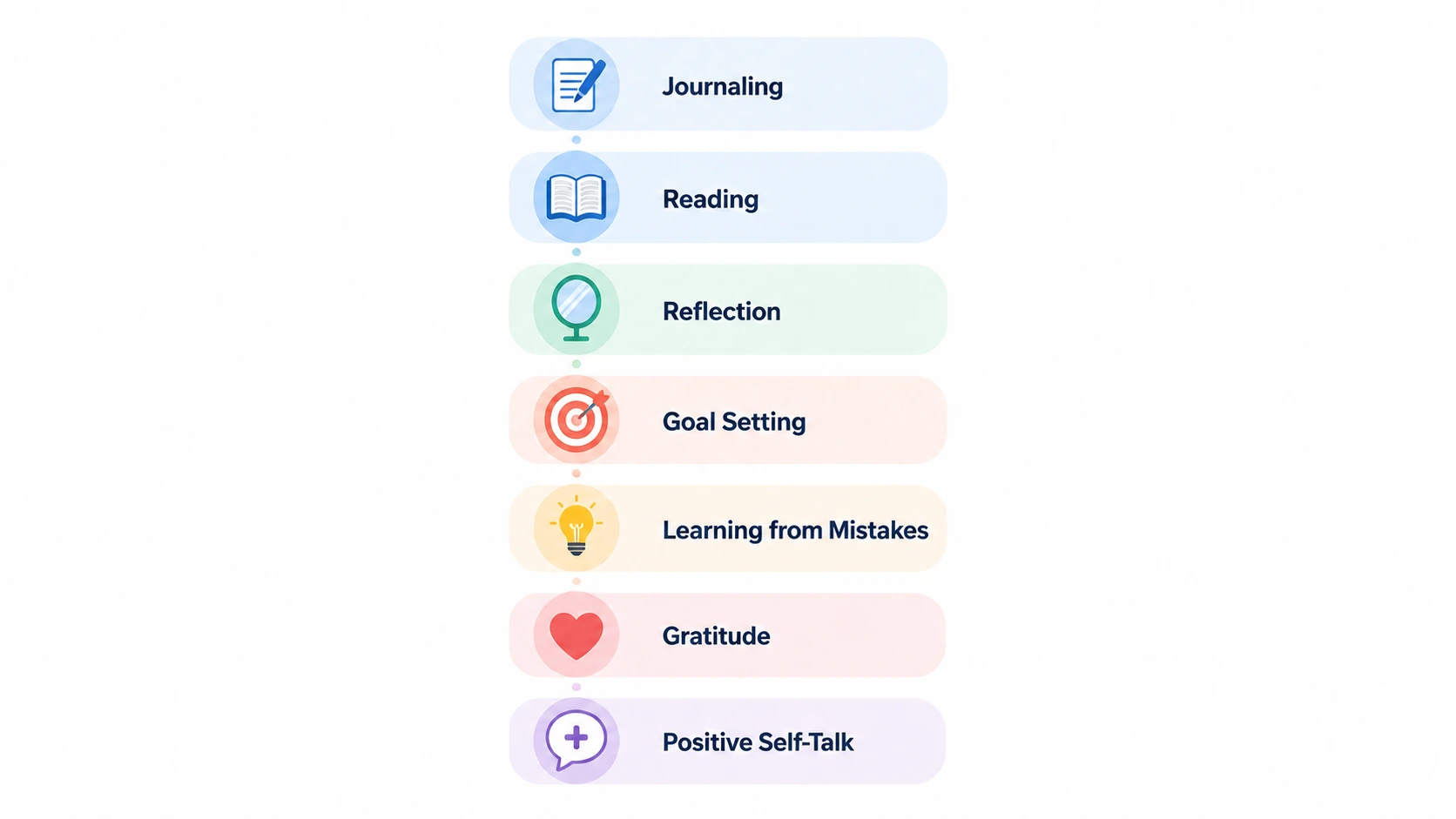
- Journaling — recording thoughts and reactions to identify patterns
- Reading — exposing the mind to new perspectives and frameworks
- Reflection — reviewing daily challenges and responses
- Goal setting — creating clear, achievable markers of progress
- Learning from mistakes — treating setbacks as information rather than failure
- Gratitude — noting positive aspects of the day to support a constructive attitude
- Positive self-talk — replacing self-critical language with constructive framing
Weekly Review Habits
- Tracking progress — reviewing wins and setbacks from the week
- Identifying limiting beliefs — noticing recurring fixed-mindset thoughts
- Adjusting behaviors — making small changes based on what worked or didn’t
- Continuous improvement — treating growth as an ongoing process rather than a one-time fix
Difficulty & Time Investment
Building a healthier mindset generally requires more sustained effort than adjusting attitude, since it involves reshaping long-held beliefs rather than reacting to a single moment. For beginners, simple daily practices like journaling or gratitude notes are low-effort starting points that build awareness without requiring major lifestyle changes. More advanced work — such as actively reframing long-standing fixed beliefs about ability — takes more consistent effort over weeks or months. Difficulty also varies by individual: personality traits, past experiences, and current stress levels all influence how much effort mindset work requires. Someone with a strong support system or low current stress may find the process easier than someone navigating multiple life pressures at once.
Results Timeline
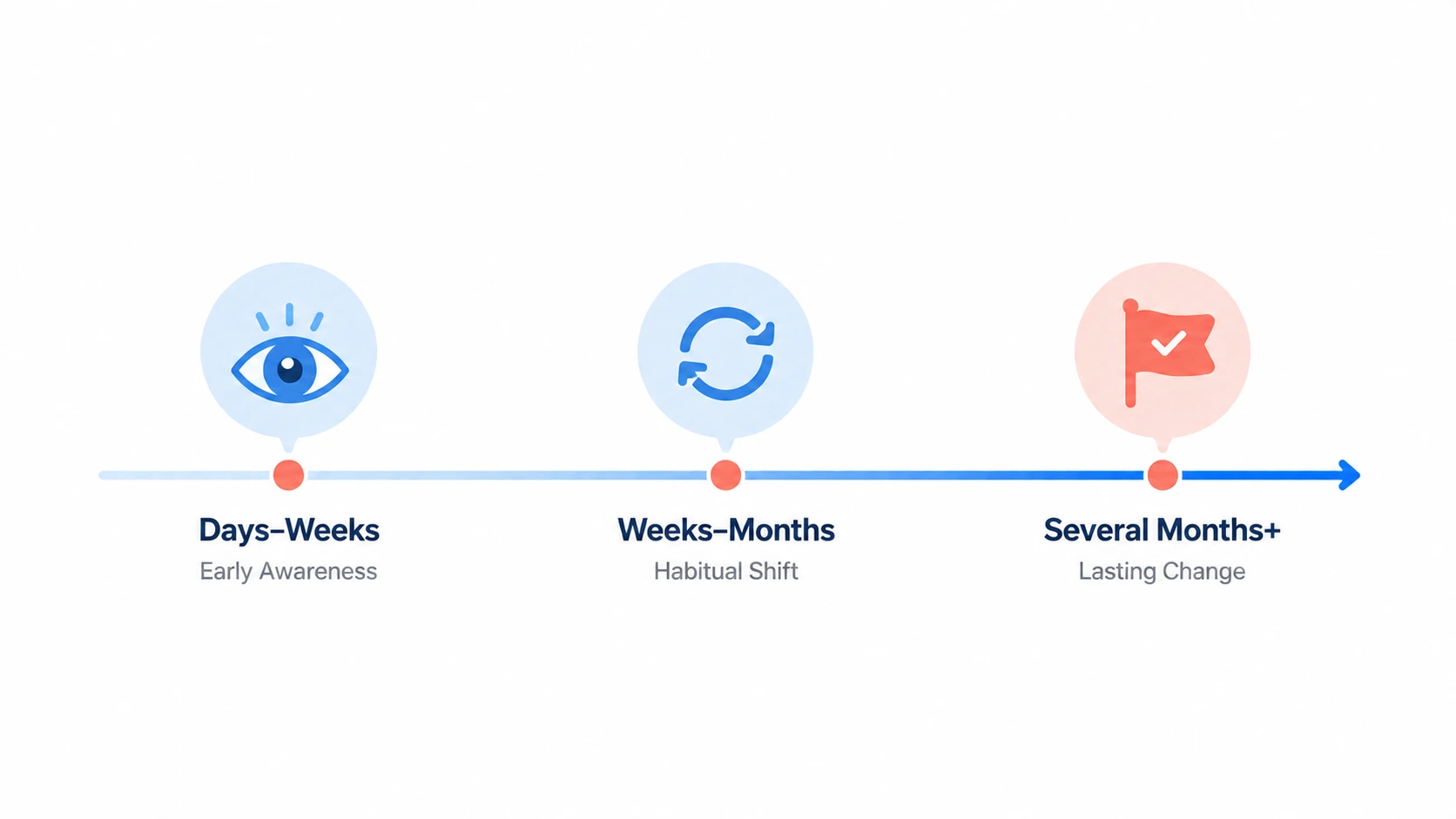
Mindset shifts typically follow a gradual pattern rather than a sudden change. In the early stages (days to a few weeks), people usually notice small increases in self-awareness — catching fixed-mindset thoughts as they happen. Over the following weeks to months, consistent practice tends to shift habitual responses to setbacks, making growth-oriented thinking feel more automatic. Long-term behavioral change — where a growth mindset becomes the default response to challenges — generally takes several months of consistent practice. Progress speed depends on factors such as consistency of practice, the presence of ongoing stressors, and how deeply rooted the original beliefs were.
Practice Guide
Daily Routine
- Reflection — a few minutes reviewing the day’s challenges and responses
- Reading — even short amounts of material that reinforce growth-oriented thinking
- Goal review — checking progress against personal or professional goals
- Gratitude practice — noting a few positive elements of the day
- Learning mindset — approaching at least one daily task as a learning opportunity rather than a test
Staying Consistent
- Accountability — sharing goals with someone else or tracking progress visibly
- Habit tracking — using a simple log or checklist to reinforce daily practices
- Motivation management — building routines that don’t rely solely on feeling motivated
- Handling setbacks — treating missed days as information, not failure
- Sustainable long-term practices — choosing habits realistic enough to maintain indefinitely
How Mindset and Attitude Apply in Different Situations
Students
A growth mindset helps students persist through difficult material, while a constructive attitude supports better focus and classroom engagement day to day.
Professionals
In the workplace, mindset shapes long-term career development and willingness to take on new challenges, while attitude affects daily collaboration, communication, and team dynamics.
Leaders
Leaders benefit from a growth mindset when navigating uncertainty and setbacks, and a steady, constructive attitude helps maintain morale and trust within a team.
Athletes
Athletic performance depends on a resilient mindset to sustain training through plateaus and losses, while attitude affects focus and composure during competition.
Personal Relationships
A flexible, growth-oriented mindset supports working through conflict constructively over time, while attitude shapes the tone of day-to-day interactions with partners, friends, and family.
Conclusion
The mindset vs attitude comparison comes down to depth and timing: mindset is the long-term belief system that shapes how someone interprets growth, effort, and setbacks, while attitude is the shorter-term emotional response to specific situations. Mindset tends to change gradually through sustained reflection and practice, while attitude can shift more quickly with perspective and emotional regulation. Developing both — a resilient, growth-oriented mindset alongside a constructive, adaptable attitude — supports stronger learning, better relationships, and more consistent personal growth over time. Understanding mindset vs attitude isn’t just a matter of definitions; it’s a practical foundation for building lasting positive change.
Frequently Asked Questions
Is mindset the same as attitude?
No. Mindset is a long-term belief system about ability and growth, while attitude is a shorter-term emotional response to a specific situation or experience.
Which is more important: mindset or attitude?
Neither is inherently more important; they serve different roles. Mindset shapes long-term behavior and resilience, while attitude affects day-to-day interactions and immediate decision-making.
Can a person have a positive attitude but a fixed mindset?
Yes. Someone can display optimism and positivity in daily interactions while still holding fixed beliefs about their own ability to grow or change in specific areas.
How does mindset affect everyday decisions?
Mindset influences how a person interprets challenges and setbacks, which shapes whether they persist, avoid difficulty, or seek out learning opportunities in daily decisions.
Can attitudes change faster than mindsets?
Yes. Attitudes are tied to immediate circumstances and emotions, so they can shift quickly, while mindsets require sustained reflection and practice to change.
What is the difference between mindset, mentality, and attitude?
Mindset is an individual’s belief system about growth and ability, mentality often reflects a shared or habitual way of thinking within a group, and attitude is a situational emotional response.
How can I improve both my mindset and attitude?
Improving mindset involves self-awareness, reflection, and consistent habit-building over time, while improving attitude involves emotional regulation, gratitude, and intentional daily choices in the moment.