
Introduction
A poverty mindset bible discussion often begins with a critical distinction: financial hardship and poverty thinking are not the same thing. The Bible addresses both material circumstances and the internal attitudes — fear, scarcity, hopelessness, and distrust — that can shape a person’s relationship with money, purpose, and God. Scripture speaks to the condition of the heart as much as to the realities of need. Understanding what the Bible actually teaches about poverty mindset meaning, stewardship, contentment, and faith provides a more complete and honest framework than many popular treatments of this topic offer.
Quick Summary
- A poverty mindset refers to patterns of thinking centered on fear, scarcity, or hopelessness — not simply having little money.
- The Bible distinguishes financial circumstances from internal attitudes such as faith, stewardship, generosity, and contentment.
- Scripture does not use the phrase “poverty mindset,” but its teachings on renewing the mind, trusting God, and wise stewardship directly relate to overcoming limiting beliefs.
- Biblical abundance refers to spiritual maturity, wisdom, and purpose — not a guaranteed promise of financial wealth.
- Overcoming unhealthy thinking is typically a gradual process involving spiritual growth, practical action, and consistent habits.
What Is a Poverty Mindset? {#what-is-a-poverty-mindset}
Poverty Mindset Meaning
A poverty mindset is a pattern of thought and belief built around fear of lack, scarcity, and the assumption that resources — whether financial, relational, or personal — are permanently limited. It is defined not by income level but by how a person perceives, approaches, and responds to the circumstances of their life.
What is a poverty mindset? At its core, it is a set of deeply held beliefs that position struggle as permanent, opportunity as inaccessible, and improvement as unlikely. A person living in genuine financial difficulty may not carry a poverty mindset, while someone with material security may think in ways that reflect ongoing fear and scarcity. What is a poor person mindset, then? It is less about a bank balance and more about whether a person believes they are capable of change, worthy of growth, or permitted to hope for something better.
Common characteristics include:
- Persistent fear of running out of resources
- Difficulty making long-term decisions due to short-term anxiety
- Reluctance to invest time, money, or energy in personal growth
- A tendency to compare negatively with others
- Avoidance of financial responsibility or planning
- A belief that success, provision, or improvement is reserved for others
Poverty Mindset Psychology
Poverty mindset psychology examines how repeated experiences of hardship, instability, or lack can shape deeply held beliefs and automatic responses. Research in behavioral economics and psychology — including scarcity theory developed by Sendhil Mullainathan and Eldar Shafir — demonstrates that a prolonged focus on what is lacking can narrow cognitive bandwidth, making it harder to plan, prioritize, or think beyond immediate pressures.
Limiting beliefs are learned. When a person grows up in an environment of financial stress, relational instability, or consistent messages that resources are unavailable, those experiences create neural pathways that function as default assumptions. Fear becomes a decision-making lens. Opportunity may go unrecognized because the mind has been trained to expect disappointment.
Biblical principles and psychology overlap at a meaningful point: both recognize that thinking patterns are not fixed. Psychology calls this cognitive restructuring; Scripture calls it the renewing of the mind. Both acknowledge that change is possible, requires intentional effort, and is shaped significantly by the environment and community surrounding a person.
Where they differ is in the source and sustaining power of transformation. Biblical teaching locates lasting change not only in mental discipline but in a relationship with God that addresses fear, provides purpose, and reorients identity.
What Does the Bible Say About a Poverty Mindset?
Does the Bible Actually Use the Term “Poverty Mindset”?
The phrase “poverty mindset” does not appear in Scripture. It is a modern psychological and self-help construct that has been imported into biblical discussions. This is an important clarification, because reading any contemporary framework backward into the Bible risks distorting what Scripture actually teaches.
That said, the Bible addresses the underlying realities that the concept points toward: fear, hopelessness, distorted beliefs about God, failure to exercise wisdom or stewardship, and the destructive power of anxiety and comparison. The absence of the exact term does not mean biblical teaching is irrelevant — it means readers should approach the topic carefully, allowing Scripture to define its own terms rather than forcing modern categories onto ancient texts.
Biblical Principles Related to a Poverty Mindset
Several biblical themes speak directly to patterns of thought and belief that poverty mindset discussions address. These include:
Trust in God. Scripture consistently calls people away from anxious striving and toward dependence on God as provider. This is not an invitation to passivity, but a reorientation of where security is ultimately grounded. Proverbs, the Psalms, and the teachings of Jesus all address worry about provision and redirect attention toward trust.
Wisdom. The wisdom literature of the Old Testament — particularly Proverbs — treats careful thinking, planning, and sound decision-making as virtues. Poverty mindset biblical teaching implicitly appears in passages that contrast hasty, fear-driven choices with deliberate, patient wisdom.
Stewardship. Biblical stewardship treats everything a person has — time, money, skills, relationships — as entrusted rather than owned. This perspective shifts the question from “how do I protect what little I have?” to “how do I use what I have been given responsibly?”
Contentment. The apostle Paul describes contentment as something learned rather than inherited, a disciplined orientation toward sufficiency that does not depend on circumstances. This is distinct from passive resignation — it is an active, cultivated response to life.
Generosity. Counterintuitively, Scripture frequently links generosity with a mindset of abundance rather than scarcity. Those who give freely are described in multiple biblical contexts as those who ultimately flourish — not necessarily financially, but in terms of character, relationships, and purpose.
Diligence. Proverbs in particular connects consistent effort with long-term fruit. The poverty mindset Bible treatment often focuses on beliefs, but Scripture also emphasizes behavior — practical engagement with work, planning, and responsibility.
Hope. Biblical hope is not optimism in the generic sense. It is a confident expectation grounded in the character of God. For people trapped in hopelessness — a core feature of poverty thinking — the biblical category of hope offers a substantively different foundation than positive thinking alone.
Renewing the Mind. Romans 12:2 is perhaps the most directly relevant passage in poverty mindset biblical discussions. The call to be transformed by the renewing of the mind assumes that thought patterns can change and that such change is spiritually meaningful.
Bible Verses Often Connected to Overcoming a Poverty Mindset
Key Bible Verses About Trust, Wisdom, and Provision
Several passages are frequently cited in poverty mindset Bible verse discussions. Among them:
Passages in Proverbs address the relationship between diligence and provision, between wise planning and stability, and between generosity and flourishing. These verses ground practical wisdom in moral and spiritual principles rather than presenting financial success as the result of spiritual merit alone.
Philippians 4 contains Paul’s well-known discussion of contentment and anxiety, in which he describes a peace that surpasses understanding as available to those who bring their concerns to God. This is frequently referenced in discussions about breaking the spirit of poverty Bible verses, particularly as a counter to chronic worry and scarcity thinking.
Matthew 6 includes Jesus’s extended teaching on anxiety, provision, and priorities. Jesus does not promise the absence of financial struggle but calls his followers to a different orientation — one in which ultimate trust is placed in God rather than in the accumulation of resources.
Deuteronomy and the Prophets contain passages that speak to God’s concern for the materially poor, the ethical obligations of communities to care for those in need, and the dangers of both wealth-driven arrogance and poverty-driven despair.
Understanding Biblical Context
A responsible poverty mindset Bible verse approach requires attention to context. Many passages frequently cited in this discussion come from wisdom literature, poetry, or specific historical narratives and were not written as universal financial promises.
Proverbs, for example, describes general patterns and tendencies rather than guaranteed individual outcomes. A verse connecting diligence with provision describes a common pattern — not a formula that eliminates all possibility of struggle for the faithful.
Prosperity theology — the view that faith reliably produces material wealth — represents a significant departure from the full biblical witness. Scripture contains abundant examples of faithful people experiencing hardship, and numerous warnings against treating material abundance as a measure of spiritual standing. Applying biblical principles about mindset, trust, and stewardship requires holding these passages in tension with the full scope of what Scripture teaches about suffering, perseverance, and hope.
Signs of a Poverty Mentality
Emotional and Behavioral Signs
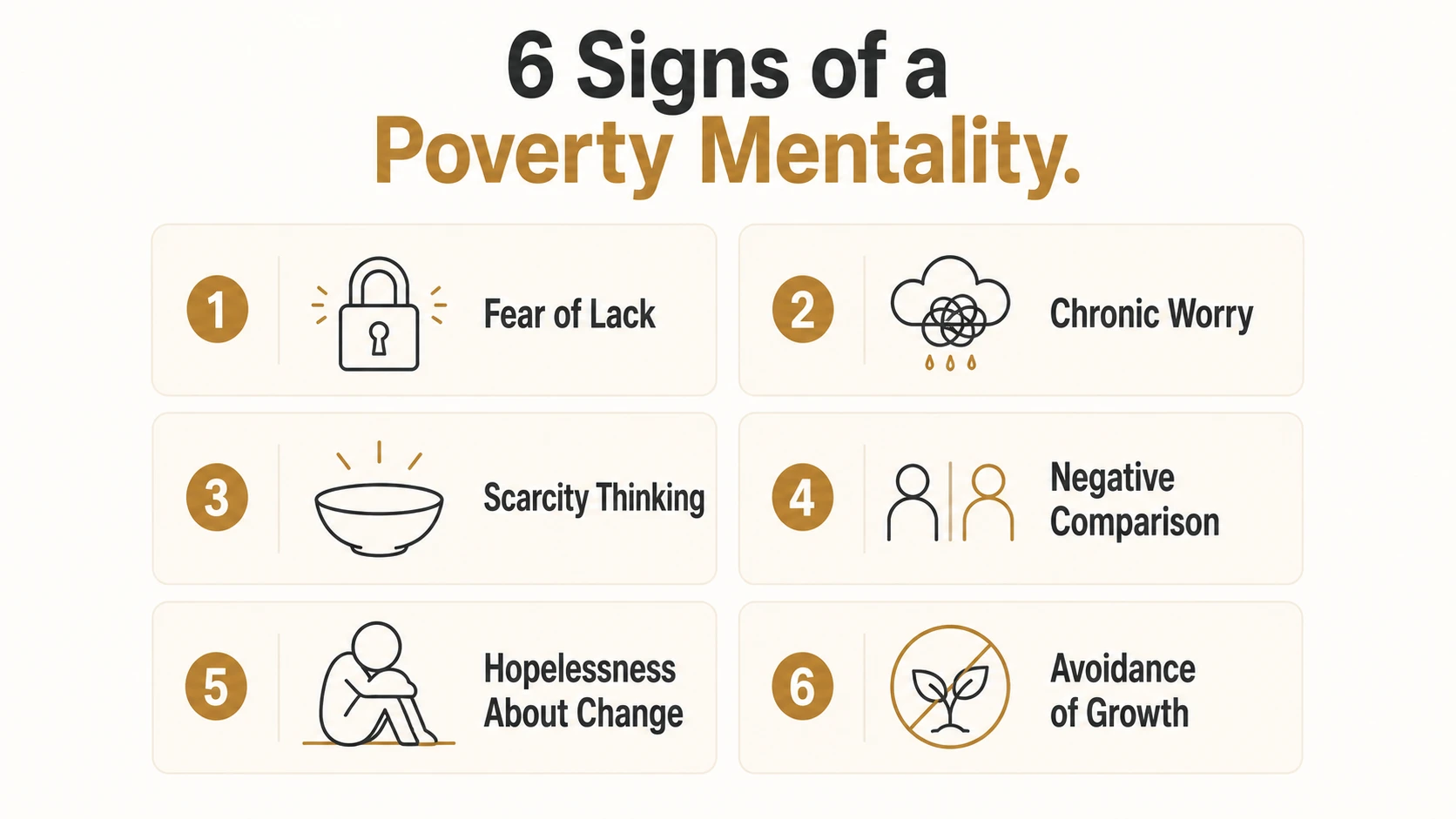
Signs of a poverty mentality appear across multiple areas of life and are often more visible in patterns of behavior than in single decisions. Common signs of poverty mindset include:
- Persistent fear of lack, even when current circumstances are stable
- Chronic worry about money, security, or the future that does not diminish with reassurance
- Scarcity thinking — the automatic assumption that resources are limited and must be hoarded or protected
- Unhealthy comparison with others, often leading to resentment or discouragement rather than motivation
- Hopelessness about change, a belief that the current situation is permanent and personal effort cannot alter it
- Reluctance to invest in growth — avoiding education, professional development, or skill-building due to fear of cost or failure
- Unhealthy financial habits such as avoidance of budgeting, impulsive spending as emotional relief, or an inability to plan beyond the immediate term
Spiritual Signs
From a biblical perspective, signs of a poverty mentality also manifest in spiritual dispositions:
- Lack of trust in God’s provision, which may appear as an inability to rest in prayer or peace despite stated belief
- Unhealthy fear that functions as a primary driver of decisions rather than wisdom and faith
- Chronic discouragement that resists the encouragement of Scripture or community
- Distorted beliefs about God’s character — viewing God as withholding, punitive, or indifferent to personal struggle
- Confusion between humility and defeat — conflating contentment with resignation, or spiritual poverty with material poverty in ways that Scripture does not support
In our experience helping readers examine their thinking, the spiritual signs are often harder to identify than the behavioral ones, precisely because they can be framed in language that sounds like faith.
Poverty Mindset Examples in Everyday Life
Poverty mindset examples appear across finance, career, education, relationships, and personal growth. The following scenarios illustrate how this pattern of thinking operates in practice:
- Finances: A person avoids opening bank statements or tracking spending because facing the numbers feels too overwhelming. Short-term relief from avoidance reinforces long-term financial instability.
- Career: Someone consistently turns down opportunities for advancement, citing reasons like “I’m not qualified enough” or “people like me don’t get promoted,” without gathering evidence to evaluate either claim.
- Education: A person who has always wanted to develop a new skill or complete further education repeatedly postpones it, believing the cost — in money or time — is too high, even when incremental options exist.
- Relationships: Reluctance to be generous with time, energy, or emotional support, driven by a belief that there is never enough to give — and that giving leads to depletion rather than connection.
- Giving: A person who believes they cannot afford to give anything until they have “more,” without defining what “more” means or examining the relationship between generosity and mindset.
- Personal growth: Dismissing books, courses, or accountability relationships as “not for someone in my situation,” without examining whether the barrier is real or assumed.
These examples illustrate that a poverty mindset is not confined to people in financial hardship. It is a pattern of perception and response that can appear across income levels, backgrounds, and life stages.
Poverty Mindset vs. Abundance Mindset
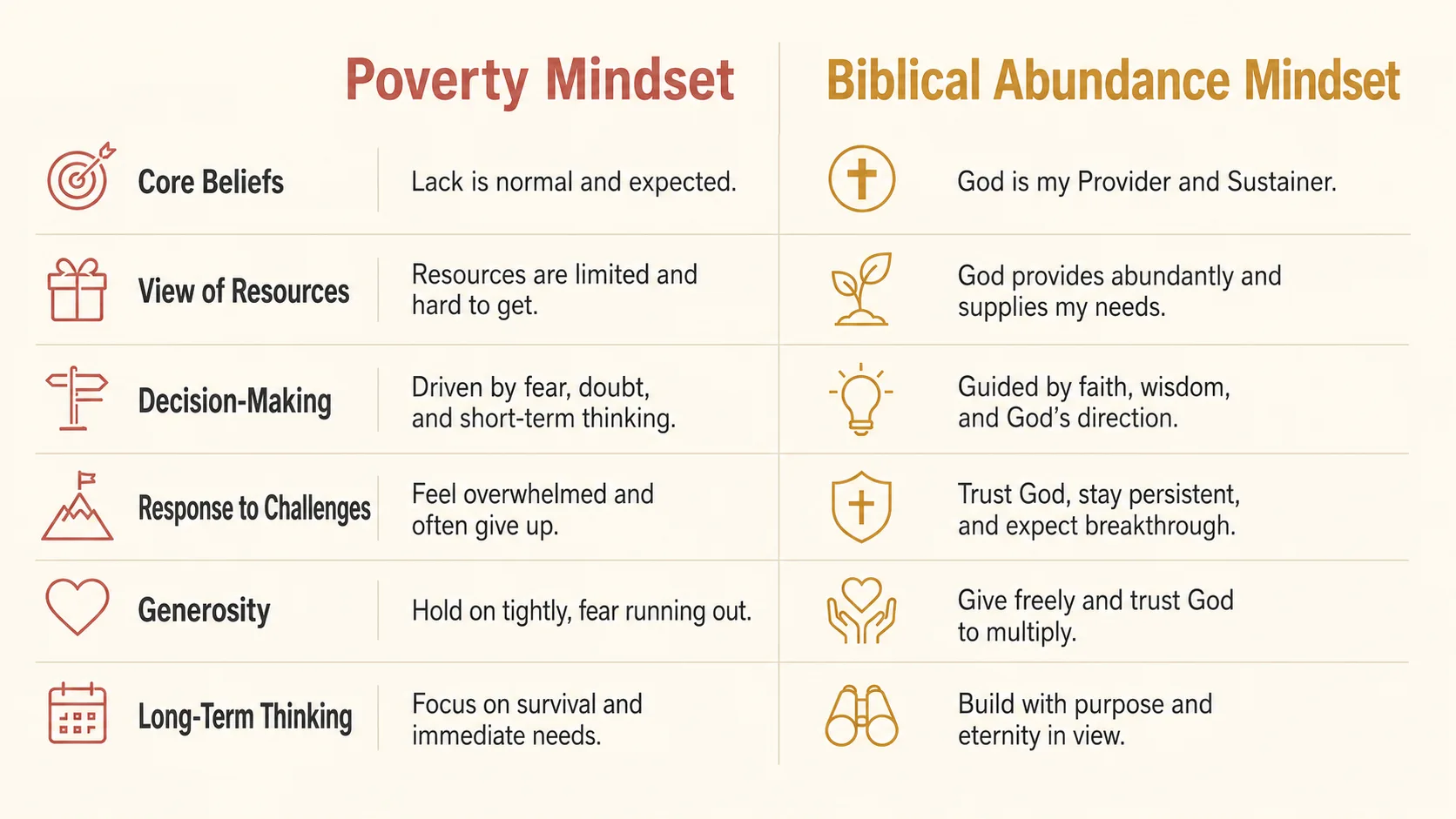
| Category | Poverty Mindset | Biblically Grounded Abundance Perspective |
|---|---|---|
| Core beliefs | Resources are scarce, fixed, and likely to run out | Resources are stewardable; God is provider; sufficiency is possible |
| View of resources | Must be hoarded and protected from loss | Can be used wisely, shared generously, and multiplied responsibly |
| Decision-making | Driven by fear of loss and short-term anxiety | Guided by wisdom, long-term thinking, and trust |
| Response to challenges | Challenges confirm that improvement is impossible | Challenges are opportunities for growth, perseverance, and learning |
| Generosity | Giving is a threat to personal security | Generosity reflects trust and is integral to a flourishing life |
| Long-term thinking | Difficult or impossible due to immediate pressures | Actively cultivated through planning, prayer, and community |
Important Misconceptions
A central misconception in poverty mindset vs. abundance mindset discussions is that “abundance” is primarily or exclusively financial. Biblical abundance does not promise material wealth. It encompasses spiritual maturity, wisdom, purposeful living, relational depth, generosity, and the peace described as surpassing understanding.
The contrast Scripture draws is not between being poor and being rich. It is between fear-driven, hopeless thinking and a life oriented around trust, wisdom, and contribution — regardless of financial circumstances.
How to Overcome a Poverty Mindset Using Biblical Principles
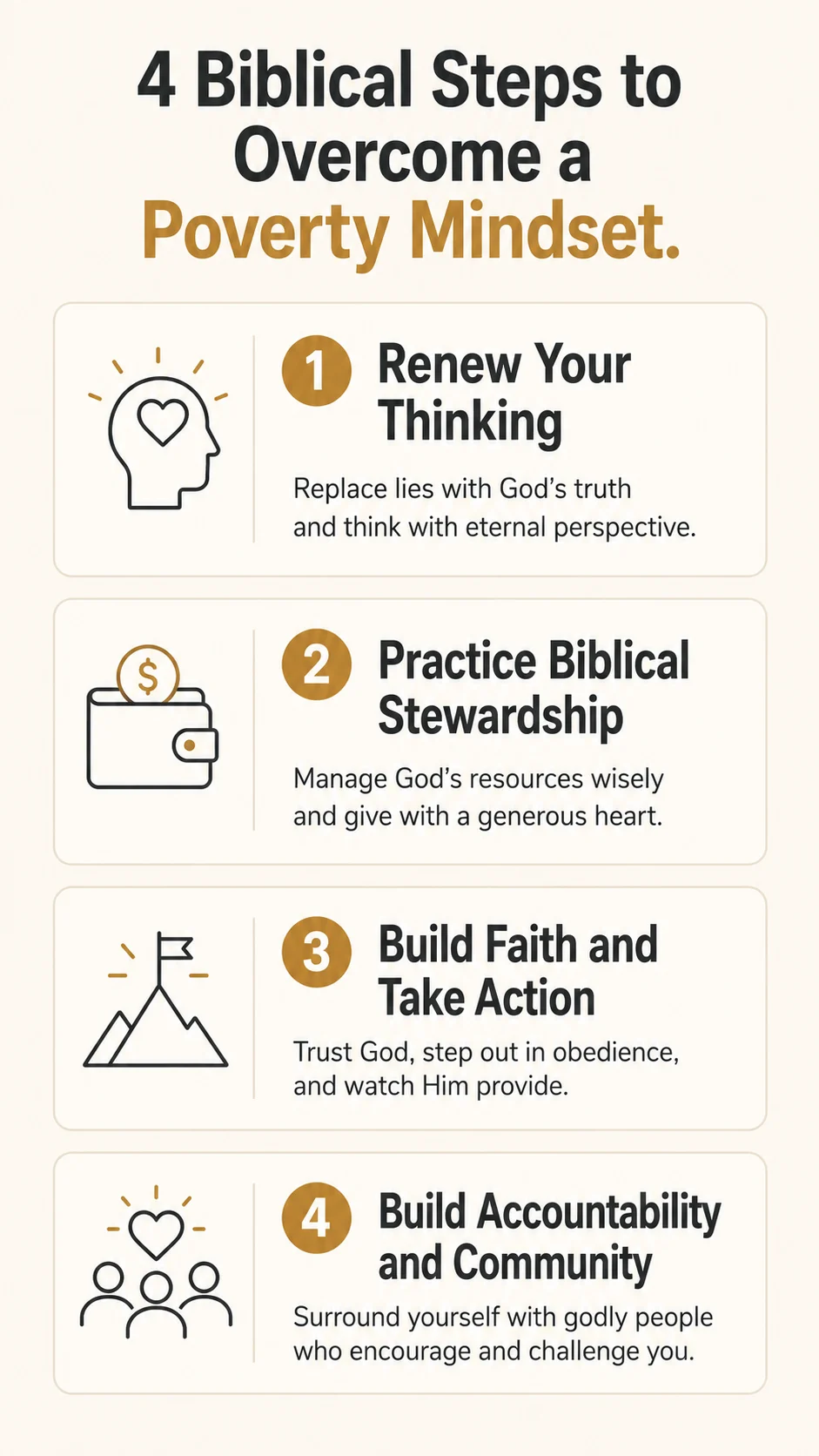
Renew Your Thinking
How to overcome a poverty mindset begins, biblically, with the recognition that thinking patterns can change. Romans 12:2 frames this as a transformation process — ongoing and active, not a one-time event. Practical steps include:
Learning how to change your thoughts is the first practical step toward replacing fear-based beliefs with biblically grounded ones.
- Identify specific limiting beliefs — not as character flaws but as learned patterns that can be examined and replaced
- Replace scarcity narratives with biblically grounded alternatives, not through forced positivity but through deliberate engagement with Scripture
- Practice biblical meditation — the sustained, intentional reflection on passages related to provision, trust, wisdom, and contentment
- Cultivate gratitude as a daily discipline that interrupts the automatic assumption of lack
Practice Biblical Stewardship
Stewardship is the practical expression of a renewed mindset. How to change a poverty mindset requires not only belief adjustment but behavioral change. Stewardship practices include:
- Creating and maintaining a simple budget as an act of responsibility rather than restriction
- Identifying areas of waste or avoidance and addressing them incrementally
- Beginning to give — even modestly — as a tangible expression of trust and abundance thinking
- Planning for the future through intentional saving and goal-setting, grounded in both faith and practical wisdom
Build Faith Alongside Practical Wisdom
Overcoming a poverty mindset is not purely spiritual or purely practical. It requires both. Actionable steps include:
- Pray specifically about fears, financial decisions, and beliefs about God’s provision
- Take practical action — prayer and planning are not opposites in biblical teaching
- Pursue financial education through reputable resources and community support
- Build accountability — sharing goals and progress with a trusted person or community dramatically improves follow-through
- Review progress regularly to recognize growth and adjust approaches that are not working
Common Mistakes When Trying to Change a Poverty Mindset
Understanding what not to do is as important as knowing the right steps. Common mistakes include: For those just starting out, positive mindset tips for beginners can provide a useful entry point — as long as they are paired with deeper belief and identity work.
Expecting instant transformation. Mindset change is a process, not an event. Expecting quick results often leads to discouragement when early effort does not produce visible change.
Confusing faith with ignoring practical responsibilities. Trusting God is not the same as avoiding budgets, avoiding difficult conversations about finances, or refusing to plan. Biblical faith operates alongside wisdom and action, not as a substitute for them.
Relying only on positive thinking. Affirmations and mindset coaching have value, but they do not address the spiritual dimension of fear, identity, and trust that biblical teaching engages. Surface-level optimism can mask deeper unresolved beliefs.
Comparing your progress to others. Comparison amplifies scarcity thinking. Each person’s circumstances, history, and growth trajectory are different. Biblical teaching consistently warns against comparison as a measure of worth or progress.
Ignoring emotional wounds. Poverty thinking is often tied to real experiences of loss, instability, neglect, or trauma. Treating it as a purely cognitive problem without addressing underlying emotional pain limits long-term change.
Misunderstanding biblical prosperity. Adopting prosperity theology as a framework — the belief that faith reliably produces financial reward — sets up a distorted relationship with both God and money, and often produces disillusionment when circumstances do not conform to the expectation.
Common Challenges and How to Overcome Them
Why Change Feels Difficult
Change feels difficult because poverty thinking is not merely intellectual — it is habitual, relational, and often generational. Key factors that make change hard include:
- Established habits that operate automatically without conscious decision
- Fear of failure that makes attempting change feel more dangerous than staying the same
- Family and cultural influences that normalize scarcity thinking and treat abundance-oriented beliefs with suspicion
- Environmental pressures — living in communities where poverty is structural makes individual mindset work harder to sustain
- Repeated setbacks that confirm existing beliefs and make sustained effort feel futile
Practical Solutions
Addressing these challenges requires realistic expectations and layered strategies:
- Start with small, concrete habit changes rather than wholesale lifestyle overhaul
- Engage Scripture regularly as a source of counternarrative to fear and hopelessness
- Pursue financial education through accessible, non-judgmental resources
- Build a support system — community is essential to sustained change, and isolation reinforces poverty thinking
- Set realistic expectations about the timeline for visible progress, recognizing that internal shifts often precede external changes
Comparing Biblical Teaching with Modern Self-Help Approaches
Modern mindset coaching and self-help frameworks share some common ground with biblical teaching: both affirm that thinking patterns influence outcomes, that change is possible, and that practical habits matter. Both emphasize the value of community, accountability, and consistent effort.
The differences are substantive, however. Secular mindset coaching typically locates the source of transformation within the individual — in willpower, discipline, identity work, or neuroplasticity. The biblical framework locates ultimate transformation in a relationship with God, which changes not only thought patterns but the underlying identity and security from which a person operates.
Personal responsibility is affirmed in both frameworks, but biblical teaching holds it in tension with humility, grace, and an acknowledgment that human effort has limits. The self-help approach tends to emphasize individual agency without an equivalent counterweight.
Faith-based growth also situates the individual within a community — the church — and within a narrative larger than personal development. The goal is not merely a better life but participation in a story of redemption, service, and purpose that extends beyond financial stability or psychological flourishing.
As of mid-2026, there is growing interest among behavioral scientists and psychologists in examining the role of religious community and spiritual practice in sustained mindset change — findings that align with what Scripture has long described.
Difficulty & Time Investment
Changing a poverty mindset is neither quick nor simple, but it is achievable at any level. Beginner-friendly practices — gratitude journaling, daily Scripture reading, and basic budgeting — can be implemented immediately with minimal resources or prior experience. These provide an accessible entry point without requiring significant prior spiritual development or financial knowledge.
More advanced practices, such as deep identity work, addressing generational patterns, or building sophisticated financial planning systems, require greater investment and are typically better approached with guidance from a mentor, counselor, or accountability community.
The difficulty of this work is influenced significantly by personal circumstances. Those carrying the weight of real financial hardship alongside mindset work face compounded challenges that those in more stable situations do not. Consistency is the primary requirement — not perfection. Ongoing spiritual growth is a lifelong process, and practical wisdom accumulates over time. Balancing faith with practical action prevents two common failure patterns: passive waiting without effort, and anxious striving without trust.
Results Timeline
Short-term (weeks 1–4): Increased awareness of existing thought patterns. People often notice how frequently scarcity thinking surfaces once they begin paying attention. Gratitude practices and Scripture engagement begin creating small interruptions to automatic negative responses.
Medium-term (months 2–6): Habit formation. Behavioral changes — budgeting, consistent giving, financial planning — begin to feel more natural. Trust in God deepens as a person practices bringing specific fears and decisions to prayer rather than managing them through anxiety.
Long-term (6 months and beyond): Character development. The deeper shifts — in identity, generosity, resilience, and hope — become more visible over time. Relationships may improve. Financial patterns may stabilize. But the most significant change is often internal: a person begins to experience the contentment Paul describes as something learned, not something received passively.
Factors affecting progress include the depth of formative experiences, the quality of community support, the regularity of practice, and the presence or absence of ongoing external stressors. Progress is rarely linear, and setbacks are a normal part of the process rather than evidence that change is impossible.
Practice Guide for Long-Term Change
Sustained change requires consistent practices across multiple areas of life. Recommended habits include:
Building consistency is easier with a structured approach — how to build good habits in 30 days offers a practical framework that complements the stewardship and renewal practices described here.
Daily practices:
- Morning Scripture reading focused on passages related to trust, provision, wisdom, and contentment
- Prayer that includes specific acknowledgment of fears and specific expressions of trust
- Gratitude practice — naming three specific things each day shifts attention from lack to sufficiency
- Brief financial tracking — even 5 minutes of reviewing daily spending builds awareness and responsibility
Weekly practices:
- Review of budget and financial goals — weekly check-ins prevent drift and maintain intentionality
- Journaling — reflecting on patterns of thought, progress, and areas of ongoing struggle builds self-awareness
- Community engagement — attending church, a small group, or a financial accountability relationship
- A moment of intentional generosity — giving, whether of money, time, or skill, reinforces abundance thinking and breaks scarcity habits
Adapting for different lifestyles:
- Those in seasons of high stress or financial crisis should simplify their practice to two or three anchors — daily Scripture and prayer, weekly accountability — rather than attempting a full routine that collapses under pressure
- Parents and caregivers may find family-based practices, such as evening gratitude conversations or simple stewardship discussions with children, more sustainable than individual disciplines alone
- Those without a faith community should prioritize finding one — the evidence is consistent that isolated mindset work produces slower and less durable results than community-embedded practice
Frequently Misunderstood Teachings About Poverty in the Bible
Several widely held beliefs about what the Bible teaches regarding poverty require correction:
“Poverty always equals weak faith.” Scripture does not support this claim. Many of the most faithful figures in biblical history experienced material poverty, persecution, and deprivation. Job, the prophets, Paul, and Jesus himself lived with material simplicity or suffered significant loss. Equating poverty with spiritual failure contradicts the full biblical witness.
“Wealth always equals God’s approval.” The Bible treats wealth with significant ambiguity. Proverbs acknowledges that diligence can produce material fruit, but the Prophets, the Psalms, and Jesus’s teachings consistently warn against the spiritual dangers of wealth and against assuming that material success reflects divine favor.
“Generosity guarantees financial riches.” While Scripture does describe a general principle of reciprocity — generosity tends to create flourishing communities and renewed capacity — it does not function as a financial formula. Giving is presented as an expression of trust and character, not an investment strategy.
“Every hardship is spiritual failure.” Scripture presents suffering as a complex reality that may result from poor choices, external forces, injustice, spiritual testing, or unexplained mystery. The book of Job explicitly challenges the assumption that hardship is always a consequence of personal failure. Interpreting all difficulty through the lens of spiritual shortcoming produces both theological error and significant emotional harm.
Recommended Books and Biblical Resources for Further Study
Readers exploring the intersection of poverty mindset, biblical teaching, and personal development will find a wide range of books and sermon series on these themes. When evaluating resources, Your Daily Thrive recommends applying the following standards:
- Does the resource distinguish between biblical teaching and prosperity theology? Any book or sermon that presents material wealth as the expected and reliable fruit of faith should be approached critically.
- Does it engage both the spiritual and practical dimensions of change? Resources that address only mindset without practical stewardship guidance, or only financial behavior without attention to belief and identity, offer an incomplete picture.
- Does it handle Scripture in context? Responsible resources engage the full counsel of biblical teaching rather than assembling isolated verses to support a predetermined conclusion.
Recommended categories include stewardship-focused Christian financial resources, biblical counseling literature addressing fear and anxiety, and academic works on the psychology of scarcity that can be read alongside Scripture. Poverty mindset sermon series from churches with a strong commitment to expository preaching — working through Scripture passage by passage — tend to produce more theologically grounded content than topical treatments alone.
Poverty mindset book options in the Christian space vary widely in theological approach. Readers are advised to read with discernment, using the standards above as an evaluative framework.
Conclusion
A poverty mindset, understood through the lens of the Bible, is ultimately a condition of the heart — a pattern of fear, scarcity, and hopelessness that Scripture consistently addresses through the themes of trust, wisdom, stewardship, contentment, and hope. The poverty mindset Bible discussion is most helpful when it resists the temptation to reduce complex realities to simple formulas: neither equating financial struggle with spiritual failure, nor promising material prosperity as the reliable reward of renewed thinking.
Renewing the mind, as Scripture describes it, is a lifelong process. It requires both faith and practical action — prayer alongside budgeting, Scripture alongside financial education, community alongside individual effort. Generosity, practiced even in seasons of scarcity, is one of the most powerful behavioral interruptions to poverty thinking that biblical teaching offers.
The goal is not wealth. It is a life characterized by trust, wisdom, faithful stewardship, and a growing capacity for hope — regardless of the financial circumstances that surround it.
Frequently Asked Questions
What is a poverty mindset according to the Bible?
According to biblical teaching, a poverty mindset describes patterns of thinking — including fear, scarcity, hopelessness, and distrust — that prevent a person from living with faith, wisdom, and generosity. The Bible addresses these patterns through teachings on trust in God, renewing the mind, contentment, and stewardship, without using the modern phrase “poverty mindset” directly.
Does the Bible actually mention a poverty mindset?
The phrase “poverty mindset” does not appear in Scripture. It is a modern psychological concept. However, the Bible extensively addresses the underlying patterns — fear of lack, hopelessness, distrust, and scarcity thinking — through themes of renewing the mind, contentment, generosity, and faith.
What Bible verses are commonly used to discuss a poverty mindset?
Passages from Proverbs on wisdom and diligence, Philippians 4 on contentment and peace, Matthew 6 on anxiety and trust in God’s provision, and Romans 12 on renewing the mind are most frequently cited. These should be read in their full context rather than as isolated promises of financial outcomes.
What are the signs of a poverty mentality?
Signs of a poverty mentality include persistent fear of lack, chronic worry, scarcity thinking, reluctance to invest in personal growth, avoidance of financial planning, hopelessness about change, and unhealthy comparison with others. Spiritually, it may appear as distorted beliefs about God’s character, lack of trust, and chronic discouragement.
How can someone overcome a poverty mindset biblically?
Overcoming a poverty mindset biblically involves renewing the mind through Scripture and prayer, practicing wise stewardship through budgeting and planning, cultivating generosity, building accountability and community, and developing realistic expectations about the timeline for change. Both faith and practical action are required — neither alone is sufficient.
Is a poverty mindset the same as being financially poor?
No. A poverty mindset is a pattern of thinking, not a financial status. A person with limited financial resources may not have a poverty mindset, while someone with material security may think in ways that reflect ongoing fear and scarcity. Financial poverty and poverty thinking are distinct realities that sometimes overlap but are not equivalent.
What is the difference between a poverty mindset and an abundance mindset?
A poverty mindset is characterized by fear, scarcity thinking, short-term anxiety, and reluctance to give or invest. A biblically grounded abundance mindset is characterized by trust in God as provider, wise stewardship, generosity, long-term thinking, and the contentment that Scripture describes as something learned through practice and faith — not guaranteed by financial circumstances.
Can Christians pursue financial success without contradicting biblical teaching?
Yes, with important qualifications. Scripture affirms diligence, wise planning, and responsible stewardship, all of which may produce financial stability and growth. What Scripture cautions against is treating financial success as the primary goal, as a measure of spiritual standing, or as an end in itself. Financial capacity, in the biblical framework, is primarily an opportunity for greater stewardship and generosity.