
Introduction
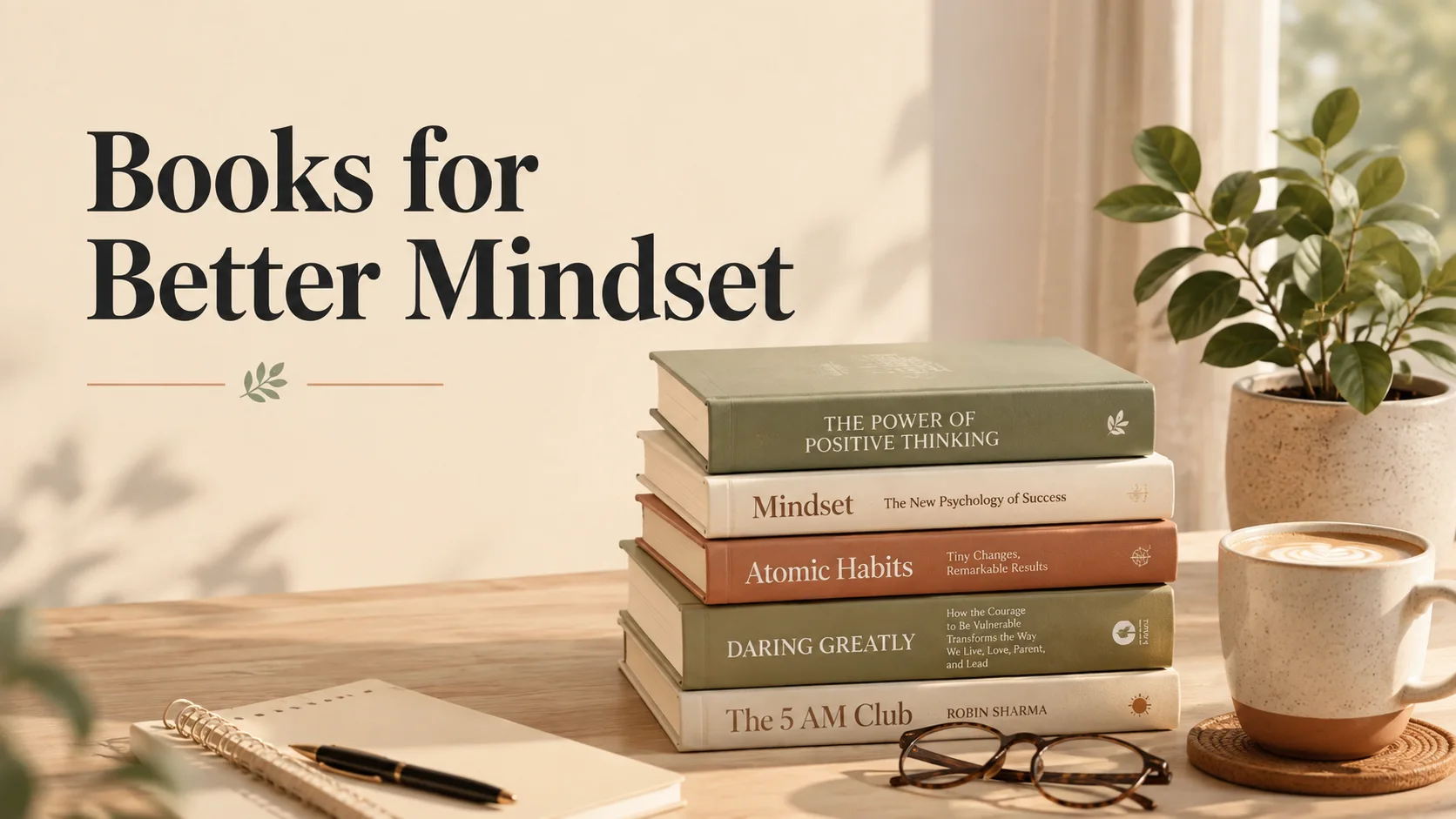
Books for better mindset are books that help readers examine their beliefs, thought patterns, habits, and responses to challenges, with the goal of thinking and reacting more effectively. There is no single universal “best” mindset; different books address different outcomes, such as confidence, resilience, discipline, or growth-oriented thinking. This category spans self-help books for better mindset, psychology books for better mindset, science books for better mindset, and classic philosophical works. Each approaches change differently, and the right choice depends on what the reader is actually trying to change.
Quick Summary
- The best books for a better mindset depend on the specific change a reader wants, such as greater confidence, resilience, discipline, or a growth-oriented approach to challenges.
- Self-help books generally focus on practical behavior change, while psychology and science-based books explain why people think and behave in particular ways.
- Books about mindset and success can support goal setting and achievement, but mindset alone does not replace skills, circumstances, consistent action, or realistic planning.
- A good reading choice should match the reader’s current needs, experience level, and willingness to apply the ideas.
What Makes a Book Helpful for Developing a Better Mindset?
A helpful mindset book does more than encourage positive thinking. Useful mindset literature typically includes evidence or credible reasoning, practical applications, clear explanations of psychological concepts, realistic expectations, and actionable exercises. It should also connect directly to the reader’s goals rather than offering generic encouragement.
A book can be inspiring without producing lasting change. Motivation fades quickly if it isn’t paired with reflection and practice. It also helps to separate related but distinct outcomes: mindset change, motivation, confidence, habit formation, and emotional resilience each require different approaches, even though mindset books often touch on all of them.
Mindset Improvement vs. Positive Thinking
A stronger mindset is not the same as ignoring problems or staying optimistic regardless of circumstances. Genuine mindset improvement involves realistic thinking, adaptability, self-awareness, and constructive responses to setbacks. Readers who confuse mindset work with forced positivity often dismiss real obstacles instead of addressing them, which can slow progress rather than support it. Genuine mindset improvement involves realistic thinking, adaptability, self-awareness, and constructive responses to setbacks — a distinction that becomes clearer once you understand mindset vs. attitude.
Best Books for Better Mindset by the Change You Want to Make
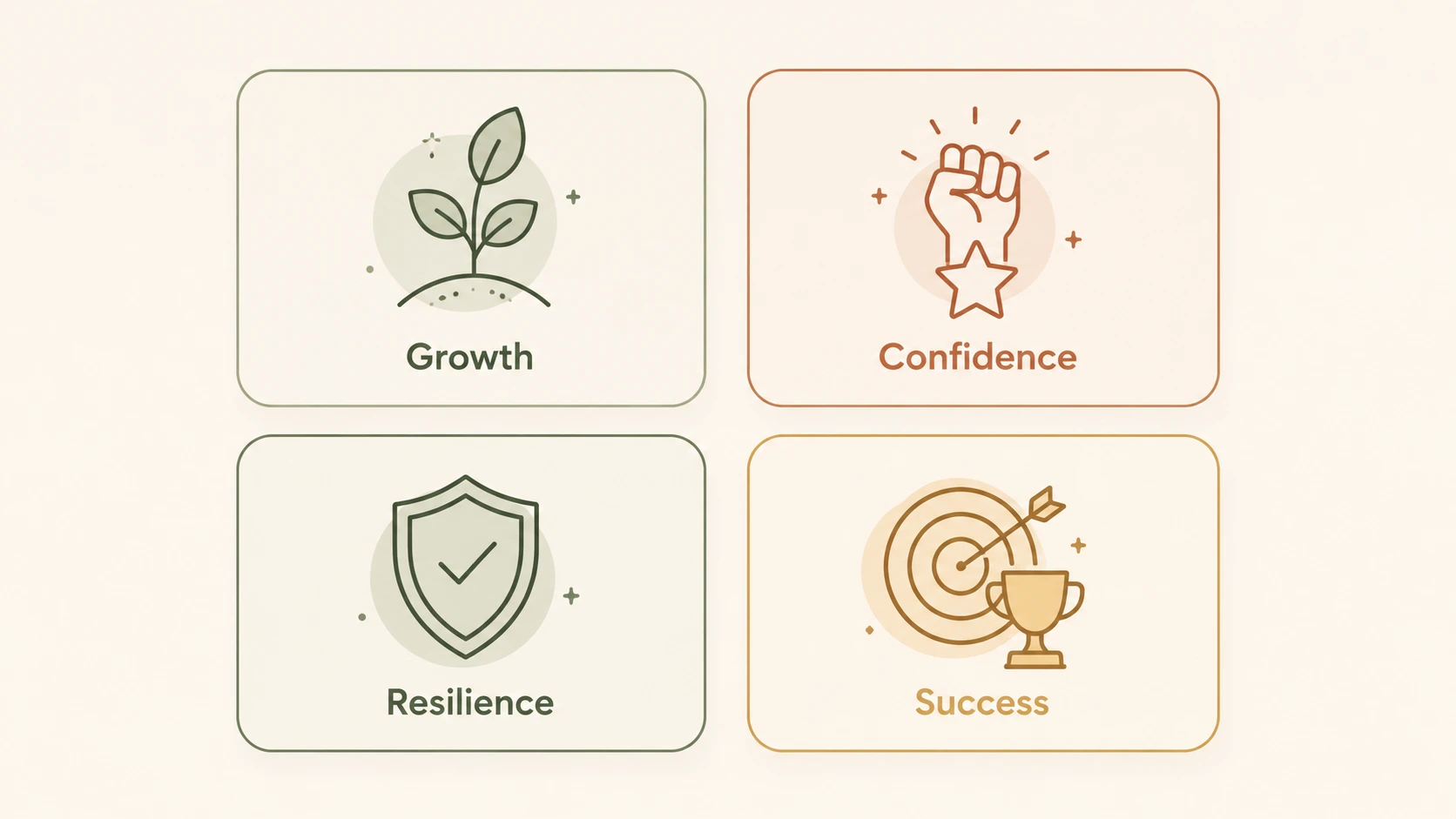
Rather than ranking titles, it is more useful to match books to the specific outcome a reader wants. The table below organizes best books for better mindset by goal, helping answer what is the best mindset book without assuming one answer fits everyone.
| Mindset Goal | Most Relevant Book Type | Core Concept | Best Suited For | Potential Limitation |
|---|---|---|---|---|
| Growth-oriented thinking | Psychology-based | Abilities develop through effort and strategy | Learners, students | May oversimplify complex outcomes |
| Confidence and self-belief | Self-help / applied psychology | Confidence builds through action and evidence | Beginners facing self-doubt | Requires consistent follow-through |
| Resilience under pressure | Psychology / science-based | Emotional regulation and adaptive coping | Readers facing high stress | Can require professional support in severe cases |
| Achievement and success | Habit and productivity-focused | Mindset supports, but doesn’t replace, execution | Professionals, entrepreneurs | Risk of overemphasizing attitude over skill |
Books for Developing a Growth-Oriented Mindset
A growth-oriented mindset is the belief that abilities and skills can develop through learning, effort, strategy, and feedback, rather than being fixed traits. Books in this category help readers distinguish genuine growth-oriented thinking from the common misconception that effort alone guarantees success. Growth-focused reading typically connects to learning from mistakes, building resilience, using feedback constructively, and setting realistic goals. A growth-oriented mindset is the belief that abilities and skills can develop through learning, effort, strategy, and feedback, rather than being fixed traits. Understanding why growth mindset is important can help readers recognize this shift before choosing a book.
Books for Building Confidence and Self-Belief
Books on mindset and confidence focus on self-efficacy, self-awareness, and overcoming self-doubt. A central idea across this category is that confidence grows primarily through action and evidence of competence, not through affirmations alone. In our experience helping readers build better habits, confidence tends to increase fastest when small, repeated actions produce visible results the reader can point to.
Books for Developing a Stronger and More Resilient Mindset
Resilience-focused books address emotional regulation, persistence, and constructive responses to adversity. A strong mindset involves adapting to difficulty, not suppressing emotions. Books that conflate mental toughness with emotional suppression can be counterproductive, since unprocessed stress tends to resurface rather than disappear.
Books on Mindset, Achievement, and Success
Books on mindset and success explore how thinking patterns interact with goal setting, discipline, decision-making, and productivity. Mindset can influence how people respond to setbacks and pursue long-term goals, but successful outcomes also depend on skills, resources, timing, and consistent execution. Your Daily Thrive recommends treating mindset books on success as a supplement to a concrete action plan, not a replacement for one. Your Daily Thrive recommends treating mindset books on success as a supplement to a concrete action plan, not a replacement for one — especially when paired with practical guidance like how to build discipline without motivation.
What Types of Books Can Help Improve Your Mindset?
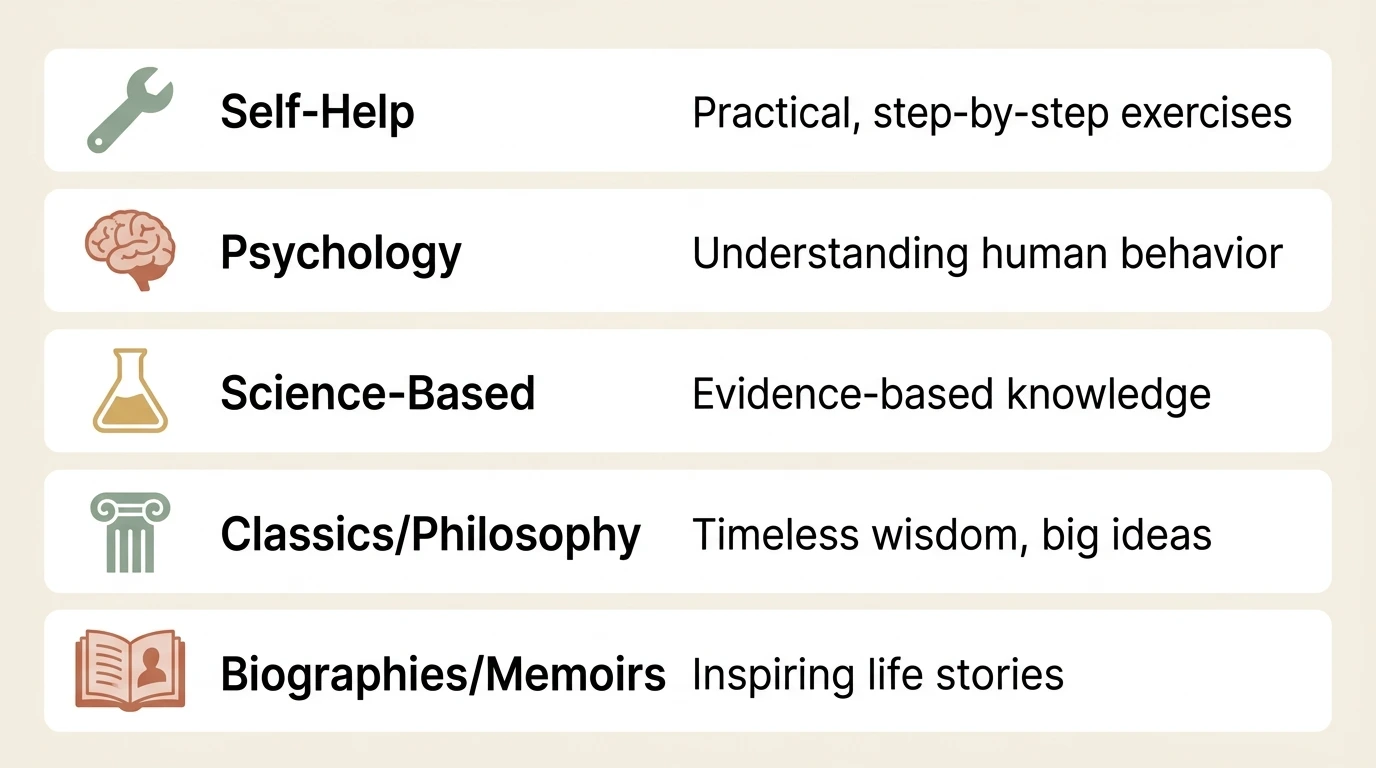
Different categories of books serve different purposes. Comparing them helps readers choose more precisely than a single “best books” list would allow.
| Category | Primary Focus | Most Useful When | Limitation |
|---|---|---|---|
| Self-help | Practical strategies and exercises | Reader wants actionable steps | Claims are not always evidence-based |
| Psychology | Explaining thought and behavior patterns | Reader wants to understand “why” | Can be dense for beginners |
| Science-based nonfiction | Research-backed explanations | Reader prefers evidence over anecdote | May be less immediately actionable |
| Classics/philosophy | Enduring frameworks for thinking | Reader wants timeless perspective | Language and context can feel dated |
| Biographical/memoir | Real-world application through story | Reader learns well from example | Individual experience may not generalize |
| Habit/productivity | Turning mindset into daily systems | Reader wants structured routines | Can overemphasize systems over insight |
Self-Help Books for Better Mindset
Self-help books translate mindset concepts into concrete exercises, strategies, and behavioral recommendations. They are often the most approachable starting point, but claims should still be evaluated critically, since quality and evidence vary widely across the genre.
Psychology Books for Better Mindset
Psychology books for better mindset provide deeper context about cognition, motivation, behavior, and emotional patterns. It’s worth distinguishing popular psychology, written for general audiences, from academic or research-oriented material, which tends to be more rigorous but less immediately practical.
Science-Based Books for Understanding Mindset
Readers who prefer evidence-based explanations often benefit from science books for better mindset that cover cognitive biases, learning, motivation, habit formation, and stress responses. These books ground mindset concepts in established behavioral science rather than anecdote alone.
Classic Books and Modern Books: Which Is More Useful?
Classic books for better mindset offer enduring philosophical or psychological frameworks that have stood the test of time, while newer books often incorporate updated research and contemporary applications. Publication date alone does not determine usefulness; a classic text can remain highly relevant, and a new book can still contain outdated or unverified claims.
How to Choose the Right Mindset Book for Your Situation
Choosing the right book depends on the current challenge, desired outcome, reading level, available time, and preference for practical exercises versus theory. It also depends on whether the reader prefers psychology-driven explanations or personal narratives, and whether evidence-based reasoning is a priority.
- If you want practical steps, start with a self-help book.
- If you want to understand underlying behavior, start with a psychology book.
- If you want evidence-based reasoning, start with a science-based book.
- If you want timeless perspective, start with a classic or philosophical work.
- If you learn best from real examples, start with a biography or memoir.
For Students and People Focused on Learning
Mindset reading for students often centers on learning from mistakes, effective study habits, persistence, and using feedback constructively. Reading alone does not improve academic performance directly; it works best when paired with applied study strategies.
For Professionals and Entrepreneurs
Mindset books for business often relate to decision-making under uncertainty, leadership, adaptability, and productivity. Professionals typically benefit most when they apply one concept at a time to real workplace decisions rather than absorbing multiple frameworks at once.
For Readers New to Personal Development
Beginners generally benefit from starting with accessible explanations rather than highly technical psychology. A common pitfall is reading many books in sequence without applying any single idea long enough to see results.
How Do Mindset Books Actually Help Change the Way You Think?
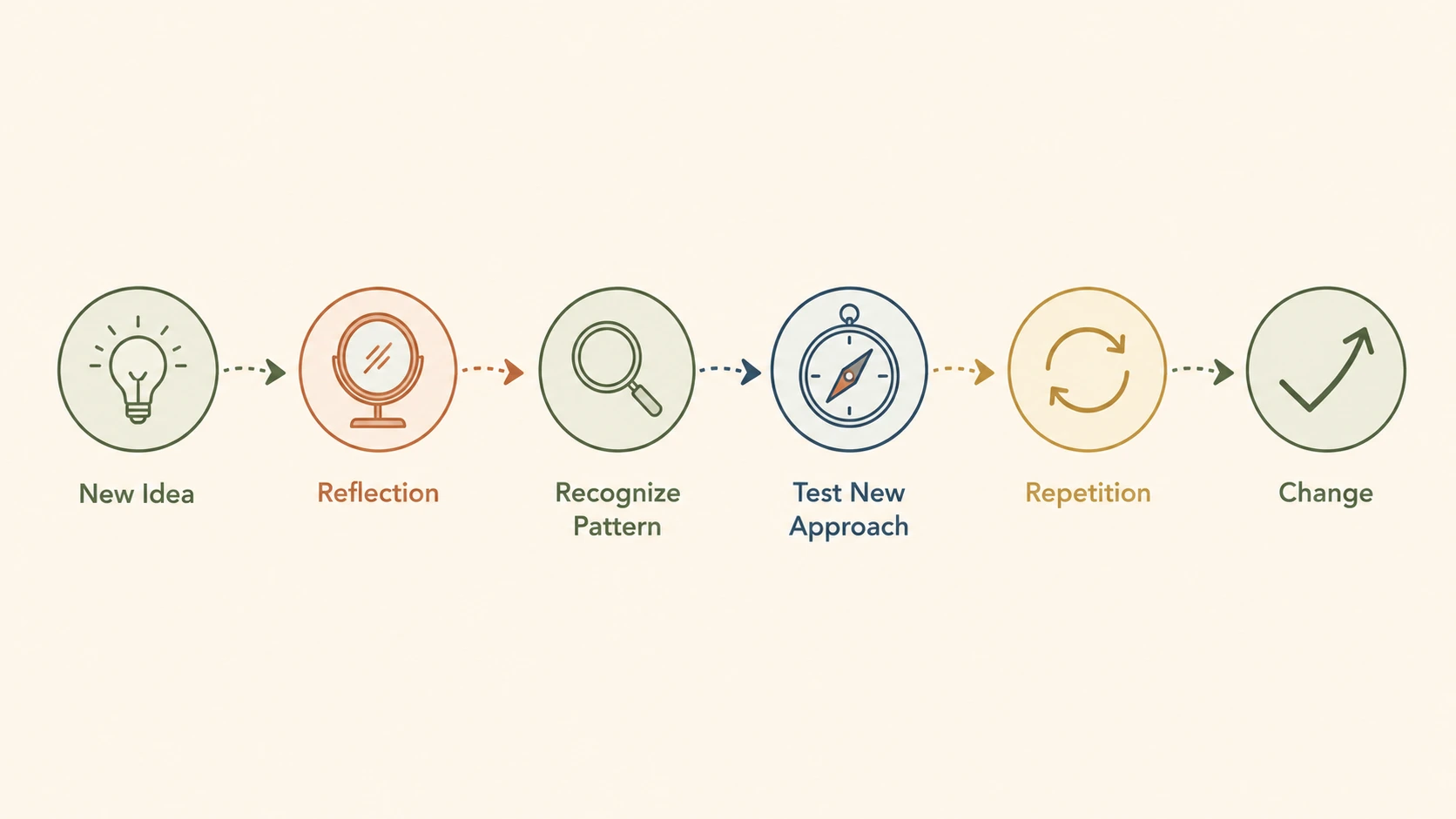
Mindset books create change through a sequence: exposure to a new idea, reflection on existing beliefs, recognition of behavioral patterns, testing a new approach, repetition, and feedback, which gradually leads to behavioral change. This process connects directly to habit formation, goal setting, and resilience. Reading is an input; mindset development requires application over time.
Reading vs. Applying What You Learn
Consuming many mindset books often produces less change than deeply applying a few key principles. Practical methods for applying ideas include taking brief notes, focusing on one principle at a time, journaling, running small behavioral experiments, reviewing progress, and discussing ideas with others for accountability. Practical methods for applying ideas include taking brief notes, focusing on one principle at a time, journaling for self-growth, running small behavioral experiments, reviewing progress, and discussing ideas with others.
Common Mistakes People Make When Reading Mindset Books
- Reading for motivation but taking no action — inspiration fades without a concrete next step; fix this by identifying one behavior to test immediately after finishing a chapter.
- Treating one book as a universal solution — no single book addresses every challenge; fix this by matching books to specific goals, as outlined earlier.
- Confusing positive thinking with mindset development — optimism without realism can mask real problems; fix this by pairing hopeful thinking with honest assessment.
- Constantly switching between books — this prevents deep application; fix this by committing to one book and one principle before moving on.
- Accepting every psychological claim uncritically — not all claims are evidence-based; fix this by checking whether ideas are grounded in established research.
- Expecting immediate transformation — durable change takes repetition; fix this by setting realistic, incremental milestones.
- Using mindset advice to ignore genuine external constraints — attitude cannot substitute for resources or skills; fix this by addressing structural obstacles directly alongside mindset work.
When Mindset Advice Is Not Enough
Mindset advice cannot replace practical skills, professional guidance, environmental changes, financial resources, or structural factors. In situations involving significant external constraints, mindset should complement realistic problem-solving and concrete action, not substitute for them.
How to Get More Value From Books for Better Mindset
- Read one relevant book at a time rather than several simultaneously.
- Identify the single central idea before moving to supporting details.
- Select one behavior to test based on that idea.
- Track what changes over a defined period.
- Revisit useful concepts periodically rather than only once.
- Stop or switch books when the material clearly doesn’t fit your situation.
Busy readers can adapt this approach by focusing on short sections, using audio formats during routine tasks, or reviewing chapter summaries before deciding whether to read in full.
A Simple Weekly Mindset Reading Practice
A sustainable practice is more valuable than an ambitious but unrealistic daily reading target. A simple weekly approach might include reading a short section several times per week, writing a brief reflection afterward, and choosing one small action to test before the next session. Over time, this combination of reading, reflection, and implementation supports habit formation and long-term consistency more reliably than reading in isolation.
How Long Does It Take to See Results From Mindset Books?
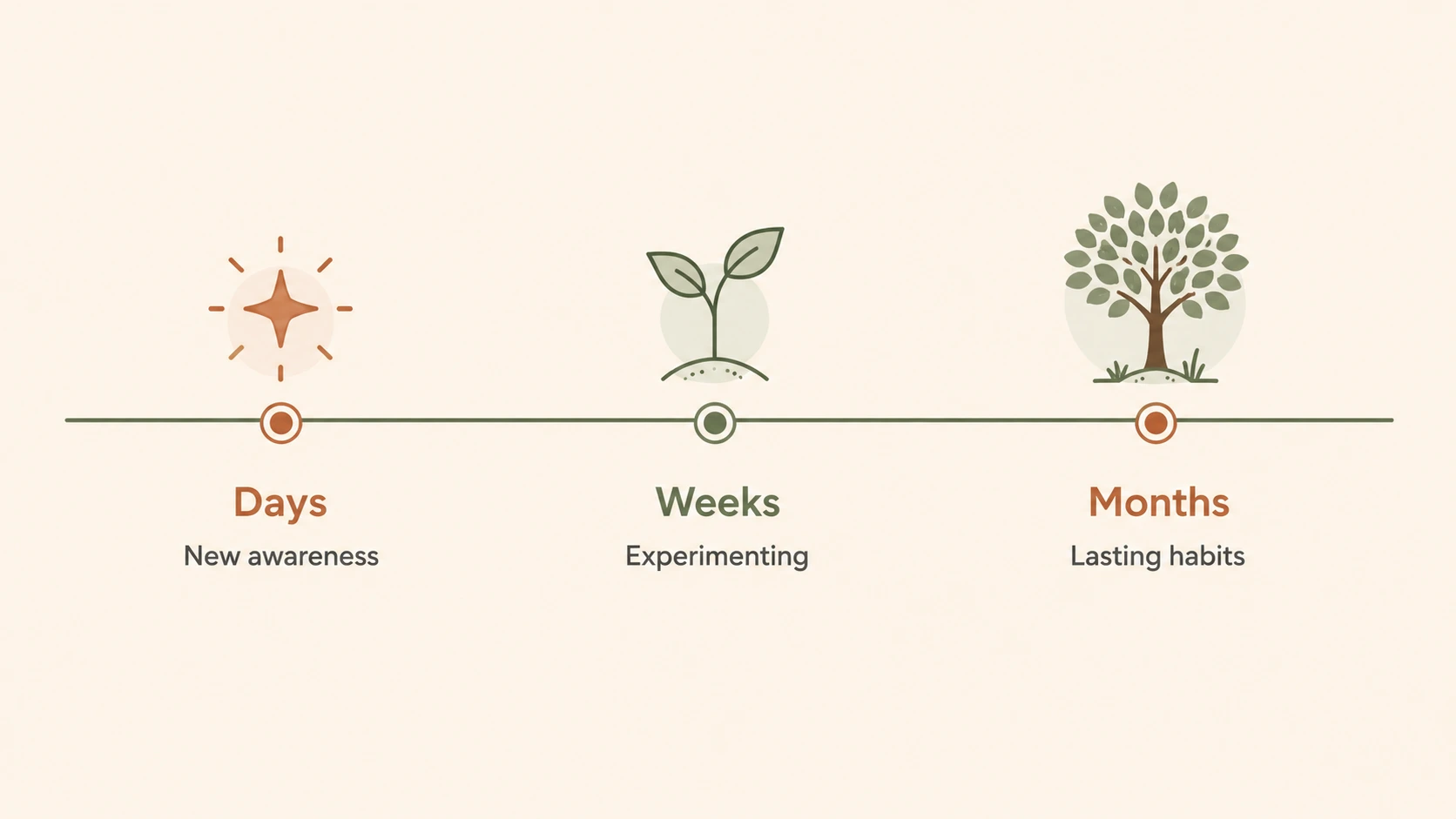
Insight from mindset books can happen within days, but durable behavioral change generally requires weeks to months of repeated practice. In the first few days, readers typically gain new ideas and awareness. Over subsequent weeks, they experiment with applying those ideas and begin forming habits. Over months, stronger behavioral patterns and shifts in perspective tend to emerge. Progress varies based on the individual’s starting point, environment, consistency, and the complexity of the desired change, and no timeline is guaranteed.
Do Mindset Books Really Work?
Mindset books can be effective, but they are not guaranteed self-improvement tools. Their usefulness depends on the quality of the material, how actively the reader engages with it, whether ideas are actually applied, individual circumstances, and whether the recommended behavior fits the reader’s situation. It’s worth distinguishing between inspiration, education, and measurable behavior change, since a book can succeed at one without producing the others. Evidence-based psychology and critical evaluation of claims generally improve the reliability of mindset advice.
How Online and Community Recommendations Can Help You Find Mindset Books
Online reading resources and reader communities can be useful discovery tools for finding books for better mindset. Reviews and community discussions often reveal common strengths, recurring criticisms, reading difficulty, and practical usefulness, as well as differences in how beginner and experienced readers respond to the same book. However, popularity within a community is not proof that a book is psychologically effective, so recommendations should still be evaluated independently against the reader’s specific goals.
Frequently Asked Questions About Books for Better Mindset
What are the best books for better mindset? The best choice depends on the specific outcome a reader wants, such as growth, confidence, resilience, productivity, success, or psychological understanding, rather than a single universal title.
What is the best mindset book for beginners? Beginners generally benefit most from accessible explanations, practical ideas, and credible concepts that are easy to apply, rather than choosing a book based on popularity alone.
Which books are best for developing a strong mindset? Books that emphasize resilience, adaptability, self-awareness, and persistence tend to be most useful, rather than books that promote emotional suppression or constant positivity.
What are the best books on mindset and success? Books that connect mindset to goal setting, discipline, and decision-making can support success, but outcomes also depend on skills, circumstances, and consistent execution.
What are the best books on mindset and confidence? Books that explain how self-belief develops through action, feedback, and evidence of competence tend to be most effective for building confidence.
Are psychology books better than self-help books for improving mindset? Neither category is universally better; psychology books tend to explain underlying behavior, while self-help books tend to offer more direct, practical steps.
How many mindset books should I read to improve my mindset? Depth and application of a few relevant principles are generally more valuable than maximizing the total number of books read.
Can reading books actually change your mindset? Reading can create awareness and introduce new mental models, but sustained mindset change generally requires applying those ideas repeatedly over time.
Conclusion
There is no single universally best book for a better mindset. Books for better mindset are most useful when matched to a specific goal, such as growth, confidence, resilience, or success, and then followed by consistent, practical application. Across categories including self-help, psychology, science-based nonfiction, and classic works, the common thread is that reading alone does not create change; testing and repeating ideas does. The clearest takeaway is to choose one relevant book, extract one useful principle, and turn that principle into a repeatable behavior.