
Introduction
Choosing the best growth mindset books for adults starts with understanding what a growth mindset actually is: the belief that abilities, intelligence, and skills can be developed through effort, strategy, and learning rather than being fixed traits. Books remain one of the most effective tools for building this belief because they combine psychological research with structured guidance, giving readers both the “why” and the “how.” This guide focuses on educational, evidence-based recommendations rather than popularity rankings, helping adults understand the difference between simply learning about mindset theory and actually developing one through consistent practice. Whether the goal is career advancement, personal confidence, or lifelong learning, the right combination of growth mindset books, mindset books, and books about mindset can create lasting behavioral change.
Quick Summary
- Growth mindset books help adults develop resilience, confidence, and a lifelong learning mindset.
- The best books combine psychological research with practical exercises and real-world examples.
- Different books serve different goals, including career growth, confidence, business, and personal development.
- Choosing the right book depends on your experience level, learning style, and personal goals.
What Is a Growth Mindset?
A growth mindset is the psychological belief that intelligence, talent, and ability are not fixed traits but qualities that can be developed through dedication, practice, and effective strategy. This concept, rooted in decades of behavioral science research, explains why some individuals respond to setbacks with renewed effort while others disengage entirely. Understanding this distinction matters beyond theory — it directly shapes motivation, learning speed, and long-term achievement, which is why growth mindset is important in the first place.
The psychological foundation of a growth mindset rests on how the brain processes challenge and failure. People with a growth orientation interpret difficulty as a normal part of the learning process, which keeps motivation and engagement high even when progress feels slow. In everyday life, this shows up in small ways: someone who struggles with a new skill at work asks for feedback and tries again, rather than assuming they simply “aren’t good at it.”
Growth Mindset vs Fixed Mindset
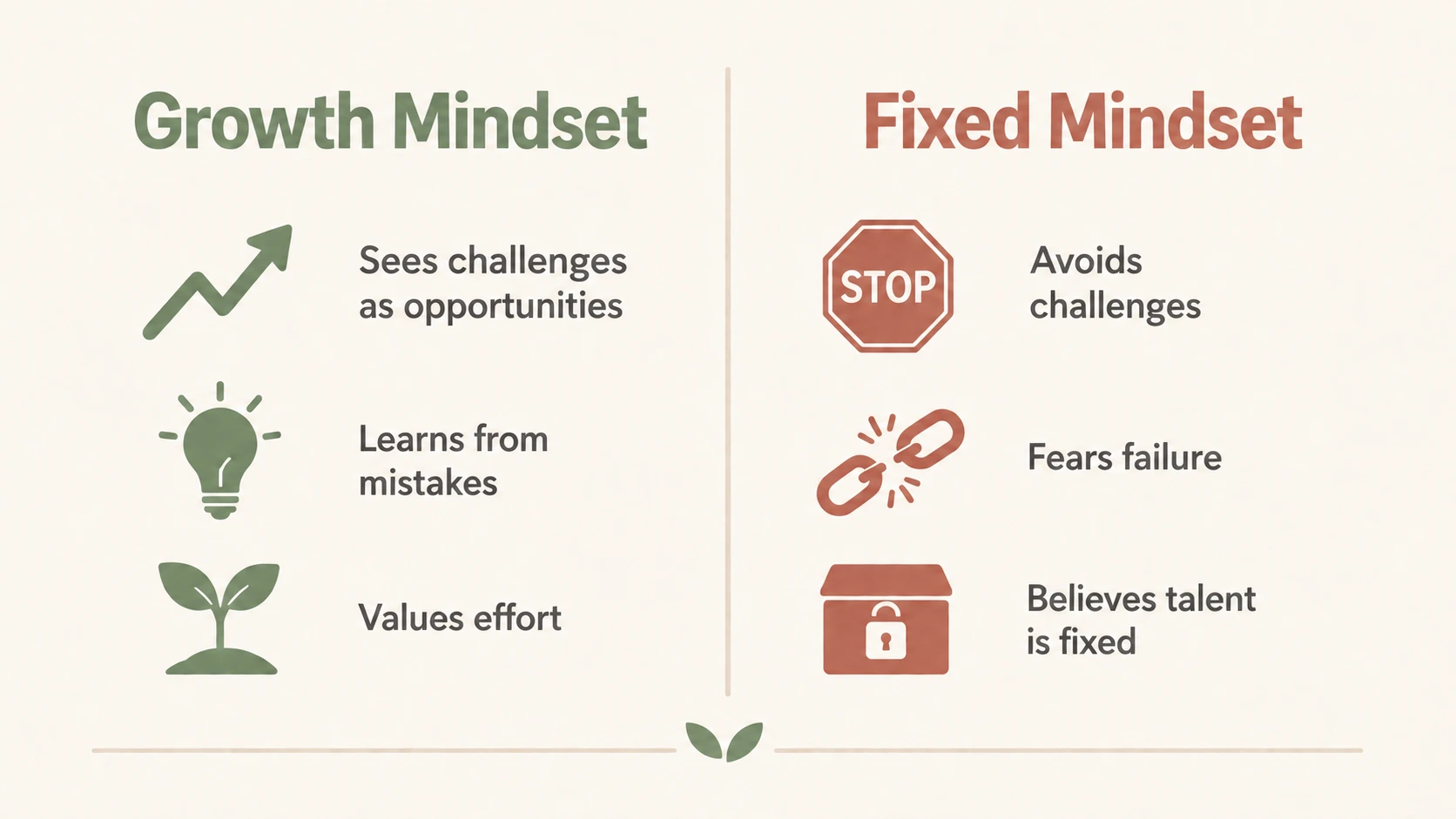
Understanding the contrast between these two orientations makes it easier to recognize which patterns show up in daily thinking and decision-making.
| Growth Mindset | Fixed Mindset |
|---|---|
| Views challenges as opportunities | Avoids challenges |
| Learns from mistakes | Fears failure |
| Values effort | Believes talent is fixed |
| Seeks feedback | Avoids or dismisses feedback |
| Persists through setbacks | Gives up when results are slow |
Many books about mindset and books mindset guides use this comparison as a foundation before moving into practical strategies, since recognizing fixed-mindset patterns is the first step toward changing them.
Why Adults Benefit from Reading Growth Mindset Books
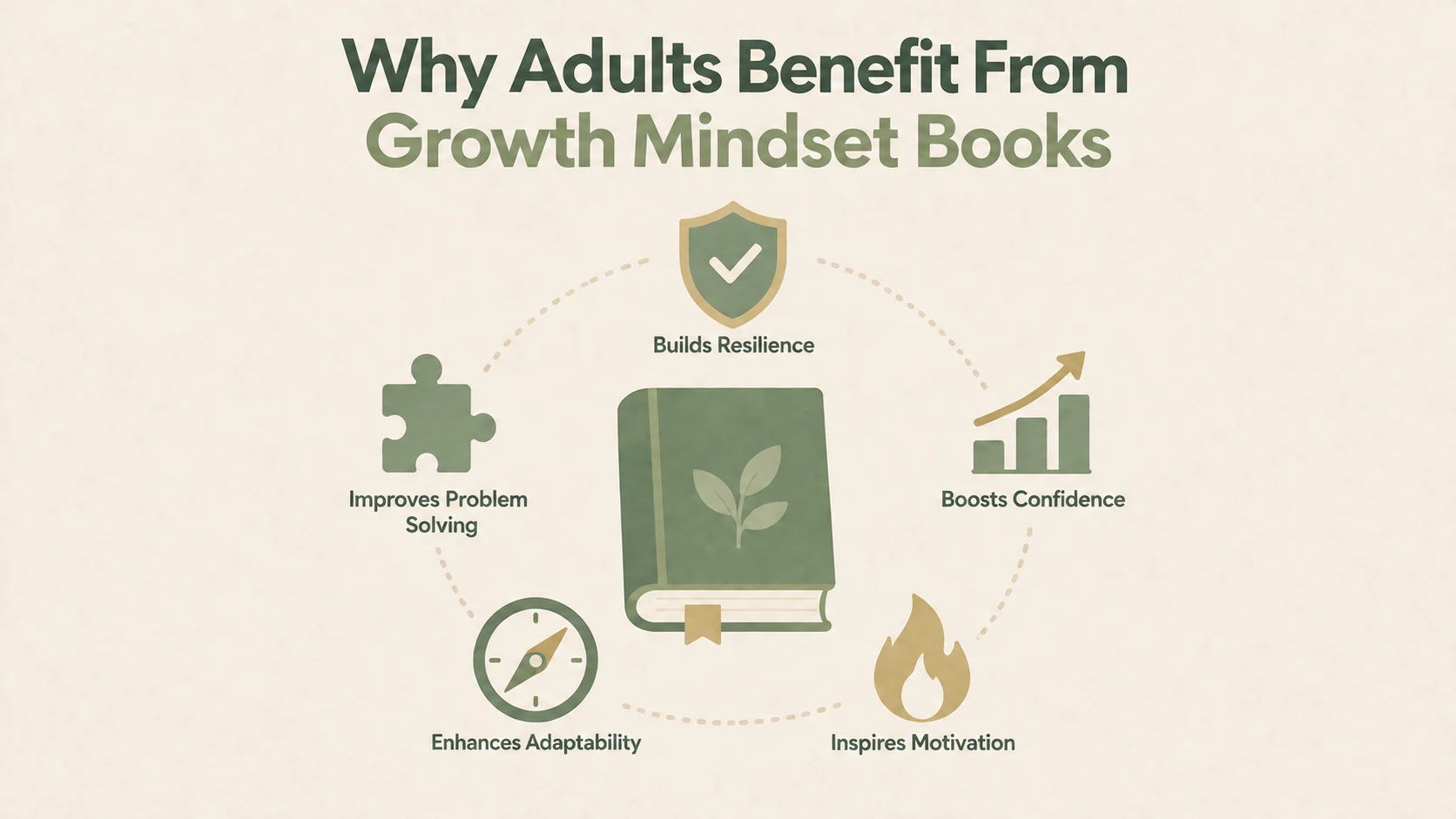
Adults often assume that mindset development is most relevant to students or early-career professionals, but the underlying psychology applies across every stage of life. Reading structured, research-backed material gives adults a framework for approaching change deliberately rather than relying on willpower alone.
Personal Development
A growth-oriented perspective supports better self-awareness, emotional regulation, and long-term goal setting. Readers often report clearer thinking about personal values and priorities after engaging with books for better mindset material.
Career and Professional Growth
Workplace performance is closely tied to how individuals respond to feedback, ambiguity, and failure. A growth mindset supports skill acquisition, adaptability during organizational change, and willingness to take on unfamiliar responsibilities.
Relationships and Emotional Resilience
Mindset theory extends beyond individual achievement into how people handle conflict, criticism, and vulnerability in relationships. A growth orientation encourages viewing relationship challenges as solvable rather than as fixed incompatibilities.
Lifelong Learning
Books for good mindset development frequently emphasize that learning does not stop after formal education ends. Adults who maintain a growth orientation are more likely to pursue new skills, certifications, and interests well into later life.
Reading in this category consistently supports:
- Increased resilience
- Better problem solving
- Improved confidence
- Greater adaptability
- Stronger motivation
Consistent engagement with books for mind growth material builds these capacities gradually, rather than producing an immediate transformation.
What Makes a Great Growth Mindset Book?
Rather than ranking books by popularity or sales figures, the strongest evaluation criteria focus on substance and applicability.
Evidence-Based Psychology
The most credible titles are grounded in psychology best growth mindset books for adults research, drawing on established behavioral science rather than anecdote alone. This distinguishes rigorous work from motivational content with limited scientific backing.
Practical Exercises
Books that include reflection questions, journaling prompts, or structured exercises tend to produce more durable behavior change than those offering theory alone.
Real-Life Examples
Concrete examples, from workplace scenarios to personal stories of setback and recovery, help readers translate abstract psychological concepts into recognizable situations.
Actionable Lessons
Strong titles conclude sections with clear, implementable takeaways rather than leaving readers with only inspiration.
Reader Accessibility
Readability matters. Science best growth mindset books for adults should present research findings in accessible language, avoiding excessive jargon while maintaining accuracy.
Categories of the Best Growth Mindset Books for Adults
Organizing recommendations by purpose is more useful than a single ranked list, since different readers have different goals.
Foundational Mindset Books
These titles introduce core psychological concepts and are typically the starting point for readers new to the topic. They form the backbone of most best books on mindset collections.
Confidence-Focused Books
This category emphasizes self-belief, overcoming self-doubt, and building the internal narrative needed to take on new challenges — a common focus among best mindset books aimed at personal confidence.
Success and Achievement Books
These titles connect mindset principles to long-term goal achievement, often drawing on case studies of high performers across various fields, and are frequently referenced in lists of books on mindset and success.
Business Mindset Books
Written primarily for entrepreneurs and professionals, mindset books for business apply growth-oriented thinking to leadership, innovation, and organizational resilience.
Habit and Productivity Books
These works bridge the gap between mindset theory and daily behavior, focusing on how small, consistent actions reinforce a growth orientation over time.
Educational Growth Mindset Books
Originally developed for classroom use, education best growth mindset books for adults content has been adapted for adult learners pursuing new skills, certifications, or career transitions.
Recommended Growth Mindset Books Every Adult Should Consider
Recommendations are organized by reading level and focus area rather than a single ranked list, since the “best” book depends heavily on the reader’s current knowledge and goals.
Beginner-Friendly Books
Foundational titles in this space introduce the core distinction between fixed and growth orientations using accessible language and relatable examples. Best mindset book choices for beginners typically avoid dense academic terminology.
- Who it is for: Readers new to psychology or self-improvement literature
- Main lessons: Core mindset theory, the impact of praise and feedback, everyday applications
- Strengths: Clear explanations, strong research foundation, broad applicability
- Limitations: Can feel repetitive to readers already familiar with the concept
- Ideal reader: Someone starting a personal development journey for the first time
Intermediate Reads
These books build on foundational theory by connecting mindset to related concepts such as perseverance, discipline, and long-term goal pursuit.
- Who it is for: Readers who understand basic mindset theory and want deeper application
- Main lessons: Persistence, deliberate practice, the role of passion in sustained effort
- Strengths: Bridges psychology with practical strategy
- Limitations: Requires more time investment and reflection to apply fully
- Ideal reader: Adults working toward a specific long-term goal
Advanced Psychology-Based Books
These titles go deeper into behavioral science, often citing academic studies and offering more nuanced discussion of when and how mindset interventions work.
- Who it is for: Readers comfortable with denser, research-heavy material
- Main lessons: Nuanced view of mindset limitations, contextual factors, research methodology
- Strengths: Scientific rigor and credibility
- Limitations: Less accessible for casual readers
- Ideal reader: Professionals, coaches, or educators applying mindset concepts formally
Books That Combine Mindset with Habits
This category focuses on the mechanics of behavior change, showing how identity, environment, and small daily actions reinforce a growth orientation. Translating a single lesson into a repeatable action is where most readers stall — our guide on how to build good habits in 30 days breaks this step down further.
- Who it is for: Readers who understand mindset theory but struggle with consistent action
- Main lessons: Habit formation, environmental design, identity-based change
- Strengths: Highly practical and structured
- Limitations: Less focus on psychological theory itself
- Ideal reader: Adults seeking a step-by-step behavior change system
Fiction That Encourages Growth Thinking
Not all fiction best growth mindset books for adults recommendations come from nonfiction shelves. Narrative fiction featuring characters who overcome adversity through persistence and self-discovery can reinforce growth-oriented thinking in a way that feels less prescriptive than direct instruction.
- Who it is for: Readers who prefer narrative learning over direct instruction
- Main lessons: Themes of perseverance, self-discovery, and purpose conveyed through story
- Strengths: Emotionally engaging, memorable
- Limitations: Lessons are implicit rather than explicitly structured
- Ideal reader: Readers who connect more with story-driven insight than academic explanation
Readers exploring books to read for growth mindset development are encouraged to sample across these categories rather than relying on a single title, since each format reinforces the concept differently.
How to Choose the Right Growth Mindset Book
Selecting from the wide range of best book growth mindset options depends on several personal factors rather than a universal answer.
Consider:
- Reading experience
- Learning objectives
- Scientific depth
- Writing style
- Practical exercises
Readers focused on career advancement may prioritize business-oriented titles, while those working through personal confidence issues may benefit more from psychology-focused foundational books. Matching the book’s format — theoretical, practical, or narrative — to individual learning preferences significantly increases the likelihood that lessons will actually be applied.
Growth Mindset Books Compared
Comparing categories directly helps clarify which type of book best matches a specific goal.
Psychology vs Self-Help
Psychology-based titles prioritize research citations and academic grounding, while general self-help best growth mindset books for adults content tends to prioritize accessibility and motivational tone over scientific depth.
Business vs Personal Development
Mindset books for business apply growth principles to leadership and organizational contexts, while personal development titles focus on individual habits, confidence, and emotional resilience.
Research-Based vs Storytelling
Research-based books offer credibility and precision, while storytelling-driven titles offer emotional resonance and memorability, often at the cost of scientific specificity.
| Category | Best For | Strengths | Limitations |
|---|---|---|---|
| Psychology-Based | Readers wanting scientific grounding | High credibility, precise language | Denser, less accessible |
| Self-Help | Readers wanting quick motivation | Easy to read, actionable tone | Less rigorous evidence base |
| Business-Focused | Professionals and entrepreneurs | Workplace relevance | Narrower personal application |
| Personal Development | Individual growth and confidence | Broad applicability | May lack structured exercises |
| Storytelling/Fiction | Readers who prefer narrative | Emotionally engaging | Lessons less explicit |
How to Apply Lessons from Growth Mindset Books
Reading alone does not create change; application does. Structured practice turns theoretical knowledge into lasting habits.
Daily Reflection
Short daily reflection on challenges faced and how they were handled reinforces awareness of fixed-mindset triggers. Short daily reflection works best with structure — if you’re not sure where to start, these journal prompts for growth mindset give you a ready-made framework.
Habit Building
Translating a single lesson into one small, repeatable action makes growth-oriented thinking part of daily routine rather than an abstract idea.
Goal Setting
Framing goals around learning and effort, rather than only fixed outcomes, keeps motivation intact even when results are slow.
Learning from Failure
Treating setbacks as data rather than judgment is one of the most consistently emphasized lessons across mindset literature.
Measuring Progress
Tracking effort-based indicators, not just outcomes, provides a more accurate picture of mindset development over time.
Practical implementation tools include:
- Journaling
- Weekly review
- Learning goals
- Reflection questions
- Accountability systems
Common Mistakes When Reading Personal Development Books
Even well-chosen books fail to produce results when readers fall into common traps.
Reading without action. This happens when readers treat books as entertainment rather than instruction manuals. The fix is to identify one concrete action per chapter before moving forward.
Information overload. Reading multiple books simultaneously without applying any single framework dilutes focus. Prevention involves finishing and applying one book before starting another.
Unrealistic expectations. Expecting immediate transformation after a single read leads to disappointment and abandonment. Understanding that mindset change is gradual helps sustain motivation.
Constant book hopping. Switching titles at the first sign of difficulty prevents deeper engagement with any single framework. Committing to finish a book, even when it feels slow, supports better retention.
Ignoring reflection. Skipping journaling or reflection exercises reduces retention significantly. Scheduling dedicated reflection time, even five minutes daily, addresses this directly.
Difficulty & Time Investment
Engaging with growth mindset literature requires relatively low barriers to entry, though depth of practice varies by individual.
Beginner-friendly reading paths typically involve shorter, example-driven books requiring minimal prior knowledge. Average reading commitment for a single foundational title ranges from a few hours spread across one to two weeks for most adult readers. Practical exercises, such as journaling or reflection prompts, generally require ten to twenty minutes per session. Factors affecting learning speed include prior familiarity with psychology concepts, consistency of practice, and the reader’s current life circumstances, such as workload or stress levels.
Results Timeline
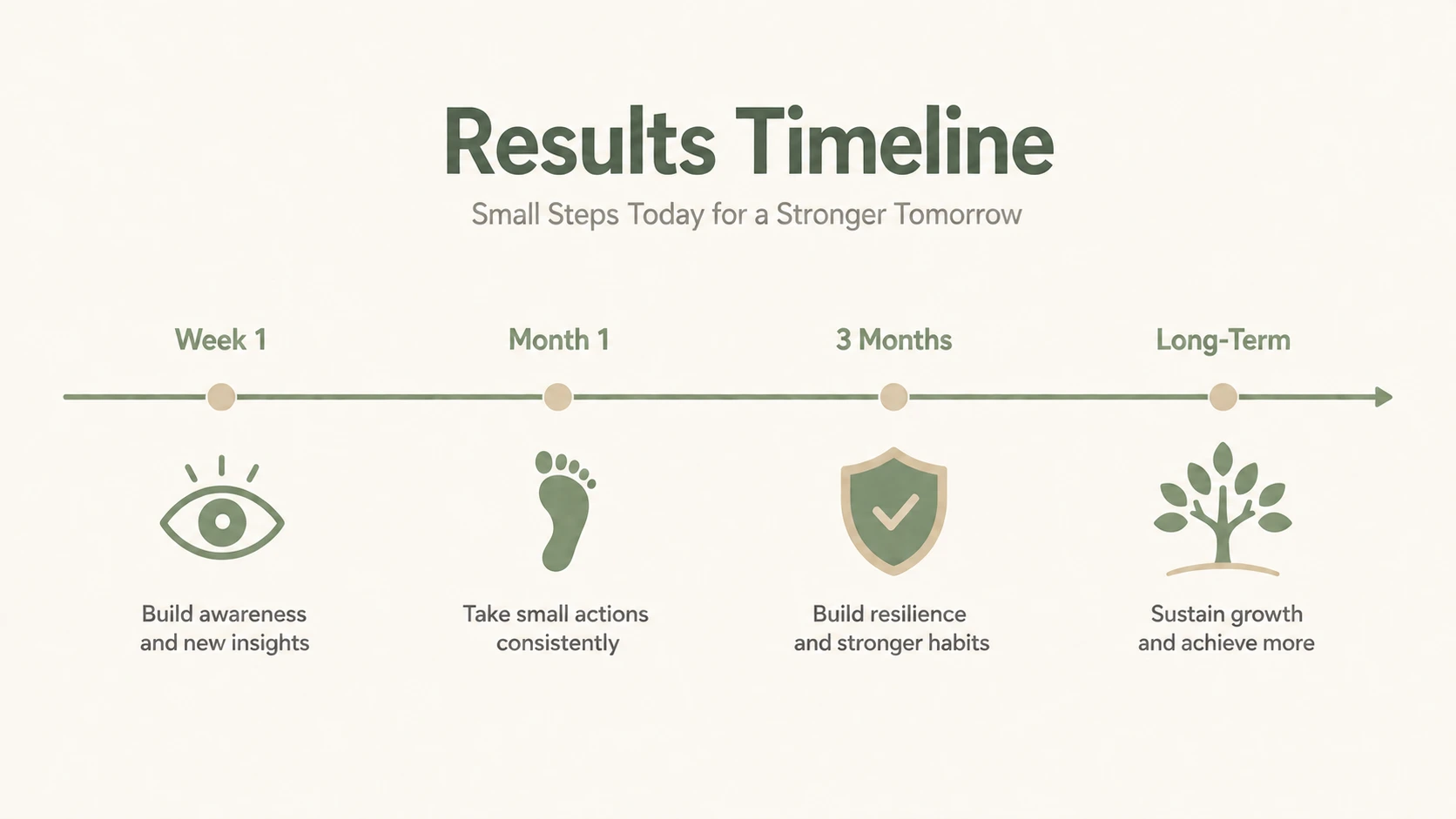
Mindset development follows a gradual, non-linear pattern rather than a fixed schedule.
First week: Readers typically notice increased awareness of fixed-mindset thoughts, such as self-critical language after mistakes.
First month: Small behavioral shifts emerge, including more willingness to attempt unfamiliar tasks or ask for feedback.
Three months: With consistent application, more noticeable changes in resilience and persistence typically appear, particularly in response to setbacks.
Long-term mindset development: Sustained practice over six months to a year tends to produce more stable shifts in how challenges and failure are interpreted.
Personal factors — including stress levels, environment, and social support — significantly influence how quickly these shifts occur, meaning timelines vary considerably between individuals.
Practice Guide for Developing a Growth Mindset
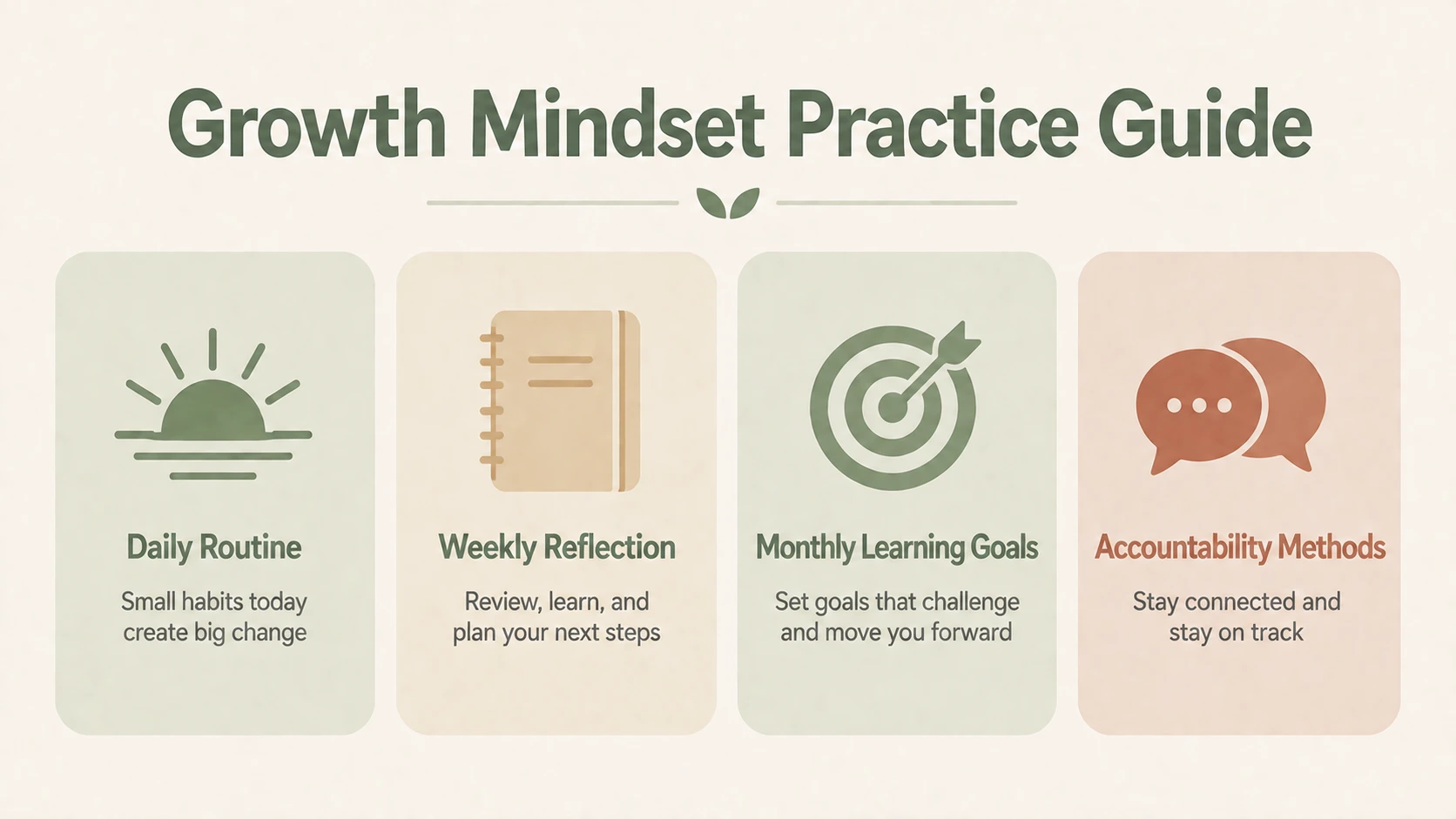
Turning book knowledge into lasting change requires a structured, repeatable system.
Daily Routine
A brief daily check-in, reviewing one challenge and how it was approached, reinforces mindset awareness without requiring significant time investment.
Weekly Reflection
A slightly longer weekly review helps identify patterns across multiple days, revealing recurring fixed-mindset triggers.
Monthly Learning Goals
Setting one specific learning objective each month keeps growth-oriented thinking connected to concrete outcomes rather than abstract intention.
Accountability Methods
Sharing goals with a colleague, mentor, or accountability partner increases the likelihood of follow-through significantly.
Sustainable practice typically includes:
- Habit tracking
- Journaling
- Mindset exercises
- Learning challenges
- Long-term sustainability checkpoints
In our experience helping readers build better habits, the adults who see the most lasting change are those who pair reading with a simple, repeatable weekly review rather than those who read the most books.
Frequently Overlooked Factors That Influence Growth Mindset
Several important factors are frequently missing from general mindset advice, despite meaningfully affecting outcomes.
Environment and social influence. Surrounding relationships and workplace culture significantly shape whether a growth orientation is reinforced or undermined day to day.
Sleep and stress management. Cognitive flexibility, a key component of growth-oriented thinking, is measurably affected by sleep quality and chronic stress levels.
Age misconceptions. Mindset development is not limited to younger adults; behavioral science research supports the brain’s capacity for adaptation throughout adulthood.
Learning styles. Individuals absorb and apply mindset concepts differently depending on whether they prefer narrative, structured exercises, or research-driven explanation.
Consistency over motivation. Relying on motivation alone tends to produce short-lived change; consistent, scheduled practice produces more durable results.
Applying concepts instead of collecting books. Your Daily Thrive recommends prioritizing depth of application over the number of titles read, since accumulating books without implementation rarely produces measurable change.
Who Can Benefit Most from Growth Mindset Books?
Growth mindset principles apply broadly across professional and personal contexts, including for professionals navigating career transitions, entrepreneurs building resilience through uncertainty, students entering adulthood and independent decision-making, leaders managing teams through change, career changers developing new skill sets, parents modeling resilience for their children, and lifelong learners pursuing ongoing personal development.
Search interest in this space often includes queries such as woman best growth mindset books for adults, female best growth mindset books for adults, man best growth mindset books for adults, male best growth mindset books for adults, and black best growth mindset books for adults. Mindset principles themselves are broadly applicable regardless of demographic background, since the underlying psychology of effort, resilience, and learning does not vary by identity. That said, readers may find added value in titles featuring authors or case studies whose perspectives and experiences they personally relate to, which can make the material feel more relevant and easier to apply.
Conclusion
The best growth mindset books for adults share a common foundation: they combine credible psychological research with practical, actionable guidance rather than relying on motivation alone. Selecting the right book depends less on popularity and more on matching content to individual goals, whether that means building career resilience, personal confidence, or long-term learning habits. Categorizing books by purpose — foundational, confidence-focused, business, habit-based, or narrative — makes it easier to build a reading path suited to specific needs. Ultimately, the value of any mindset book depends on consistent application through reflection, habit-building, and accountability, not simply the act of reading. The most effective approach combines thoughtful book selection with a structured practice routine, applied consistently over time.
Frequently Asked Questions
What is the best growth mindset book for adults?
There is no single universal answer, since the best choice depends on the reader’s goals and experience level. Foundational, research-based titles work well for beginners, while more advanced psychology-focused books suit readers seeking deeper scientific grounding.
Which mindset books are backed by psychological research?
The most credible titles cite established behavioral science research, including studies on motivation, learning, and resilience, rather than relying solely on anecdote or motivational language.
Are growth mindset books effective for improving confidence?
Yes, when paired with consistent application. Books alone provide the framework, but confidence improvements typically come from applying reflection exercises and taking on new challenges over time.
How many growth mindset books should I read each year?
There is no fixed number. Fully applying the lessons from one book before moving to the next tends to produce better results than reading many titles without implementation.
Can growth mindset books improve career success?
Growth mindset principles support skill development, adaptability, and resilience during workplace change, all of which contribute to long-term career growth, though outcomes also depend on external opportunity and effort.
What is the difference between mindset books and self-help books?
Mindset books focus specifically on beliefs about ability and learning, often grounded in psychological research, while general self-help books cover a broader range of topics with varying levels of scientific backing.
Are business mindset books different from personal growth books?
Yes. Business-focused titles apply growth mindset principles to leadership, innovation, and organizational contexts, while personal growth books focus more broadly on individual habits, confidence, and emotional resilience.
How do I apply lessons from mindset books in daily life?
Consistent application through daily reflection, small habit changes, and periodic review of progress helps translate book knowledge into lasting behavioral change.