
Introduction
A fail forward mindset treats failure as information rather than proof that a goal is unreachable. Instead of viewing a setback as a final verdict, this approach uses the failing forward meaning of extracting a lesson, adjusting strategy, and trying again with better information. Failure, learning, adaptation, and progress are directly connected: without reflection and adjustment, failure is simply repetition, not growth. The fail forward definition depends on this distinction — it is not about ignoring mistakes or repeating the same error indefinitely, but about converting actionable feedback into a more effective next attempt.
Quick Summary
- A fail forward mindset means using setbacks as feedback to improve the next attempt.
- Failing forward requires reflection, adaptation, and action—not simply experiencing failure repeatedly.
- The approach works best when mistakes are analyzed, lessons are captured, and behavior or strategy changes accordingly.
- It can support resilience, learning, goal achievement, productivity, and long-term personal development.
What Does “Fail Forward” Mean?
The basic definition
Failing forward means converting a failed attempt into useful information that shapes future decisions. A negative outcome only becomes a productive learning experience when it is analyzed and acted on. The word “forward” is central to the failing forward meaning: the objective is movement toward a better outcome, not failure treated as a goal in itself.
Fail forward vs. simply failing
Failure alone does not automatically create growth. Progress follows a specific sequence: attempt → result → reflection → lesson → adjustment → next attempt. A setback becomes useful learning only when the person identifies what happened, why it happened, and what should change before the next try.
Fail forward synonyms and related concepts
Several concepts overlap with fail forward but are not exact synonyms:
- Learning from failure
- Learning through mistakes
- Resilience
- Adaptive learning
- Experimentation
- Continuous improvement
- Growth-oriented thinking
Each term shares elements of the fail forward mindset, but fail forward specifically emphasizes the cycle of reflection and adjustment after a setback.
How a Fail Forward Mindset Works
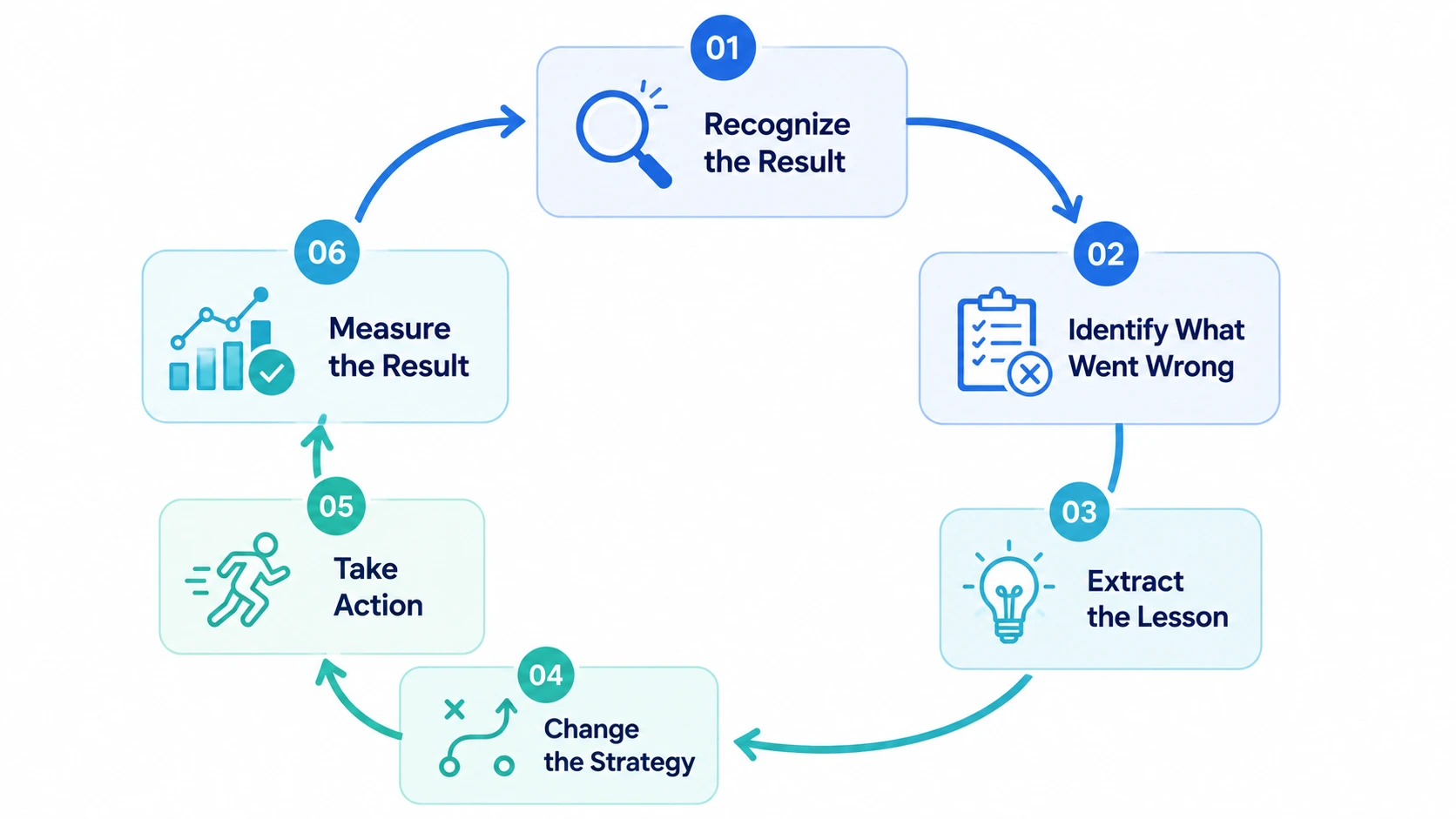
The failing forward mindset follows a repeatable process:
- Recognize the result without denial or excessive self-judgment.
- Identify what went wrong and separate facts from assumptions.
- Extract the lesson from the experience.
- Change the strategy based on what was learned.
- Take another informed action rather than remaining stuck in analysis.
- Measure the new result and repeat the learning cycle.
Honest feedback and a genuine willingness to adapt are essential. Skipping reflection or repeating an unchanged approach breaks the cycle and prevents progress.
Fail Fast, Fail Forward: What Is the Difference?
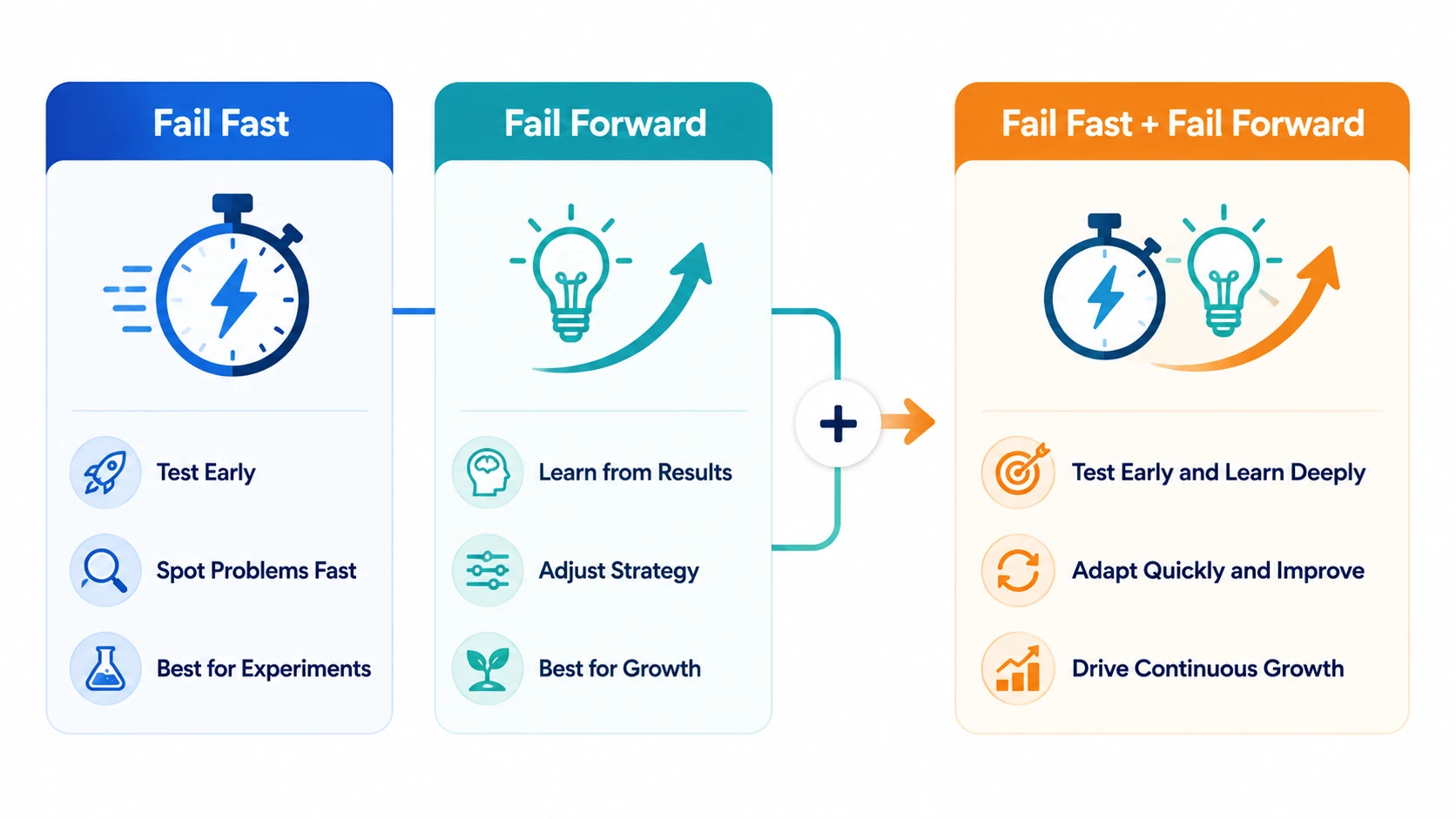
What “fail fast” means
Fail fast is the practice of testing assumptions early so an ineffective approach can be identified before excessive time or resources are invested. It relies on experimentation, prototypes, small tests, and short feedback loops.
What “fail forward” adds to the concept
Fail forward focuses on what happens after a failed experiment. Early failure only becomes valuable when the resulting information is reviewed and applied, connecting the speed of fail fast with the learning process of failing forward.
Fail fast vs. fail forward
| Concept | Main Focus | Key Question | Best Use |
|---|---|---|---|
| Fail fast | Detecting problems early | “Does this approach work?” | Experiments and uncertain decisions |
| Fail forward | Learning and improving after setbacks | “What can this result teach me?” | Personal growth and continuous improvement |
| Fail fast + fail forward | Early testing plus adaptation | “What did we learn, and what should we change?” | Iterative projects and complex goals |
Failing fast without learning can simply produce repeated mistakes at a faster pace, which is why the two concepts work best together.
Real-World Examples of Failing Forward
These examples show the mechanism of learning and adjustment rather than presenting failure as inherently positive.
Learning or education: A student performs poorly on an exam, identifies weaknesses in preparation, changes the study method, and evaluates the next result.
Career and professional development: A project misses its target, the team analyzes the causes, changes its process, and applies the lessons to the next project.
Entrepreneurship and experimentation: An initial idea receives weak feedback, prompting a change in the product, audience, or underlying assumption.
Personal goals: A person abandons an unrealistic routine, identifies the barrier, reduces the scope, and creates a more sustainable approach.
In our experience helping readers build better habits, the readers who improve fastest are the ones who write down one specific lesson after each setback rather than moving on immediately.
How to Develop a Fail Forward Mindset
Change how you interpret mistakes
Replace identity-based conclusions such as “I am bad at this” with process-based questions such as “What part of my approach needs to change?” Constructive self-evaluation focuses on the process; unproductive self-criticism focuses on the person. Developing this mindset works best alongside other structured personal development activities that reinforce reflection and self-awareness over time.
Turn setbacks into actionable feedback
Ask the following questions after a setback:
- What was the intended outcome?
- What actually happened?
- Which assumption was incorrect?
- What factors were within my control?
- What should I repeat, stop, or change?
- What is the smallest useful next experiment?
Build a habit of reflection
Your Daily Thrive recommends a brief review after any meaningful setback rather than an extended period of avoidance. Reflection connects directly to habit formation, goal setting, and productivity, since each review generates a specific adjustment rather than a vague intention to “do better.” Adjusting the system rather than abandoning the goal is a core principle covered in how to build good habits in 30 days, where small environmental changes often matter more than willpower.
Set goals that allow for iteration
Rigid goals can make a single setback feel like a final failure. Milestones, experiments, and process-based goals create built-in opportunities to adjust course without abandoning the larger objective.
Common Mistakes When Trying to Fail Forward
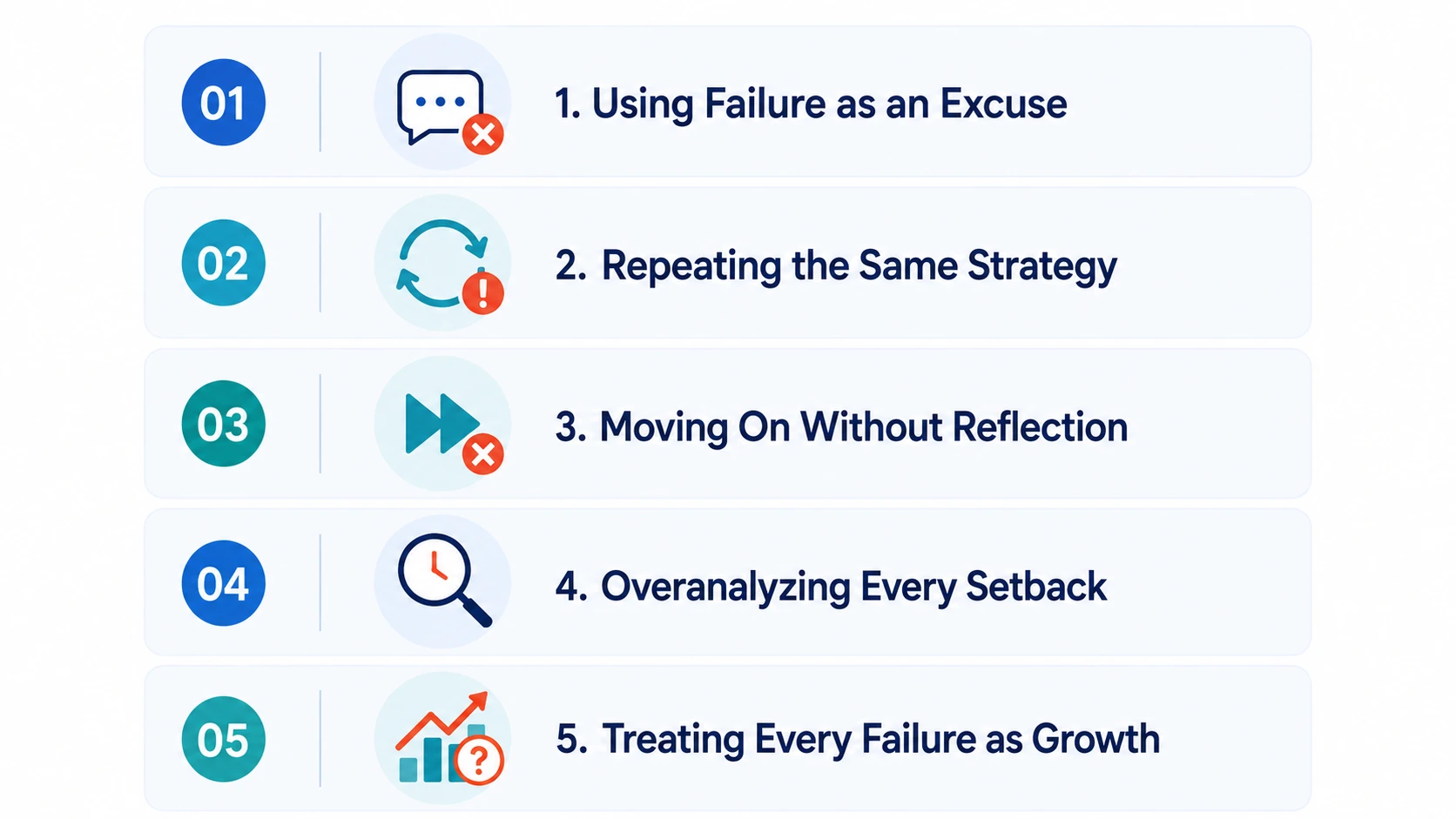
Using failure as an excuse: “Failure is learning” does not justify poor preparation, negligence, or avoidable mistakes. Accountability keeps the mindset constructive rather than becoming a rationalization.
Repeating the same strategy: Persistence without adaptation is not the same as failing forward. If the same approach repeatedly produces the same result, the strategy itself needs examination.
Moving on without reflection: Trying again immediately can waste the information contained in the first attempt. Capturing one or two concrete lessons before the next attempt preserves that value.
Overanalyzing every setback: Excessive reflection can become a form of avoidance. Once a clear lesson and next step are identified, further analysis usually adds diminishing returns.
Treating every failure as personal growth: Situational limits, external factors, randomness, and circumstances outside a person’s control all affect outcomes. Realistic interpretation is more useful than forced positivity.
When Does a Fail Forward Mindset Work Best—and When Can It Fail?
The approach works best when several conditions are present: feedback is available, the situation allows another attempt, lessons can be clearly identified, the person has enough control to make adjustments, and the cost of experimentation is manageable.
Repeated failure can also indicate that the goal, environment, resources, or strategy needs fundamental reconsideration rather than another attempt. Productive persistence — adjusting based on evidence — is different from blind persistence, which repeats the same approach regardless of outcome. External constraints such as finances, deadlines, health, responsibilities, or organizational limits also affect how much experimentation is realistically practical.
Fail Forward Mindset vs. Growth Mindset, Resilience, and Perfectionism
| Concept | Core Idea | Response to Setbacks | Main Risk |
|---|---|---|---|
| Fail forward mindset | Use setbacks to improve the next attempt | Analyze and adapt | Repeating mistakes without learning |
| Growth mindset | Abilities can develop through effort and learning | Treat challenges as opportunities to develop | Overemphasizing effort without strategy |
| Resilience | Recover and continue after adversity | Adapt and regain functioning | Enduring without addressing the cause |
| Perfectionism | High standards and avoidance of mistakes | May interpret errors negatively | Fear of failure and avoidance |
These concepts can complement one another, but a fail forward mindset is primarily an action-and-learning framework, not simply an optimistic attitude. These concepts can complement one another — understanding why is growth mindset important helps clarify how belief in one’s ability to improve supports the action-based process of failing forward.
How Failing Forward Connects With Goals, Productivity, and Personal Growth
Goal setting: Setbacks often reveal unrealistic assumptions about a goal. Failure analysis directly informs revised milestones, timelines, and strategies.
Productivity and time management: Small experiments reduce wasted effort, and reviewing unsuccessful approaches improves future prioritization.
Habit formation: Missed days or failed routines often reveal environmental or scheduling problems. Adjusting the system, rather than abandoning the broader goal, keeps progress intact.
Mindset and resilience: Repeated cycles of reflection and adaptation build confidence based on evidence rather than positive thinking alone.
Practical Fail Forward Framework for Everyday Use
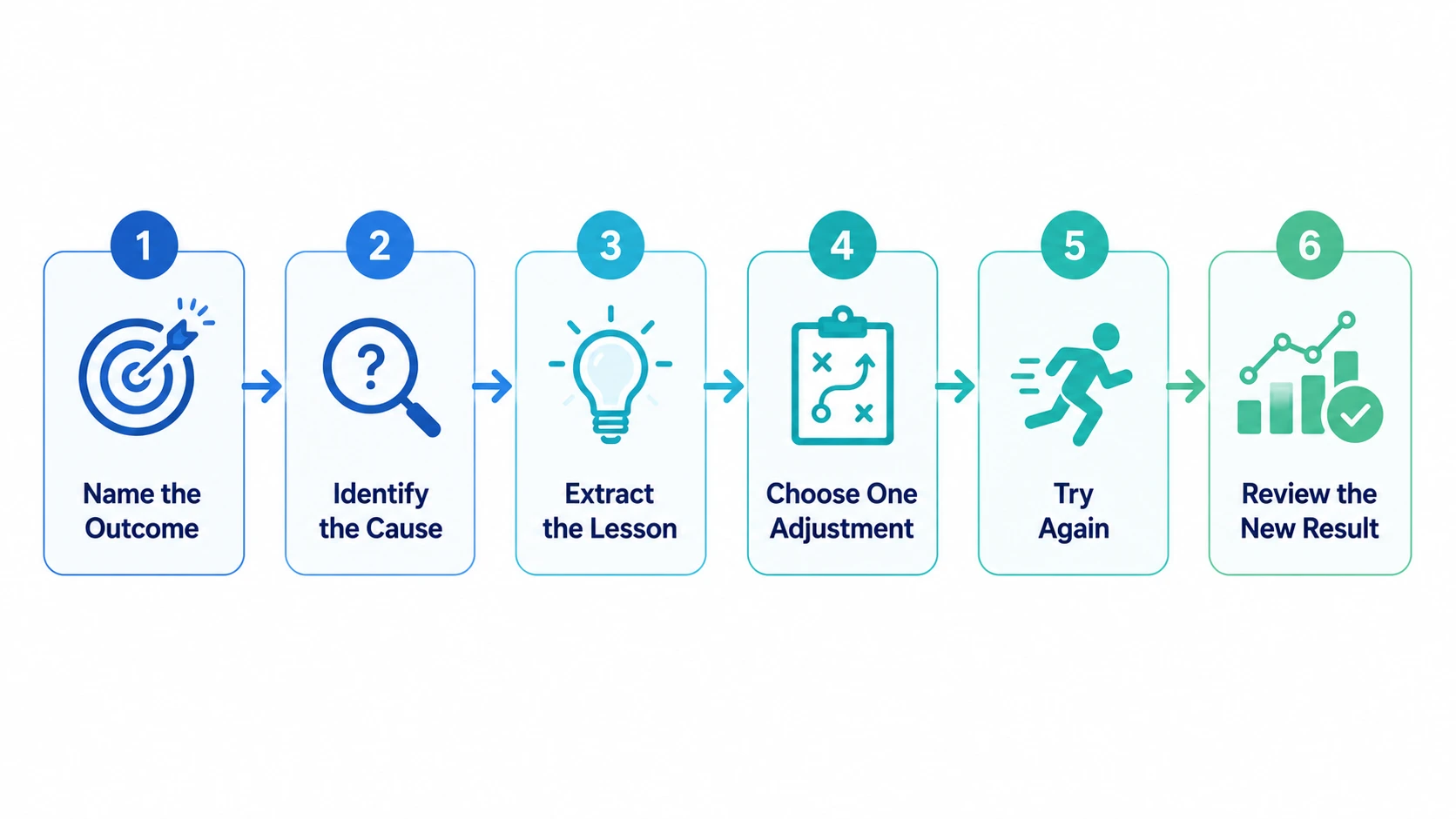
A reusable framework for applying the mindset after a setback:
1. Name the outcome → 2. Identify the cause → 3. Extract the lesson → 4. Choose one adjustment → 5. Try again → 6. Review the new result
Post-failure review checklist:
- What did I expect?
- What happened?
- Why was there a gap?
- What did I learn?
- What will I change?
- What evidence will tell me whether the change worked?
This framework can be adapted for students, professionals, entrepreneurs, and personal goals by adjusting the scale of the review — a quick mental check for small setbacks, and a written review for significant ones.
Quotes and the Broader Idea Behind “Fail Forward”
The idea of “fail forward” is commonly expressed through motivational quotes about failure, persistence, learning, and progress. Rather than relying on isolated quotations, it is more useful to apply the underlying principle: a memorable quote can inspire a moment of motivation, but an actionable mindset requires the ongoing process of reflection and adjustment described throughout this article.
The “Failing Forward” Book and Its Core Ideas
Failing Forward is a widely referenced personal-development concept associated with author John C. Maxwell. The book’s central theme is that the difference between people who achieve their goals and those who do not is not the presence or absence of failure, but how failure is interpreted and used. Readers commonly encounter ideas about redefining failure, separating self-worth from outcomes, and treating setbacks as part of a normal path toward achievement. The book’s broader philosophy connects directly to the practical fail forward framework described above — understanding the concept is a starting point, while applying the framework in real situations is what produces measurable change.
How to Practice Failing Forward Consistently
Difficulty and time investment
The basic reflection process is beginner-friendly and can take only a few minutes after a small setback. More complex goals may require structured reviews, experimentation, data collection, or mentorship. Emotional difficulty, stakes, available feedback, and previous experience all influence how much effort the process requires.
Results timeline
Mindset changes generally develop through repeated practice rather than a single successful attempt. Small improvements in decision-making may become visible quickly, while stronger resilience and lasting habit changes can take weeks or months. Progress speed varies by goal, environment, and how consistently the framework is applied.
Practice guide
A weekly or event-based reflection routine supports consistency. Track:
- Attempts
- Outcomes
- Lessons
- Strategy changes
- Subsequent results
Accountability, journaling, feedback from others, and measurable goals all support consistency. Common obstacles include embarrassment, discouragement, perfectionism, and a lack of visible progress. As of 2026, behavioral development guidance increasingly emphasizes small, trackable process goals over broad motivational statements, since concrete tracking makes adjustment easier to sustain. The goal is sustainable reflection, not constant failure-seeking.
Conclusion: Turning Failure Into Forward Progress
A fail forward mindset is a cycle of attempting, learning, adapting, and trying again. Failure becomes useful only when it produces insight or a meaningful change in strategy — not simply by occurring repeatedly. Productive persistence, which adjusts based on evidence, is fundamentally different from repeating the same mistake without change. In practice: fail forward by treating setbacks as feedback, changing what needs to change, and using the next attempt to move closer to the desired outcome.
FAQ: Common Questions About the Fail Forward Mindset
What does a fail forward mindset mean? It means treating a setback as feedback rather than a final outcome, then using reflection and adjustment to inform a better next attempt.
What is an example of failing forward? A student who performs poorly on an exam, identifies specific weaknesses in their preparation, changes their study method, and improves on the next test is failing forward.
What is the difference between fail fast and fail forward? Fail fast emphasizes discovering problems early through quick testing, while fail forward emphasizes learning and adapting from the result of that test.
Is failing forward the same as having a growth mindset? They overlap but are not identical. A growth mindset is a belief that abilities can develop through effort, while failing forward is a specific action-and-learning process applied after a setback.
What are some synonyms for fail forward? Related terms include learning from failure, adaptive learning, resilience, and continuous improvement, though none is an exact equivalent.
How can I develop a fail forward mindset? Build the habit of reviewing setbacks with a short set of questions, extracting one clear lesson, and adjusting your strategy before the next attempt.
Can failing forward become an excuse for making mistakes? Yes, if it is used without accountability. The mindset stays useful only when it leads to an actual change in strategy or behavior, not when it justifies repeated negligence.
What should I do immediately after a failure? Pause, assess the result, identify the cause, extract one lesson, choose an adjustment, and decide on your next action.