
Introduction
A growth mindset is the belief that abilities are not fixed traits but qualities that can develop over time through learning, effort, effective strategies, feedback, and consistent practice. A growth mindset PPT takes this psychological concept and turns it into a clear, teachable visual presentation that an audience can actually apply — not just a slide of inspirational quotes.
There’s an important distinction between explaining growth mindset and simply promoting it. A presentation that only encourages people to “believe in themselves” or “never give up” misses the substance of the concept. An effective one instead introduces the key entities behind the idea — psychologist Carol Dweck, the contrast between growth and fixed mindsets, and the roles of learning, effort, feedback, and resilience — and shows how they connect to real skill development.
Before building slides, it helps to know what an effective presentation needs to communicate: a working definition, a clear comparison to the fixed mindset, realistic examples, and strategies people can put into practice immediately.
Quick Summary
- A growth mindset presentation explains how abilities can develop through learning, practice, strategies, and feedback — not through motivation alone.
- The central comparison is between growth mindset and fixed mindset, while recognizing that most people show both patterns depending on the situation.
- Effective presentations use realistic examples and actionable strategies rather than treating growth mindset as simply “trying harder.”
- The best presentation structure changes depending on the audience — students, children, educators, or employees each need different framing.
What Is a Growth Mindset?
Growth Mindset Meaning and Definition
A growth mindset is the belief that intelligence and skill are not fixed at birth but can be developed through sustained learning, deliberate practice, and effective strategies. This is the growth mindset meaning at its core: ability is a starting point, not a ceiling. Understanding this distinction also explains why growth mindset is important for long-term learning and resilience, not just short-term motivation.
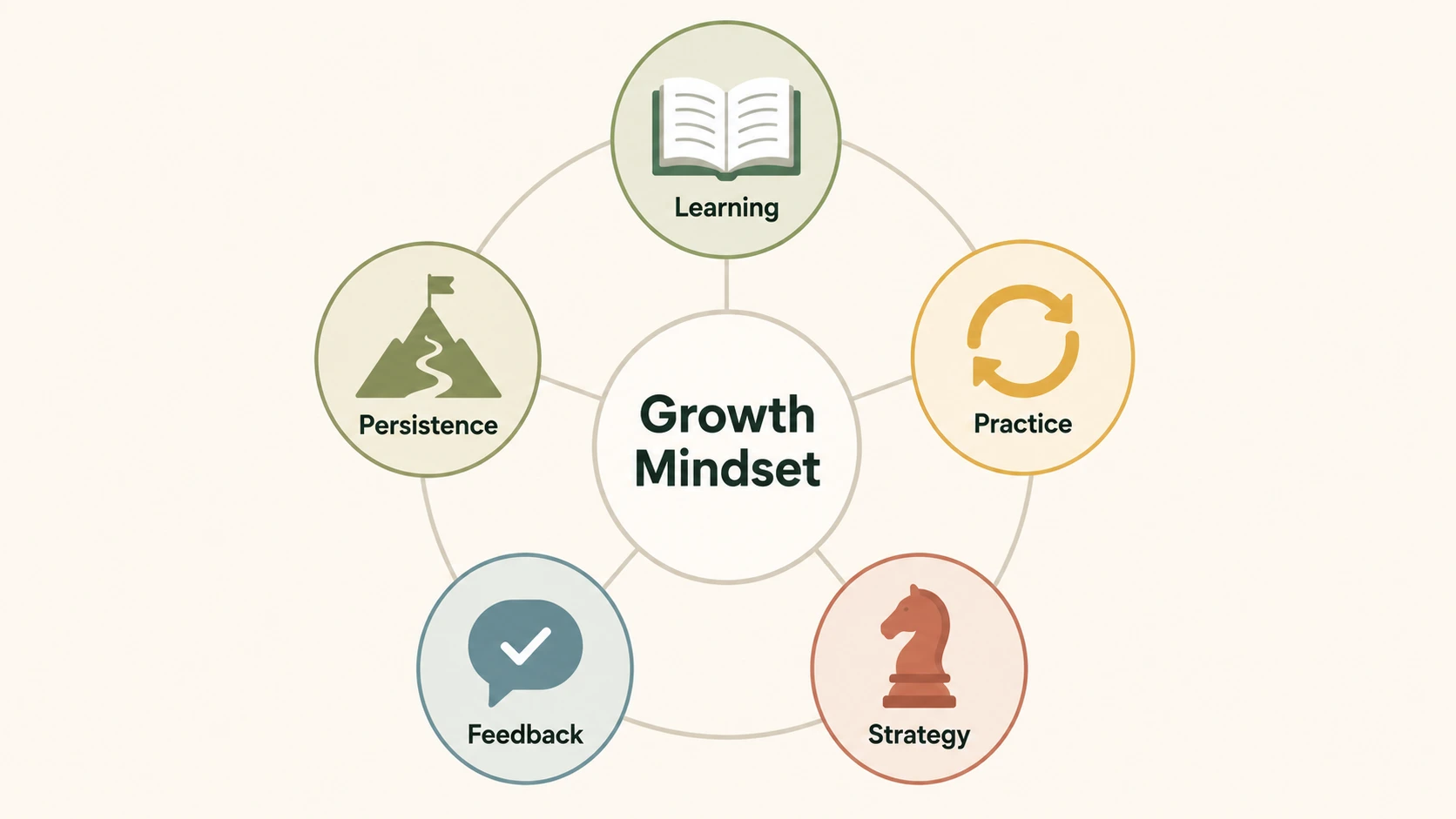
It’s important to separate this from a common oversimplification. Believing abilities can develop is not the same as believing that effort alone guarantees success. A growth mindset, properly defined, depends on several interacting factors:
- Learning — actively acquiring new knowledge or skills
- Practice — repeated, deliberate engagement with a task
- Strategy — choosing and adjusting methods based on what works
- Feedback — using information about performance to improve
- Persistence — continuing through setbacks in a productive way
When these elements work together, the definition of a growth mindset becomes less about optimism and more about a practical approach to improvement.
Carol Dweck and the Development of the Growth Mindset Concept
The growth mindset concept was developed by psychologist Carol Dweck through decades of research on beliefs about intelligence and ability. Carol Dweck’s growth mindset framework distinguishes between people who view intelligence as malleable and people who view it as a fixed, unchangeable trait. For presenters who want supporting material, a curated set of Carol Dweck growth mindset quotes can reinforce these ideas on a slide without oversimplifying them.
It’s worth noting that Dweck’s original psychological research is more nuanced than many popular interpretations suggest. The academic concept focuses on how beliefs about ability shape behavior — particularly how people respond to challenges and setbacks — rather than functioning as a general motivational slogan. A well-informed presentation should reflect this original framing rather than a simplified, purely inspirational version.
Growth Mindset vs. Fixed Mindset
What Is a Fixed Mindset?
A fixed mindset is the belief that intelligence, talent, or ability are largely stable traits that don’t change much over time. People operating from a fixed mindset tend to show recognizable thought patterns, such as avoiding challenges that might expose a weakness, giving up quickly when a task becomes difficult, and interpreting mistakes as proof of inability rather than as information to learn from.
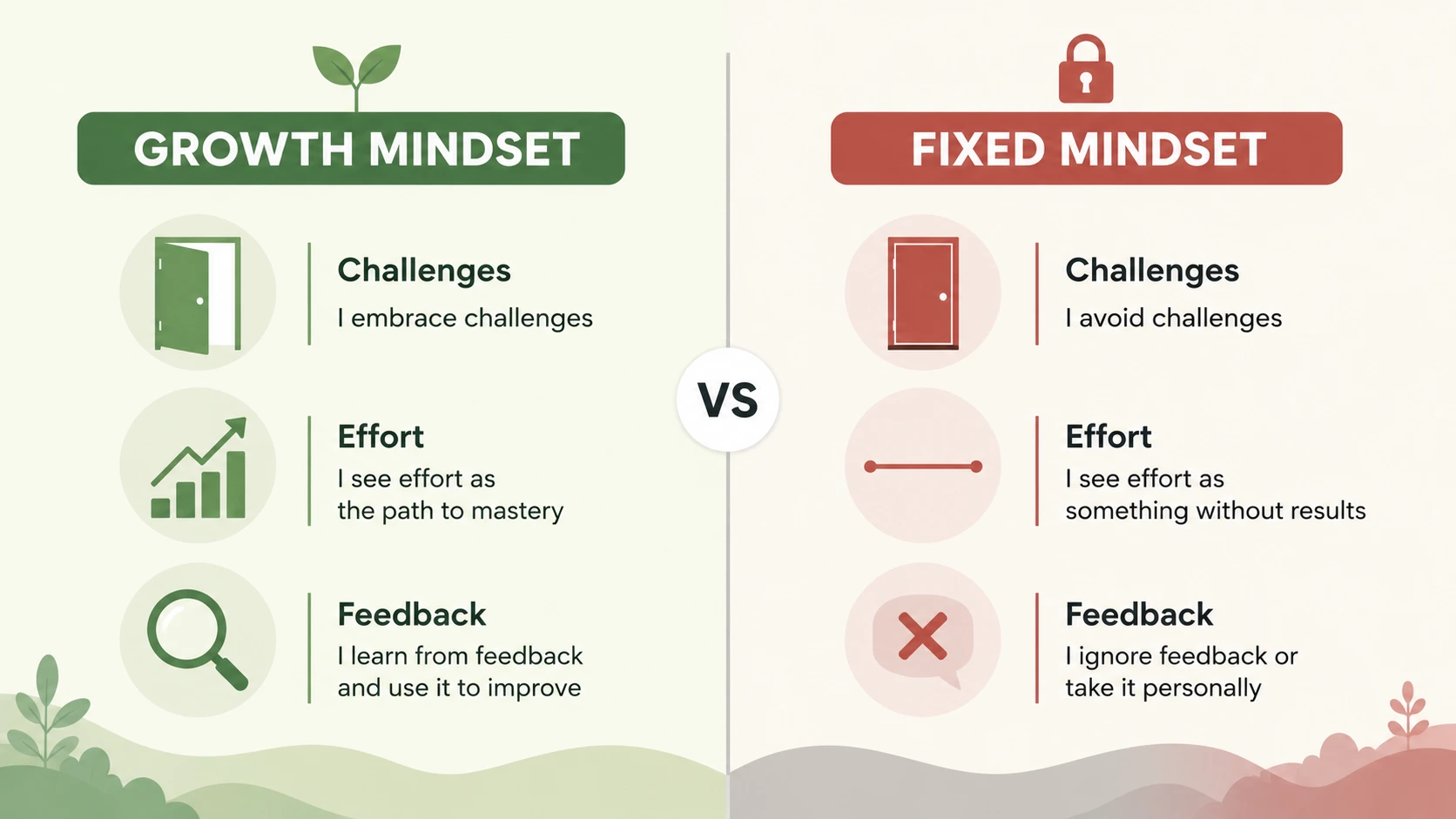
How Growth and Fixed Mindsets Differ
The two mindsets differ across several dimensions: core beliefs about ability, responses to challenges, reactions to mistakes, attitudes toward feedback, and general approaches to learning. Importantly, mindset is not necessarily a fixed label attached to a person — most people show growth-oriented thinking in some areas of life and fixed thinking in others, often depending on context, past experience, or how much is at stake.
| Category | Growth Mindset | Fixed Mindset | Typical Response |
|---|---|---|---|
| Belief about ability | Can be developed | Largely fixed | Growth: “I can improve.” Fixed: “I’m just not good at this.” |
| Challenges | Seen as opportunities | Often avoided | Growth: seeks difficulty. Fixed: sticks to what’s easy. |
| Mistakes | Treated as information | Treated as failure | Growth: adjusts approach. Fixed: disengages. |
| Feedback | Actively sought | Often resisted | Growth: asks for specifics. Fixed: feels criticized. |
| Effort | Seen as a path to mastery | Seen as a sign of low ability | Growth: persists strategically. Fixed: gives up early. |
What Should a Growth Mindset PPT Include?
Essential Presentation Sections
A growth mindset PPT that functions as education rather than motivation should generally include:
- A clear definition of growth mindset
- A comparison between growth and fixed mindset
- Realistic, relatable examples
- An explanation of the role of mistakes, challenges, feedback, and effort
- Practical strategies the audience can apply
- Reflection questions or a concrete action step to close the presentation
These components give the presentation practical differentiation — they explain the conceptual building blocks that make it educational, rather than a set of loosely connected motivational statements. Some presenters also introduce growth mindset affirmations here as a starting template for reframing fixed language — though these work best paired with the strategy and feedback steps above, not as a replacement for them.
How to Structure the Information for Clear Learning
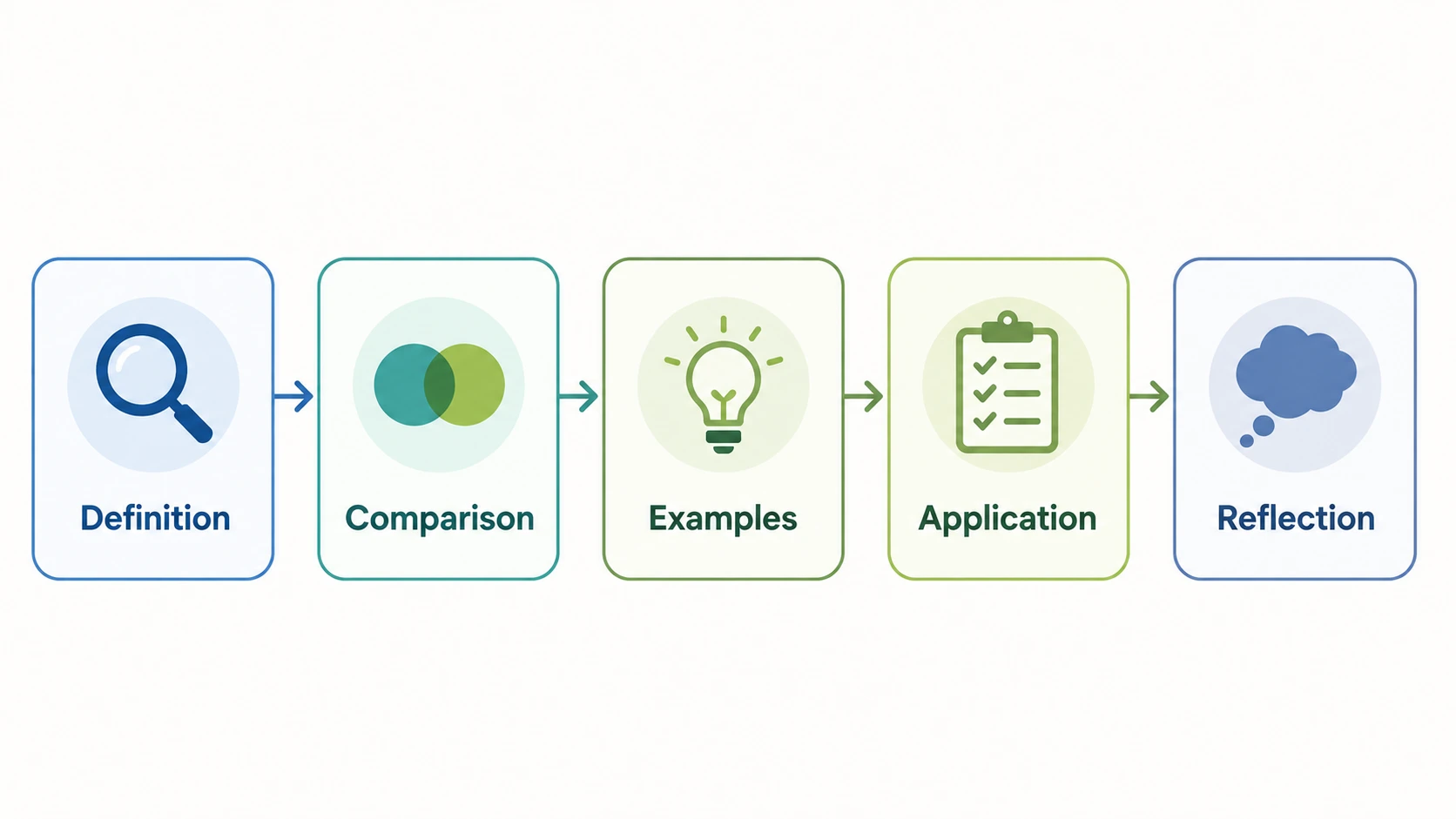
The clearest structure for a growth mindset presentation follows a logical progression: definition → comparison → examples → application → reflection. Each slide should focus on one major idea rather than combining several concepts, and information should be delivered through short explanations, examples, diagrams, and comparisons rather than dense paragraphs of text.
Building conceptual relationships — connecting challenge, response, strategy, feedback, and improvement — helps the audience see growth mindset as a functioning system rather than a list of unrelated tips.
| Presentation Section | Purpose | Audience Outcome |
|---|---|---|
| Definition | Establish shared understanding | Clear working knowledge of the term |
| Growth vs. fixed comparison | Highlight contrasting patterns | Ability to recognize both mindsets |
| Examples | Ground the concept in real situations | Relatable understanding |
| Strategies | Provide actionable steps | Tools for immediate application |
| Reflection | Reinforce personal relevance | Increased likelihood of behavior change |
Growth Mindset Examples for Students and Children
How Students Can Apply a Growth Mindset
Students encounter regular opportunities to apply growth mindset principles — difficult subjects, disappointing grades, mistakes on assignments, and challenging projects. A growth mindset PPT for students works best when it shows how to replace fixed statements with learning-oriented alternatives, such as reframing “I’m bad at math” into “I haven’t learned this method yet.”
Critically, growth mindset should be connected to learning strategies, not effort alone. A student who studies the same way repeatedly without results needs a new approach, not simply more hours of the same method.
How to Explain Growth Mindset to Children
When explaining growth mindset to children, age-appropriate language and concrete examples work better than abstract psychological terminology. A growth mindset PPT for kids should focus on relatable ideas: practicing a skill, learning from mistakes, and trying different strategies when something doesn’t work the first time.
Classroom Examples and Reflection Activities
Classroom-based examples can draw from homework struggles, exam preparation, sports, creative projects, and learning new skills. Reflection questions — such as asking students to identify a recent mistake and what it taught them — help learners distinguish between fixed and growth-oriented responses in their own experience. This practical implementation layer is often missing from generic growth mindset content.
Growth Mindset in the Workplace
Growth Mindset for Employees
In a professional setting, growth mindset applies to ongoing learning, receiving feedback, adapting to changing responsibilities, developing new skills, and recovering from setbacks. A growth mindset presentation for employees should show how experimentation and feedback loops — not just positive thinking — drive performance improvement.
It’s equally important that a growth mindset framework should never be used to justify unrealistic workloads or the expectation of endless effort. Growth mindset describes how people respond to challenges, not a rationale for unsustainable demands.
Building a Growth-Oriented Workplace
Managers and teams contribute to a growth-oriented culture by normalizing learning from mistakes rather than punishing them. This requires constructive feedback, psychological safety, coaching, and genuine development opportunities. It’s worth distinguishing an individual’s mindset from organizational culture — a person with strong growth-oriented beliefs can still struggle in an environment that penalizes risk-taking or honest mistakes.
How to Develop a Growth Mindset
Practical Strategies
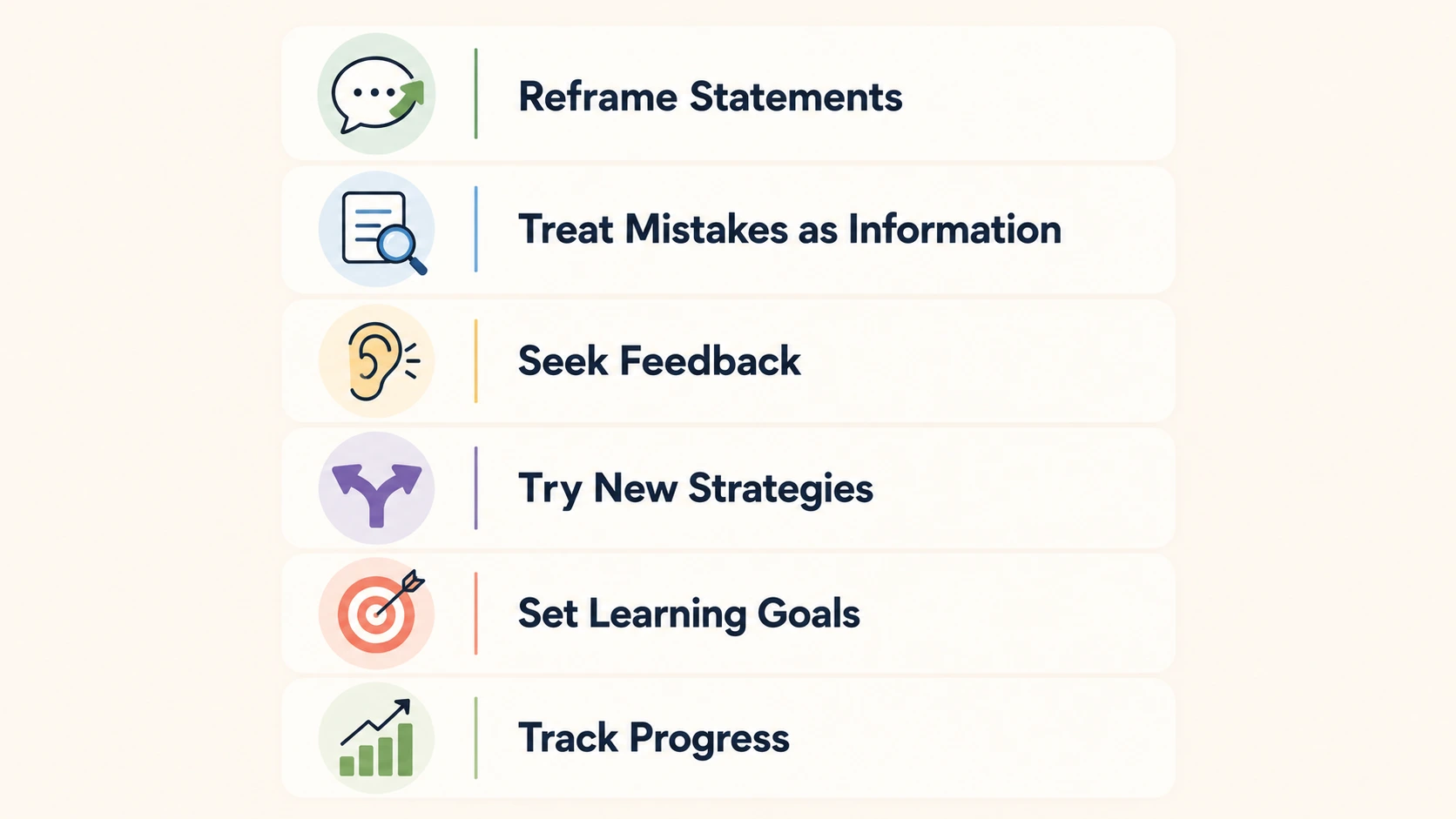
Developing a growth mindset involves specific, repeatable practices:
- Reframe ability-focused statements (“I can’t do this”) into learning-focused statements (“I can’t do this yet“)
- Treat mistakes as information rather than failure
- Seek specific, actionable feedback instead of general praise
- Try alternative strategies when the first approach isn’t working
- Set learning-oriented goals rather than only outcome-oriented goals
- Track progress over time to make development visible
The Role of Effort, Feedback, and Strategy
“Work harder” is an incomplete growth-mindset message on its own. Productive effort needs to combine with effective strategies, available resources, useful feedback, and willingness to adjust course. In our experience helping readers build better habits, the difference between stalled progress and real improvement usually comes down to strategy changes, not just increased effort.
Persistence is useful when a strategy is working slowly; changing the approach becomes more effective when repeated effort produces no measurable improvement.
Common Growth Mindset Mistakes and Misconceptions
Why “Just Try Harder” Is Not Enough
Productive persistence differs from ineffective repetition. Simply repeating an unsuccessful approach rarely produces better results — feedback and strategy selection are what actually influence improvement, not sheer repetition of effort.
Why Growth Mindset Does Not Mean Ignoring Limitations
Growth mindset does not claim that every outcome is achievable with unlimited effort. External constraints — such as available resources, prior knowledge, access to opportunity, and individual differences — genuinely shape what’s realistically achievable, and a credible presentation should acknowledge this rather than overstate the concept.
Avoiding an Overly Positive or Motivational Presentation
A well-balanced presentation pairs encouragement with evidence, realistic expectations, and actionable strategies. Growth mindset should not be presented as a guarantee of academic, professional, or personal success — that framing overstates what the research actually supports and is a nuance often missing from generic growth mindset presentations.
Evidence and Neuroscience Behind Growth Mindset
What Research Says About Growth Mindset
Research on growth mindset generally investigates how mindset interventions affect motivation, learning behavior, and academic or performance outcomes. Your Daily Thrive recommends treating this as an active area of study rather than settled fact: findings vary by context, population, and how the intervention is designed. It’s important to separate the underlying psychological concept from claims that go further than the current evidence supports.
How to Present Evidence Without Overclaiming
A responsible growth mindset presentation distinguishes between well-established findings, emerging or mixed evidence, and simplified popular explanations that have moved beyond what research directly shows. Citing credible, peer-reviewed sources when presenting scientific claims strengthens the presentation’s trustworthiness.
| Claim | What It Means | Evidence Strength | How to Present It |
|---|---|---|---|
| Beliefs about ability can influence behavior | Mindset shapes how people respond to challenges | Well-supported | Present as a core, established finding |
| Mindset interventions always significantly boost grades | Simple messaging alone reliably raises achievement | Mixed / inconsistent | Present cautiously, note variability |
| The brain can form new neural connections through learning | Neuroplasticity supports skill development | Well-supported (general neuroscience) | Present as supporting context, not a growth-mindset-specific claim |
Adapting a Growth Mindset Presentation to Different Audiences
The same core concept requires different examples and framing depending on who is in the room.
Students and Young Learners
Prioritize concrete examples, classroom situations, mistakes, learning strategies, and short reflection exercises.
Educators and Trainers
Focus on teaching practices, how to give effective feedback, common student responses to challenge, and building a classroom culture that supports learning from error.
Employees and Managers
Emphasize professional development, feedback processes, adaptability during change, collaboration, and learning from workplace setbacks.
| Audience | Purpose | Example Type | Language | Desired Takeaway |
|---|---|---|---|---|
| Students | Build learning resilience | Grades, assignments, exams | Simple, direct | Try new study strategies |
| Children | Introduce the concept early | Practice, games, mistakes | Concrete, age-appropriate | Mistakes are part of learning |
| Educators | Improve teaching practice | Feedback methods, classroom culture | Professional, practical | Model growth-oriented responses |
| Employees/Managers | Support performance growth | Feedback, setbacks, skill-building | Professional, outcome-focused | Adapt strategy, seek feedback |
How to Make a Growth Mindset PPT More Effective
- Use one central concept per slide rather than combining multiple ideas
- Prefer concrete, relatable examples over abstract motivational statements
- Include growth-versus-fixed comparisons wherever they clarify the concept
- Use questions and scenarios to prompt audience reflection
- Keep scientific claims accurate and appropriately qualified
- End with practical, specific actions rather than a generic motivational close
These practices keep the presentation informational and usable, rather than a collection of feel-good statements without follow-through.
Conclusion
A growth mindset PPT should explain a nuanced, evidence-informed approach to learning and development — not simply encourage people to work harder. The core relationships worth reinforcing are between growth mindset, fixed mindset, challenges, mistakes, feedback, strategy, and practice: each shapes how effectively a person or group improves over time.
As of 2026, presentations that hold up best are the ones that adapt their examples and activities to their specific audience, whether that’s students, children, educators, or employees, while staying grounded in what the research actually supports. A strong growth mindset presentation defines the concept, contrasts it with a fixed mindset, explains realistic applications, addresses common misconceptions, and gives its audience practical, specific ways to approach learning and improvement.
FAQs
What is a growth mindset PPT? A growth mindset PPT is a presentation designed to teach the concept that abilities can develop through learning, effort, strategy, and feedback, typically covering definitions, comparisons, examples, and practical application.
What should be included in a growth mindset presentation? It should cover the definition, a growth-versus-fixed-mindset comparison, realistic examples, practical strategies, relevant evidence, reflection prompts, and audience-specific applications.
What is the difference between growth mindset and fixed mindset? Growth mindset is the belief that ability can develop through effort and strategy, while fixed mindset is the belief that ability is largely stable; the two differ in how people respond to challenges, mistakes, and feedback.
How do you develop a growth mindset? Developing a growth mindset involves setting learning-oriented goals, seeking specific feedback, changing strategies when something isn’t working, and treating mistakes as useful information rather than failure.
How can growth mindset be taught to students? It can be taught through age-appropriate examples, classroom activities tied to real assignments, structured feedback, and reflection exercises that help students recognize fixed versus growth-oriented responses.
How can growth mindset be applied in the workplace? In the workplace, it applies to professional learning, seeking and using feedback, adapting to change, coaching, and building an organizational culture that treats mistakes as learning opportunities.
Is growth mindset the same as simply trying harder? No — effort is only one component. Strategy, feedback, available resources, and willingness to adjust course all matter as much as, or more than, effort alone.
Does having a growth mindset mean anyone can achieve anything? No — growth mindset does not eliminate the effect of realistic constraints such as available resources, prior knowledge, opportunity, and individual circumstances.
What does Carol Dweck mean by growth mindset? Carol Dweck’s growth mindset framework describes the belief that intelligence and ability can be developed over time, in contrast to a fixed mindset, which views these traits as largely unchangeable.