
Introduction
Letting go of expectations means reducing emotional attachment to specific outcomes, behaviors, or responses from other people. In practical terms, it involves accepting uncertainty while staying emotionally balanced. Psychologically, unrealistic expectations often create frustration, resentment, anxiety, disappointment, and relationship conflict because reality rarely matches rigid mental assumptions. Many people confuse healthy standards with unhealthy expectations. Healthy standards are based on values, boundaries, and self-respect, while unhealthy expectations often involve trying to control people or situations. Emotional peace usually comes from flexibility, acceptance, communication, and self-awareness rather than constantly trying to predict or control outcomes.
Quick Summary
- Letting go of expectations means reducing attachment to specific outcomes, behaviors, or responses from others.
- Unrealistic expectations often lead to disappointment, stress, overthinking, and relationship tension.
- Healthy relationships require communication, boundaries, and acceptance rather than control.
- Emotional freedom improves when people focus on actions they can control instead of outcomes they cannot.
- Psychological flexibility and realistic thinking help reduce emotional stress and burnout.
What Does Letting Go of Expectations Mean?
The psychological meaning of expectations involves mental predictions about how situations, relationships, or people should behave. These expectations are often shaped by past experiences, emotional needs, personal beliefs, and social conditioning.
The let go of expectations meaning is not about becoming emotionally detached or lowering standards. Instead, it means reducing rigid attachment to outcomes that cannot always be controlled.
Letting go of expectations means accepting uncertainty while maintaining emotional balance. It allows people to respond more calmly when reality differs from what they imagined.
There is an important difference between expectations, hopes, goals, and standards:
- Expectations often involve assumptions about outcomes or behavior.
- Hopes are flexible desires without emotional rigidity.
- Goals focus on effort, progress, and direction.
- Standards reflect personal values and healthy boundaries.
Humans naturally create expectations because the brain seeks predictability, emotional safety, and stability.
Why People Create Expectations
People develop expectations for several emotional and psychological reasons:
- Desire for certainty and emotional safety
- Need for validation and predictability
- Fear of rejection or disappointment
- Social conditioning and relationship ideals
Behavioral psychology shows that uncertainty often activates stress responses in the brain. Expectations can temporarily create a sense of control, even when that control is unrealistic.
Expectations vs Healthy Standards
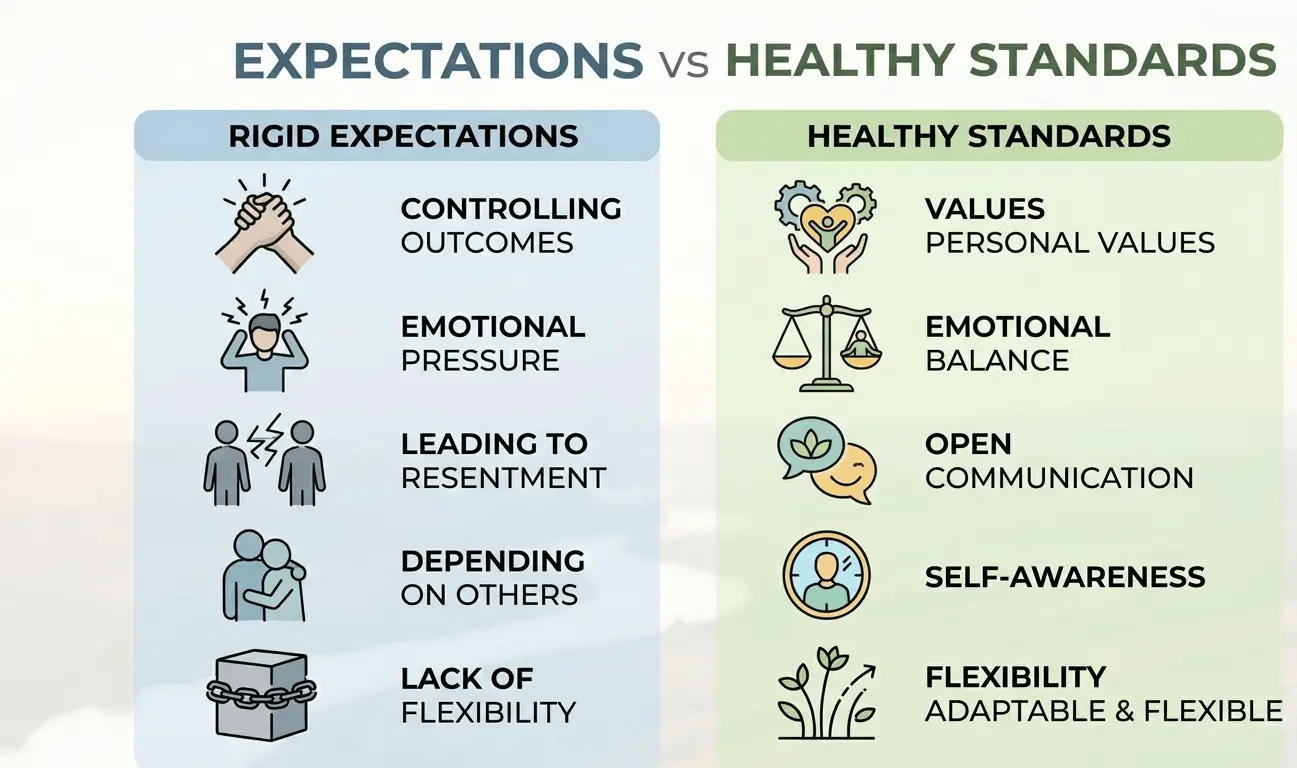
| Expectations | Healthy Standards |
|---|---|
| Focused on controlling outcomes | Focused on personal values |
| Often rigid | Flexible and realistic |
| Creates resentment | Encourages communication |
| Depends on others changing | Depends on self-awareness |
Why Letting Go of Expectations Improves Mental and Emotional Health
Letting go of unrealistic expectations improves emotional regulation because it reduces anxiety, overthinking, and emotional dependency. Many mental health struggles are intensified by attachment to outcomes that cannot be fully controlled.
Psychological flexibility allows people to adapt instead of reacting emotionally whenever reality differs from expectations.
Behavioral psychology also shows that cognitive distortions can increase emotional suffering. Examples include catastrophizing, all-or-nothing thinking, and assuming people should behave according to personal expectations.
The Hidden Stress Caused by Expectations
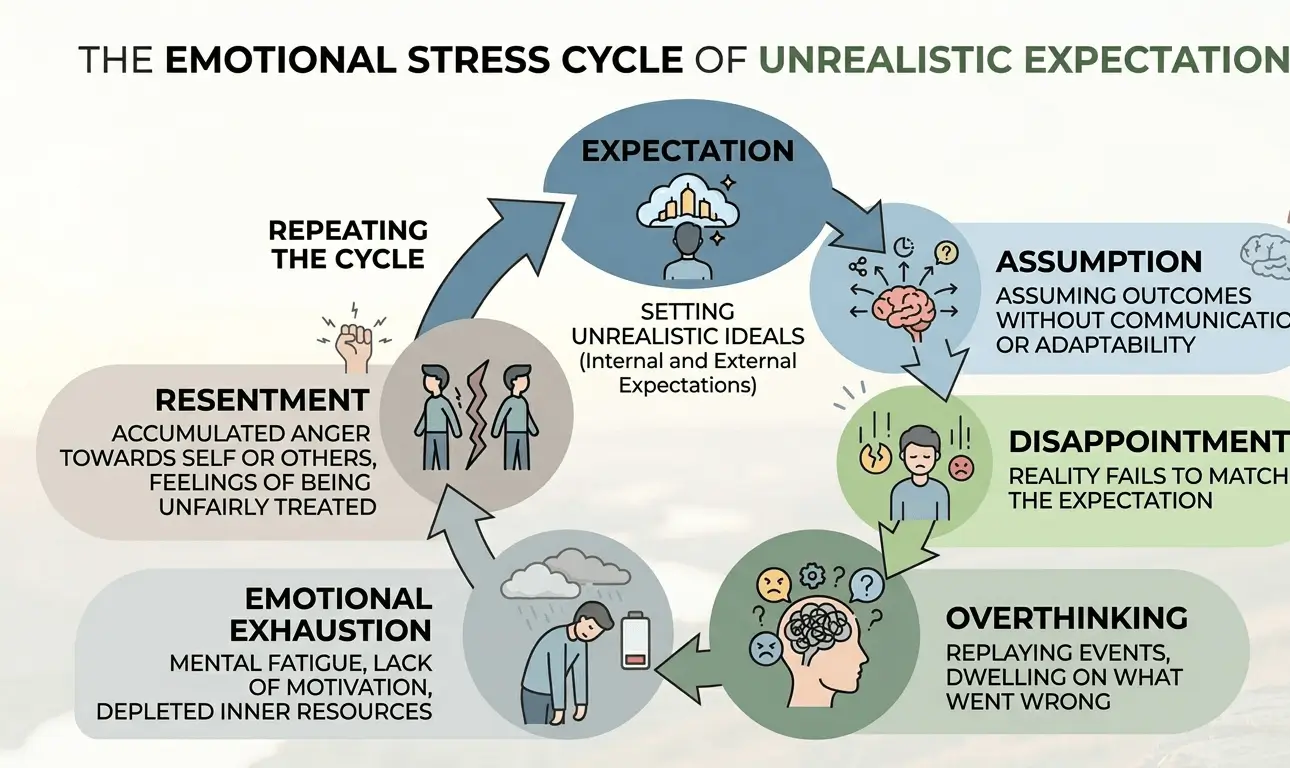
Rigid expectations create ongoing emotional pressure and mental exhaustion.
Common effects include:
- Constant disappointment cycles
- Mental exhaustion from unmet assumptions
- Overthinking social interactions
- Emotional burnout from trying to control outcomes
Many people experience stress not because situations are inherently harmful, but because reality fails to match internal expectations.
How Acceptance Creates Emotional Peace
Acceptance creates emotional peace by shifting attention away from control and toward adaptability.
Healthy acceptance involves:
- Practicing realistic thinking
- Focusing on present experiences
- Building emotional resilience
- Reducing attachment to perfect outcomes
Acceptance does not mean giving up. It means responding to reality more calmly and flexibly.
Signs Expectations Are Hurting Your Mental Health
- Frequent resentment toward others
- Feeling emotionally drained
- Constant disappointment
- Difficulty enjoying the present moment
- Unrealistic relationship fantasies
How to Let Go of Expectations From Others
Learning how to let go of expectations from others begins with emotional independence. Many conflicts develop because people expect others to think, behave, or communicate exactly as they would.
Letting go of expectations of others does not mean tolerating unhealthy behavior. Instead, it means recognizing the difference between boundaries and emotional control.
Healthy relationships rely on communication and understanding rather than assumptions.
Stop Assuming People Think Like You
People differ in many ways:
- Emotional needs
- Communication styles
- Priorities and values
- Personality traits
- Stress responses
Expecting everyone to respond similarly often leads to frustration and resentment.
Replace Assumptions With Communication
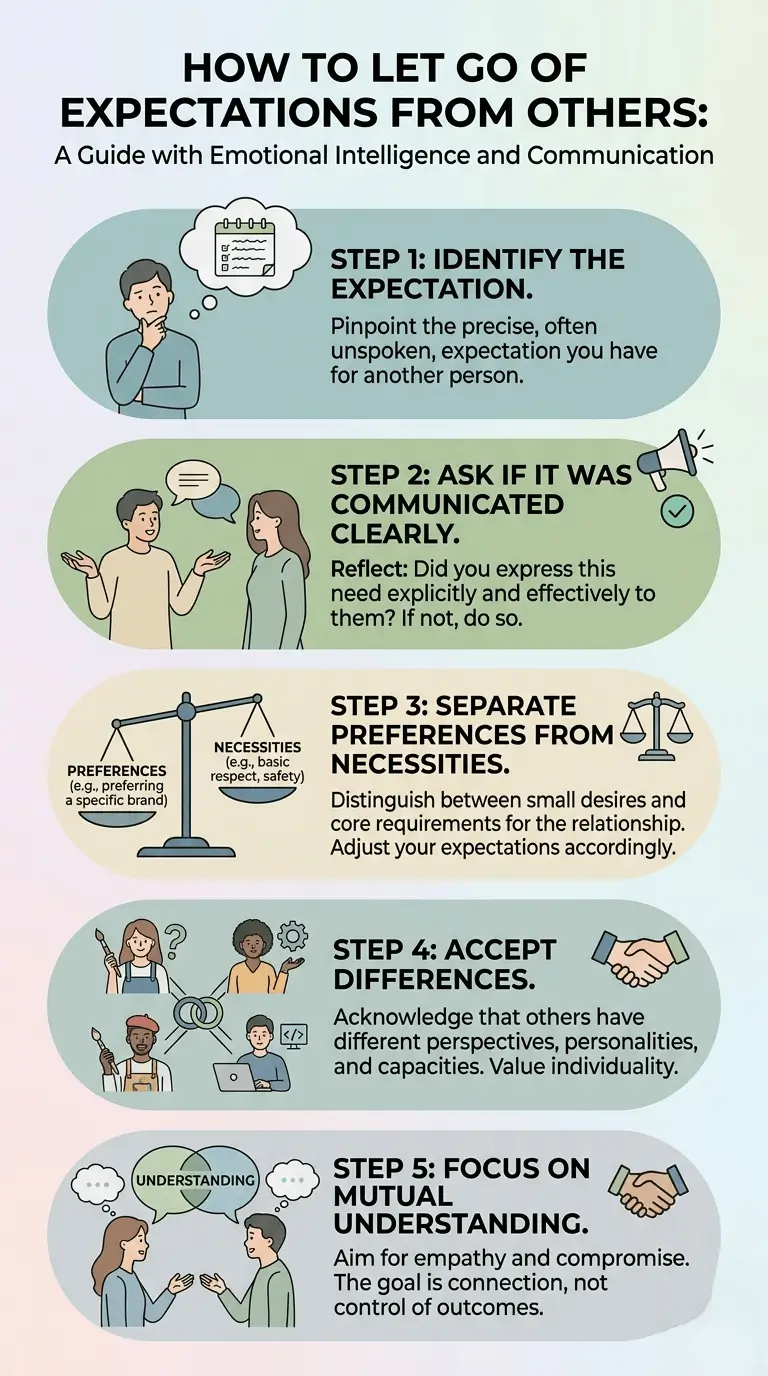
Clear communication reduces misunderstanding and emotional tension.
Actionable Framework
- Identify the expectation
- Ask whether it was communicated clearly
- Separate preferences from necessities
- Accept possible differences
- Focus on mutual understanding
This framework helps reduce mind-reading and emotional assumptions.
Focus on What You Can Control
Emotional peace improves when attention shifts toward controllable behaviors.
Focus on:
- Your reactions
- Your boundaries
- Your habits
- Your emotional responses
Trying to control people or outcomes often increases emotional stress and disappointment.
Letting Go of Expectations in Relationships
Letting go of expectations in relationships helps reduce emotional pressure, resentment, and dependency. Many relationship conflicts develop because expectations remain unspoken or unrealistic.
People searching for how to stop having expectations in relationships often struggle with emotional attachment to validation, reassurance, or idealized relationship outcomes.
Why Expectations Create Relationship Conflict
Relationship expectations commonly create tension because of:
- Unspoken assumptions
- Idealized relationship fantasies
- Dependency on validation
- Fear of abandonment
When expectations are not communicated clearly, disappointment becomes more likely.
Motivation vs Emotional Security in Relationships
| Expecting Validation | Building Emotional Security |
|---|---|
| Needs constant reassurance | Builds internal confidence |
| Creates anxiety | Encourages stability |
| Depends on partner behavior | Depends on self-regulation |
| Fear-driven | Trust-driven |
Healthy Dating Without Unrealistic Expectations
People learning how to keep expectations low when dating often benefit from focusing on curiosity rather than emotional attachment.
Healthy dating habits include:
- Staying curious instead of attached
- Avoiding future projection too early
- Evaluating compatibility realistically
- Balancing openness with emotional boundaries
This approach improves emotional balance while still allowing genuine connection.
Letting Go of Expectations in Marriage
Letting go of expectations in marriage often requires flexibility, communication, and emotional maturity.
Common marriage-related expectation issues include:
- Long-term resentment cycles
- Household responsibility assumptions
- Emotional labor expectations
- Difficulty adapting to life changes
Healthy marriages function better when couples communicate openly instead of assuming roles, needs, or emotional responses.
Why People Struggle to Let Go of Expectations
Many people struggle to release expectations because expectations are closely tied to emotional security, identity, and fear of uncertainty.
Perfectionism, emotional control, and childhood conditioning can also strengthen rigid expectations.
The Psychology of Control and Attachment
Expectations often act as emotional protection mechanisms.
People use expectations to:
- Avoid disappointment
- Feel emotionally safe
- Reduce uncertainty
- Create a sense of control
However, excessive emotional control increases stress and rigidity.
Unrealistic Expectations and Perfectionism
Perfectionistic thinking often includes:
- “Everything must go my way” thinking
- All-or-nothing mentality
- Emotional rigidity
- Fear of mistakes or uncertainty
Perfectionism creates emotional exhaustion because life rarely follows perfect plans.
Social Media and Idealized Life Expectations
Social media can intensify unrealistic expectations through:
- Comparison culture
- Unrealistic relationship standards
- Productivity pressure
- Artificial success timelines
Constant exposure to idealized lifestyles can distort emotional expectations and increase dissatisfaction.
Practical Ways to Practice Letting Go of Expectations Daily
Building emotional flexibility requires consistent habits and self-awareness practices.
Daily emotional regulation routines help reduce attachment to rigid outcomes over time.
Mindfulness and Meditation Practices
Letting go of expectations meditation practices help people become aware of thoughts without becoming emotionally attached to them.
Meditation letting go of expectations techniques improve mindfulness and emotional regulation.
Helpful practices include:
- Breath awareness exercises
- Observing thoughts without attachment
- Gratitude practices
- Emotional acceptance meditation
Mindfulness strengthens psychological flexibility and reduces emotional reactivity.
Journaling Techniques for Releasing Expectations
Journaling improves emotional awareness by helping people identify unrealistic assumptions and emotional triggers.
Helpful journaling exercises include:
- Writing unmet expectations
- Identifying emotional triggers
- Reframing rigid thinking
- Practicing self-reflection
This process helps people understand emotional patterns more clearly.
Affirmations for Letting Go of Expectations
Healthy affirmations reinforce emotional adaptability and acceptance.
Example Affirmations
- “I can accept uncertainty.”
- “I release the need to control outcomes.”
- “I focus on effort, not perfection.”
- “People are allowed to be different from me.”
These affirmations for letting go of expectations support healthier emotional habits and thought patterns.
Common Mistakes When Trying to Let Go of Expectations
Many people misunderstand emotional acceptance and accidentally develop unhealthy coping patterns.
| Common Mistake | Better Alternative |
|---|---|
| Suppressing emotions | Acknowledge emotions calmly |
| Expecting instant peace | Practice gradual emotional adjustment |
| Avoiding communication | Express needs clearly |
| Lowering all standards | Keep healthy boundaries |
| Detaching emotionally | Practice balanced acceptance |
Healthy emotional growth requires balance rather than emotional avoidance.
Letting Go of Expectations Without Losing Motivation or Standards
Acceptance does not mean passivity or emotional indifference. People can maintain ambition, discipline, and healthy standards while reducing emotional attachment to outcomes.
The goal is to become flexible rather than emotionally rigid.
Consistency vs Intensity in Personal Growth
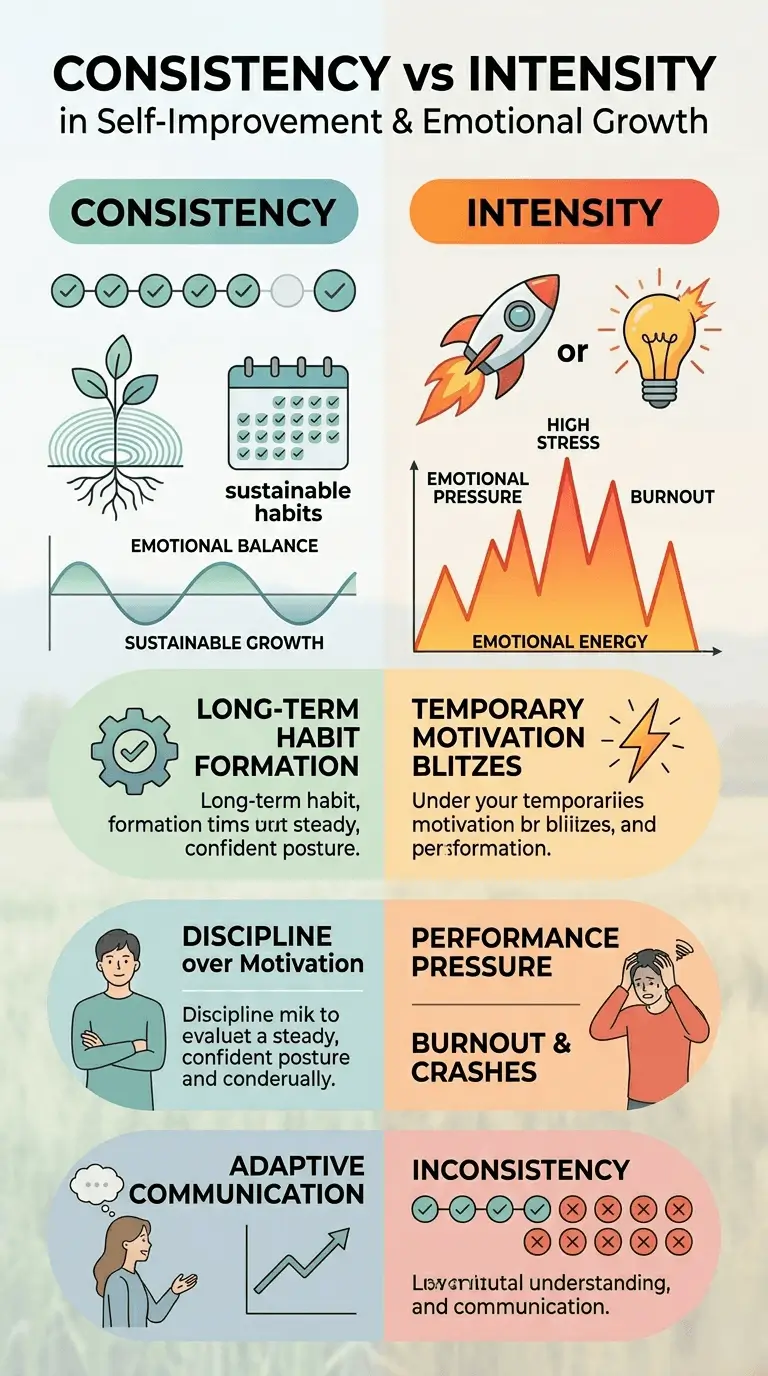
| Consistency | Intensity |
|---|---|
| Sustainable | Temporary |
| Builds long-term habits | Often causes burnout |
| Encourages discipline | Relies on emotion |
| Supports emotional balance | Creates pressure |
Consistency generally creates healthier long-term growth than emotionally intense bursts of motivation.
System-Based Thinking Instead of Outcome Obsession
System-based thinking focuses on habits and daily behaviors rather than perfect results.
Helpful approaches include:
- Focusing on habits over results
- Tracking daily progress realistically
- Practicing process-oriented thinking
- Building emotional adaptability
This mindset reduces frustration and improves long-term resilience.
Science-Backed Insights on Expectations and Happiness
Behavioral psychology research suggests that emotional well-being is strongly connected to cognitive flexibility and realistic expectations.
The brain’s dopamine system is influenced by reward prediction. When reality consistently fails to meet unrealistic expectations, emotional disappointment increases.
Acceptance-based therapy principles encourage mindfulness, emotional awareness, and reduced attachment to uncontrollable outcomes.
Why Lower Attachment Often Increases Emotional Stability
Reducing attachment to rigid outcomes improves:
- Anxiety management
- Emotional regulation
- Psychological resilience
- Long-term life satisfaction
People often feel calmer when they stop trying to control everything around them.
What Actually Works vs Common Myths
| Myth | Reality |
|---|---|
| “Expect nothing from everyone” | Healthy boundaries still matter |
| “Letting go means not caring” | It means reducing unhealthy attachment |
| “Motivation solves emotional stress” | Systems and habits matter more |
| “Relationships should feel effortless” | Healthy relationships require communication |
Real-Life Examples of Letting Go of Expectations
Letting go of unrealistic expectations becomes easier through practical emotional habits and realistic thinking.
Common real-life examples include:
- Dating disappointment after idealizing someone too quickly
- Friendship imbalance caused by unspoken expectations
- Workplace frustration from expecting constant recognition
- Family pressure related to life choices or achievements
- Personal growth frustration from expecting instant progress
Emotional flexibility improves when people accept gradual progress and uncertainty.
Beginner vs Advanced Emotional Flexibility
- Beginner: Reacting emotionally to unmet expectations
- Advanced: Observing emotions without immediate attachment
Emotional maturity involves awareness and adaptability rather than emotional perfection.
Sustainable Emotional Habits That Actually Help
Helpful emotional habits include:
- Self-awareness routines
- Emotional check-ins
- Flexible thinking practices
- Healthy communication habits
These habits support long-term emotional resilience and healthier relationships.
Conclusion
Letting go of expectations is not about lowering self-worth, ambition, or personal standards. It is about reducing unhealthy emotional attachment to outcomes that cannot always be controlled. Emotional peace grows through flexibility, realistic thinking, communication, and self-awareness rather than rigid control.
People who focus on controllable actions, sustainable habits, and emotional resilience often experience healthier relationships, lower stress levels, and greater emotional stability. Over time, learning to accept uncertainty while maintaining healthy boundaries creates stronger emotional balance, improved personal growth, and deeper peace of mind.
FAQ Section
Why do I struggle with letting go of expectations?
People often attach expectations to emotional security, validation, or control. Fear of disappointment and uncertainty makes it difficult to release rigid outcomes.
How do I stop expecting too much from people?
Focus on communication instead of assumptions, accept personality differences, and shift attention toward what you can control.
Is it healthy to have no expectations in relationships?
Healthy relationships still require standards, boundaries, and communication. The goal is to reduce unrealistic or controlling expectations.
Why do expectations cause disappointment?
Expectations create mental predictions about how people or situations should behave. Disappointment happens when reality does not match those assumptions.
How can I let go of expectations without becoming emotionally detached?
Practice emotional flexibility rather than emotional avoidance. Stay connected while accepting uncertainty and differences.
Can meditation help with letting go of expectations?
Mindfulness and meditation help people observe thoughts and emotions without becoming attached to them, improving emotional regulation.
What is the difference between expectations and standards?
Expectations often involve controlling outcomes from others, while standards reflect personal values and boundaries.
How do I stop overthinking expectations in dating?
Focus on present experiences, avoid future projection, communicate openly, and evaluate compatibility gradually instead of idealizing outcomes.