

Introduction
Building habits is not a matter of willpower but of structured repetition and environmental design. The idea of how to build good habits in 30 days is based on the principle that consistent behavior in a stable context gradually becomes automatic. Over time, repeated actions form neural pathways that reduce effort and decision-making. While 30 days is not a strict biological threshold, it is a practical starting period for creating consistency, reducing resistance, and shaping identity-based behavior change.
Quick Summary
- Habits are formed through repetition, not motivation
- 30 days is a foundational phase, not full habit mastery
- Cue–routine–reward loops drive behavior automation
- Systems are more reliable than willpower
- Replacing bad habits is more effective than stopping them
Understanding How Habit Formation Actually Works
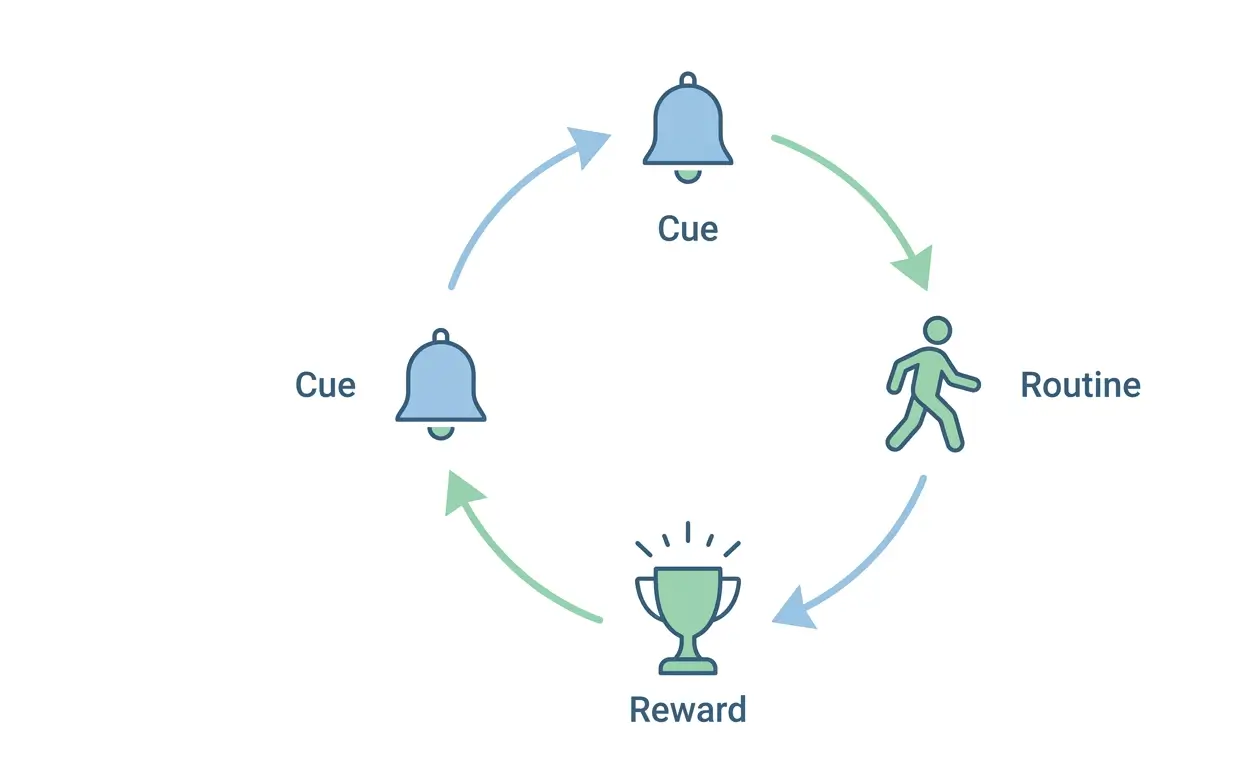
Habit formation works by linking repeated actions to consistent cues and rewards until the behavior becomes automatic.
Habits operate through a neurological feedback loop that reduces cognitive load over time.
Habit Loop
- Cue: Trigger that starts behavior (time, place, emotion)
- Routine: The action performed
- Reward: Positive reinforcement that strengthens repetition
When this loop repeats consistently, the brain automates the behavior to conserve energy.
Why 30 Days Is Important
- Builds behavioral momentum
- Reduces decision fatigue
- Establishes identity shifts (“I am someone who…”)
30-Day Habit Building Framework (Step-by-Step)
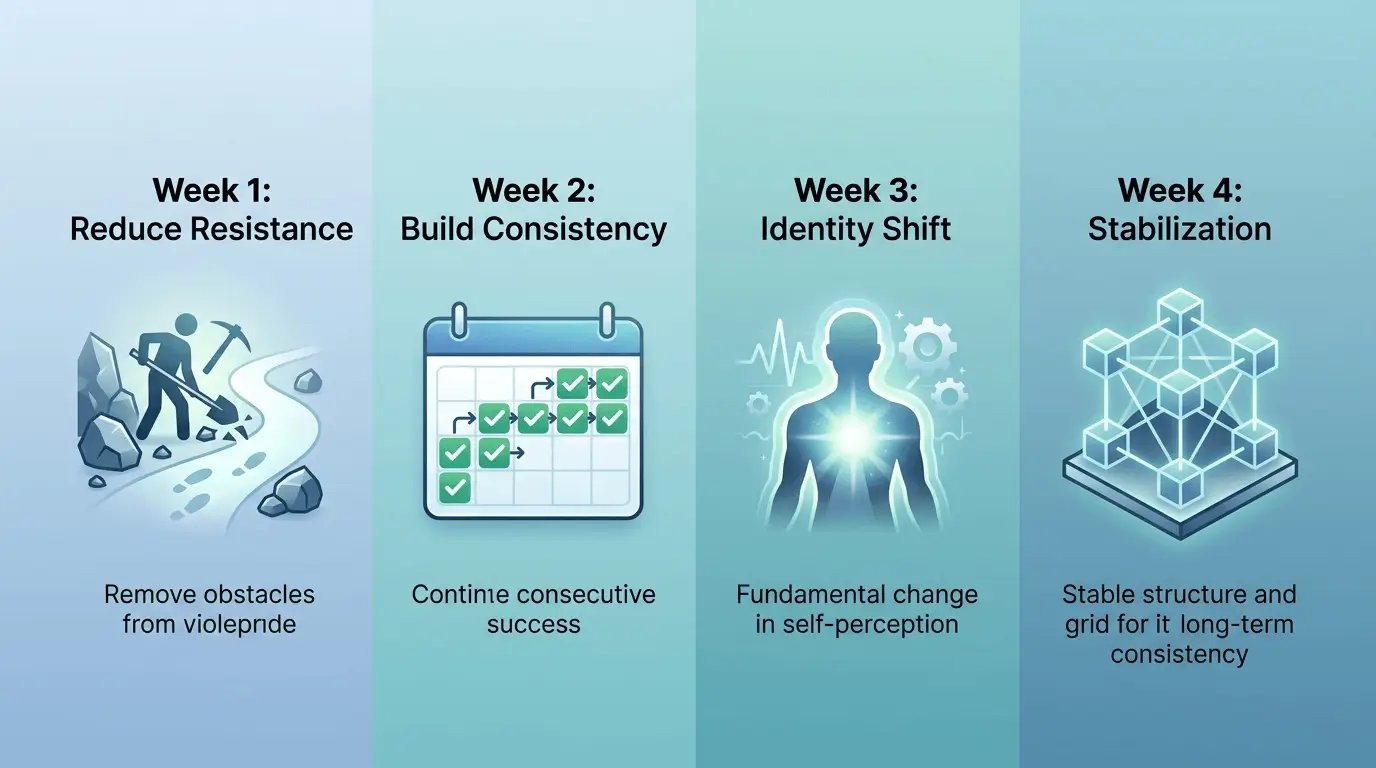
A structured 30-day system gradually shifts behavior from resistance to automation.
Week 1: Reduce Resistance
- Start with 2–5 minute habits
- Use habit stacking (attach to existing routines)
- Remove friction from the environment
Week 2: Build Consistency
- Focus on daily repetition
- Track completion visually
- Accept resistance without stopping
Week 3: Strengthen Identity
- Shift identity from “trying” to “becoming”
- Slightly increase difficulty only if consistent
- Reinforce completion with small rewards
Week 4: Stabilize System
- Automate habit execution in fixed context
- Reduce decision-making
- Prepare for long-term continuation
Why People Fail to Build Habits (Behavioral Barriers)
Most habit failures come from system design errors, not lack of motivation.
Key Causes
- Overreliance on motivation
- Unrealistic goals
- Inconsistent timing and environment
- No immediate reward system
Psychological Barriers
- Perfectionism leading to restart cycles
- Avoidance of discomfort
- Burnout from excessive intensity
Good Habits vs Bad Habits — Replacement Strategy
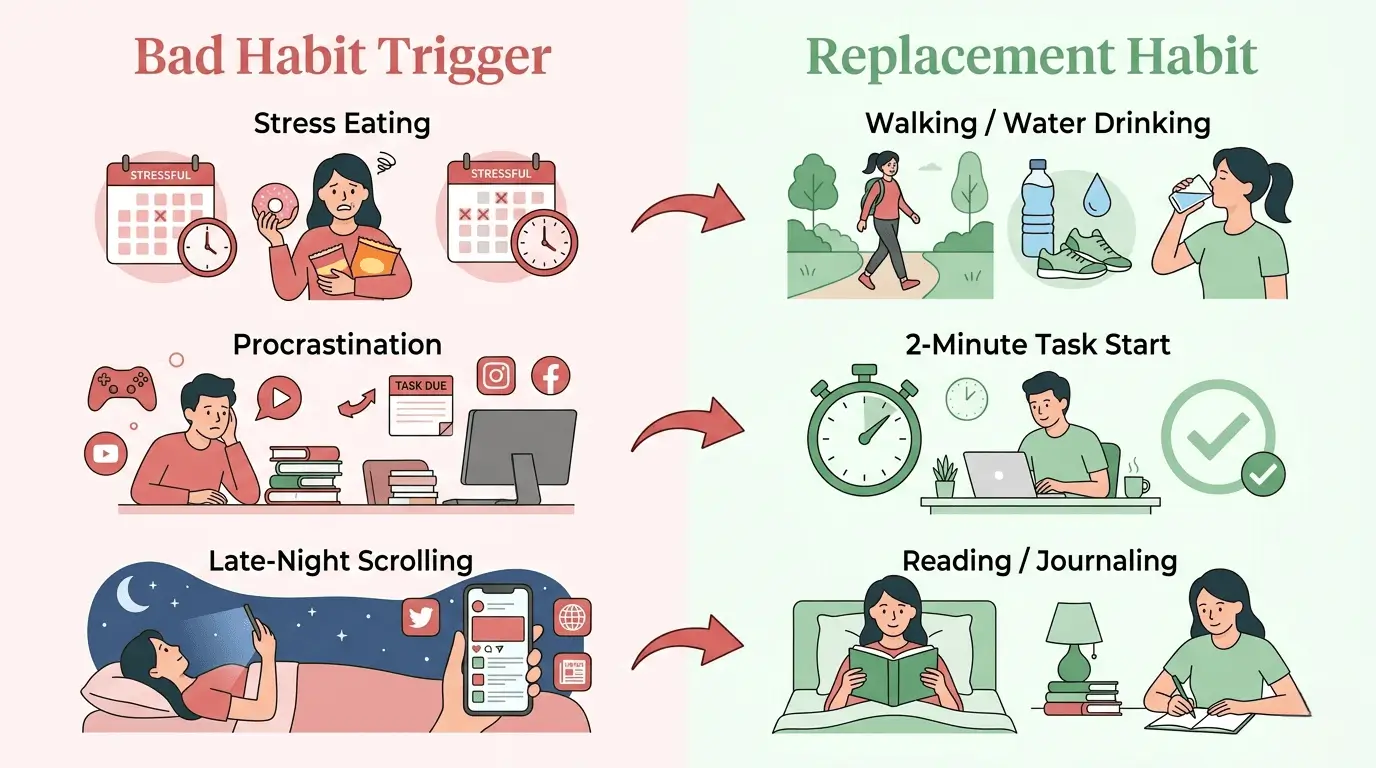
Bad habits persist because cues and rewards remain; only the routine must change.
| Bad Habit Trigger | Replacement Habit | Outcome |
|---|---|---|
| Stress eating | Walking or hydration | Emotional balance |
| Procrastination | 5-minute task start | Action initiation |
| Late-night scrolling | Reading or journaling | Better sleep |
Why Replacement Works
- Preserves cue–reward loop
- Changes behavior pattern only
- Reduces psychological resistance
Daily Habits That Improve Life Quality
Journaling becomes more effective when done intentionally, and How to Journal for Self-Growth provides practical methods for turning reflection into measurable personal development.
Small daily habits create compounding improvements in energy, focus, and emotional stability.
High-Impact Habits
- Consistent sleep schedule
- Morning sunlight exposure
- Short focused work sessions (10–30 min)
- Regular hydration and movement
- Daily reflection or journaling
Why They Work
- Reduce cognitive overload
- Improve energy management
- Build long-term behavioral stability
Good Habits for Students (Performance & Focus)
Students looking to apply these principles in a structured schedule can explore Daily Routine for Self Improvement Student for practical examples of habit-based planning.
Students improve performance when learning is structured and consistent rather than last-minute.
Essential Habits
- Daily revision instead of cramming
- Active recall instead of rereading
- Fixed study blocks
- Phone-free study sessions
Outcomes
- Better retention
- Lower exam stress
- Improved academic consistency
Building a Sustainable Daily Routine
A strong routine is based on systems that organize behavior automatically.
Core Structure
- Morning: activation (movement, planning)
- Midday: deep work focus
- Evening: recovery and reflection
Principles
- Anchor habits to fixed events
- Avoid overload
- Keep transitions simple
Comparison — Motivation vs Discipline vs Systems
If you want a deeper understanding of why systems outperform willpower, read How to Build Discipline Without Motivation, which explains how consistent action can continue even when motivation is low.
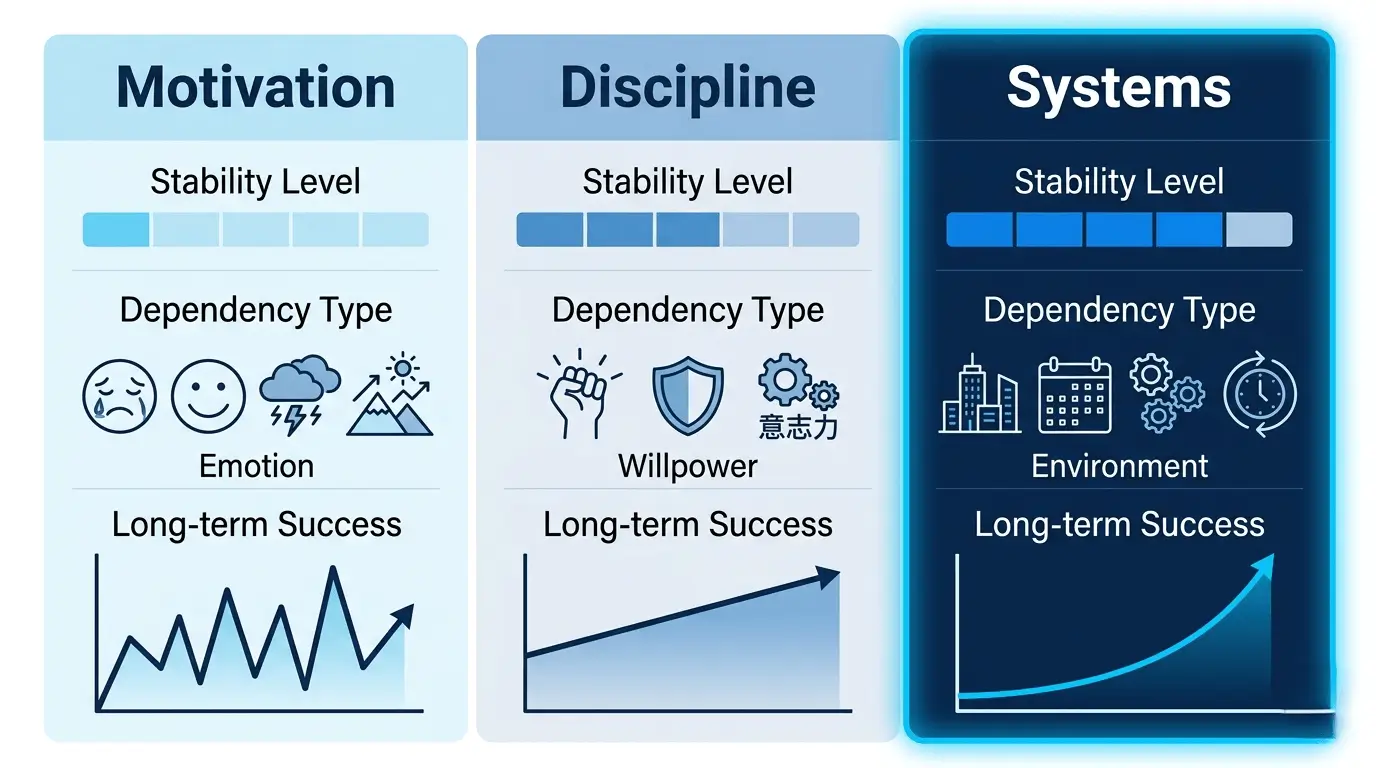
| Factor | Motivation | Discipline | Systems |
|---|---|---|---|
| Stability | Low | Medium | High |
| Dependency | Emotional | Willpower | Environment |
| Long-term success | Weak | Moderate | Strong |
| Sustainability | Unstable | Exhausting | Efficient |
Key Insight: Systems outperform motivation and discipline because they remove the need for constant decision-making.
Problem-Solution Breakdown (Real-Life Struggles)
Procrastination
- Cause: task feels overwhelming
- Fix: 2-minute start rule
- Prevention: break tasks into micro-steps
Lack of Motivation
- Cause: no immediate reward
- Fix: progress tracking
- Prevention: small daily wins
Inconsistency
- Cause: no fixed cue
- Fix: attach habit to routine
- Prevention: same time, same place
Burnout
- Cause: excessive intensity
- Fix: reduce workload
- Prevention: minimum viable habits
Science-Backed Insight on Habit Formation
Behavioral psychology shows that repetition in a consistent context strengthens neural pathways, making actions more automatic over time. Habits form through frequency and stability rather than intensity, which is why consistent small actions outperform inconsistent large efforts.
Practical 30-Day Habit Implementation Plan
- Choose 1–3 habits only
- Define clear cue (time/place)
- Start with smallest version
- Track daily execution
- Adjust only after stability
- Focus on identity change
Conclusion
How to build good habits in 30 days is not about rigid transformation but structured repetition that reshapes behavior. When habits are designed with clear cues, small actions, and consistent systems, they gradually become automatic. The key principle is simple: reduce resistance, repeat consistently, and let systems—not motivation—drive behavior.
FAQs
Why do I struggle with consistency even when motivated?
Because motivation is temporary; consistency depends on systems and structure.
How long does it take to build a habit?
It varies depending on complexity, but it requires consistent repetition over time.
What if I miss a day in my habit?
One missed day does not break a habit; stopping completely does.
How can I stay disciplined long-term?
By relying on systems and environmental cues instead of willpower.
What is the easiest way to start a habit?
Start with the smallest possible action and attach it to an existing routine.
How do I know a habit is forming?
When the behavior becomes automatic and requires little conscious effort.










6 Responses