
Introduction
Understanding core mindset facts helps explain why some people respond to setbacks with resilience while others give up quickly. Mindset refers to the collection of beliefs a person holds about their own abilities, intelligence, and potential for change. These beliefs shape motivation, effort, and how challenges are interpreted. Psychologist Carol Dweck’s research identified two dominant patterns — fixed and growth mindset — that influence learning, relationships, and long-term achievement. This article breaks down what mindset is, how it forms, the main types, and practical ways to strengthen a growth-oriented outlook.
Quick Summary
- Mindset is the set of core beliefs a person holds about whether abilities are fixed or can be developed.
- A fixed mindset assumes talent and intelligence are static traits; a growth mindset assumes they can be developed through effort.
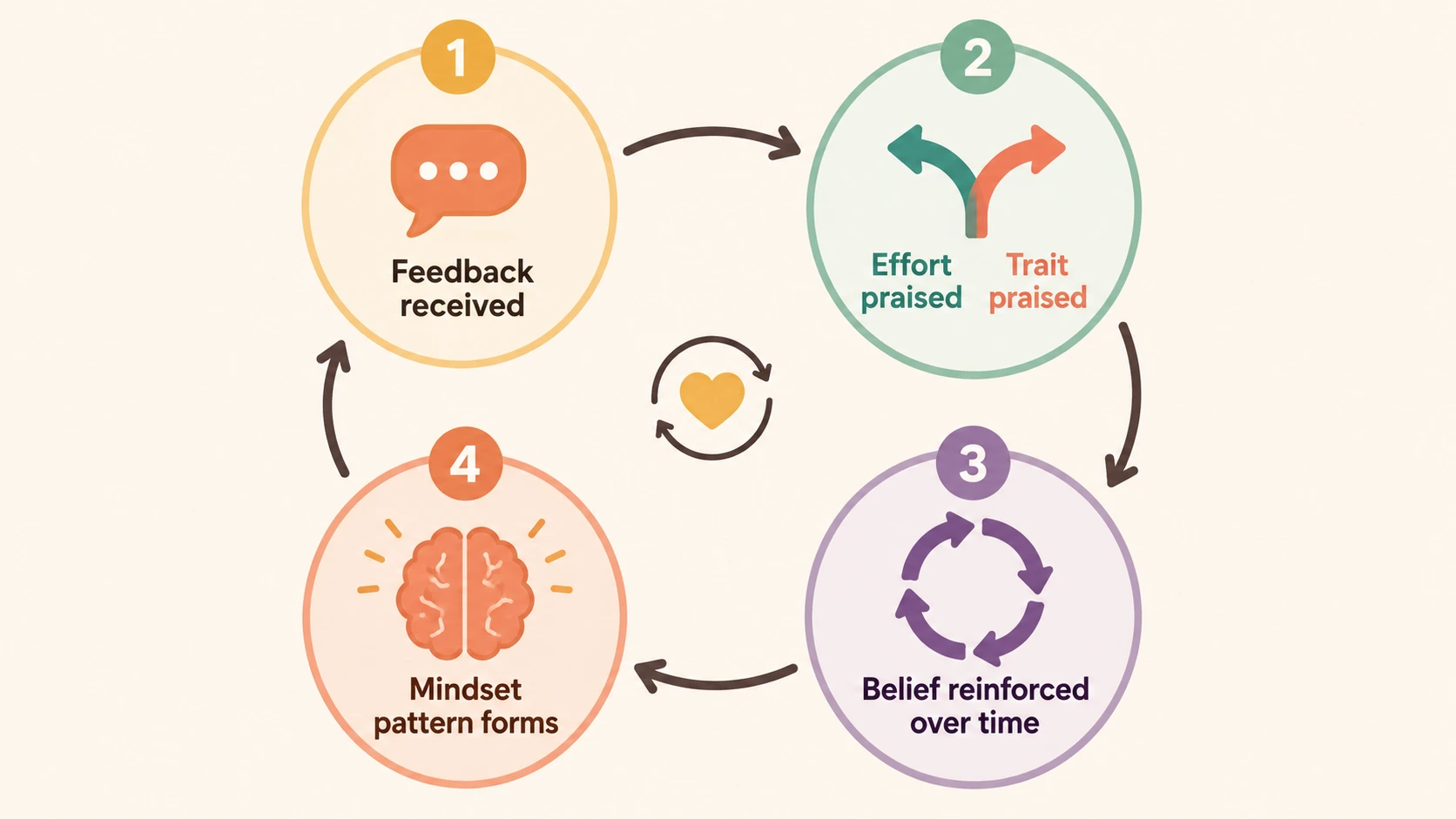
- Mindset is shaped early by feedback style, especially praise focused on effort versus praise focused on innate ability.
- Growth mindset is linked to greater resilience, persistence through failure, and long-term skill development.
- Mindset is not permanent — research shows it can shift with deliberate practice and changes in self-talk.
What Is Mindset?
Mindset is the underlying set of beliefs a person holds about the nature of their own abilities, intelligence, and potential for growth. These beliefs act as a mental framework that determines how someone interprets challenges, setbacks, effort, and feedback.
A Simple Mindset Example
A useful mindset example: two students each receive a low grade on a test. A student with a fixed mindset may conclude, “I’m just not good at this subject,” and disengage. A student with a growth mindset is more likely to think, “I need a different study strategy,” and adjust their approach. The event is identical; the interpretation — shaped by mindset — determines the response.
Why Mindset Matters
Mindset matters because it directly influences motivation, resilience, and long-term outcomes across school, work, relationships, and health-related behavior change. Research led by Carol Dweck and colleagues found that students who held a growth mindset were more likely to seek out challenges and maintain effort after failure, which over time supported stronger academic performance. Understanding why growth mindset is important can help explain why some people bounce back from failure faster than others.
In our experience helping readers build better habits, the biggest shift usually happens not when someone gains new information, but when they change how they interpret difficulty itself. A person’s mindset also affects:
- How they handle criticism and feedback
- Willingness to attempt unfamiliar or difficult tasks
- Persistence when progress is slow
- Long-term goal-setting behavior
How Is Mindset Formed?
Mindset is formed primarily through repeated feedback patterns, especially the type of praise and correction received during childhood and early skill development. Dweck’s research found that praising effort and strategy (“You worked hard on that”) tends to build a growth mindset, while praising fixed traits (“You’re so smart”) tends to reinforce a fixed mindset.
Mindset formation is also shaped by:
- Early role models — parents, teachers, and coaches who model persistence or avoidance
- Cultural and environmental messaging — whether effort or natural talent is emphasized
- Personal experiences with failure — whether setbacks were framed as learning opportunities or as proof of inadequacy
- Self-talk patterns — internal language reinforced over years of repeated experiences
Because mindset develops gradually through repeated exposure, it is also possible to reshape it deliberately through consistent, intentional practice later in life.
Mindset Characteristics
Certain observable characteristics tend to define a person’s dominant mindset. Common mindset characteristics include:
| Area | Fixed Mindset Tendency | Growth Mindset Tendency |
|---|---|---|
| View of ability | Seen as a fixed trait | Seen as developable |
| Response to failure | Avoidance, discouragement | Learning opportunity |
| Effort | Seen as a sign of low ability | Seen as necessary for mastery |
| Feedback | Often felt as personal criticism | Used as useful information |
| Challenges | Avoided to protect self-image | Sought out for growth |
The 4 Types of Mindsets You Should Know
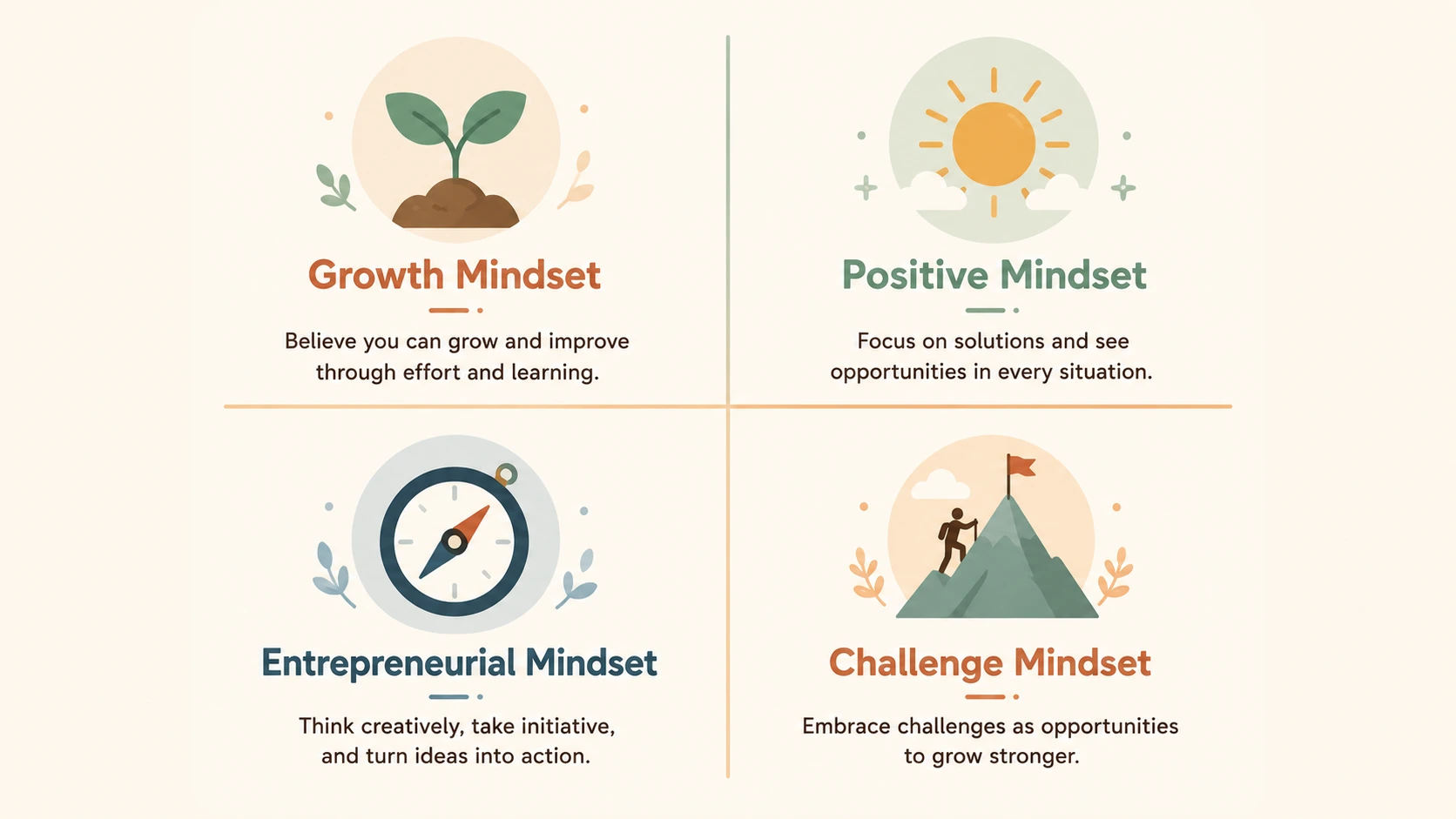
While fixed and growth mindset are the most researched pair, some psychology writers group mindset into four broader categories to reflect how differently people can orient toward challenges. One widely referenced framework describes these as the growth mindset, positive mindset, entrepreneurial mindset, and challenge mindset.
Growth Mindset
The belief that abilities can be developed through effort, strategy, and feedback. This is the most extensively studied mindset type and the one most closely associated with Carol Dweck’s research.
Positive Mindset
An orientation toward optimism and constructive interpretation of events, associated with broader emotional resilience and better stress recovery.
Entrepreneurial Mindset
A pattern of thinking geared toward opportunity recognition, calculated risk-taking, and adaptability in uncertain conditions.
Challenge Mindset
A tendency to interpret demanding situations as opportunities to rise to rather than threats to avoid, often linked to better performance under pressure.
It’s worth noting that mindset researchers have proposed dozens of other narrower “mindsets” (such as scarcity, abundance, or victim mindset) tied to specific life domains — but fixed and growth mindset remain the foundation most self-improvement guidance is built on.
What Is a Fixed Mindset?
A fixed mindset is the belief that intelligence, talent, and abilities are static traits that cannot meaningfully change, regardless of effort.
Fixed Mindset Facts
- People with a fixed mindset often avoid challenges to protect their self-image.
- Effort is frequently interpreted as evidence of low natural ability rather than a normal part of mastery.
- Feedback is more likely to be experienced as personal judgment rather than useful data.
- A fixed mindset can apply selectively — someone may hold a fixed mindset about math ability while holding a growth mindset about athletic skill.
What Is a Growth Mindset?
A growth mindset is the belief that abilities and intelligence can be developed over time through deliberate effort, learning strategies, and persistence.
People with a growth mindset are more willing to attempt difficult tasks, treat setbacks as informative rather than final, and adjust their strategy instead of giving up. This orientation is associated with stronger long-term skill development because effort is viewed as the mechanism of improvement rather than a sign of inadequacy.
Fixed vs. Growth Mindset: Key Differences
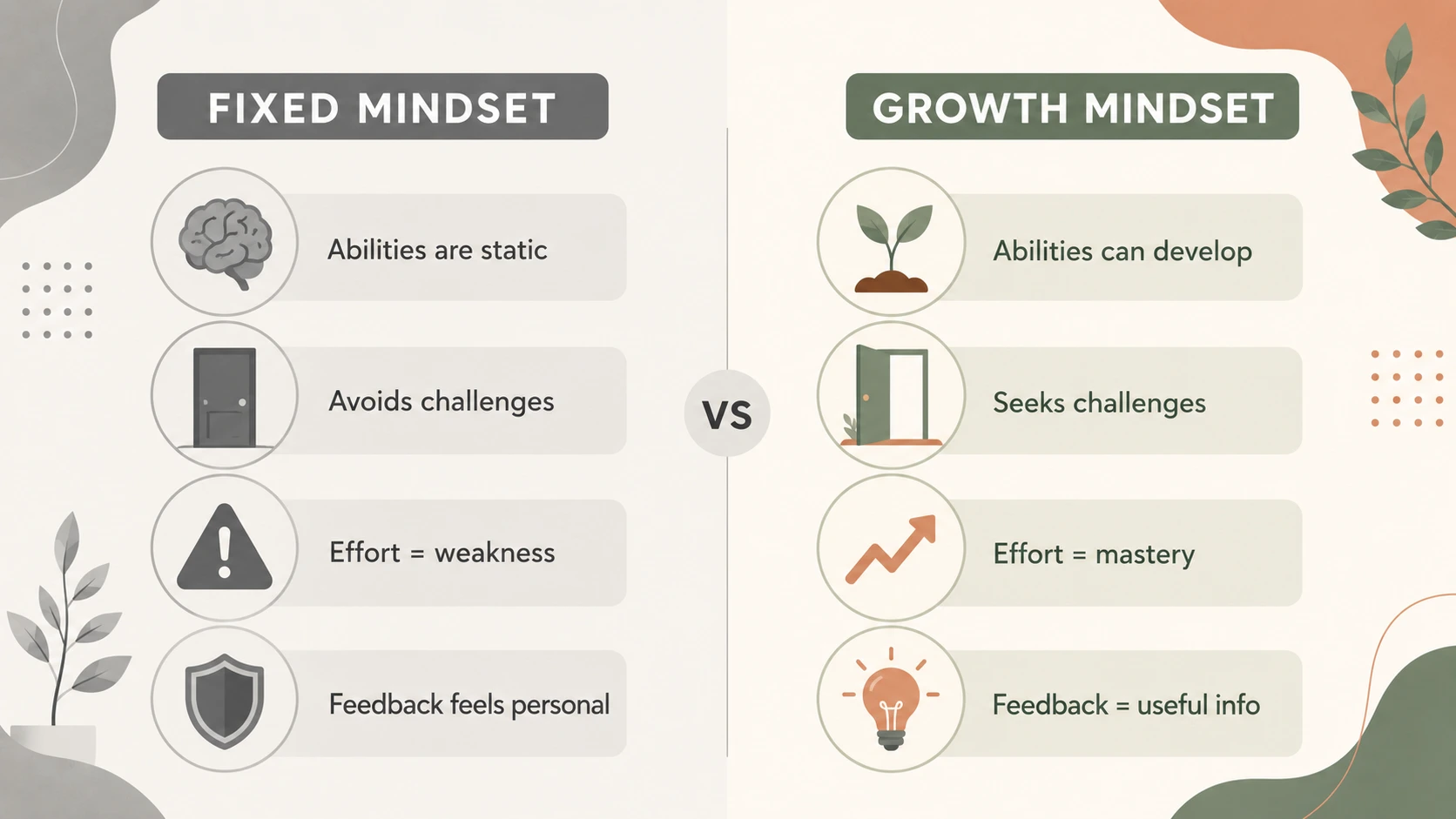
| Factor | Fixed Mindset | Growth Mindset |
|---|---|---|
| Core belief | Abilities are static | Abilities can be developed |
| Reaction to setbacks | Discouragement, avoidance | Adjustment, persistence |
| View of effort | Sign of weakness | Path to mastery |
| Handling criticism | Defensive | Receptive |
| Long-term outcome | Plateaued skill growth | Continued improvement |
Growth Mindset Facts
- Growth mindset is not the same as simply “trying harder” — it also requires adjusting strategy when effort alone isn’t working.
- Praise focused on process and strategy strengthens growth mindset more effectively than praise focused on innate talent.
- A growth mindset can coexist with realistic self-assessment; it does not mean ignoring genuine skill gaps.
- Growth mindset facts for kids specifically show that children praised for effort (“You tried a new approach”) are more likely to persist through difficult tasks than children praised for being “smart.”
- Mindset is domain-specific — a person can hold a growth mindset in one area of life and a fixed mindset in another.
Carol Dweck and the Mindset Book
Carol S. Dweck, Ph.D., is a Stanford University psychologist whose decades of research on motivation and achievement led to the popularization of the growth mindset concept. She has also served as the William B. Ransford Professor of Psychology at Columbia University before becoming the Lewis and Virginia Eaton Professor of Psychology at Stanford University. For daily inspiration drawn from her research, see this collection of Carol Dweck growth mindset quotes.
Her book, Mindset: The New Psychology of Success, was originally published in 2006 and later released in an updated edition. The updated edition added new material on what Dweck calls a “false growth mindset,” addressing common misapplications of the concept. The book remains the most widely referenced work on the subject and is the primary source for the modern fixed vs. growth mindset framework used across education, coaching, and workplace development.
Difficulty & Time Investment
Shifting from a fixed to a growth mindset is a gradual process rather than a one-time decision, and the effort required varies by person and context.
- Beginner-friendly starting point: Noticing fixed-mindset self-talk (e.g., “I’m just not good at this”) and consciously reframing it.
- More advanced practice: Deliberately seeking out challenging tasks and treating repeated failure as data rather than identity.
- Personal factors that affect difficulty: Prior experiences with criticism, current stress levels, and how deeply a fixed belief is tied to identity (e.g., “I am a math person” vs. “I am not a math person”).
Most people find mindset shifts easier in domains with lower emotional stakes first, then apply the same reframing skills to higher-stakes areas over time.
Results Timeline
Mindset shifts typically follow a gradual, non-linear timeline rather than producing immediate results.
- Short term (days to a few weeks): Increased awareness of fixed-mindset thoughts as they occur; this awareness alone does not yet change behavior.
- Moderate term (weeks to a few months): More consistent reframing of setbacks and a noticeable increase in willingness to attempt difficult tasks.
- Longer term (several months and beyond): Growth-oriented responses become more automatic, and effort-based self-talk replaces trait-based self-talk in most situations.
Progress is also affected by environmental factors — for example, a workplace or household that reinforces fixed-mindset language can slow individual change even when personal effort is consistent.
Practice Guide: Building a Growth Mindset
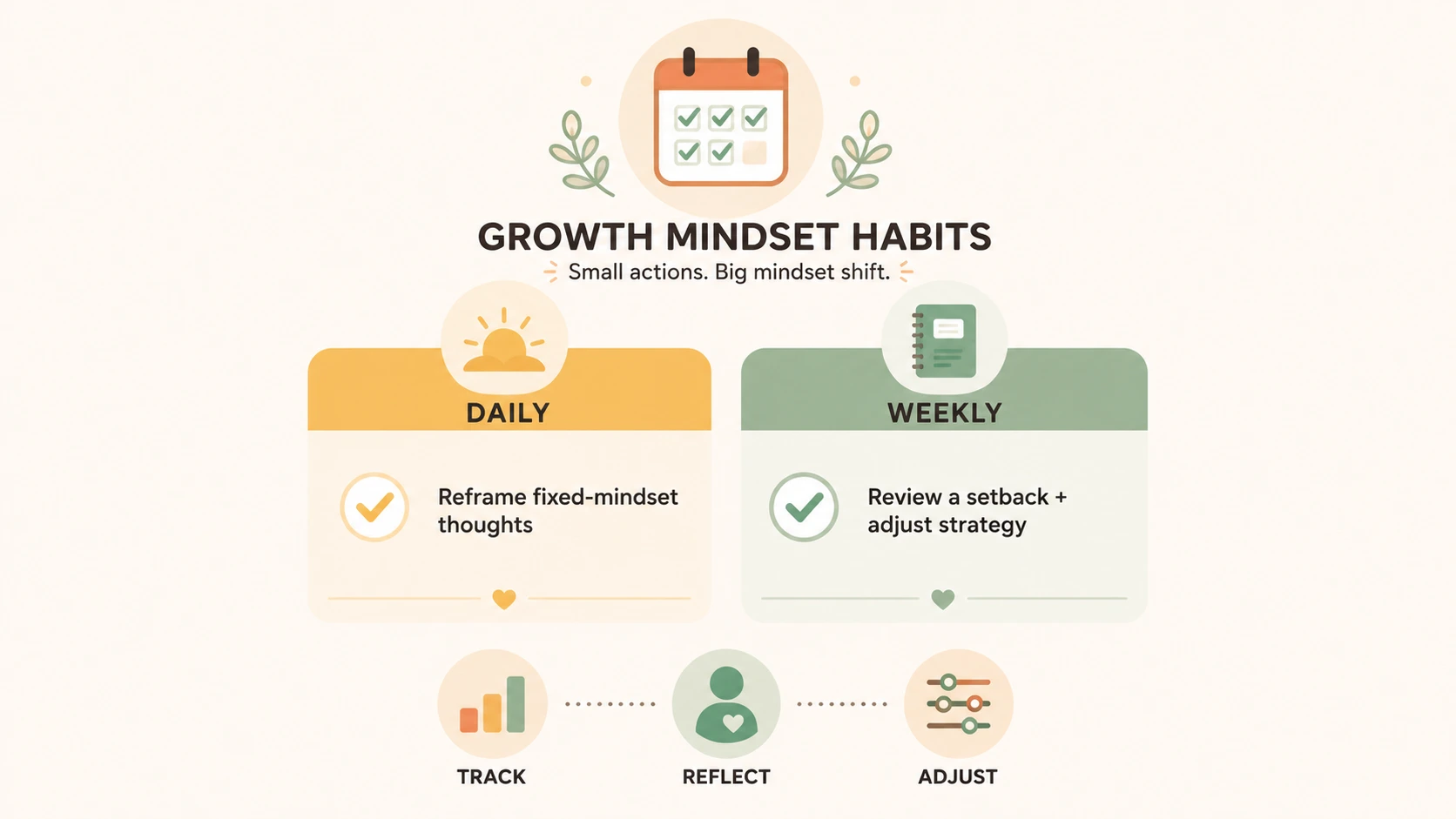
Building a growth mindset relies on consistent, small adjustments rather than a single insight. Pairing this reframing habit with growth mindset affirmations can reinforce the shift each morning.
- Daily practice: Notice and relabel fixed-mindset thoughts in the moment (“I can’t do this” becomes “I can’t do this yet“).
- Weekly practice: Review one recent setback and identify a specific strategy adjustment rather than a character judgment.
- Tracking and accountability: A simple journal noting effort, strategy used, and outcome helps make growth-oriented thinking measurable over time.
- Common obstacles: Old praise patterns from childhood, high-stress environments, and comparison to others can all pull a person back toward fixed-mindset thinking.
- Sustainability: Growth mindset is easier to maintain long-term when it’s applied to specific, valued goals rather than treated as a vague general attitude.
As of 2026, behavioral researchers increasingly emphasize combining growth mindset language with concrete strategy-building — simply believing change is possible works best when paired with an actual plan for how to improve.
Conclusion
Mindset facts consistently point to one core idea: beliefs about ability directly shape behavior, resilience, and long-term outcomes. A fixed mindset treats talent as static and effort as risky, while a growth mindset treats ability as something that develops through strategy, feedback, and persistence. Carol Dweck’s research laid the foundation for this understanding, and decades of follow-up work continue to confirm that mindset is not fixed in the literal sense — it can be reshaped through consistent, intentional practice. Recognizing which mindset is driving a specific reaction is often the first step toward changing it.
FAQs
What is mindset? Mindset is the set of core beliefs a person holds about whether their abilities, intelligence, and talents are fixed traits or qualities that can be developed over time.
What is a fixed mindset? A fixed mindset is the belief that intelligence and abilities are unchangeable, which often leads to avoiding challenges and viewing effort as a sign of weakness.
What is a growth mindset? A growth mindset is the belief that abilities can be developed through effort, learning, and persistence, leading to greater resilience and willingness to face challenges.
How is mindset formed? Mindset is formed mainly through repeated feedback patterns, particularly whether praise focuses on effort and strategy or on fixed traits like natural talent.
Who created the growth mindset concept? Stanford psychologist Carol S. Dweck popularized the growth mindset concept through decades of research, most notably in her book Mindset: The New Psychology of Success.
Can a fixed mindset change into a growth mindset? Yes. Mindset is not permanent — research shows it can shift through consistent practice, such as reframing setbacks and focusing feedback on strategy rather than identity.
Is mindset the same in every area of life? No. Mindset is often domain-specific; a person can hold a growth mindset toward one skill, such as public speaking, while holding a fixed mindset toward another, such as math.