
Introduction
The growth mindset book refers primarily to Mindset: The New Psychology of Success by psychologist Mindset: The New Psychology of Success, written by Carol Dweck. It explains how beliefs about intelligence and ability shape learning, success, and personal development.
A growth mindset describes the belief that abilities can be developed through effort, strategies, and learning. This concept contrasts with a fixed mindset, where abilities are seen as static and unchangeable.
This topic is widely used in education, productivity, parenting, and self-improvement because it explains why some people improve continuously while others plateau.
Quick Summary Block
- A growth mindset book explains how beliefs about ability affect learning and success
- Growth mindset = abilities can improve with effort and strategy
- Fixed mindset = abilities are seen as unchangeable traits
- Developed and popularized by Carol Dweck’s research
What Is a Growth Mindset? (Definition & Meaning)
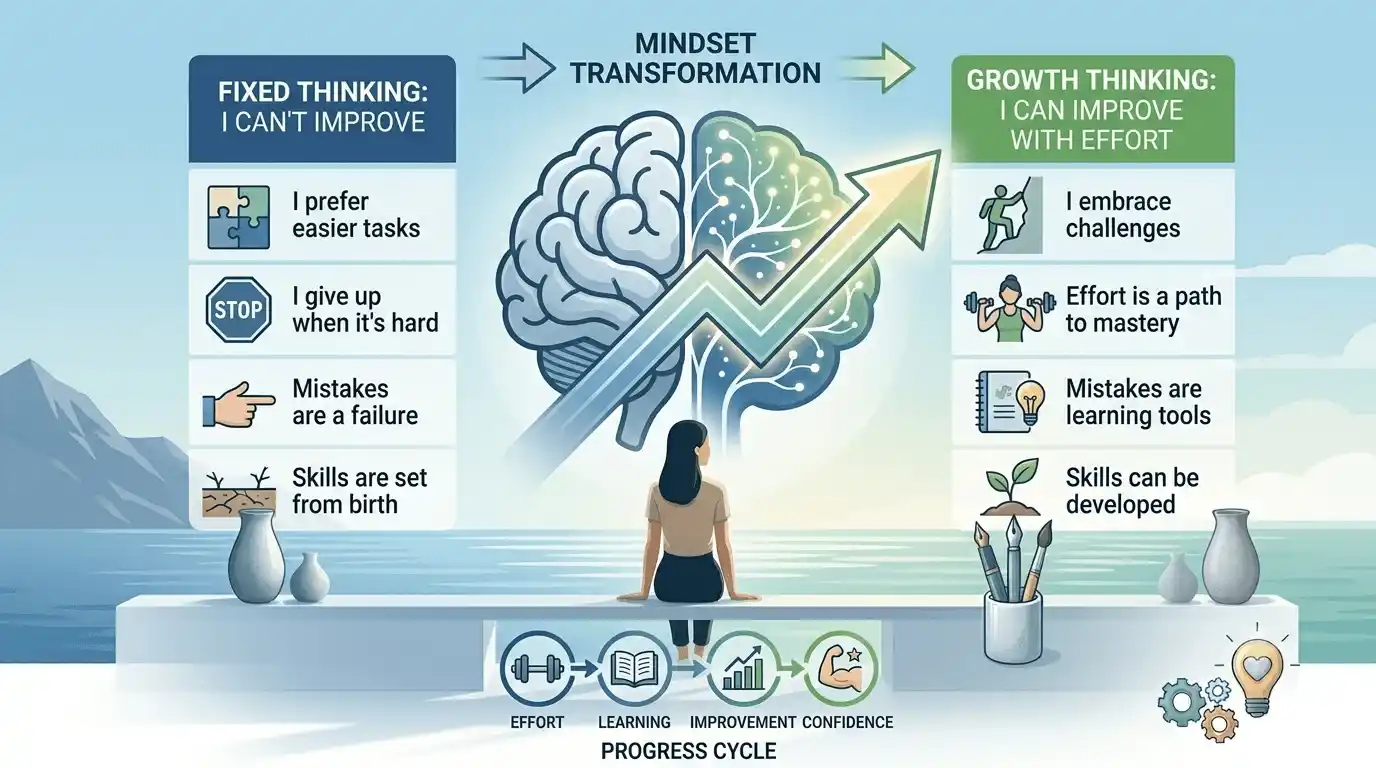
A growth mindset meaning refers to the belief that intelligence, skills, and talents can be developed over time through effort and learning strategies.
- People believe improvement is possible
- Mistakes are seen as learning opportunities
- Challenges are treated as growth signals
Key psychological idea
- Your beliefs shape your behavior
- Behavior shapes long-term performance
- Performance reinforces identity
Fixed Mindset vs Growth Mindset (Core Comparison)
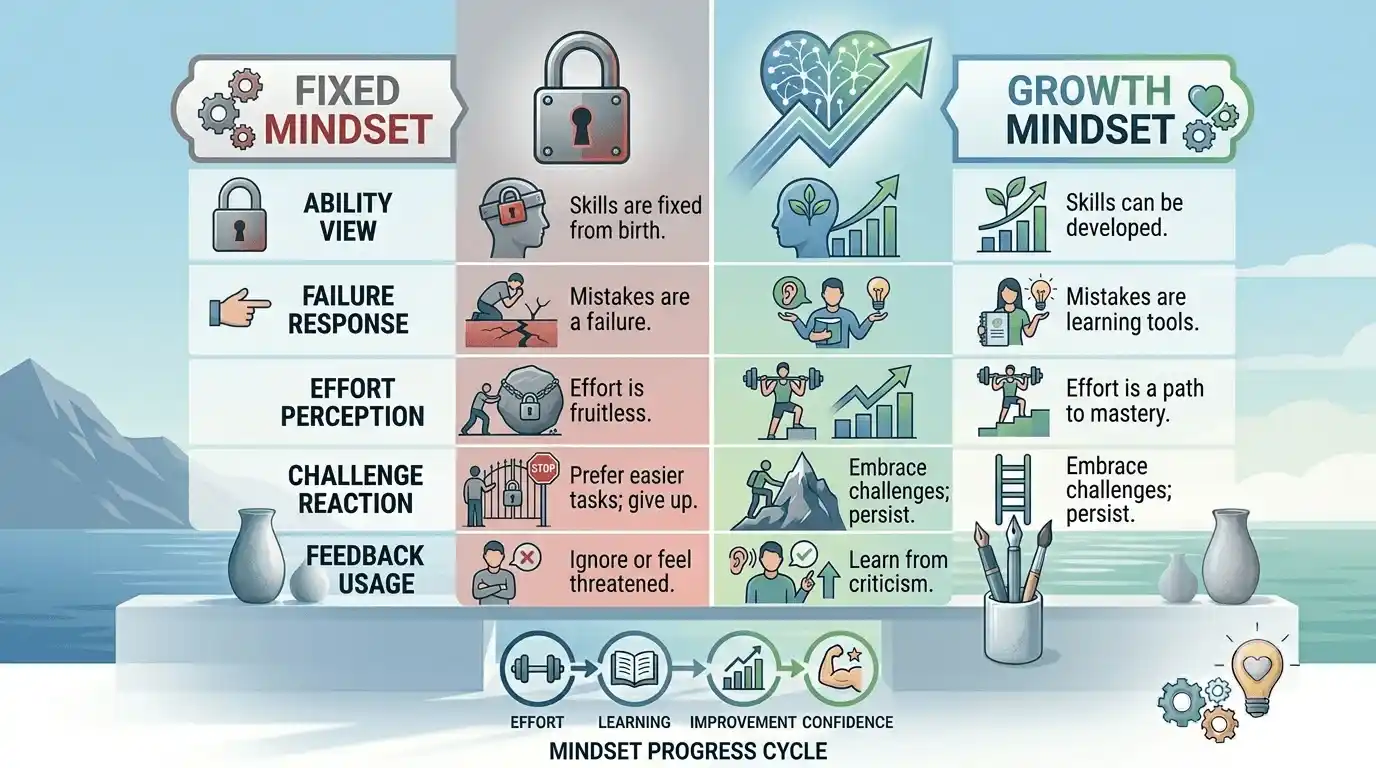
| Aspect | Growth Mindset | Fixed Mindset |
| View of ability | Can be developed | Fixed trait |
| Response to failure | Learning opportunity | Proof of inability |
| Effort | Necessary for growth | Seen as weakness |
| Challenges | Embraced | Avoided |
| Feedback | Used for improvement | Taken personally |
Why this matters
- Determines persistence during difficulty
- Affects learning speed and resilience
- Shapes long-term achievement patterns
Carol Dweck and the Growth Mindset Theory
Carol Dweck developed the growth mindset theory through decades of research in motivation and learning behavior. The concept of growth mindset was introduced by psychologist Carol Dweck through her extensive research on motivation and learning behavior.
Key insights:
- Students perform better when they believe intelligence is improvable
- Praise focused on effort improves resilience
- Fixed praise (e.g., “you are smart”) reduces persistence
How the Growth Mindset Book Explains Success
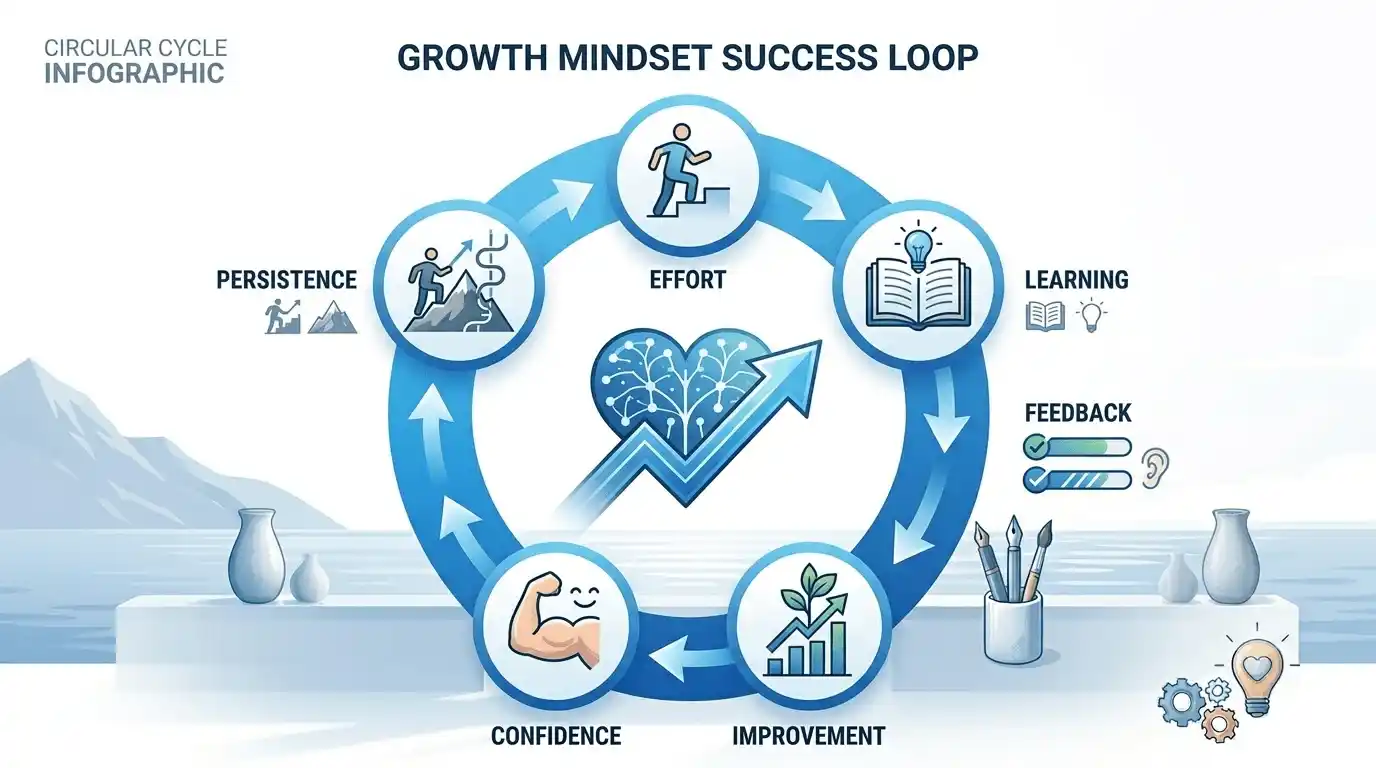
A growth mindset only becomes powerful when combined with consistent behavior systems, such as the habit-building approach explained in how to build good habits in 30 days.
The growth mindset framework explains success through:
- Effort → skill improvement → confidence → persistence
- Failure → feedback → adjustment → mastery
- Learning habits → long-term competence
Cause-effect relationship
- Belief in improvement → more effort → better outcomes
- Belief in fixed ability → avoidance → stagnation
Why People Struggle With Growth Mindset
Common barriers:
- Fear of failure
- Low confidence in ability change
- Past negative experiences
- Social comparison pressure
Hidden issue
People often believe they have a fixed mindset in some areas and a growth mindset in others (e.g., math vs communication).
In many cases, resistance to a growth mindset is actually linked to deeper motivation patterns, which is why understanding why do I lack motivation can help remove hidden psychological blocks.
Growth Mindset in Daily Life (Practical Application)
Practical applications:
- Replace “I can’t do this” → “I can learn this”
- Focus on progress tracking instead of perfection
- Break tasks into skill-building steps
- Treat feedback as data, not judgment
Daily habit examples
- Journaling mistakes and lessons
- Setting learning-based goals
- Reviewing weekly progress improvements
Growth Mindset in Education and Kids
Growth mindset books for kids
Growth Mindset Children’s Books help children understand effort-based learning early
Key applications:
- Praise effort instead of intelligence
- Normalize mistakes in learning
- Encourage curiosity over performance
Growth mindset books for kids
- Encourage resilience in schoolwork
- Build confidence in problem-solving
- Reduce fear of failure
Best Books on Growth Mindset
- Core book: Mindset: The New Psychology of Success
- Other books on mindset focus on habits, discipline, and cognitive change
- “best book for mindset” often refers to Dweck’s foundational research
What makes a strong mindset book
- Evidence-based psychology
- Practical behavior strategies
- Real-world applications
- Habit-building frameworks
Mindset Growth in Real Life Systems
Turning mindset theory into action is essential, and structured frameworks like personal growth action help convert beliefs into real behavioral change.
To develop mindset growth:
- Replace outcome goals with learning goals
- Focus on repetition and feedback loops
- Build identity-based habits (“I am a learner”)
Example transformation
- Old belief: “I’m bad at this”
- New belief: “I’m developing this skill”
Common Mistakes When Trying to Build Growth Mindset
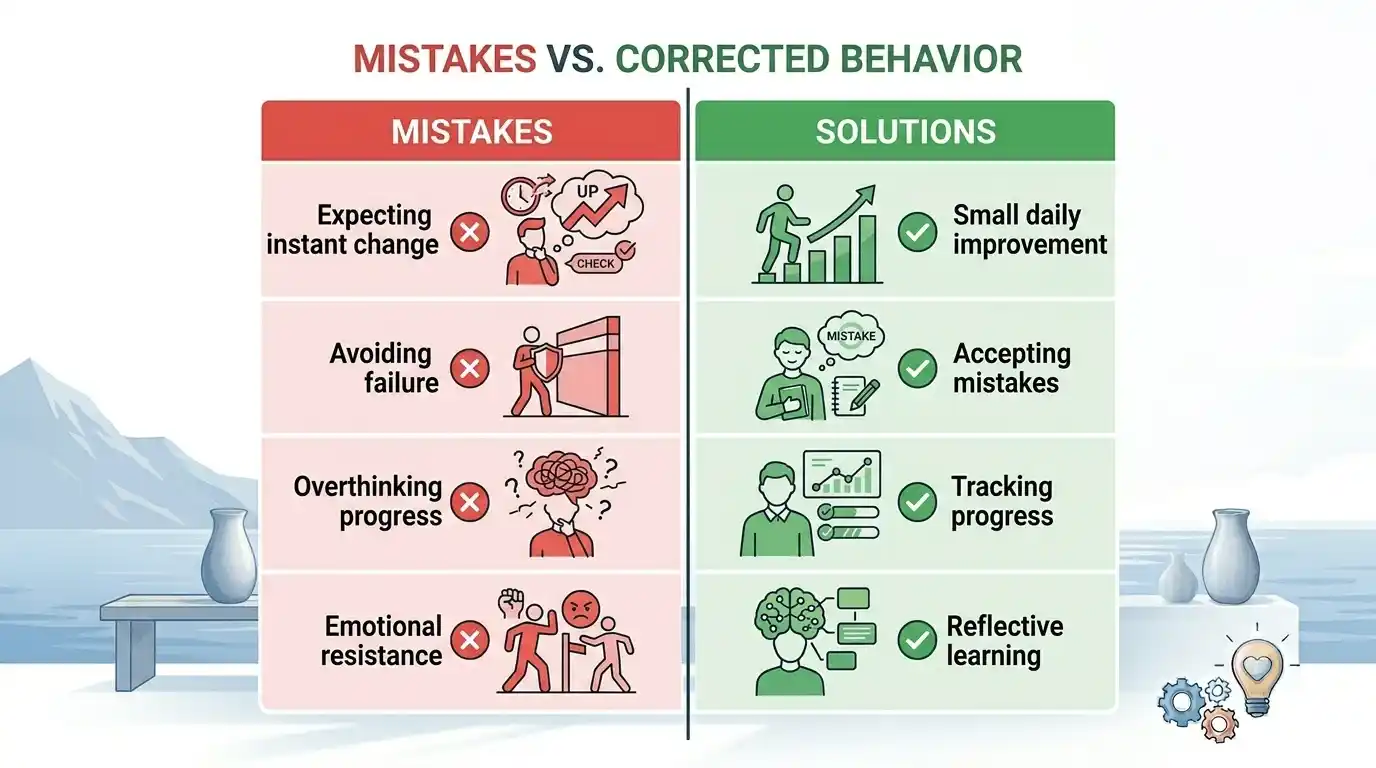
- Expecting instant change
- Forcing positivity instead of realism
- Ignoring emotional resistance
- Overloading self-improvement tasks
What Actually Works (Science-Backed Insights)
- Repeated exposure builds neural pathways
- Feedback improves adaptation speed
- Effort + reflection accelerates mastery
Comparison: Sustainable vs Unsustainable Growth Mindset
| Sustainable Approach | Unsustainable Approach |
| Small daily learning | Overwhelming goals |
| Reflection-based growth | Constant pressure |
| Process-focused | Outcome obsession |
| Gradual improvement | Instant transformation expectation |
Conclusion
The growth mindset book concept, developed by Carol Dweck, explains that success is shaped more by beliefs and effort than by fixed talent. A growth mindset encourages learning, resilience, and continuous improvement.
The key takeaway is simple: ability is not fixed—your approach to learning determines your long-term results.
FAQs
1. What is a growth mindset in simple words?
It is the belief that abilities and intelligence can improve through effort and learning.
2. What is the difference between fixed mindset vs growth mindset?
Fixed mindset believes ability is static, while growth mindset believes it can be developed.
3. Who wrote the growth mindset book?
It was written by psychologist Carol Dweck.
4. Why is growth mindset important?
It improves resilience, learning ability, and long-term success.
5. Can adults develop a growth mindset?
Yes, mindset can change through consistent practice and self-awareness.
6. What are growth mindset books for kids?
They are books designed to teach children that effort and learning lead to improvement.









2 Responses