

Introduction
Learning how to change your thoughts is one of the most valuable personal development skills you can build. Thoughts influence emotions, behaviors, decisions, relationships, and long-term outcomes. However, changing your thinking does not mean forcing yourself to be positive all the time. Instead, it involves recognizing unhelpful thought patterns, questioning their accuracy, and replacing them with healthier and more realistic perspectives. Because thoughts shape actions and actions shape results, learning how to change the way you think can gradually improve confidence, productivity, emotional resilience, and overall well-being. The process takes practice, but it is a skill that can be learned and strengthened over time.
Quick Summary
- Thoughts influence emotions, actions, and habits.
- Negative thinking patterns can be identified and changed through awareness and practice.
- Consistent mindset shifts often produce lasting improvements in confidence, productivity, and emotional well-being.
- Changing your thoughts works best when combined with behavior change and daily habits.
What Does It Mean to Change Your Thoughts?
Changing your thoughts means intentionally shifting the way you interpret experiences, challenges, and situations. Thoughts shape perception. Two people can experience the same event yet interpret it differently because of their thought patterns.
Psychologists often describe a connection between thoughts, feelings, and behaviors. What you think affects how you feel, and how you feel influences what you do.
Automatic thoughts occur instantly and often operate below conscious awareness. Intentional thinking involves actively evaluating and directing your mental responses.
When you learn how to change your thought process, you often change your emotional reactions, decisions, habits, and ultimately your life outcomes. This is why many people seek to change their life by changing their thoughts.
Why Negative Thoughts Come Into the Mind
Negative thoughts are a normal part of human psychology. The brain evolved to prioritize threats because survival depended on identifying danger quickly.
Why Negative Thinking Feels Automatic
The brain’s negativity bias causes negative information to receive more attention than positive information. This can make negative thinking seem automatic even when no real threat exists.
The Role of Stress, Anxiety, and Uncertainty
Stress activates survival-focused thinking. During uncertain situations, the brain often generates worst-case scenarios in an attempt to prepare for potential problems.
Common Cognitive Distortions That Fuel Negative Thinking
Common cognitive distortions include:
- Catastrophizing: Expecting the worst outcome.
- Overgeneralization: Applying one negative event to everything.
- Mind reading: Assuming others think negatively about you.
- Black-and-white thinking: Viewing situations as complete success or total failure.
These distortions often contribute to negative thoughts in anxiety and chronic stress.
How Thoughts, Feelings, and Behaviors Influence Each Other

Thoughts, emotions, and behaviors operate in a continuous feedback loop.
How Negative Thoughts Create Negative Feelings
When you think negatively about a situation, your emotional response often becomes fear, frustration, sadness, or stress.
How Emotions Reinforce Existing Beliefs
Strong emotions can make beliefs feel true even when evidence is limited. This creates self-reinforcing thinking patterns.
Why Behavior Change Accelerates Mindset Change
Taking action creates evidence that challenges limiting beliefs. Small behavioral changes often produce faster mindset shifts than thinking alone.
Thought → Emotion → Action → Result → Reinforced Thought
Changing any part of this cycle can influence the others.
How to Change Your Thoughts Step by Step
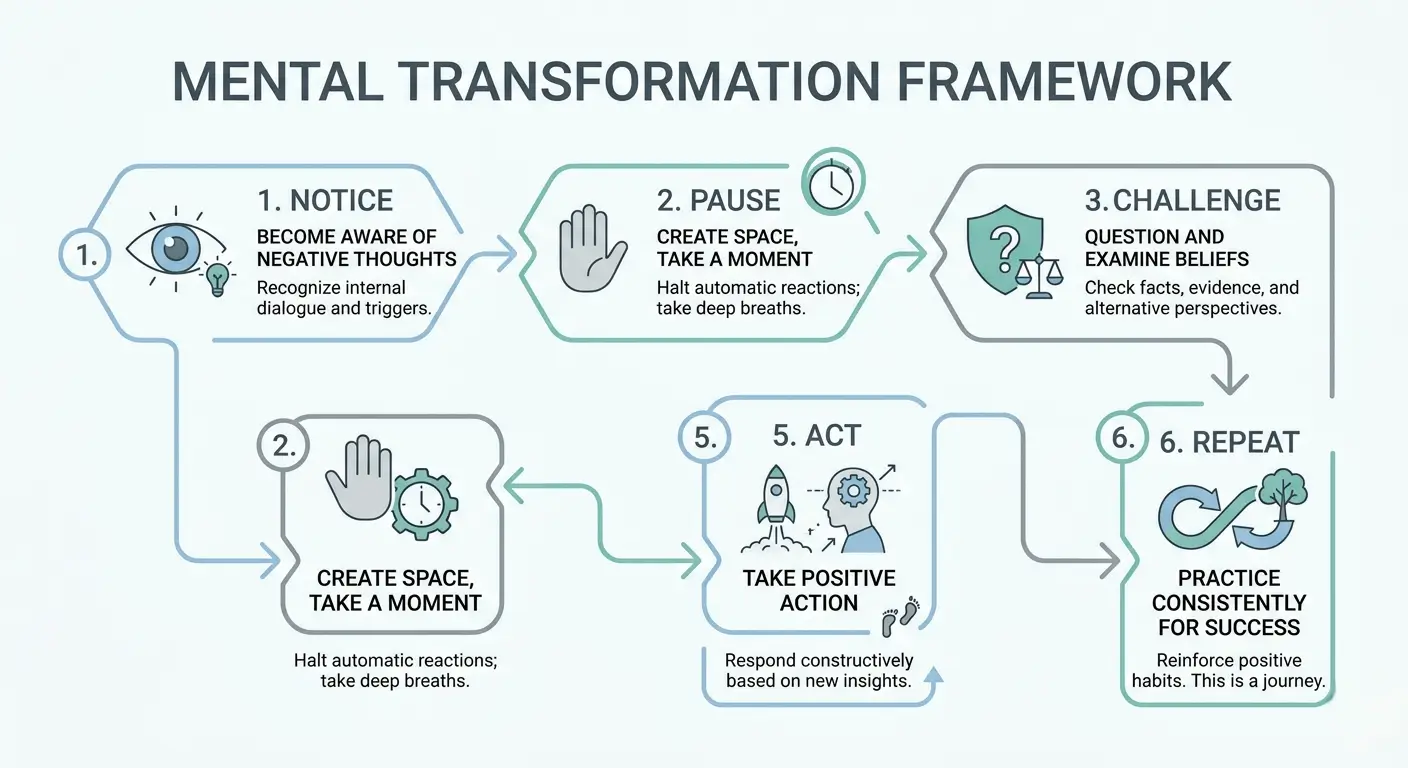
A practical framework for changing your thinking includes awareness, evaluation, replacement, and reinforcement.
For readers who are new to mindset work, these positive mindset tips for beginners can make the transition from negative thinking to balanced thinking easier and more sustainable.
Step 1 — Identify Negative Thought Patterns
Notice recurring thoughts and emotional triggers.
Step 2 — Question the Accuracy of the Thought
Ask:
- Is this thought completely true?
- What evidence supports it?
- What evidence contradicts it?
Step 3 — Replace the Thought With a Balanced Alternative
Avoid unrealistic positivity. Replace extreme thinking with balanced thinking.
Step 4 — Reinforce the New Thought Through Action
Take actions that support the new belief.
Step 5 — Repeat Until the New Pattern Becomes Automatic
Repetition strengthens new neural pathways and habits.
Framework:
- Notice
- Pause
- Challenge
- Reframe
- Act
- Repeat
How to Stop Negative Thoughts Without Fighting Them
Stopping negative thoughts works best when you stop resisting them and start responding differently.
Why Trying to “Force Away” Thoughts Often Fails
Thought suppression often increases mental focus on the unwanted thought. The brain treats suppression as a signal that the thought is important.
The Observe-Label-Redirect Technique
- Observe the thought.
- Label it objectively.
- Redirect attention toward a productive activity.
Healthy Mental Redirection Strategies
- Mindfulness
- Journaling
- Physical movement
- Deep work
- Gratitude practice
These methods help stop negative thinking without creating additional mental resistance.
How Anxiety Creates Negative Thinking Loops
Anxiety often increases threat-focused thinking and worry cycles.
Why Anxiety Makes Negative Thoughts Feel Real
Anxiety heightens emotional intensity, making hypothetical fears seem factual.
Breaking the Anxiety-Thinking Cycle
Interrupt rumination with action, evidence gathering, and present-moment awareness.
Practical Strategies for Managing Both Anxiety and Negative Thoughts
- Focus on controllable actions.
- Limit reassurance-seeking.
- Practice mindfulness.
- Use structured problem-solving.
- Challenge catastrophic predictions.
How to Get Rid of Negative Thoughts Through Daily Habits
Long-term thought change is often habit-driven rather than motivation-driven.
One of the most effective ways to identify recurring thought patterns is journaling for self-growth, which helps increase self-awareness and emotional clarity.
Morning Habits That Improve Thinking Patterns
Start the day with intentional focus rather than reactive consumption.
Mental Habits That Reduce Negativity
Regular self-awareness practices help prevent negative thinking from becoming automatic.
Evening Reflection Practices
Review progress, lessons learned, and positive experiences before sleep.
Helpful habits:
- Thought journaling
- Gratitude tracking
- Daily wins review
- Limiting negative inputs
- Exercise and sleep habits
Motivation vs Discipline When Changing Thought Patterns
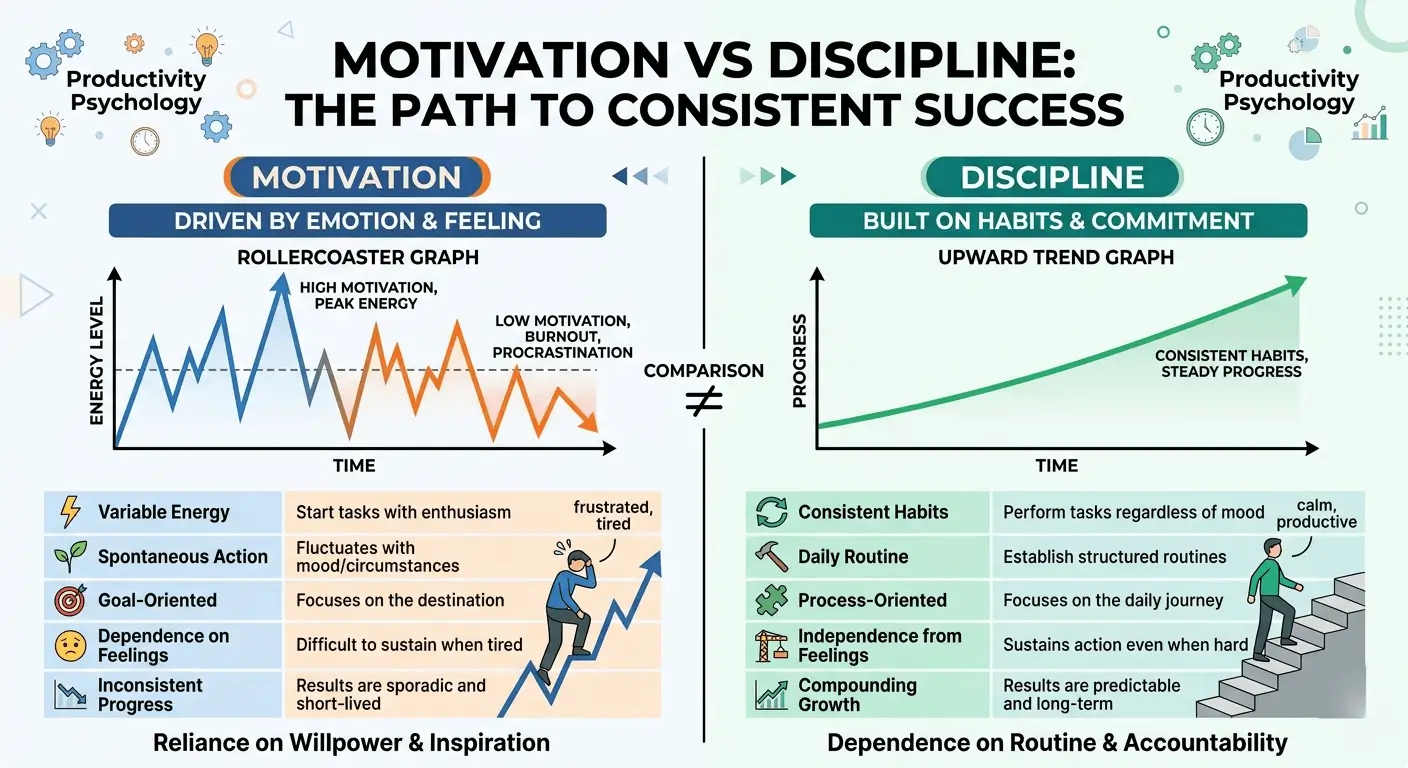
| Motivation | Discipline |
|---|---|
| Emotion-driven | Habit-driven |
| Temporary | Sustainable |
| Depends on mood | Depends on routines |
| Unpredictable | Reliable |
Motivation can help you start. Discipline helps you continue when motivation disappears.
If you want to create lasting mindset change, learning how to build discipline without motivation can help you stay consistent even when enthusiasm fades.
Consistency vs Intensity in Mental Transformation
| Consistency | Intensity |
| Builds long-term change | Creates short-term effort |
| Easier to maintain | Harder to sustain |
| Reduces burnout | Increases burnout risk |
Small daily improvements often outperform occasional bursts of effort.
Common Mental Barriers That Prevent Positive Thinking
Several psychological barriers can make positive thinking difficult.
Why People Stay Stuck in Negative Thinking
Negative thinking can become a deeply practiced habit.
The Hidden Comfort of Familiar Thought Patterns
Even unhelpful thoughts can feel familiar and predictable.
How Identity Shapes Thinking Habits
People often behave in ways that match their self-image. Lasting change becomes easier when new thoughts align with a healthier identity.
Problem-Solution Guide for Negative Thinking
| Problem | Why It Happens | How to Fix It | Prevention Strategy |
| Procrastination | Fear and overwhelm | Small actions | Daily planning |
| Lack of motivation | Emotional dependence | Habit systems | Consistent routines |
| Overthinking | Need for certainty | Action focus | Decision limits |
| Burnout | Unsustainable effort | Recovery periods | Balanced routines |
| Fear of failure | Negative predictions | Reframing mistakes | Growth mindset |
Science-Backed Strategies That Help Rewire Thought Patterns
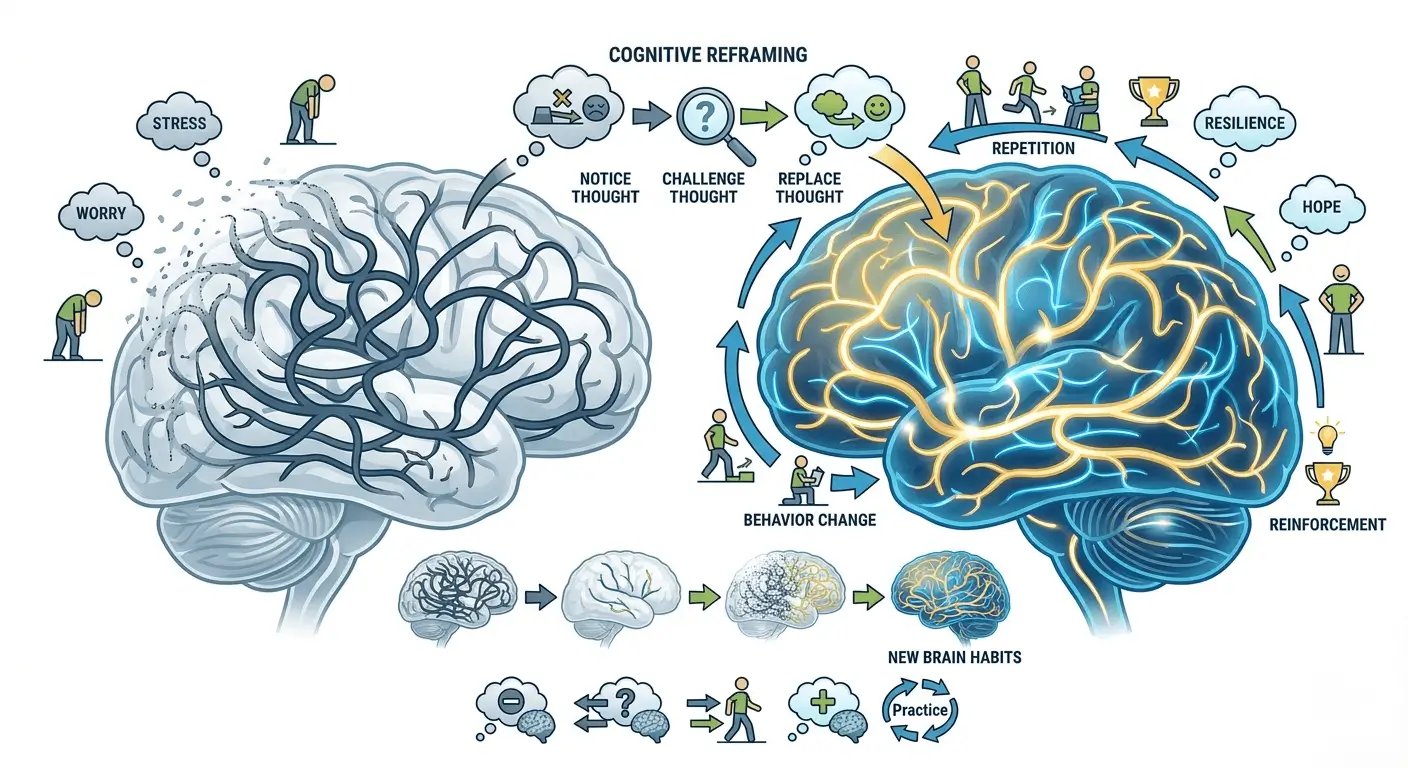
Research shows that thought patterns can change through repeated practice.
How the Brain Learns New Thinking Patterns
Neuroplasticity allows the brain to adapt and form new neural connections based on repeated experiences and behaviors.
Why CBT Is Effective for Thought Change
Cognitive Behavioral Therapy (CBT) helps individuals identify, challenge, and replace unhelpful thinking patterns with more accurate alternatives.
What Research Says About Lasting Mindset Shifts
Research consistently shows that repetition, behavioral reinforcement, and consistent practice create more durable mindset changes than temporary motivation.
Real-Life Examples of Changing Negative Thoughts
Example: Replacing Self-Doubt With Evidence-Based Thinking
Instead of thinking, “I always fail,” review actual evidence of previous successes and progress.
Example: Overcoming Fear of Failure
Replace “Failure means I’m not capable” with “Failure provides information for improvement.”
Example: Breaking an Anxiety-Based Thought Cycle
Replace repeated worry with action-focused planning and evidence-based evaluation.
How Long Does It Take to Change Your Thoughts?
Thought change is gradual rather than immediate.
Short-Term Changes vs Long-Term Transformation
Some improvements can appear within days or weeks. Deeply rooted thinking patterns often require months of consistent practice.
What Progress Actually Looks Like
Progress usually looks like:
- Faster awareness of negative thoughts
- Reduced emotional intensity
- Better decision-making
- Increased resilience
- More constructive self-talk
The goal is not perfect thinking. The goal is healthier and more useful thinking.
Conclusion
Changing your thoughts is a skill that develops through awareness, repetition, and consistent action. Negative thinking patterns are often learned over time, which means they can also be unlearned. By understanding why negative thoughts occur, challenging unhelpful beliefs, and reinforcing healthier mental habits, you can gradually change your thinking, improve emotional resilience, and create positive long-term life changes. Sustainable mindset transformation comes from small daily actions repeated consistently over time.
FAQs
1. Why do I struggle with consistency when trying to change my thoughts?
Consistency is difficult because the brain prefers familiar patterns. Building routines and systems makes thought change easier than relying on motivation alone.
2. How do I stop negative thoughts from taking over my day?
Notice the thought, label it objectively, challenge its accuracy, and redirect attention toward a meaningful action.
3. Can changing my thoughts improve my anxiety?
Yes. While changing thoughts may not eliminate anxiety completely, it can reduce anxiety-driven interpretations and improve emotional regulation.
4. What is the fastest way to change negative thinking patterns?
There is no instant solution. Combining awareness, cognitive reframing, and consistent behavior change produces the fastest sustainable results.
5. How long does it take to develop a more positive mindset?
The timeline varies by person. Many people notice early improvements within weeks, while deeper changes often take several months of practice.
6. Why do negative thoughts keep coming back even after I challenge them?
Thought patterns are strengthened through repetition. Old patterns may reappear until new ones become more established through consistent reinforcement.
7. Can I change my thoughts without forcing myself to be positive all the time?
Yes. Healthy thought change focuses on realistic and balanced thinking rather than constant positivity.
8. What daily habits help create lasting mindset change?
Thought journaling, gratitude practice, exercise, quality sleep, reflection, and consistent action toward meaningful goals are among the most effective habits for lasting change.









8 Responses