

Introduction
A stagnant mindset is a pattern of thinking that keeps a person locked into familiar routines, beliefs, and reactions, even when those patterns no longer serve their growth. Unlike a temporary lack of motivation or short-term burnout, a stagnation mindset is a longer-lasting mental pattern that resists new information, avoids discomfort, and reinforces the status quo. Understanding the stagnant mindset meaning matters because mindset shapes nearly every area of life — how people learn, make decisions, build relationships, and grow in their careers. A stagnant mentality doesn’t mean someone is incapable of change; it means their current thinking patterns are working against progress rather than for it.
Quick Summary
- A stagnant mindset is a pattern of thinking that limits learning, adaptation, and personal growth.
- Recognizing early signs of stagnation makes change easier before habits become deeply rooted.
- Mindset shifts require awareness, consistent action, and supportive environments rather than quick fixes.
- Developing a growth-oriented perspective improves resilience, confidence, relationships, and long-term progress.
What Is a Stagnant Mindset?
Stagnant Mindset Meaning and Definition
A stagnant mindset is a psychological pattern characterized by resistance to change, avoidance of new challenges, and a tendency to interpret setbacks as permanent limitations rather than temporary obstacles. The stagnant mindset definition centers on rigidity: a person with this mentality tends to rely on familiar routines even when those routines no longer produce meaningful results.
Psychologically, this pattern often develops gradually. Repeated avoidance of discomfort, combined with limited exposure to new ideas or environments, reinforces fixed thinking over time. Each time a person chooses comfort over challenge, the neural and behavioral pathways associated with that choice become more established, making the stagnant mentality feel more natural and the alternative — growth — feel riskier.
This is different from simply preferring stability. A stagnant mindset specifically involves an underlying belief that change is unlikely, unnecessary, or unsafe, which then shapes decisions, habits, and self-perception.
Feeling Stagnant Meaning vs Having a Stagnant Mindset
Feeling stagnant meaning, in the emotional sense, refers to a temporary state — a sense of being stuck, bored, or directionless that most people experience at some point. This is normal and often situational, tied to a specific life stage, job, or season.
A stagnant mindset is different. It’s not a passing feeling but an ongoing thinking pattern that persists across situations. The feeling stagnant in life meaning may describe a short-term emotional dip, while a stagnant mindset describes the deeper cognitive habits that keep someone stuck long after the original circumstance has changed.
| Aspect | Feeling Stagnant (Temporary) | Stagnant Mindset (Pattern) |
|---|---|---|
| Duration | Days to a few weeks | Months to years |
| Trigger | Specific event or season | Underlying belief system |
| Resolution | Often resolves naturally | Requires intentional change |
| Scope | Limited to one area | Affects multiple life areas |
Common Signs of a Stagnant Mindset
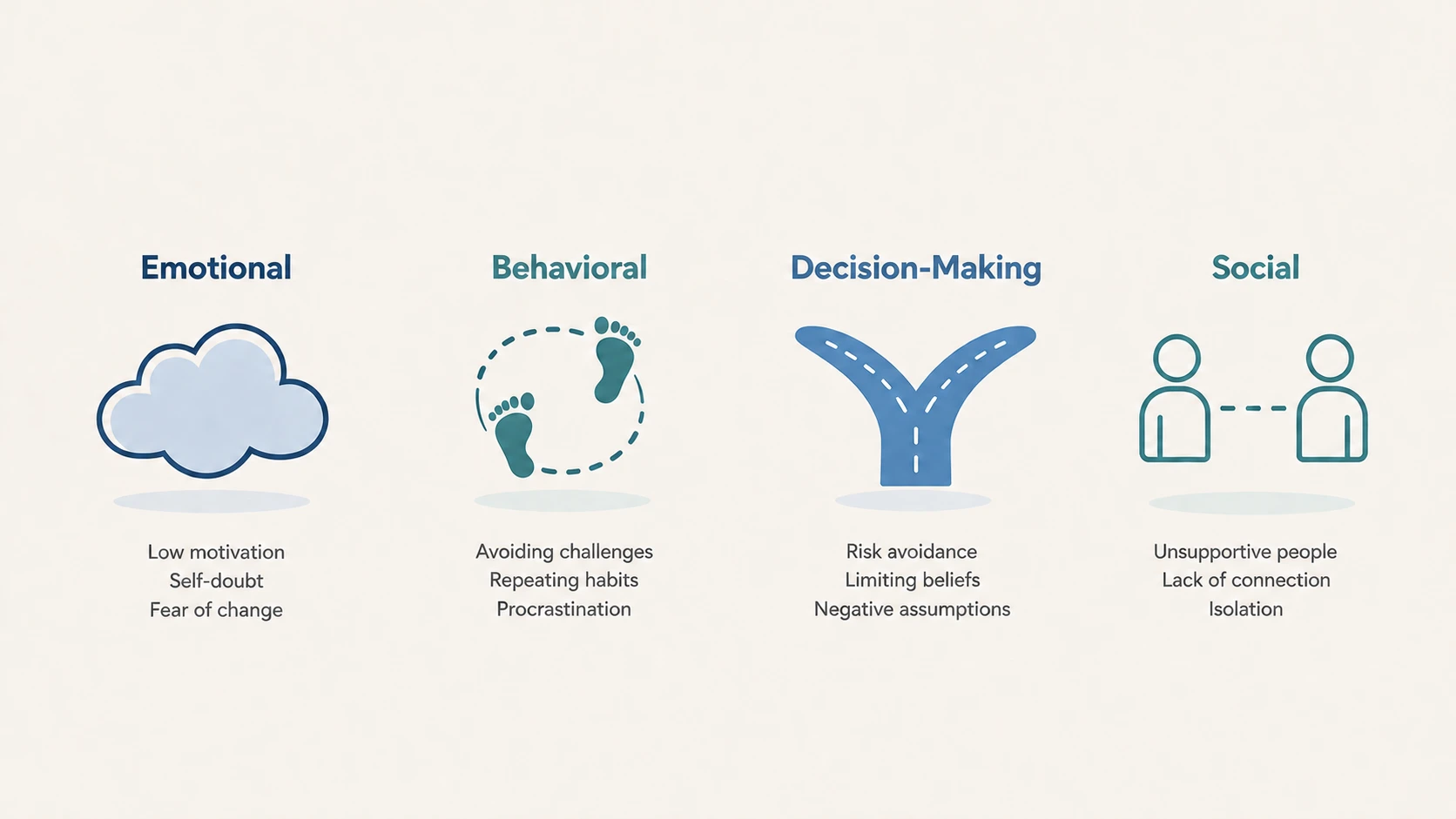
Recognizing the signs of stagnation early makes it easier to address before patterns become deeply rooted habits.
Emotional Signs
- Lack of motivation, even for previously enjoyable activities
- Fear of change or uncertainty about the future
- Persistent self-doubt about one’s abilities
- Low curiosity toward new ideas, skills, or experiences
- A general loss of sense of purpose or direction If this sounds familiar, it may help to explore why you lack motivation before assuming it’s simply laziness.
Behavioral Signs
- Avoiding challenges that involve risk or discomfort
- Repeating ineffective habits despite poor results
- Resistance to feedback, even when it’s constructive
- Strong dependence on comfort zones
- Chronic procrastination on meaningful tasks
Decision-Making Patterns
People with a stagnant mindset often show consistent decision-making patterns tied to signs of stagnation in life:
- Risk avoidance: Choosing the safest option even when growth requires calculated risk
- Negative assumptions: Expecting failure before attempting something new
- Limiting beliefs: Assuming personal ability or circumstance cannot change
- Fixed expectations: Believing outcomes are predetermined regardless of effort
Indicators of a stagnant mindset typically fall into four categories:
- Emotional indicators (low motivation, fear, self-doubt)
- Mental indicators (rigid thinking, limiting beliefs)
- Behavioral indicators (avoidance, procrastination, resistance to feedback)
- Social indicators (withdrawal, reduced engagement with others’ growth)
Why People Develop a Stagnant Mindset
Psychological Causes
Several established psychological factors contribute to the development of a stagnant mindset:
- Fear of failure: Avoiding effort to avoid the possibility of falling short
- Fear of success: Anxiety about the responsibility or visibility that comes with achievement
- Learned helplessness: A behavioral science concept describing the belief that effort won’t change outcomes, often formed after repeated setbacks
- Low confidence: Reduced belief in one’s own competence or capability
- Negative experiences: Past failures or criticism that shape current risk-avoidance
Lifestyle and Environmental Factors
Beyond internal psychology, external conditions play a significant role:
- Routine: Highly repetitive schedules that limit exposure to new challenges
- Lack of learning: Minimal engagement with new skills, information, or perspectives
- Stress: Chronic stress that narrows focus toward short-term survival rather than growth
- Burnout: Depleted mental and physical resources that reduce capacity for change
- Unsupportive environments: Relationships or workplaces that discourage risk-taking or new ideas
Can Spiritual Beliefs Influence Feelings of Stagnation?
For some individuals, spiritual causes of stagnation in life are a meaningful part of the picture, though this varies widely by person. Spiritual or existential reflection can influence how people interpret stagnation — some may view it as a sign of misalignment with personal values or purpose, while others may not connect it to spirituality at all.
Where relevant, this can include:
- Personal beliefs about purpose and meaning
- Practices of reflection or mindfulness
- Alignment between daily actions and core values
- Spiritual practices used for clarity or grounding
This is a matter of individual interpretation. Spiritual perspective is not a required lens for understanding stagnation, but for those who hold such beliefs, it can be one contributing factor among the psychological and environmental ones discussed above.
Stagnant Mindset vs Growth Mindset
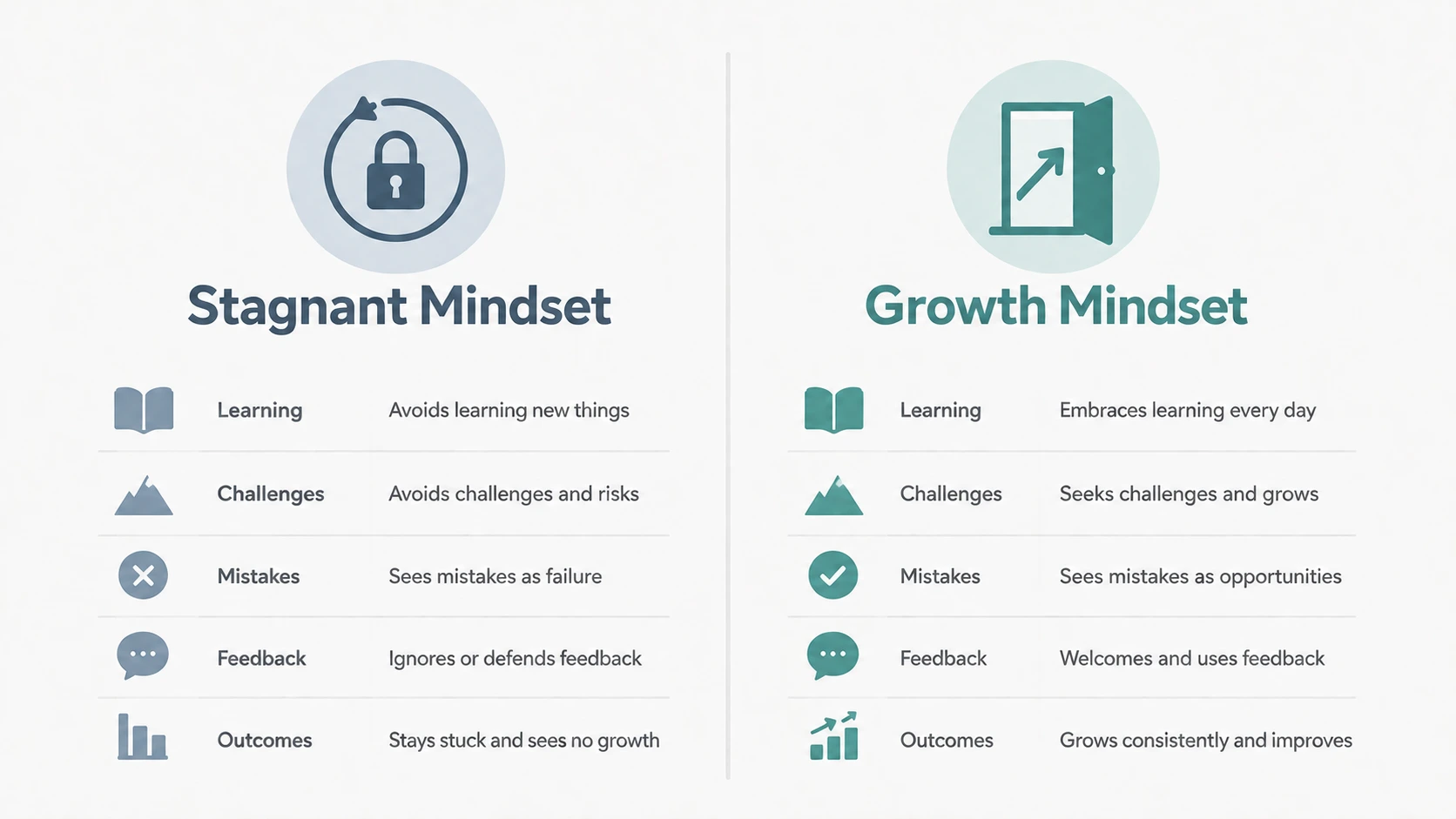
Comparing a growth vs stagnant mindset highlights how differently each approach handles core aspects of learning and progress.
| Aspect | Stagnant Mindset | Growth Mindset |
|---|---|---|
| Learning | Avoided or seen as unnecessary | Actively sought and valued |
| Challenges | Avoided due to fear of failure | Approached as opportunities |
| Mistakes | Seen as evidence of inadequacy | Seen as part of the learning process |
| Success | Attributed to fixed talent | Attributed to effort and strategy |
| Feedback | Often resisted or dismissed | Welcomed and used constructively |
| Adaptability | Low; resistant to change | High; adjusts approach as needed |
| Long-term outcomes | Limited growth, repeated patterns | Sustained improvement over time |
Stagnant Mindset vs Scarcity Mindset vs Abundance Mindset
While related, these three mindsets are not identical. Understanding scarcity mindset vs abundance mindset alongside a stagnant mindset clarifies their distinct — though sometimes overlapping — characteristics.
| Mindset | Core Belief | Typical Behaviors | Long-Term Impact |
|---|---|---|---|
| Stagnant Mindset | Change is unlikely or unsafe | Avoidance, repetition of habits | Limited growth, feeling stuck |
| Scarcity Mindset | Resources/opportunities are limited | Hoarding, competition, risk aversion | Missed opportunities, chronic stress |
| Abundance Mindset | Opportunities can expand through action | Collaboration, openness, calculated risk | Increased opportunity and resilience |
A stagnant mindset and a scarcity mindset often overlap — both involve avoidance and risk aversion — but they are not the same. A stagnant mindset centers on resistance to change itself, while a scarcity mindset centers on a belief that resources or opportunities are inherently limited. Someone can hold an abundance mindset in one area of life (such as finances) while still showing signs of stagnation in another (such as career growth).
How a Stagnant Mindset Affects Different Areas of Life
Personal Development
A stagnant mindset limits self-improvement by discouraging new skills, habits, or perspectives. Without regular exposure to challenge, personal growth slows or plateaus entirely.
Career and Learning
Professionally, a stagnant mindset can lead to missed promotions, reduced skill development, and difficulty adapting to industry changes. Avoiding feedback or new responsibilities often results in being passed over for growth opportunities.
Relationships
Stagnation affects relationships in several concrete ways:
- Communication: Reduced willingness to address difficult topics
- Emotional growth: Limited capacity to process and express emotions constructively
- Shared goals: Difficulty building or pursuing goals with a partner
- Conflict avoidance: Sidestepping disagreements rather than resolving them
Feeling stagnant in relationship dynamics often shows up as routine without progression — connection without evolution, which over time can create emotional distance.
Mental Well-Being
A stagnant mindset is associated with lower life satisfaction, reduced sense of purpose, and increased vulnerability to anxiety or low mood, particularly when someone senses their potential is unfulfilled but feels unable to act on it.
How to Overcome a Stagnant Mindset
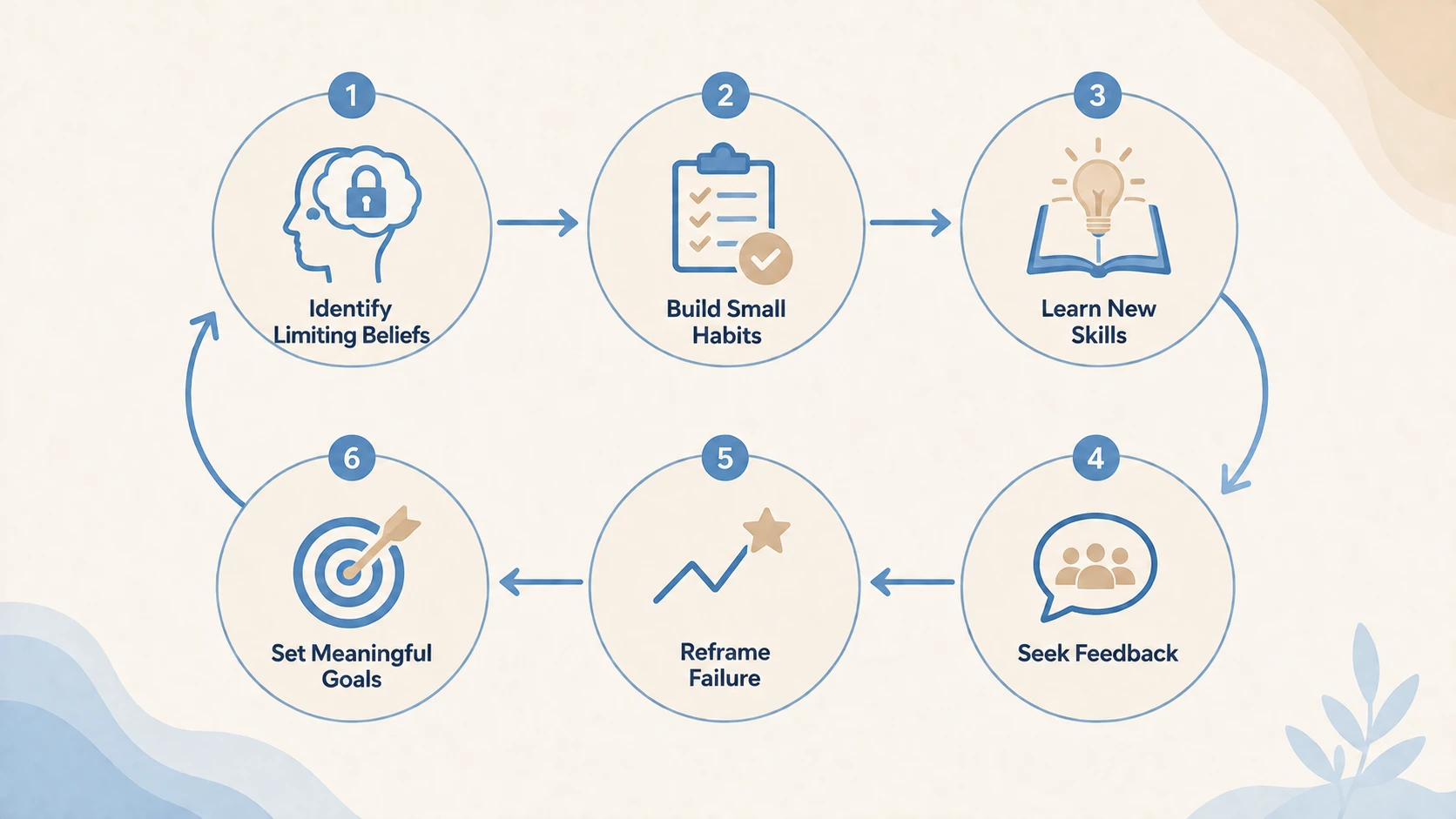
Overcoming stagnation involves practical, evidence-informed steps rather than a single dramatic change.
Identify Limiting Beliefs
Write down assumptions that discourage action (e.g., “I’m not good at this”) and examine whether they’re based on fact or habit. If this pattern feels familiar, learning how to change your thoughts is often the first practical step before any habit change sticks.
Build Small Growth HabitsHow to Get Your Life in Order with Simple Systems
Start with low-risk actions — a new daily habit, a short skill-building session — to rebuild confidence in change.
Learn New Skills Regularly
Regular learning, even informal, keeps the brain engaged with new information and reduces reliance on fixed patterns.
Seek Feedback
Actively requesting input from trusted sources counters the tendency to avoid or dismiss feedback.
Reframe Failure as Learning
Treating setbacks as data rather than verdicts reduces the fear that reinforces avoidance behavior.
Create Meaningful Goals
Goals connected to personal values are more sustainable motivators than generic or externally imposed ones.
Practical structure for how to overcome stagnation in life:
- Daily habits: Small, consistent actions (5–15 minutes) toward a specific skill or goal
- Weekly reflection: Reviewing what worked, what didn’t, and why
- Monthly learning goals: A new skill, book, or course to maintain momentum
- Accountability methods: A partner, coach, or tracking system to maintain consistency
In our experience helping readers build better habits, the people who overcome stagnation fastest are those who start with very small, repeatable actions rather than attempting a complete lifestyle overhaul at once. This matters most on low-energy days — here’s how to build discipline without motivation.
How to Build an Abundance-Oriented Growth Mindset
Replacing Scarcity Thinking
Shifting from “there’s not enough” to “there are multiple paths forward” starts with identifying specific scarcity-based assumptions and testing them against evidence.
Practicing Gratitude
Regularly acknowledging existing resources and progress — however small — helps counter the scarcity-driven urge to hoard opportunities or avoid risk.
Expanding Opportunities
Actively seeking new information, relationships, and experiences increases the range of options available, which supports how to get into an abundance mindset in practical terms.
Long-Term Thinking
Abundance-oriented thinking involves evaluating decisions based on long-term potential rather than only immediate outcomes, which supports sustained motivation.
Your Daily Thrive recommends approaching how to change scarcity mindset patterns gradually: replacing one scarcity-based habit at a time is more sustainable than attempting to overhaul thinking all at once. For those exploring how to cultivate abundance mindset habits, consistency matters more than intensity — small, regular shifts in perspective compound over time.
Common Mistakes That Keep People Stuck
Several commonly overlooked mistakes prevent people from overcoming a stagnant mindset, even when they’re actively trying to change.
- Waiting for motivation: Motivation often follows action rather than preceding it; waiting for it delays progress indefinitely.
- Comparing yourself with others: Comparison shifts focus away from personal progress and toward external, often incomplete, benchmarks.
- Perfectionism: Setting unrealistically high standards discourages starting or continuing new efforts.
- Fear of criticism: Avoiding visibility to prevent judgment also prevents growth opportunities.
- Overplanning without action: Excessive planning can become a form of avoidance disguised as productivity.
- Ignoring small improvements: Dismissing incremental progress reduces motivation to continue.
Why each mistake happens, how to fix it, and how to prevent it: Most of these patterns stem from fear-based avoidance rather than lack of effort. Addressing them involves recognizing the avoidance behavior, taking a small deliberate action despite discomfort, and building a routine that doesn’t depend on feeling ready. Preventing relapse into these patterns typically requires ongoing self-monitoring and periodic honest review of habits.
Practical Strategies for Staying Out of Stagnation Long-Term
Continuous Learning
Ongoing exposure to new skills or information prevents the return of fixed thinking patterns.
Habit Reviews
Regularly assessing whether current habits still serve current goals prevents outdated routines from becoming default behavior.
Goal Adjustment
Revisiting and updating goals as circumstances change keeps growth aligned with present priorities rather than past ones.
Building Supportive Environments
Surrounding oneself with people, resources, and settings that encourage growth reduces the likelihood of falling back into stagnant patterns. Sustainable improvement depends more on consistent environment and routine than on short bursts of motivation.
Difficulty & Time Investment
Overcoming a stagnant mindset is generally beginner-friendly, though difficulty varies based on how deeply the pattern is established.
- Beginner-friendly starting points: Small daily habits and reflection exercises require minimal time (10–20 minutes) and low risk.
- Moderate vs advanced effort: Addressing deeper limiting beliefs or long-standing avoidance patterns may require more sustained effort, sometimes with professional support such as coaching or therapy.
- Factors influencing difficulty: Duration of the stagnant pattern, current stress levels, and available support systems all affect how challenging the process feels.
- Lifestyle considerations: Busy schedules or high-stress environments may require smaller, more flexible steps rather than rigid routines.
- Consistency requirements: Regular, moderate effort produces more reliable results than occasional intense effort.
Results Timeline
Progress in overcoming a stagnant mindset typically follows a gradual pattern rather than a sudden shift.
- Early mindset awareness: Noticeable within the first 1–2 weeks as self-monitoring increases.
- Habit formation over weeks: Consistent behavior change generally becomes more automatic after several weeks of repetition.
- Long-term behavioral change: Deeper shifts in thinking patterns typically develop over months of sustained practice.
- Factors affecting progress speed: Consistency, environmental support, and the depth of underlying limiting beliefs all influence how quickly change occurs.
Practice Guide
Building sustainable change involves a structured, repeatable practice:
- Daily reflection exercises: Brief check-ins on mindset and behavior patterns
- Weekly goal reviews: Assessing progress and adjusting plans as needed
- Journaling prompts: Questions that surface limiting beliefs or emotional patterns
- Learning routines: Scheduled time for new skills or information
- Accountability strategies: Check-ins with a trusted person, coach, or group
- Habit tracking: Simple tools to monitor consistency over time
- Motivation maintenance: Reconnecting regularly with personal reasons for change
- Sustainable long-term practice: Adjusting routines as circumstances evolve, rather than maintaining a rigid plan indefinitely
Frequently Confused Terms Related to Stagnation
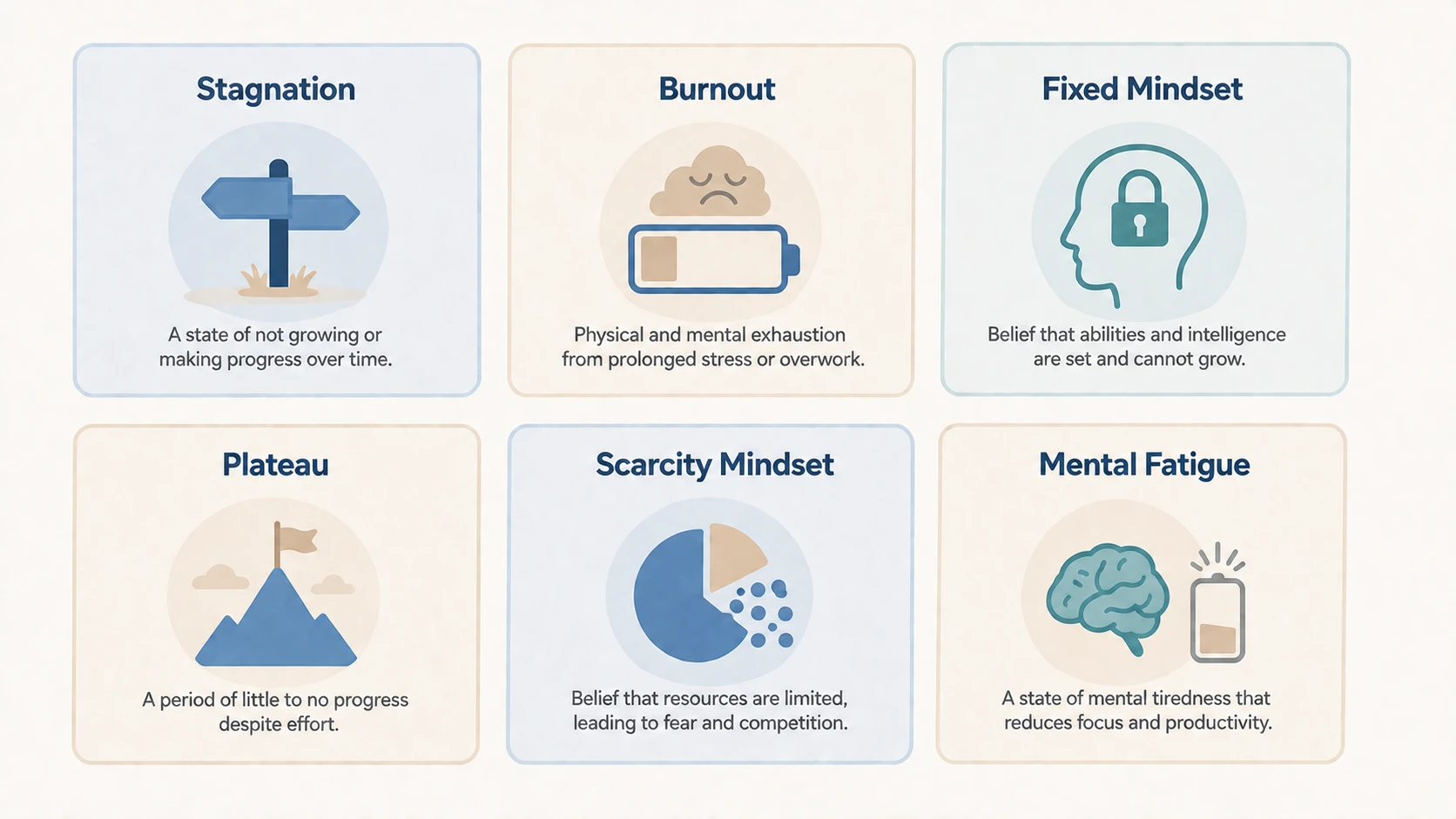
| Term | Meaning | When It Applies |
|---|---|---|
| Stagnation | A prolonged state of limited progress or change | When growth has stopped across multiple life areas |
| Burnout | Physical and emotional exhaustion from prolonged stress | When depletion, not avoidance, is the primary driver |
| Lack of motivation | A temporary dip in drive to act | When the dip is short-term and situational |
| Fixed mindset | Belief that abilities are static and unchangeable | When self-perception, specifically, blocks growth |
| Plateau | A temporary pause in progress despite continued effort | When effort continues but results stall |
| Scarcity mindset | Belief that resources or opportunities are limited | When decisions are driven by fear of “not enough” |
| Mental fatigue | Reduced cognitive capacity from overuse or stress | When tiredness, not belief patterns, limits action |
Conclusion
A stagnant mindset is a thinking pattern — not a permanent trait — that limits learning, adaptability, and personal growth by reinforcing avoidance, fixed beliefs, and comfort-driven decisions. Understanding the stagnant mindset meaning, recognizing its emotional, behavioral, and decision-making signs, and identifying its psychological or environmental causes are the first steps toward change. Because stagnation is not permanent, it can be addressed through consistent, evidence-informed habits: identifying limiting beliefs, building small growth routines, seeking feedback, and creating supportive environments. The most reliable path forward isn’t a dramatic overhaul, but gradual, sustainable action repeated consistently over time.
Frequently Asked Questions
What is a stagnant mindset? A stagnant mindset is a thinking pattern characterized by resistance to change, avoidance of challenges, and reliance on familiar routines, even when those patterns limit personal growth.
What are the most common signs of a stagnant mindset? Common signs include low motivation, fear of change, avoidance of challenges, resistance to feedback, procrastination, and a general loss of curiosity or purpose.
Can a stagnant mindset be changed? Yes, a stagnant mindset can be changed through consistent, small actions such as building new habits, seeking feedback, learning new skills, and reframing failure as part of the learning process.
How is a stagnant mindset different from a growth mindset? A stagnant mindset avoids challenges and treats mistakes as evidence of inadequacy, while a growth mindset actively seeks challenges and treats mistakes as part of the learning process.
Why do people feel stagnant in life? People often feel stagnant due to psychological factors like fear of failure or learned helplessness, combined with environmental factors such as repetitive routines, stress, or unsupportive surroundings.
Can stress or burnout cause feelings of stagnation? Yes, chronic stress and burnout can deplete the mental and physical resources needed for growth, which can contribute to or intensify feelings of stagnation.
Does feeling stagnant always mean you’re failing? No, feeling stagnant is often a normal, temporary experience and does not necessarily indicate failure; it typically signals a need for reflection or a change in approach.
How long does it take to overcome a stagnant mindset? Early awareness can develop within a couple of weeks, while habit formation and deeper behavioral change generally take several weeks to months of consistent practice.
Can relationships contribute to feeling stagnant? Yes, relationships lacking communication, shared goals, or emotional growth can contribute to feelings of stagnation, particularly when conflict or difficult topics are consistently avoided.
What daily habits help prevent a stagnant mindset? Helpful daily habits include brief reflection exercises, small learning activities, goal-setting check-ins, and consistent tracking of progress toward personal growth goals.