
Introduction
A coding mindset is the way programmers approach problem-solving, learning, debugging, and continuous improvement — not just the act of writing code. The coding mindset meaning goes beyond syntax knowledge; it describes a thinking pattern built on curiosity, logic, and persistence. Mindset influences programming success more than memorizing language rules, because code changes constantly while problem-solving skills transfer across every language and tool. Understanding how to develop a coding mindset helps beginners build confidence and helps experienced developers keep improving, adapt to new technologies, and write better software over the long term.
Quick Summary
- A coding mindset focuses on solving problems logically rather than memorizing programming languages.
- Strong programmers develop habits like debugging systematically, writing maintainable code, and continuously learning.
- Coding practices, code organization, and programming principles are practical outcomes of a good coding mindset.
- Anyone can build a coding mindset through deliberate practice and structured learning.
What Is a Coding Mindset?
Coding Mindset Meaning Explained
A coding mindset is a structured way of thinking that helps a programmer break problems apart, test ideas, and learn from mistakes rather than relying on memorized answers. The coding mindset meaning centers on process, not output: it’s the internal habit of asking “what is this problem actually asking?” before touching a keyboard. Technical skills — a specific language, framework, or tool — are learnable in weeks. A coding mindset is the underlying reasoning ability that makes learning any new technical skill faster. In our experience helping readers build better habits, the people who advance fastest in programming are rarely the ones who memorized the most syntax; they’re the ones who learned to reason through unfamiliar problems calmly.
Why Mindset Matters More Than Memorizing Syntax
Syntax is easy to look up; reasoning is not. Experienced programmers rely on abstraction — the ability to ignore irrelevant details and focus on the structure of a problem — rather than recalling exact commands. This is why a developer can move between Python, JavaScript, and Go with relatively little friction: the underlying logical reasoning stays the same even when the syntax changes. Memorization without understanding tends to break down the moment a problem doesn’t match a familiar pattern, while mindset-driven reasoning adapts to new and unexpected situations.
Core Attributes of a Coding Mindset
What Are the Attributes of a Coding Mindset?
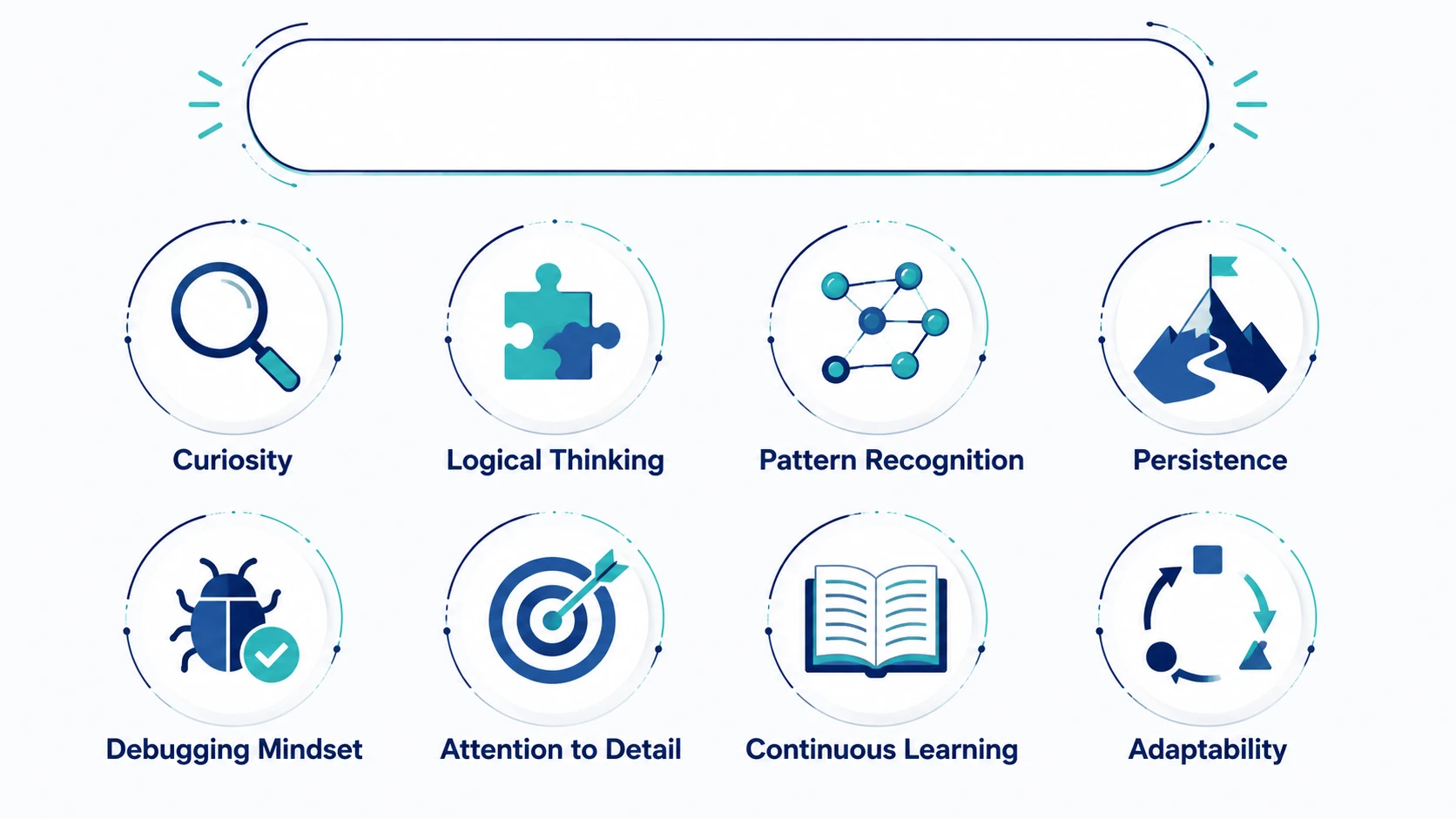
The attributes of a coding mindset describe the specific thinking habits that separate strong problem-solvers from those who struggle with new challenges. Common attributes include:
- Curiosity — a drive to understand why something works, not just that it works.
- Logical thinking — structuring reasoning in clear, testable steps.
- Pattern recognition — identifying similarities between new and previously solved problems.
- Persistence — continuing to work through a problem despite repeated failures.
- Debugging mindset — treating errors as information rather than setbacks.
- Attention to detail — noticing small inconsistencies that cause large failures.
- Continuous learning — actively seeking new concepts and updating outdated assumptions.
- Adaptability — adjusting an approach when the first solution doesn’t work.
- Collaboration — communicating logic clearly so others can review and build on it.
- Patience — accepting that meaningful progress in programming is often gradual.
Growth Mindset vs Fixed Mindset in Programming
A growth mindset treats mistakes as learning opportunities and challenges as chances to improve, while a fixed mindset treats failure as proof of a lack of ability. In programming, this distinction has an outsized effect on long-term progress. Developers with a growth mindset see a failing test or a compiler error as useful feedback and work through it methodically. Developers with a fixed mindset are more likely to avoid difficult problems altogether. Because programming involves constant error messages and failed attempts by design, a growth-oriented approach to learning from mistakes is directly tied to long-term skill development and continuous improvement. This is exactly why growth mindset is important — not just in programming, but in any skill that involves regular failure on the way to mastery
How Programmers Think When Solving Problem
Breaking Large Problems into Smaller Tasks
Decomposition — breaking a large, unclear problem into smaller, well-defined tasks — is a foundational programming skill. Instead of trying to solve an entire feature at once, an experienced developer identifies the smallest testable unit of the problem, solves it, and builds outward. This modular, incremental approach reduces cognitive load and makes debugging far easier, since each small piece can be verified independently before it’s combined with the rest of the system.
Thinking Like a Computer Without Thinking Like a Robot
Programming requires understanding how a computer processes instructions — through algorithms, defined inputs and outputs, and explicit decision-making logic — without losing human judgment about intent and design. This means considering edge cases (unusual or extreme inputs a program must still handle correctly), following logical step-by-step procedures, and being precise about how data moves through a system, while still applying creativity and context that a purely mechanical process cannot provide on its own.
Debugging as a Thinking Process
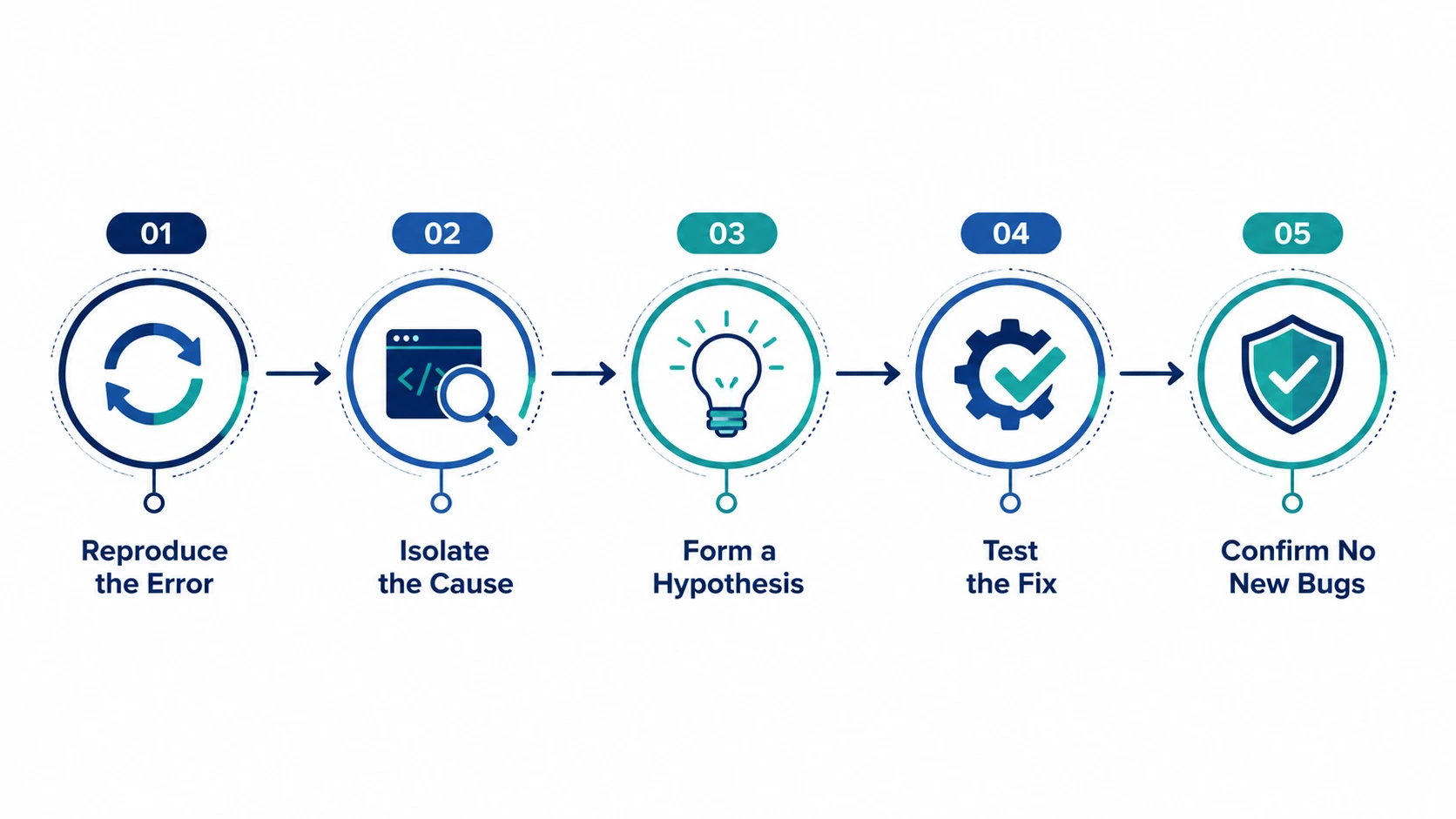
Effective debugging is a systematic thinking process, not random trial and error. It typically follows a repeatable sequence: reproduce the error reliably, isolate the smallest section of code where it occurs, form a hypothesis about the cause, test that hypothesis, and confirm the fix resolves the issue without creating new ones. Programmers who guess randomly at fixes tend to introduce more bugs than they solve; programmers who debug systematically build a mental model of the system that makes future problems easier to diagnose.
How to Develop a Coding Mindset
Practical Daily Habits
Learning how to develop a coding mindset comes down to consistent, deliberate practice rather than occasional bursts of effort. Helpful daily habits include:
- Reading other people’s code to understand different problem-solving approaches.
- Writing code consistently, even in small amounts, rather than in irregular long sessions.
- Reviewing past mistakes to identify recurring patterns in errors.
- Building small projects that apply new concepts in a real context.
- Practicing algorithmic thinking through structured exercises.
- Reflecting briefly after each coding session on what worked and what didn’t. If you want a more structured approach to making these habits stick, a guide on how to build good habits in 30 days can help turn this list into a repeatable routine.
Learning Through Real Projects
Real projects reinforce programming concepts far more effectively than tutorials alone, because tutorials typically present pre-solved problems with clear instructions, while real projects require independent decision-making. Building an actual project forces a learner to research documentation, debug unexpected errors, and make design decisions — all of which strengthen the reasoning skills that a coding mindset depends on. Your Daily Thrive recommends pairing every tutorial with a small independent project that applies the same concept in a new way.
Building Confidence Through Incremental Challenges
Confidence in programming builds through small, consistent wins rather than large, infrequent achievements. Progressive difficulty — starting with manageable challenges and gradually increasing complexity — helps a learner build a track record of success that supports harder problems later. Consistency matters more than intensity: short, regular practice sessions build durable skill and confidence more reliably than occasional intense study sessions followed by long breaks. This kind of consistency raises a common question — is self discipline a skill or one you build? In programming, it’s clearly the latter.
Coding Practices That Reinforce the Right Mindset
Writing Readable Code
Readable code uses clear naming conventions, avoids unnecessary complexity, and prioritizes simplicity over cleverness. Descriptive variable and function names reduce the mental effort required to understand what code does, which matters both for the original author revisiting the code later and for anyone else reviewing it. Readable code is also easier to maintain and extend, since intent is clear without extensive comments.
Code Organization Best Practices
Strong code organization relies on logical folder structures, modular design, and clear separation of concerns — keeping different responsibilities (such as data handling, business logic, and user interface) in distinct, well-defined sections. This structure supports scalability, allowing a codebase to grow without becoming unmanageable, and makes it easier for teams to work on different parts of a project simultaneously without conflicts.
Programming Best Practices and Principles
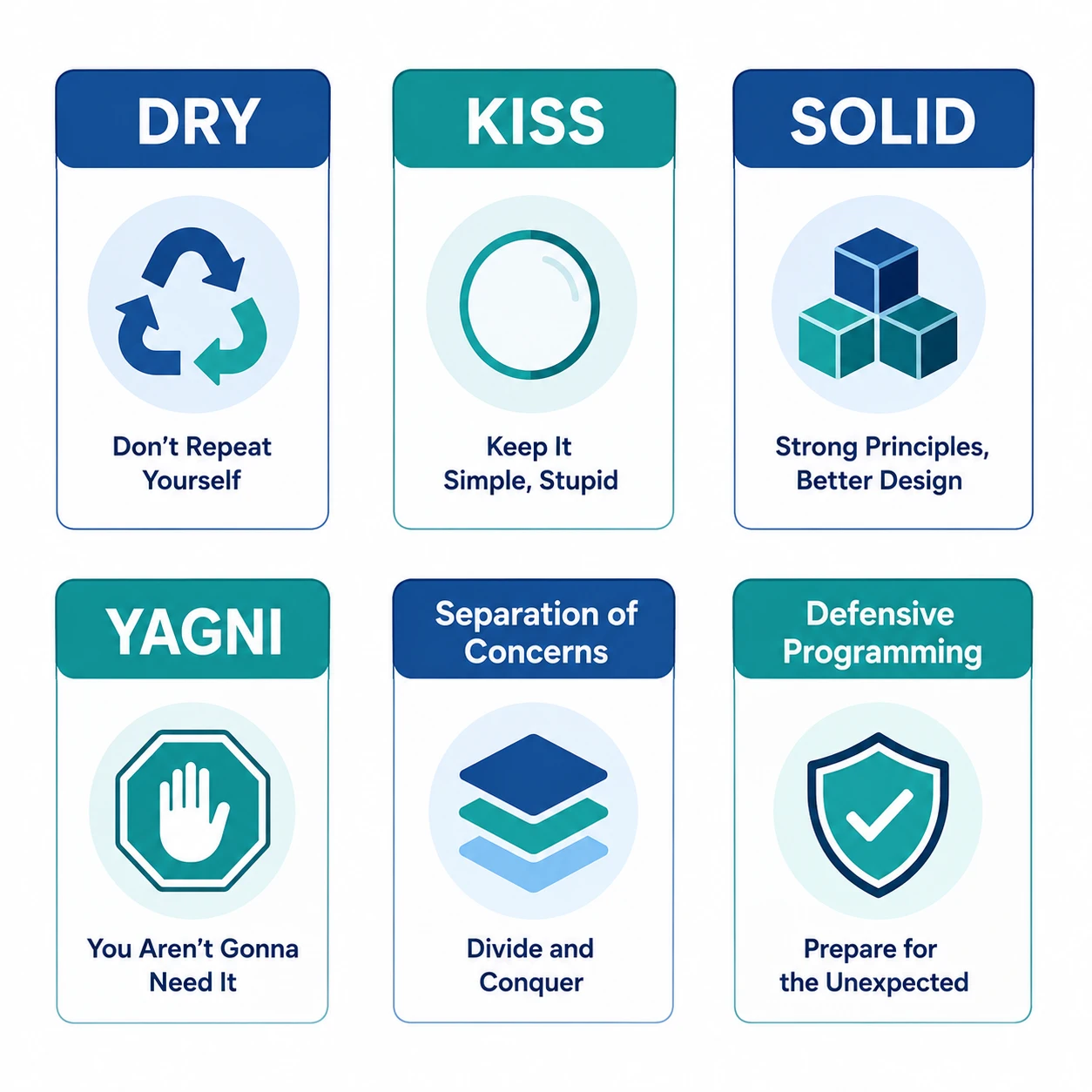
Several widely recognized programming best practices and principles support both individual coding practices and long-term maintainability:
| Principle | Meaning |
|---|---|
| DRY (Don’t Repeat Yourself) | Avoid duplicating logic; reuse code instead |
| KISS (Keep It Simple, Stupid) | Favor the simplest solution that works |
| SOLID | A set of five principles for maintainable object-oriented design |
| YAGNI (You Aren’t Gonna Need It) | Avoid building features before they’re actually needed |
| Separation of Concerns | Keep distinct responsibilities in separate parts of the code |
| Defensive Programming | Anticipate and handle unexpected inputs or failures |
Coding Standards and Why They Matter
What Is a Coding Standards Document?
A coding standards document is a written set of guidelines that defines how code should be formatted, named, and structured within a team or organization. Its purpose is to support collaboration, consistency, and long-term maintainability by ensuring that code written by different developers follows a shared, predictable style. This reduces the time needed to understand unfamiliar code and lowers the likelihood of avoidable errors.
Individual Coding Habits vs Team Standards
Personal coding habits often differ from organizational standards, and understanding the difference helps developers work effectively on teams.
| Personal Coding Habits | Team Coding Standards | Benefits |
|---|---|---|
| Based on individual preference | Agreed upon by the whole team | Improved consistency |
| May vary between projects | Documented and enforced | Easier onboarding |
| Flexible and informal | Reviewed and updated over time | Reduced miscommunication |
| Reflects personal style | Prioritizes shared readability | Better long-term maintainability |
Real-World Coding Mindset Examples
Coding Mindset Examples for Beginners
Practical coding mindset examples for beginners include:
- Debugging a failing script by isolating each function instead of rewriting the whole thing.
- Refactoring a working but messy piece of code to make it clearer, without changing its behavior.
- Reading official documentation before searching for a quick workaround.
- Improving existing code gradually, rather than treating it as finished after the first working version.
Examples from Professional Software Development
In professional environments, a coding mindset shows up through code reviews (structured feedback on peers’ code), automated and manual testing, disciplined use of version control systems to track changes safely, ongoing collaboration across teams, and a consistent habit of continuous improvement — refining working systems rather than leaving them untouched once they function.
Different Approaches to Building a Programming Mindset
Self-Taught Developers
Self-taught developers typically build a programming mindset through independent projects, online resources, and trial and error, which strengthens self-direction and resourcefulness but may require extra effort to fill in foundational gaps like data structures or algorithms.
Computer Science Students
Computer science students often develop a structured, theory-first mindset through formal coursework covering algorithms, systems design, and mathematical reasoning, which provides strong fundamentals but benefits from hands-on project work to build practical fluency.
Career Changers
Career changers frequently bring strong problem-solving habits and discipline from a previous field, applying transferable skills like project management or analytical thinking, while focusing their learning specifically on technical fundamentals and coding practices.
Professional Developers
Professional developers continue refining their coding mindset through real-world constraints — deadlines, legacy code, and team collaboration — that push mindset development beyond individual learning into practical, high-stakes decision-making.
Common Mistakes That Prevent a Strong Coding Mindset
Several recurring mistakes slow down mindset development:
- Copying code without understanding it happens when learners prioritize speed over comprehension; the fix is to rewrite copied code from memory to confirm real understanding.
- Tutorial dependency occurs when learners rely on step-by-step guidance indefinitely; overcoming it requires attempting independent projects without following along.
- Fear of debugging often stems from treating errors as failures; reframing errors as diagnostic information reduces this fear over time.
- Seeking perfect code immediately slows progress because it discourages iteration; accepting a working first draft before refining it prevents this stall.
- Avoiding documentation limits deeper understanding; setting aside time to read official docs builds independence.
- Comparing yourself with experienced developers creates discouragement; tracking personal progress instead of relative skill level supports steadier motivation.
Common Challenges and How to Overcome Them
Feeling Stuck During Programming
Feeling stuck is common and usually resolved by stepping back, breaking the problem into smaller pieces, or explaining the issue aloud (a method known as rubber duck debugging) to reveal gaps in reasoning.
Losing Motivation
Motivation dips are best addressed by setting small, achievable goals and tracking visible progress, which restores a sense of momentum even during slow learning periods.
Information Overload
Information overload is reduced by focusing on one topic or project at a time rather than consuming multiple unrelated resources simultaneously.
Imposter Syndrome
Imposter syndrome — the persistent feeling of being less capable than others perceive you to be — is common among developers at every level and is best managed by focusing on measurable personal growth rather than comparison to others’ visible achievements.
Coding Mindset vs Programming Skills
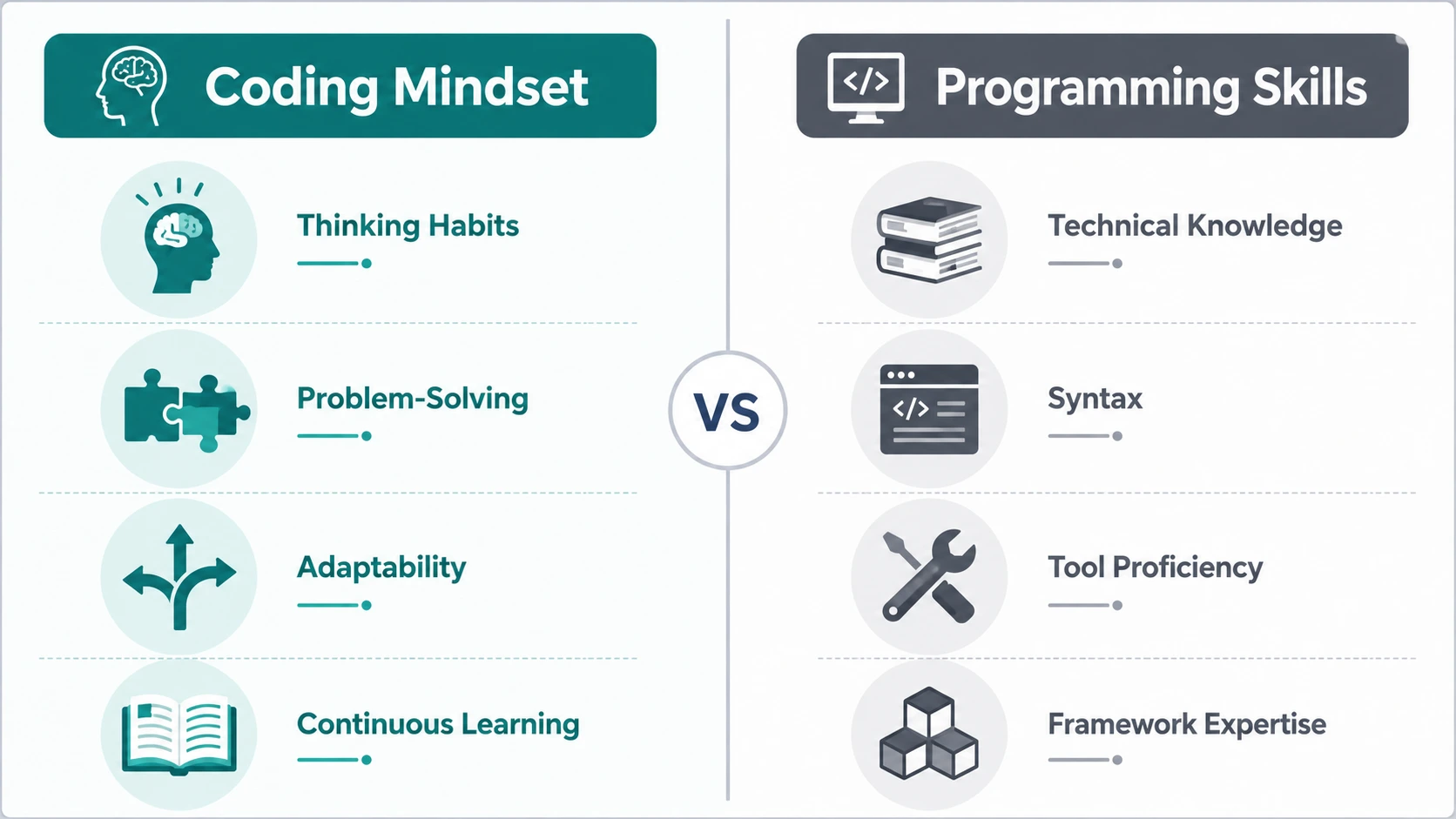
A coding mindset and programming skills are related but distinct, and understanding the difference clarifies what to prioritize while learning.
| Coding Mindset | Programming Skills |
|---|---|
| Thinking habits | Technical knowledge |
| Problem-solving | Language syntax |
| Adaptability | Tool proficiency |
| Continuous learning | Framework expertise |
Programming skills are specific and language-dependent, while a coding mindset is transferable across languages, frameworks, and tools. Skills allow a developer to execute a solution; mindset determines whether they can find the right solution in the first place. Long-term adaptability and learning efficiency both depend more heavily on mindset than on any single technical skill.
Recommended Books and Learning Resources
Programming Mindset Books
A well-chosen programming mindset book can reinforce problem-solving habits, software craftsmanship, and disciplined coding practices in ways that go beyond language-specific tutorials. Readers exploring a coding mindset book or broader programming mindset book should prioritize titles focused on reasoning, design principles, and long-term habits rather than syntax reference guides, since those concepts remain useful regardless of which language or framework a developer is using.
Communities and Peer Learning
Coding communities, structured peer reviews, and mentorship all accelerate mindset development by exposing developers to different problem-solving approaches. Discussion forums — including active coding mindset Reddit communities — offer informal spaces to ask questions, share progress, and learn from others’ debugging processes, though they work best as a supplement to structured learning rather than a primary resource.
Frequently Misunderstood Concepts
Is Coding Talent Natural or Learned?
Coding ability is primarily learned rather than innate; while some individuals may grasp certain concepts faster, structured practice and deliberate learning are consistently shown to be the main drivers of programming proficiency.
Does Learning Multiple Languages Improve Mindset?
Learning multiple languages can strengthen a coding mindset by reinforcing that underlying logic and problem-solving patterns transfer across syntax differences, though the improvement comes from applied practice, not exposure alone.
Can AI Replace the Need for a Coding Mindset?
AI tools can accelerate code generation, but they cannot replace a coding mindset, since evaluating whether AI-generated code is correct, secure, and appropriate for a given context still requires human reasoning, debugging skill, and judgment.
SERP Gap – Practical Tips Most Articles Miss
Several practical details are frequently overlooked in general coverage of this topic:
- Experienced developers read unfamiliar code by scanning for structure and entry points first, rather than reading line by line from the top.
- Writing pseudocode — a plain-language outline of logic — before writing actual code improves clarity and reduces wasted effort.
- Code reviews catch issues that automated tests often miss, including unclear logic and long-term maintainability concerns.
- Knowing when to refactor (rather than rewrite or leave code untouched) depends on whether the code is still actively changing and whether its complexity is slowing development.
- Managing cognitive load while programming — for example, by minimizing distractions and working on one logical unit at a time — improves both speed and accuracy.
- Balancing speed with maintainability means accepting a slightly slower pace in exchange for code that remains easy to modify later.
Conclusion
A coding mindset is the combination of logical reasoning, persistence, curiosity, and continuous learning that shapes how a programmer approaches problems, not just how they write syntax. It matters because it determines how effectively someone learns new tools, debugs unfamiliar issues, and adapts as technology changes. Developing a coding mindset happens gradually, through consistent habits like reading code, building real projects, and reflecting on mistakes rather than through memorization alone. Coding practices, code organization, and established programming principles are the practical, visible outcomes of this mindset in action. Ultimately, building a strong coding mindset is an ongoing process — one shaped by deliberate practice, thoughtful problem-solving, and steady, incremental improvement over time.
Frequently Asked Questions
What is a coding mindset in simple terms?
A coding mindset in simple terms is the habit of thinking through problems logically and systematically, rather than relying only on memorized syntax or step-by-step instructions.
Why is a coding mindset important for beginners?
A coding mindset is important for beginners because it builds problem-solving skills that transfer across languages and tools, making it easier to learn new technologies over time.
How long does it take to develop a coding mindset?
Developing a coding mindset typically takes months of consistent practice, though initial improvements in problem-solving and debugging often appear within a few weeks of deliberate effort.
Can you develop a coding mindset without a computer science degree?
Yes, a coding mindset can be developed without a computer science degree through self-directed learning, consistent project work, and structured practice, since mindset depends on habits rather than formal credentials.
What daily habits help improve a coding mindset?
Daily habits that improve a coding mindset include reading code written by others, practicing consistently in small sessions, reviewing past mistakes, and reflecting briefly after each coding session.
How does a coding mindset improve debugging skills?
A coding mindset improves debugging skills by encouraging a systematic approach — reproducing the error, isolating its cause, and testing hypotheses — rather than making random changes and hoping they work.
What’s the difference between coding skills and a coding mindset?
Coding skills refer to specific technical knowledge like language syntax, while a coding mindset is the underlying problem-solving and reasoning ability that makes learning and applying those skills easier.