
Introduction
Growth mindset books remain some of the most practical tools for building resilience, improving learning, and sustaining long-term success. At their core, a growth mindset is the belief that abilities and intelligence can be developed through effort, strategy, and feedback rather than being fixed traits. The best growth mindset books translate this idea into concrete habits for readers at every stage of life. Because needs differ by age and goal, adults, students, children, teens, educators, and parents each benefit from different titles, written at different reading levels and focused on different outcomes. This guide breaks down how to identify the right book for your specific situation.
Quick Summary
- Growth mindset books help readers develop resilience, improve learning, and embrace challenges instead of avoiding them.
- The best book depends on the reader’s age, current goals, and stage of personal growth.
- Different titles focus on education, psychology, leadership, parenting, or success habits.
- Evidence-based books produce more practical and lasting mindset changes than purely motivational ones.
What Is a Growth Mindset and Why Does It Matter?
A growth mindset is the belief that intelligence, skill, and character can be developed through dedicated effort and learning. This concept, popularized by psychologist Carol Dweck, contrasts with a fixed mindset, which assumes abilities are static traits that cannot meaningfully change.To understand the full impact on learning and behavior, read our deeper breakdown of why is growth mindset important.
Mindset shapes how people respond to setbacks, learn new skills, and pursue goals. Readers with a growth orientation tend to interpret failure as feedback rather than as proof of inadequacy, which supports stronger learning outcomes and greater persistence. This connects closely to neuroplasticity, the brain’s capacity to reorganize and form new neural connections in response to learning and experience. Understanding this biological basis helps explain why mindset is trainable rather than fixed.
In practice, mindset influences confidence, motivation, and achievement across nearly every domain, from academic performance to career advancement. Resilience and self-belief grow stronger when effort is consistently reframed as a path to improvement rather than a referendum on innate ability. This is the foundation that makes personal development through reading possible.
Growth Mindset vs Fixed Mindset
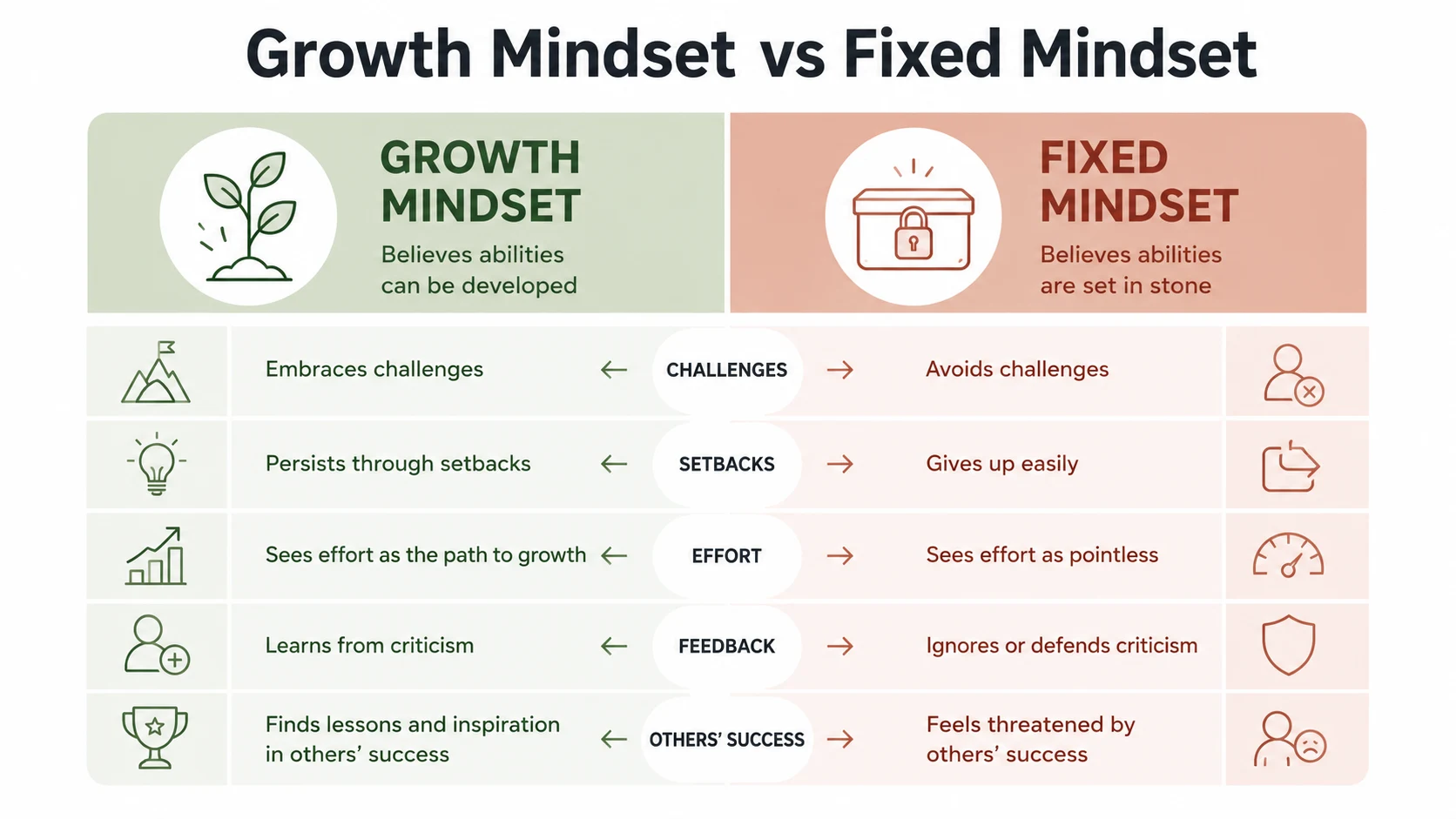
| Growth Mindset | Fixed Mindset |
|---|---|
| Believes abilities can be developed | Believes abilities are fixed traits |
| Views effort as the path to mastery | Views effort as a sign of weakness |
| Embraces challenges as learning opportunities | Avoids challenges to protect self-image |
| Treats failure as useful feedback | Treats failure as a personal limitation |
| Seeks feedback to improve | Avoids or dismisses feedback |
A simple everyday example: a fixed-mindset student who fails a test may conclude they are “bad at math,” while a growth-mindset student treats the same result as a signal to adjust study strategy. Over time, this difference compounds, shaping long-term academic and career trajectories far more than raw ability alone.
What Makes a Great Growth Mindset Book?
A strong growth mindset book combines scientific credibility with practical usability. The most effective titles are grounded in evidence-based psychology rather than vague motivational language, and they translate research into exercises readers can actually apply.
Key evaluation criteria include:
- Actionable advice that readers can implement immediately
- Research-backed concepts drawn from cognitive or behavioral science
- Practical exercises for reflection, goal-setting, or habit tracking
- Easy-to-understand language appropriate to the intended audience
- Long-term applicability beyond a single read-through
Readability and audience suitability matter as much as scientific rigor. A book written for working professionals will use different examples and pacing than one designed for a ten-year-old, even if both are grounded in the same underlying psychology.
Best Growth Mindset Books Overall
Several titles consistently appear across educational, psychological, and self-improvement discussions because they balance scientific grounding with accessibility. Rather than ranking by popularity alone, it’s more useful to compare what type of reader each book serves best.For a broader look beyond this category, our curated list of best mindset book covers psychology, performance, and behavioral change together.
Books Focused on Psychology
Books in this category emphasize cognitive science, behavioral research, and the mechanisms behind motivation and learning. These titles are best suited to readers who want to understand the “why” behind mindset shifts, not just the “how.” They typically draw on academic research and present case studies illustrating how mindset shapes real-world outcomes in education, sports, and business.
Books Focused on Success and Achievement
This category connects mindset principles directly to goal achievement, leadership, and performance. These books on mindset and success tend to appeal to readers pursuing career advancement or entrepreneurial goals, blending psychological concepts with practical frameworks for habit-building and persistence. Among the best mindset books in this space, the strongest titles avoid generic motivational language in favor of structured, research-supported strategies.
When searching for the best books about mindset or the best book for mindset, it helps to distinguish between books mindset readers use for foundational understanding versus those used for applied performance coaching. Both categories of growth mindset books serve valuable, complementary purposes.
Best Growth Mindset Books for Adults
Adults typically seek growth mindset books for adults that address career growth, confidence, habit change, leadership development, relationships, and lifelong learning. The right choice depends heavily on which of these goals is most pressing.
Beginners
Readers new to the concept benefit from foundational titles that clearly define growth mindset principles without heavy academic jargon, prioritizing accessible language and relatable examples.
Professionals
Working professionals often prefer books that connect mindset to workplace performance, feedback culture, and career resilience, with practical frameworks for navigating setbacks.
Entrepreneurs
Entrepreneurs benefit most from books linking mindset to risk tolerance, persistence through failure, and adaptive decision-making under uncertainty.
Lifelong Learners
Readers focused on continuous self-improvement often prefer deeper, research-driven titles that explore mindset alongside broader themes of habit formation and self-discipline.
Best Growth Mindset Books for Students
Best growth mindset books for students typically address academic resilience, motivation, learning strategies, exam preparation, and self-confidence, helping students reframe struggle as part of the learning process rather than a sign of inadequacy.
High School Students
At this stage, books that connect mindset to academic pressure, social comparison, and identity formation tend to resonate most strongly.
College Students
College-focused titles often emphasize independence, time management, and resilience amid increased academic and personal responsibility.
Study Skills and Academic Confidence
Books in this niche pair mindset principles with concrete study techniques, helping students build confidence through demonstrated improvement rather than abstract encouragement.
Best Growth Mindset Books for Kids
Best growth mindset books for kids introduce perseverance and learning through storytelling and relatable characters, making abstract psychological concepts tangible for young readers. Parents and teachers play a central role in reinforcing these lessons through daily conversation and modeling, and the best books to teach growth mindset are often designed with discussion prompts for this purpose.For a fully dedicated breakdown, see our complete guide to growth mindset books for kids covering picture books through middle grade.
Picture Books for Young Children
The best picture books for growth mindset use simple narratives and visual storytelling to introduce concepts like persistence and effort to children as young as three to six years old.
Books for Elementary Students
Best growth mindset books for elementary students typically blend short chapters or illustrated stories with relatable school and friendship scenarios.
Books for 10-Year-Olds
Growth mindset books for 10 year olds often introduce more nuanced themes, such as handling failure in sports or academics, while remaining age-appropriate in tone and complexity.
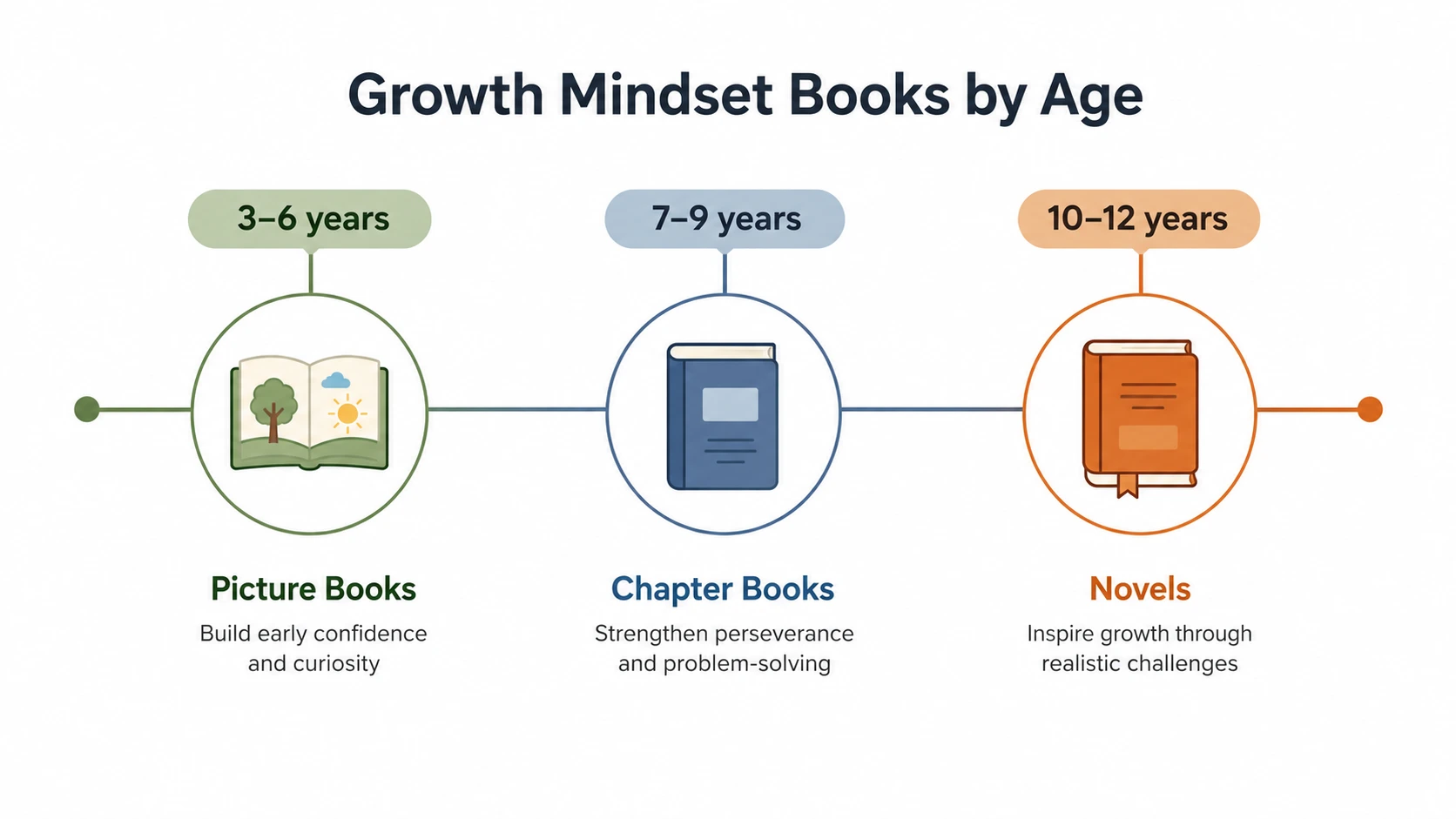
| Age Group | Recommended Book Type | Primary Learning Goal |
|---|---|---|
| 3–6 years | Picture books | Introducing persistence through story |
| 7–9 years | Illustrated chapter books | Building confidence and effort-based thinking |
| 10–12 years | Short novels or guided books | Handling setbacks and goal-setting |
Best Growth Mindset Books for Teens
Best growth mindset books for teens address identity development, confidence, school pressure, emotional resilience, and goal setting during a developmental stage marked by significant social and academic change. The strongest titles for this age group balance psychological insight with relatable, age-specific examples rather than adult-oriented case studies, helping teens connect mindset principles to their lived experience.
How to Choose the Right Growth Mindset Book
Selecting the right book starts with matching content to specific goals, reading level, learning style, and personal interests, while also considering whether a scientific or motivational approach fits best.
Based on Your Goals
- Academic growth
- Career development
- Confidence
- Parenting
- Leadership
- Habit building
Based on Reading Experience
- Beginner: simple language, foundational concepts
- Intermediate: applied frameworks and case studies
- Advanced: research-dense, academically rigorous texts
Growth Mindset Books vs Success Books
Growth mindset books and success books overlap but serve distinct purposes. Books on mindset and success often blend both categories, but a clear distinction exists in scope and emphasis.
| Growth Mindset Books | Success Books |
|---|---|
| Focus on belief systems and learning processes | Focus on outcomes and achievement strategies |
| Grounded primarily in psychology | Often blend psychology with business or productivity tactics |
| Applicable across all life domains | Frequently targeted at career or financial goals |
| Emphasize internal change | Emphasize external results |
A common misconception is that these categories are interchangeable. In reality, mindset books address the underlying beliefs that make sustained success possible, while success books often assume a foundational mindset is already in place.
How to Apply Lessons from Growth Mindset Books
Reading alone rarely produces lasting change. Implementation requires structured reflection, deliberate practice, and ongoing feedback.
Build Daily Reflection Habits
Short daily reflection, even five to ten minutes, helps reinforce key concepts and track shifts in thinking over time.
Practice Deliberate Learning
Applying one concept at a time, rather than attempting wholesale change, supports more sustainable progress.
Track Personal Progress
Journaling or habit-tracking tools provide measurable evidence of growth, which reinforces motivation.
Apply Concepts in Real Life
Testing ideas in real situations, such as reframing a setback at work or school, solidifies learning far more effectively than passive reading.
Common Mistakes When Reading Growth Mindset Books
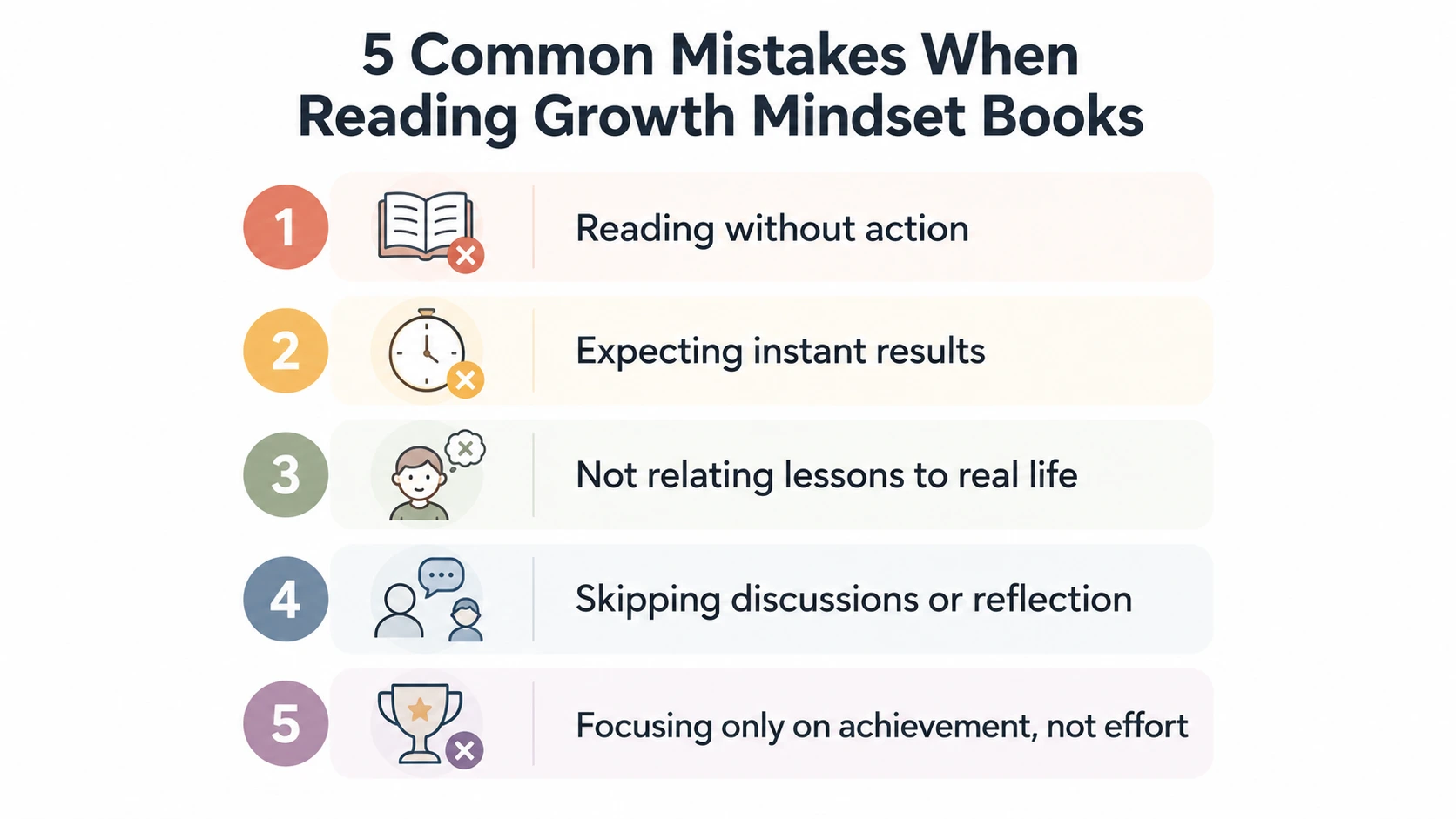
Several overlooked mistakes limit the effectiveness of growth mindset reading:
- Reading without taking action, treating books as entertainment rather than practical tools
- Expecting instant transformation, when mindset shifts typically occur gradually
- Choosing books above current knowledge level, leading to confusion or disengagement
- Ignoring practical exercises, which are often where the real value lies
- Reading too many books without implementation, diluting focus and follow-through
These mistakes happen because readers often conflate consumption with progress. Avoiding them requires choosing fewer books, applying concepts deliberately, and revisiting key ideas rather than constantly seeking new material.
Are Growth Mindset Books Backed by Research?
Yes, the core principles in most reputable growth mindset books are grounded in psychological and educational research, particularly studies on neuroplasticity and learning behavior. Decades of research in educational psychology support the idea that beliefs about ability influence motivation, effort, and academic outcomes.
It’s important to distinguish evidence-based titles from purely motivational books that lack scientific grounding. A common misconception is that any book mentioning “mindset” is automatically research-backed; readers should look for citations, studies, or academic credentials to verify credibility.
Difficulty & Time Investment
Reading difficulty varies significantly depending on the audience and writing style of a given book. Beginner-friendly titles use simple language and relatable examples, while research-heavy books require more sustained attention and background knowledge.
Most growth mindset books can be read in five to ten hours, but applying their lessons effectively requires ongoing time investment beyond the initial read. Factors influencing learning outcomes include prior familiarity with psychology, reading habits, and willingness to engage with reflective exercises.
Results Timeline
Mindset changes typically occur gradually rather than instantly. Reading alone produces limited change; consistent practice and real-world application accelerate improvement significantly.
In our experience helping readers build better habits, noticeable shifts in self-talk and resilience often begin within a few weeks of consistent reflection, while deeper, more durable changes in behavior typically take several months of sustained practice.
Practice Guide
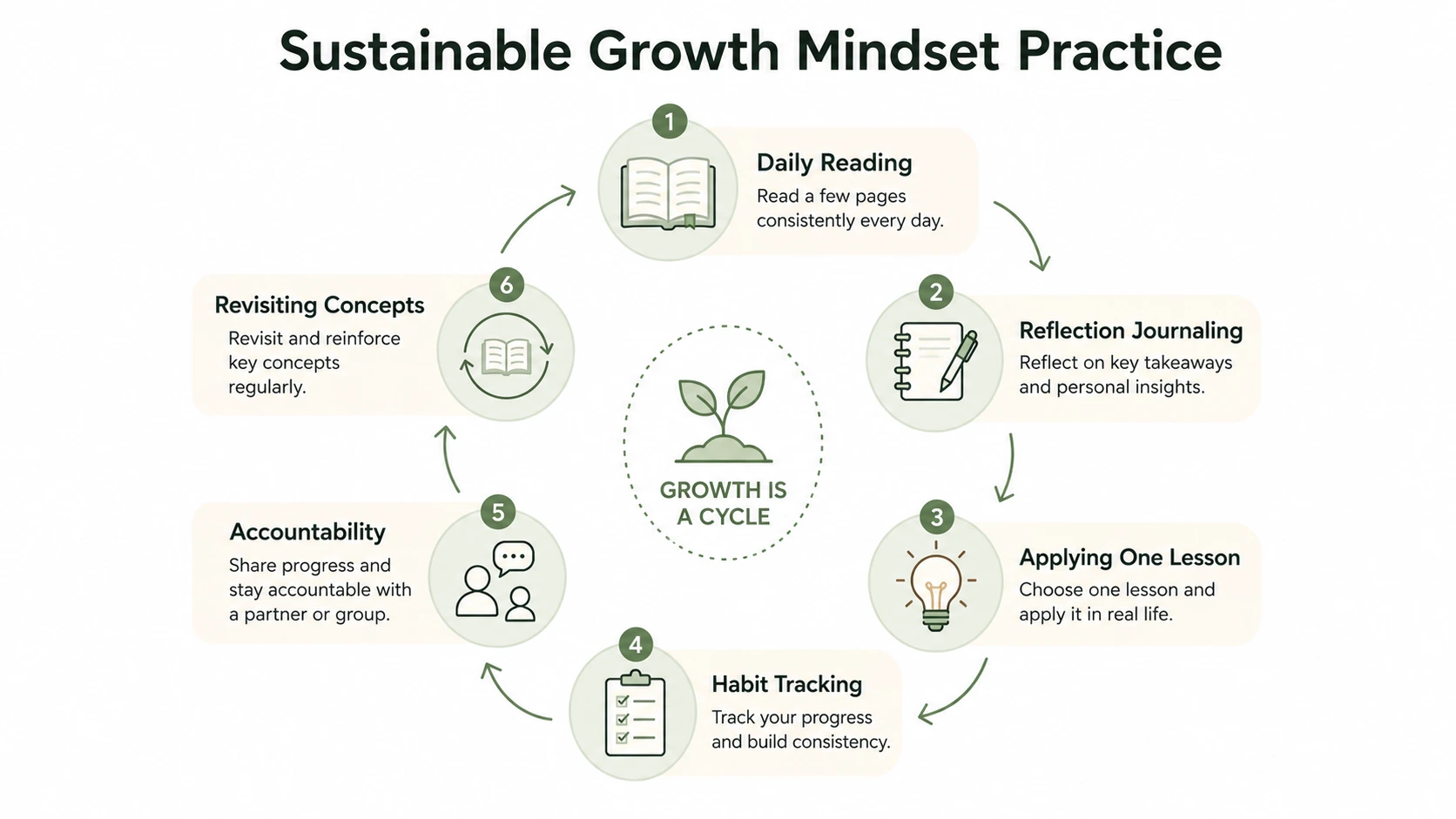
Sustained mindset development relies on consistent habits beyond reading alone:
- Daily reading routine to reinforce key concepts incrementally
- Reflection journaling to track shifts in thinking
- Applying one lesson at a time rather than overwhelming change
- Habit tracking to measure consistency
- Accountability through partners, mentors, or communities
- Discussion groups to deepen understanding through dialogue
- Revisiting key concepts periodically to reinforce learning
- Long-term sustainability through realistic, manageable goals
Your Daily Thrive recommends pairing any growth mindset book with at least one structured practice, such as weekly journaling, to translate reading into measurable behavior change.
Growth Mindset Books in a Broader Personal Development Journey
Growth mindset reading rarely exists in isolation. It connects naturally to habit formation, goal setting, productivity, emotional resilience, continuous learning, and self-discipline. Readers who integrate mindset principles into a broader personal development practice tend to see more durable results than those who treat mindset as a standalone topic.
As of 2026, many educators and behavioral coaches increasingly emphasize combining mindset literature with structured coaching or community accountability, reflecting an evolving best practice in the field.
Conclusion
Choosing the right growth mindset book depends on matching content to age, goals, and current stage of development, whether for personal growth, academic resilience, or professional advancement. Across every category, the most effective books for mindset combine evidence-based psychology with practical, actionable exercises rather than relying on motivational language alone. Lasting growth ultimately comes not from the number of books read, but from consistent application of their core lessons. Readers seeking real change should select titles aligned with their specific learning needs and commit to applying concepts through reflection, practice, and accountability over time.
Frequently Asked Questions
What is the best growth mindset book for beginners?
The best starting point is a book that uses simple, accessible language and clearly defines core concepts without heavy academic jargon, prioritizing practical value over theoretical depth.
Which growth mindset books are best for students?
Books that improve motivation, learning strategies, and academic resilience tend to work best for students, particularly those that connect mindset principles directly to study habits and exam preparation.
What age should children start reading growth mindset books?
Children can begin engaging with growth mindset concepts as early as age three to four through picture books, with more complex formats introduced as reading comprehension develops through elementary and middle school years.
Can growth mindset books improve confidence and resilience?
Yes, growth mindset books can improve confidence and resilience by reframing failure as feedback and reinforcing the belief that abilities develop through effort, which supports long-term behavioral and emotional change.
How many growth mindset books should I read each year?
Quality and implementation matter more than volume; reading two to four books per year while actively applying their lessons typically produces better outcomes than reading many books without follow-through.
Are growth mindset books supported by scientific research?
Many reputable growth mindset books are grounded in educational psychology and behavioral science research, particularly studies on neuroplasticity, though readers should verify scientific credibility before assuming a book is evidence-based.
What’s the difference between mindset books and success books?
Mindset books focus on the underlying beliefs and psychological processes that shape behavior, while success books focus more directly on achievement strategies and external outcomes, often assuming a growth-oriented mindset is already in place.