

Introduction
You already know something needs to change. Maybe you feel stuck in the same patterns, watching time pass without progress. Maybe you’re motivated one night and exhausted by noon the next day. Maybe you’ve read all the right books but still can’t seem to bridge the gap between who you are and who you know you’re capable of being.
That gap is not a character flaw. It’s a system problem — and systems can be fixed.
This guide gives you the complete framework for personal growth: the mindset shifts, the daily habits, the discipline strategies, and the self-reflection tools that compound into real, lasting transformation. Whether you’re starting from scratch or rebuilding after a setback, every concept here is actionable from today.
What “Best Version of Yourself” Actually Means
The phrase gets thrown around so often that it’s lost its meaning. Most people hear it and picture someone who wakes up at 5 a.m., never skips a workout, and always has their life together. That’s not what it means.
Becoming your best self is a process of intentional alignment — closing the distance between who you are today and who you are capable of being across the areas that matter most to you: your health, your relationships, your work, your mindset, and your character.
It is deeply personal. Your best version is not a copy of someone else’s highlight reel. It’s the version of you that has built the habits, clarity, and resilience to show up fully in your own life.
The three dimensions of personal growth
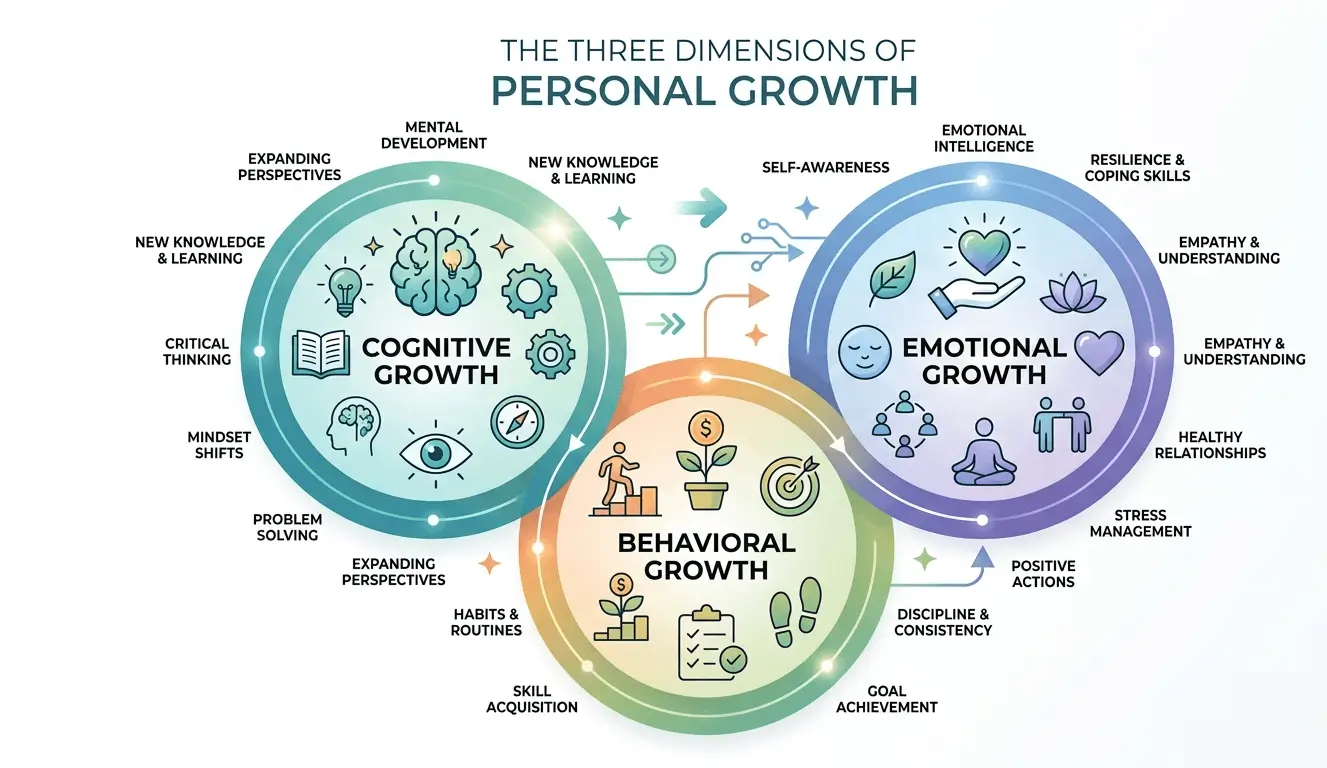
Psychologists and behavioral scientists generally agree that sustainable self-improvement operates across three interconnected dimensions:
- Cognitive growth — developing your thinking, expanding your perspective, and learning to manage your mental patterns and beliefs.
- Behavioral growth — the habits, routines, and daily actions that compound over time into significant change.
- Emotional growth — building self-awareness, emotional regulation, and the capacity to maintain motivation and resilience even in difficulty.
True personal development happens when all three are working together. This guide addresses each one.
For a deeper foundation, explore what
For a deeper foundation, explore what personal betterment really means and why the small-step approach matters far more than grand transformations.
Do an Honest Self-Audit First
Growth without direction is just motion. Before you build new habits or restructure your days, you need a clear-eyed picture of where you are right now — your strengths, your patterns, and the specific areas dragging you backward.
The life-area self-audit
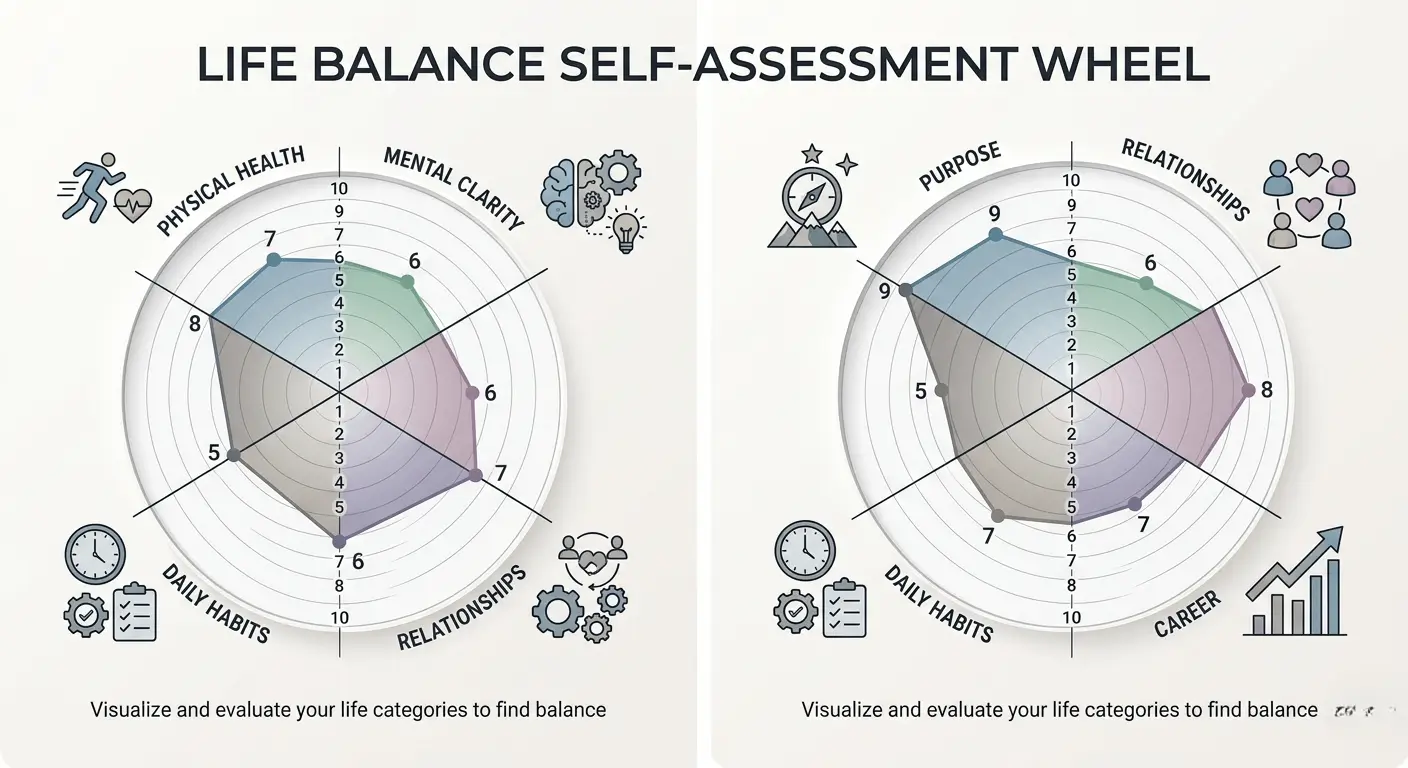
Rate each area of your life on a scale of 1 to 10, then write one sentence about why you gave it that score:
- Physical health and energy
- Mental clarity and emotional stability
- Quality of relationships
- Career or academic progress
- Daily habits and productivity
- Sense of purpose and meaning
Any area scoring below 6 is a priority zone. Don’t try to fix everything at once — choose one or two and build from there.
Identify your growth gaps honestly
Growth gaps are the spaces between what you know you should do and what you actually do. Common examples include: knowing you should exercise but not doing it, wanting to journal but never starting, or feeling motivated at night but doing nothing with it by morning.
If you often find yourself energized and full of plans in the evening but unable to act on them the next day, you’re not lazy — you may be experiencing
If you often find yourself energized and full of plans in the evening but unable to act on them the next day, you’re not lazy — you may be experiencing a specific motivational pattern. Understanding why you feel most motivated at night can help you stop fighting your own biology and start working with it instead.
How to Grow as a Person: The Foundations
Personal growth is not a single decision — it’s a daily accumulation of small choices that either compound toward the person you want to become or slowly drift you away from them. The foundation is not willpower. It’s identity.
Shift your identity, not just your behavior
Behavioral psychology research — particularly the work popularized by James Clear — shows that lasting habit change begins at the identity level. Instead of “I want to read more,” the internal statement becomes “I am someone who reads.” Instead of “I’m trying to get healthy,” it becomes “I am someone who takes care of their body.”
This identity-first approach changes the motivational architecture completely. Actions become expressions of who you are, not tasks on a to-do list.
Start with the behaviors that build the identity
Every identity claim needs behavioral evidence. If you want to become a disciplined, growth-oriented person, you need consistent small actions that prove it to yourself over time:
- Read or learn something for 20 minutes daily
- Honor one commitment to yourself every single day, no matter how small
- Track one positive behavior and review it weekly
These behavioral anchors are the entry points to becoming the person you’re aiming to be.
For a practical breakdown of habits that drive lasting growth, read through the best ways to achieve personal growth — it covers the evidence-based approaches that actually stick.
If you’re also working on expressing your personality more fully as you grow, how to have a personality and build confidence is a useful companion read.
How to Build Discipline Without Motivation
Motivation is a feeling. It comes and goes based on energy levels, mood, sleep, and circumstances. Discipline is a skill — it’s the ability to act in alignment with your goals regardless of how you feel in the moment.
If you’ve ever started strong on a new goal only to fall off after a week or two, you were relying on motivation. The solution is to build systems that don’t require motivation to function.
The discipline-motivation distinction
High performers across fields — athletes, writers, executives, scientists — are not more motivated than everyone else. They have built structures and routines that reduce the decision-making required to take action. When the behavior is scheduled, automatic, and tied to a specific trigger or environment, it happens whether motivation is present or not.
Five principles of building real discipline
- Reduce decision friction. The easier the behavior is to start, the more likely it will happen. Lay out your workout clothes the night before. Keep your journal on your desk. Remove the apps that drain your time.
- Use implementation intentions. Replace vague goals (“I’ll exercise more”) with specific if-then plans: “When I finish breakfast, I will take a 20-minute walk.” Research shows this simple shift significantly increases follow-through.
- Build the minimum viable habit. Commit to a version of the habit so small you can’t say no. Two minutes of journaling. One page of reading. Five push-ups. The goal is to make starting automatic — the rest often follows naturally.
- Track and protect your streak. Behavioral research consistently shows that visual progress — seeing a chain of completed days — creates a powerful commitment to continuation. Don’t break the chain.
- Control your environment, not your willpower. Willpower is a finite resource. Environmental design — shaping your physical and digital surroundings to make good choices easier and bad choices harder — is infinitely more reliable.
For a full practical guide on this topic, read how to build discipline without motivation — it includes specific techniques you can implement immediately.
Focus on What You Can Control
One of the highest-leverage mindset shifts in personal growth is learning to direct your energy exclusively toward the variables within your control — and release your grip on everything else.
This is not a passive philosophy. It’s an active cognitive discipline rooted in Stoic philosophy and validated extensively in modern psychology, particularly in research on learned helplessness and locus of control.
The control matrix
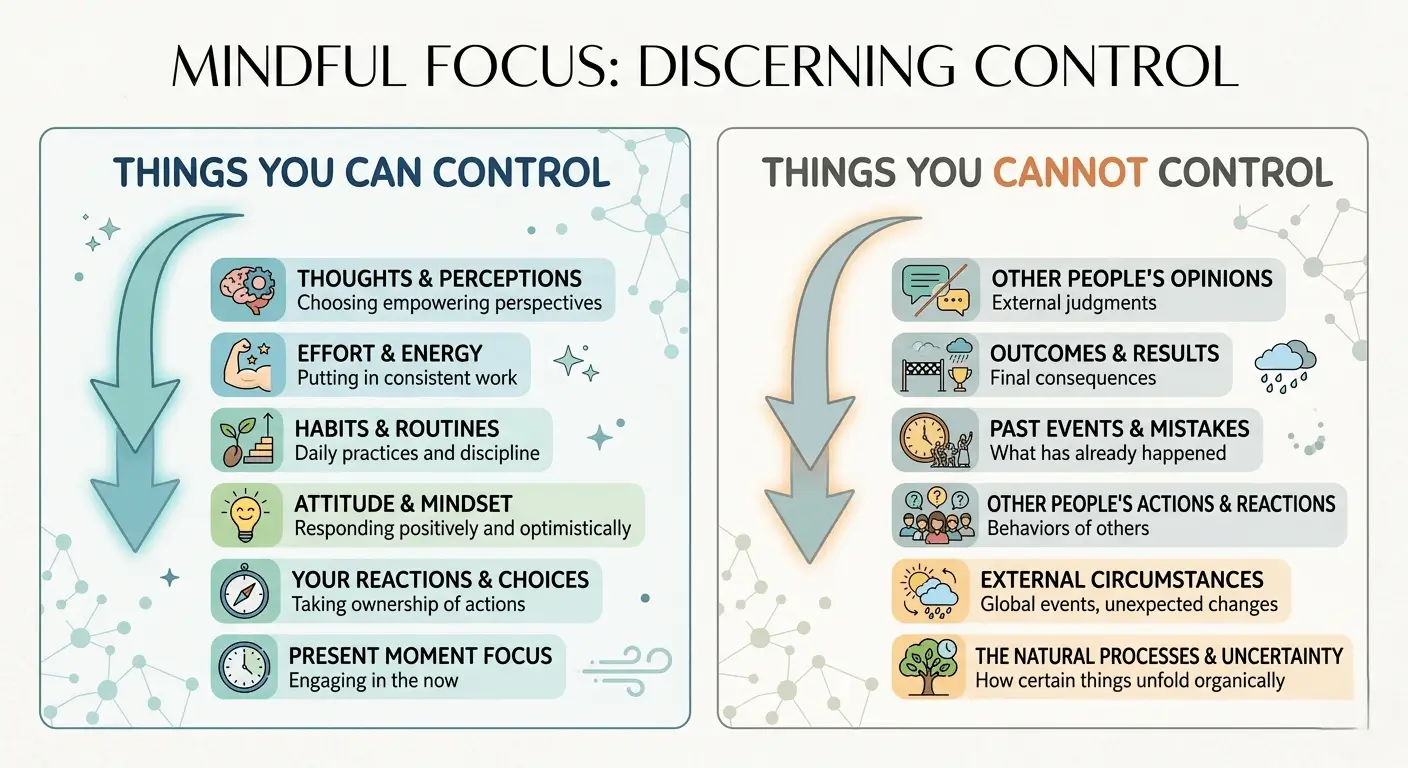
Every situation presents two categories of variables:
- Within your control: your thoughts, your effort, your responses, your habits, your attention, your attitude.
- Outside your control: other people’s opinions and behavior, outcomes, the past, external circumstances.
People who direct most of their mental energy toward the uncontrollable category experience chronic frustration, anxiety, and stagnation. People who focus relentlessly on their own response and action experience progress, calm, and increasing self-efficacy.
This is not about ignoring problems. It’s about engaging with them from the right angle — through your own choices and actions rather than hoping circumstances will change.
When you develop this habit consistently, you also find it easier to regulate your emotions in difficult situations. This connects directly to building the emotional resilience that personal growth requires in the long run.
Design a Daily Routine That Builds You
Your daily routine is the single most powerful personal growth tool available to you. Not because any one day matters enormously, but because who you become is the arithmetic sum of your repeated daily behaviors over months and years.
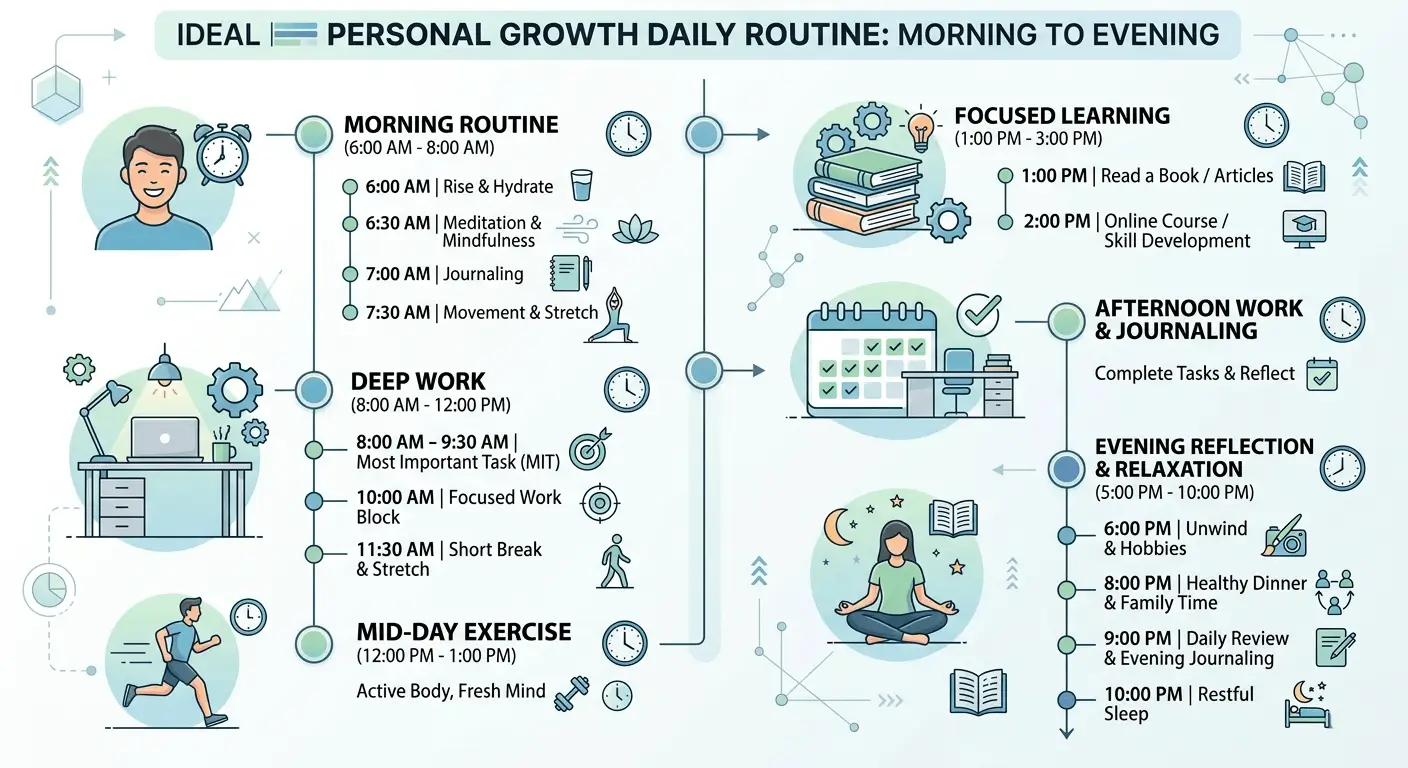
A strong routine doesn’t need to be rigid or dramatic. It needs three things: a reliable start, productive middle blocks, and a reflective close.
The growth-oriented day structure
Morning anchor (30–60 minutes): The first hour of your day sets the neurochemical tone for everything that follows. Protect it. Use it for movement, stillness, intentional reading, or review of your goals — before email, social media, or reactive tasks enter your attention.
Deep work blocks (90 minutes): Schedule your most cognitively demanding work during your peak energy window — typically mid-morning for most people. Use focused, distraction-free blocks rather than diffuse multitasking.
Movement and recovery: Physical movement is not a bonus feature of a growth routine — it’s foundational. Exercise has robust evidence for improving cognitive function, emotional regulation, and long-term mental health.
Evening reflection (15–20 minutes): End the day with a brief review: what went well, what didn’t, what you’ll do differently tomorrow. This closes the day’s loop and primes intentional behavior for the next morning.
For a full structured schedule designed specifically for students and young adults building growth habits, see the daily routine for self-improvement students guide. If you’re primarily home-based, the daily routine of a student at home offers a schedule adapted for that context.
The viral “that girl” routine has also popularized a high-performance morning structure worth understanding — explore the that girl morning routine guide for a breakdown of what makes it effective beyond the aesthetic.
How to Journal for Self-Growth
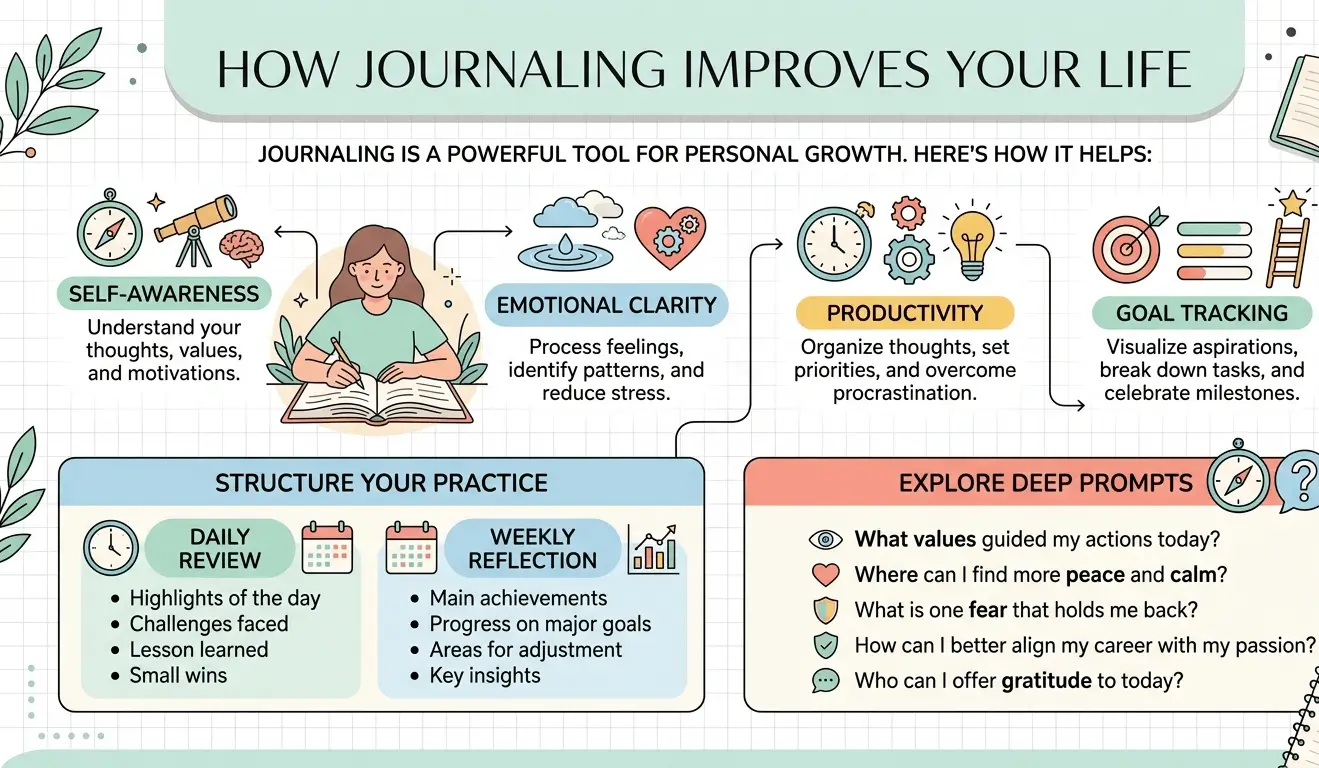
Journaling is one of the most evidence-backed self-development practices available — and also one of the most underused. Research by psychologist James Pennebaker showed that expressive writing about one’s thoughts and experiences produces measurable improvements in mental clarity, emotional processing, and even physical health markers.
But journaling for growth is different from diary-keeping. It’s a structured self-inquiry practice designed to surface patterns, clarify values, identify blockers, and set direction.
Three journaling formats that drive growth
- The daily review: Three wins from today. One thing I would do differently. One intention for tomorrow. Short, consistent, compound over time.
- The weekly reflection: What am I proud of this week? What pattern am I noticing? What one shift would make next week better?
- Prompt-based deep dives: Open-ended questions that pull insight out of experience — especially useful when stuck or at a crossroads.
For a comprehensive set of questions to use in your practice, explore journaling prompts for self-growth — or start with the broader collection of journaling prompts organized by theme and purpose.
How to Use Affirmations That Actually Work
Affirmations have a reputation problem — mostly because they’re used incorrectly. Simply repeating “I am confident” when you feel deeply unconfident creates cognitive dissonance, and research by Joanne Wood has shown this can actually backfire for people with low self-esteem.
Effective affirmations work differently. They are specific, process-oriented, and grounded in genuine aspiration — not fantasy.
The science of effective affirmations
Self-affirmation theory, developed by Claude Steele, demonstrates that reflecting on one’s core values and identity — particularly in areas of strength — buffers the psychological system against threat and failure. In practical terms: affirmations work best when they connect to behaviors you’re already taking and values you genuinely hold.
The shift from “I am always disciplined” (fantasy) to “I am someone who chooses discipline today” (behavioral intention) makes them both psychologically credible and neurologically activating.
Affirmations for different growth goals
If you’re building self-discipline, affirmations for discipline and self-control give you specific statements aligned with that behavioral goal.
For confidence and self-worth, self-trust affirmations are particularly useful during periods of self-doubt or rebuilding.
Start your mornings with positive morning affirmations to set your mental frame before the day’s demands arrive.
The lucky girl affirmation practice — which centers on expected positivity — has psychological roots in what researchers call “optimism bias” and expectation effects.
For peace and stress reduction, affirmations for peace of mind can serve as a calming practice within your daily routine.
If you’re moving to a new chapter of life — new home, new beginning — new home affirmations for peaceful living support the psychological transition that accompanies big changes.
How to Live Your Best Life — Starting Now
Living your best life is not a destination you arrive at. It’s a mode of engagement with each day — a quality of presence, intention, and alignment that makes even ordinary moments feel purposeful.
The research on well-being and life satisfaction consistently points to several pillars: meaningful relationships, a sense of progress toward valued goals, autonomy over your choices, contribution beyond yourself, and physical vitality. These aren’t luxuries. They’re the architecture of a genuinely good life.
Practical steps to start living better today
- Identify your top three life priorities and ensure they’re actually receiving your time.
- Eliminate or reduce one low-value time drain this week.
- Do one thing today that your future self will thank you for.
- Connect genuinely with one person who matters to you.
- Spend at least 30 minutes outside, moving, or away from screens.
For a complete approach to elevating your daily experience, read how to live your best life: meaning and daily habits and the companion guide on how to live a better life with simple daily habits.
If financial constraints feel like a barrier, living life to the fullest without money reframes the concept entirely around meaning, connection, and presence.
When you’re ready for a more systematic reset, the reinvent yourself checklist gives you a structured process for rebuilding your habits, environment, and identity.
The guide to start living your best life: meaning and daily habits is a strong companion for implementing these shifts in practice.
Common Mistakes That Quietly Slow Your Growth
Most people who want to grow are not failing because of laziness. They’re failing because of invisible structural errors — patterns of thinking and action that feel productive but systematically work against progress.
The most common personal growth mistakes
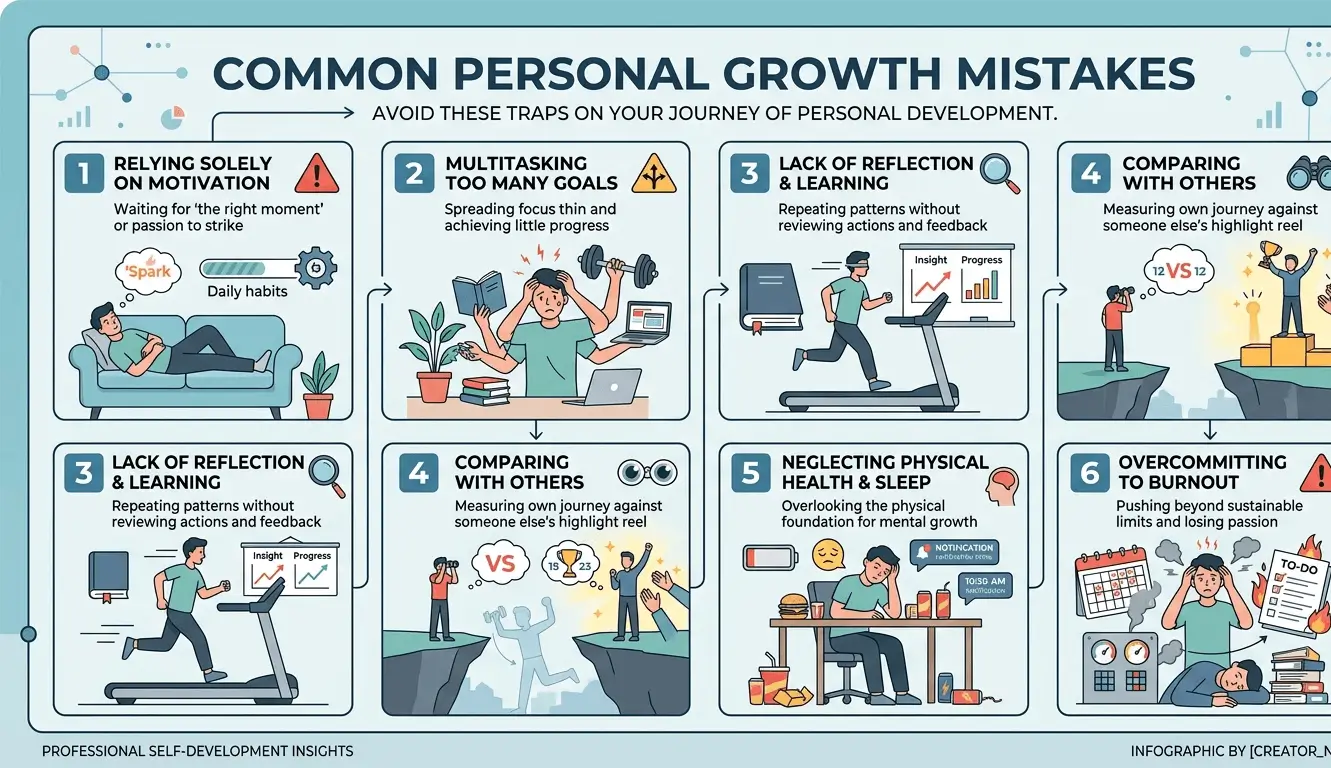
- Chasing inspiration instead of building systems. Motivation spikes fade. Systems persist. Stop waiting for a motivational video to get you started and start building structures that don’t require motivation.
- Trying to change everything simultaneously. Cognitive and behavioral bandwidth is finite. Attempting to overhaul diet, exercise, sleep, finances, and relationships at once guarantees failure across all of them. Pick one domain, build real traction, then expand.
- Confusing consumption with growth. Reading books, watching documentaries, and listening to podcasts about growth is not the same as growing. Information without implementation is just entertainment. Every piece of content you consume should translate into at least one concrete action.
- Comparing your beginning to someone else’s middle. Social comparison — especially in the age of curated digital lives — creates a distorted benchmark that produces shame, not growth. Your reference point should always be the person you were last month, not the person ahead of you on their own timeline.
- Neglecting recovery and rest. Growth happens in the recovery phase, not just the effort phase. Chronic overextension without rest produces diminishing returns, burnout, and eventual regression. Protect sleep, schedule recovery, and view rest as a performance input — not a reward.
- Skipping self-reflection. Without regular reflection, you’re running the same mental and behavioral loops without realizing it. Journal, review, and audit. Growth without self-awareness is blind.
For a deeper understanding of how consistent growth compounds over time, explore how to grow as a person: habits that build growth — which examines the habit science behind lasting change.
And if you feel like you need to get your whole life back on track before you can grow, how to get your life in order with simple systems is the right place to start.
Final Thoughts
Becoming the best version of yourself is neither a sudden transformation nor a lifelong struggle. It is a daily practice — small decisions, consistent habits, honest reflection, and gradual accumulation of the behaviors that prove to yourself who you are becoming.
You don’t need to overhaul your entire life this week. You need to take one better action today than you took yesterday. Then again tomorrow. Then the day after that.
The compounding effect of consistent self-directed growth is extraordinary over time — and it’s available to anyone willing to begin.
Frequently Asked Questions
How long does it take to become the best version of yourself?
There is no finish line — personal growth is an ongoing process, not a destination. That said, meaningful, visible progress typically begins to compound within 60 to 90 days of consistent behavioral change. The key variable is not time but consistency. Small, repeated actions outperform intense but sporadic efforts every time.
Can you grow as a person without therapy or professional help?
Yes — most personal growth work is self-directed and accessible to anyone willing to be honest with themselves and take consistent action. Journaling, habit-building, structured reading, and community support are all effective and widely accessible tools. That said, if you’re dealing with significant trauma, persistent mental health challenges, or patterns you can’t seem to shift on your own, professional support is genuinely valuable and not something to avoid.
What is the most important habit for personal growth?
Self-reflection — in whatever form works for you — is arguably the highest-leverage habit. Without the ability to honestly examine your behavior, identify your patterns, and course-correct, every other growth effort lacks direction. Journaling, meditation, weekly reviews, and regular conversations with trusted people all serve this function.
Is personal growth the same as self-improvement?
They’re closely related but slightly different. Self-improvement often refers to specific, measurable changes — improving fitness, learning a skill, increasing income. Personal growth is broader: it includes the development of character, emotional depth, self-awareness, and values. The best approach integrates both — working on specific capabilities while developing as a whole person.
How do affirmations support personal growth?
When used correctly — grounded in genuine values, tied to behavioral intentions, and practiced consistently — affirmations help shift the identity narrative that underpins your behavior. They work not through magic but through repeated cognitive framing that gradually makes new self-perceptions feel natural and credible. The key is specificity and behavioral linkage, not wishful repetition.










4 Responses