

Introduction
New home affirmations are positive statements designed to support a healthier mindset during the process of finding, buying, or moving into a new living space. Many people use new home affirmations, positive affirmations for new home goals, and affirmations for moving to a new home to reduce stress, improve emotional focus, and stay motivated during uncertain transitions.
Affirmations influence mindset by reinforcing repeated thought patterns that shape attention, emotional responses, and daily behavior. Neuroscience research suggests that repetition strengthens neural pathways, which can gradually influence self-belief and decision-making. However, affirmations are not magical shortcuts. They work best when combined with practical effort, emotional alignment, consistency, and realistic action.
People often experience uncertainty, financial stress, fear of change, and emotional attachment to their current situation when searching for a home. Positive affirmations can help create emotional clarity and improve focus during these transitions.
To strengthen this mindset shift, many people also explore how to become the best version of yourself, practice focus on what you can control, and use structured reflection methods like how to journal for self-growth to stay emotionally grounded during life transitions.
Quick Summary
- New home affirmations help reinforce positive thinking, emotional clarity, and goal-focused behavior during the home-search process.
- Consistent affirmations may reduce self-doubt, increase motivation, and improve decision-making.
- Combining affirmations with realistic planning and action creates better long-term results.
- Peaceful home affirmations can support emotional well-being, comfort, and a stronger sense of security.
What Are New Home Affirmations?
How Affirmations Influence Thoughts and Behavior
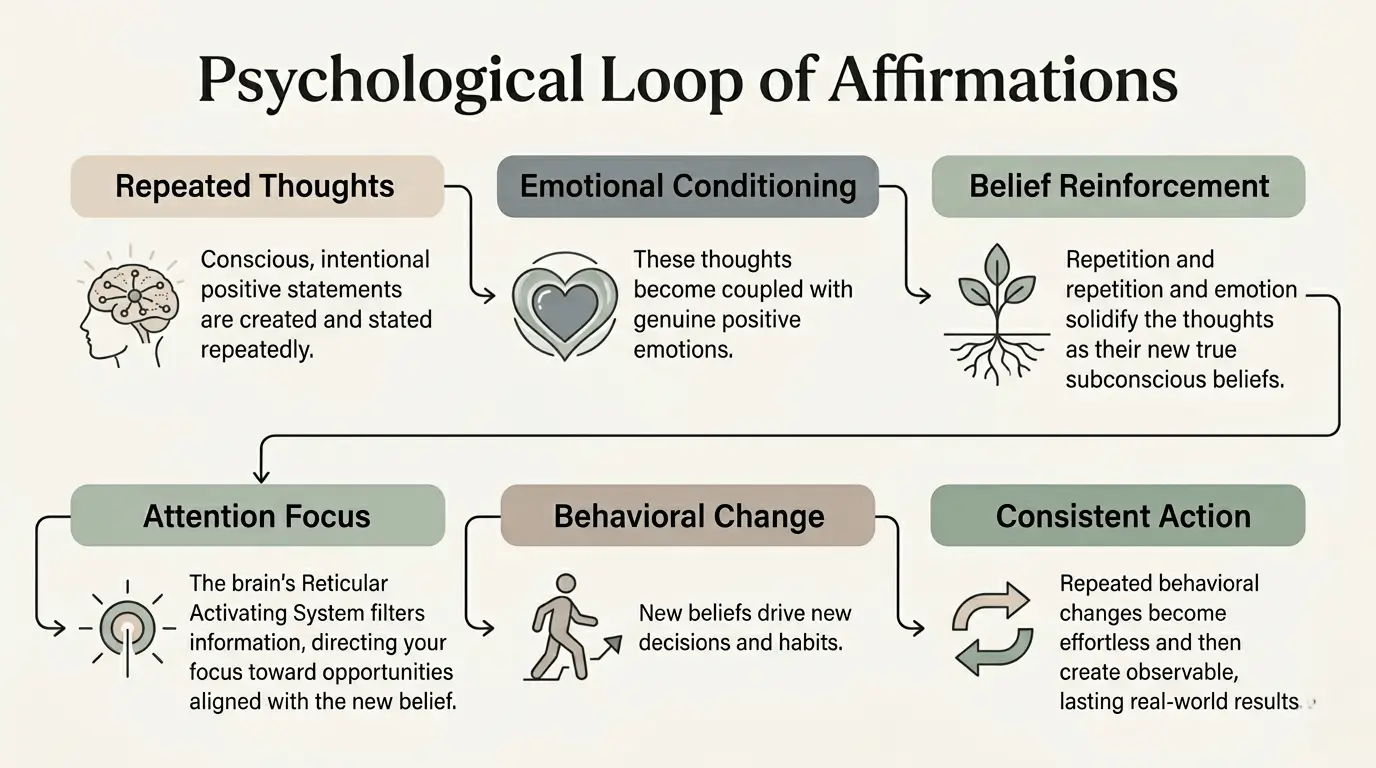
New home affirmations are repeated positive statements that help shape mental focus, emotional conditioning, and long-term behavioral patterns. Manifesting a new home affirmations and dream house new home affirmations are often used to encourage confidence, emotional stability, and goal-oriented thinking.
Psychologically, affirmations work through repetition and attention reinforcement. Repeated thoughts can influence how the brain prioritizes information and responds to challenges. This is connected to cognitive bias, where people naturally notice opportunities and experiences that align with their dominant beliefs.
Emotionally believable affirmations are usually more effective than unrealistic statements. If an affirmation feels emotionally impossible, the brain may resist it.
Examples of grounded affirmations include:
- “I am improving my financial habits to support my future home.”
- “I am becoming more confident in my housing decisions.”
- “I am creating stability step by step.”
Identity-based thinking also plays an important role. This aligns with deeper personal development concepts like best version of yourself, personal betterment, and even philosophical approaches such as consciousness awareness and non duality examples, which help people understand thoughts without emotional over-identification. When people repeatedly identify themselves as capable, calm, and responsible, their daily actions often begin to align with those beliefs.
Visualization strengthens this process by helping people mentally rehearse future outcomes. Repeated emotional imagery can improve focus and motivation.
Why People Use Affirmations During Major Life Transitions
Moving to a new home is often emotionally stressful because it involves uncertainty, change, financial pressure, and major decisions. People commonly seek affirmations to create a stronger sense of stability and emotional grounding.
A home is deeply connected to safety, belonging, comfort, and personal identity. Because of this emotional connection, housing transitions can trigger anxiety, overwhelm, and decision fatigue.
Affirmations may help regulate emotions during transitions by encouraging calmer thinking and emotional balance. Instead of focusing entirely on fear or worst-case scenarios, affirmations can redirect attention toward adaptability, planning, and progress.
Practical mindset applications include:
- Reducing panic during uncertain situations
- Staying emotionally grounded while searching for housing
- Improving focus during budgeting and planning
- Managing fear of change more effectively
How New Home Affirmations Support the Manifestation Process
The Connection Between Mindset and Goal Achievement
Affirmations for manifesting a house and techniques related to how to manifest a new home quickly are often connected to the relationship between mindset and consistent behavior.
Optimistic thinking improves persistence because people are more likely to continue taking action when they believe progress is possible. Confident thinking can also improve decision-making and increase willingness to pursue opportunities.
Mindset influences behavior in several ways:
- Positive thinking encourages consistent effort
- Emotional clarity improves decision-making
- Confidence reduces avoidance behavior
- Long-term focus increases persistence
People who maintain hopeful but realistic thinking are often more likely to:
- Research housing opportunities consistently
- Improve budgeting habits
- Build financial discipline
- Continue despite setbacks
However, manifestation should not be confused with fantasy thinking. Positive thoughts alone do not create results without action. Realistic expectations and practical behavior remain essential.
Why Emotional Alignment Matters When Manifesting a Home
Emotional alignment refers to maintaining emotional states, habits, and beliefs that support long-term goals.
Important emotional factors include:
- Gratitude
- Emotional stability
- Self-worth
- Reduced scarcity thinking
- Openness to improvement
Many people struggle with limiting beliefs around money, success, or deservingness.
Examples include:
- “I will never afford a peaceful home.”
- “People like me cannot achieve stability.”
- “Nothing ever works out for me.”
These thought patterns can create emotional resistance and self-sabotage. Negative beliefs often influence behavior by increasing procrastination, hopelessness, or avoidance.
Replacing these patterns with grounded affirmations may improve emotional resilience and consistency over time.
Best New Home Affirmations for Different Situations
Positive Affirmations for Buying a New Home
Affirmations for buying a new home and affirmations for finding a new home should focus on emotional stability, confidence, and realistic optimism.
Suggested Affirmations
- “I am attracting the right home for my needs and future.”
- “I make calm and confident housing decisions.”
- “I deserve a safe and peaceful living environment.”
- “I trust myself to make thoughtful financial choices.”
- “I am improving my habits to support long-term stability.”
These affirmations encourage grounded confidence rather than unrealistic certainty.
Affirmations for Moving to a New Home or Apartment
Affirmations for moving to a new home and affirmations for moving to a new apartment can help reduce anxiety related to change and relocation.
Suggested Affirmations
- “My new space supports my growth and happiness.”
- “I adjust easily to positive life changes.”
- “I create comfort and peace wherever I live.”
- “I am capable of handling this transition calmly.”
- “I welcome healthy new beginnings into my life.”
Adaptability and emotional flexibility are especially important during stressful transitions.
Affirmations for a Peaceful and Safe Home Environment
Affirmations for peaceful home environments focus on emotional safety, calmness, balance, and well-being.
Suggested Affirmations
- “My home is filled with peace, balance, and positivity.”
- “I feel emotionally safe and relaxed in my space.”
- “My home supports healthy habits and emotional healing.”
- “I create an environment that encourages calmness and focus.”
- “My living space supports rest, productivity, and happiness.”
A peaceful environment can positively influence stress levels, emotional regulation, relationships, and productivity.
Prayer, Visualization, and Affirmations for Manifesting a Home
How Prayer and Affirmations Work Together
Prayer to manifest a new home often provides emotional reassurance, hope, and psychological comfort during stressful transitions.
For many people, prayer and affirmations function as emotional support systems that encourage patience, optimism, and emotional grounding. Spiritual practices may reduce anxiety by helping people feel emotionally supported during uncertainty.
Prayer and affirmations together can:
- Reinforce hope during difficult situations
- Encourage emotional calmness
- Improve emotional resilience
- Support long-term patience and consistency
Visualization Techniques for Dream Home Manifestation
Manifestation dream house new home affirmations and dream house new home affirmations are often combined with visualization practices.
Visualization involves mentally rehearsing positive future experiences to strengthen emotional focus and motivation.
Helpful visualization methods include:
- Visualizing routines inside the future home
- Mentally imagining peaceful daily experiences
- Creating emotional familiarity with desired outcomes
- Combining gratitude with visualization exercises
Sensory visualization can improve emotional immersion. For example, imagining the sounds, lighting, comfort, and atmosphere of a peaceful home may strengthen emotional engagement.
Common Mistakes People Make With New Home Affirmations
Expecting Instant Results Without Action
One of the most common mistakes is expecting affirmations alone to create immediate results.
Affirmations support mindset, but practical action remains necessary.
Effective action may include:
- Budgeting consistently
- Researching homes and neighborhoods
- Improving financial habits
- Building long-term savings systems
- Creating realistic housing goals
Mindset improves consistency, but behavior creates measurable progress.
Using Unrealistic or Emotionally Disconnected Statements
Forced positivity can create emotional resistance when affirmations feel disconnected from reality.
For example, repeating statements that feel impossible may increase frustration rather than confidence.
Emotionally believable affirmations create healthier mindset shifts because they feel achievable and emotionally grounded.
Gradual belief-building is often more sustainable than extreme positivity.
Inconsistency and Emotional Burnout
Many people struggle with consistency because they rely entirely on temporary motivation.
Common causes of emotional burnout include:
- Unrealistic expectations
- Excessive consumption of manifestation content
- Emotional exhaustion
- Lack of structure or routine
Small daily habits are usually more sustainable than emotionally intense practices.
Realistic consistency strategies include:
- Practicing affirmations for a few minutes daily
- Combining affirmations with existing routines
- Tracking progress gradually
- Avoiding perfectionism
Motivation vs Discipline in Manifestation Practices
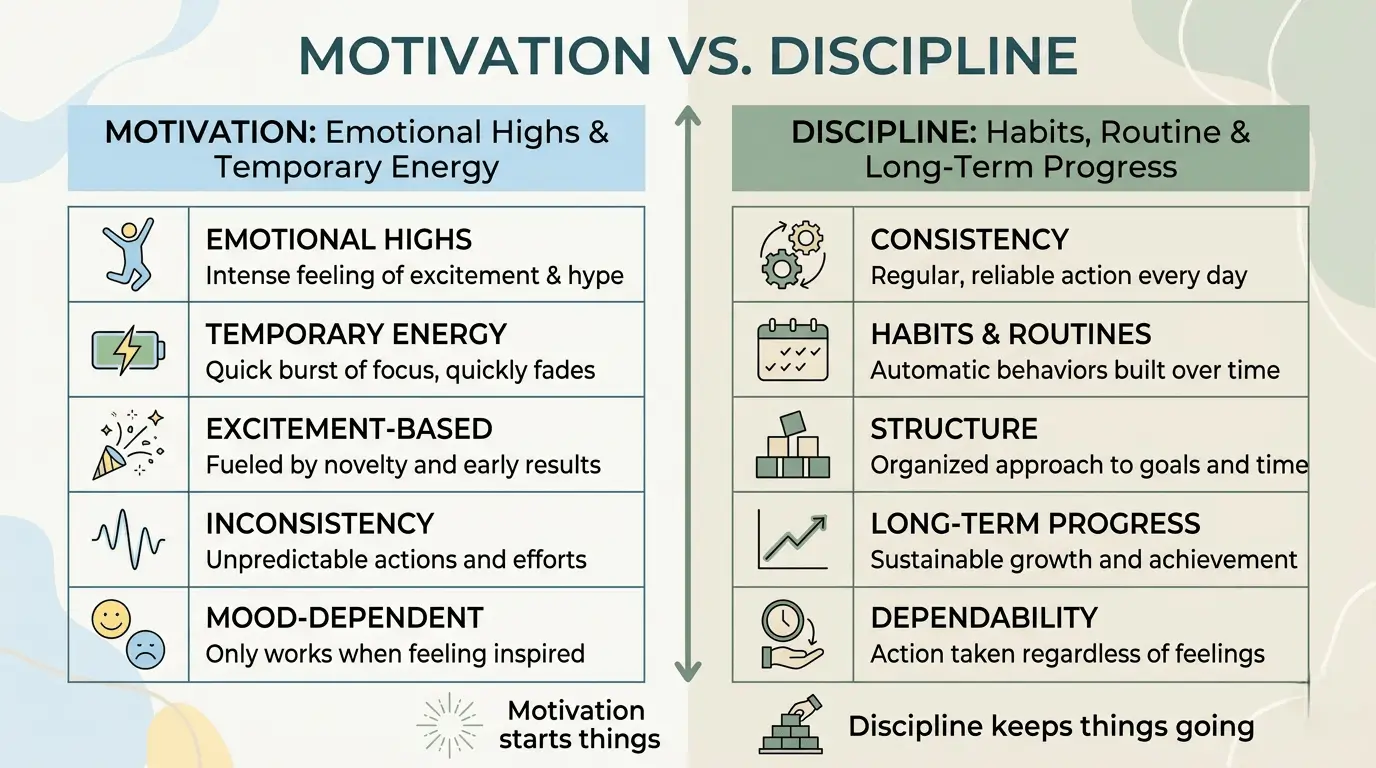
| Motivation | Discipline |
|---|---|
| Emotion-driven | Habit-driven |
| Temporary energy | Long-term consistency |
| Depends on mood | Works despite mood |
| Creates excitement | Creates progress |
| Unstable without systems | Sustainable with routines |
Motivation creates short-term excitement, but discipline creates sustainable progress. Systems and routines reduce dependence on emotional highs and help people stay consistent even during stressful periods.
Behavioral psychology shows that small repeated actions usually outperform inconsistent bursts of emotional intensity.
Daily Routine for Practicing New Home Affirmations
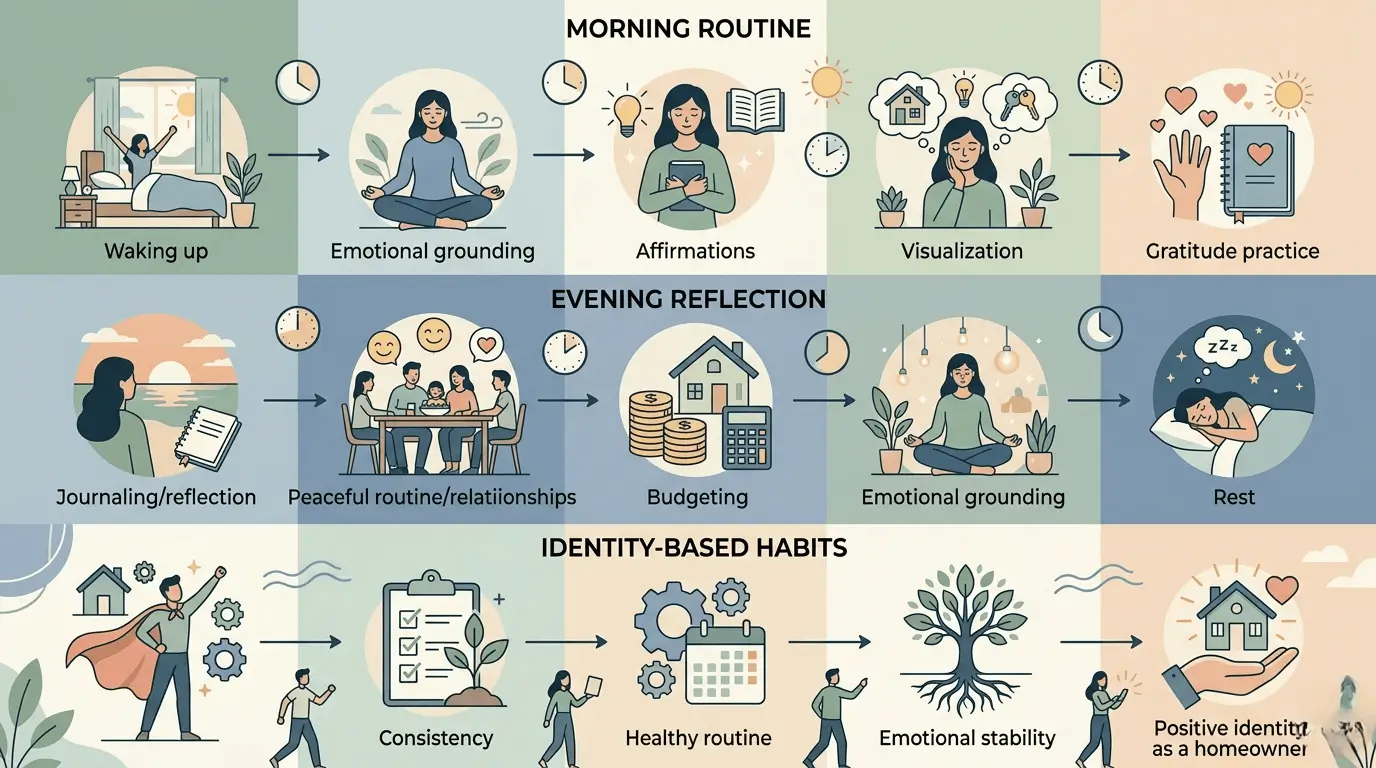
Morning Affirmation Routine
Morning routines can improve emotional focus and mental clarity throughout the day.
Helpful practices include:
- Habit stacking affirmations with morning routines
- Journaling intentions and goals
- Short visualization exercises
- Emotional grounding through breathing practices
Consistency matters more than duration. Even a few minutes daily can reinforce positive mental patterns.
Evening Reflection and Gratitude Practices
Evening reflection practices help reinforce emotional stability and reduce anxiety.
Useful evening habits include:
- Gratitude journaling
- Reflecting on progress instead of perfection
- Reducing comparison thinking
- Reviewing practical actions completed during the day
These practices encourage emotional balance and long-term consistency.
Creating an Identity-Based Manifestation Habit
Identity-based habits focus on becoming the type of person who naturally supports their goals.
Examples include:
- “I am becoming someone who creates a peaceful home.”
- “I am becoming more financially responsible.”
- “I am building habits that support stability and peace.”
Behavior-based reinforcement strengthens identity over time because repeated actions influence self-image.
Psychological Barriers That Block Manifestation Efforts
Fear of Failure and Fear of Change
In more intense emotional states, people sometimes feel overwhelmed and search for grounding strategies like how do I get my life in order, how to live a better life, or structured recovery routines such as daily routine for self improvement student.
Fear often creates emotional avoidance patterns that prevent consistent action.
People may delay decisions because uncertainty feels emotionally uncomfortable. However, long-term growth usually requires adaptation and temporary discomfort.
Recognizing avoidance patterns can improve emotional awareness and decision-making.
Scarcity Mindset and Financial Anxiety
Questions like how to manifest a house with no money often reflect deeper fears related to financial insecurity.
Healthy optimism is different from denial. Practical empowerment strategies include:
- Improving financial literacy
- Creating realistic budgets
- Developing long-term savings habits
- Building gradual financial stability
Optimism supports resilience, but realistic planning creates sustainable improvement.
Overthinking and Comparison
Social media and online lifestyle content can create unrealistic expectations about homes and success.
Constant comparison often leads to:
- Mental exhaustion
- Reduced confidence
- Decision paralysis
- Emotional dissatisfaction
Reducing comparison triggers and focusing on personal progress can improve mental clarity and emotional stability.
What Actually Works vs Popular Manifestation Myths
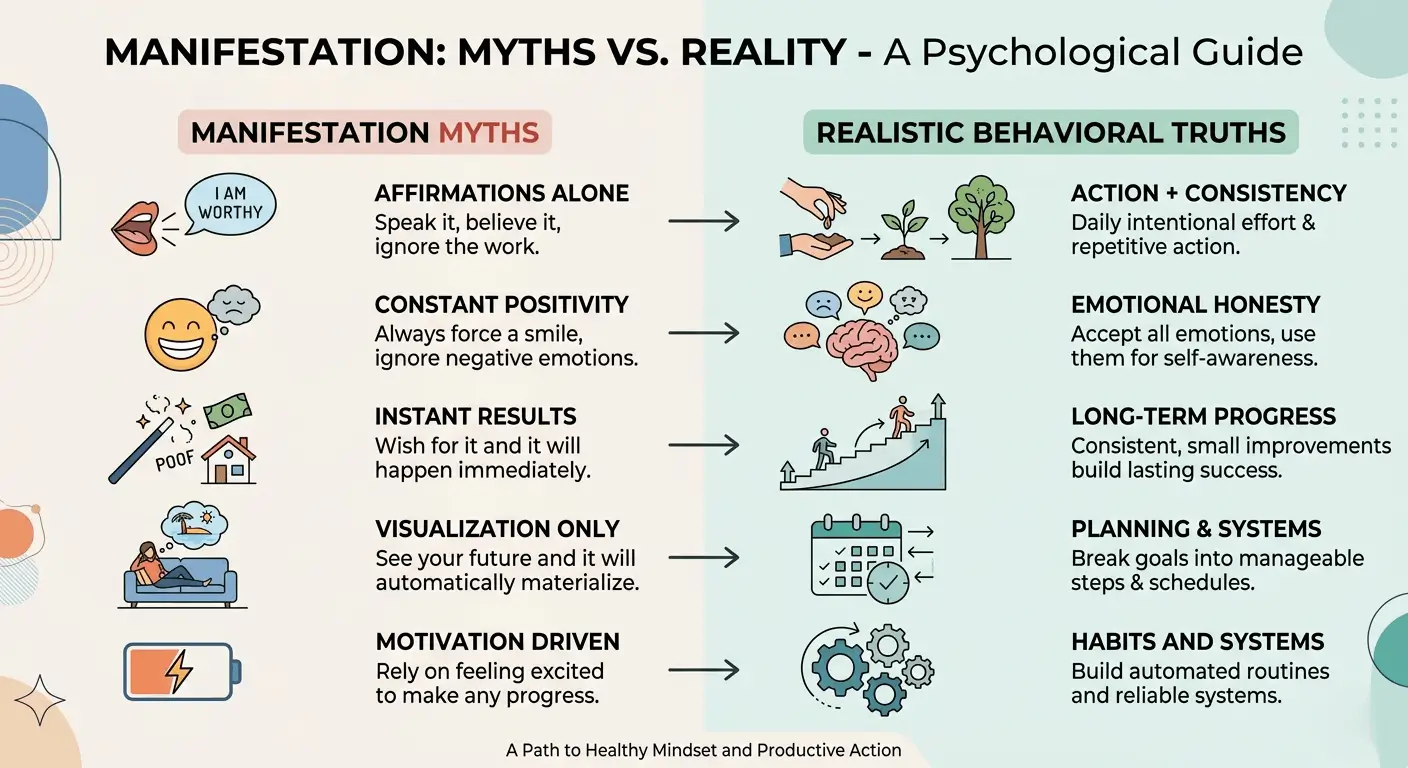
| Myth | Reality |
| Affirmations alone create results | Action and consistency matter most |
| You must stay positive constantly | Emotional honesty is healthier |
| Manifestation works instantly | Progress usually takes time |
| Visualization replaces planning | Planning increases success |
| Motivation guarantees consistency | Systems and habits sustain results |
Science-backed behavioral insights consistently show that self-regulation, emotional awareness, and habit systems are more effective than temporary inspiration alone.
Implementation creates progress. Inspiration only becomes useful when connected to consistent action.
Real-Life Examples of Using New Home Affirmations
Beginner Scenario
Someone feeling financially overwhelmed may use affirmations to reduce panic and improve emotional clarity.
Example approach:
- Practicing calming affirmations daily
- Creating a simple budget plan
- Reducing impulsive spending
- Researching realistic housing options
The affirmations support emotional regulation while practical actions create measurable progress.
Advanced Personal Growth Scenario
An individual with established routines may integrate affirmations into long-term financial and emotional systems.
This may include:
- Weekly goal reviews
- Consistent budgeting habits
- Daily visualization practices
- Emotional regulation techniques
- Long-term savings goals
Sustainable manifestation practices combine mindset work with disciplined behavior and realistic planning.
Louise Hay and the Popularity of Home Affirmations
Why Louise Hay’s Affirmation Philosophy Became Influential
Louise Hay new home affirmations became widely recognized because her philosophy connected self-belief, emotional healing, and personal growth.
Her teachings encouraged people to examine limiting beliefs and develop healthier thought patterns. This approach influenced modern personal development culture by promoting emotional awareness and intentional thinking.
Her work also helped popularize affirmations as tools for emotional support rather than instant solutions.
Conclusion
New home affirmations can support emotional clarity, confidence, and healthier decision-making during major life transitions. However, they are most effective when combined with practical action, emotional awareness, and consistent routines.
Sustainable progress comes from balancing positive thinking with realistic planning, financial responsibility, and long-term habit formation. Mindset influences behavior, but behavior creates lasting change.
Creating a peaceful home involves more than physical space. It also requires emotional stability, intentional habits, and supportive routines. By combining affirmations with grounded action, people can gradually build both an internal and external sense of home.
FAQ Section
Why do new home affirmations help some people feel more motivated?
New home affirmations can improve emotional focus and confidence by reinforcing constructive thought patterns. This often helps people stay more engaged with their goals and daily actions.
How often should I practice new home affirmations?
Consistency is usually more effective than intensity. Short daily routines are often more sustainable than long emotional sessions practiced inconsistently.
Can affirmations help reduce stress during a move?
Yes. Affirmations may support emotional regulation by reducing negative thought spirals and encouraging calmer thinking during stressful transitions.
What if I struggle to believe my affirmations?
Use realistic wording that feels emotionally believable. Gradual belief-building is often more effective than exaggerated positivity.
How do I stay consistent with manifestation practices?
Habit stacking, routines, journaling, and identity-based habits can improve consistency. Linking affirmations to existing daily routines also helps reduce friction.
Do affirmations work without taking action?
No. Affirmations support mindset and emotional focus, but practical planning and consistent behavior are necessary for measurable results.
What are the best affirmations for a peaceful home?
Affirmations focused on emotional safety, calmness, gratitude, balance, and healthy relationships are often the most effective for creating a peaceful home environment.
Can visualization improve manifestation results?
Visualization can improve emotional engagement and mental rehearsal. When combined with planning and consistent action, it may strengthen focus and long-term motivation.