Introduction
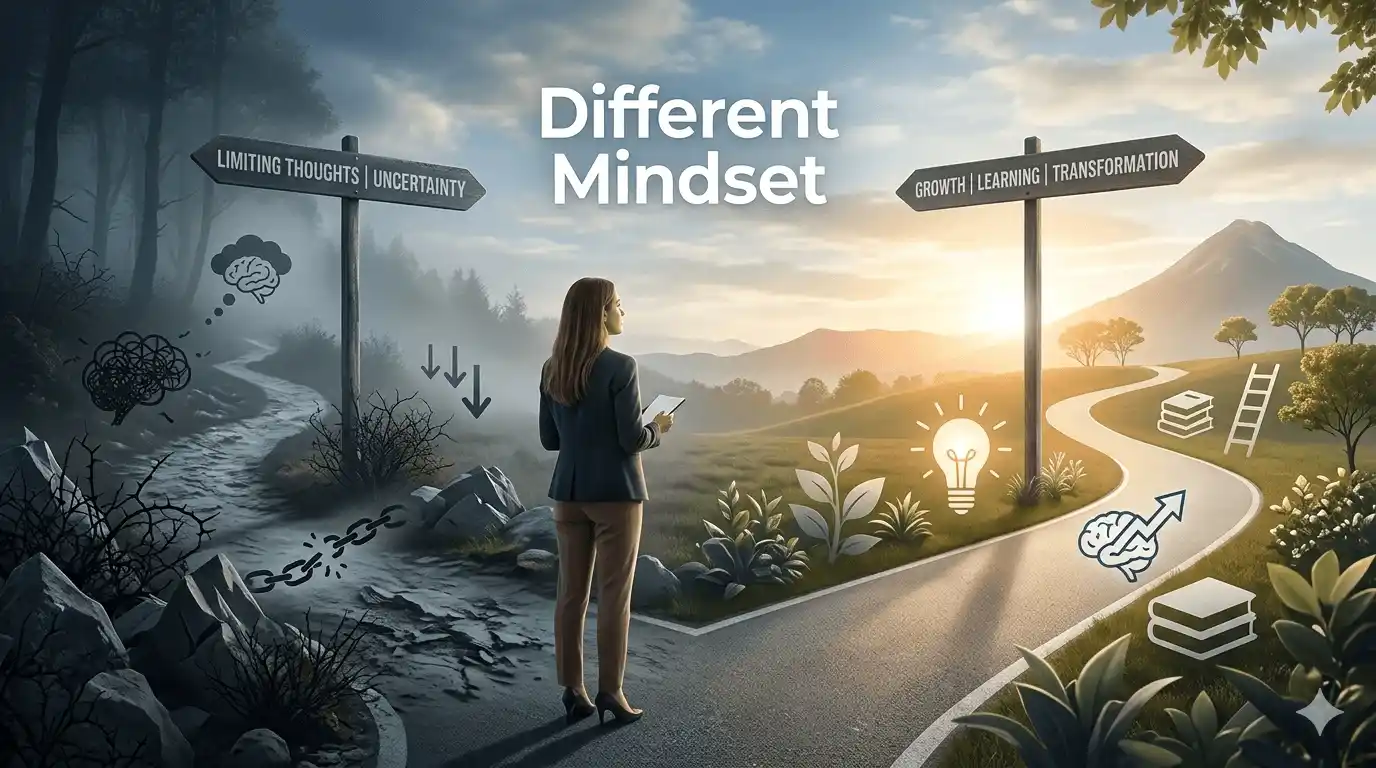
A different mindset refers to a different way of thinking, interpreting experiences, and responding to situations based on a person’s beliefs, attitudes, and mental frameworks. Mindsets influence how people approach challenges, learning, relationships, and personal growth. Understanding different mindsets helps explain why two people can experience the same situation but respond in completely different ways. Psychological research on beliefs, motivation, and behavior shows that thought patterns can influence actions and outcomes. By recognizing common mindset patterns and learning how to develop more effective ones, individuals can improve adaptability, resilience, and long-term growth.
By Your Daily Thrive | Self-Improvement & Personal Growth Expert
Quick Summary
- A different mindset means approaching situations with a different set of beliefs, perspectives, and thought patterns.
- Different types of mindsets influence motivation, learning, decision-making, and responses to challenges.
- Growth and fixed mindsets are commonly discussed psychological frameworks that explain how people view ability and improvement.
- Mindset patterns can change through awareness, practice, reflection, and consistent behavior changes.
- Developing a healthier mindset supports personal development, productivity, and resilience.
What Does Different Mindset Mean?
A different mindset means having a different pattern of thinking that influences how a person understands situations, makes decisions, and responds to challenges. A mindset is a collection of beliefs, assumptions, and attitudes that shape perception and behavior.
For example, two people may experience failure in the same situation. One person may view failure as evidence that improvement is possible, while another may see it as proof that they lack ability. The difference is not only the event itself but the mindset used to interpret it.
Mindsets are not fixed personality traits. They can develop through experiences, education, social influences, and repeated thought patterns. This means people can intentionally develop new ways of thinking over time.
Your Daily Thrive’s approach to mindset development focuses on practical awareness: identifying existing thought patterns, understanding why they appear, and replacing unhelpful patterns with more constructive approaches.
Mindset Definition and Its Role in Human Behavior
A mindset is a mental framework that affects how people interpret information and choose actions. In psychology, mindsets are connected to beliefs, cognition, motivation, and behavioral responses.
A person’s mindset can influence:
- How they respond to challenges
- Whether they seek learning opportunities
- How they handle mistakes
- Their motivation toward goals
- Their ability to adapt to change
Psychologist Carol Dweck introduced the concept of fixed and growth mindsets through research on beliefs about intelligence and ability. This framework suggests that people who believe abilities can develop tend to approach learning differently from those who believe abilities are largely unchangeable.
Mindset does not determine every action a person takes, but it can influence the choices and interpretations that shape behavior over time.
Why Do People Have Different Mindsets?
People develop different mindsets because thinking patterns are influenced by many personal and environmental factors.
Common influences include:
- Life experiences: Past successes and failures can shape beliefs about ability and possibility.
- Environment: Family, education, workplace culture, and social groups influence attitudes.
- Learning history: Exposure to new ideas and feedback can change perspectives.
- Personal goals: People often develop mindsets based on what they want to achieve.
- Emotional experiences: Confidence, fear, and previous challenges can affect interpretation.
A different mindset does not necessarily mean one person is right and another is wrong. Instead, different mindsets represent different ways people process information and respond to circumstances.
What Are the Different Types of Mindsets?
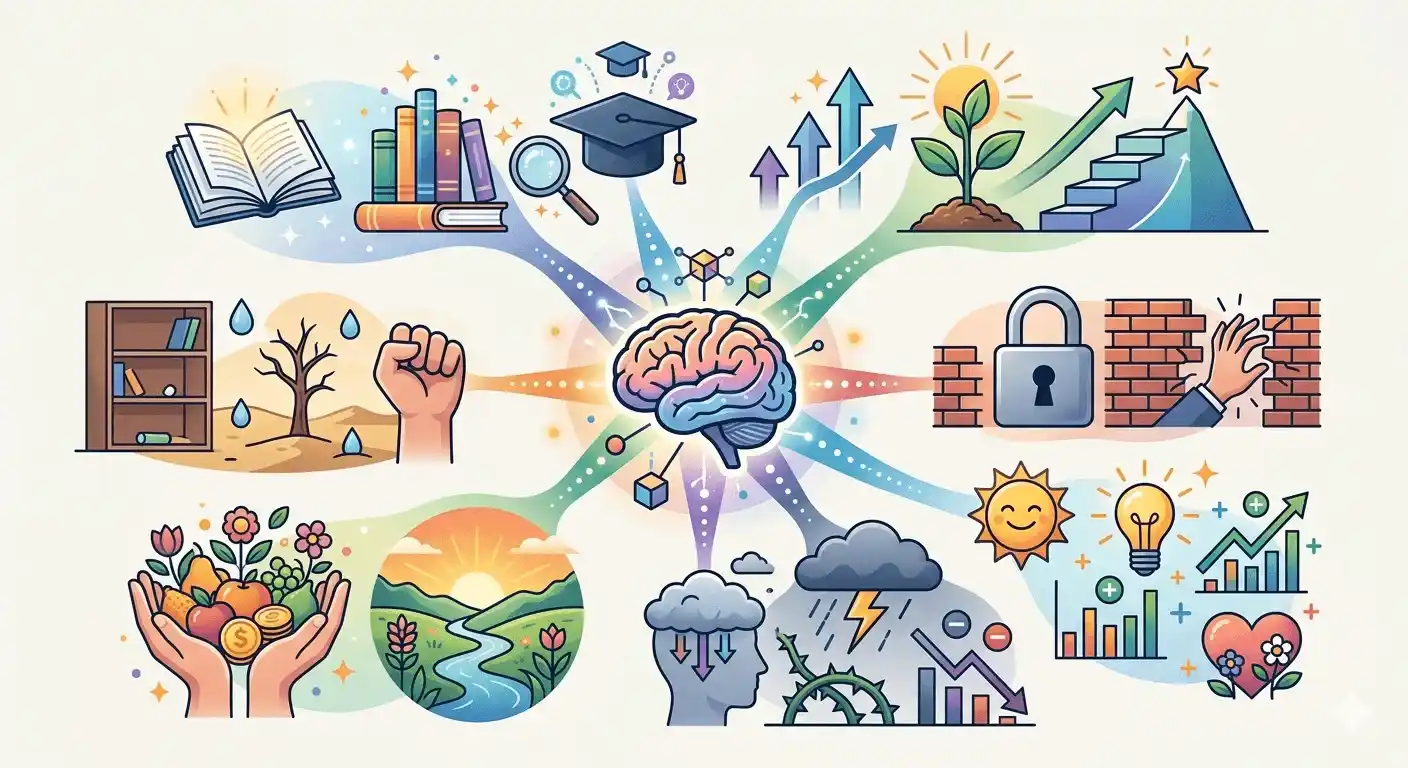
The different types of mindsets are categories used to describe common patterns of thinking, beliefs, and attitudes. These categories help people understand how their thoughts influence behavior, although individuals may experience a combination of multiple mindset patterns.
Common mindset types include:
- Growth mindset
- Fixed mindset
- Positive mindset
- Negative mindset
- Abundance mindset
- Scarcity mindset
- Learning mindset
These categories are useful because they provide a vocabulary for understanding personal development. They allow people to identify thinking patterns that support improvement and recognize patterns that may limit progress.
Growth Mindset
A growth mindset is the belief that abilities, skills, and knowledge can improve through effort, learning, practice, and feedback.
Many people reinforce this way of thinking through daily habits such as journaling and using growth mindset affirmations that encourage continuous learning and improvement.
People with a growth mindset often:
- View challenges as opportunities to learn
- Accept constructive feedback
- Persist when progress is difficult
- Focus on improvement rather than immediate perfection
A growth mindset does not mean believing that everyone can achieve anything without limits. Instead, it emphasizes that skills can often be developed through appropriate strategies, effort, resources, and time.
In practical situations, a person with a growth mindset may think, “I cannot do this yet, but I can learn how,” rather than assuming ability is permanently fixed.
Fixed Mindset
A fixed mindset is the belief that abilities, intelligence, or talents are mostly unchangeable.
People with a fixed mindset may:
- Avoid situations where they might fail
- See mistakes as evidence of inability
- Feel threatened by others’ success
- Avoid feedback that challenges their beliefs
A fixed mindset can develop when people repeatedly associate mistakes with failure rather than learning. However, mindset patterns are not permanent. Awareness and practice can help people develop more flexible approaches.
Positive and Negative Mindsets
Positive and negative mindsets describe general patterns in how people interpret situations.
A positive mindset involves approaching challenges with realistic optimism. It focuses on identifying possibilities, solutions, and opportunities while still recognizing difficulties.
For those looking to develop this skill, practical positive mindset tips for beginners can provide simple strategies for building healthier thinking patterns.
A negative mindset often focuses heavily on limitations, risks, or expected problems. While caution can sometimes be useful, excessive negative thinking may reduce motivation and problem-solving ability.
A balanced approach involves acknowledging challenges while maintaining the belief that improvement and solutions are possible.
Other Common Mindset Categories
Beyond the commonly discussed growth and fixed mindsets, researchers and personal development frameworks often discuss additional mindset categories.
Examples include:
| Mindset Type | Main Focus |
| Abundance mindset | Seeing opportunities and available possibilities |
| Scarcity mindset | Focusing on limitations and lack of resources |
| Learning mindset | Prioritizing curiosity and skill development |
| Performance mindset | Focusing on achievement and results |
| Creative mindset | Exploring ideas and generating solutions |
These different mindsets can appear in different areas of life. For example, someone may have a learning mindset at work but a more fixed mindset in a personal area where they feel less confident.
What Are the 4 Types of Mindsets?
The 4 types of mindsets commonly refer to a simplified framework that groups thinking patterns into four broad categories. Different authors and researchers may define these categories differently, so there is no single universal four-type model.
A commonly used comparison includes:
| Mindset Type | Core Belief | Common Behavior |
| Growth mindset | Skills can improve | Learns from challenges and feedback |
| Fixed mindset | Abilities are limited | Avoids risks and protects existing beliefs |
| Positive mindset | Solutions and opportunities exist | Looks for constructive approaches |
| Negative mindset | Problems are dominant | Focuses mainly on obstacles |
Understanding these categories helps individuals recognize patterns rather than label themselves permanently. A person may demonstrate different mindsets depending on the situation, experience level, and environment.
For example, someone may have a growth mindset when learning a new skill but experience a fixed mindset when facing criticism. Recognizing these differences creates opportunities for intentional improvement.
What Are the 7 Types of Mindsets?
The 7 types of mindsets refer to a broader classification used to describe different patterns of thinking and behavior. The exact categories vary depending on the framework being used, but many personal development models identify several common mindset approaches that influence how people learn, solve problems, and handle challenges.
A broader mindset framework may include:
| Mindset Type | Main Focus |
| Growth mindset | Improvement, learning, and skill development |
| Fixed mindset | Existing abilities and perceived limitations |
| Positive mindset | Possibilities, solutions, and constructive thinking |
| Negative mindset | Risks, obstacles, and limitations |
| Abundance mindset | Opportunities, resources, and collaboration |
| Scarcity mindset | Lack, competition, and fear of losing resources |
| Learning mindset | Curiosity, experimentation, and continuous improvement |
These categories are not personality labels. A person can shift between different mindsets depending on their circumstances, goals, emotional state, and level of experience.
For example, an employee may demonstrate a learning mindset when developing a new professional skill but show a scarcity mindset when they feel threatened by workplace competition. Recognizing these patterns allows people to adjust their thinking more intentionally.
Different Mindset Examples in Everyday Life
Different mindset examples show how beliefs influence actions, decisions, and responses. The same situation can produce different outcomes depending on the mindset a person applies.
Consider receiving critical feedback:
- A growth-oriented mindset may interpret feedback as useful information for improvement.
- A fixed mindset may interpret feedback as a personal attack.
- A learning mindset may use feedback to identify specific skills to develop.
Mindsets influence everyday areas such as:
- Career decisions
- Education and learning
- Relationships
- Health habits
- Personal goals
- Problem-solving
In our experience helping readers build stronger personal development habits, one of the most common patterns is that people often focus on changing external circumstances before examining the beliefs influencing their responses. Building awareness of thought patterns is usually the first step toward meaningful change.
Examples of Different Mindsets at Work
A different mindset in the workplace can influence how employees approach challenges, teamwork, leadership, and professional development.
Examples include:
Growth mindset at work
- Seeks opportunities to improve skills
- Accepts feedback from managers and colleagues
- Views challenges as learning experiences
Fixed mindset at work
- Avoids unfamiliar responsibilities
- May resist feedback
- May interpret mistakes as evidence of failure
Learning mindset at work
- Experiments with new methods
- Looks for better processes
- Develops expertise through continuous learning
Modern workplaces increasingly value adaptability because industries, technologies, and job requirements continue to change. Developing flexible thinking can help individuals respond more effectively to workplace transitions.
Examples of Different Mindsets in Personal Growth
Mindset affects personal development because goals require consistent action, learning, and adaptation.
Developing greater self-awareness is often an important step in personal growth, especially for people learning and clarify their values.
Examples include:
When building a habit:
A fixed mindset may think:
- “I am not disciplined enough.”
A growth mindset may think:
- “I need a better system and more practice.”
When facing a setback:
A negative mindset may focus only on the problem.
A solution-focused mindset may ask:
- What can I learn from this?
- What adjustment can I make?
- What support or resources do I need?
Your Daily Thrive recommends focusing on small, repeatable improvements rather than expecting immediate transformation. Sustainable personal growth usually comes from consistent actions supported by realistic thinking patterns.
Different Mindsets in Psychology: How Thinking Patterns Shape Behavior
Different mindsets in psychology describe the mental frameworks people use to interpret experiences, evaluate themselves, and respond to situations. Psychology studies how beliefs, thoughts, and perceptions influence emotions and behavior.
Mindsets are connected to several psychological concepts, including:
- Cognitive patterns
- Self-beliefs
- Motivation
- Self-efficacy
- Behavioral learning
A person’s mindset affects how they explain events to themselves. For example, someone who believes mistakes are opportunities for learning may continue practicing, while someone who believes mistakes reveal inability may avoid future challenges.
How Mindsets Influence Decision-Making
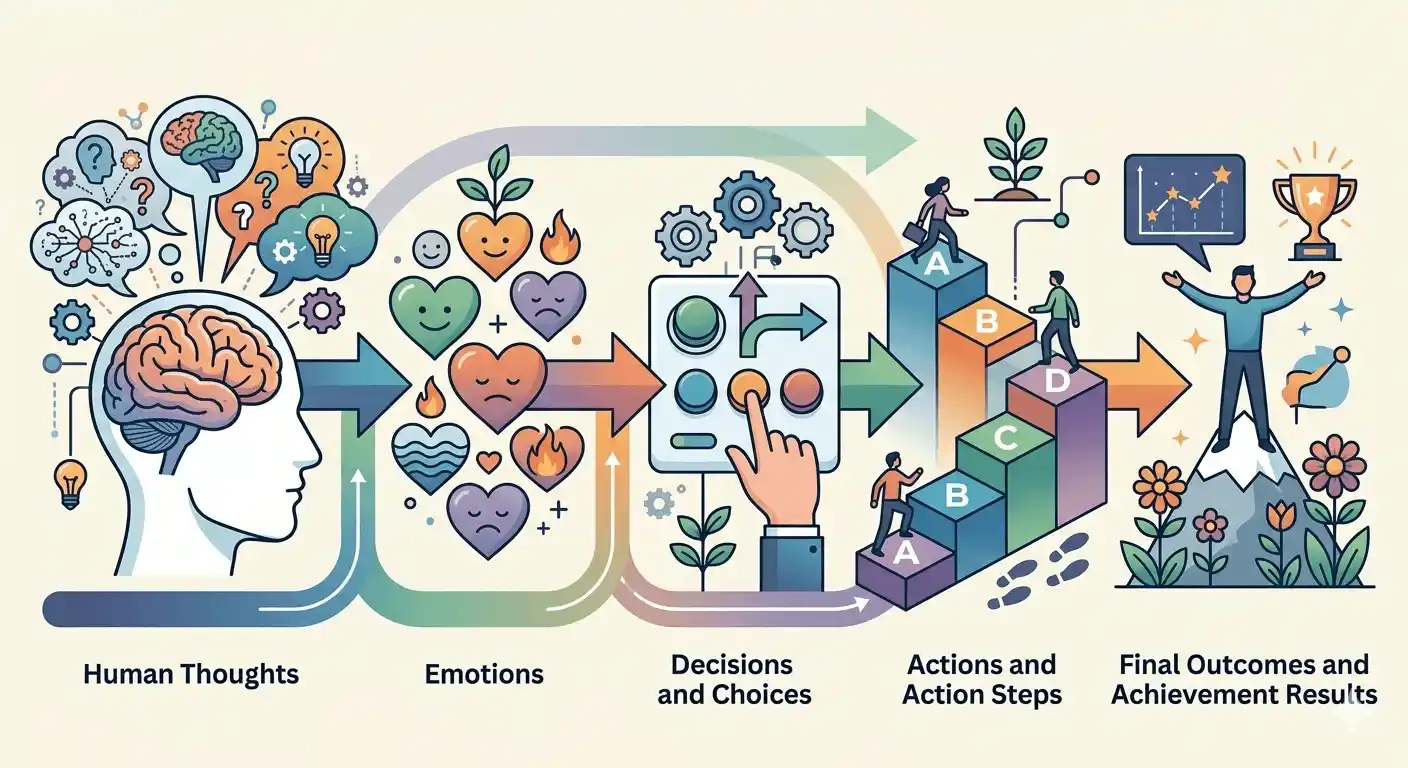
Mindsets influence decisions by shaping how people evaluate risks, opportunities, and possible outcomes.
A person’s thinking pattern can affect:
- Whether they attempt difficult goals
- How they respond to uncertainty
- Whether they seek feedback
- How they interpret success and failure
For example, someone with a learning mindset may approach a difficult task by asking, “What skills do I need to develop?” Someone with a limiting mindset may ask, “What if I fail?”
Behavioral science suggests that repeated thoughts and actions can reinforce patterns over time. This is why intentional practice, reflection, and environmental changes are important parts of developing new habits of thinking.
Different Mindset vs Similar Concepts: Understanding the Differences
Understanding the difference between related concepts helps clarify what a mindset actually represents. Although terms like mindset, mentality, and personality are sometimes used interchangeably, they describe different ideas.
Mindset vs Mentality
Mindset and mentality are closely related but have slightly different meanings.
| Concept | Meaning |
| Mindset | A specific set of beliefs and thought patterns that influence behavior |
| Mentality | A broader attitude or way of thinking about situations |
For example, a person may have a growth mindset toward learning, while their overall mentality may be shaped by cultural, social, or personal experiences.
Mindset often refers to specific beliefs that can be examined and changed, while mentality may describe a broader perspective.
Different Mindset vs Different Personality
A different mindset and a different personality are not the same.
| Concept | Focus |
| Mindset | Beliefs, attitudes, and ways of interpreting experiences |
| Personality | More stable traits and patterns of behavior |
Personality describes characteristics such as being outgoing, cautious, or organized. Mindset describes how someone thinks about abilities, challenges, and possibilities.
A person’s personality may influence their preferred approach, but mindset can often be developed through learning and intentional practice.
Fixed Mindset vs Growth Mindset
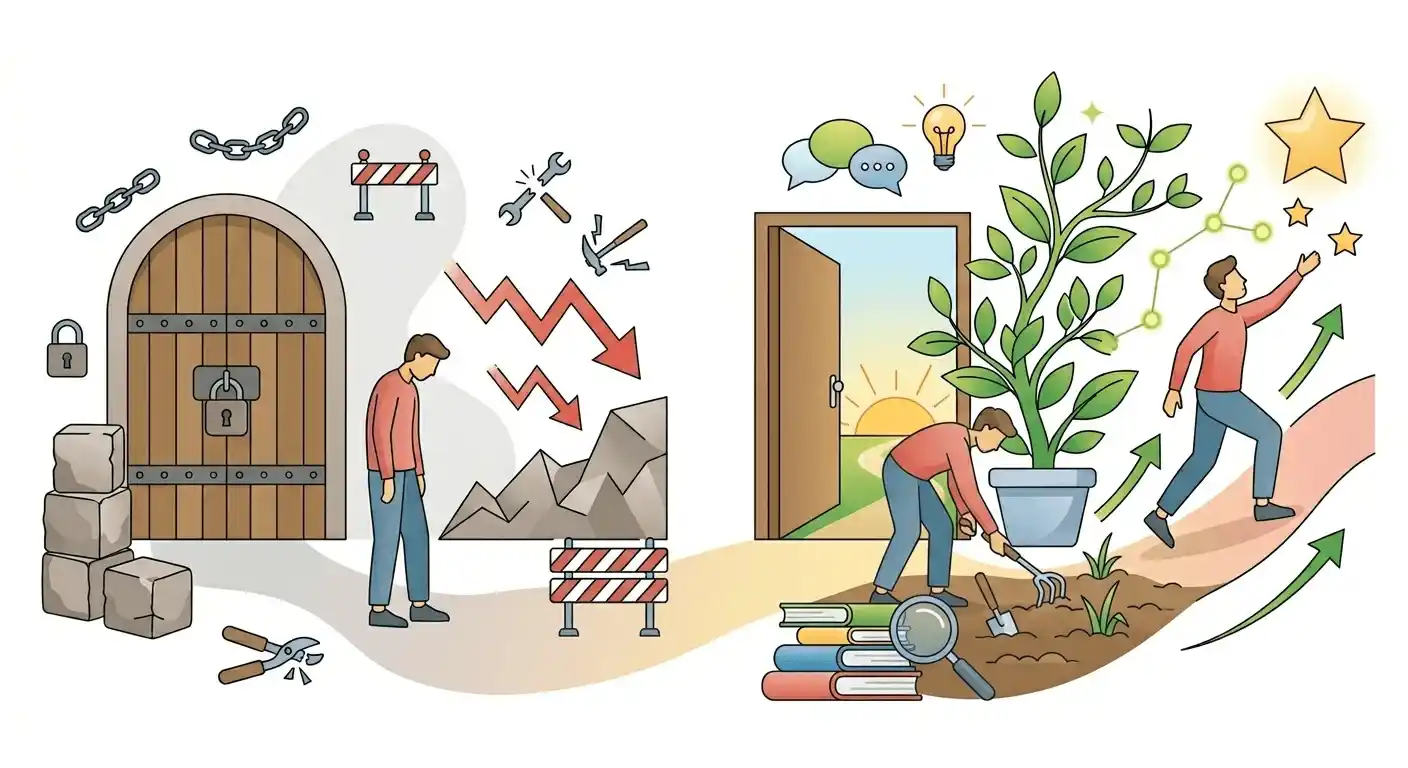
The difference between a fixed mindset and a growth mindset is one of the most recognized comparisons in psychology and personal development.
| Area | Fixed Mindset | Growth Mindset |
| Challenges | May avoid difficult tasks | Accepts challenges as opportunities |
| Mistakes | Viewed as failure | Viewed as feedback |
| Effort | May seem unnecessary | Seen as part of improvement |
| Feedback | Can feel threatening | Used for development |
| Success of others | May create comparison | Can provide inspiration |
Understanding this difference helps people identify whether their current thinking supports learning or limits progress.
How to Develop a Different and More Effective Mindset
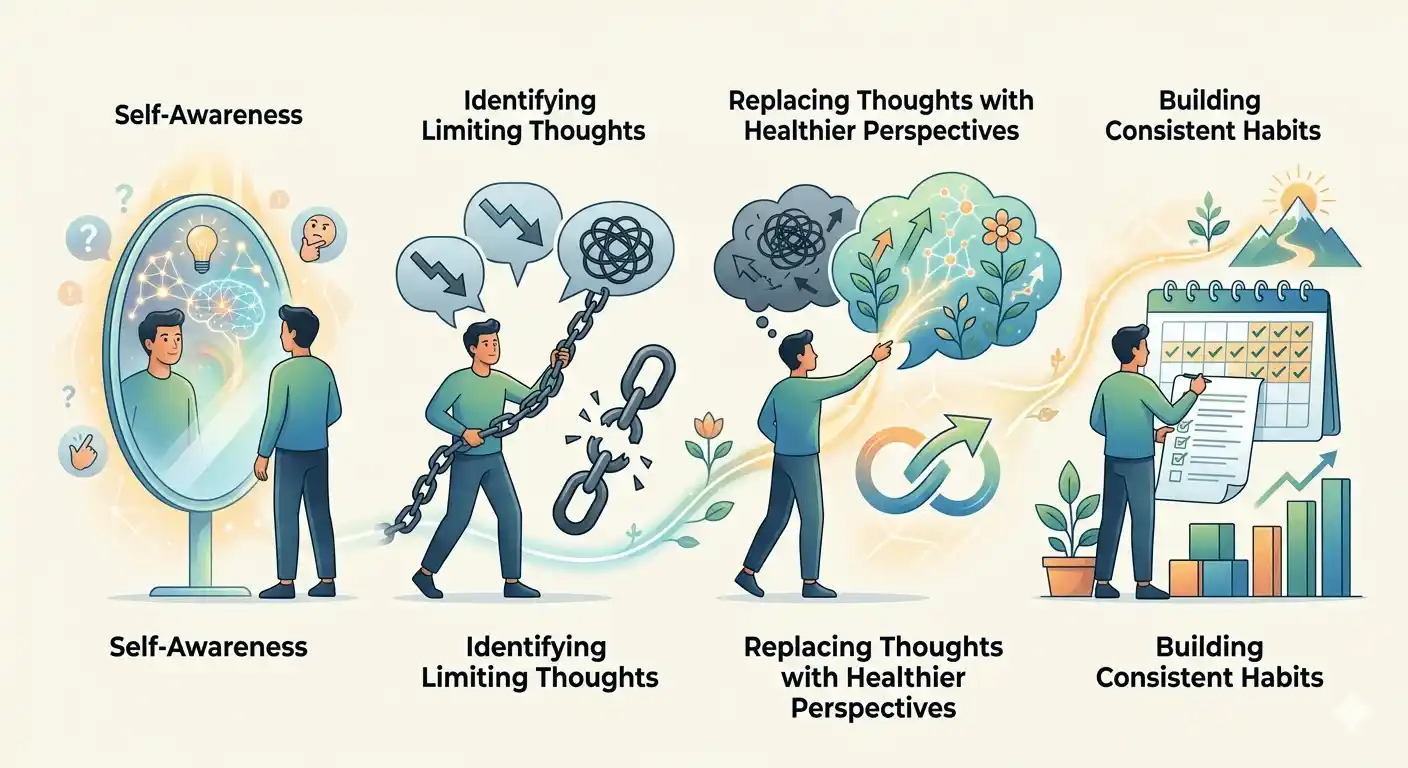
Developing a different mindset involves changing how you interpret situations, respond to challenges, and approach personal growth. Mindset change is usually a gradual process built through awareness and repeated practice.
Effective strategies include:
- Identifying unhelpful thought patterns
- Practicing realistic self-reflection
- Learning from feedback
- Setting achievable improvement goals
- Building supportive habits
Practice Awareness of Current Thinking Patterns
The first step in changing a mindset is recognizing existing beliefs.
Useful reflection questions include:
- How do I usually respond when I make mistakes?
- Do I avoid challenges because of fear of failure?
- What assumptions do I make about my abilities?
- What thoughts help or limit my progress?
Journaling, reflection exercises, and mindfulness practices can help individuals notice automatic reactions before responding.
Replace Limiting Beliefs With Growth-Oriented Thinking
Changing beliefs does not mean ignoring difficulties. It means developing more accurate and constructive interpretations.
Learning how to change your thoughts can make it easier to replace limiting beliefs with more constructive and realistic perspectives.
Examples:
Instead of:
- “I cannot improve this skill.”
Try:
- “I can improve this skill with practice and support.”
Instead of:
- “Failure means I am not capable.”
Try:
- “Failure provides information about what I need to improve.”
This process is related to cognitive restructuring, a technique commonly used in cognitive behavioral approaches to help people examine and adjust unhelpful thought patterns.
Build Mindset Through Daily Habits
Long-term mindset development requires consistent practice.
Helpful routines include:
- Reviewing progress weekly
- Setting learning-focused goals
- Reading or studying new concepts
- Seeking constructive feedback
- Tracking improvements over time
Common obstacles include:
- Expecting immediate results
- Returning to old habits during stressful periods
- Comparing personal progress with others
Long-term sustainability comes from creating systems that fit personal circumstances rather than relying only on motivation.
Common Mistakes People Make When Trying to Change Their Mindset
Changing a mindset can be challenging because beliefs are often connected to past experiences and established habits. Understanding common mistakes makes the process more effective.
Expecting Instant Mindset Change
Mindset development usually happens gradually. People often make the mistake of expecting one insight or motivational moment to completely change their thinking.
A more effective approach involves:
- Repeated practice
- Reflection
- Small behavioral changes
- Learning from setbacks
Confusing Positive Thinking With Ignoring Problems
A positive mindset does not mean pretending problems do not exist.
Healthy positive thinking involves:
- Recognizing challenges
- Evaluating realistic solutions
- Maintaining confidence in the ability to improve
Ignoring difficulties can prevent problem-solving and create unrealistic expectations.
Trying to Copy Someone Else’s Mindset
Different people have different goals, environments, strengths, and challenges.
A useful mindset should consider:
- Personal values
- Current circumstances
- Available resources
- Individual learning style
The goal is not to copy another person’s thinking but to develop a mindset that supports meaningful growth.
Difficulty and Time Investment for Developing a Different Mindset
Developing a different mindset requires ongoing awareness and practice. The difficulty level depends on personal history, current beliefs, environment, and willingness to change.
For beginners, mindset development may start with simple practices:
- Identifying recurring thoughts
- Reframing challenges
- Setting small improvement goals
More advanced development may involve:
- Changing deeply established beliefs
- Building new habits
- Creating supportive environments
The process is easier when people have:
- Clear goals
- Supportive relationships
- Regular reflection practices
- Realistic expectations
Results Timeline: When Does a Mindset Change Happen?
Mindset change usually develops gradually rather than immediately. Some people notice awareness of their thinking patterns quickly, while deeper behavioral changes may take weeks or months.
Common progress patterns include:
Early stage:
- Recognizing existing thought patterns
- Identifying limiting beliefs
Middle stage:
- Practicing new responses
- Developing healthier habits
Long-term stage:
- Automatically applying new approaches
- Maintaining flexibility during challenges
As of 2026, behavioral science continues to emphasize sustainable habit formation, environmental support, and consistent practice as important factors in maintaining long-term personal development.
Conclusion: Understanding the Power of a Different Mindset
A different mindset represents a different way of viewing challenges, abilities, opportunities, and personal growth. Understanding different mindsets helps people recognize how beliefs influence decisions, behavior, and progress.
Growth, fixed, positive, negative, abundance, and learning mindsets are useful frameworks for understanding common thinking patterns. While people may naturally develop certain approaches, mindsets can change through awareness, practice, and intentional learning.
The key takeaway is that changing how you interpret experiences can change how you respond to them. Developing a more effective mindset supports resilience, adaptability, productivity, and lifelong growth.
Frequently Asked Questions About Different Mindset
What does “different mindset” mean?
A different mindset means having a different way of thinking, interpreting situations, and responding based on different beliefs, attitudes, or perspectives. It describes how mental frameworks influence decisions and behavior.
What is a mindset and why is it important?
A mindset is a set of beliefs and thought patterns that influence how people understand experiences and take action. It is important because it affects motivation, learning, resilience, and responses to challenges.
What are the different types of mindsets?
Common types of mindsets include growth mindset, fixed mindset, positive mindset, negative mindset, abundance mindset, scarcity mindset, and learning mindset. These frameworks describe different approaches to challenges and development.
What are the 4 types of mindsets?
The four types of mindsets often refer to simplified categories such as growth, fixed, positive, and negative mindsets. Different frameworks may use different classifications.
What are the 7 types of mindsets?
The seven types of mindsets commonly include growth, fixed, positive, negative, abundance, scarcity, and learning mindsets. These categories describe different ways people approach learning, challenges, and opportunities.
Can a person change their mindset?
Yes. People can develop new mindset patterns through self-awareness, practice, feedback, learning, and consistent behavior changes. Mindset change is usually gradual and requires repeated effort.