

Introduction
The adversarial mindset is the ability to think from an opponent’s or attacker’s perspective in order to identify weaknesses, anticipate actions, and improve decision-making. It is not about being hostile or confrontational — it is an analytical framework used by professionals across cybersecurity, psychology, strategic planning, business, and problem-solving. Understanding the adversarial mindset meaning and definition helps individuals and organizations build stronger defenses, make smarter decisions, and anticipate risks before they become costly failures.
Quick Summary
- An adversarial mindset means thinking like an opponent to identify risks before they become problems.
- It is widely used in cybersecurity, psychology, strategic planning, and risk management.
- Developing this mindset improves critical thinking, resilience, and defensive decision-making.
- It differs from simply having an adversarial attitude, which focuses on conflict rather than analysis.
- As of 2025, adversarial thinking has expanded into AI safety and machine learning evaluation.
What Is an Adversarial Mindset?
An adversarial mindset is a deliberate cognitive approach in which a person or team thinks from the perspective of an adversary, attacker, or opponent. The adversarial mindset definition centers on proactive analysis: identifying weaknesses, anticipating threats, and stress-testing systems before external actors can exploit them. The adversarial mindset meaning extends beyond conflict — it is a structured method of improving preparedness through perspective-shifting.
Organizations adopt this approach to uncover blind spots in their defenses, strategies, and processes. Individuals use it to make more resilient decisions by challenging their own assumptions and testing the durability of their plans. It is most prominent in cybersecurity, military strategy, competitive business analysis, and increasingly in artificial intelligence safety.
Core Characteristics of an Adversarial Mindset
- Thinking from an opponent’s perspective — actively considering how an external actor views a system, process, or decision
- Challenging assumptions — questioning accepted norms to find hidden vulnerabilities
- Identifying vulnerabilities — systematically looking for weaknesses before they are exploited
- Predicting possible actions — modeling likely moves an adversary might take
- Continuous evaluation — treating threat analysis as an ongoing process, not a one-time exercise
How the Adversarial Mindset Works
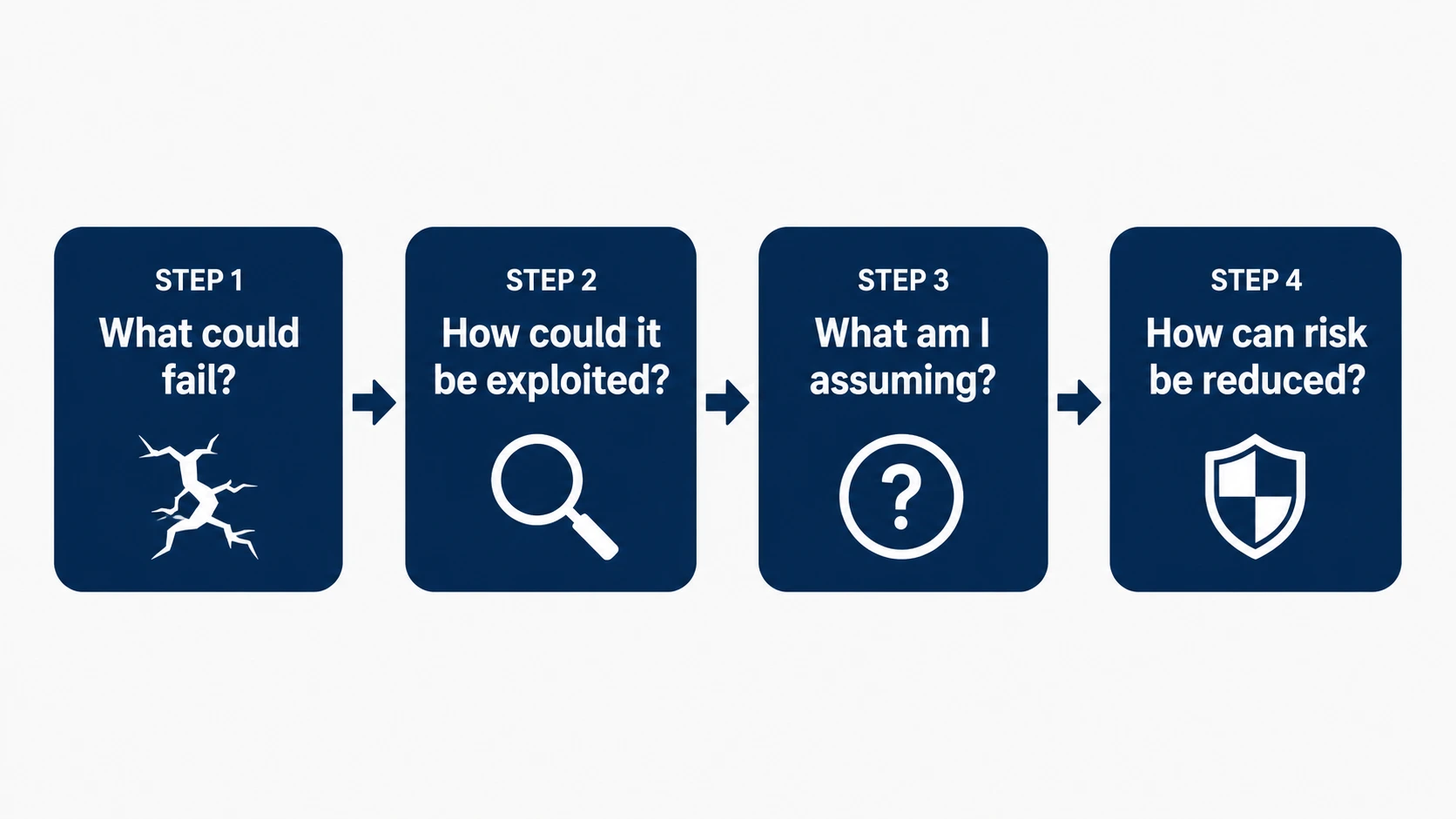
The adversarial mindset operates through perspective-shifting — stepping outside one’s own viewpoint and deliberately occupying the position of someone with opposing goals. This cognitive shift enables a thinker to see gaps that would otherwise remain invisible from a conventional, goal-aligned perspective. The process improves decisions by surfacing alternative outcomes and exposing hidden assumptions that normal planning tends to overlook.
Effective adversarial thinking involves four interrelated stages: observation, hypothesis testing, anticipating outcomes, and evaluating consequences. Each stage builds on the previous one to create a comprehensive risk picture.
The Typical Thought Process
- What could fail? — Identify every point of failure in a plan, system, or decision, including unlikely scenarios.
- How could someone exploit this? — Adopt the attacker’s or opponent’s viewpoint to spot exploitable weaknesses.
- What assumptions am I making? — Surface hidden assumptions that, if incorrect, could invalidate the entire strategy.
- How can risks be reduced? — Develop countermeasures, fallbacks, and contingency plans to address identified threats.Understanding mindset psychology more broadly helps explain why some individuals default to defensive thinking while others require deliberate training to adopt it.
Adversarial Mindset in Psychology
From a psychological standpoint, the adversarial mindset is grounded in critical thinking, cognitive flexibility, and defensive reasoning. Adversarial mindset psychology focuses on the capacity to adopt multiple simultaneous viewpoints without losing objectivity. It requires emotional regulation — the ability to analyze threats calmly without defaulting to fear, overconfidence, or reactivity. Cognitive flexibility, a well-documented psychological skill, enables thinkers to shift frames of reference and consider scenarios outside their immediate experience.
Importantly, this mindset does not promote paranoia. Defensive thinking, in the psychological sense, means structured analysis of realistic threats — not catastrophizing or assuming worst-case outcomes reflexively. In our experience helping readers build better habits of thought, the distinction between healthy skepticism and unproductive anxiety is one of the most important skills to develop alongside this mindset.
Psychological Skills That Support This Mindset
- Situational awareness — continuously monitoring the environment for changes, anomalies, and emerging risks
- Pattern recognition — identifying recurring threat signatures and behavioral patterns before they escalate
- Emotional regulation — maintaining analytical objectivity under pressure or uncertainty
- Decision-making under uncertainty — making sound judgments when complete information is unavailable
- Perspective taking — the ability to accurately model the intentions, capabilities, and motivations of an adversary
Adversarial Mindset in Cybersecurity
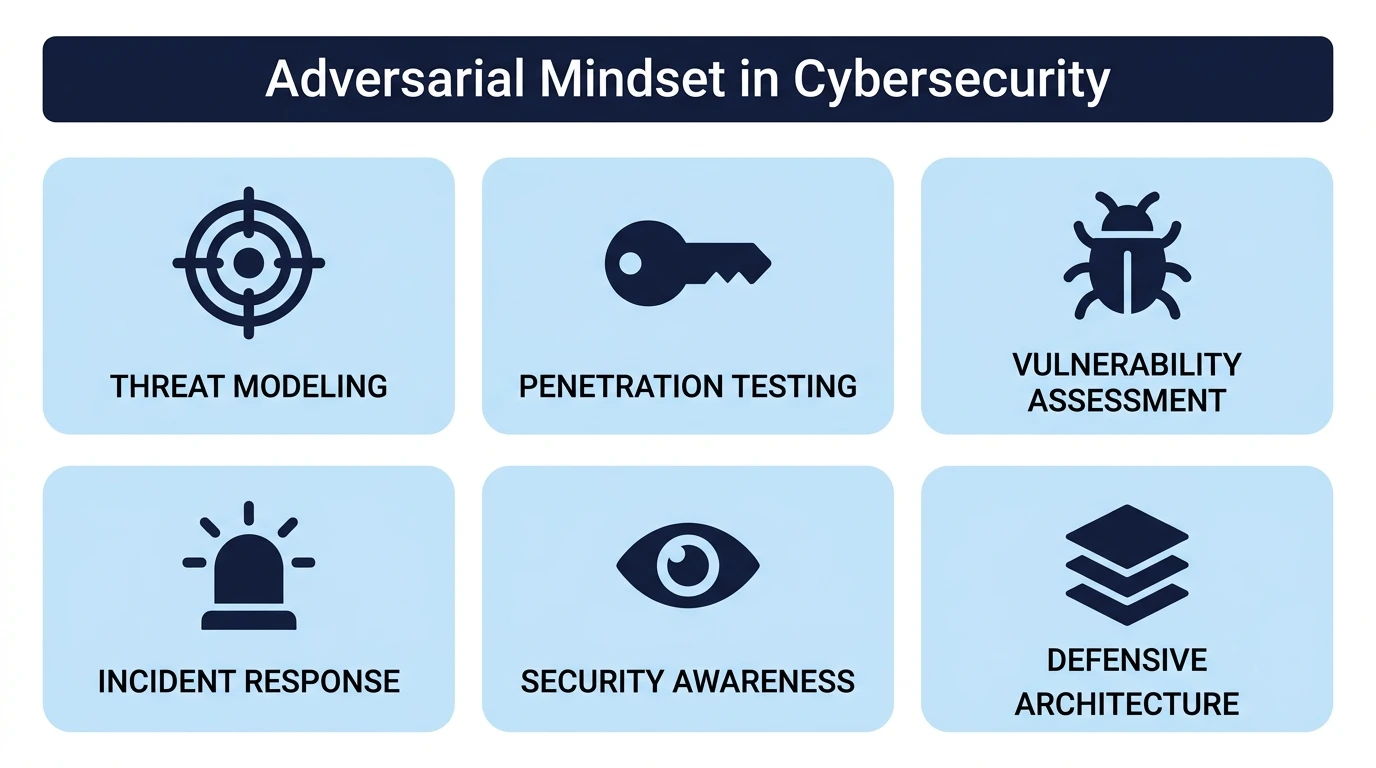
In cybersecurity, the adversarial mindset cyber security framework is foundational. Security professionals who think like attackers are significantly better equipped to identify vulnerabilities before malicious actors exploit them. Rather than focusing only on building defenses, practitioners with an adversarial mindset ask how those defenses would be circumvented — and build accordingly. This approach drives some of the most effective practices in modern information security.
Your Daily Thrive recommends that anyone building digital systems or managing sensitive data understand at least the basics of adversarial thinking in security contexts. As of 2025, the evolving threat landscape — including AI-assisted attacks and automated exploitation — makes this mindset more important than ever for non-specialists as well.
Common Cybersecurity Applications
- Threat modeling — systematically identifying and prioritizing potential threats to a system
- Penetration testing — simulating real attacks to find weaknesses before adversaries do
- Vulnerability assessment — auditing systems for known and unknown security gaps
- Incident response planning — preparing response protocols for likely attack scenarios
- Security awareness training — educating users to recognize social engineering and phishing attempts
- Defensive architecture — designing systems with adversarial scenarios built into the architecture from the start
Benefits and Limitations in Cybersecurity
The primary benefit of the adversarial mindset in cybersecurity is improved risk identification. Teams that think like attackers find more vulnerabilities, build more resilient systems, and respond more effectively to incidents. However, overconfidence is a genuine risk — assuming all threats have been identified can create a false sense of security. Ethical boundaries are also critical: adversarial thinking used without proper authorization, oversight, and ethical constraints can cause significant harm.
Adversarial Mindset vs Adversarial Attitude
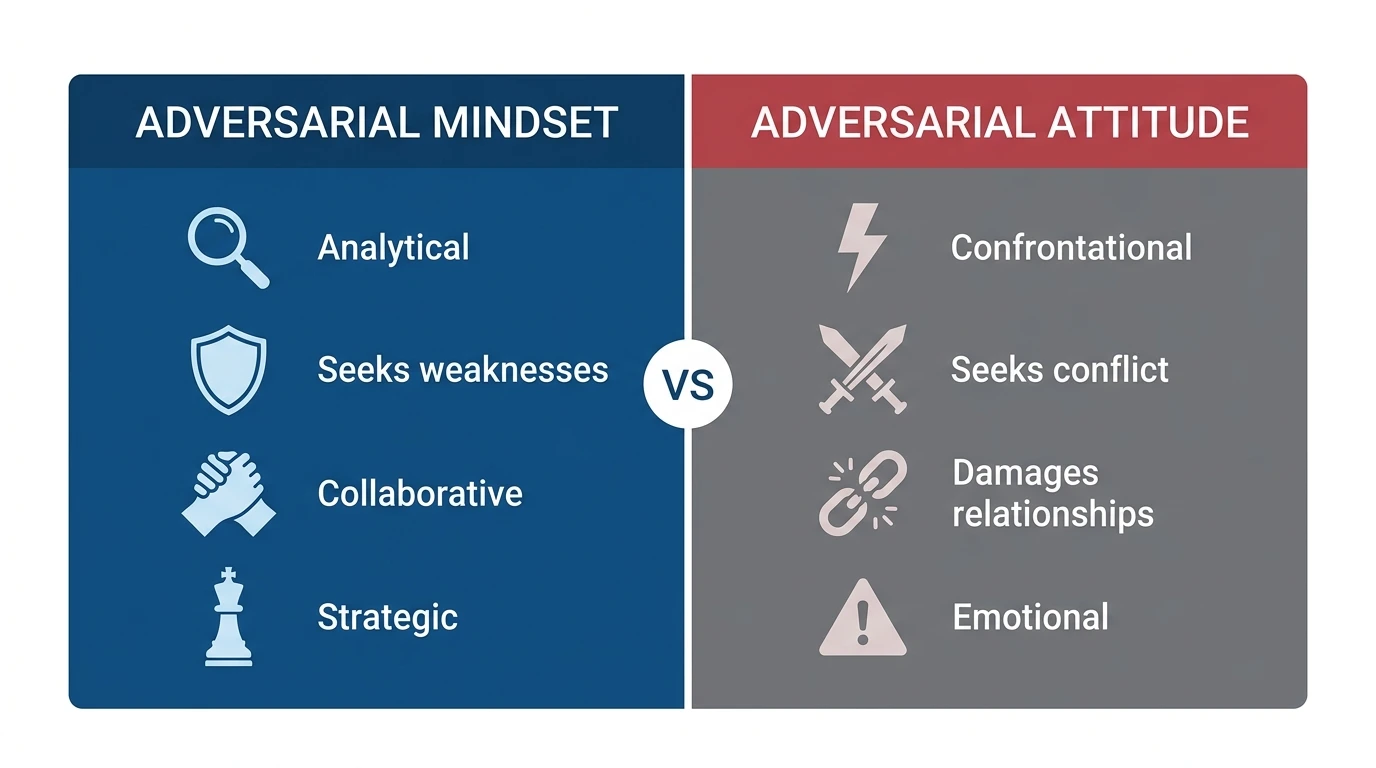
A common source of confusion is conflating the adversarial mindset with an adversarial attitude. The adversarial attitude meaning refers to a confrontational stance toward others — approaching situations with opposition, hostility, or a desire to win at the expense of collaboration. In contrast, the adversarial mindset is an analytical tool, not an emotional disposition. One is strategic; the other is relational.
| Adversarial Mindset | Adversarial Attitude |
| Analytical and structured | Confrontational and emotional |
| Seeks weaknesses to improve defenses | Seeks conflict or dominance |
| Improves security, strategy, and decisions | May damage relationships and teamwork |
| Applied deliberately in controlled contexts | Often reactive and unintentional |
| Compatible with collaboration | Tends to undermine trust |
Confusing the two can lead to organizations that encourage adversarial thinking ending up with toxic cultures of distrust. The mindset must always be applied within a framework of ethical responsibility and collaborative intent.
Adversarial Mindset vs Adversarial Behavior
Adversarial behavior meaning refers to actions taken that are deliberately obstructive, competitive, or harmful toward another party. It is defined by intent and conduct — not just perspective. A person with an adversarial mindset may never exhibit adversarial behavior; they are simply analyzing scenarios through an opponent’s lens. The behavioral distinction is important in professional, legal, and organizational contexts.
| Dimension | Adversarial Mindset | Adversarial Behavior |
| Nature | Cognitive (analytical) | Behavioral (action-based) |
| Intent | Improve defenses or decisions | Oppose, obstruct, or harm |
| Communication style | Neutral, collaborative | Competitive, hostile |
| Real-world application | Security reviews, risk analysis | Legal disputes, competitive sabotage |
| Ethical alignment | Typically ethical | May be unethical or harmful |
In practice, a security analyst performing a red team exercise has an adversarial mindset but not adversarial behavior. A competitor engaging in deliberate misinformation campaigns exhibits adversarial behavior. The two must not be conflated, especially in organizational, legal, or interpersonal contexts.
How Large Language Models Are Evaluated Using an Adversarial Mindset
Understanding LLMs under attack through an adversarial mindset has become a critical area of AI safety research. As large language models (LLMs) are deployed in high-stakes environments, researchers and safety teams use adversarial thinking to stress-test these systems. This means actively trying to break them — identifying outputs that are harmful, biased, incorrect, or manipulable through specifically crafted inputs known as prompt attacks or jailbreaks.
Adversarial evaluation of AI systems involves constructing prompts designed to elicit undesirable outputs, testing the boundaries of model behavior, and identifying failure modes that normal use would not reveal. Safety evaluation and robustness testing are now standard components of responsible AI development pipelines at leading organizations.
Why Adversarial Testing Improves AI Safety
- Uncovers weaknesses — reveals how models respond to edge cases, manipulation attempts, and ambiguous inputs
- Reduces harmful outputs — helps developers identify and patch responses that could cause real-world harm
- Improves reliability — ensures models perform consistently across a wide range of adversarial conditions
- Supports responsible AI development — creates accountability mechanisms that align AI behavior with ethical standards
Related Concepts Often Confused with the Adversarial Mindset
Several related technical concepts share the word ‘adversarial’ but differ substantially from the human adversarial mindset. Understanding these distinctions prevents conceptual confusion across disciplines.
Adversarial Search in Artificial Intelligence
In artificial intelligence, adversarial search refers to decision-making algorithms designed for competitive environments — particularly two-player zero-sum games. The adversarial search minimax algorithm is the foundational technique: it models all possible moves by both players and selects the action that minimizes the maximum possible loss. This is a mathematical decision procedure, not a human cognitive skill.
The minimax algorithm works by constructing a decision tree of possible game states, alternating between maximizing one player’s outcome and minimizing the opponent’s. Unlike the human adversarial mindset, adversarial search operates deterministically within a defined rule system and does not involve psychological insight, intuition, or ethical judgment.
Adversarial Attacks in Machine Learning
An adversarial attack on a CNN model (Convolutional Neural Network) involves introducing carefully crafted perturbations to input data — typically images — that cause the model to misclassify them with high confidence. These inputs are imperceptible to humans but exploit statistical vulnerabilities in the model’s learned representations. For example, a slight pixel-level modification to an image of a cat can cause a CNN to classify it as a toaster.
Defensive techniques include adversarial training (retraining models on adversarial examples), input preprocessing, and certified robustness approaches. Adversarial attacks in machine learning are a mathematical and engineering challenge, distinct from cybersecurity attacks, which exploit software, network, or human vulnerabilities rather than statistical model weaknesses.
Benefits of Developing an Adversarial Mindset
- Better risk assessment — proactively identifies threats and failure points before they materialize
- Improved critical thinking — trains the mind to question assumptions and test conclusions rigorously
- Stronger strategic planning — enables anticipation of competitor or adversary moves
- Better problem-solving — generates a wider range of solutions by considering multiple failure scenarios
- More resilient decision-making — builds contingency thinking into every major choice
- Improved security awareness — whether in digital, financial, or personal contexts, adversarial awareness reduces exposure to manipulation and exploitation
Potential Risks and Limitations
While the adversarial mindset offers significant advantages, it carries real risks when applied without discipline or balance. Overthinking is among the most common pitfalls: spending excessive time modeling unlikely threats can paralyze decision-making and consume resources disproportionately. Analysis paralysis — the inability to act due to over-analysis — is a direct consequence of an unchecked adversarial approach.
Distrust is another hazard. When applied to interpersonal relationships without awareness, the adversarial mindset can erode trust and create an environment of suspicion. Confirmation bias can also emerge when practitioners fixate on a particular threat model and filter evidence to support it, missing other risks entirely. Ethical concerns are equally important: using adversarial thinking to identify vulnerabilities in others’ systems without authorization is illegal and harmful, regardless of intent.
Maintaining balanced thinking requires deliberate effort. The adversarial mindset should be a tool with defined application contexts — not a constant cognitive state.
How to Develop an Adversarial Mindset Responsibly
Building an adversarial mindset is achievable at any experience level. The key is consistent practice within an ethical framework. In our experience guiding readers through analytical skill development, the most effective approaches combine structured exercises with ongoing reflection and collaborative input.Learning how to change your thoughts at a foundational level is often the first real step toward building the cognitive flexibility this mindset requires.
Beginner Practice Guide
- Ask ‘What could go wrong?’ — practice this question as a routine step in any planning process
- Practice threat modeling — for any system, plan, or decision, map out who might want to exploit it and how
- Challenge your assumptions — identify three core assumptions behind any major decision and stress-test each one
- Analyze historical failures — study well-documented case studies of security breaches, business failures, or strategic errors
- Conduct red-team style exercises — simulate an opponent’s perspective in a structured, low-stakes environment
- Learn from incident reports — review post-mortems and failure analyses in your field
Difficulty and Time Investment
The adversarial mindset is beginner-friendly in concept but requires moderate practice to apply reliably. Basic awareness — asking ‘what could go wrong?’ — can be developed quickly with daily practice. Deeper analytical skills, such as systematic threat modeling or perspective-taking in complex domains, develop over weeks and months of applied effort. Domain knowledge significantly influences difficulty: a cybersecurity professional may master security-specific adversarial thinking faster than a general practitioner. Personal factors, including comfort with uncertainty and tolerance for ambiguity, also affect the learning curve.
Results Timeline
Early awareness develops quickly — most practitioners notice an improvement in their ability to identify obvious risks within the first few weeks of intentional practice. Analytical skills deepen over one to three months of consistent application. Long-term mastery, which includes rapid intuitive threat identification and nuanced perspective-taking, typically emerges after sustained practice over six months or more. Progress accelerates when the mindset is applied in real-world contexts rather than only studied theoretically.
Long-Term Practice Guide
- Weekly review habits — set aside time each week to review decisions, identify what could have gone wrong, and note emerging risks
- Reflection exercises — maintain a written log of assumptions challenged, threats identified, and predictions made
- Risk journals — document threats encountered in daily or professional life, noting patterns over time
- Team discussions — incorporate adversarial review sessions into team workflows, using structured red-team formats
- Scenario planning — regularly model future scenarios, including low-probability, high-impact events
- Continuous learning — follow developments in threat intelligence, behavioral science, and strategic analysis
Common Mistakes When Applying an Adversarial Mindset
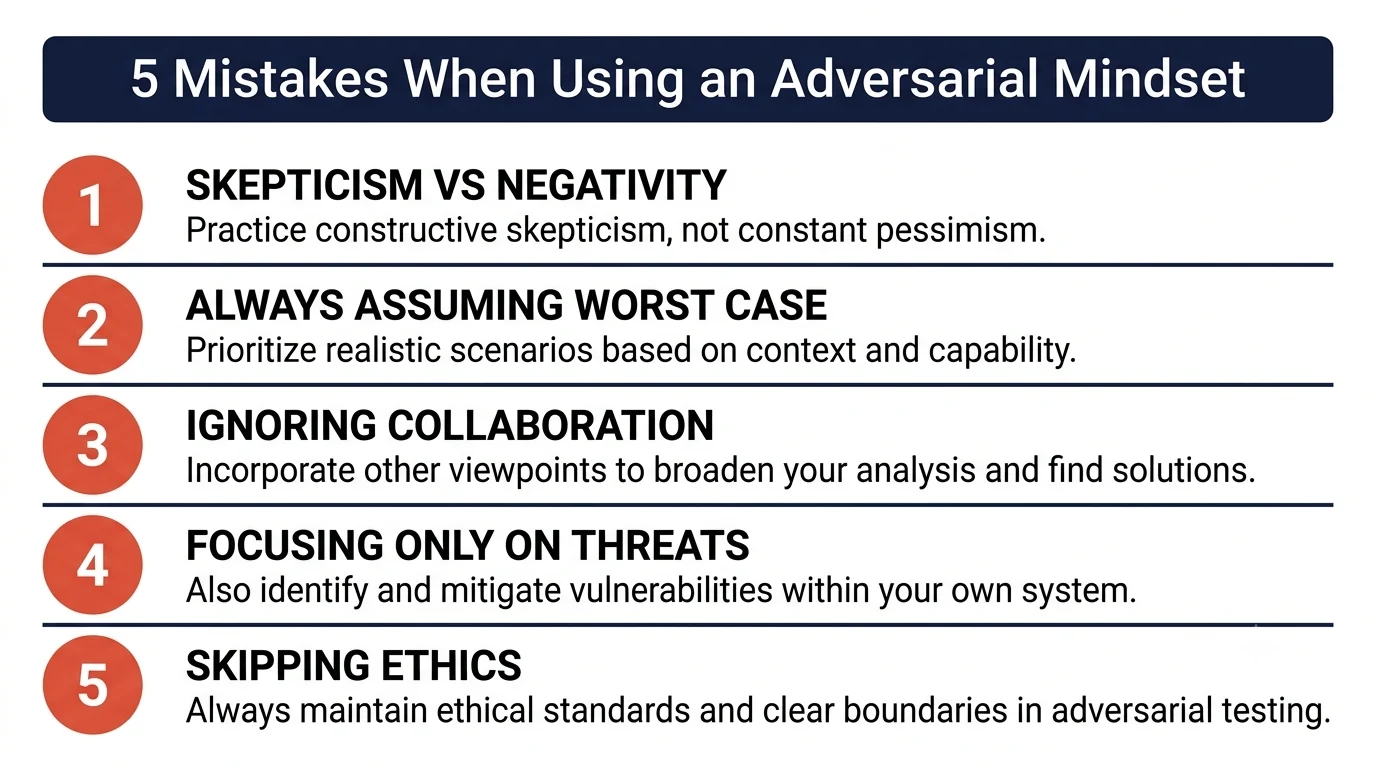
- Confusing skepticism with negativity — healthy skepticism challenges assumptions constructively; negativity assumes failure without analysis. Fix: focus on structured evaluation, not pessimism.
- Assuming worst-case scenarios every time — not every situation warrants maximum threat assessment. Fix: calibrate the level of adversarial analysis to the actual stakes and context.
- Ignoring collaboration — adversarial thinking is most effective as a team discipline, not a solo exercise. Fix: incorporate diverse perspectives into threat modeling and red-team sessions.
- Focusing only on threats — overemphasizing threats at the expense of opportunities leads to overly conservative decisions. Fix: balance adversarial analysis with opportunity assessment.
- Forgetting ethical considerations — adversarial thinking applied to systems without authorization is harmful and often illegal. Fix: always operate within clear ethical and legal boundaries.
Practical Examples Across Different Fields
- Cybersecurity — penetration testers simulate real attacks to find vulnerabilities before malicious actors do
- Business strategy — competitive analysts model rivals’ likely product launches, pricing moves, and market entries
- Software development — engineers conduct adversarial code reviews, identifying edge cases and injection vulnerabilities
- Product design — designers stress-test user flows by modeling how confused, frustrated, or malicious users might interact with a product
- Military planning — war gaming and red-team exercises simulate enemy strategies to improve defensive and offensive planning
- Negotiation — skilled negotiators model the other party’s interests, constraints, and alternatives to identify leverage points
- Personal decision-making — individuals apply pre-mortem thinking to major life decisions, imagining what could go wrong before committing
Frequently Overlooked Considerations
Several important aspects of the adversarial mindset are routinely absent from mainstream discussions of the concept.
When an adversarial mindset is unnecessary: Not every situation benefits from adversarial analysis. Routine, low-stakes decisions with well-understood outcomes rarely warrant the cognitive overhead of threat modeling. Applying the mindset indiscriminately can create unnecessary friction in collaborative environments and slow down decision-making without proportionate benefit.
Balancing optimism with skepticism: The adversarial mindset works best alongside a baseline of constructive optimism. Practitioners who apply only adversarial thinking tend toward risk aversion and may miss high-value opportunities. Effective thinkers calibrate between seeing what could go wrong and recognizing what could go right.
Team collaboration vs individual analysis: Individual adversarial thinking is limited by one person’s knowledge and blind spots. Team-based adversarial exercises — such as structured red-team sessions — produce significantly more comprehensive threat models by incorporating multiple professional perspectives.
Context-specific limitations: The adversarial mindset is most applicable in high-stakes, competitive, or security-sensitive environments. Its value diminishes in contexts built on trust, openness, and collaborative innovation where excessive skepticism can undermine the culture required for creative work.
Ethical responsibility: Identifying vulnerabilities carries an ethical obligation to handle that knowledge responsibly. Practitioners must be clear on the boundaries of authorized analysis and must not use adversarial insights for unauthorized access, manipulation, or harm.
Conclusion
The adversarial mindset is one of the most practical analytical frameworks available to professionals across cybersecurity, psychology, artificial intelligence, strategy, and personal decision-making. At its core, the adversarial mindset meaning is simple: think like your opponent to build better defenses and make smarter decisions. Its application, however, requires discipline, ethical awareness, and deliberate practice.
In cybersecurity, it drives penetration testing and threat modeling. In psychology, it builds cognitive flexibility and resilience. In AI safety, it powers robustness testing and alignment research. Across strategic and business contexts, it sharpens competitive analysis and risk planning. And in everyday personal decisions, it helps individuals anticipate failure points before they occur.
The key is balance: applying adversarial thinking proportionately, ethically, and collaboratively. When used responsibly, it is not a source of paranoia but a source of preparedness — one of the most durable advantages any individual or organization can develop.
Frequently Asked Questions
What is an adversarial mindset in simple terms?
An adversarial mindset means thinking like an opponent or attacker to identify weaknesses in your own plans, systems, or decisions before someone else exploits them. It is an analytical perspective used to improve defenses and anticipate risks, not a hostile or confrontational personality trait.This analytical approach shares foundational principles with the warrior mindset which similarly emphasizes mental preparedness, resilience, and anticipating challenges before they arise.
How is an adversarial mindset different from an adversarial attitude?
An adversarial mindset is a deliberate analytical tool — a way of thinking used to improve security and decision-making. An adversarial attitude is an emotional disposition toward conflict, opposition, or hostility. The mindset is strategic and controlled; the attitude is relational and often reactive. Confusing the two can damage team culture and professional relationships.
Why is the adversarial mindset important in cybersecurity?
In cybersecurity, thinking like an attacker allows security professionals to identify vulnerabilities before malicious actors do. It drives practices such as penetration testing, threat modeling, and defensive architecture. Without this perspective, defenders tend to overlook the creative and persistent approaches real attackers use.
How does psychology explain the adversarial mindset?
Psychologically, the adversarial mindset draws on cognitive flexibility, situational awareness, pattern recognition, and emotional regulation. It reflects a capacity for perspective-taking — accurately modeling the intentions and capabilities of an adversary — combined with disciplined critical thinking. It is not paranoia; it is structured defensive reasoning.
Can anyone develop an adversarial mindset?
Yes. The adversarial mindset is a learnable cognitive skill. Beginners can start with simple habits such as asking ‘what could go wrong?’ in planning situations and challenging their assumptions regularly. Deeper analytical capabilities develop through consistent practice, exposure to real-world failure cases, and structured exercises like red-teaming or threat modeling.
Is an adversarial mindset always beneficial?
Not always. Applying adversarial thinking indiscriminately in low-stakes or high-trust collaborative environments can create unnecessary friction, slow decisions, and erode team culture. The mindset is most valuable in high-stakes, security-sensitive, or competitive contexts. It should be balanced with optimism, collaboration, and contextual judgment.
How is the adversarial mindset used to evaluate AI systems?
AI systems, including large language models, are evaluated using adversarial testing by constructing inputs designed to elicit harmful, biased, or incorrect outputs. This process — sometimes called red-teaming for AI — uncovers weaknesses in model behavior, informs safety improvements, and supports responsible AI development. It applies the same perspective-shifting logic as human adversarial thinking to machine learning systems.
What is the difference between adversarial search and the adversarial mindset?
Adversarial search is a mathematical AI technique — specifically the minimax algorithm — used to make optimal decisions in two-player competitive games by modeling all possible moves and outcomes. The adversarial mindset is a human cognitive approach involving perspective-taking, threat identification, and defensive reasoning. One is a computational algorithm; the other is a psychological and strategic skill.