
Introduction
The Albert Einstein growth mindset is a phrase people use to describe how the physicist’s habits of curiosity, persistence, and continuous learning line up with modern growth-mindset psychology. Einstein lived and worked decades before psychologist Carol Dweck coined the term “growth mindset,” so he never used the phrase himself. Even so, his documented approach to problem-solving, experimentation, and learning from failure is frequently cited in discussions about intellectual development. This article explains what a growth mindset actually is, examines the historical evidence behind Einstein’s learning habits, and separates verified quotes from popular misattributions.
Quick Summary
- Albert Einstein demonstrated habits commonly associated with a growth mindset, including curiosity, persistence, and continuous learning.
- A growth mindset is the belief that abilities can improve through effort, practice, and effective learning strategies.
- Many quotes attributed to Einstein support growth-oriented thinking, although several popular quotes are misattributed to him.
- Applying Einstein-inspired principles can help improve learning, creativity, and problem-solving in everyday life.
What Is a Growth Mindset?
A growth mindset is the belief that intelligence, skills, and abilities can be developed over time through effort, practice, and effective learning strategies. This concept, introduced by psychologist Carol Dweck, sits at one end of a spectrum that contrasts with a fixed mindset, which holds that talent and intelligence are largely unchangeable traits. Understanding why a growth mindset matters helps explain why Einstein’s story continues to resonate in modern learning psychology.
People with a learning mindset tend to view intelligence development as an ongoing process rather than a fixed endpoint. This framework has become one of the most widely referenced models in educational psychology because it links directly to behaviors like effort, resilience, and continuous improvement. Rather than asking “how smart am I,” a growth-oriented learner asks “how can I get better at this.”
Growth Mindset vs Fixed Mindset
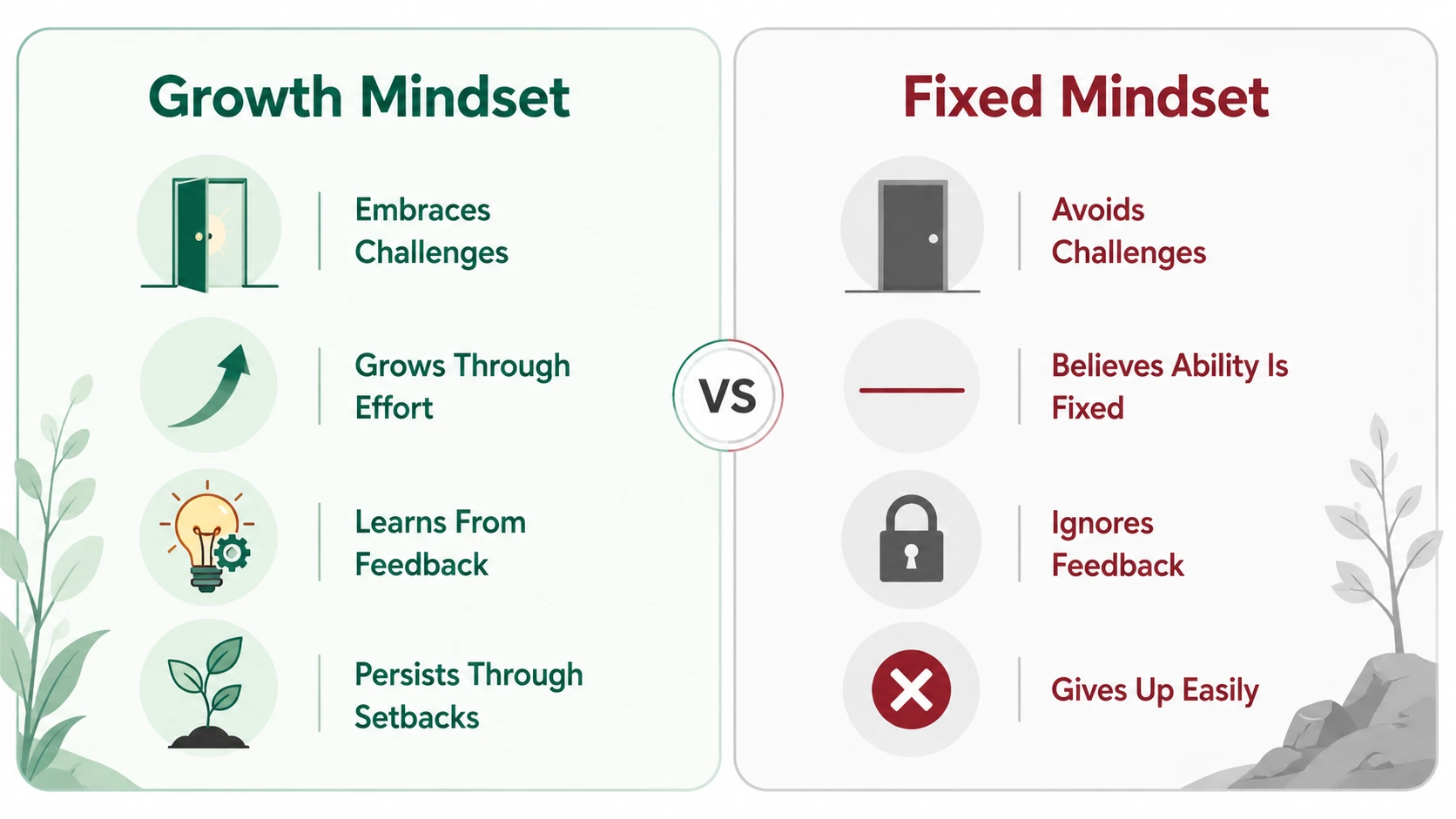
The core difference between these two mindsets lies in how a person interprets challenges, effort, and failure. A growth mindset treats setbacks as useful information; a fixed mindset treats setbacks as evidence of a personal limit. This difference shapes long-term learning outcomes far more than raw talent does.
| Growth Mindset | Fixed Mindset |
|---|---|
| Views challenges as opportunities | Avoids difficult tasks |
| Learns from mistakes | Fears failure |
| Believes skills can improve | Believes abilities are permanent |
| Values effort and strategy | Focuses mainly on talent |
Did Albert Einstein Have a Growth Mindset?
Albert Einstein did not have a growth mindset in the literal, formal sense, because the term was coined by Carol Dweck decades after his death in 1955. What historical evidence does show is that Einstein’s documented habits — sustained curiosity, tolerance for long periods of failure, and willingness to revise his own theories — closely mirror the behaviors that growth-mindset research associates with successful long-term learning.
This is why the phrase einstein growth mindset” appears so often in educational content: writers and educators use his life as a case study, not as a literal historical claim. Einstein’s own letters and recollections describe a person who struggled academically in some areas, was rejected from a technical program on his first attempt, and spent roughly a decade developing general relativity through repeated revision. These are patterns of effort and iteration, not evidence of innate, effortless brilliance.
Traits That Reflect Growth-Oriented Thinking
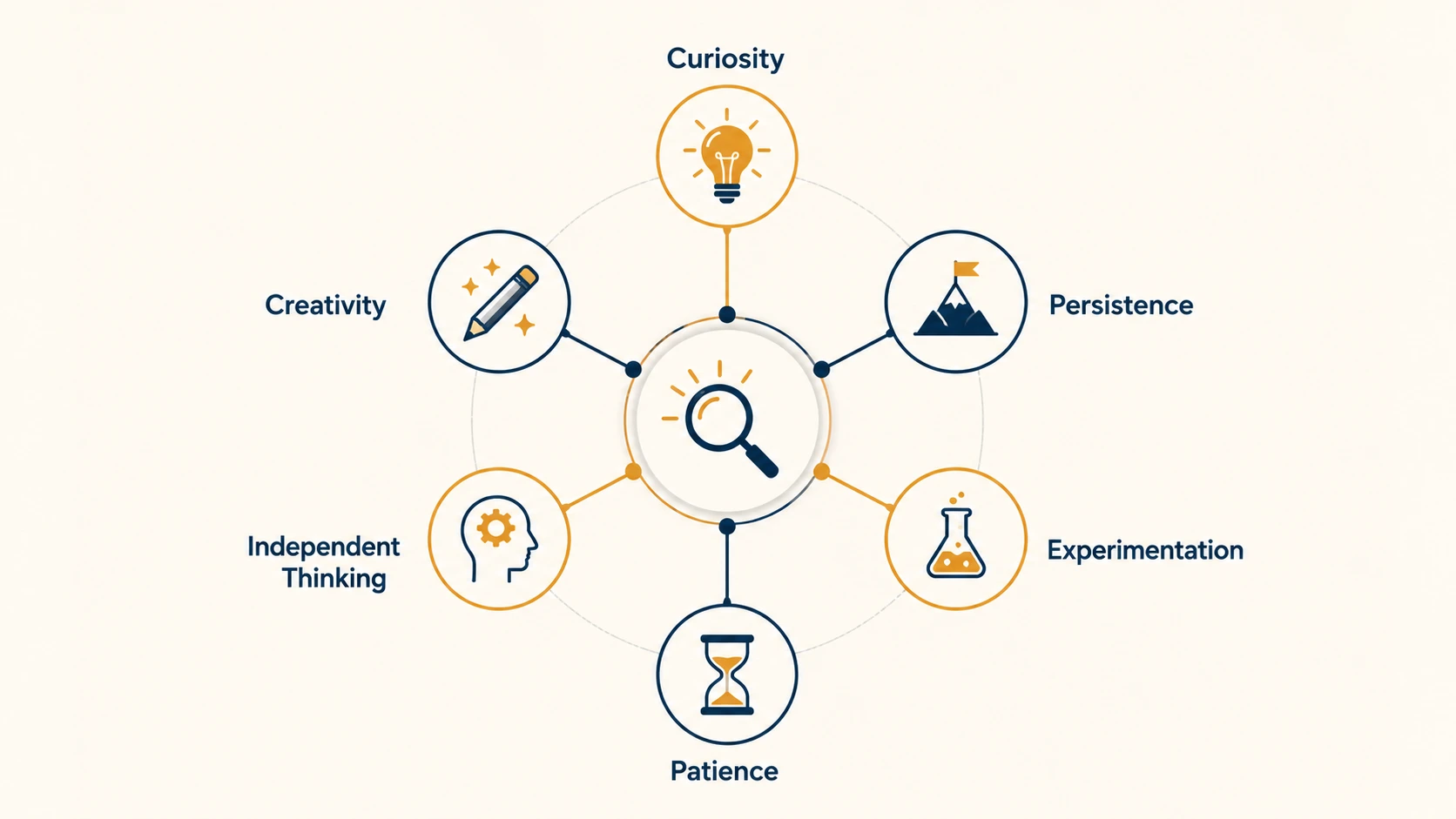
Several traits documented in Einstein’s biography and correspondence align with growth-mindset behavior:
- Curiosity — a well-documented, lifelong fascination with fundamental questions, dating back to childhood wonder at a compass
- Lifelong learning — continued engagement with physics, philosophy, and mathematics well into his later career
- Questioning assumptions — willingness to challenge established Newtonian physics rather than accept it uncritically
- Persistence through setbacks — years of failed attempts and revised equations before finalizing general relativity
- Independent thinking — developing ideas outside mainstream academic institutions during his early career
- Creativity — using visual thought experiments to explore abstract physical concepts
- Experimentation — testing ideas mentally before formal mathematical proof
- Patience with difficult problems — a documented willingness to remain with unsolved problems for extended periods
Why Albert Einstein Is Often Associated With a Growth Mindset
Einstein is a frequent reference point in educational psychology because his career illustrates several principles that align with modern learning theory: sustained curiosity, comfort with uncertainty, and recovery from academic and professional setbacks. Educators use his story to demonstrate that persistence and process-oriented learning matter as much as, or more than, raw aptitude.
His career touches several themes relevant to growth-oriented learning:
- Scientific curiosity that drove him to revisit foundational questions others considered settled
- Love of learning that extended beyond formal coursework into self-directed study
- Problem-solving through iterative refinement rather than single flashes of insight
- Imagination, expressed through thought experiments rather than laboratory equipment
- Learning through experimentation, in the conceptual rather than physical sense
- Resilience after failure, including early career setbacks and academic struggles
Examples From Einstein’s Life
Several documented episodes from Einstein’s career illustrate growth-oriented behavior in practice:
- Developing the theory of relativity over many years. Special relativity was published in 1905, but general relativity took roughly a decade of further refinement, published in 1915.
- Continuous refinement of ideas. Einstein revised his field equations multiple times before arriving at the final formulation of general relativity.
- Learning through thought experiments. Concepts like imagining riding alongside a beam of light helped him reason through problems before formal mathematics caught up.
- Academic struggles and persistence. Einstein failed the general portion of the entrance exam for the Swiss Federal Polytechnic on his first attempt and worked at the Swiss patent office rather than in academia during some of his most productive early years.
- Collaboration and intellectual discussion. Correspondence with peers such as Marcel Grossmann and later Cornelius Lanczos shows a pattern of testing and refining ideas through dialogue.
Albert Einstein Growth Mindset Quotes
Numerous quotes are circulated online under Einstein’s name to illustrate growth-oriented themes like curiosity, persistence, and learning. Some of these are well documented in Einstein’s letters and interviews; others are fabrications or statements made by different people entirely.
Verified vs Misattributed Quotes
Many popular “Einstein quotes” circulating on social media and inspirational content sites cannot be traced to any verified letter, interview, or publication. Researchers such as quote historian Garson O’Toole and editor Alice Calaprice, who compiled The Ultimate Quotable Einstein, have traced several of these back to other authors. Before using an inspirational quote for research, teaching, or content, it is worth checking a documented source rather than relying on secondhand attribution.
| Frequently Shared Quote | Historically Verified? | Growth Mindset Theme |
|---|---|---|
| “I have no special talent. I am only passionately curious.” | Yes — from a 1952 letter | Curiosity |
| “Life is like riding a bicycle. To keep your balance, you must keep moving.” | Yes — from a 1930 letter to his son | Persistence |
| “Everyone is a genius. But if you judge a fish by its ability to climb a tree…” | No — origin untraced, not linked to Einstein | Learning |
| “The definition of insanity is doing the same thing over and over and expecting different results.” | No — traced to later, unrelated sources | Persistence |
| “Two things inspire me to awe — the starry heavens above and the moral universe within.” | No — adapted from philosopher Immanuel Kant | Curiosity |
What Can We Learn From Einstein’s Approach to Learning?
Einstein’s documented learning habits offer practical lessons that apply well beyond physics. The recurring theme across his biography is process over shortcuts: asking better questions, tolerating long periods without answers, and treating errors as informative rather than discouraging. For readers who want to go deeper into the psychology behind these habits, our roundup of the best growth mindset books is a good next step.
Several transferable lessons stand out:
- Asking better questions rather than settling for surface-level explanations
- Deep thinking that prioritizes understanding over memorization
- Learning through mistakes, treating failed attempts as data rather than verdicts on ability
- Long-term persistence, since meaningful understanding of a hard problem often takes years, not days
- Independent learning, pursuing knowledge outside formal structures when necessary
- Reflective thinking, regularly revisiting and revising prior conclusions
Habits That Encourage Continuous Learning
- Read widely across subjects, not only within one specialty
- Stay curious about ordinary, overlooked phenomena
- Accept uncertainty as a normal part of the learning process
- Practice patience with problems that do not resolve quickly
- Review mistakes deliberately instead of avoiding them
- Experiment with new ideas before judging their value
- Think critically about assumptions, including your own
Practical Exercises Inspired by Albert Einstein’s Thinking
The exercises below are Einstein-inspired learning practices developed from the habits documented in his biography — they are not exercises Einstein himself created or prescribed.
Daily Growth Mindset Exercises
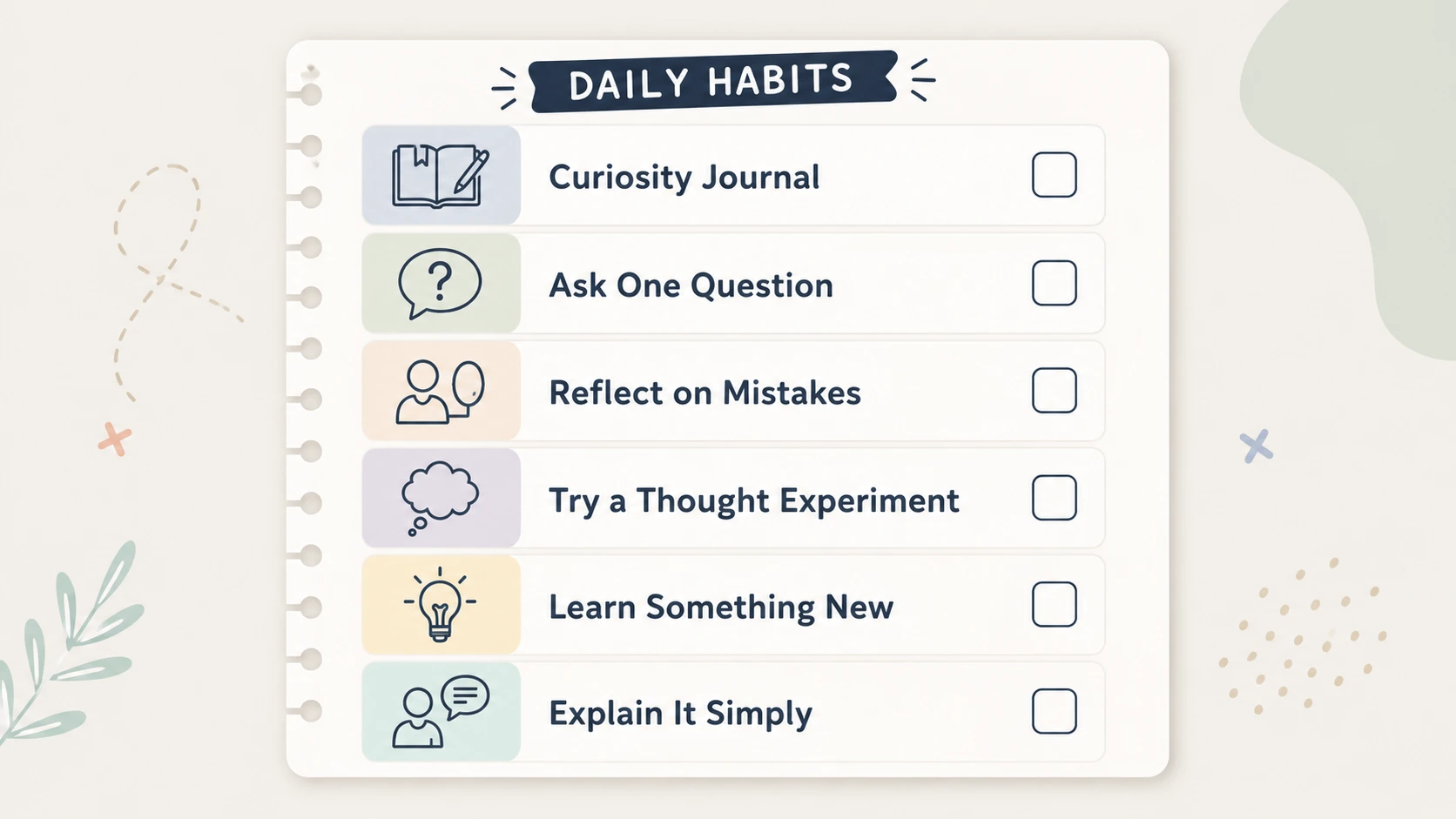
- Curiosity journal. Write down one question you cannot yet answer each day.
- Daily questioning exercise. Pick one assumption in your work or studies and ask why it is true.
- Problem-solving challenges. Spend focused time on one unresolved problem without seeking an immediate answer.
- Reflection writing. Summarize what you learned from a recent mistake.
- Thought experiments. Mentally walk through a scenario or concept step by step, as Einstein did with light and motion.
- Learning something unfamiliar. Study a topic outside your usual field for a short, regular period.
- Explaining complex ideas simply. Try to describe a difficult concept in plain language, which tests real understanding.
Common Misconceptions About Einstein and Intelligence
Einstein’s fame has made him the subject of several widely repeated intelligence myths. Two of the most common involve claims about brain usage and secondhand assumptions about innate genius.
The “Mind Use Percentage” Myth
Humans do not use only 10 percent of their brains — this claim is a myth with no basis in neuroscience, and it has never been reliably linked to anything Einstein actually said. Brain imaging techniques such as fMRI and PET scans show that virtually all regions of the brain are active over the course of a day, even though not every region fires simultaneously for every task. The “10 percent” figure has been traced to unrelated self-help literature from the mid-20th century, not to Einstein or to any peer-reviewed scientific source. It continues to circulate because it is intuitive and motivational, not because it is accurate.
Growth Mindset vs Natural Genius: Which Matters More?
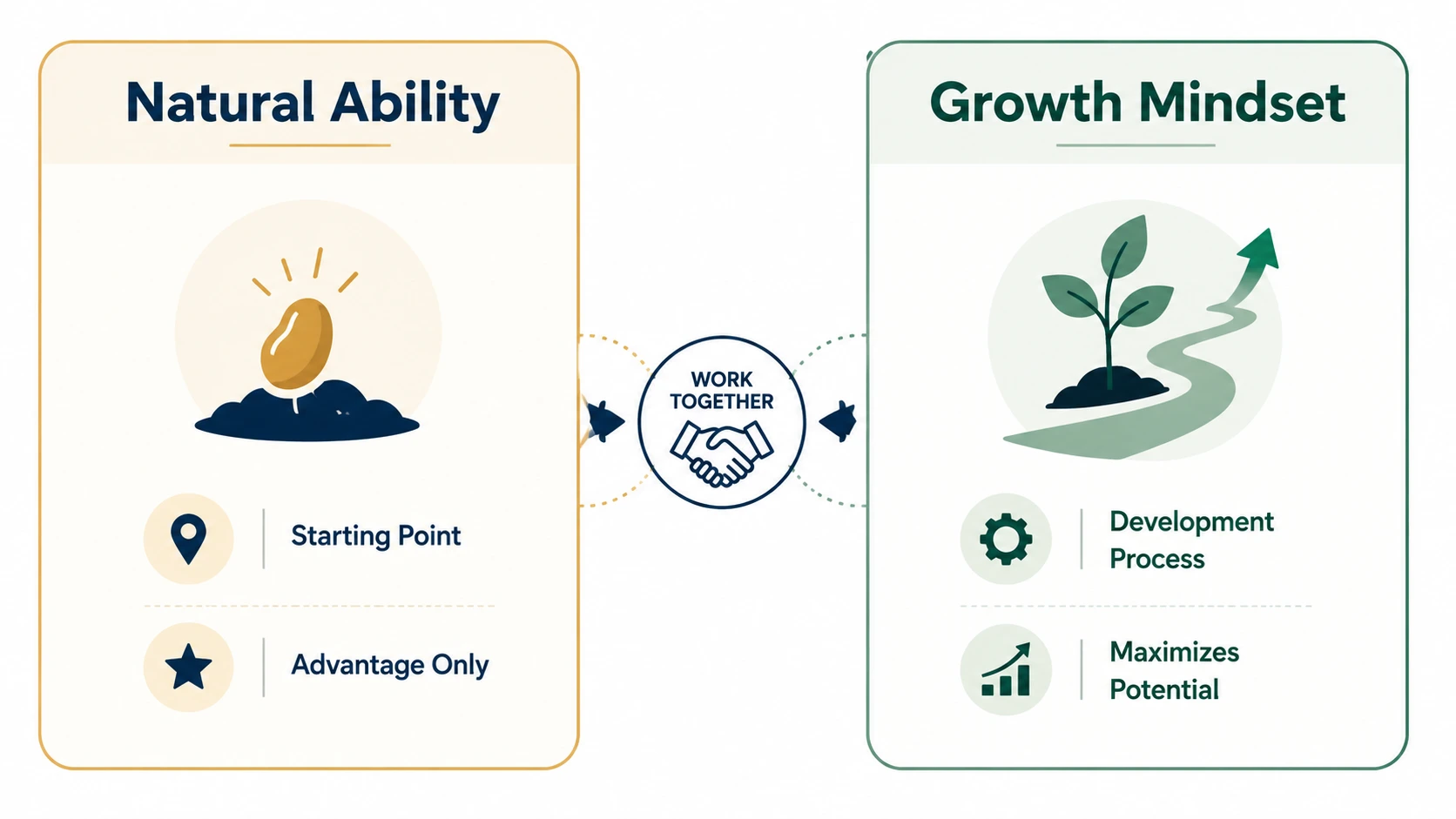
Modern research treats natural ability and growth mindset as complementary rather than competing factors. Talent may provide a starting advantage, but sustained progress depends heavily on deliberate practice, persistence, and the learning environment a person has access to.
| Natural Ability | Growth Mindset |
|---|---|
| Starting point | Development process |
| May provide advantages | Helps maximize potential |
| Cannot replace learning | Encourages continuous improvement |
Deliberate practice — focused, feedback-driven repetition — consistently predicts skill development better than raw aptitude alone across many fields studied in behavioral science. Opportunity and environment also shape outcomes significantly, meaning growth mindset works best when paired with access to good instruction, feedback, and resources.
Common Beginner Mistakes When Applying a Growth Mindset
People new to growth-mindset practice often misunderstand what the approach actually requires, which can undermine progress before it starts.
- Expecting immediate results. Meaningful skill development takes weeks or months, not days.
- Confusing effort with effective practice. Time spent is not the same as targeted, feedback-driven practice.
- Ignoring feedback. Growth requires acting on corrective information, not just working harder.
- Fear of making mistakes. Avoiding errors also avoids the information needed to improve.
- Comparing progress with others. Individual learning curves vary significantly based on background and circumstances.
These mistakes typically occur because growth mindset is sometimes oversimplified into “just try harder,” without the accompanying emphasis on strategy and reflection. Addressing them involves setting realistic timelines, seeking specific feedback, and treating errors as expected steps in the learning process rather than signs of failure.
Applying Einstein-Inspired Thinking in Everyday Life
Curiosity- and persistence-driven habits translate across a wide range of roles and life stages, not just scientific research.
- Students can apply patient, question-driven study habits instead of relying on memorization alone.
- Professionals can use reflective practice to identify skill gaps and target development deliberately.
- Researchers can apply long-term persistence when working on problems without immediate answers.
- Entrepreneurs can treat failed attempts as data for iterating on a business idea.
- Lifelong learners can maintain curiosity habits, such as regularly exploring unfamiliar topics.
These habits support broader capabilities including decision-making, creativity, innovation, problem-solving, and adaptability — all areas where a growth-oriented approach to learning tends to outperform a fixed, talent-only mindset over time.
Difficulty and Time Investment
Building growth-mindset habits is beginner-friendly at the start but requires sustained effort to produce lasting change. Simple practices, such as a daily curiosity journal, take only a few minutes and require no special tools. More advanced practices, such as sustained deliberate practice in a skill area, require consistent weekly time investment and active feedback-seeking.
Time commitment varies by individual circumstances, including existing habits, available time, and access to feedback or mentorship. Beginners typically benefit from starting with one or two small daily practices rather than attempting a full routine at once.
Results Timeline
Early mindset shifts, such as noticing fewer moments of self-doubt after a mistake, can appear within the first few weeks of consistent practice. Measurable skill improvements generally take longer, often becoming noticeable over one to three months of regular, deliberate effort. Long-term habit formation — where growth-oriented thinking becomes automatic rather than effortful — typically develops over six months or more.
Progress speed depends on several factors, including consistency, the difficulty of the skill being developed, and the quality of feedback available during practice. Setbacks and plateaus are a normal part of this timeline, not signs that the approach is failing.
Practice Guide
Sustaining a growth-mindset approach over time benefits from structure rather than relying on motivation alone.
- Daily routines. Short, consistent practices, such as a five-minute curiosity journal, build habit strength more reliably than occasional long sessions.
- Weekly reflection. Set aside time each week to review what was learned and where progress stalled.
- Goal setting. Define specific, process-based goals rather than vague outcome goals.
- Progress tracking. Keep a simple log of attempts, mistakes, and adjustments to see patterns over time.
- Accountability methods. Share goals with a peer, mentor, or study group to maintain consistency.
- Maintaining curiosity. Deliberately explore unfamiliar topics on a regular schedule to keep learning habits active.
- Sustainable learning habits. Favor small, repeatable practices over intensive but unsustainable routines.
- Adapting practices to different lifestyles. Adjust time commitments and formats based on work schedule, energy levels, and season of life.
As of 2026, behavioral science guidance increasingly emphasizes short, consistent practice sessions supported by regular feedback over long, infrequent study blocks, reflecting updated research on habit formation and skill retention.
Conclusion
Albert Einstein’s approach to learning — marked by curiosity, patience with difficult problems, and willingness to revise his own ideas — reflects many characteristics associated with a growth mindset, even though the term itself did not exist during his lifetime. In our experience helping readers build better learning habits, the details of Einstein’s story consistently reinforce a simple point: curiosity, persistence, thoughtful practice, and continuous learning are skills anyone can cultivate, not traits reserved for a select few. Focusing on effective learning habits, rather than relying solely on perceived natural ability, is the most practical takeaway from the Albert Einstein growth mindset conversation — and one that applies well beyond physics.
Frequently Asked Questions
Did Albert Einstein actually have a growth mindset?
Einstein did not use the term “growth mindset,” since it was coined decades after his death, but historical evidence of his curiosity, persistence, and iterative approach to problem-solving closely matches growth-mindset behaviors described in modern psychology.
What is a growth mindset in simple terms?
A growth mindset is the belief that abilities and intelligence can improve through effort, practice, and effective learning strategies, rather than being fixed traits a person is simply born with. This concept, introduced by psychologist Carol Dweck, sits at one end of a spectrum that contrasts with a fixed mindset — and her own words on the topic remain some of the most cited growth mindset quotes from Carol Dweck in psychology today.
Why is Albert Einstein often used as an example of a growth mindset?
Einstein is used as an example because his documented habits — sustained curiosity, tolerance for years of failed attempts, and willingness to revise his own theories — illustrate growth-oriented learning in practice, making his story a relatable teaching case.
Are Albert Einstein growth mindset quotes historically accurate?
Some quotes attributed to Einstein are verified through letters and documented interviews, but many widely shared quotes, including the popular “insanity” and “genius fish” quotes, have been traced to other sources and are not historically accurate.
Can anyone develop a growth mindset like Einstein?
Yes, growth-mindset research indicates that curiosity, persistence, and reflective learning habits can be developed by most people through consistent practice, rather than depending on innate talent.
What daily habits reflect a growth mindset?
Daily habits that reflect a growth mindset include staying curious about unfamiliar topics, reviewing mistakes for lessons rather than avoiding them, practicing patience with unresolved problems, and seeking feedback regularly.
Is intelligence fixed or can it improve over time?
Behavioral science generally supports the view that many cognitive skills can improve over time through effective learning strategies and practice, although some aspects of ability, such as processing speed, involve both environmental and biological factors.
Did Einstein really say people use only a small percentage of their brain?
No, there is no credible evidence Einstein made this claim, and neuroscience research using brain imaging shows that virtually all regions of the brain are used, just not all simultaneously for a single task.
Meta Title: Albert Einstein Growth Mindset: What It Really Means (2026)
Meta Description: Did Albert Einstein have a growth mindset? Explore the psychology, verified quotes, and practical lessons behind the Albert Einstein growth mindset.