
Introduction
A community mindset is a way of thinking that puts shared goals, mutual support, and collective well-being ahead of purely personal interests. Rather than asking “what benefits me,” someone with a community mindset asks “what benefits us.” The community mindset meaning centers on connection: people see themselves as part of a larger group whose success is tied to their own. Community mindset psychology draws on cooperation, empathy, and social identity to explain why humans naturally gravitate toward group belonging. This way of thinking matters far beyond neighborhoods — it shapes workplaces, schools, volunteer groups, and online communities, influencing how effectively people collaborate, trust one another, and solve shared problems.
Quick Summary
- Community mindset is a way of thinking that prioritizes shared goals, mutual support, and collective success.
- It is influenced by psychological principles such as cooperation, empathy, belonging, and social identity.
- Individuals and organizations with a community-oriented mindset often build stronger relationships, trust, and long-term resilience.
- Community mindset can be intentionally developed through habits, communication, collaboration, and shared responsibility.
What Is a Community Mindset?
Community Mindset Meaning
Community mindset meaning refers to an orientation toward collective well-being rather than solely individual advancement. A person with this mindset views their actions as connected to a group’s outcomes, not as isolated events. This differs from behavior: mindset is the underlying belief system, while behavior is the visible action that results from it. Someone can behave cooperatively out of obligation, but a true community mindset means cooperation stems from genuine belief in shared responsibility.
Core Principles of a Community Mindset
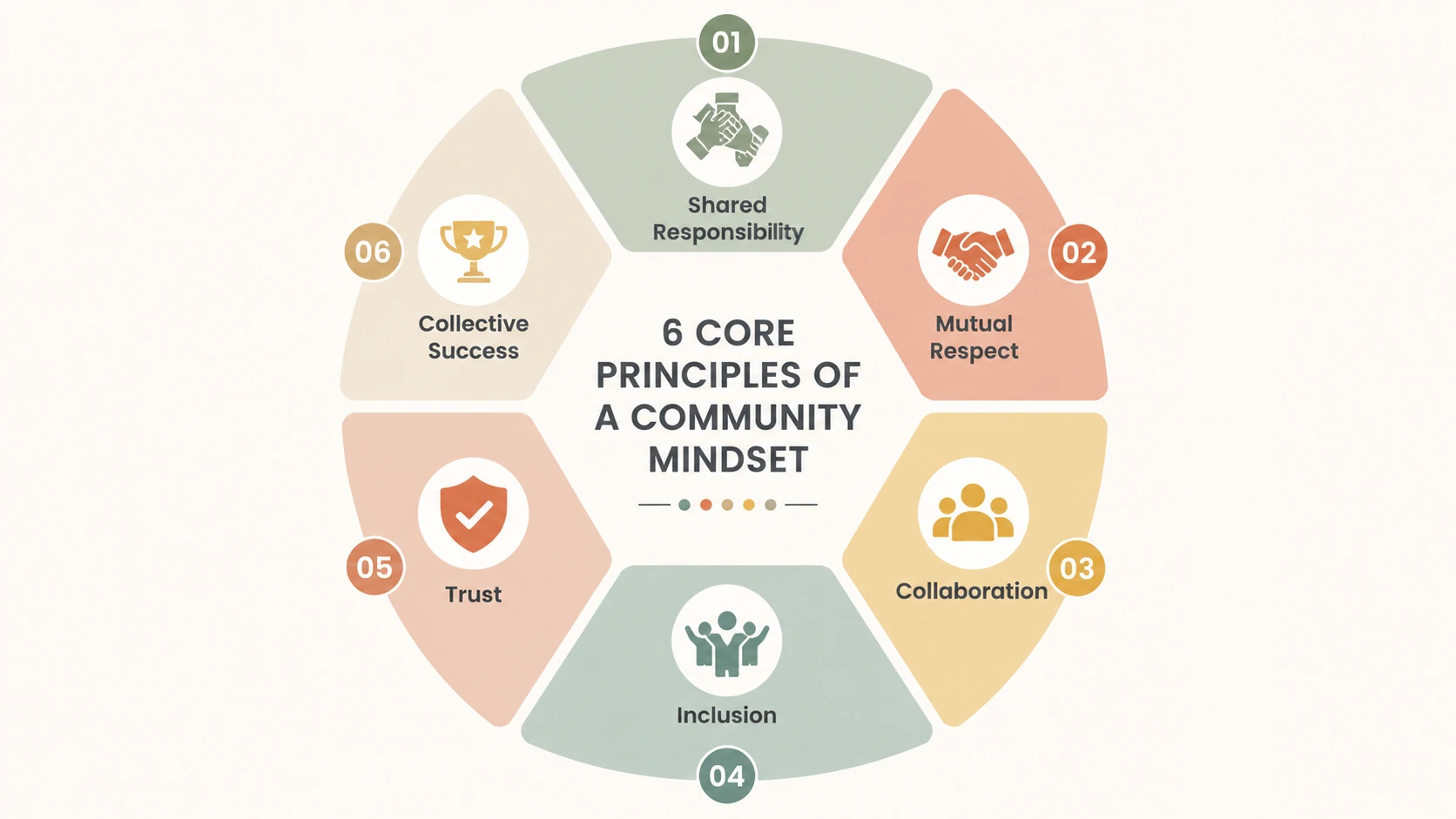
A community mindset rests on several core principles:
- Shared responsibility
- Mutual respect
- Collaboration
- Inclusion
- Trust
- Collective success over individual gain
These principles show up in daily habits and decisions. Key supporting behaviors include:
- Cooperation
- Empathy
- Accountability
- Participation
- Long-term thinking
- Shared ownership
The Psychology Behind Community Mindset
How Community Mindset Develops
Community mindset psychology suggests this orientation develops gradually through several influences: Community mindset psychology draws on broader principles of mindset psychology, including how beliefs form, evolve, and influence behavior over time.
- Early childhood experiences, especially cooperative play and shared caregiving
- Family influence and modeled behavior around helping others
- Education systems that reward group work and peer learning
- Cultural values that emphasize collectivism over individualism
- Broader social learning, where people adopt norms observed in their communities
- Environmental influences, including neighborhood stability and access to shared resources
Psychological Factors That Encourage Community Thinking
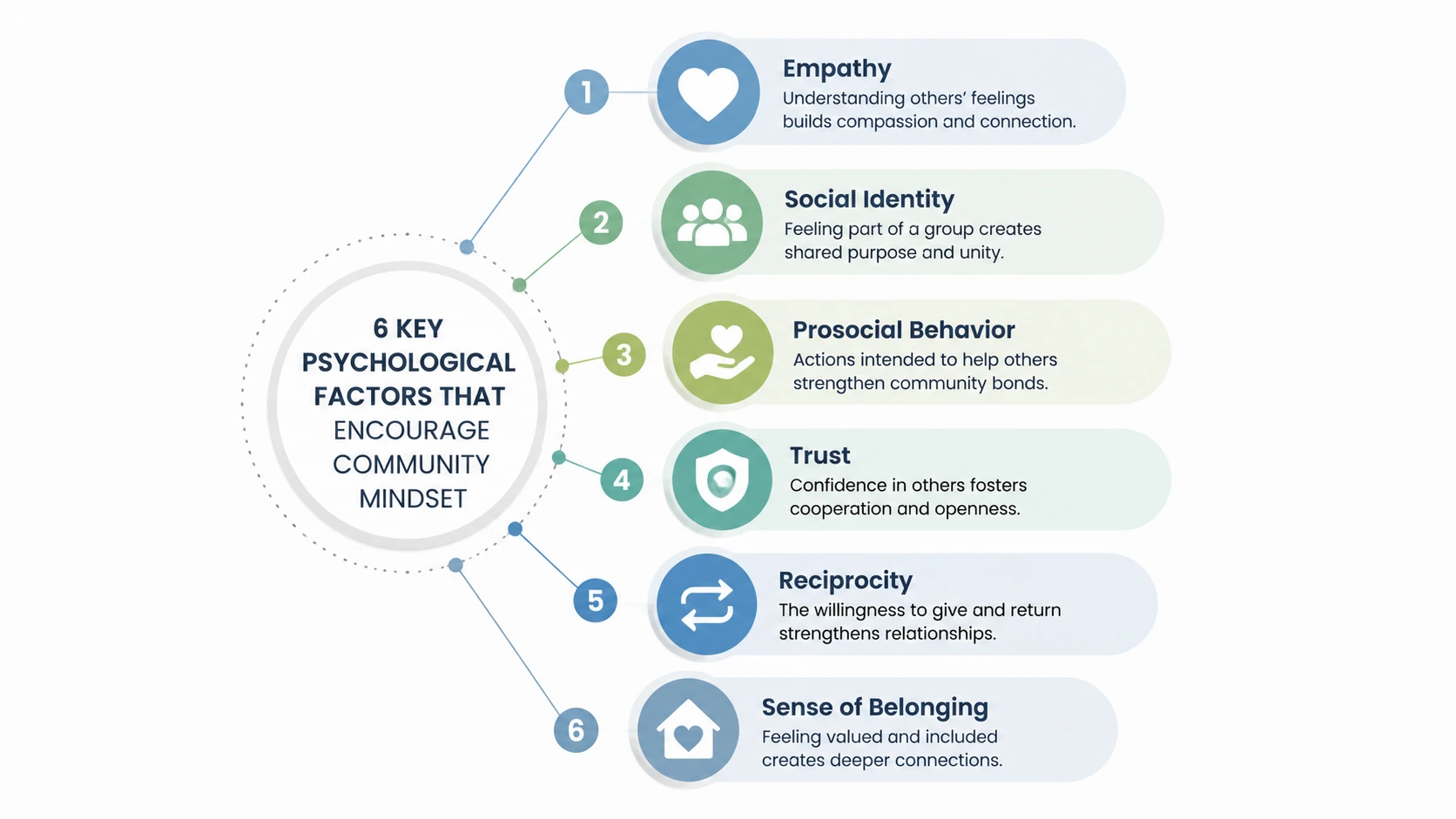
Several psychological mechanisms support community-oriented thinking: Empathy doesn’t just strengthen communities — it’s also foundational to close personal bonds; see why empathy is important in relationships for a closer look at how it plays out one-on-one.
- Empathy — the ability to understand and share others’ feelings
- Social identity — defining part of one’s self-concept through group membership
- Prosocial behavior — voluntary actions intended to benefit others
- Trust — the belief that others will act reliably and fairly
- Reciprocity — the expectation that helping others will be returned
- Sense of belonging — feeling accepted and valued within a group
Why Humans Naturally Form Communities
From an evolutionary perspective, humans formed communities because cooperation improved survival. Working together provided safety in numbers, access to shared resources, and emotional support during hardship. These evolutionary roots help explain why community mindset psychology remains deeply embedded in human behavior today, even in modern, less physically dangerous environments.
Community Mindset vs Individual Mindset
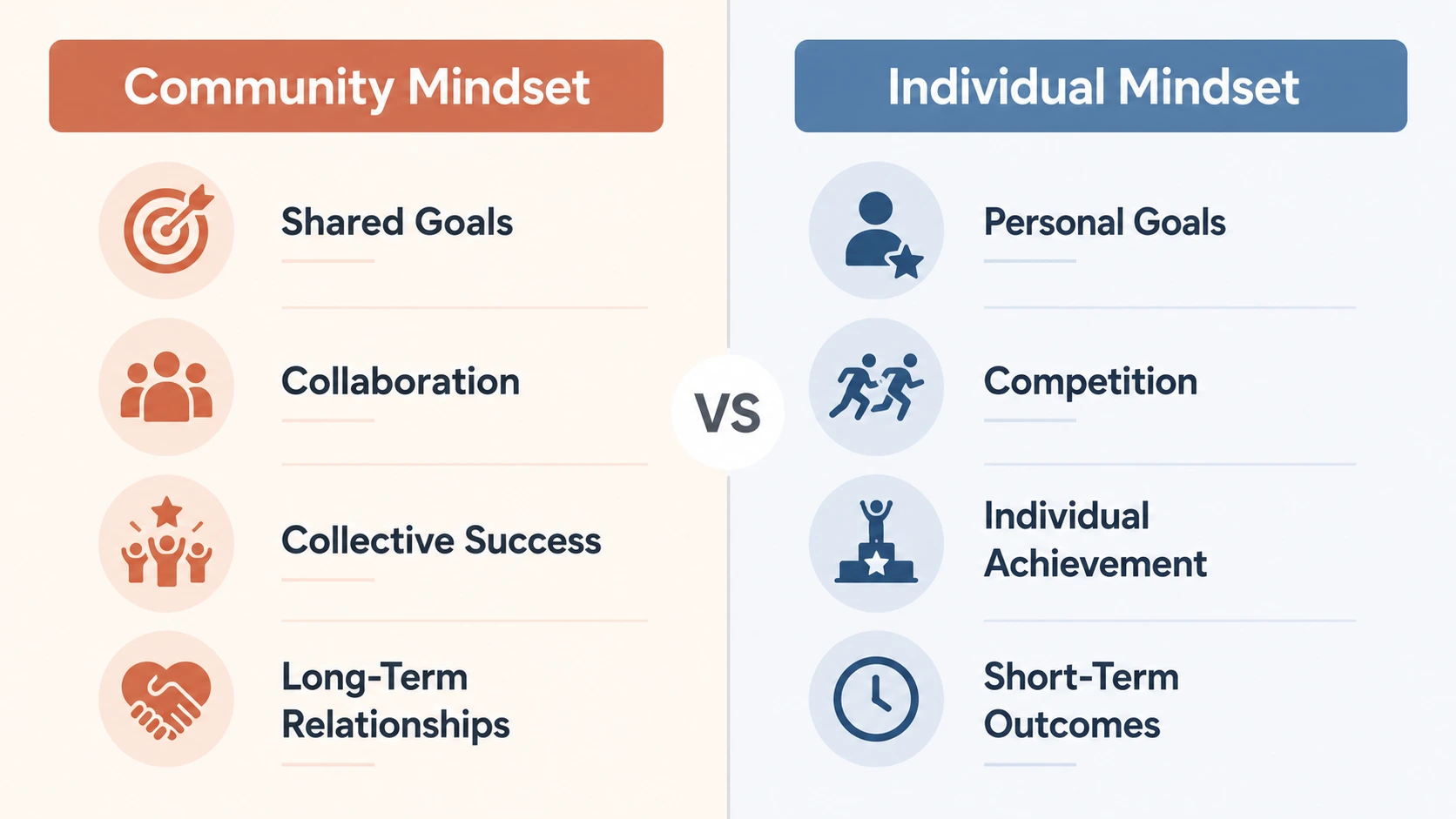
Understanding community mindset vs individual mindset helps clarify when each approach is most useful.
| Community Mindset | Individual Mindset |
|---|---|
| Shared goals | Personal goals |
| Collaboration | Competition |
| Collective success | Individual achievement |
| Shared responsibility | Personal responsibility |
| Long-term relationships | Short-term outcomes |
When Each Mindset Is Appropriate
A community mindset works best in situations requiring collaboration, such as team projects, neighborhood initiatives, or group problem-solving. An individual mindset is more appropriate when quick, independent decision-making is needed, such as personal career choices or time-sensitive tasks. Most well-adjusted individuals and organizations benefit from balancing both perspectives, applying collective thinking where it strengthens outcomes and independent thinking where autonomy is essential.
Examples of Community Mindset in Everyday Life
A community mindset example can be found in nearly every setting where people interact regularly.
Personal Life Examples
- Helping neighbors with errands or emergencies
- Volunteering time for local causes
- Supporting small businesses and local initiatives
Workplace Examples
- Cross-team collaboration on shared projects
- Open knowledge sharing instead of information hoarding
- Mentorship programs that support newer employees
- Team accountability for collective results
School and Educational Examples
- Group projects that require coordinated effort
- Peer learning and tutoring
- Inclusive classrooms that welcome diverse perspectives
Online Community Examples
- Knowledge sharing on forums and Q&A platforms
- Respectful, constructive discussions
- Open-source software collaboration
- Volunteer community moderation
Types of Community-Oriented Mindsets
Several related terms describe slightly different applications of community thinking.
Community-Oriented Mindset
Emphasizes service and active engagement with the needs of a group, often used in leadership and public service contexts.
Community-Focused Mindset
Highlights prioritizing shared priorities over individual agendas, common in organizational strategy discussions.
Community-Driven Mindset
Describes decisions and initiatives led directly by community members rather than imposed from outside, often used in development projects.
Community-Centered Mindset
Places people and their needs at the core of decision-making, frequently used in social program design.
Community-Based Mindset
Refers to approaches rooted in local knowledge and grassroots participation.
Community First Mindset
Signals that community interests are prioritized ahead of individual or organizational gain when decisions are made.
While these terms overlap significantly, each is commonly used in slightly different contexts — leadership, development work, social programs, or grassroots organizing.
Growth Mindset and Community Mindset
How They Complement Each Other
A growth mindset community pairs well with collective thinking. When groups embrace continuous improvement, shared learning becomes a group asset rather than an individual pursuit. This combination fosters a learning culture where mistakes are treated as opportunities and collective resilience increases over time. This pairing works because growth mindset already emphasizes continuous improvement — community settings simply extend that improvement from the individual to the group.
Building a Community Growth Mindset
A community growth mindset can be strengthened by:
- Encouraging open, constructive feedback
- Celebrating incremental progress, not just final outcomes
- Treating mistakes as shared learning opportunities rather than individual failures
Community Mindset in Leadership and Organizations
Building Community Within Teams
Leaders foster community mindset by creating shared vision and consistent communication across teams.
Community Mindset in Nonprofits
Nonprofits rely heavily on community mindset to coordinate volunteers, donors, and beneficiaries toward common goals.
Community Mindset in Local Government
Local governments benefit from community mindset when designing policies that reflect resident input and shared civic responsibility.
Community Mindset in Businesses
In businesses, community mindset supports:
- Shared vision across departments
- Higher employee engagement
- Stronger internal trust
- Better cross-functional collaboration
- Long-term organizational sustainability
Community Mobilization and Mindset Change
What Is Community Mobilization?
Community mobilization is the process of organizing people around a shared cause to create collective action and measurable change.
Why Mindset Change Matters
Mindset change matters because sustainable community mobilization and mindset change depend on shifting how people think, not just what they do temporarily. Lasting change requires internal belief shifts, not only short-term compliance.
Stages of Community Change
Community change typically progresses through awareness, growing engagement, active participation, and eventually sustained collective action.
Factors That Support Lasting Change
- Awareness of shared issues
- Consistent participation
- Clear, trusted leadership
- Open communication
- Shared ownership of outcomes
How the Behavior and Mindset of Community Members Influence Success
To discuss how the behaviour mindset of community members shapes outcomes, it helps to separate strengthening behaviors from weakening ones.
Positive Behaviors That Strengthen Communities
Cooperation, respect, accountability, volunteerism, and inclusion all reinforce collective trust and effectiveness.
Behaviors That Weaken Communities
Exclusion, poor communication, blame-shifting, and inconsistent participation erode trust and slow collective progress.
Encouraging Positive Participation
Communities can encourage positive participation through consistent recognition, transparent conflict resolution processes, and accessible opportunities to contribute.
Benefits of Developing a Community Mindset
Developing a community mindset offers measurable advantages:
- Stronger relationships
- Greater trust
- Better communication
- Higher participation
- Improved mental well-being
- Shared learning
- Increased resilience
- Better problem-solving
- Sustainable community growth
In our experience helping readers build better habits, those who intentionally practice community-oriented thinking report feeling more supported during difficult transitions, since they are less likely to face challenges in isolation.
Common Challenges and Misconceptions
Common Beginner Mistakes
- Confusing agreement with genuine collaboration
- Ignoring diverse perspectives within the group
- Expecting immediate trust without consistent effort
- Poor or inconsistent communication
- Low or sporadic participation
Practical Ways to Overcome These Challenges
- Practicing active listening in group settings
- Communicating transparently, even during disagreements
- Making decisions inclusively rather than top-down
- Participating consistently, not just during major events
- Building trust gradually through repeated reliable actions
Practical Ways to Build a Strong Community Mindset
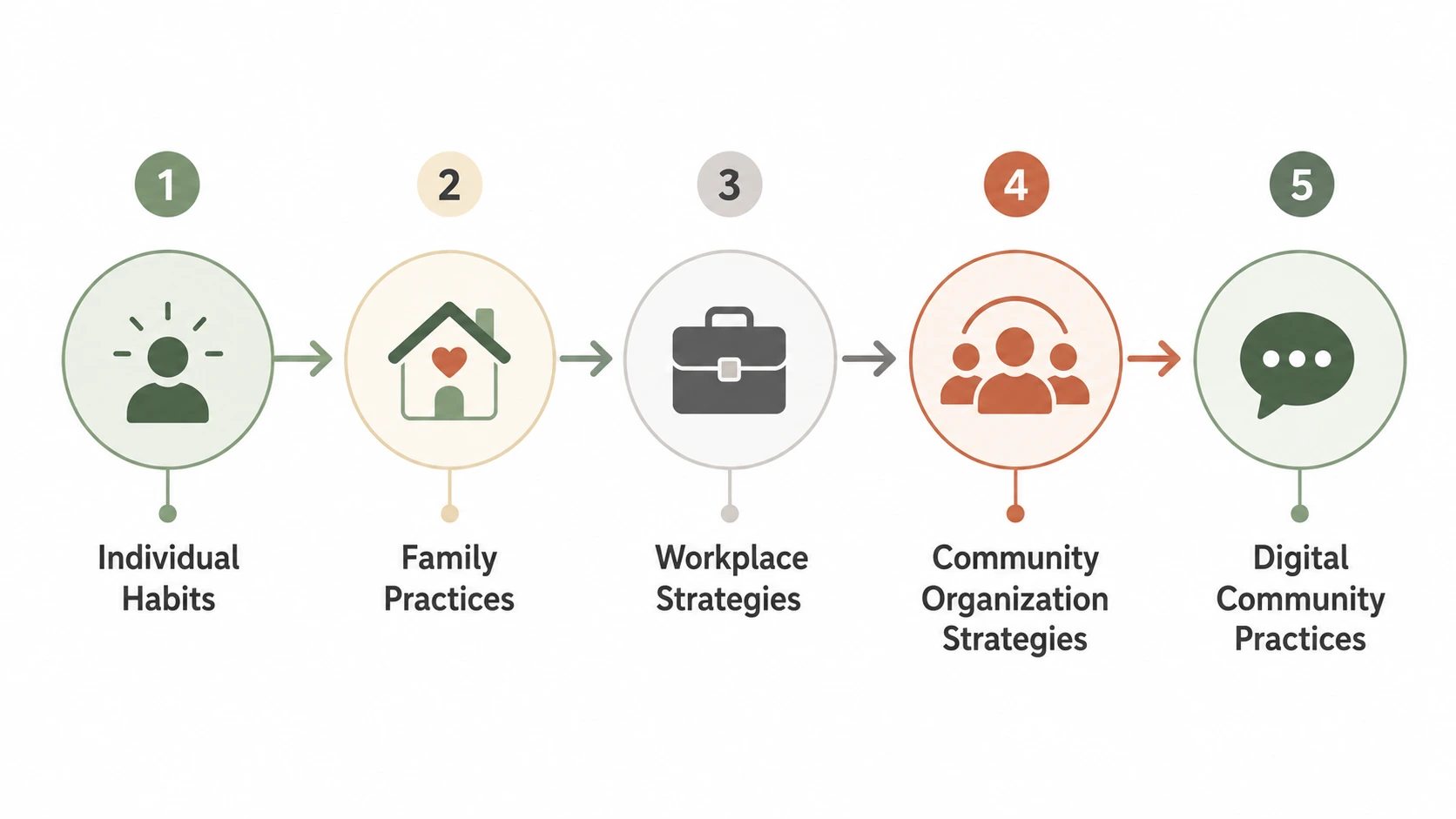
Individual Habits
Daily actions such as checking in on others, offering help without being asked, and practicing gratitude support community thinking.
Family Practices
Shared chores, collaborative decision-making, and open communication build a family-level community mindset.
Workplace Strategies
Setting shared goals, recognizing team contributions, and encouraging cross-team communication strengthen workplace community.
Community Organization Strategies
Volunteer opportunities, inclusive leadership structures, and regular community forums support broader collective engagement.
Digital Community Best Practices
Clear community guidelines, respectful moderation, and consistent recognition of contributors help online communities maintain a healthy, community-first culture. Your Daily Thrive recommends starting small — consistent, modest contributions build trust faster than occasional large gestures.
Frequently Used Terms Related to Community Mindset
| Term | Meaning | When Commonly Used |
|---|---|---|
| Community mindset | Overall concept | General discussions |
| Community-oriented mindset | Service and collaboration | Leadership |
| Community-focused mindset | Shared priorities | Organizations |
| Community-driven mindset | Community-led decisions | Development projects |
| Community-centered mindset | People-first approach | Social programs |
These terms are sometimes used interchangeably as community minded synonyms, though each carries a slightly different emphasis depending on context.
Common Questions About Community Mindset Resources
Are There Community Mindset PDFs and Learning Resources?
Yes, community mindset PDFs and other learning materials exist across academic, nonprofit, and organizational sources. Rather than relying on format alone, it is more useful to evaluate any resource — PDF, article, or course — based on credibility, supporting evidence, and the reputation of its publishing source.
SERP Gap — What Most Articles Miss About Community Mindset
Many existing resources overlook important nuances, including:
- How community mindset applies specifically within digital and online communities
- Practical methods for balancing individual needs with collective goals
- The influence of cultural background on community-oriented thinking
- Ways to measure genuine community engagement, not just participation counts
- Long-term sustainability strategies beyond initial enthusiasm
- Real-world implementation challenges organizations face when adopting community mindset
- Rebuilding trust after conflict within a community
- How community mindset shifts across different life stages, from childhood to older adulthood
Addressing these gaps helps readers apply community mindset concepts more realistically, beyond surface-level definitions.
Conclusion
Community mindset means choosing collective well-being alongside personal goals — a way of thinking rooted in empathy, trust, cooperation, and shared responsibility. As explored throughout this article, community mindset psychology explains why this orientation comes naturally to humans, while practical habits show how it can be intentionally strengthened in families, workplaces, schools, and online spaces. Ultimately, a strong community mindset is not a fixed trait; it is a learnable approach built through consistent behaviors, open communication, and shared values that benefit both individuals and the groups they belong to.
Frequently Asked Questions
What is a community mindset?
A community mindset is a way of thinking that prioritizes shared goals, mutual support, and collective success over purely individual interests.
Why is community mindset important?
It builds trust, strengthens relationships, and improves collaboration, making groups more resilient and effective at solving shared problems.
How does community mindset differ from an individual mindset?
Community mindset emphasizes collaboration and shared outcomes, while individual mindset focuses on personal goals and independent achievement.
What psychological principles influence a community mindset?
Empathy, social identity, prosocial behavior, trust, reciprocity, and a sense of belonging all shape community-oriented thinking.
Can a community mindset be developed over time?
Yes, it can be strengthened through consistent habits like active listening, transparent communication, and regular participation in group efforts.
What are some real-life examples of a community mindset?
Examples include volunteering, cross-team workplace collaboration, peer learning in schools, and respectful participation in online communities.
How does community mindset improve teamwork?
It encourages shared accountability, open communication, and trust, which help teams coordinate more effectively toward common goals.
What challenges can prevent a strong community mindset?
Common challenges include poor communication, low participation, ignoring diverse perspectives, and expecting trust to form immediately.
How does community mobilization support mindset change?
Community mobilization organizes people around shared causes, encouraging engagement and participation that can shift beliefs and drive lasting collective change.
What are the key characteristics of a community-oriented mindset?
Key characteristics include shared responsibility, mutual respect, inclusion, collaboration, trust, and prioritizing collective success over individual gain.