
Table of Contents
ToggleIntroduction
Hope vs fear describes two emotional forces that shape human behavior, habits, and decision-making. Hope encourages people to move toward growth, opportunity, and future improvement, while fear focuses on protection, survival, and avoiding pain. Both emotions influence mindset, motivation, consistency, and emotional resilience.
People often operate from either growth-oriented hope or protection-oriented fear without realizing it. Fear can prevent risk and protect people from danger, but excessive fear can also limit progress and create avoidance behaviors. Hope supports long-term thinking, persistence, and adaptability during setbacks.
Neither emotion is completely good or bad. The difference is that fear usually prioritizes short-term safety, while hope supports long-term transformation and meaningful personal growth.
Quick Summary Block
- Hope encourages action through possibility, meaning, and future improvement
- Fear motivates protection, avoidance, and short-term survival behaviors
- Long-term growth usually depends on learning how to act despite fear
- Sustainable motivation comes from balancing awareness of risk with hopeful direction
What Does “Hope vs Fear” Mean?
The hope vs fear meaning refers to two opposite emotional approaches to uncertainty and life decisions. Hope focuses on future possibility, improvement, and growth, while fear focuses on risk, danger, and emotional protection. Understanding the hope and fear difference helps explain why people respond differently to challenges, setbacks, and opportunities.
Humans naturally experience both hope and fear because the brain is designed to balance survival with adaptation. Fear helps protect safety, while hope encourages exploration, learning, and long-term progress.
How Hope Influences Human Behavior
Hope encourages future-oriented thinking and supports consistent action even during difficult situations. People driven by hope are more likely to continue working toward goals despite setbacks or uncertainty.
Hope positively influences behavior by:
- Encouraging long-term thinking
- Building resilience during setbacks
- Supporting goal pursuit and consistency
- Increasing emotional endurance
- Strengthening motivation through progress
Hope also improves adaptability because people become more willing to tolerate discomfort when they believe improvement is possible.
How Fear Influences Human Behavior
Fear activates survival-based thinking and avoidance responses. In dangerous situations, fear can improve awareness and encourage caution.
However, chronic fear often creates:
- Hesitation
- Overthinking
- Emotional exhaustion
- Avoidance behavior
- Reduced confidence
Fear becomes limiting when the brain starts treating normal uncertainty as a threat instead of a challenge that can be managed.
Why People Often Struggle Between Hope and Fear
People often struggle between fear vs hope because the brain naturally prioritizes safety over growth. Fear focuses on possible loss, while hope focuses on possible gain.
This creates emotional conflict:
- Fear asks, “What if I fail?”
- Hope asks, “What if this improves my life?”
Emotional uncertainty increases internal tension because growth usually requires discomfort, vulnerability, and risk-taking.
The Psychology Behind the Fear Cycle
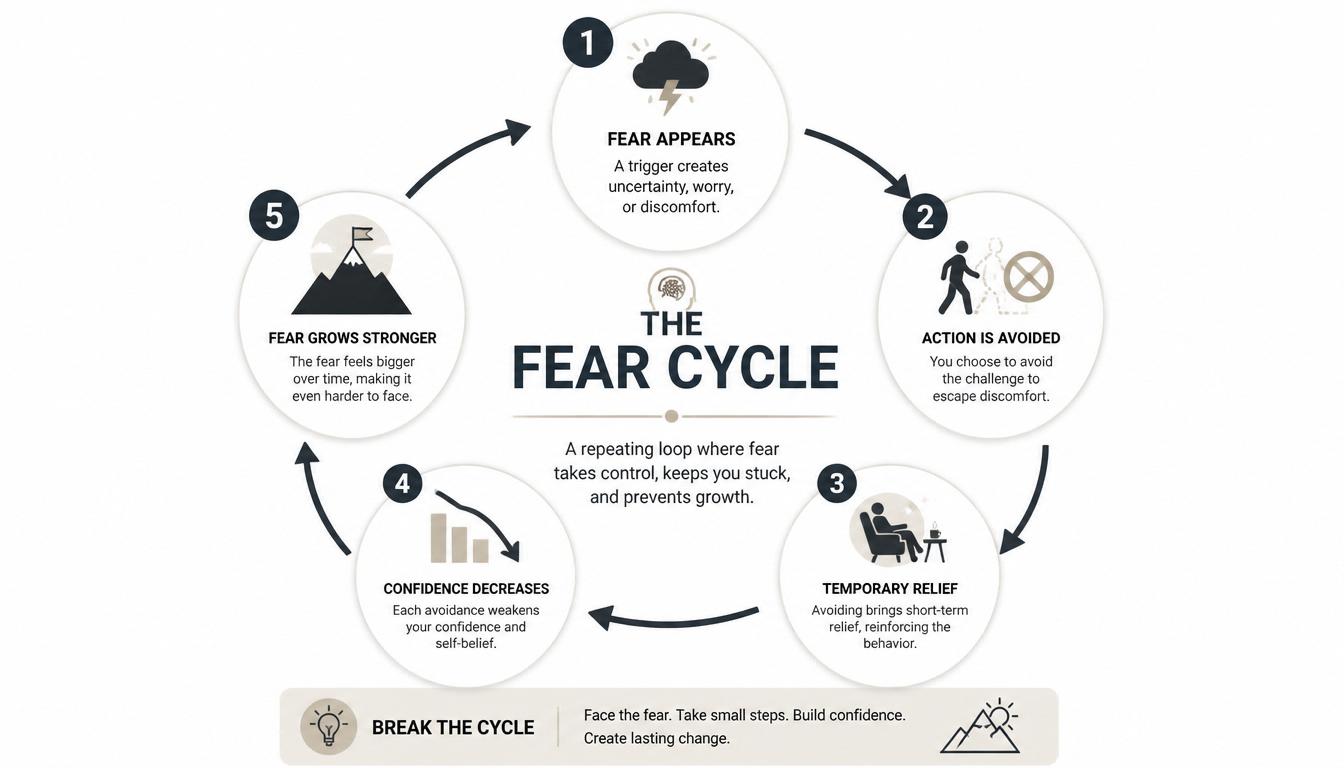
The fear cycle is a psychological pattern where avoidance temporarily reduces anxiety but strengthens fear over time. This cycle affects confidence, productivity, emotional resilience, and personal growth.
The fear of failure and hope of success often compete within this cycle, influencing whether people move forward or avoid action.
How the Fear Cycle Starts
The fear cycle often begins through emotionally painful experiences or repeated negative outcomes.
Common causes include:
- Negative experiences
- Fear of rejection or failure
- Overthinking future outcomes
- Learned helplessness
- Emotional criticism or disappointment
When people avoid uncomfortable situations, the brain associates avoidance with emotional safety.
The Avoidance-Reinforcement Loop
The fear cycle commonly follows this pattern:
- Fear appears
- Action is avoided
- Temporary relief occurs
- Confidence decreases
- Fear grows stronger
This reinforcement loop strengthens anxiety because avoiding discomfort prevents emotional adaptation and confidence-building.
Why Fear Feels Safer Than Hope
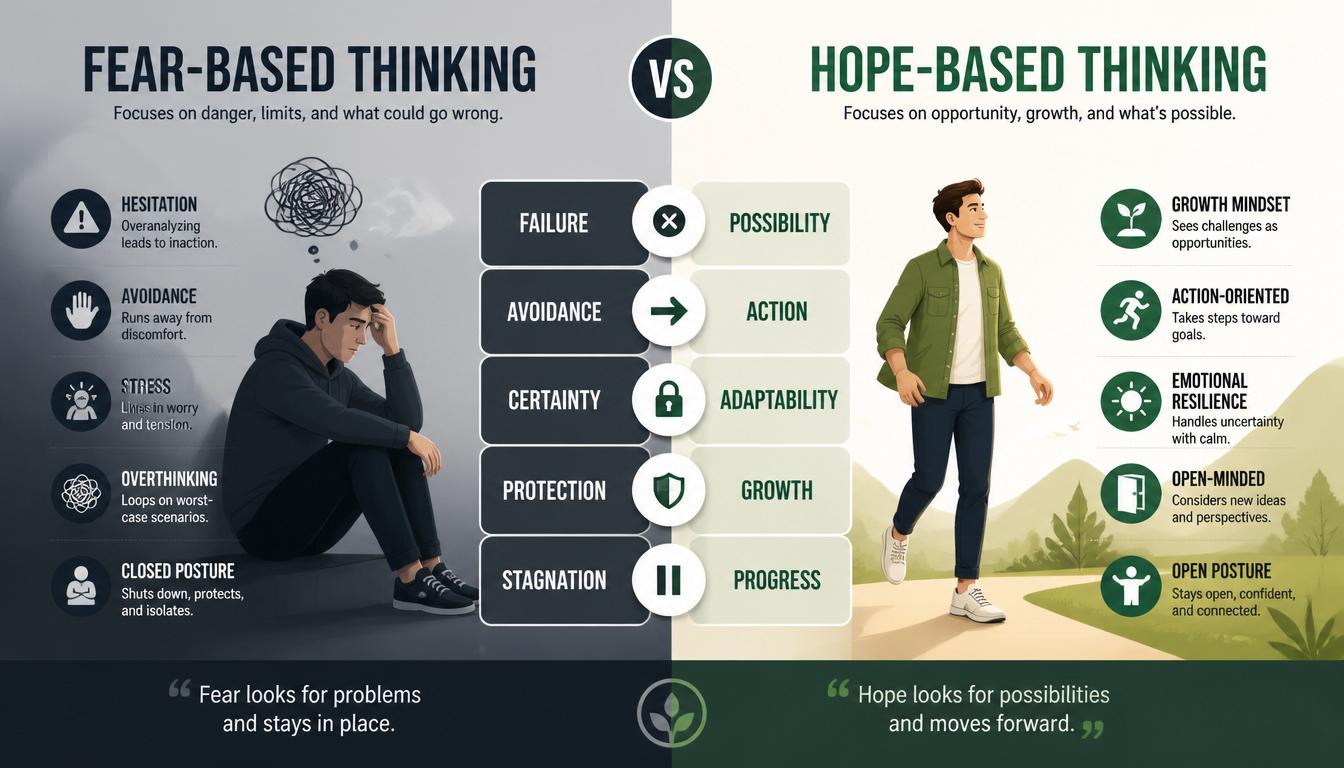
Fear often feels safer than hope because hope requires emotional vulnerability. Hoping for positive outcomes creates the possibility of disappointment.
Fear creates an illusion of control by preparing for negative outcomes and avoiding emotional exposure. Many people unconsciously choose fear because disappointment feels emotionally threatening.
| Fear-Based Thinking | Hope-Based Thinking |
|---|---|
| Focuses on failure | Focuses on possibility |
| Avoids discomfort | Accepts temporary discomfort |
| Seeks certainty | Accepts uncertainty |
| Protects identity | Expands identity |
| Stops action | Encourages progress |
Is Hope Stronger Than Fear?
Fear usually feels stronger in the short term because the brain reacts quickly to perceived threats. However, hope can become stronger over time through repeated action, emotional resilience, and evidence of progress.
Why Fear Dominates Short-Term Decisions
Fear dominates short-term decisions because survival systems prioritize risk avoidance.
Important factors include:
- Emotional urgency
- Stress hormones
- Reactive thinking
- Risk sensitivity
- Loss aversion psychology
Fear pushes people toward immediate comfort and certainty instead of long-term growth.
One of the most effective ways to reduce fear-driven thinking is learning to focus only on what you can control instead of uncertain outcomes.
Why Hope Creates Long-Term Transformation
Hope creates long-term transformation because it supports persistence, purpose, and future-oriented thinking.
Hope encourages people to:
- Continue during setbacks
- Build meaningful habits
- Develop emotional resilience
- Maintain long-term goals
- Strengthen identity-based growth
Unlike fear-based motivation, hope-based motivation is usually more sustainable and emotionally healthy.
What Actually Makes Hope Powerful
Hope becomes stronger through consistent evidence of growth and capability.
Key factors include:
- Small wins
- Evidence of progress
- Supportive environments
- Clear goals
- Identity-based habits
Hope grows when people repeatedly experience progress through action and consistency.
Hope vs Fear in Daily Life and Decision-Making
People often operate from fear or hope, ego or generosity, depending on mindset, emotional state, and environment. Daily choices reveal whether people prioritize protection or growth.
Fear-Based Decision Patterns
Fear-driven behaviors commonly include:
- Procrastination
- Staying in unhealthy routines
- Avoiding opportunities
- Seeking constant reassurance
- Delaying important decisions
These behaviors prioritize short-term emotional comfort instead of long-term improvement.
Hope-Based Decision Patterns
Hope-based decisions encourage adaptability, growth, and learning.
Examples include:
- Taking calculated risks
- Starting new habits
- Asking for help
- Learning new skills
- Investing in long-term growth
These behaviors strengthen confidence through experience and action.
Ego, Scarcity, and Defensive Thinking
Fear-driven identity protection often creates defensive thinking patterns such as:
- Comparison and insecurity
- Fear of criticism
- Control-oriented behaviors
- Scarcity mindset thinking
- Emotional defensiveness
These patterns reduce openness to growth and increase stress.
Generosity, Growth, and Hopeful Thinking
Hopeful thinking supports:
- Abundance mindset
- Openness to learning
- Collaboration and trust
- Emotional flexibility
- Long-term relationship building
Growth-oriented thinking encourages improvement rather than constant self-protection.
Fear of Failure vs Hope of Success
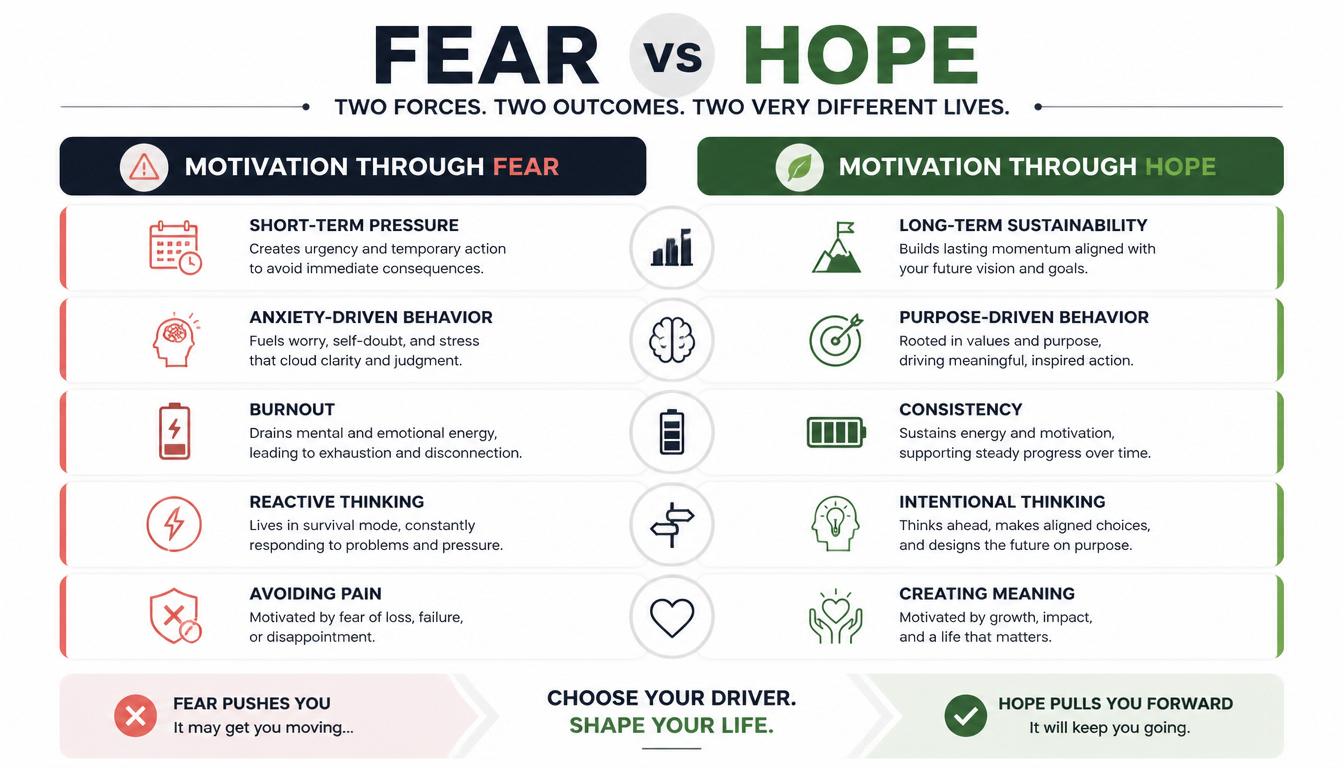
Fear of failure and hope of success are major motivational forces that influence human behavior and performance.
Why Fear of Failure Stops Progress
Fear of failure often creates psychological resistance that prevents action and consistency.
Common causes include:
- Perfectionism
- Shame avoidance
- Identity attachment
- Catastrophic thinking
- Fear of judgment
People may avoid trying because failure feels emotionally threatening to self-worth.
Why Hope of Success Creates Momentum
Hope of success builds momentum because it gives people emotional direction and purpose.
Hope-based motivation:
- Creates direction
- Builds intrinsic motivation
- Encourages experimentation
- Improves consistency
- Supports long-term effort
People are more likely to continue when growth feels meaningful instead of fear-driven.
| Motivation Through Fear | Motivation Through Hope |
|---|---|
| Short-term pressure | Long-term sustainability |
| Anxiety-driven | Purpose-driven |
| Leads to burnout | Supports consistency |
| Reactive behavior | Intentional behavior |
| Focus on avoiding pain | Focus on creating meaning |
What Is the Fear of Hope Called?
The fear of hope is often linked to fear of disappointment, emotional vulnerability, and self-protection mechanisms.
Why Some People Are Afraid to Hope
People may avoid hope because previous experiences taught them that hope can lead to emotional pain.
Common reasons include:
- Past emotional pain
- Repeated failure
- Trauma and distrust
- Fear of emotional exposure
- Emotional exhaustion
For some people, expecting less feels emotionally safer than risking disappointment again.
Signs Someone Is Avoiding Hope
Common signs include:
- Cynicism
- Emotional numbness
- Avoiding goals
- Expecting failure
- Self-sabotage
These behaviors often function as emotional defense systems.
How to Rebuild Hope Gradually
Rebuilding hope requires consistent emotional and behavioral reinforcement.
Step-by-step process:
- Start with realistic goals
- Build trust through small actions
- Track progress visibly
- Reduce all-or-nothing thinking
- Practice emotional resilience
Hope usually returns gradually through repeated experiences of stability and progress.
Practical Ways to Shift From Fear to Hope
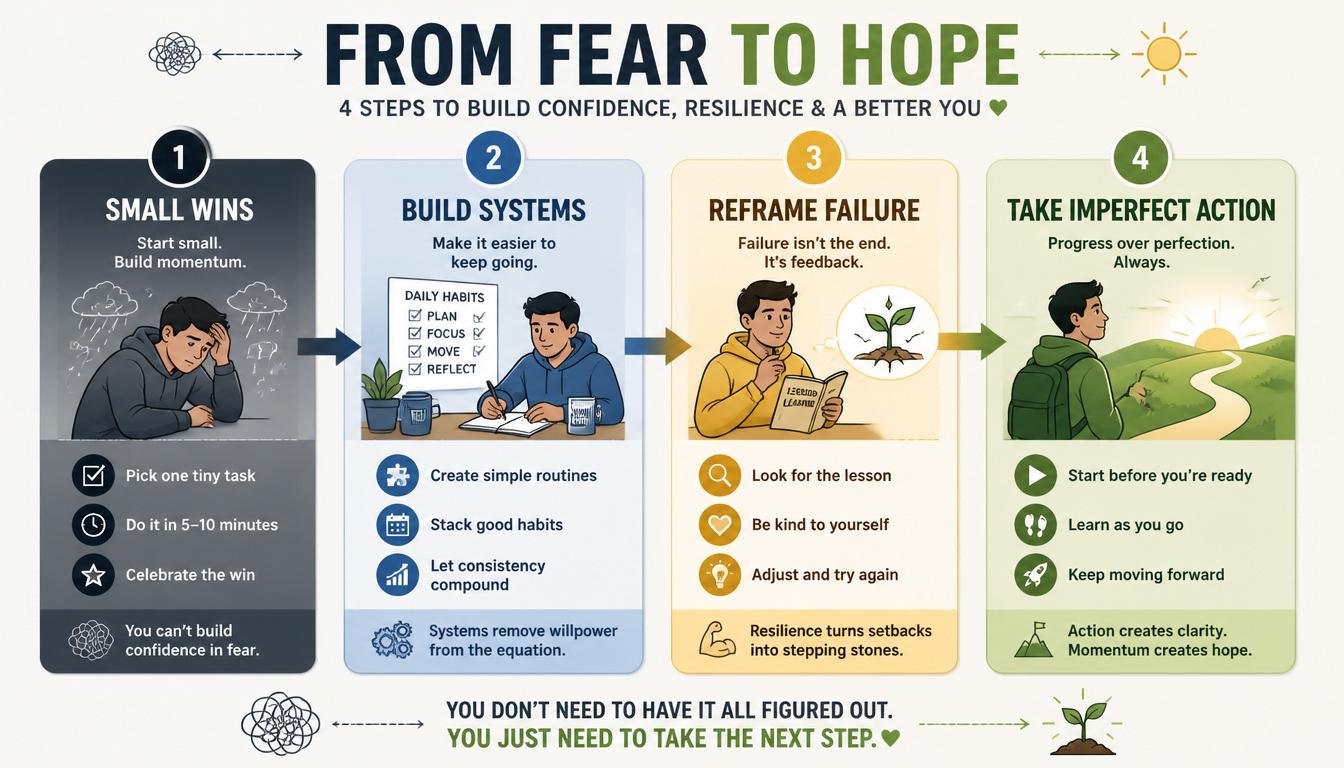
Shifting from fear to hope requires sustainable habits, emotional regulation, and long-term thinking systems.
Shifting from fear-based thinking to hope-based action is a core step in learning how to become the best version of yourself over time.
Use Small Wins to Reduce Fear
Small wins reduce fear by creating evidence of capability and progress.
Helpful methods include:
- Progress tracking
- Confidence reinforcement
- Behavioral momentum
- Habit consistency monitoring
Repeated success gradually retrains the brain toward confidence.
Build Systems Instead of Relying on Motivation
Motivation changes frequently, but systems create consistency and structure.
Useful systems include:
- Daily routines
- Environmental design
- Identity-based habits
- Time-blocking methods
- Consistency-focused planning
Long-term growth usually depends more on systems than temporary motivation.
Reframe Failure as Feedback
Growth mindset principles help people treat failure as information instead of personal defeat.
Learning-focused thinking encourages:
- Reflection instead of shame
- Adaptive thinking
- Behavioral adjustment
- Continuous improvement
This reduces fear and supports emotional resilience.
Focus on Action Instead of Certainty
Long-term growth often requires action before certainty exists.
Helpful mindset shifts include:
- Imperfect action
- Emotional tolerance
- Risk acceptance
- Long-term perspective
Confidence usually develops after repeated action, not before it.
Common Myths About Hope and Fear
Misconceptions about emotional strength often create unrealistic expectations around confidence, courage, and personal growth.
Myth — Fear Is Always Bad
Fear is not always harmful. Healthy fear can improve awareness, preparation, and caution.
The problem occurs when fear becomes chronic avoidance that limits growth and decision-making.
Myth — Hope Means Blind Positivity
Real hope is not unrealistic optimism. Healthy hope accepts uncertainty while continuing to pursue meaningful goals.
Hope requires:
- Action
- Adaptability
- Emotional resilience
- Honest self-awareness
Myth — Confident People Feel No Fear
Confident people still experience fear. Courage means acting despite fear rather than waiting for fear to disappear completely.
Emotional mastery involves managing emotions effectively instead of avoiding them.
Real-Life Examples of Hope vs Fear
Hope vs fear appears in everyday decisions related to careers, habits, relationships, and self-improvement.
Career Example
Fear may stop someone from applying for a better opportunity because of possible rejection. Hope encourages applying anyway because growth often requires uncertainty and discomfort.
Health and Habit Example
Fear-based habit cycles often involve quitting after setbacks or expecting perfect results immediately. Hope-based progress focuses on sustainable routines, consistency, and gradual improvement.
Relationship Example
Fear of rejection may prevent emotional openness and trust. Hope encourages vulnerability, communication, and relationship growth despite emotional uncertainty.
Conclusion
Hope vs fear is a daily internal struggle that influences habits, decisions, emotional resilience, and identity. Fear protects survival and reduces risk, but hope supports long-term growth, transformation, and meaningful progress.
Sustainable personal growth depends on learning how to act even while fear exists. People who build supportive systems, emotionally resilient habits, and growth-oriented perspectives are more likely to maintain consistent improvement.
Long-term self-improvement does not require eliminating fear completely. Real growth happens when people learn to keep moving forward while fear is still present.
FAQs
Why do people naturally choose fear over hope?
The brain prioritizes safety and survival, making fear feel more urgent and believable than hope.
Is hope stronger than fear?
Fear is often stronger in the short term, but hope becomes stronger through repeated action, resilience, and meaningful progress.
What causes the fear cycle?
Avoidance behavior reinforces anxiety and reduces confidence, creating a repeating cycle of fear and inaction.
How can I stop making fear-based decisions?
Focus on small actions, realistic goals, emotional awareness, and long-term thinking rather than immediate comfort.
Why am I afraid to hope for better things?
Past disappointment, failure, or emotional pain can make hope feel risky and emotionally vulnerable.
Can fear ever be helpful?
Yes. Fear can protect people from danger and encourage preparation, but chronic fear becomes limiting when it blocks growth.
How do I stay hopeful during setbacks?
Track small progress, focus on controllable actions, maintain supportive routines, and avoid all-or-nothing thinking.








One Response