
Introduction
A balanced mindset is the ability to think clearly, regulate emotions, and respond to situations with realism rather than extremes. Understanding the balanced mindset meaning matters because it shapes how people handle stress, make decisions, and maintain relationships. A balanced mind meaning goes beyond staying positive — it involves accepting both good and difficult moments without being overwhelmed by either. This approach supports emotional well-being, sharper decision-making, and steady personal growth. Understanding mindsets in general helps explain why some people recover from setbacks faster than others: it isn’t luck, but a trainable way of thinking that anyone can develop with consistent practice.
Quick Summary
- A balanced mindset helps people respond to challenges with clarity, flexibility, and emotional stability.
- It combines realistic thinking, self-awareness, and healthy emotional regulation rather than extreme optimism or pessimism.
- Developing a balanced mindset requires consistent habits, reflection, and practice over time.
- Anyone can strengthen mindset skills through intentional learning and daily application.
What Is a Balanced Mindset?
Balanced Mindset Meaning
A balanced mindset is a way of thinking that acknowledges reality without exaggerating the positive or the negative. The balanced mindset meaning centers on emotional stability paired with clear, adaptive reasoning. The balanced mind meaning is often confused with simply “staying calm,” but it actually involves actively processing emotions rather than pushing them aside. This is an important distinction: emotional balance means feeling an emotion, understanding it, and choosing a measured response. Emotional suppression, by contrast, means ignoring or burying feelings, which tends to increase stress over time rather than resolve it.
Why Mindset Shapes Everyday Life
Beliefs quietly influence emotions, decisions, habits, and resilience. A person who believes setbacks are permanent may give up quickly, while someone with a balanced outlook treats setbacks as temporary and solvable. This applies across personal and professional situations — from how someone handles critical feedback at work to how they navigate disagreements at home. Understanding mindsets more broadly reveals that thought patterns are not fixed traits; they are shaped by repeated experiences and can be intentionally reshaped through practice.
Understanding Different Types of Mindsets
What Is a Mindset?
A mindset is a collection of beliefs and habitual thought patterns that shape how a person interprets events and reacts to them. Mindsets develop gradually through personal experience, upbringing, education, and environment. Understanding mindsets skills — the specific abilities that support flexible, adaptive thinking — helps clarify what is mindset skills in practice: they are learnable capacities like self-reflection, emotional regulation, and cognitive flexibility, not fixed personality traits.
Balanced Mindset vs Fixed Mindset vs Growth Mindset
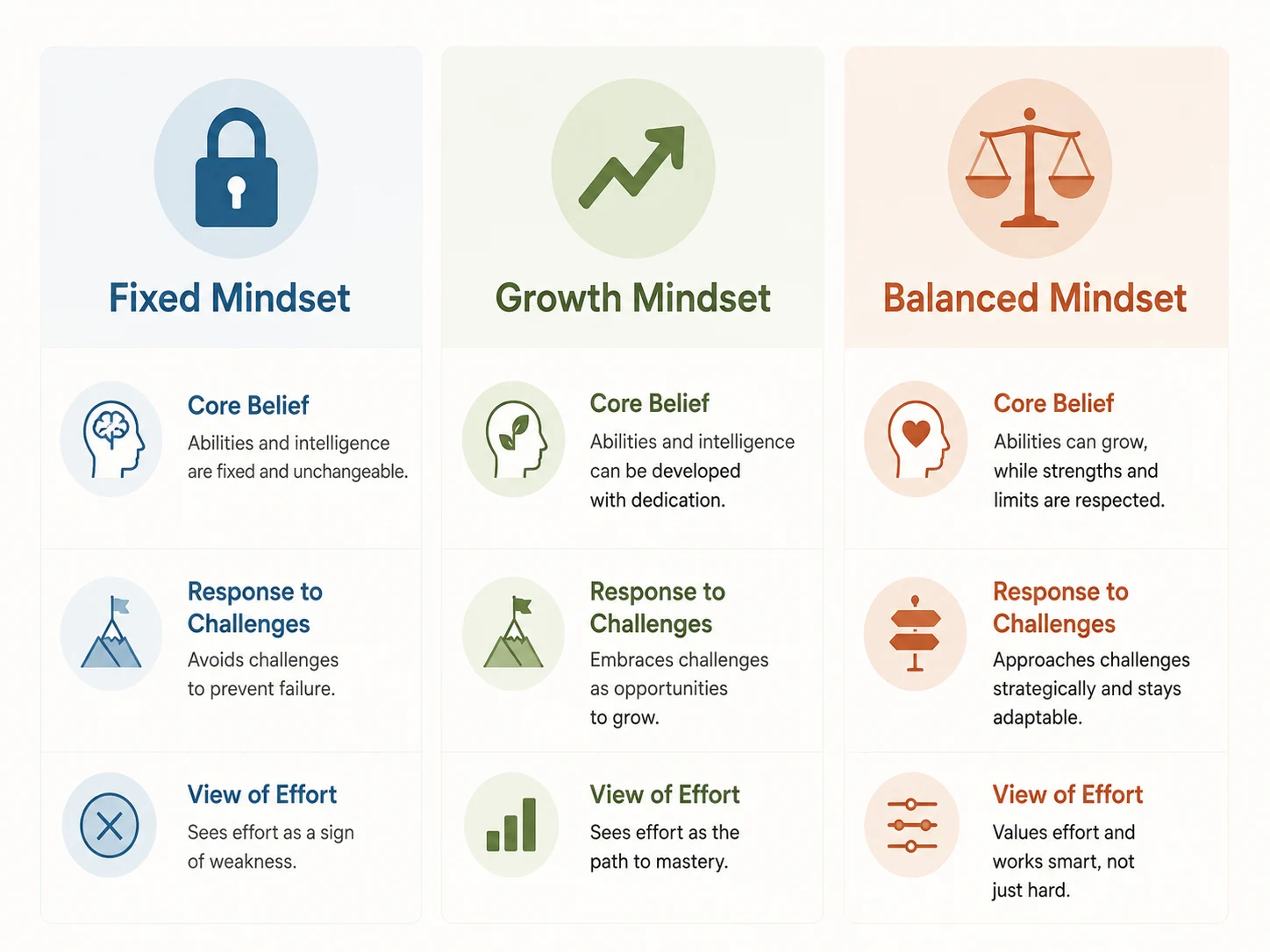
A balanced mindset shares some overlap with growth thinking, since both value adaptability and learning from experience. However, a balanced mindset places more emphasis on emotional regulation and realistic assessment, while a growth mindset focuses primarily on the belief that abilities can improve through effort. A fixed mindset, in contrast, assumes traits and abilities are static. A common misconception is that a balanced mindset means avoiding ambition or ignoring emotion — in reality, it means engaging with challenges without distorting them in either direction. If you want to explore how growth-oriented thinking builds long-term resilience on its own, see our guide on why growth mindset is important.
| Mindset Type | Core Belief | Typical Response to Challenges | Strengths | Limitations |
|---|---|---|---|---|
| Fixed Mindset | Abilities are static | Avoidance or discouragement | Provides short-term stability | Limits growth and adaptability |
| Growth Mindset | Abilities can be developed | Views challenges as opportunities | Encourages learning and persistence | Can overlook emotional regulation |
| Balanced Mindset | Reality includes both strengths and limits | Realistic, steady problem-solving | Combines emotional stability with adaptability | Requires ongoing self-awareness to maintain |
Characteristics of a Balanced Mindset
Emotional Characteristics
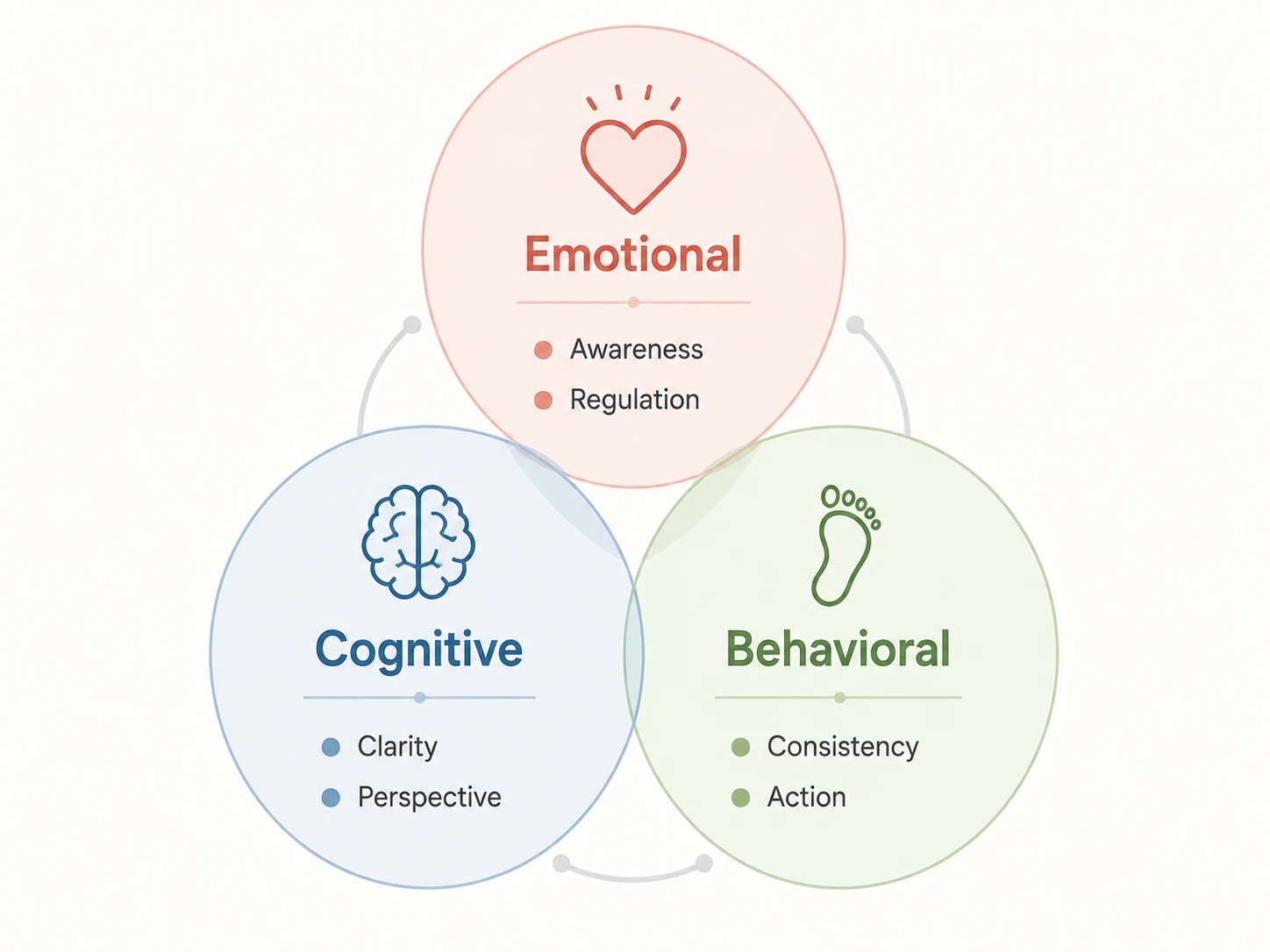
- Emotional awareness — noticing feelings as they arise
- Emotional regulation — managing intensity without suppression
- Self-compassion — responding to mistakes without harsh self-criticism
- Perspective taking — considering situations from multiple viewpoints
Cognitive Characteristics
- Flexible thinking — adjusting views when new information appears
- Critical thinking — evaluating situations objectively
- Realistic expectations — anticipating both progress and setbacks
- Balanced decision-making — weighing pros and cons without extreme bias
Behavioral Characteristics
- Consistent habits — maintaining routines that support stability
- Healthy communication — expressing needs clearly and respectfully
- Adaptability — adjusting behavior to changing circumstances
- Problem-solving — approaching obstacles methodically rather than reactively
Common signs of a balanced mindset include staying composed under pressure, recovering steadily from setbacks, and communicating needs without escalation. Daily behaviors that reflect healthy thinking patterns include pausing before reacting, checking assumptions, and adjusting plans without panic.
Why a Balanced Mindset Matters
Mental and Emotional Benefits
A balanced mindset is associated with reduced stress, since realistic thinking prevents situations from feeling more threatening than they are. It also supports greater resilience, better emotional control during conflict, and increased confidence, because decisions are made from a place of clarity rather than reactivity.
Benefits in Daily Life
- Relationships: Clearer communication and fewer emotionally charged conflicts
- Work performance: Steadier focus and more consistent decision-making under pressure
- Learning: Greater openness to feedback and correction
- Personal development: Sustainable progress instead of burnout cycles
- Decision-making: Choices grounded in evidence rather than extreme emotion
How to Have a Balanced Mindset
Build Self-Awareness
Identifying recurring thought patterns is the first step toward change. Practicing regular reflection — through journaling or quiet review of the day — helps surface emotional triggers before they escalate into stronger reactions.
Challenge Extreme Thinking
All-or-nothing thinking (“I always fail” or “This will never work”) distorts reality. Balanced thinking involves evaluating evidence objectively and practicing interpretations that account for both strengths and limitations in a situation. For a deeper breakdown of reframing techniques, see how to change your thoughts.
Develop Healthy Daily Habits
- Consistent sleep schedule
- Regular physical exercise
- Balanced nutrition
- Mindfulness practice
- Journaling
Practice Emotional Regulation
- Breathing techniques to lower physiological stress
- Pausing before reacting to a triggering event
- Naming emotions specifically rather than generally
- Reframing situations to consider alternative explanations
Daily habits checklist: sleep, movement, mindfulness, reflection, and one intentional pause before reacting to stress. Weekly reflection routine: review recurring triggers, note progress, and adjust one habit at a time.
In our experience helping readers build better habits, the biggest shift often comes not from adding more techniques, but from practicing fewer techniques consistently.
Mindset Skills That Support Balance
What Are Mindset Skills?
Mindset skills are the specific, learnable abilities that make balanced thinking possible. Answering what is mindset skills directly: they are trainable capacities — not fixed traits — that include emotional regulation, adaptability, and self-reflection, all of which improve with deliberate practice.
Essential Skills to Develop
- Adaptability
- Emotional intelligence
- Critical thinking
- Self-reflection
- Communication
- Resilience
- Problem-solving
| Mindset Skill | Why It Matters | Practical Example | How to Improve |
|---|---|---|---|
| Adaptability | Helps manage unexpected change | Adjusting plans after a schedule disruption | Practice small, deliberate changes to routine |
| Emotional Intelligence | Supports healthier relationships | Recognizing a colleague’s frustration before reacting | Practice naming emotions daily |
| Critical Thinking | Reduces reactive decisions | Evaluating a problem before assuming the worst outcome | Ask “what evidence supports this?” |
| Self-Reflection | Builds long-term self-awareness | Reviewing what triggered a stressful reaction | Keep a brief daily journal |
| Resilience | Speeds recovery from setbacks | Returning to a goal after a failed attempt | Focus on process over immediate results |
Common Obstacles to Maintaining a Balanced Mindset
Why People Struggle
Stress, cognitive biases, perfectionism, fear of failure, and negative self-talk are common barriers. These factors often reinforce each other — for example, perfectionism increases fear of failure, which then intensifies negative self-talk after a mistake.
How to Overcome These Challenges
Practical strategies include building consistency through small, repeatable actions, seeking support from trusted people, and setting realistic expectations rather than aiming for constant improvement.
Quick mindset changes rarely last because they are not supported by consistent habits — a single insight rarely rewires long-standing thought patterns. Environment plays a significant role too; a stressful or chaotic environment can undo progress made through internal reflection alone. Setbacks are a normal, expected part of growth rather than a sign that the process has failed.
Common Beginner Mistakes
- Confusing positivity with balance: This happens because positivity feels productive, but ignoring difficulties creates unrealistic expectations. Fix this by acknowledging challenges honestly while still looking for constructive next steps.
- Ignoring emotions instead of processing them: This often happens under time pressure. Prevent it by scheduling brief, regular check-ins with yourself rather than waiting for emotions to build up.
- Expecting immediate results: This mistake stems from comparing mindset work to quick fixes. Fix it by tracking small, weekly indicators of progress instead of expecting overnight change.
- Comparing progress with others: This happens because progress feels invisible without a reference point. Prevent it by comparing current habits only to your own starting point.
- Trying to change too many habits at once: This often leads to burnout. Fix it by focusing on one or two habits before adding more.
Practical Ways to Apply a Balanced Mindset in Everyday Life
At Work
A balanced mindset supports clearer decision-making under deadline pressure, more constructive collaboration during disagreements, and steadier performance when managing multiple responsibilities.
In Relationships
Balanced thinking improves communication by reducing defensive reactions, supports fairer conflict resolution, and strengthens empathy by encouraging perspective-taking before responding.
During Difficult Life Events
During uncertainty, a balanced mindset helps by focusing attention on what can be controlled. It also supports accepting setbacks as part of a longer process and gradually building resilience through repeated, manageable challenges.
Difficulty and Time Investment
Building a balanced mindset is beginner-friendly, though it requires patience. Typical effort involves 10–20 minutes of daily reflection or mindfulness practice, with more advanced variations including structured journaling or therapy-based techniques. Personal factors — such as existing stress levels, support systems, and prior habits — influence how difficult the process feels. Consistency matters more than intensity: brief, daily practice tends to produce steadier results than occasional, longer sessions.
Results Timeline
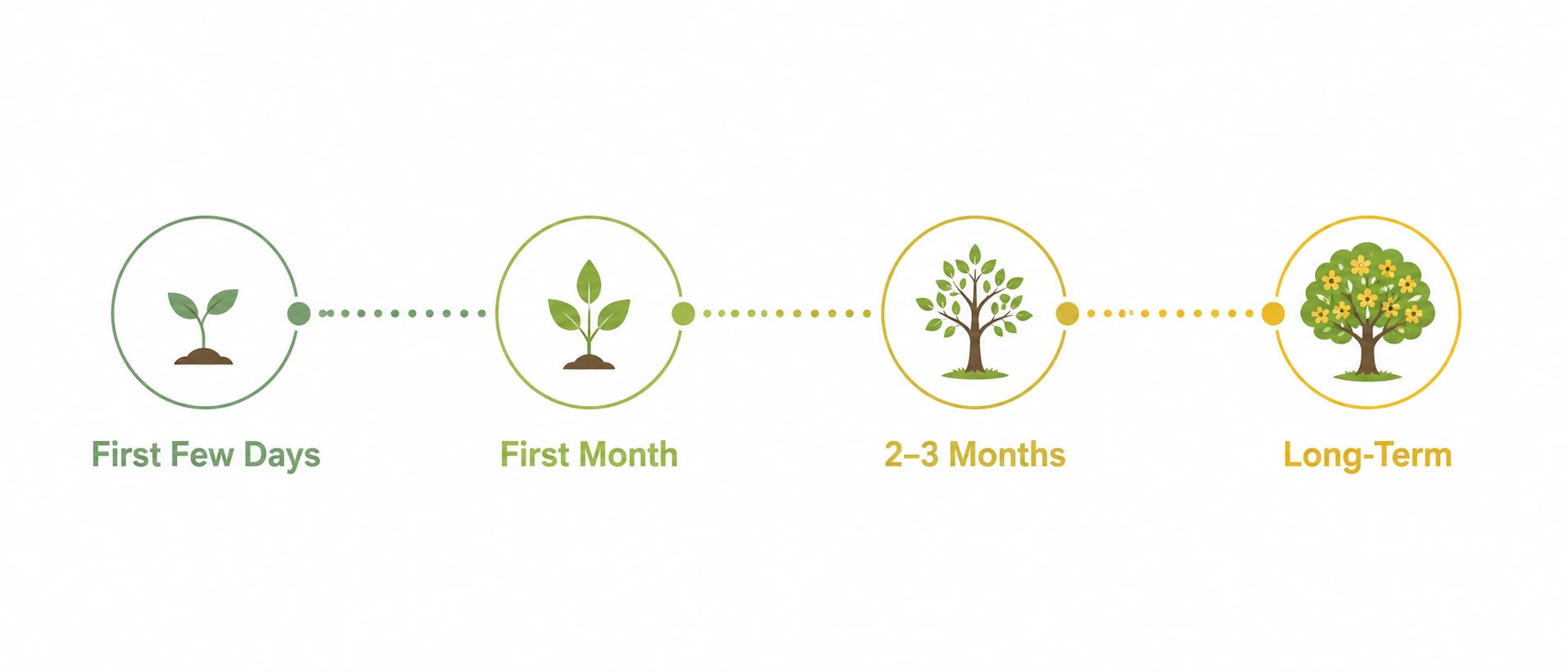
Progress with mindset development is typically gradual rather than immediate.
- First few days: Increased awareness of thought patterns and emotional triggers
- First month: More consistent use of regulation techniques during stress
- Two to three months: Noticeable improvement in emotional stability and decision-making
- Long-term maintenance: Balanced thinking becomes a more automatic response
Factors affecting progress include existing habits, environment, current stress levels, and the strength of available support systems.
Daily Practice Guide for Building a Balanced Mindset
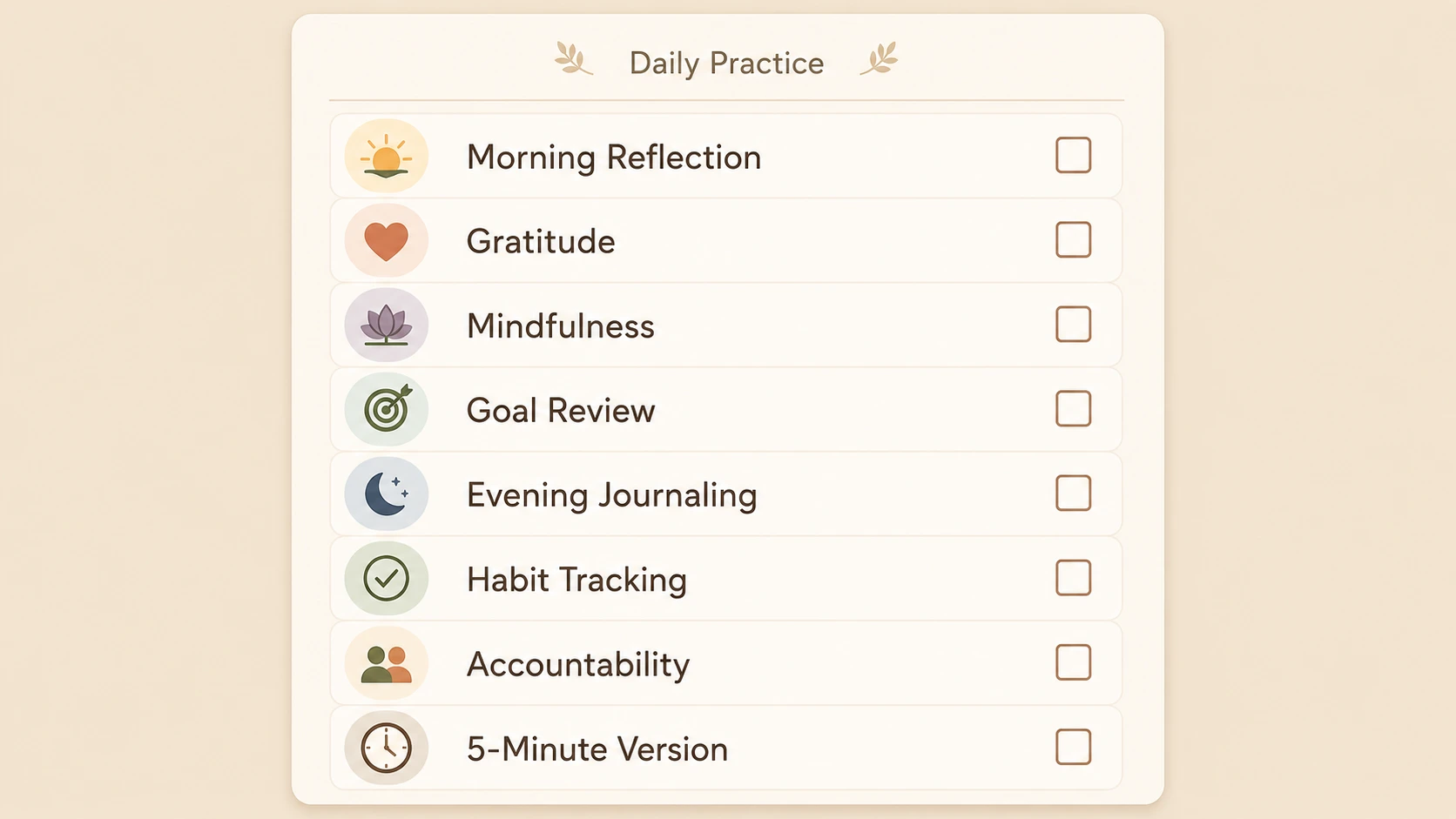
- Morning reflection to set intentions for the day
- Gratitude practice to reinforce realistic perspective
- Short mindfulness exercises to build present-moment awareness
- Goal review to check alignment with priorities
- Evening journaling to process the day’s events
- Habit tracking to monitor consistency
- Accountability methods, such as a check-in partner or app
- Adjustments for busy lifestyles, such as condensing practices into five-minute versions
- Long-term sustainability through periodic review and flexible routines During uncertainty, a balanced mindset helps by focusing on what you can control rather than fixating on outcomes outside your influence.
As of mid-2026, many self-improvement practitioners recommend shorter, more frequent mindset check-ins over long single sessions, reflecting updated research on habit formation and consistency.
Balanced Mindset vs Positive Thinking
A balanced mindset and positive thinking are related but not identical. Positive thinking emphasizes optimistic interpretation, while a balanced mindset incorporates emotional realism alongside optimism.
| Balanced Mindset | Positive Thinking |
|---|---|
| Acknowledges both positive and negative realities | Emphasizes optimistic outcomes |
| Uses evidence-based decision-making | May rely on hopeful assumptions |
| Sets realistic, adjustable expectations | Can set idealistic expectations |
| Uses varied coping strategies, including acceptance | Primarily relies on reframing toward positivity |
Conclusion
A balanced mindset means responding to life’s challenges with clarity, emotional regulation, and realistic thinking rather than constant positivity or negativity. It supports stronger relationships, steadier work performance, and long-term emotional well-being. Developing this way of thinking depends on consistent mindset skills — self-awareness, emotional regulation, and adaptability — practiced regularly rather than pursued perfectly. Readers looking to begin can start with one small step today: a short daily reflection to notice thought patterns before they shape a reaction.
Frequently Asked Questions (FAQs)
What is a balanced mindset?
A balanced mindset is a way of thinking that combines realistic assessment with emotional regulation, allowing a person to respond to challenges without extreme optimism or pessimism.
Why is having a balanced mindset important?
It supports better decision-making, stronger relationships, and reduced stress by helping people process situations accurately rather than reactively.
How can I develop a balanced mindset in daily life?
Building self-awareness, challenging extreme thinking, maintaining healthy daily habits, and practicing emotional regulation techniques all contribute to a more balanced mindset over time.
Is a balanced mindset the same as positive thinking?
No. A balanced mindset includes realistic acknowledgment of both positive and negative circumstances, while positive thinking focuses mainly on optimistic interpretation.
What mindset skills help create emotional balance?
Key skills include emotional intelligence, adaptability, self-reflection, critical thinking, and resilience, all of which can be developed through consistent practice.
Can a balanced mindset reduce stress and anxiety?
Yes. Realistic thinking combined with emotional regulation techniques can lower stress by preventing situations from feeling more threatening than they are.
How long does it take to build a balanced mindset?
Initial awareness often develops within days, noticeable habit consistency within a month, and stronger emotional stability typically within two to three months of regular practice.
Can anyone learn to develop a balanced mindset?
Yes. Mindset skills are learnable abilities, not fixed traits, meaning anyone can strengthen them through intentional, consistent practice.