
Introduction
How does a growth mindset help you? A growth mindset helps by reframing challenges, effort, and setbacks as opportunities to build ability rather than proof of a fixed limit. At its core, a growth mindset is the belief that intelligence, talent, and skill can improve through effort, learning, and persistence rather than being permanently fixed at birth. This belief shapes how people approach school, work, relationships, and personal development. Instead of avoiding difficulty, someone with a growth mindset uses it as information for what to practice next. As of 2026, this concept remains one of the most widely applied frameworks in education and workplace training, and understanding it practically — not just theoretically — is what turns the idea into real progress.
Quick Summary
- A growth mindset encourages continuous learning by viewing challenges as opportunities to improve.
- It helps people build resilience, confidence, adaptability, and long-term success.
- Students, professionals, and lifelong learners benefit from developing habits that strengthen a growth mindset.
- Small daily actions and consistent reflection gradually create lasting mindset changes.
What Is a Growth Mindset?
Growth Mindset Definition Explained
A growth mindset is the belief that abilities and intelligence can be developed over time through dedication, practice, and learning from mistakes. The growth mindset definition traces back to psychological research on motivation and achievement, which found that people who believe ability is malleable tend to persist longer, take on more challenges, and recover faster from failure than those who believe ability is fixed. So what do you think is a growth mindset in practical terms? It’s the working assumption that today’s skill level is a starting point, not a ceiling. Understanding this distinction also clarifies why a growth mindset is important for long-term learning and success.
Two ideas anchor the growth mindset def:
| Term | Simple Meaning |
|---|---|
| Growth mindset | Belief abilities improve with learning |
| Fixed mindset | Belief abilities cannot significantly change |
Growth Mindset vs Fixed Mindset
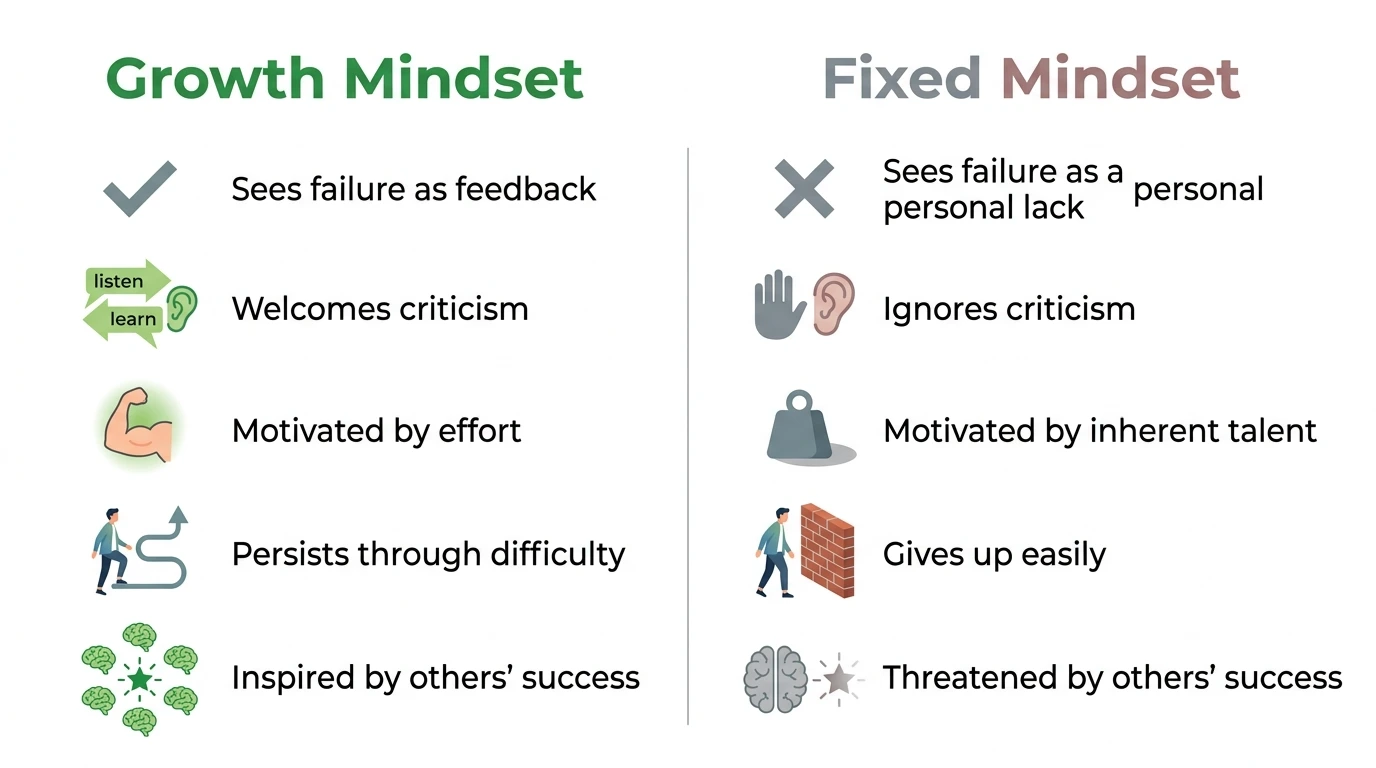
The difference between these two mindsets shows up most clearly under pressure — during failure, feedback, or new challenges.
| Growth Mindset | Fixed Mindset |
|---|---|
| Sees failure as feedback | Sees failure as a verdict on ability |
| Welcomes constructive criticism | Avoids or dismisses criticism |
| Motivated by effort and progress | Motivated by proving existing talent |
| Persists through difficulty | Gives up when things get hard |
| Views others’ success as inspiration | Views others’ success as a threat |
How Does a Growth Mindset Help You?
Improves Learning and Skill Development
A growth mindset helps you learn faster because it treats confusion and mistakes as part of the process rather than a reason to stop. People actively engaged in growth mindset development tend to build new skills more efficiently because they accept constructive feedback instead of avoiding it, and they keep refining their approach after each attempt rather than repeating the same errors. This is central to growing your mindset over time — small corrections compound into meaningfully better performance.
Builds Confidence Through Progress
Confidence built through a growth mindset comes from visible improvement, not from being flawless. Tracking small wins — a slightly better presentation, a slightly faster run, a slightly clearer explanation — creates self-belief rooted in evidence rather than assumption. Mistakes become checkpoints for learning instead of sources of shame, which keeps motivation intact even when results are imperfect.
Helps You Handle Challenges and Failure
A growth mindset helps you handle failure by reframing setbacks as data rather than defeat. This shift supports emotional resilience because the person’s sense of worth is not tied to a single outcome. It also supports adaptability, since attention naturally moves to “what can I adjust” instead of “what does this say about me,” and it sustains persistence long enough for skill to actually develop.
Encourages Lifelong Learning
Growth mindset thinking naturally extends into curiosity and self-directed learning. How does a growth mindset help you in self learning? It removes the fear of looking incompetent while acquiring a new skill, which is often the biggest barrier to starting something new as an adult. This keeps people engaged in continuous improvement long after formal schooling ends.
Benefits of Having a Growth Mindset
Personal Benefits
The importance of growth mindset in life shows up in several measurable ways. What are the benefits of growth mindset at a personal level?
- Greater resilience when facing setbacks
- Increased motivation to attempt difficult tasks
- Better decision-making under uncertainty
- Emotional flexibility when plans change
Academic Benefits
Why is growth mindset important for students? It directly shapes study behavior. Students with a growth mindset tend to build more consistent study habits, persist through difficult material instead of avoiding it, and treat poor grades as a signal to adjust strategy rather than a fixed ceiling. Over time, this consistency contributes to improved grades and stronger learning confidence.
Career and Professional Benefits
Why is having a growth mindset important for success at work? How does a growth mindset help you succeed professionally? It supports:
- Adaptability to new tools, roles, and expectations
- Leadership grounded in developing others, not just directing them
- Innovation, since untested ideas feel like experiments rather than risks
- Long-term career growth through continuous skill-building
Mental Health Benefits
How does a growth mindset help your mental health? It reduces the fear of failure by removing the idea that one mistake defines a person’s ability. This lowers stress connected to perfectionism, supports healthier self-talk (“I haven’t mastered this yet” instead of “I’m bad at this”), and builds emotional resilience by keeping setbacks in proportion.
Better Relationships and Empathy
How does a growth mindset help you be more empathetic? It encourages viewing other people’s behavior and mistakes as changeable rather than fixed character traits. This supports active listening, genuine compassion, understanding of different perspectives, and more constructive conflict resolution, since disagreements are approached as solvable rather than permanent.
Why Is a Growth Mindset Important in Everyday Life?
Personal Growth
How does a growth mindset help you in life outside of school or work? It supports learning new hobbies without the pressure of immediate mastery, building confidence gradually, managing life changes with less anxiety, and approaching everyday problems as solvable rather than overwhelming. These everyday applications tie directly into the broader question of how you can grow as a person over time.
Lifelong Success
The importance of growth mindset in life extends across decades, not just single events. Long-term achievement depends on consistency, adaptability to changing circumstances, and the ability to learn from experience rather than repeat the same mistakes.
How to Develop a Growth Mindset
Practical Daily Habits
Learning how to develop a growth mindset starts with small, repeatable actions rather than one dramatic change. Growth mindset development is built through: If you want a structured approach, see how to build good habits in 30 days for a step-by-step framework.
- Embracing challenges instead of avoiding them
- Learning from mistakes instead of hiding them
- Seeking feedback instead of dismissing it
- Replacing negative self-talk with growth-oriented language
- Celebrating progress, not just final outcomes
- Practicing patience with the pace of change
- Reflecting regularly on what worked and what didn’t
10 Ways to Develop a Growth Mindset
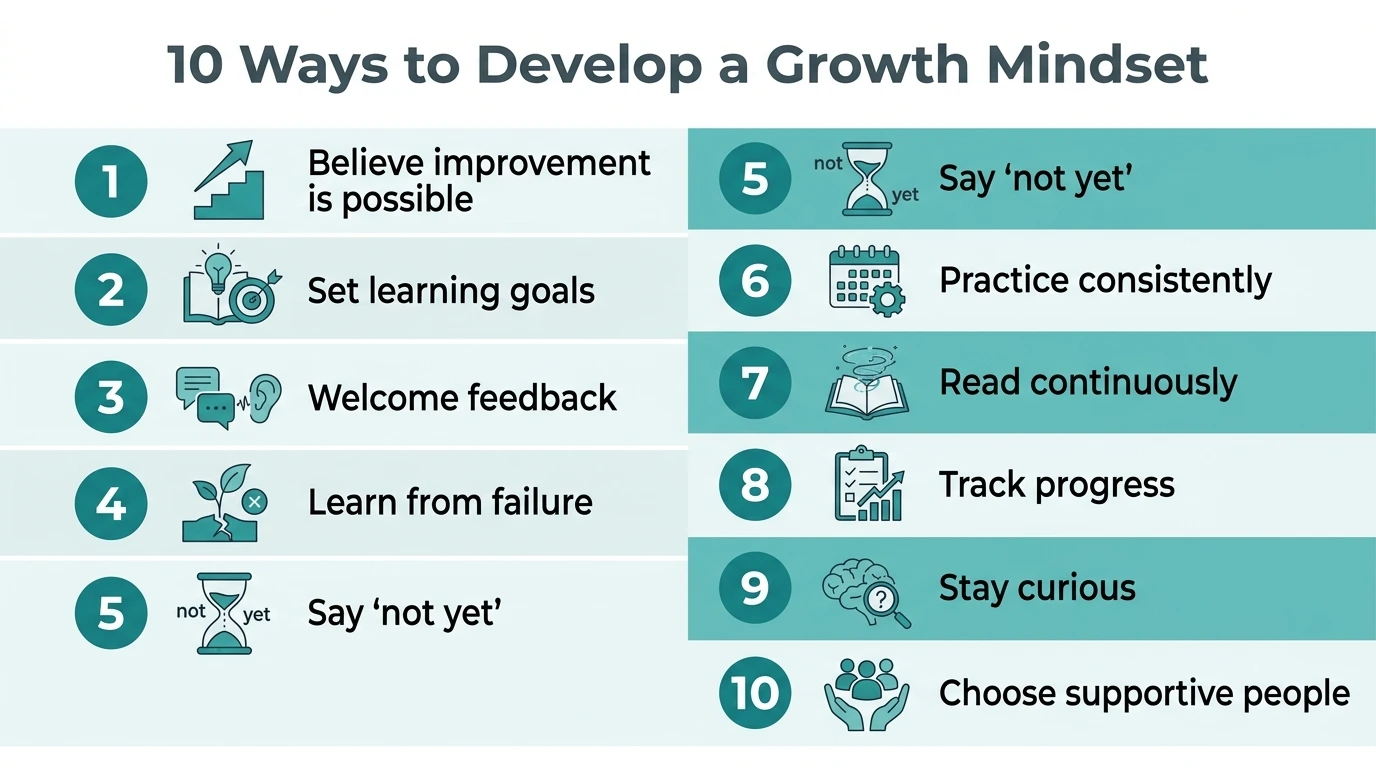
The following list of 10 ways to develop a growth mindset can be applied by students, professionals, and lifelong learners alike:
- Believe improvement is possible with effort
- Set specific learning goals, not just outcome goals
- Welcome constructive feedback without defensiveness
- Learn from failure instead of avoiding it
- Replace “I can’t” with “I can’t yet”
- Practice consistently rather than occasionally
- Read and learn continuously outside formal requirements
- Track progress with notes or a simple log
- Stay curious about unfamiliar topics and skills
- Surround yourself with people who support growth over comparison
Growth Mindset Strategies for Students
Study Habits That Build a Growth Mindset
Growth mindset strategies for students work best when built into regular study routines. Effective habits include keeping a reflection journal, practicing active learning instead of passive reading, asking clarifying questions rather than staying silent, prioritizing practice over perfection, and setting specific, achievable learning goals for each study session.
Classroom and Self-Learning Strategies
Beyond the classroom, independent learning strengthens growth mindset habits through collaboration with peers, using feedback constructively, managing time realistically, and treating mistakes as expected steps rather than failures. How does a growth mindset help you in self learning? It keeps motivation steady even without a teacher present, because progress is measured against a personal baseline instead of external comparison.
Real-Life Growth Mindset Examples
Everyday Examples
Common growth mindset examples include learning a new language despite early mistakes, improving fitness through gradual training rather than instant results, developing communication skills through repeated practice, learning to code by debugging errors instead of giving up, and improving public speaking by rehearsing after each imperfect attempt.
Student Examples
Examples of a growth mindset in a school setting include improving grades through revised study habits, continuing to learn material after failing a test instead of giving up on the subject, participating in class despite fear of being wrong, and actively seeking teacher feedback to correct mistakes early.
Workplace Examples
In professional settings, an example of growth mindset in action includes learning new software instead of relying only on familiar tools, accepting constructive criticism during performance reviews, deliberately building leadership skills over time, and adapting to changing job responsibilities without resistance.
Common Mistakes That Prevent a Growth Mindset
Even well-intentioned efforts can stall without awareness of common pitfalls. Frequent mistakes include:
- Expecting instant results instead of gradual progress
- Letting fear of failure prevent attempts altogether
- Comparing personal progress to other people’s outcomes
- Ignoring or dismissing useful feedback
- Giving up too early before habits take hold
- Mistaking effort alone for progress without honest reflection
Common Challenges and How to Overcome Them
Losing Motivation
Motivation naturally fades over time, which is normal rather than a sign of failure. Building small habits and using visible small wins helps sustain momentum when initial enthusiasm decreases.
Dealing with Self-Doubt
Self-doubt can be managed by reframing negative thoughts into specific, actionable next steps, practicing self-compassion instead of harsh self-criticism, and building confidence gradually through consistent small actions rather than expecting immediate certainty.
Staying Consistent
Consistency improves with structured tracking of progress, accountability through another person or a simple system, creating repeatable routines, and adjusting expectations realistically as circumstances change.
Growth Mindset Compared with Other Personal Development Approaches
A growth mindset is often confused with related but distinct concepts.
| Concept | Focus | How It Differs from Growth Mindset |
|---|---|---|
| Positive thinking | Optimistic outlook | Focuses on attitude, not skill development |
| Self-confidence | Belief in current ability | Can exist without belief that ability can grow |
| Motivation | Drive to act | Can be short-term and outcome-focused |
| Grit | Sustained effort toward long-term goals | Emphasizes persistence more than belief in improvement |
| Resilience | Recovery from setbacks | Focuses on bouncing back, not necessarily on skill growth |
Difficulty & Time Investment
A growth mindset is beginner-friendly and does not require special tools or prior training to begin practicing. The typical effort required is consistent, small daily attention rather than intense short bursts. Because mindset shifts involve rewiring habitual thought patterns, they require ongoing, repeated practice rather than a single decision. Progress is also shaped by individual factors such as environment, existing habits, workplace or school culture, and the presence of supportive feedback from others.
Results Timeline
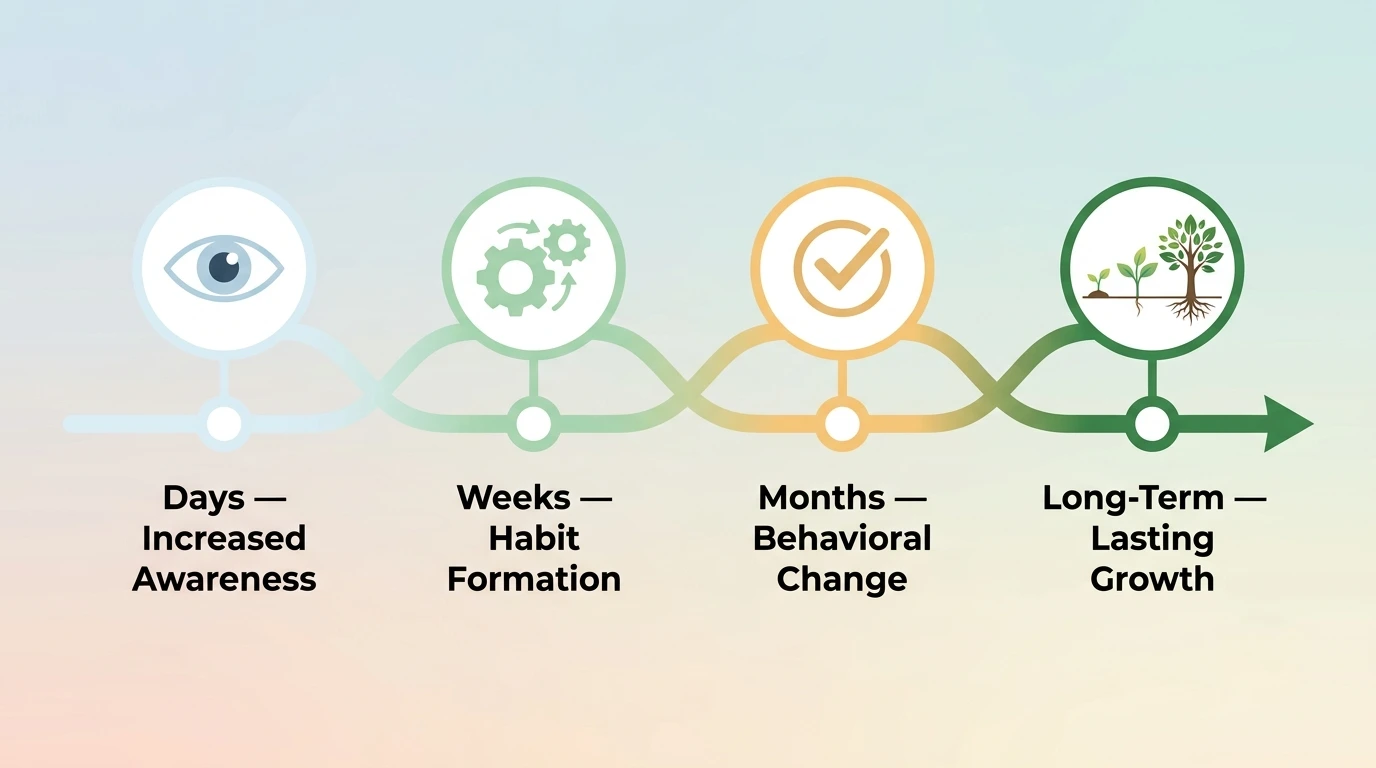
Change following a growth mindset practice tends to unfold in stages. In the first few days, most people notice increased awareness of fixed-mindset thoughts as they occur. Within a few weeks, small habit formation begins, such as catching negative self-talk and reframing it. Within a few months, noticeable behavioral change typically appears — greater persistence, calmer reactions to setbacks, and more consistent effort. Long-term benefits, including stronger resilience and sustained skill growth, build through continued practice well beyond the initial months.
Practice Guide
A practical, repeatable routine supports long-term growth mindset development:
- Daily reflection on one challenge faced and how it was approached
- Weekly learning goals tied to a specific skill or habit
- Ongoing reading or skill development in an area of interest
- Regularly seeking feedback rather than waiting for it
- Tracking progress through notes, journals, or simple logs
- Maintaining motivation through small, visible wins
- Adapting the routine for different contexts — students may focus on study habits, professionals on workplace skills, and lifelong learners on personal interests
Conclusion
A growth mindset is the belief that abilities can be developed through effort, learning, and persistence rather than being fixed. So how does a growth mindset help you? It improves learning speed, builds confidence through visible progress, strengthens resilience during setbacks, and supports better relationships through empathy and adaptability. The benefits extend across academic performance, career growth, mental health, and everyday problem-solving. Rather than pursuing perfection, the most effective approach is consistent, small-scale practice — daily reflection, regular feedback, and patience with the pace of change — allowing a growth mindset to develop gradually into lasting behavior.
Frequently Asked Questions (FAQs)
How does a growth mindset help you in everyday life?
A growth mindset helps in everyday life by making new hobbies, changes, and problems feel manageable, since challenges are approached as learnable rather than fixed obstacles.
Why is a growth mindset important for students?
A growth mindset is important for students because it supports consistent study habits, resilience after poor grades, and long-term learning confidence rather than avoidance of difficult subjects.
What are the biggest benefits of having a growth mindset?
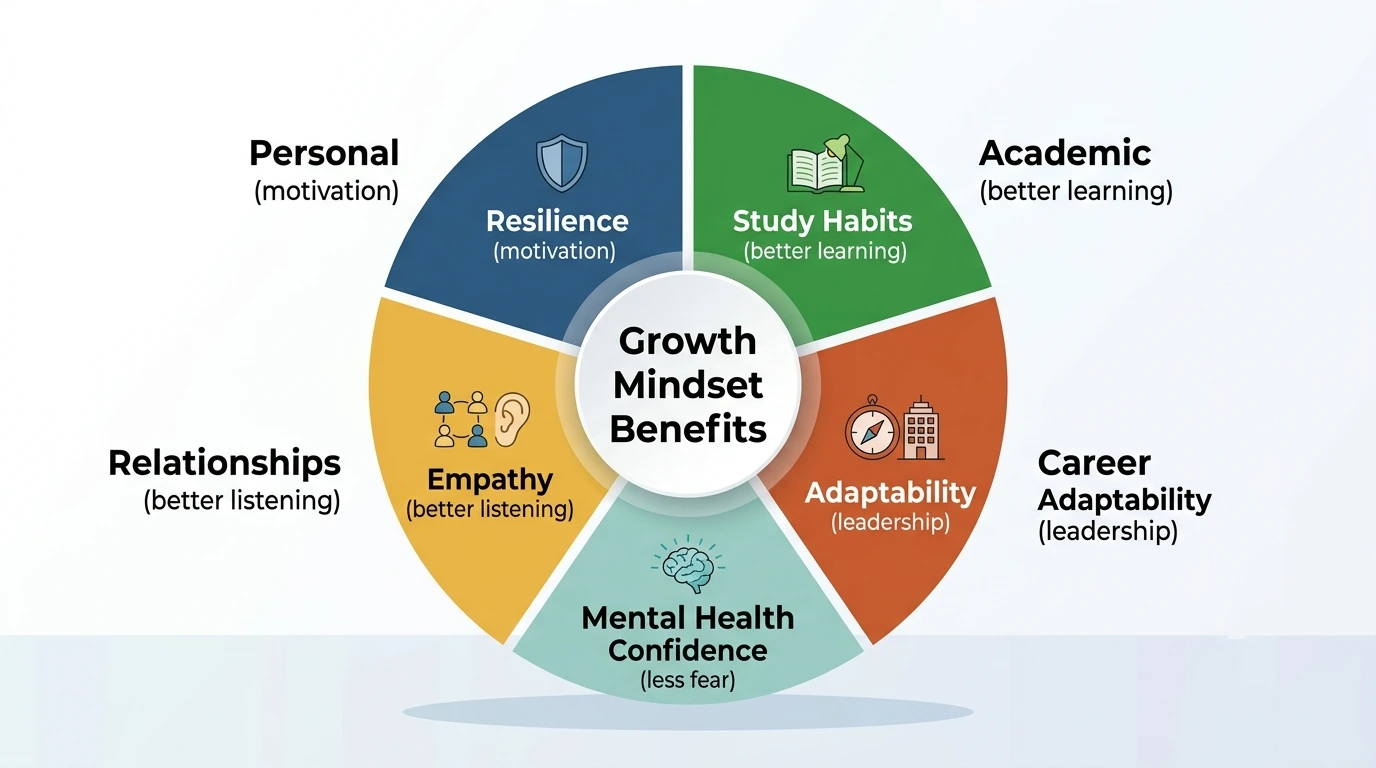
The biggest benefits include greater resilience, increased motivation, improved decision-making, stronger relationships, and reduced stress connected to perfectionism.
How can you develop a growth mindset in your life?
A growth mindset can be developed through daily habits such as embracing challenges, seeking feedback, reflecting regularly, and replacing negative self-talk with growth-oriented language.
Can a growth mindset improve mental health?
Yes, a growth mindset can improve mental health by reducing fear of failure, easing perfectionism-related stress, and supporting healthier, more constructive self-talk.
How does a growth mindset help you succeed?
A growth mindset supports success by encouraging adaptability, persistence through setbacks, and continuous skill development rather than reliance on fixed, existing talent alone.
What are some real-life examples of a growth mindset?
Real-life examples include learning a new language despite mistakes, improving fitness gradually, accepting workplace feedback, and continuing to study a subject after an initial setback.
Can anyone develop a growth mindset?
Yes, anyone can develop a growth mindset through consistent practice, since it is built through repeated habits like reflection, feedback-seeking, and reframing setbacks rather than requiring innate talent.