Introduction
A creator mindset is the belief that individuals can shape outcomes through action, problem-solving, and consistent effort rather than waiting for circumstances to improve on their own. Mindset shapes how people interpret setbacks, approach decisions, and pursue growth, which is why understanding creator mindset examples matters for anyone seeking clarity on how this way of thinking works in daily life. Unlike a purely consumer approach — absorbing information without applying it — a creator mindset emphasizes turning ideas into tangible results. This article breaks down what a creator mindset looks like in practice, how it compares to victim and consumer mindsets, and the specific habits that help build one over time.
Quick Summary
- A creator mindset focuses on taking action, solving problems, and creating value instead of waiting for circumstances to change.
- Creator, consumer, and victim mindsets represent different ways of thinking that influence everyday decisions.
- Developing a creator mindset involves intentional habits, creative thinking, and continuous learning.
- Small daily mindset shifts often produce meaningful long-term personal and professional growth.
What Is a Creator Mindset?
A creator mindset is a way of thinking centered on ownership, initiative, and the deliberate production of value rather than passive reaction to events. People with this mindset see themselves as active participants in their outcomes.
Creator Mindset Definition
At its core, a creator mindset means taking responsibility for decisions, initiating action instead of waiting for permission, and focusing energy on building something useful — whether that’s a skill, a relationship, or a business. This mindset extends well beyond entrepreneurship; it applies to how someone approaches a classroom assignment, a household routine, or a difficult conversation. Used in a sentence, a creator mindset might sound like: “Instead of blaming the market, she used a creator mindset to redesign her product around customer feedback.” Someone who wants to create their own mindset intentionally starts by noticing where they default to reaction rather than initiative.
Creator Mindset in Everyday Life
A creator mindset shows up in ordinary moments long before it shows up in major achievements. Recognizing it in daily contexts makes the concept easier to apply.
- At work: Proposing a solution instead of only flagging a problem.
- At school: Turning a difficult subject into a personal study system.
- Relationships: Initiating repair after a disagreement rather than waiting for the other person to act first.
- Learning new skills: Practicing deliberately instead of passively watching tutorials.
- Personal projects: Starting an imperfect first draft rather than delaying until conditions feel ideal.
Creator Mindset Examples in Real Life
Concrete creator mindset examples make the concept easier to apply than abstract definitions alone. The behaviors below illustrate how this mindset differs in practice across settings.
Personal Development Examples
A person practicing a creator mindset might track a recurring frustration, identify its root cause, and build a small daily habit to address it — such as replacing late-night scrolling with a short planning routine.
Workplace Examples
An employee with a creator mindset redesigns an inefficient process rather than repeatedly complaining about it, and volunteers for unfamiliar projects to build new capabilities.
Student Examples
A student applying this mindset turns a poor grade into a revised study method, seeks feedback from instructors, and treats setbacks as data rather than verdicts on ability.
Business and Entrepreneurship Examples
An entrepreneur using a creator mindset tests a small version of an idea before investing heavily, and adjusts the offer based on real customer response instead of assumptions.
Everyday Decision-Making Examples
In daily decisions, a creator mindset appears as choosing to act on imperfect information rather than waiting indefinitely for certainty.
Common creator-oriented behaviors include:
- Solving problems instead of complaining
- Creating opportunities rather than waiting for them
- Learning from failure instead of avoiding it
- Seeking feedback proactively
- Taking ownership of outcomes
- Building consistent habits over relying on motivation
Creator Mindset vs Victim Mindset
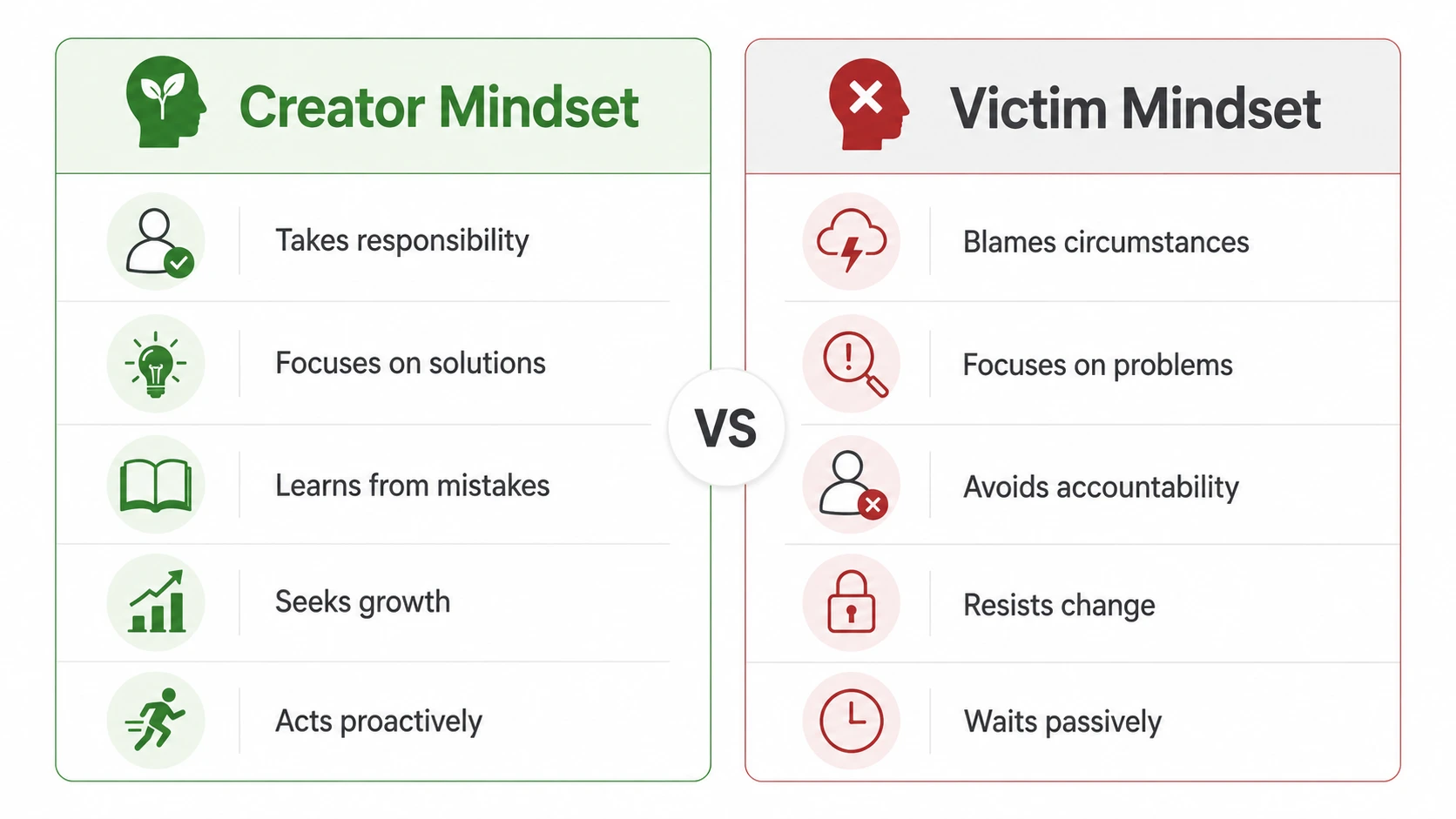
The comparison between a creator mindset and a victim mindset highlights one of the clearest psychological contrasts in personal development. A creator mindset centers on responsibility and action, while a victim mindset centers on external blame and passivity.
Key Differences
| Creator Mindset | Victim Mindset |
|---|---|
| Takes responsibility | Blames circumstances |
| Focuses on solutions | Focuses on problems |
| Learns from mistakes | Avoids accountability |
| Seeks growth | Resists change |
| Acts proactively | Waits passively |
Real-Life Comparison Examples
When a project fails, a creator mindset asks, “What can I adjust next time?” A victim mindset asks, “Why does this always happen to me?” The same event produces two very different behavioral responses depending on which mindset is active.
Consumer vs Creator Mindset
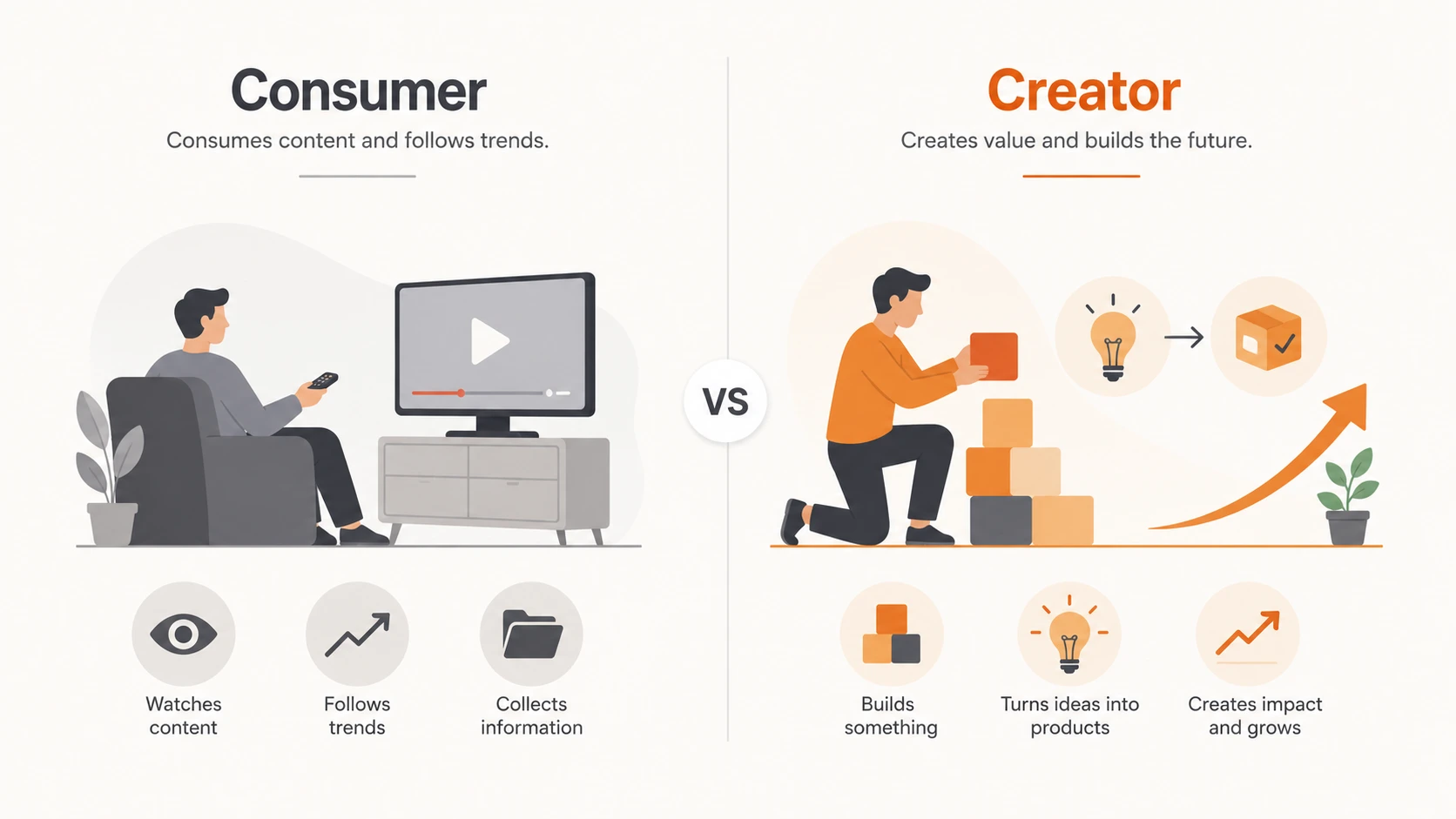
A consumer mindset and a creator mindset are not opposites in a moral sense — both play a healthy role when balanced. The distinction lies in whether information leads to applied action.
When Consuming Is Helpful
Consuming information is valuable when it directly informs a specific decision or skill someone is actively building, such as researching before starting a project.
When Creating Leads to Growth
Growth accelerates when consumption is converted into output — writing, building, teaching, or applying what was learned rather than only absorbing more content.
| Consumer Mindset | Creator Mindset |
|---|---|
| Learns passively | Applies learning |
| Watches | Builds |
| Follows trends | Creates value |
| Collects information | Produces outcomes |
Understanding Creative Mindset
A creative mindset overlaps with a creator mindset but is not identical to it. Creative mindset refers specifically to the capacity for original thinking, while creator mindset refers to turning ideas — creative or otherwise — into action.
Creative Mindset Meaning
Creative mindset meaning centers on flexible thinking: the ability to generate novel connections, reframe problems, and consider multiple solutions rather than defaulting to the first available answer.
Creative Thinking vs Creative Mindset
Creative thinking describes a specific cognitive process used in a moment, while a creative mindset describes an ongoing disposition toward that kind of thinking across many situations.
Common Creative Mindset Synonyms
- Innovative thinking
- Resourceful thinking
- Solution-oriented mindset
- Inventive thinking
- Imaginative thinking
What Is a Growth Mindset?
Understanding what a growth mindset is provides useful context before connecting it to a creator mindset, since the two concepts frequently reinforce each other. Understanding why a growth mindset is important helps explain why it pairs so naturally with a creator mindset.
Growth Mindset Definition
A growth mindset, a term developed through psychological research on motivation and achievement, is defined as the belief that abilities and intelligence can be developed through effort, strategy, and feedback rather than being fixed traits. The definition of growth mindset centers on the idea that challenges are opportunities to build capability rather than threats to be avoided.
Fixed Mindset vs Growth Mindset
| Growth Mindset | Fixed Mindset |
|---|---|
| Learns continuously | Avoids challenges |
| Values effort | Seeks certainty |
| Welcomes feedback | Fears criticism |
How Growth Mindset Supports a Creator Mindset
A growth mindset provides the psychological foundation that makes a creator mindset sustainable, since believing skills can improve makes it easier to take creative risks and tolerate early failures.
How to Develop a Creative and Creator Mindset
Learning how to develop a creative mindset and how to think creatively involves specific, repeatable practices rather than waiting for inspiration.
Daily Habits That Build Creativity
Small daily actions — reading outside a familiar subject, sketching an idea, or asking “what if” — build the mental flexibility that supports creative thinking over time.
Creative Thinking Exercises
Structured exercises such as generating ten unconventional solutions to a routine problem help train the brain to move past obvious answers, which strengthens the ability to enhance creativity.
Building Better Problem-Solving Skills
Problem-solving improves when someone practices breaking large problems into smaller, testable pieces rather than searching for one complete solution upfront.
To develop as a creative thinker:
- Ask better questions
- Practice idea generation
- Keep an idea journal
- Learn through experimentation
- Reflect regularly
- Seek diverse perspectives
Common Challenges When Developing a Creator Mindset
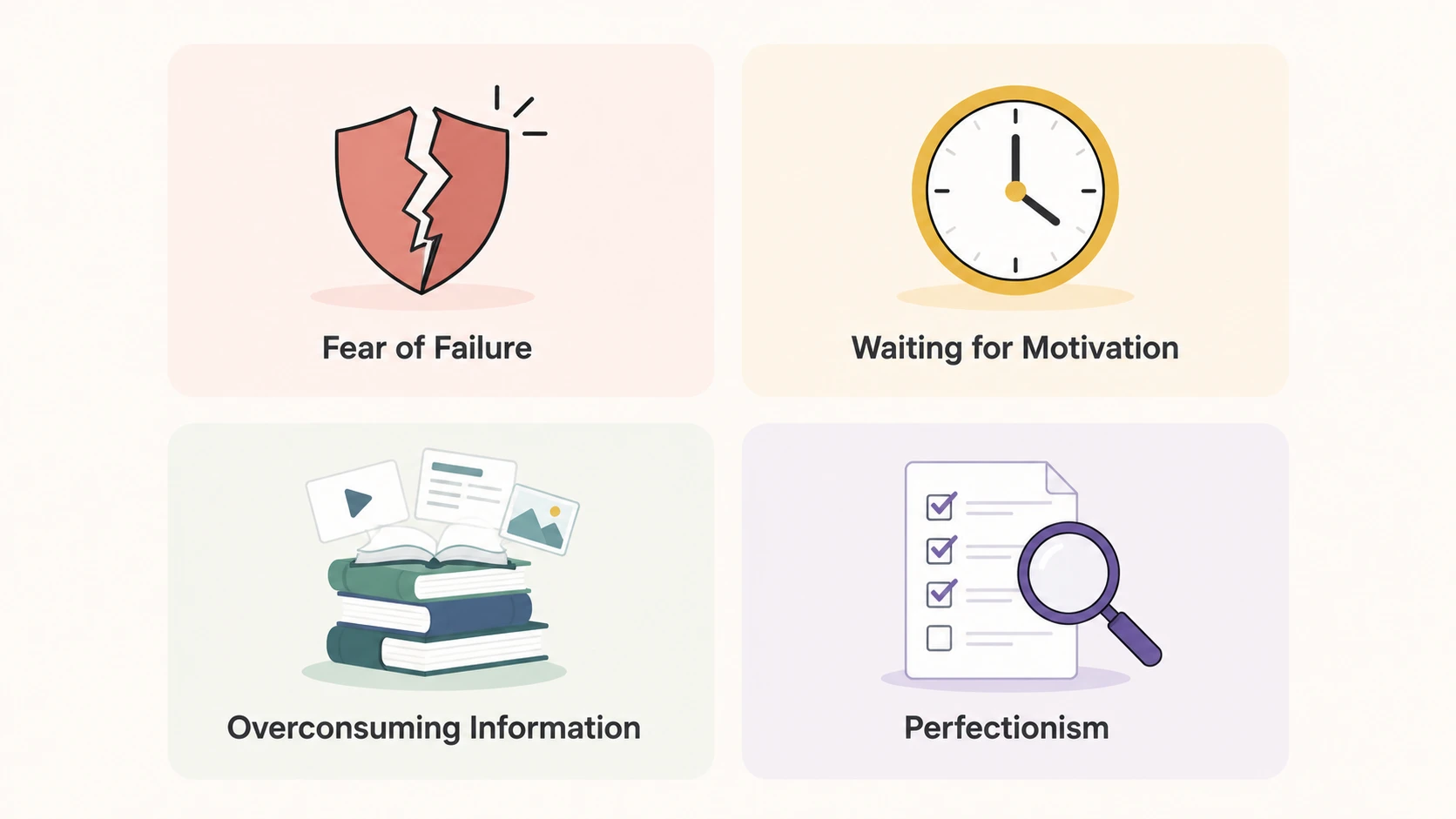
Most people encounter predictable obstacles when shifting toward a creator mindset, and understanding these challenges in advance makes them easier to manage.
Fear of Failure
Fear of failure happens because mistakes feel like evidence of inadequacy rather than useful information. It can be reduced by reframing failure as feedback and prevented by starting with lower-stakes attempts.
Waiting for Motivation
Waiting for motivation happens because people assume feeling ready must come before action. It is overcome by building small habits that don’t depend on motivation, and prevented by scheduling action at fixed times regardless of mood. This is where learning how to build discipline without motivation becomes essential to sustaining a creator mindset.
Overconsuming Information
Overconsumption happens when learning feels productive even without application. It is overcome by setting a rule to apply one insight before consuming new material, and prevented by tracking output alongside input.
Perfectionism
Perfectionism happens when self-worth becomes tied to flawless results. It is overcome by deliberately releasing imperfect work, and prevented by setting “good enough” thresholds in advance.
Beginner Mistakes That Slow Creative Growth
Several avoidable mistakes commonly slow progress for people building a creator mindset:
- Comparing yourself to others
- Seeking perfect ideas before starting
- Avoiding experimentation
- Expecting quick results
- Ignoring feedback
- Consuming more than creating
Practical Ways to Apply a Creator Mindset Every Day
Turning theory into practice requires applying a creator mindset across the specific contexts where decisions actually happen.
At Work
Propose one improvement each week instead of waiting for annual reviews to raise concerns.
In Education
Treat assignments as opportunities to build a personal system rather than tasks to merely complete.
In Personal Life
Initiate difficult conversations early rather than allowing frustration to build silently.
During Difficult Situations
Focus on the next controllable action rather than dwelling on factors outside personal control.
Difficulty & Time Investment
Building a creator mindset is a gradual psychological shift rather than an instant change, and the effort required varies by individual starting point. Beginners often find the first stage — noticing automatic reactive patterns — the most demanding, since it requires ongoing self-awareness before new habits can form. Experienced practitioners typically find it easier to sustain, since the underlying habits become more automatic with repetition. Consistency, supportive environments, and realistic expectations all influence how much conscious effort this mindset shift requires at any given stage.
Results Timeline
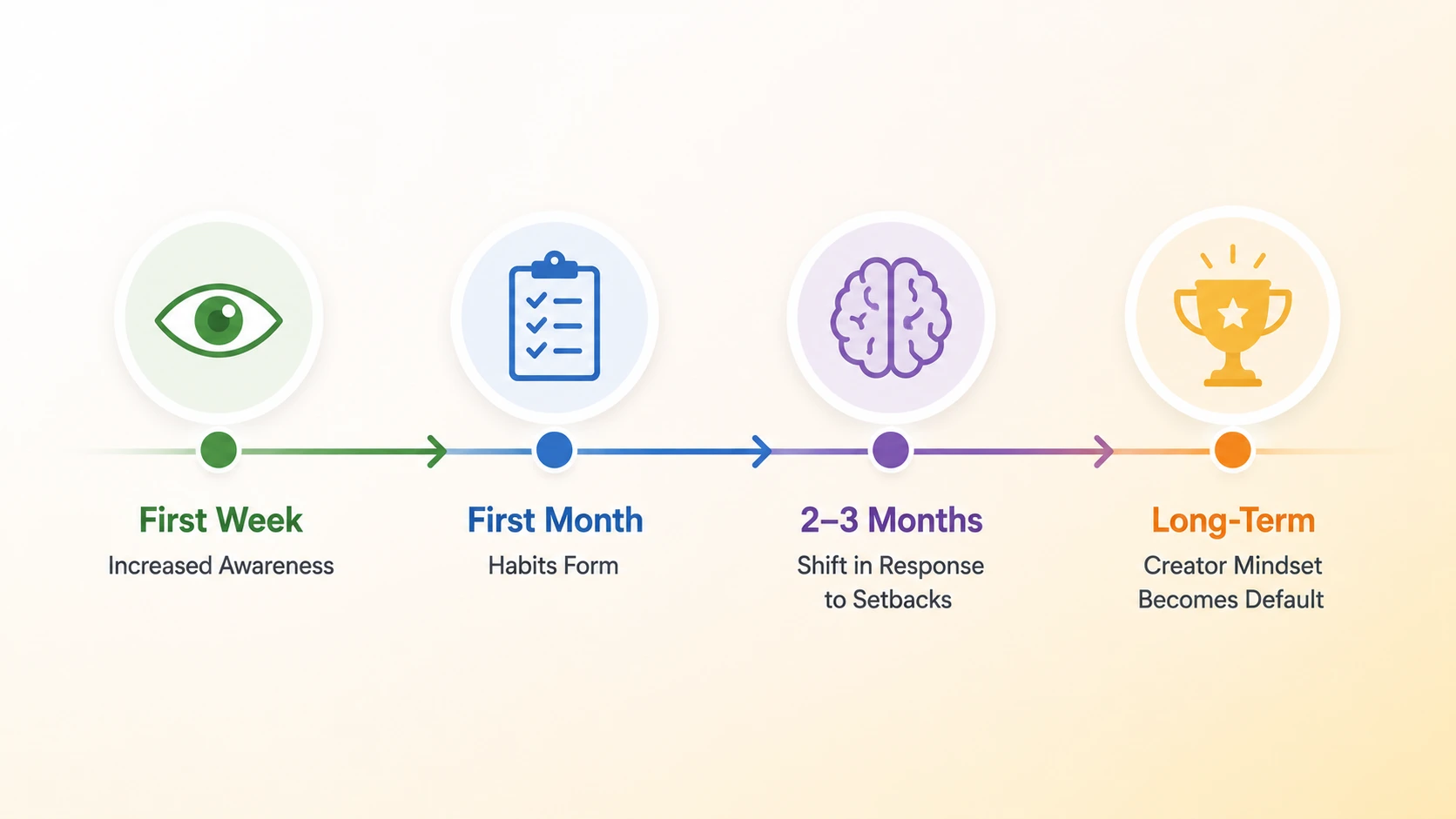
Progress in developing a creator mindset tends to follow a recognizable pattern, though pace varies by individual.
- First week: Increased awareness of reactive versus proactive responses.
- First month: Small, repeatable habits begin to feel more natural.
- 2–3 months: Noticeable shifts in how challenges and setbacks are interpreted.
- Long-term development: Creator-oriented responses become a default rather than a deliberate effort.
Consistency, regular reflection, frequency of practice, and a supportive environment all directly affect how quickly these shifts take hold.
Practice Guide
A structured routine helps translate creator mindset principles into lasting behavior.
Daily Practices
Identify one situation each day to respond to proactively rather than reactively.
Weekly Reflection
Review which decisions reflected a creator mindset and which slipped into passive or reactive patterns.
Tracking Progress
Use a simple journal or habit tracker to record proactive actions taken each day. Pairing this habit with journal prompts for self growth can make daily tracking more reflective and consistent.
Staying Consistent
Consistency benefits from journaling, clear goal setting, habit tracking, accountability partners, and continuous learning to reinforce the mindset over time.
Creative Mindset Resources for Continued Learning
Continued learning can reinforce the ideas covered in this article without relying on any single source as authoritative.
Influential Books
Widely referenced works on creativity, motivation, and mindset psychology offer deeper frameworks for readers who want to study the underlying research further.
Inspirational Quotes
Short, well-known quotes on creativity and growth can serve as helpful daily reminders when paired with consistent action rather than used as a substitute for it.
Learning Through Practice
The most reliable way to internalize a creator mindset is through repeated, reflective practice rather than passive study alone.
Conclusion
A creator mindset, a creative mindset, and a growth mindset are distinct but interconnected concepts that together shape how effectively someone turns ideas into outcomes. The creator mindset examples throughout this article show that this way of thinking is built through small, consistent, proactive choices — not through waiting for ideal conditions or instant transformation. Readers looking to strengthen this mindset benefit most from focusing on steady daily practice rather than pursuing an unrealistic standard of perfection.
Frequently Asked Questions
What is a creator mindset in simple terms?
A creator mindset is the practice of taking responsibility and action to produce value, rather than waiting passively for circumstances to change.
What are some everyday creator mindset examples?
Examples include proposing solutions at work, initiating repair in relationships, and turning setbacks at school into revised study strategies.
How is a creator mindset different from a victim mindset?
A creator mindset focuses on responsibility and solutions, while a victim mindset focuses on blame and passivity.
What is the difference between a consumer and creator mindset?
A consumer mindset absorbs information passively, while a creator mindset applies that information to produce tangible outcomes.
Is a creator mindset the same as a growth mindset?
No. A growth mindset is the belief that abilities can improve with effort, while a creator mindset is the practice of taking proactive action; the two often reinforce each other.
How can I develop a creative mindset?
A creative mindset develops through daily habits like idea journaling, deliberate practice, and exposure to varied perspectives.
Can anyone become a creative thinker?
Yes. Creative thinking is a skill that improves with consistent practice rather than a fixed trait limited to certain people.
Why is creative thinking important for personal growth?
Creative thinking supports personal growth by enabling flexible problem-solving and helping individuals adapt to new challenges rather than relying on rigid, outdated approaches.