

Introduction
How often do couples fight varies widely, but relationship conflict is common and does not automatically mean a relationship is unhealthy. Some couples argue rarely, some disagree weekly, and some go through seasons of more frequent conflict because of stress, finances, parenting, life transitions, or unmet emotional needs. The real question is not only how often do couples fight in a relationship, how often do couples fight on average, or how often does the average married couple fight. What matters more is how couples argue, whether they repair afterward, and whether conflict creates understanding or emotional distance.
Quick Summary
- Couples may fight anywhere from rarely to several times a month, but frequency is less important than the pattern, intensity, and repair afterward.
- Healthy arguments usually involve respectful communication, problem-solving, and emotional reconnection.
- Fighting every day, not speaking for days, or repeating the same unresolved issues can signal deeper relationship problems.
- The healthiest couples focus less on “winning” arguments and more on understanding, accountability, and behavior change.
How Often Do Couples Fight in a Healthy Relationship?
There is no universal “correct” number for how often couples fight in a healthy relationship. A healthy relationship is not defined by never fighting, but by whether both partners feel safe, heard, respected, and emotionally connected during and after conflict.
Some healthy couples argue a few times per month. Some have small disagreements weekly without serious emotional harm. Others fight rarely because they communicate early, before frustration becomes resentment.
How often do couples fight healthy depends on several factors:
- Stress levels
- Personality differences
- Attachment styles
- Emotional regulation skills
- Communication habits
- Work, family, or financial pressure
- How quickly issues are addressed
How often do couples fight per month or how often do couples fight a week matters less than the quality of the conflict. A weekly disagreement may be healthy if both partners listen, repair, and make changes. A rare fight may be unhealthy if it includes fear, contempt, insults, or emotional withdrawal.
Unresolved emotions increase conflict because small issues start representing deeper unmet needs. A disagreement about being late may really mean, “I do not feel prioritized.” A fight about chores may really mean, “I feel unsupported.”
How Often Do Couples Fight on Average?
Couples fight on average in different patterns, so there is no single number that defines normal. Conflict frequency depends on relationship stage, lifestyle pressure, emotional maturity, and how well both people communicate.
Common conflict rhythms include:
- New couples may fight during adjustment periods as expectations become clearer.
- Long-term couples may argue about routines, money, family responsibilities, intimacy, or emotional connection.
- Married couples may experience recurring arguments when roles, responsibilities, or communication patterns become fixed.
- Couples under stress often fight more because emotional regulation becomes harder.
Questions like statistically how often do couples fight, how often do couples fight statistics, and how often does the average married couple fight can be useful, but statistics should not replace honest self-assessment.
A couple arguing twice a month may be unhealthy if the fights are cruel, unresolved, or emotionally damaging. A couple disagreeing weekly may be healthy if they resolve issues respectfully and reconnect afterward.
The better question is: “Do our fights help us understand each other, or do they push us further apart?”
What Do Couples Fight About Most?
Couples most often fight about money, responsibilities, communication, intimacy, family boundaries, trust, and feeling unappreciated. These topics create emotional reactions because they connect to safety, fairness, respect, love, and long-term stability.
Common topics couples argue about include:
- Money and spending habits
- Household responsibilities
- Communication styles
- Time together vs personal space
- Family boundaries
- Parenting decisions
- Sex and intimacy
- Feeling unappreciated
- Future goals and commitment
- Trust, jealousy, or insecurity
Many couple arguments are not only about the surface issue. Relationship fights often hide deeper emotional needs.
For example, fighting about dishes may really be about feeling unsupported, unseen, or taken for granted. An argument about phone use may really mean, “I miss your attention.” A fight about money may really mean, “I need to feel secure.”
This is why couples arguments often repeat. The topic may look practical, but the emotional need underneath remains unresolved.
When Do Couples Fight the Most?
Couples often fight the most during stressful seasons, major transitions, and periods of emotional overload. Stress reduces patience, increases defensiveness, and makes neutral comments feel like criticism.
Situations where fighting in a relationship commonly increases include:
- Moving in together
- Planning a wedding
- Buying a home
- Having children
- Financial stress
- Career changes
- Lack of sleep
- Family conflict
- Major decisions
- Emotional disconnection
Fighting in relationships often increases when life changes expose differences in values, habits, and expectations. Moving in together may reveal different standards around cleanliness, money, privacy, or routines. Having children may expose different beliefs about discipline, emotional labor, and responsibility.
The cause-effect pattern is clear: when stress rises, emotional regulation becomes harder. When regulation drops, people react faster, listen less, and defend themselves more strongly. This can turn small disagreements into bigger arguments.
Is It Normal for Couples to Argue Every Day?
It can be common for couples to argue every day during stressful seasons, but daily arguing should not be dismissed as automatically normal or healthy. Daily small disagreements may happen under pressure, but daily intense arguments often point to deeper resentment, poor communication, emotional dysregulation, or incompatible expectations.
Daily couple arguing may happen during:
- Parenting stress
- Financial pressure
- Moving or major transitions
- Sleep deprivation
- Work overload
- Grief or emotional strain
- Unresolved recurring problems
Arguing and relationships become concerning when conflict creates exhaustion, fear, avoidance, or emotional distance. If one or both partners feel like they are walking on eggshells, avoiding conversations, or constantly preparing for the next fight, the pattern needs attention.
If arguments repeat without resolution, the problem is usually not the topic. The problem is the conflict pattern.
A practical prevention strategy is to schedule calm conversations before problems escalate. Instead of waiting until both people are angry, couples can choose a specific time to discuss one issue with the goal of understanding, not winning.
Is It Normal for Couples to Fight and Not Talk for Days?
It is normal for couples to need space after a fight, but not talking for days can become unhealthy when it turns into avoidance, punishment, or emotional withdrawal. Healthy space includes a plan to return; unhealthy silence leaves the relationship emotionally unsafe.
| Healthy Space | Unhealthy Silence |
|---|---|
| “I need time to calm down, but I want to talk later.” | Ignoring, punishing, or withdrawing affection |
| Has a clear return point | Has no repair plan |
| Reduces emotional intensity | Increases anxiety and resentment |
| Protects the relationship | Creates emotional distance |
Couple fighting does not always need immediate resolution. Sometimes both people need time to calm their nervous system before speaking clearly. However, couples fighting and then refusing to talk for days can increase insecurity, resentment, and fear.
A helpful repair window is to revisit the issue within 24 hours when possible. Repair matters more than immediate resolution. Even saying, “I still care about us, and I want to talk when we are calmer,” can protect emotional safety.
How Much Fighting Is Too Much in a Relationship?
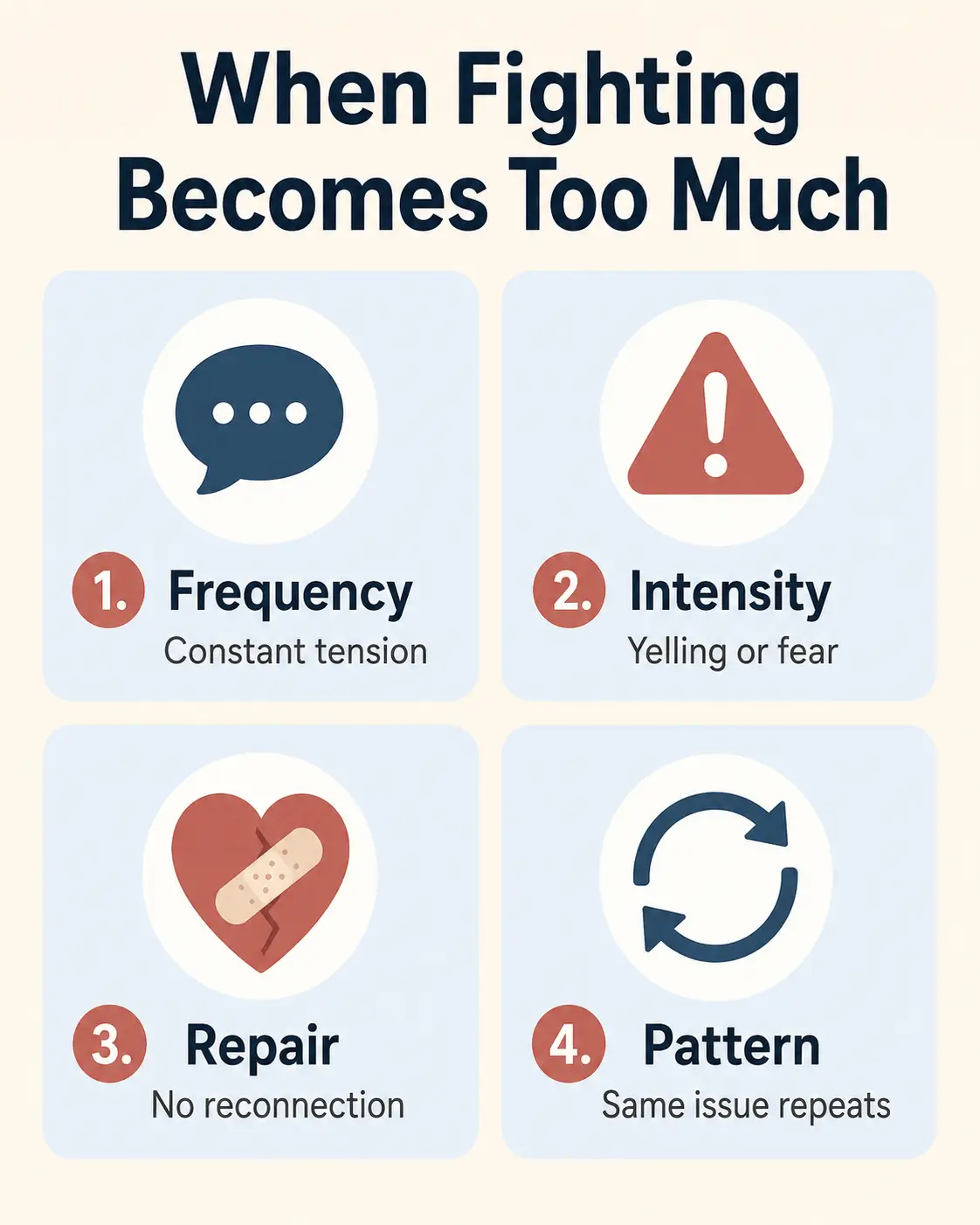
Fighting is too much when it becomes repetitive, emotionally unsafe, unresolved, or damaging to daily life. The healthiest way to judge a fighting relationship is to look at frequency, intensity, repair, and pattern together.
Too much fighting may look like:
- Arguing about the same issue repeatedly with no change
- Feeling anxious before bringing up concerns
- Name-calling, contempt, insults, or threats
- One partner always shutting down or dominating
- Avoiding each other to prevent conflict
- Fights affecting sleep, work, parenting, or mental health
- Apologies without behavior change
- Emotional distance after every disagreement
A simple decision framework is:
| Factor | Healthy Sign | Warning Sign |
|---|---|---|
| Frequency | Occasional or manageable disagreements | Constant conflict or daily tension |
| Intensity | Respectful disagreement | Yelling, contempt, threats, or fear |
| Repair | Both reconnect afterward | Silence, avoidance, or punishment |
| Pattern | Issues improve over time | Same fights repeat with no change |
Repeated unresolved conflict weakens trust because partners stop believing change is possible. When apologies happen without behavior change, the relationship can feel emotionally unstable even if both people still care.
Healthy Fighting vs Unhealthy Fighting
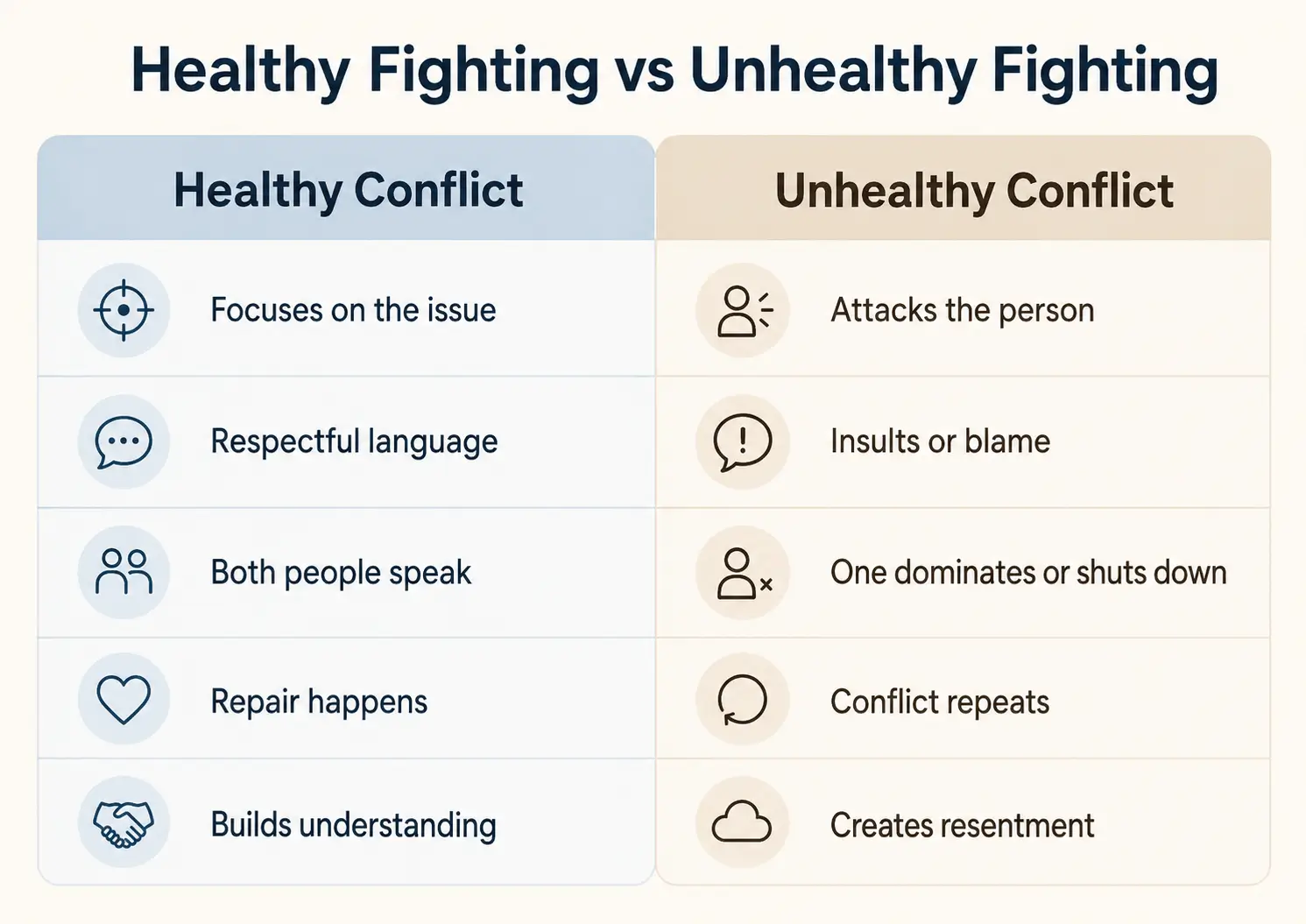
Healthy fighting focuses on solving the issue, while unhealthy fighting attacks the person. Fighting itself is not always the problem; destructive patterns are.
| Healthy Conflict | Unhealthy Conflict |
|---|---|
| Focuses on the issue | Attacks the person |
| Uses calm or respectful language | Uses insults, contempt, or blame |
| Allows both people to speak | One person dominates or shuts down |
| Leads to repair or compromise | Repeats without resolution |
| Builds understanding | Creates fear or resentment |
| Includes accountability | Avoids responsibility |
Couples that argue can still have a strong relationship if both partners feel emotionally safe. Couples who fight in destructive ways may lose trust even if the fights are not frequent.
Healthy conflict can strengthen understanding because it reveals needs, expectations, values, and areas for change. The goal is not to remove every disagreement. The goal is to disagree without damaging respect or emotional safety.
Destructive conflict patterns often include criticism, contempt, defensiveness, and stonewalling, which are commonly discussed in the four horsemen of relationships.
Are Couples Who Fight a Lot Actually More in Love?
Couples who fight a lot are not necessarily more in love. Frequent fighting may show emotional investment, honesty, or passion, but love is better measured by respect, repair, emotional safety, and consistent care.
| Myth | Reality |
|---|---|
| “Couples who fight a lot are more passionate.” | Passion without emotional regulation can become instability. |
| “If we fight, it means we care.” | Caring should lead to better communication, not repeated harm. |
| “No fighting means no love.” | Some couples resolve issues early and calmly. |
High-conflict relationships can feel intense, but intensity is not the same as emotional security. Emotional highs after conflict can sometimes be mistaken for closeness, especially when a painful argument is followed by affection or relief.
A secure relationship feels stable, not constantly dramatic. Love allows honesty, but honesty should not become repeated emotional harm.
Why Couples Keep Having the Same Fights
Couples keep having the same fights because the emotional need underneath the issue remains unresolved. The surface topic may change, but the hidden pattern continues.
Common hidden causes include:
- Unspoken expectations
- Poor emotional regulation
- Feeling unheard
- Avoiding difficult conversations
- Different attachment styles
- Resentment from past conflicts
- Power struggles
- Lack of clear agreements
For example, “You never help around the house” may really mean, “I feel alone and unsupported.” “You are always on your phone” may mean, “I miss feeling connected to you.”
Repeated fights often become habit loops. One partner complains, the other becomes defensive, the first escalates, the second withdraws, and nothing changes. Over time, the pattern becomes automatic.
Healthier conflict requires self-awareness, emotional regulation, and habit change. Couples need to pause the automatic reaction, name the real issue, and create a clearer agreement.
Problem-Solution Guide for Common Relationship Fight Patterns
Procrastination in Relationship Conversations
Procrastination in relationship conversations happens when one or both partners delay hard conversations because they fear conflict, discomfort, or emotional reaction. Avoidance may feel easier short term, but it often creates resentment long term.
Why it happens:
- Fear of conflict
- Avoiding discomfort
- Hoping the issue disappears
How to fix it:
- Bring up concerns early and calmly.
- Use specific examples instead of accusations.
- Set a time to talk when both partners are regulated.
How to prevent it:
- Have weekly check-ins before resentment builds.
Lack of Motivation to Change
Lack of motivation to change often happens when one or both partners feel blamed, hopeless, or emotionally tired. When the same conflict repeats, people may stop believing improvement is possible.
Why it happens:
- One or both partners feel blamed, hopeless, or emotionally tired.
How to fix it:
- Focus on one behavior change at a time.
- Replace “You never…” with “I need…”
How to prevent it:
- Celebrate small improvements instead of only criticizing failures.
Inconsistency After Apologies
Inconsistency after apologies happens because apologies are emotional, but behavior change requires systems. A partner may feel sincere in the moment but return to old habits when stress returns.
For couples who struggle with repair, learning how to apologize without saying sorry can help turn regret into clearer accountability and behavior change.
Why it happens:
- Apologies are emotional, but behavior change requires systems.
How to fix it:
- Turn apologies into clear agreements.
- Define what will change, when, and how.
How to prevent it:
- Review progress without shaming each other.
Overthinking After a Fight
Overthinking after a fight happens because unresolved tension makes the brain search for threats. Anxious attachment can intensify fear of abandonment, rejection, or future conflict.
Why it happens:
- Unresolved tension makes the brain search for threats.
- Anxious attachment can intensify fear of abandonment.
How to fix it:
- Ask for clarity instead of guessing.
- Use calming routines before discussing the issue again.
How to prevent it:
- End arguments with a repair statement, even if the issue is not fully solved.
Burnout From Constant Conflict
Burnout from constant conflict happens when emotional energy is drained because every issue becomes a battle. Over time, even small topics feel heavy.
Why it happens:
- Emotional energy is drained when every issue becomes a battle.
How to fix it:
- Pause non-urgent arguments.
- Prioritize the top recurring issue.
- Consider couples therapy if conflict feels unmanageable.
How to prevent it:
- Build routines for rest, connection, and calm communication.
Fear of Failure in the Relationship
Fear of failure in the relationship happens when repeated fights make partners believe the relationship is doomed. This fear can increase panic, defensiveness, and hopelessness.
Why it happens:
- Repeated fights can make partners believe the relationship is doomed.
How to fix it:
- Separate “we had a bad conflict pattern” from “we are a bad couple.”
- Focus on repair skills.
How to prevent it:
- Track progress through behavior, not emotional perfection.
Table-Friendly Section — Common Fight Triggers and Healthier Responses
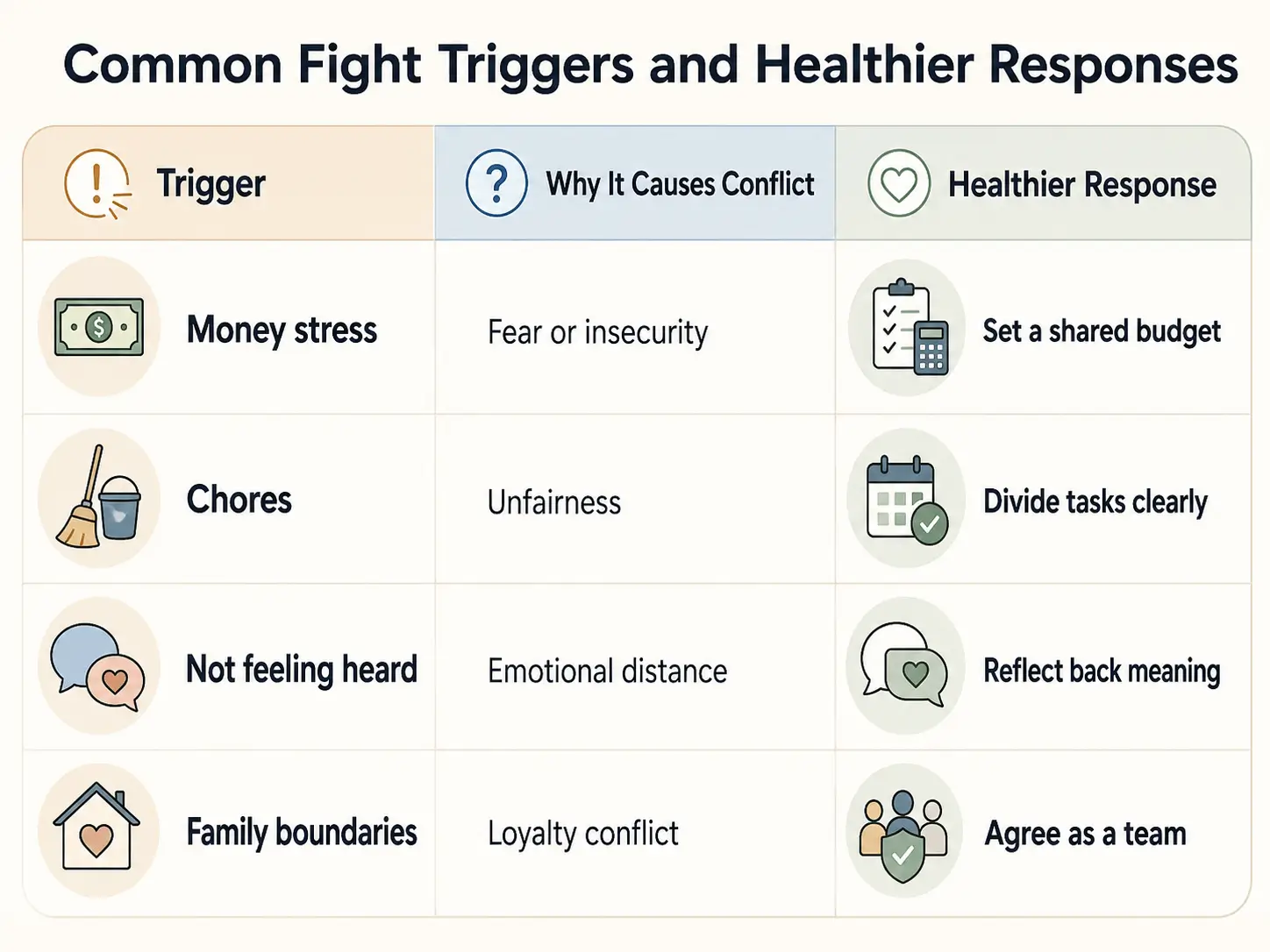
Common fight triggers become easier to manage when couples understand the cause of the conflict and choose a healthier response.
| Fight Trigger | Why It Causes Conflict | Healthier Response |
|---|---|---|
| Money stress | Creates fear, control issues, or insecurity | Set a shared budget and discuss values |
| Chores | Triggers feelings of unfairness | Divide tasks clearly and review weekly |
| Not feeling heard | Creates emotional distance | Reflect back what each person means |
| Different schedules | Reduces connection time | Plan intentional time together |
| Family boundaries | Creates loyalty conflicts | Agree on boundaries as a team |
| Repeated criticism | Causes defensiveness | Ask for change without attacking character |
| Lack of affection | Triggers rejection fears | Discuss emotional and physical needs openly |
This framework connects couple arguments, couples arguments, fighting in a relationship, and relationship fights with practical behavior change. The goal is to move from blame to clarity.
Motivation vs Discipline in Relationship Conflict
Better conflict habits require discipline, not just motivation. Many couples know what they should do, but emotional triggers make calm communication difficult in the moment.
| Motivation | Discipline |
|---|---|
| “I want us to communicate better.” | “I pause before reacting.” |
| Depends on mood | Depends on repeated practice |
| Often fades during stress | Helps during stress |
| Starts change | Maintains change |
| Emotion-driven | Value-driven |
Motivation often appears after a fight, when both people feel regret or hope. Discipline matters during the next difficult conversation, when the nervous system is activated and old habits return.
Calm conflict is a practiced habit, not a personality trait. Couples improve by repeating small behaviors: pausing, lowering their voice, asking better questions, and returning to repair.
Consistency vs Intensity in Fixing Relationship Fights
Consistency fixes repeated relationship fight patterns better than intensity. One deep conversation rarely changes a long-term conflict cycle unless it is followed by repeated behavior change.
Examples of consistent repair habits include:
- Pausing before raising your voice
- Naming the real issue
- Apologizing specifically
- Returning to the conversation after cooling down
- Asking, “What do you need from me right now?”
- Following through on agreed behavior changes
Intensity can feel powerful after an emotional fight. A partner may make a strong promise, apologize deeply, or express love passionately. But intense promises are less useful without daily behavior change.
Consistency builds trust because it gives the nervous system repeated evidence of safety. Every respectful repair teaches both partners that conflict does not have to become emotional danger.
Science-Backed Insights About Relationship Conflict
Relationship conflict is shaped by emotional flooding, defensiveness, repair attempts, attachment patterns, and habit loops. These principles explain why slowing down, taking breaks, and using softer language can change the outcome of an argument.
| Concept | What It Means | Practical Application |
|---|---|---|
| Emotional flooding | People struggle to think clearly when overwhelmed | Pause before continuing |
| Defensiveness | Criticism triggers self-protection instead of listening | Use softer language |
| Repair attempts | Small gestures can de-escalate conflict | Say, “Can we restart?” |
| Attachment patterns | Fear of abandonment or fear of control can shape arguments | Name the fear underneath |
| Habit loops | Repeated fight patterns become automatic unless interrupted | Pause the cycle early |
Emotional flooding makes it harder to think clearly, listen well, or respond calmly. This is why taking a short break can be more productive than forcing the conversation to continue.
Defensiveness often appears when a partner hears criticism as a character attack. “I feel unsupported when chores pile up” usually works better than “You are lazy.”
Repair attempts are small actions that protect connection during conflict. A calmer tone, a short apology, a soft question, or a request to restart can prevent escalation.
Real-Life Scenarios: What Different Fight Patterns May Mean
Different fight patterns can mean different things depending on emotional safety, repair, and whether problems improve over time.
The Couple That Rarely Fights
The couple that rarely fights may be healthy if both partners communicate openly, address issues early, and feel emotionally safe. Low conflict can reflect compatibility, maturity, or strong communication habits.
It can be unhealthy if one or both partners avoid conflict to keep the peace. Avoidance may look calm on the surface while resentment grows underneath.
The Couple That Fights Weekly
The couple that fights weekly may be normal if disagreements are respectful and resolved. Weekly conflict becomes concerning when the same issue repeats without change.
Couples arguing weekly should ask whether the conversations are creating progress or repeating the same emotional cycle.
The Couple That Argues Every Day
The couple that argues every day may be dealing with stress, resentment, emotional reactivity, or poor communication systems. Daily couples arguing often means the relationship needs structure, not just effort.
This couple may benefit from scheduled check-ins, clearer agreements, calmer timing, or professional support.
The Couple That Stops Talking for Days
The couple that stops talking for days may be experiencing emotional overwhelm, avoidance, or punishment. Couples fighting and then withdrawing for long periods can weaken trust.
Healthy couples create a plan to reconnect. They may take space, but they do not leave the relationship emotionally uncertain.
How to Fight Less and Communicate Better
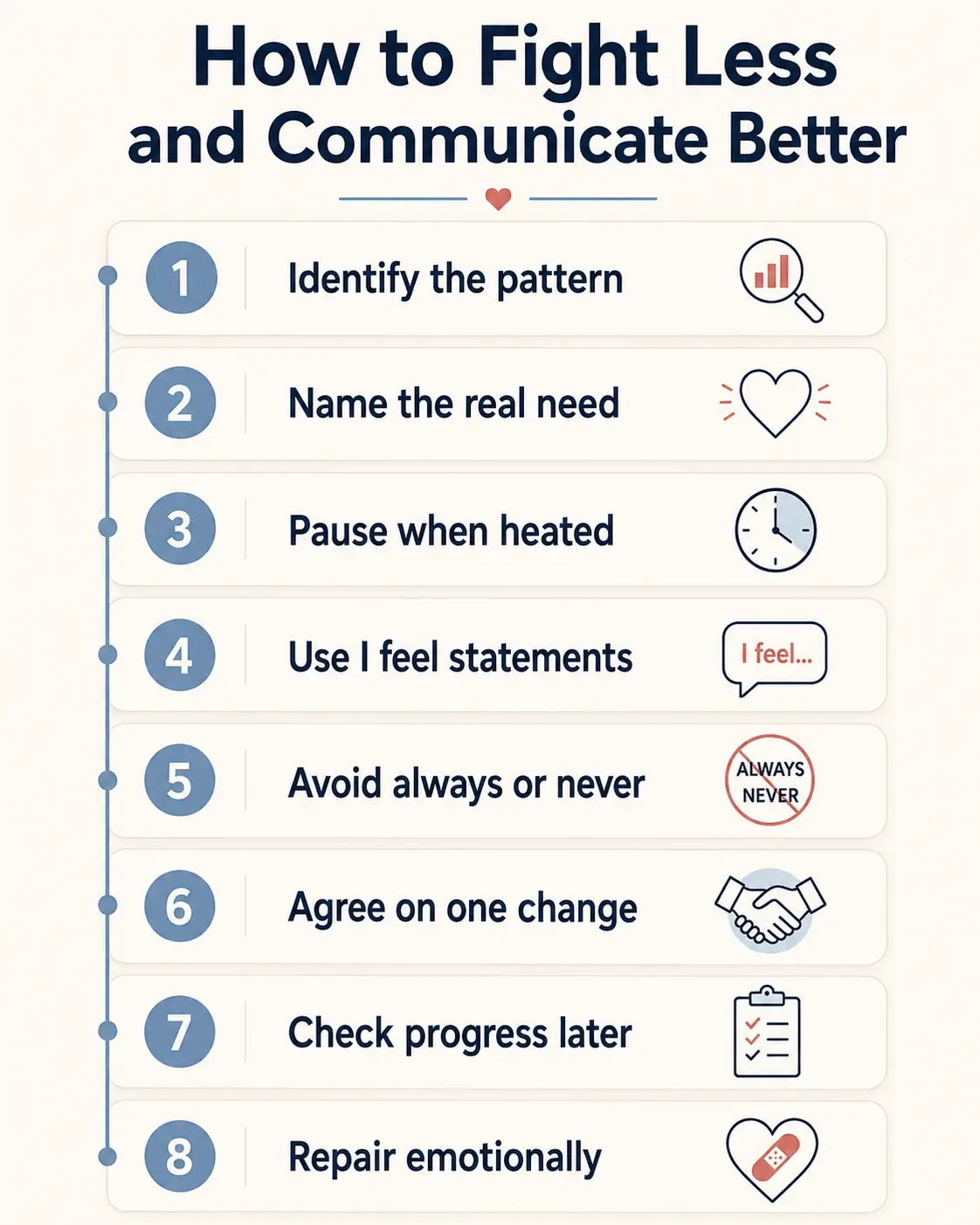
Couples fight less and communicate better by identifying the repeated pattern, naming the real emotional need, pausing during escalation, and agreeing on one specific behavior change. Better communication is built through repeated small choices.
Understanding your partner’s feelings is a major part of healthy repair, which is why empathy is important in relationships during and after conflict.
Step-by-step framework:
- Identify the repeated pattern, not just the latest argument.
- Name the real emotional need underneath the complaint.
- Pause when the conversation becomes too heated.
- Use “I feel” and “I need” statements.
- Avoid character attacks like “you always” or “you never.”
- Agree on one specific behavior change.
- Revisit the issue later to check progress.
- Repair emotionally, even when full agreement is not possible.
For example, instead of saying, “You never listen,” say, “I feel dismissed when I talk and you look at your phone. I need five minutes of focused attention.”
Couples need systems, not just intentions. A weekly check-in, a repair window, and a shared pause strategy can reduce fights because problems are addressed before they become emotional explosions.
When Relationship Fighting May Need Outside Help
Relationship fighting may need outside help when conflict feels repetitive, unsafe, escalating, or impossible to resolve alone. Therapy or counseling can help couples identify patterns they cannot clearly see during emotional conflict.
Signs outside help may be useful include:
- The same fight keeps happening with no progress.
- One or both partners feel emotionally unsafe.
- Arguments escalate quickly.
- There is stonewalling, contempt, manipulation, or fear.
- Conflict affects children, work, sleep, or mental health.
- One partner wants to improve but the other refuses accountability.
Seeking help does not mean the relationship has failed. It often means the couple needs better tools, structure, and a neutral third party to slow the pattern down.
Professional support is especially important when conflict includes fear, coercion, threats, emotional abuse, or physical harm.
Common Myths About Couples Fighting
Common myths about couples fighting often make unhealthy patterns seem normal or make normal disagreements seem dangerous. What sounds good is not always what works.
| Myth | Reality |
|---|---|
| Healthy couples never fight. | Healthy couples disagree, but they repair and communicate respectfully. |
| Fighting means the relationship is failing. | Conflict can reveal what needs attention. |
| More fighting means more passion. | Intensity is not the same as emotional security. |
| Avoiding arguments keeps peace. | Avoidance often turns into resentment. |
| Apologizing fixes everything. | Apologies only matter when followed by behavior change. |
The healthiest couples do not avoid all conflict. They learn how to disagree without attacking, withdrawing, or repeating the same unresolved pattern.
FAQ
How often do couples fight in a normal relationship?
There is no exact number that applies to every couple. Some couples argue rarely, while others disagree several times a month. What matters most is whether arguments are respectful, resolved, and followed by repair.
Is it normal for couples to fight every week?
Weekly disagreements can be normal if they are calm, respectful, and productive. Weekly intense fights with yelling, blame, or emotional withdrawal may signal deeper communication problems.
Why do I struggle with consistency after relationship fights?
Consistency is difficult because emotions fade faster than habits change. A couple may feel motivated after an argument, but without clear agreements and repeated practice, old patterns usually return.
What if I lose motivation to fix the same relationship problems?
Loss of motivation often happens when fights repeat without visible progress. Focus on one specific behavior change instead of trying to fix the entire relationship at once.
Is silence after a fight unhealthy?
Short breaks can be healthy when they help both partners calm down. Silence becomes unhealthy when it lasts for days, avoids repair, or is used as punishment.
Do couples who fight more love each other more?
Not necessarily. Frequent fighting can show emotional investment, but it can also show poor communication, unresolved resentment, or emotional instability. Love is better measured by respect, repair, and consistent care.
How do I know if we fight too much?
You may be fighting too much if arguments feel repetitive, emotionally unsafe, exhausting, or unresolved. If fights damage trust or daily life, the issue is no longer just frequency; it is the conflict pattern.
What is the healthiest way to end an argument?
The healthiest way to end an argument is to reduce emotional intensity, acknowledge each other’s feelings, agree on the next step, and reconnect respectfully even if the issue is not fully solved.
Conclusion
How often couples fight is less important than the quality, intensity, and outcome of those fights. Conflict can be normal, but repeated unresolved arguments, daily tension, or long periods of silence may signal deeper issues.
Healthy couples do not avoid every disagreement. They learn how to argue with respect, regulate emotions, repair quickly, and turn conflict into behavior change.
The goal is not a fight-free relationship. The goal is a relationship where both people feel safe, heard, respected, and willing to grow.