
Introduction
A mindset center is more than a motivational idea — it is a structured framework for developing the mental attitudes that drive learning, resilience, and long-term achievement. Mindset refers to the collection of beliefs and attitudes that shape how individuals respond to challenges, process failure, and pursue goals. When supported by concepts like growth mindset, grit, and passion, a mindset center becomes a practical foundation for lasting personal and professional development. This article explores how these principles work together and how inspiring quotes can reinforce their application across education, sports, work, and daily life.
Quick Summary
| ✔ A mindset center focuses on developing resilient, growth-oriented thinking that supports long-term success. |
| ✔ Grit, determination, and passion complement a growth mindset by encouraging persistence through challenges. |
| ✔ Inspirational quotes can reinforce positive thinking when paired with consistent habits and action. |
| ✔ Different contexts — education, sports, and work — benefit from mindset principles in unique ways. |
| ✔ Building a strong mindset requires deliberate practice, reflection, and tolerance for slow progress. |
What Is a Mindset Center?
A mindset center is a conceptual hub for developing the mental habits, attitudes, and beliefs that shape how people engage with learning, challenges, and growth. Rather than a physical location, it represents a personal or organizational commitment to cultivating resilience, self-belief, and continuous improvement. In educational institutions, coaching environments, and workplace development programs, mindset centers function as frameworks that guide how individuals think about their abilities, respond to setbacks, and sustain motivation over time.
The purpose of a mindset center is to move people from reactive to proactive thinking — shifting the default response to difficulty from avoidance to engagement. Core concepts within this framework include growth mindset, grit, perseverance, self-discipline, and lifelong learning. These are not innate traits but developable skills that improve with deliberate practice and structured reflection.
Fixed Mindset vs. Growth Mindset
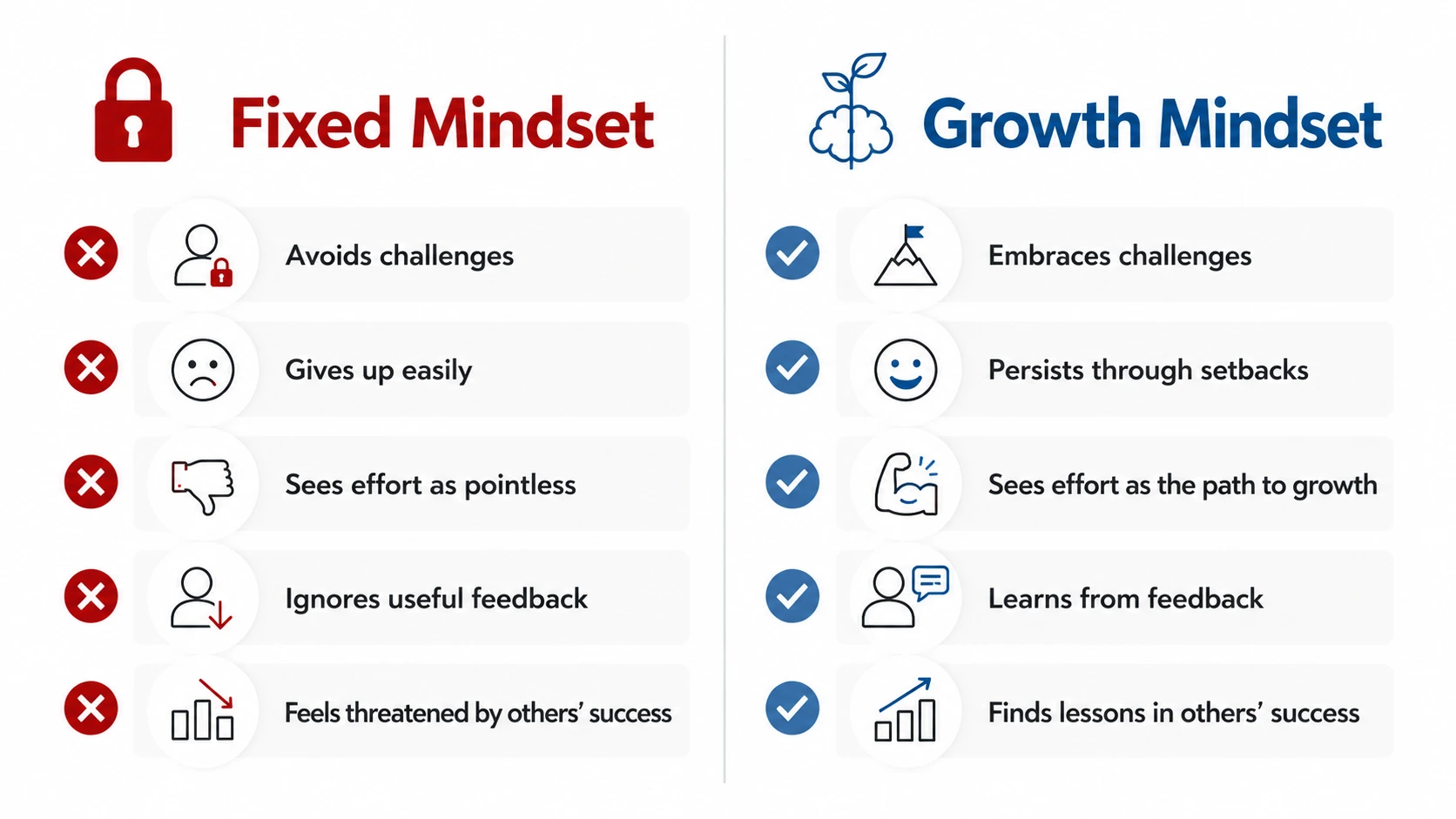
The distinction between a fixed and a growth mindset, introduced by psychologist Carol Dweck, forms the foundation of mindset-centered development. A fixed mindset assumes that intelligence and talent are static — people either have ability or they do not. A growth mindset holds that skills and intelligence can be developed through dedication, effort, and the right strategies.
Understanding why a growth mindset is important goes beyond theory — it directly shapes how individuals respond to failure, feedback, and long-term challenges.
| Fixed Mindset | Growth Mindset |
| Believes talent is innate and unchangeable | Believes abilities improve with effort and learning |
| Avoids challenges to prevent failure | Embraces challenges as opportunities to grow |
| Views effort as a sign of weakness | Sees effort as the path to mastery |
| Ignores or resents constructive feedback | Seeks feedback to improve performance |
| Gives up easily after setbacks | Persists through obstacles with renewed strategy |
Adopting a growth mindset does not mean ignoring limitations. It means recognizing that current limitations are starting points, not permanent conditions. This belief shift directly influences how people approach learning, manage failure, and sustain motivation in pursuit of long-term goals.
Understanding Grit and Why It Matters
Grit is the combination of passion and perseverance directed toward long-term meaningful goals. Defined and researched extensively by psychologist Angela Duckworth, grit distinguishes high achievers not by their intelligence or natural talent, but by their sustained commitment over time. Where motivation can fluctuate and talent can plateau, grit provides the consistent drive to continue working despite difficulty, boredom, or slow progress.
Grit matters because most meaningful achievements — academic degrees, professional expertise, athletic mastery, personal transformation — require effort sustained over months or years. Short bursts of enthusiasm rarely produce lasting results. Grit fills the gap between initial motivation and long-term success, making it one of the most practically important psychological traits for individuals operating in competitive, demanding, or goal-oriented environments.
Grit vs. Motivation
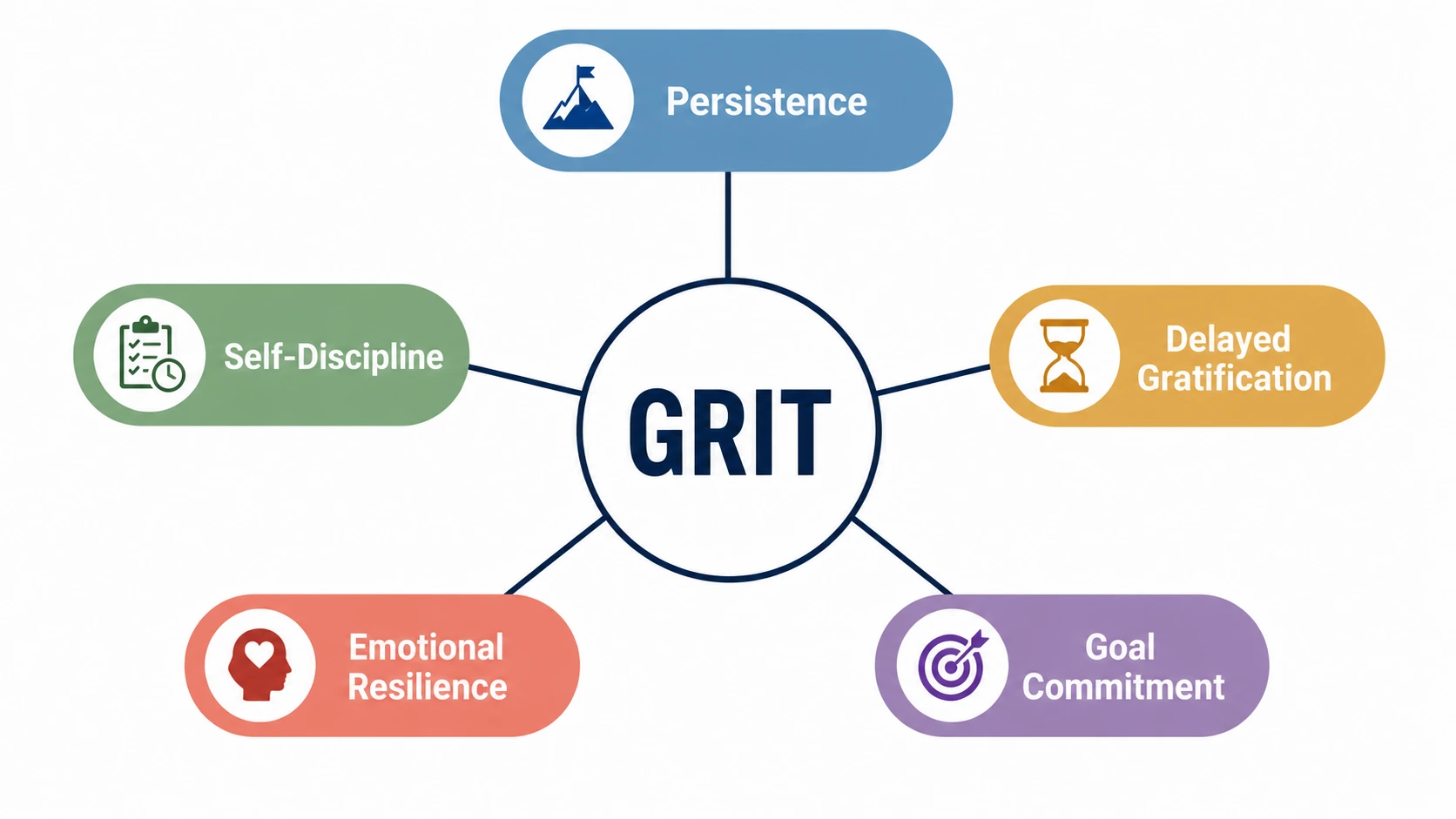
Motivation is the energy that initiates action. It is responsive to rewards, novelty, and emotional state — which means it rises and falls unpredictably. Grit, by contrast, is not dependent on feeling motivated. A person with developed grit continues working on their goals even when motivation has faded, boredom has set in, or progress feels invisible.
This distinction is important for long-term goal pursuit. Relying on motivation alone creates an unstable foundation. Developing grit means building systems, habits, and internal commitment that operate independently of mood or external reinforcement. In practice, gritty individuals do not wait to feel ready — they act consistently based on values and purpose.
For practical strategies on sustaining effort when inspiration fades, explore how to build discipline without motivation — a foundational skill that complements grit development directly.
Grit vs. Determination
While grit and determination share similarities, they operate differently. Determination is the resolve to accomplish a specific goal — it is often goal-bound and may diminish once the target is achieved. Grit is a broader, sustained character trait that encompasses passion, consistency, and resilience across multiple goals and life areas over extended time periods.
| Grit | Determination |
| Long-term persistence across multiple goals | Goal-specific resolve focused on a single outcome |
| Driven by deep passion and intrinsic values | Often activated by external pressure or urgency |
| Maintains effort even without external rewards | Can fade once the immediate goal is achieved |
| Includes emotional resilience and adaptability | Primarily cognitive and volitional in nature |
| A stable character trait developed over years | A temporary state that responds to specific situations |
How Inspirational Quotes Reinforce a Growth-Oriented Mindset
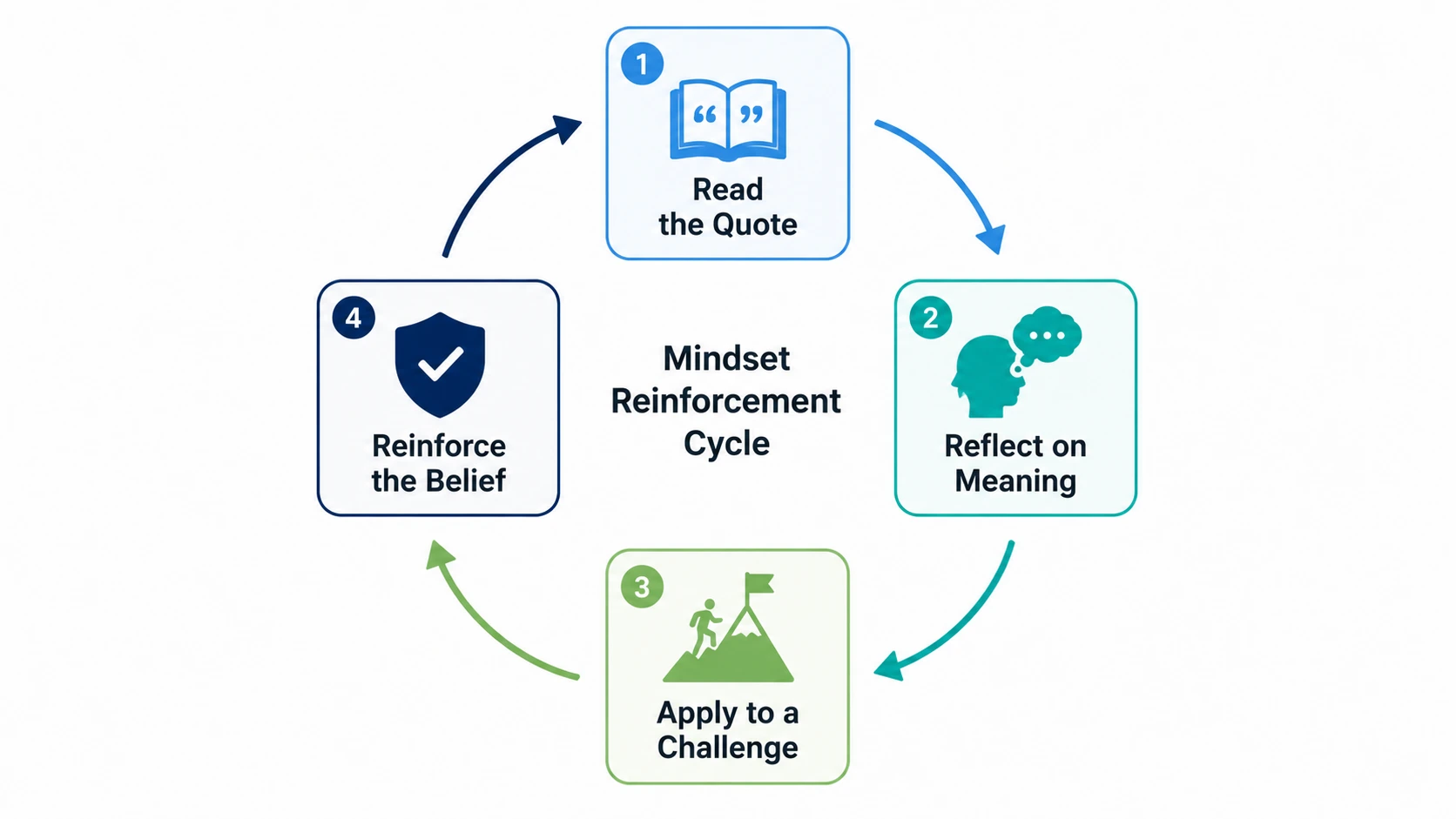
Inspirational quotes serve as compressed reminders of principles that take years to fully internalize. When selected thoughtfully and applied consistently, a well-chosen quote can interrupt unproductive thinking patterns, reframe challenges, and reconnect individuals to their deeper purpose. Neurologically, repeated exposure to meaningful language can strengthen associative pathways — making growth-oriented beliefs more accessible under pressure.
However, quotes alone do not produce change. Their value depends entirely on how they are used. A quote encountered and forgotten contributes nothing. A quote that is reflected upon, written in a journal, discussed with a mentor, or revisited during moments of doubt becomes a practical tool for mindset reinforcement. Your Daily Thrive recommends treating quotes not as decoration but as prompts for deliberate reflection.
Pairing quotes with daily growth mindset affirmations creates a consistent language environment that reinforces belief in improvement at the start and end of each day.
Characteristics of Effective Mindset Quotes
Not all motivational quotes are equally useful. The most effective mindset quotes share four core characteristics:
- Simplicity: They communicate a complex idea in accessible language, making them easy to recall under stress.
- Practical meaning: They point toward a behavior, belief, or strategy — not just a feeling.
- Emotional connection: They resonate with genuine human experiences such as failure, doubt, or perseverance.
- Long-term relevance: Their meaning deepens with experience rather than fading after initial exposure.
Grit Quotes for Different Situations
Different life contexts require different expressions of grit. A student navigating exam pressure, an athlete pushing through physical training, and a professional managing career setbacks all face distinct challenges. Mindset quotes tailored to specific situations carry greater emotional resonance and practical applicability than generic affirmations.
Short Quotes About Grit
Concise quotes are particularly effective because they are easy to memorize and repeat internally during moments of difficulty. Their brevity makes them practical for journals, presentations, pre-performance routines, and daily affirmation practices. The most impactful short grit quotes distill a complex truth into a single sentence — reminding individuals that persistence itself is the strategy, not a byproduct of talent.
The underlying lesson in most short grit quotes is consistent: effort applied over time outperforms talent applied inconsistently. This message is especially powerful for beginners who compare their early struggles with the polished results of experienced practitioners. As of 2026, behavioral researchers continue to emphasize that self-talk quality significantly affects performance outcomes, making short, personally meaningful quotes an underutilized practical tool.
Quotes About Grit and Determination
Quotes that address grit and determination together reinforce the relationship between sustained effort and purposeful resolve. They speak to the experience of pursuing a goal that feels distant or uncertain, and they validate the reality that meaningful progress is often invisible before it becomes undeniable. These quotes are particularly effective when individuals are in the middle stages of a goal — past initial enthusiasm but not yet close enough to the finish line to feel momentum.
The core theme across grit-and-determination quotes is that setbacks are not signals to stop but signals to adjust. This reframing of difficulty — from threat to information — is a foundational skill in cognitive behavioral approaches to resilience and is widely supported by performance psychology research.
Quotes About Grit for Students
Academic environments present unique grit challenges: sustained study across subjects with varying interest levels, performance pressure during assessments, and the emotional difficulty of learning from failure when grades feel high-stakes. Grit quotes aimed at students address three specific themes:
- Academic persistence: Reinforcing that slow learning is still learning, and that confusion is a precursor to understanding.
- Exam preparation: Encouraging consistent study habits over last-minute cramming, grounding students in process rather than outcome.
- Learning from failure: Normalizing low scores or failed attempts as data points rather than definitive judgments of ability.
In our experience helping readers build better habits, students who consistently engage with growth-oriented language during study routines report greater tolerance for academic difficulty and recover more quickly from poor performance outcomes.
Quotes About Grit for Athletes
Athletic development demands a particular form of grit: the ability to sustain intense training when improvement is incremental, to compete after setbacks, and to maintain mental discipline when the body signals discomfort. Grit quotes for athletes focus on three core principles:
- Training consistency: Success in sport is built in practice, not performance. Quotes that reinforce daily discipline over game-day inspiration address this directly.
- Competition mindset: The ability to stay present, execute under pressure, and recover from mistakes within the same performance.
- Mental toughness: Building the psychological durability to continue competing through injury recovery, losing streaks, or performance plateaus.
Grit Quotes for Work
Professional environments test grit differently than academic or athletic ones. Career setbacks — rejection, stagnation, workplace conflict, missed promotions — tend to unfold over longer timelines and with less external feedback than sports or school. Grit quotes for work reinforce professional resilience, remind individuals of their longer-term career arc, and reframe short-term obstacles as part of a normal developmental process.
Leadership development research consistently identifies perseverance as among the top distinguishing traits of effective leaders. Grit in the workplace is not about working harder without boundaries — it is about maintaining commitment to meaningful work through the inevitable frustrations of long-term professional growth.
Famous Quotes About Grit
Some of the most enduring ideas about grit come from thinkers, athletes, educators, and leaders who demonstrated sustained perseverance in their own lives. What makes these perspectives timeless is not the novelty of the language but the consistency of the underlying principle: that meaningful achievement is inseparable from sustained, purposeful effort.
Recurring themes across famous perspectives on grit include the idea that failure is instructional rather than final, that the willingness to continue distinguishes those who succeed from those who do not, and that talent without effort produces far less than effort without exceptional talent. These themes are reinforced by modern behavioral science research, which validates the primacy of deliberate practice over innate ability across a wide range of domains.
Passion, Purpose, and Long-Term Success
Passion is not simply enthusiasm or interest — in the context of grit and a growth mindset, passion refers to a sustained, directional commitment to a meaningful domain. Angela Duckworth’s research defines grit as passion plus perseverance, and the passion component is what differentiates productive long-term effort from directionless hard work. Without a genuine sense of purpose, sustained effort becomes exhausting rather than energizing.
Sustainable motivation in long-term goal pursuit comes from intrinsic sources: personal meaning, alignment with values, and genuine interest in the work itself. External motivation — praise, money, recognition — initiates effort but does not sustain it across years of difficulty. Individuals who develop passion for their field or goal are more likely to continue working through the phases where results feel absent and doubt is highest.
Quotes About Passion for Work
Passion-for-work quotes address the relationship between career satisfaction, purpose-driven engagement, and continuous improvement. They speak to the difference between working to fulfill an external obligation and working because the activity itself feels meaningful. Key themes include:
- Career satisfaction: Recognizing that sustained engagement requires more than compensation — it requires a sense of contribution and growth.
- Purpose-driven work: Understanding that meaningful professional roles are built deliberately through reflection, not discovered passively.
- Continuous improvement: Framing professional development as a lifelong process rather than a destination.
Quotes on Grit and Grace
The pairing of grit and grace represents one of the most nuanced concepts in mindset development. Grit without grace can become rigid, exhausting, and disconnected from one’s values and relationships. Grace — in this context — refers to emotional intelligence, humility, adaptability, and compassion toward oneself and others during difficulty.
Quotes that address both grit and grace highlight that true resilience is not forceful or combative. It is persistent and flexible. The most effective performers in any field combine relentless effort with the emotional awareness to pace themselves, acknowledge support systems, and adapt strategies when the original approach is not producing results.
Growth Mindset Grit Quotes
Quotes that specifically connect growth mindset and grit reinforce the idea that the belief in improvability and the sustained commitment to improve are inseparable. A growth mindset without grit produces optimism without follow-through. Grit without a growth mindset produces effort without adaptation — continuing the same ineffective approaches with greater intensity.
Together, these concepts produce the most effective learning and achievement orientation: believing that improvement is possible, and persistently working toward it while remaining open to feedback, strategy revision, and honest self-assessment.
Practical Ways to Develop Grit and a Growth Mindset
Developing grit and a growth mindset is not a passive process. Both require deliberate, repeated practice applied consistently over time. The following strategies translate conceptual understanding into daily behavioral habits:
- Set realistic long-term goals: Define specific, meaningful objectives that align with your values and provide direction during difficult periods.
- Break goals into manageable steps: Large goals become psychologically overwhelming without intermediate milestones. Small, achievable steps build confidence and momentum.
- Practice deliberate reflection: After setbacks or successes, take time to analyze what worked, what did not, and what can be adjusted. Reflection turns experience into learning.
- Learn from setbacks: Reframe failures as feedback rather than evidence of inability. Ask what the situation reveals about your current approach rather than your permanent capacity.
- Seek constructive feedback: Proactively request honest assessments from mentors, peers, and coaches. Growth mindset individuals treat feedback as a resource, not a threat.
- Celebrate incremental progress: Acknowledge small improvements regularly. Progress recognition reinforces the connection between effort and outcome, sustaining motivation through slow phases.
Common Misconceptions About Grit
Despite its growing prominence in psychology and popular development discourse, grit is frequently misunderstood. Several persistent misconceptions undermine its practical application:
- Grit is not working without rest. Rest and recovery are essential for sustained high performance. Grit includes the wisdom to recover strategically, not the compulsion to continue at personal expense.
- Grit is not refusing help. Seeking mentorship, collaboration, and support is consistent with grit. Isolating oneself to demonstrate self-sufficiency is counterproductive, not admirable.
- Grit is not never changing direction. Adapting strategy, shifting goals, or pivoting approaches is part of intelligent perseverance. Continuing an ineffective path out of stubbornness is not grit — it is rigidity.
- Grit is compatible with flexibility and learning. The most gritty individuals regularly reassess their methods while maintaining commitment to their broader purpose.
Your Daily Thrive recommends distinguishing between commitment to a goal and commitment to a specific method. Grit protects the former while allowing the latter to evolve.
Beginner Mistakes When Building a Strong Mindset
Individuals beginning their mindset development journey often encounter predictable obstacles. Recognizing these patterns in advance significantly improves long-term consistency:
- Expecting instant results: Mindset development is gradual. Expecting rapid transformation leads to premature discouragement when initial progress is slow or invisible.
- Depending only on motivation: Motivation fluctuates naturally. Building habits and systems that operate independently of mood is more reliable than waiting to feel inspired.
- Comparing progress with others: Each person’s developmental timeline is unique. Comparing early-stage progress to someone else’s established results creates a distorted and demoralizing benchmark.
- Ignoring consistent habits: Sporadic intensive effort is far less effective than consistent moderate practice applied daily or weekly over time.
- Fear of failure: Treating mistakes as catastrophic rather than instructional triggers avoidance behaviors that prevent the very practice needed for growth.
- Setting unrealistic expectations: Goals that are too ambitious too early deplete motivation and erode self-efficacy. Realistic, progressive goal-setting builds sustainable confidence.
Applying Mindset Principles in Everyday Life
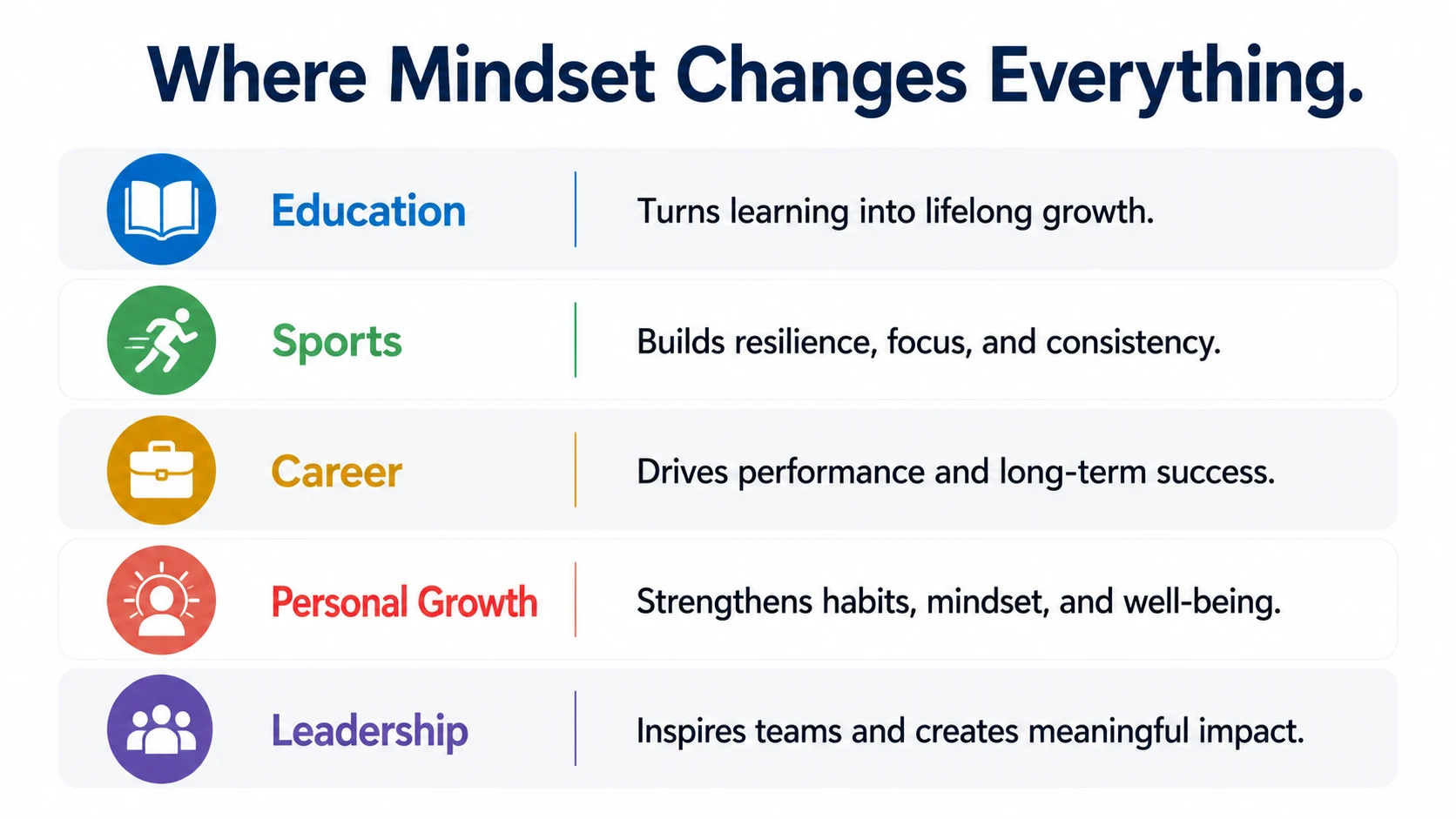
Mindset development is not confined to a single domain. Its principles apply across every area of life where learning, performance, and resilience are relevant.
Education
In academic settings, a growth mindset reframes the learning process itself. Students who believe their understanding can deepen with effort engage more persistently with challenging material, recover more effectively from poor grades, and develop stronger metacognitive skills — the ability to monitor and adjust their own learning strategies. Grit in education means showing up to study even when the subject feels difficult or unrewarding, trusting that understanding will follow sustained engagement.
Sports
Athletic performance is among the most visible applications of grit and growth mindset. Elite athletes do not simply possess superior physical traits — they develop superior training habits, mental discipline, and recovery practices over years of deliberate effort. A growth mindset in sport means viewing a poor performance as information rather than identity, and grit means maintaining training discipline through injury, loss, and plateaus.
Career and Workplace
Professional development unfolds over decades, and the mindset an individual brings to career challenges significantly influences their trajectory. Growth mindset professionals pursue skill development proactively, handle critical feedback constructively, and remain adaptable as industries evolve. Grit in the workplace means maintaining commitment to professional goals through periods of stagnation, rejection, or organizational difficulty.
Personal Growth
Personal development — whether in relationships, health, creative pursuits, or self-understanding — requires the same principles as any skill domain: belief that change is possible, consistent practice, honest self-assessment, and patience with the pace of progress. In our experience helping readers build sustainable habits, the most common obstacle to personal growth is not lack of information but inconsistency in applying what is already known.
Leadership
Effective leadership demands both grit and grace at scale. Leaders with growth mindsets create environments where team members feel safe to take risks, make mistakes, and learn openly. Gritty leaders model persistence during organizational difficulty, maintain vision during uncertainty, and sustain commitment to long-term objectives without compromising the well-being of the people they lead.
Conclusion
A mindset center, understood as a framework for developing resilient, growth-oriented thinking, provides the conceptual foundation for lasting personal and professional achievement. At its core, this framework integrates three mutually reinforcing principles: a growth mindset that believes improvement is always possible, grit that sustains effort through difficulty over time, and passion that ensures effort remains directional and meaningful.
Inspirational quotes about grit, determination, passion, and grace are valuable tools within this framework — not because they replace action, but because they reinforce the beliefs that make consistent action possible. The most effective use of mindset quotes is as prompts for reflection, reminders during moments of doubt, and anchors for the values that guide long-term commitment.
The central takeaway is straightforward: lasting success is not the product of exceptional talent but of growth-oriented belief, sustained effort, and the willingness to learn continuously. Gradual, consistent improvement — applied across education, sport, work, and personal life — produces outcomes that neither motivation alone nor talent alone can reliably deliver. Building a mindset center begins with the decision to develop these capacities deliberately, one habit, one reflection, and one day at a time.
Frequently Asked Questions
What is a mindset center, and why is it important?
A mindset center is a framework for developing the mental habits, beliefs, and attitudes that support resilience, learning, and long-term achievement. It is important because mindset — not talent or circumstance — is among the most significant determinants of whether individuals persist through challenges and reach their goals.
How is grit different from a growth mindset?
A growth mindset is a belief — specifically, the belief that abilities can be developed through effort and learning. Grit is a behavioral trait — the sustained combination of passion and perseverance applied toward long-term goals. A growth mindset supports grit by providing the belief system that makes persistent effort feel worthwhile. Both work together: belief without sustained action produces little, and effort without a belief in improvability leads to frustration.
Can inspirational quotes actually improve motivation?
Yes, but with an important qualification. Quotes improve motivation when they are used as prompts for reflection and behavior, not as substitutes for action. Research in cognitive psychology supports the role of self-talk and belief language in shaping behavioral patterns. A quote that is regularly reflected upon, journaled, or applied to specific situations reinforces growth-oriented thinking over time. A quote that is passively encountered and forgotten does not.
Why is grit valuable for students, athletes, and professionals?
In each of these contexts, meaningful outcomes require sustained effort over time — academic mastery, athletic excellence, and professional advancement all unfold across months and years. Grit provides the persistence to continue working through difficulty, boredom, and slow progress that characterize the middle phases of any long-term goal. Talent and intelligence create potential; grit determines whether that potential is developed.
How can I build grit without experiencing burnout?
Building grit sustainably requires balancing consistent effort with deliberate recovery. Burnout typically occurs when high effort is sustained without rest, reflection, or purpose reconnection. Strategies that prevent burnout while building grit include: setting realistic daily and weekly effort targets, scheduling regular rest periods, monitoring emotional energy alongside physical output, maintaining clarity on why the goal is meaningful, and adjusting pace during high-stress periods without abandoning the goal entirely.
What role does passion play in long-term success?
Passion provides the directional energy that makes sustained effort coherent rather than exhausting. Without passion — genuine interest in and commitment to a domain or goal — grit becomes grinding: effort applied without meaning. Individuals who develop passion for their goals experience difficulty as part of an engaging process rather than as an obstacle to endure. Passion is not a fixed trait that individuals either have or lack; it develops gradually through engagement, skill-building, and meaningful connection to the purpose behind the work.
How can I apply mindset principles in everyday life?
Mindset principles are most effectively applied through daily habits rather than occasional intensive effort. Practical daily applications include: starting each morning with a clear intention for the day’s most important work, using a brief end-of-day reflection to identify one learning from the day’s challenges, maintaining a journal to track progress and process setbacks, seeking one piece of constructive feedback each week, and regularly reconnecting with the longer-term purpose behind current efforts. Consistency in small practices produces significantly greater mindset development than sporadic large efforts.