
Introduction
Mindset wrestling refers to the mental side of the sport — the combination of confidence, focus, resilience, discipline, and decision-making that shapes how a wrestler trains and competes. While technique and conditioning determine physical capability, mental preparation often determines whether that capability shows up on the mat. Sports psychology research consistently shows that mental training is not a supplement to physical training but a parallel discipline with its own skills and habits. Mindset development benefits wrestlers at every level, from youth athletes learning to handle nerves to elite competitors refining visualization and emotional control. This article explains the components of wrestling mindset, practical mental training techniques, and how to build competitive resilience over time.
Quick Summary
- Wrestling mindset focuses on developing mental skills that improve performance before, during, and after matches.
- Elite wrestlers combine technical training with confidence, emotional control, and disciplined habits.
- Mental training techniques such as visualization, self-talk, and goal setting can be practiced consistently.
- Building a winning mindset is a long-term process supported by coaching, reflection, and regular practice.
What Is a Wrestling Mindset?
A wrestling mindset is the collection of mental habits and attitudes that shape how an athlete prepares for, competes in, and recovers from matches. It governs how a wrestler interprets pressure, setbacks, and opportunities on the mat. A strong mental mindset in wrestling doesn’t replace technical skill — it determines how consistently that skill gets executed under stress. Mindset wrestling shares much in common with the broader athlete mindset that drives performance across combat and team sports alike.
Mindset influences three distinct phases of competition. Before a match, it shapes confidence and readiness. During competition, it governs focus, composure, and split-second decisions. After the match, whether it ends in victory or defeat, mindset determines how quickly an athlete processes the outcome and returns to productive training. A winning mindset in wrestling treats each of these phases as trainable, not fixed by natural temperament.
Why Mindset Matters More Than Many Athletes Realize
Many wrestlers underestimate the mental dimension of the sport because it’s less visible than physical conditioning. But several performance factors are almost entirely psychological:
- Confidence under pressure — the ability to execute technique when a match is close or stakes are high.
- Handling adversity — recovering mentally after giving up points or losing position.
- Staying focused — maintaining concentration through six-minute matches despite fatigue or crowd noise.
- Maintaining consistency — performing at a similar level in practice, low-stakes matches, and championship rounds.
Wrestlers who neglect these areas often plateau physically because their mental state limits how effectively they apply what they’ve trained.
Characteristics of Wrestlers with a Strong Mindset
Certain traits appear consistently among wrestlers who perform well under pressure:
- Discipline — showing up for training and mental practice even without external motivation.
- Coachability — accepting feedback without defensiveness.
- Emotional control — staying composed after mistakes or bad calls.
- Persistence — continuing to compete effort fully even when behind.
- Accountability — owning performance outcomes rather than blaming external factors.
- Growth mindset — viewing losses as information rather than identity-defining events. This concept closely mirrors the growth mindset framework popularized by Carol Dweck, which treats ability as something developed through effort rather than fixed at birth.
The Core Components of Wrestling Mental Training
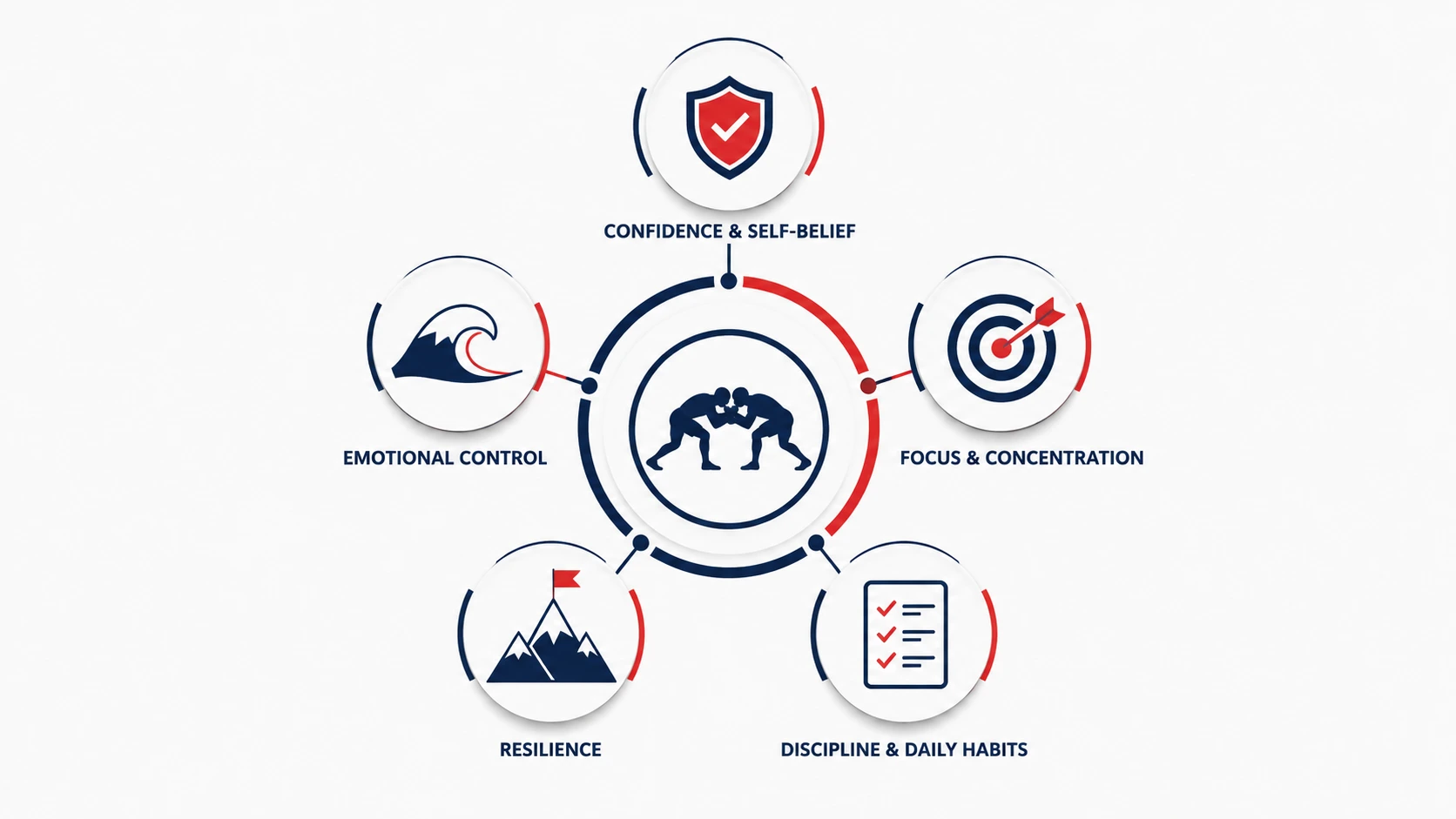
Wrestling mental training is built from several distinct skills, each of which can be developed independently through deliberate practice.
Confidence and Self-Belief
Confidence in wrestling comes from evidence — repeated experiences of executing technique successfully in practice and competition. It is reinforced through preparation, not manufactured through empty positive thinking. Wrestlers build genuine self-belief by tracking small wins in training, such as successfully finishing a takedown drill or escaping a difficult position.
Focus and Concentration
Focus is the ability to stay present during a match rather than being distracted by the scoreboard, crowd, or anticipated outcomes. Wrestlers train focus through drills that require sustained attention, such as live wrestling under fatigue, where maintaining technique despite exhaustion strengthens concentration.
Emotional Control During Matches
Emotional control means regulating frustration, anxiety, or overconfidence in real time. A wrestler who lets a bad call or an opponent’s aggressive style provoke an emotional reaction is more likely to make technical errors. Controlled breathing and pre-planned responses to setbacks help maintain composure.
Resilience After Wins and Losses
Resilience is the capacity to process both outcomes productively. After a loss, resilient wrestlers analyze what happened without excessive self-criticism. After a win, they avoid complacency by identifying what still needs improvement.
Discipline and Daily Habits
Mental discipline shows up in the consistency of daily routines, not just in competition. Key habit areas include:
- Match preparation — consistent pre-match routines that reduce anxiety.
- Recovery mindset — treating rest and recovery as part of training, not a break from it.
- Practice consistency — showing up with full effort regardless of motivation level.
- Long-term development — tracking progress over months and years rather than judging based on single matches.
How Elite Wrestling Champions Develop Their Mindset
Mindset wrestling champions across weight classes and eras tend to share psychological habits, even when their training programs differ significantly. This approach overlaps with warrior mindset training used across combat sports, where mental preparation is treated as a core discipline, not an afterthought.
Training Beyond Physical Skills
Elite wrestlers typically integrate mental preparation into their regular training schedule, treating visualization, goal setting, and reflection as seriously as technical drilling.
Learning from Defeats
Rather than avoiding the discomfort of losses, top competitors analyze them in detail — reviewing film, identifying technical and mental breakdowns, and adjusting training accordingly.
Maintaining Competitive Confidence
Champions maintain confidence by focusing on process metrics they control, such as effort and technique execution, rather than solely on outcomes like win-loss records.
Performing Under Pressure
High-level wrestlers often use pre-competition routines — including visualization and controlled breathing — to manage pressure so that big-match nerves don’t disrupt technical execution.
Mental Training Techniques Every Wrestler Can Practice
Mindset training in wrestling is built from specific, repeatable techniques rather than abstract encouragement.
Visualization Before Competition
Visualization involves mentally rehearsing specific match scenarios — takedowns, escapes, and responses to common opponent tactics — before stepping on the mat. This primes the nervous system and builds familiarity with high-pressure moments.
Positive Self-Talk
Self-talk refers to the internal dialogue a wrestler uses during training and competition. Replacing critical or defeatist internal language with constructive, instructional self-talk (for example, cueing a specific technical adjustment rather than dwelling on a mistake) supports better in-match decision-making.
Goal Setting
Effective goal setting in wrestling combines long-term outcome goals (such as qualifying for a tournament) with short-term process goals (such as improving a specific technique each week). Process goals are more directly within the athlete’s control and support steady motivation.
Match-Day Routines
Consistent pre-match routines — covering warm-up, nutrition timing, and mental preparation — reduce uncertainty and anxiety by making competition day feel familiar rather than novel.
Reflection After Practice
Brief post-practice reflection, whether verbal or written, helps wrestlers consolidate what they learned and identify one or two specific areas to focus on next session.
Supporting habits that reinforce these techniques include:
- Daily journal — logging technical notes, mental state, and goals.
- Breathing exercises — using controlled breathing to regulate pre-match nerves.
- Performance reviews — periodically assessing progress against goals.
- Routine building — establishing consistent pre-practice and pre-match sequences.
Winning Mindset vs Fixed Mindset in Wrestling (Comparison)
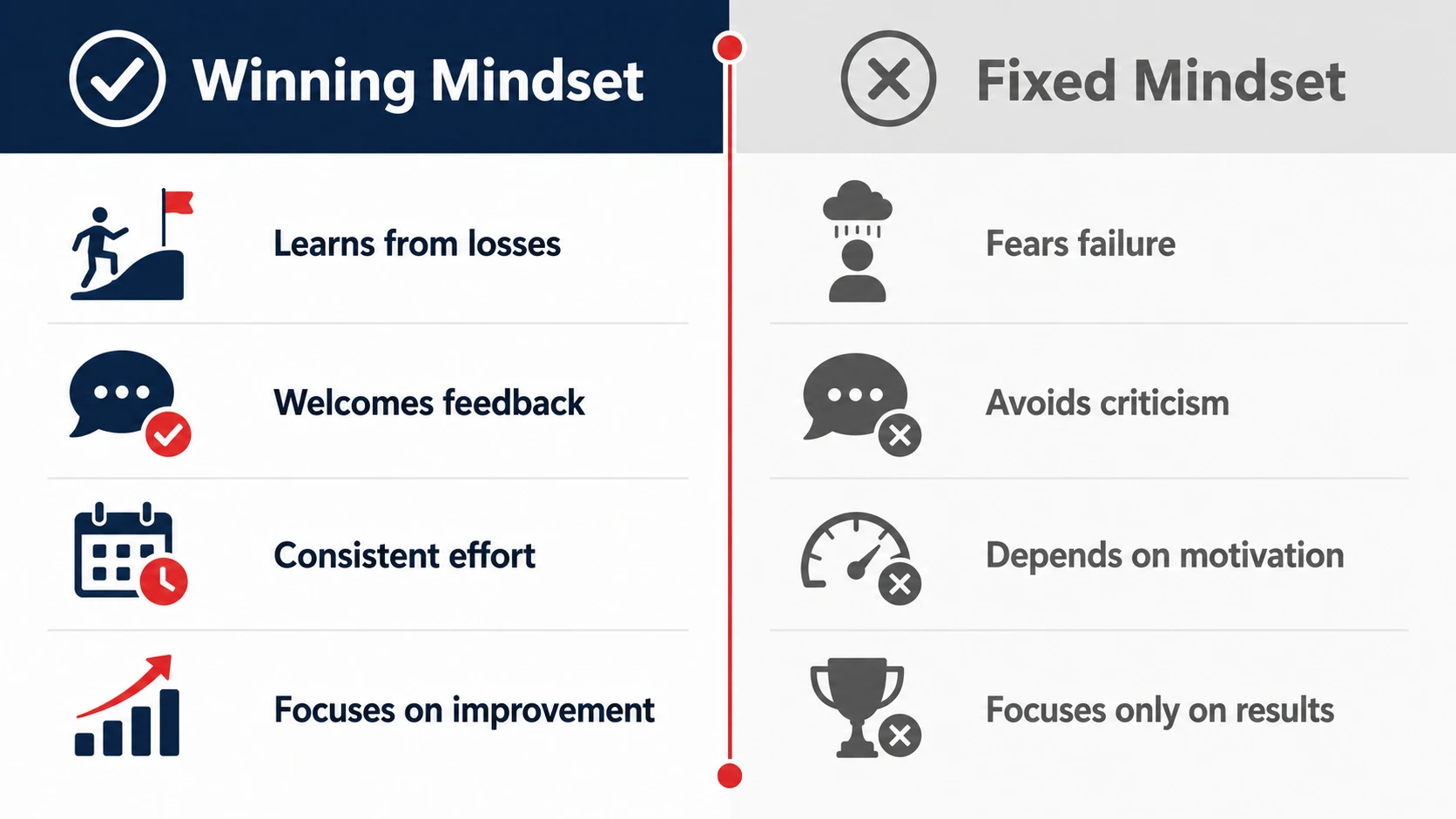
A winning mindset in wrestling differs from a fixed mindset in how wrestlers interpret setbacks, feedback, and effort.
| Winning Mindset | Fixed Mindset |
|---|---|
| Learns from losses | Fears failure |
| Welcomes feedback | Avoids criticism |
| Consistent effort | Depends on motivation |
| Focuses on improvement | Focuses only on results |
Wrestlers with a winning mindset treat losses as diagnostic information that guides future training, while those with a fixed mindset often avoid difficult opponents or challenging drills to protect their self-image. Over time, the winning-mindset approach produces more consistent long-term improvement, since it removes the psychological cost of temporary setbacks.
Common Mental Challenges Wrestlers Face
Even experienced wrestlers encounter recurring mental obstacles that, left unaddressed, limit performance.
Fear of Losing
Fear of losing often causes wrestlers to compete cautiously, avoiding risks that could lead to bigger scoring opportunities. It typically stems from tying self-worth too closely to match outcomes. Reframing losses as part of the learning process reduces this fear over time.
Performance Anxiety
Performance anxiety shows up as physical tension, racing thoughts, or difficulty executing familiar technique under competition pressure. Controlled breathing, pre-match routines, and gradual exposure to higher-pressure practice scenarios help manage it.
Lack of Confidence
Low confidence often results from insufficient preparation or a pattern of focusing only on mistakes rather than successes. Building a track record of small wins in practice, and consciously reviewing them, helps rebuild self-belief.
Burnout
Burnout develops when training volume and mental demands exceed a wrestler’s capacity for recovery. Prevention requires balancing training intensity with adequate rest, variety in practice, and periodic breaks from competition-focused training.
Negative Self-Talk
Negative self-talk — harsh internal criticism after mistakes — undermines focus and confidence. Replacing it with instructional, forward-looking language is a trainable skill that improves with consistent practice.
Returning After Injury
Wrestlers returning from injury often face lingering anxiety about re-injury or lost conditioning. Gradual return-to-competition protocols, combined with realistic goal-setting, help rebuild both physical and mental confidence.
Beginner Mistakes That Slow Mindset Development
Several common mistakes slow mental progress, particularly among newer wrestlers:
- Expecting instant confidence — confidence builds through repeated experience, not immediately.
- Ignoring recovery — mental fatigue accumulates just as physical fatigue does.
- Comparing yourself with others — individual progress timelines vary significantly.
- Overthinking matches — excessive pre-match analysis can increase anxiety rather than reduce it.
- Practicing only physical skills — mental training is often skipped entirely by beginners.
- Avoiding difficult opponents — this limits exposure to the pressure situations that build resilience.
How Coaches Shape a Wrestler’s Mindset
Wrestling mindset coaches play a central role in mental development, often shaping habits that extend beyond the sport itself.
Building Confidence
Coaches build confidence by structuring practice so athletes experience incremental, achievable challenges rather than being overwhelmed by mismatched competition.
Providing Constructive Feedback
Effective feedback focuses on specific, actionable adjustments rather than general criticism, helping wrestlers improve without damaging confidence.
Creating Accountability
Coaches establish accountability systems — such as goal check-ins or attendance expectations — that reinforce discipline as a daily habit rather than an occasional effort.
Encouraging Long-Term Growth
Strong coaches frame short-term losses within a longer development timeline, helping athletes maintain motivation through inevitable setbacks.
Learning Through Wrestling Mindset Books
A wrestling mindset book can provide structured frameworks for mental training that complement on-mat coaching.
Topics Commonly Covered
Wrestling and broader sports psychology books typically cover confidence-building, visualization techniques, goal-setting frameworks, and strategies for managing competitive anxiety.
How to Apply Lessons During Training
The most effective approach involves selecting one or two concepts at a time and integrating them directly into existing training routines, rather than attempting to apply an entire book’s framework at once.
Choosing Reliable Learning Resources
Reliable resources are typically grounded in established sports psychology research or written by credentialed coaches and psychologists, rather than relying solely on anecdotal success stories.
Practical Weekly Mindset Practice Guide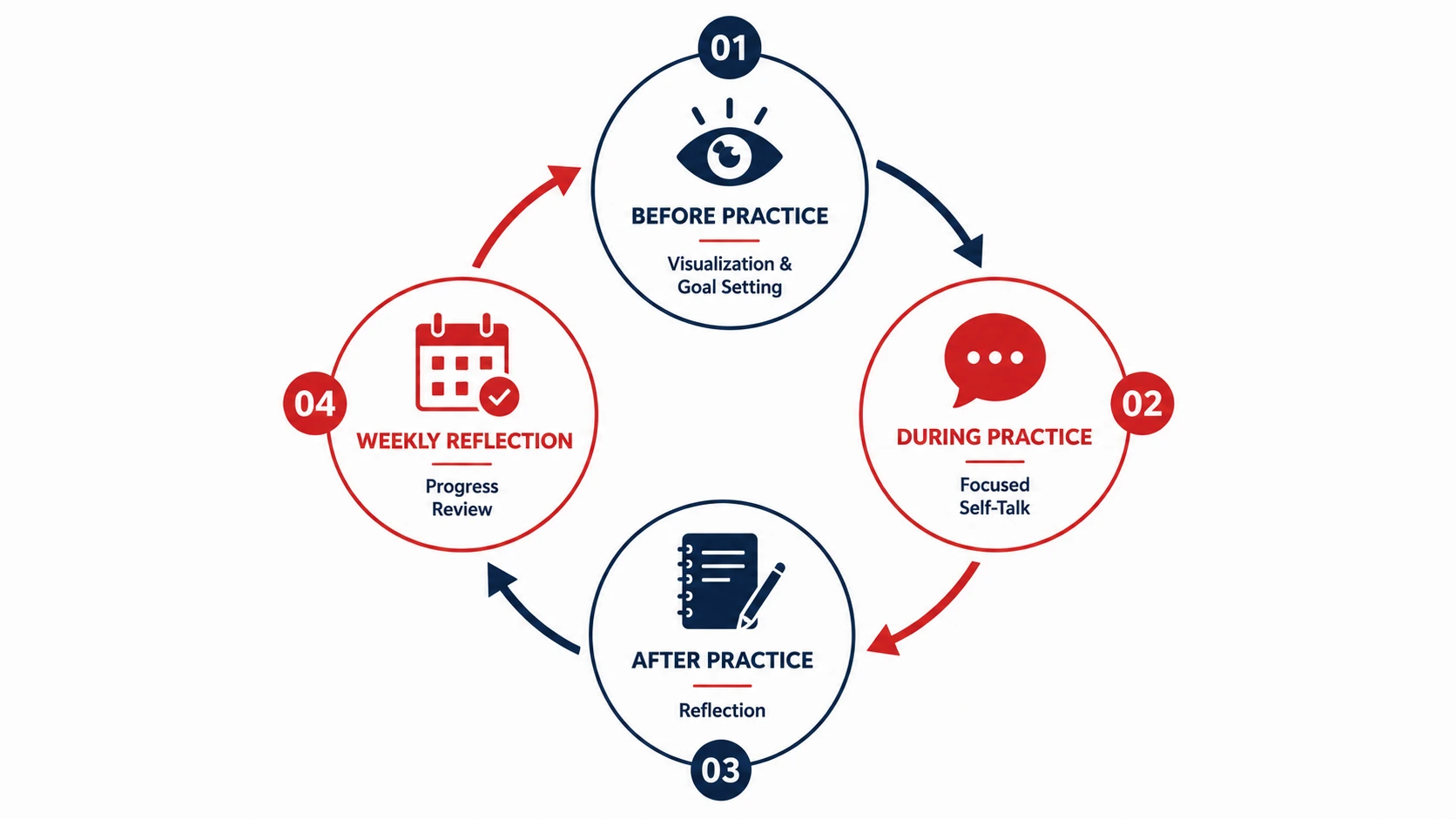
Mindset training works best when integrated into a consistent weekly structure.
Before Practice
Set a specific technical or mental goal for the session, and use brief visualization to mentally prepare.
During Practice
Apply focused self-talk during live wrestling, and treat mistakes as immediate learning cues rather than sources of frustration.
After Practice
Spend a few minutes reflecting on what went well and what needs adjustment before the next session.
Weekly Reflection
Review the week’s progress against goals and adjust the following week’s focus areas accordingly.
Core weekly practices include:
- Visualization — rehearsing key scenarios before practice or competition.
- Goal review — checking progress against short-term process goals.
- Journaling — recording technical and mental notes.
- Match analysis — reviewing footage or notes from recent competition.
- Recovery habits — ensuring adequate rest supports mental as well as physical readiness.
Difficulty & Time Investment
Mindset training requires a modest but consistent daily time commitment rather than large blocks of time. Beginner-friendly habits — such as brief visualization or a short post-practice reflection — take as little as five to ten minutes per day. Intermediate progression involves structured goal-setting and regular journaling, typically adding fifteen to twenty minutes several times per week. Advanced mental training may include working with a sports psychologist or dedicated mental performance coach for more personalized strategies.
Several factors influence how difficult this process feels for a given athlete, including prior exposure to competitive pressure, natural temperament, and the level of coaching support available. Wrestlers new to structured mental training often find the biggest challenge is consistency rather than the techniques themselves.
Results Timeline
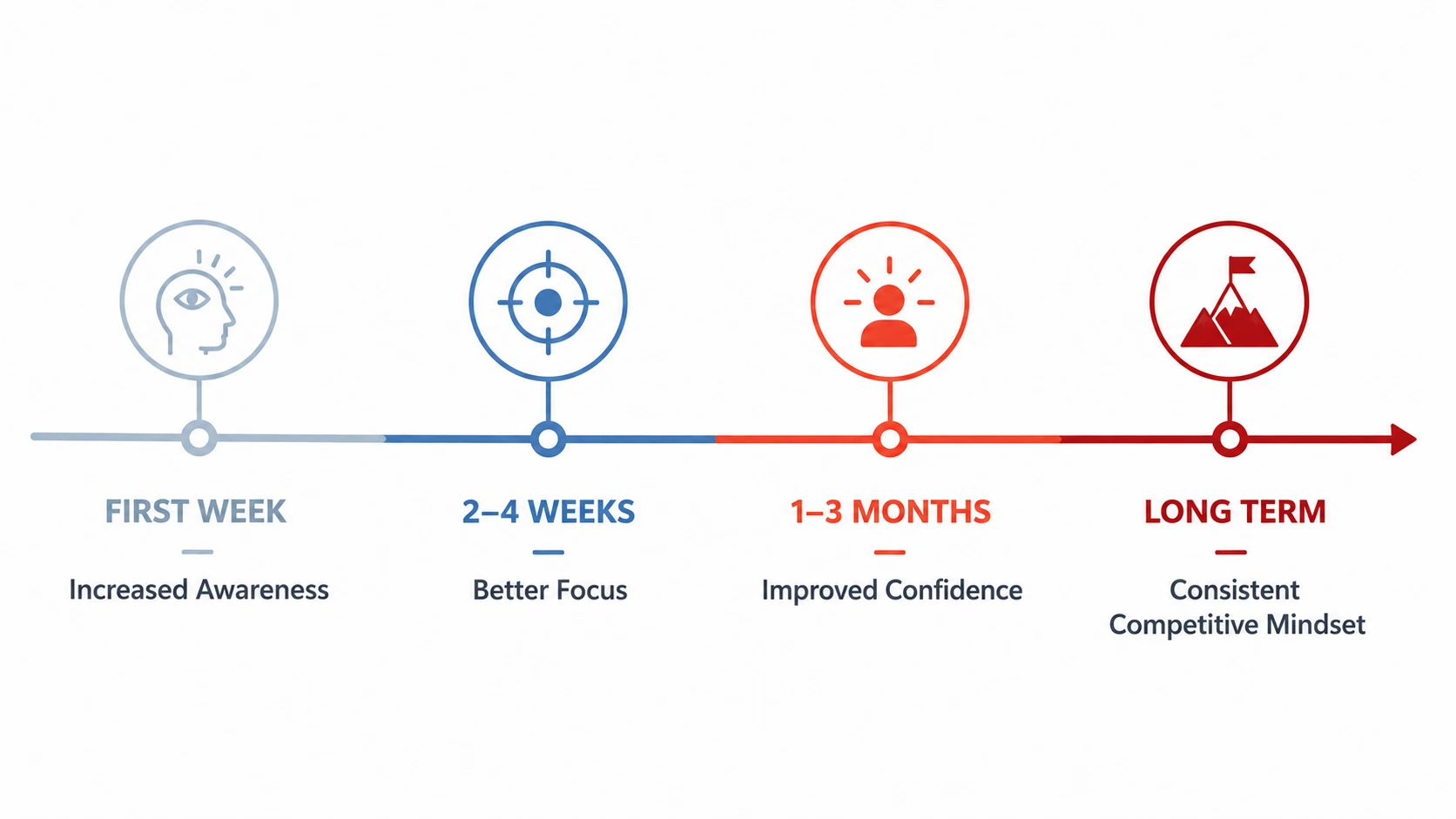
Mental training produces gradual, cumulative results rather than immediate transformation.
| Time Period | Typical Progress |
|---|---|
| First week | Increased awareness |
| 2–4 weeks | Better focus |
| 1–3 months | Improved confidence |
| Long term | Consistent competitive mindset |
Several factors affect how quickly progress appears, including:
- Coaching — quality feedback accelerates mental skill development.
- Practice quality — focused, deliberate practice builds mental skills faster than unstructured repetition.
- Competition experience — real match pressure accelerates learning that practice alone cannot replicate.
- Consistency — irregular mental training produces slower, less durable results than daily habits.
Different Wrestling Mindset Approaches
Not all mental training approaches emphasize the same priorities, and different approaches suit different situations.
- Competitive mindset — centers on outperforming opponents; useful heading into high-stakes tournaments.
- Growth mindset — treats setbacks as learning opportunities; particularly valuable for younger or developing wrestlers.
- Process-focused mindset — prioritizes execution of specific techniques over outcomes; helps reduce performance anxiety.
- Resilience mindset — emphasizes recovery after setbacks; useful for wrestlers returning from losses or injuries.
- Performance mindset — focuses on peak execution in the moment; most relevant during the days immediately before competition.
Many wrestlers benefit from blending these approaches depending on where they are in a season — for example, using a growth mindset during the off-season and shifting toward a performance mindset closer to competition.
Frequently Asked Questions About Wrestling Mindset
Can mindset really improve wrestling performance?
Yes, mindset directly affects wrestling performance by influencing focus, confidence, and decision-making under pressure, which determines how consistently technical skill is executed in competition.
How do wrestlers build confidence before a match?
Wrestlers build pre-match confidence through consistent preparation routines, visualization of successful execution, and reviewing evidence of past training progress.
What are the best daily mental exercises for wrestlers?
Effective daily exercises include brief visualization, goal review, controlled breathing, and short post-practice reflection focused on specific technical or mental adjustments.
How long does it take to develop a stronger wrestling mindset?
Noticeable improvements in focus typically appear within two to four weeks of consistent practice, while deeper confidence and competitive resilience generally develop over one to three months or longer.
Is mental training as important as physical training?
Mental training is considered equally important as physical training because it determines how effectively technical and physical skills are applied during actual competition.
Can young wrestlers benefit from mindset training?
Yes, young wrestlers benefit from age-appropriate mindset training, including simple goal-setting and basic confidence-building exercises, which establish habits that support long-term development.
Conclusion
Mindset wrestling is the mental framework that determines how effectively physical skill and conditioning translate into competitive results. Confidence, focus, emotional control, resilience, and discipline are all trainable skills, developed through consistent practices like visualization, goal setting, and reflection rather than natural talent alone. Wrestlers who treat mental training with the same seriousness as physical training tend to perform more consistently under pressure and recover more effectively from setbacks. Building a strong wrestling mindset is a gradual, ongoing process — one supported by coaching, structured practice, and daily habits that compound over time into lasting competitive confidence.