

Introduction
An investing mindset is the collection of beliefs, habits, and decision-making patterns that shape how a person approaches money over time. The investing mindset meaning goes beyond picking stocks or funds; it describes the psychological framework that determines whether someone reacts to market noise or stays committed to a long-term plan. Financial knowledge alone does not produce good outcomes — mindset influences whether that knowledge is applied consistently. Patience, discipline, and risk management often matter more than technical skill, because most investment mistakes come from emotional reactions rather than a lack of information. As of 2026, behavioral finance research continues to confirm that psychology, not just strategy, drives long-term investment results.
Quick Summary
- An investing mindset focuses on long-term wealth creation rather than short-term market movements.
- Successful investors rely on discipline, evidence-based decisions, and risk management instead of emotions.
- Building the right mindset involves continuous learning, realistic expectations, and consistent investing habits.
- Different investing styles share common psychological principles despite using different strategies.
What Is an Investing Mindset?
Investing Mindset Meaning
The investing mindset meaning refers to how a person thinks about risk, time, and money when making investment decisions. It is not a specific strategy or asset class — it is the underlying psychological approach that guides how strategies are chosen and followed. A person can hold a well-researched investment plan and still fail if their mindset drives them to abandon that plan during volatility. Mindset differs from strategy because strategy is the “what” (which assets, allocation, or timeframe), while mindset is the “how” — how a person handles uncertainty, setbacks, and the passage of time. Psychological habits such as patience, consistency, and self-control directly shape financial outcomes, often more than the specific investments chosen.
Why Mindset Matters More Than Market Predictions
Markets are inherently unpredictable in the short term, which is why mindset tends to matter more than forecasting. Emotional decision-making — buying out of excitement or selling out of fear — is one of the most common reasons investors underperform their own investments. Long-term consistency, by contrast, allows compounding and diversification to work as intended. Behavioral finance identifies recurring patterns such as loss aversion (feeling losses more intensely than equivalent gains) and herd behavior (following the crowd instead of independent analysis). Confidence is useful when grounded in research, but overconfidence — believing one can consistently predict short-term price movements — is a well-documented driver of poor decisions.
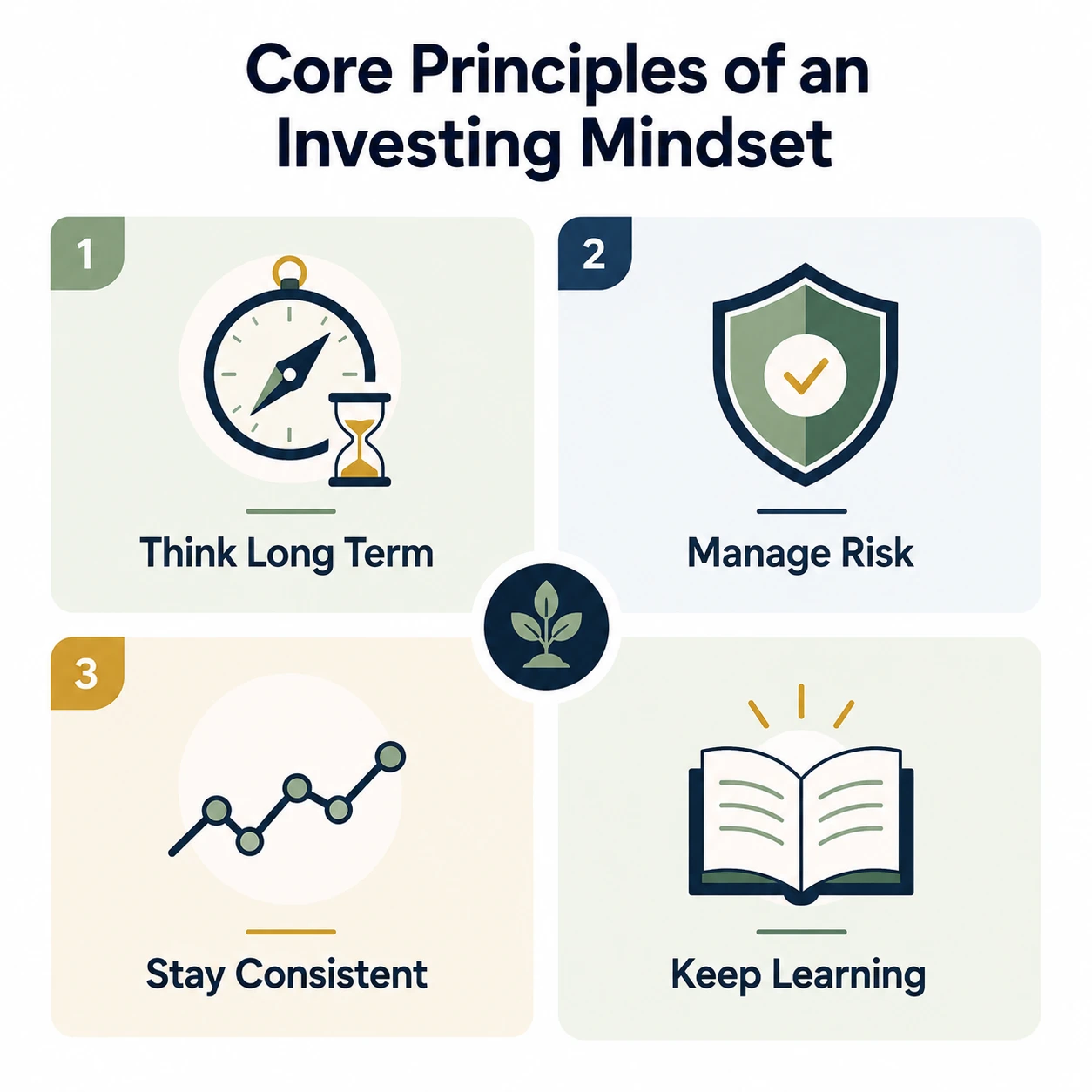
Core Principles of a Successful Investing Mindset
Thinking Long Term
A long term investing mindset treats time as an asset rather than an obstacle. Long-term wealth accumulation depends heavily on compounding, where returns generate their own returns over successive years. This requires delayed gratification: prioritizing future financial security over immediate spending or short-term gains. In our experience helping readers build better financial habits, those who commit to multi-year timeframes are far less likely to make reactive decisions during temporary downturns.
Managing Risk Instead of Chasing Returns
Strong investors manage risk deliberately rather than pursuing the highest possible returns. This includes understanding personal risk tolerance — the level of volatility someone can withstand without making emotional decisions. Diversification, or spreading investments across different assets, reduces the impact of any single loss. Capital preservation, protecting the money already invested, is treated as equally important as growth, particularly as financial goals get closer. Rather than reacting to headlines or price swings, disciplined investors learn to focus on what you can control — their contributions, allocation, and behavior — instead of chasing predictions.
Staying Consistent During Market Volatility
Emotional discipline separates investors who build wealth steadily from those who erode it through poor timing. Avoiding panic selling during downturns preserves the ability to benefit from eventual recoveries. Following a structured investment plan, created in advance and free from real-time emotional pressure, removes much of the guesswork during turbulent periods.
Continuous Learning and Adaptation
A healthy investing mindset treats past decisions as learning opportunities. This means periodically reviewing assumptions to confirm they still hold, learning from mistakes without excessive self-criticism, and using those lessons to refine future decision-making. Your Daily Thrive recommends treating each market cycle as new information rather than a reason to abandon core principles.
Common Rules of Investing and Why They Matter
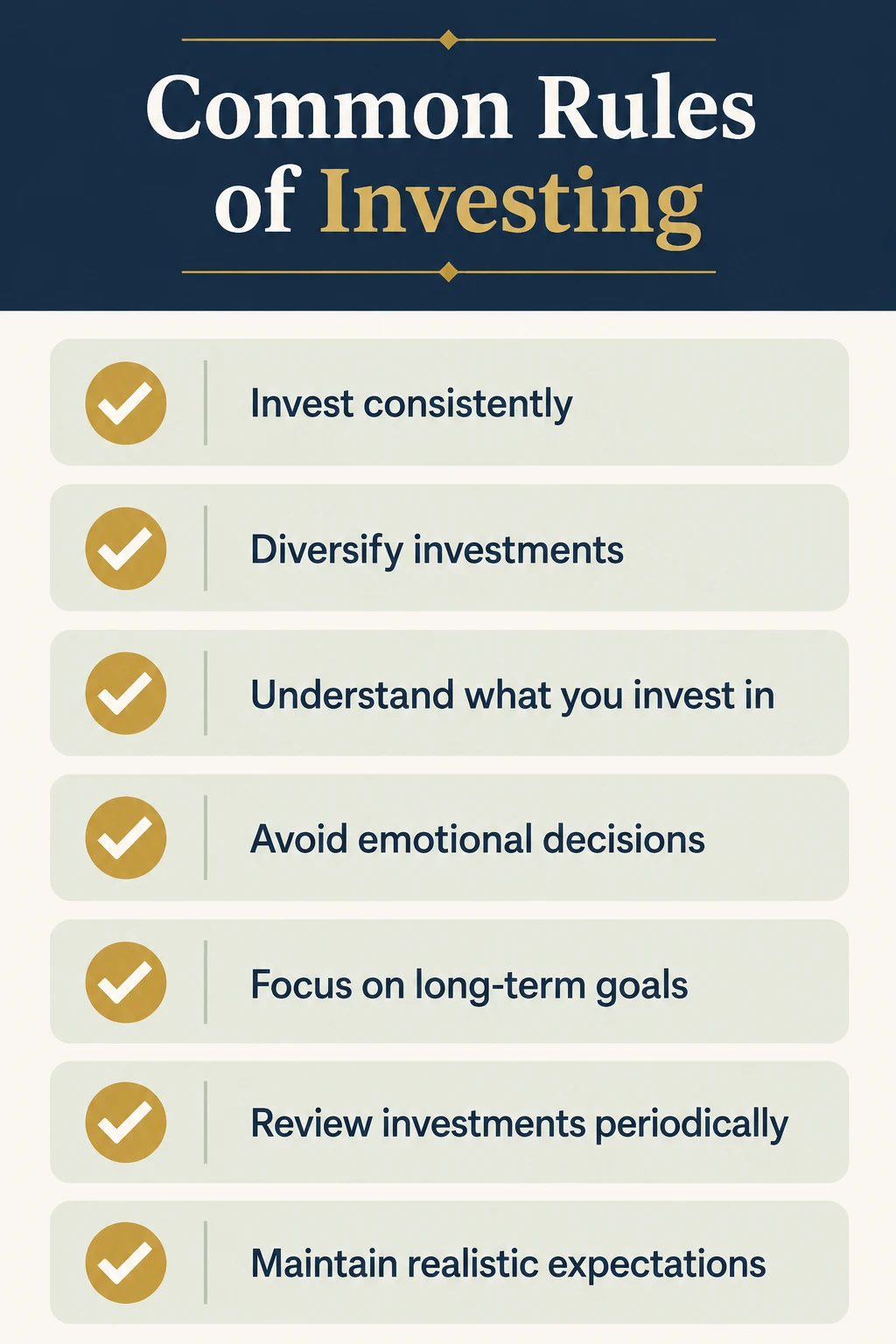
Widely accepted investing principles have emerged across decades of market history and behavioral research, independent of any single source. These rules of investing are commonly recommended because they address the most frequent causes of investor underperformance.
Frequently Recommended Investing Rules
- Invest consistently
- Diversify investments
- Understand what you invest in
- Avoid emotional decisions
- Focus on long-term goals
- Review investments periodically
- Maintain realistic expectations
Table: Common Investing Rules and Their Purpose
| Rule | Why It Matters | Common Mistakes | When It Applies |
|---|---|---|---|
| Invest consistently | Builds discipline and takes advantage of compounding | Investing only when markets feel favorable | Ongoing, regardless of market conditions |
| Diversify investments | Reduces exposure to any single asset’s decline | Concentrating in one stock or sector | When building or rebalancing a portfolio |
| Understand what you invest in | Prevents decisions based on hype or speculation | Investing based on trends alone | Before any new investment |
| Avoid emotional decisions | Protects long-term returns from short-term reactions | Panic selling or impulsive buying | During volatility or sudden news events |
| Focus on long-term goals | Aligns decisions with actual financial objectives | Chasing short-term performance | Throughout the entire investing journey |
| Review investments periodically | Keeps the portfolio aligned with goals and risk tolerance | Reviewing too often or not at all | Quarterly or annually |
| Maintain realistic expectations | Reduces disappointment and impulsive changes | Expecting consistent above-average returns | When setting goals and evaluating progress |
Different Types of Investing Mindsets
Long-Term Investing Mindset
A long-term investing mindset prioritizes patience over speed. It relies on compounding across years or decades and requires a multi-year perspective that tolerates short-term fluctuations in exchange for sustained growth.
Stock Investing Mindset
A stock investing mindset centers on evaluating individual companies. It requires company analysis — understanding financial health, competitive position, and management quality — along with awareness of market volatility and the risks tied to individual securities.
Value Investing Mindset
A value investing mindset focuses on identifying assets trading below their intrinsic value, the estimated true worth of a company based on its fundamentals. A margin of safety — buying at a meaningful discount to that estimated value — helps reduce downside risk. This approach typically involves long-term ownership rather than frequent trading.
Comparison Table
| Investing Mindset | Primary Focus | Typical Time Horizon | Key Decision Driver |
|---|---|---|---|
| Long-term investing | Wealth growth | Years to decades | Patience |
| Stock investing | Company ownership | Medium to long term | Business performance |
| Value investing | Undervalued assets | Long term | Intrinsic value |
Psychological Traits That Strong Investors Develop
Successful investors are often defined more by how they think than by what they buy. Common traits include: Discipline isn’t an innate personality trait — self-discipline is a skill that can be deliberately built through repetition and structure, which is exactly why consistent investors improve over time.
- Patience — the ability to wait for outcomes over years rather than days
- Discipline — sticking to a plan regardless of market noise
- Emotional control — separating feelings from financial decisions
- Critical thinking — evaluating information rather than accepting it at face value
- Independent decision-making — resisting herd behavior
- Adaptability — adjusting to new information without abandoning core principles
- Realistic expectations — understanding that markets fluctuate and returns vary over time
These traits translate into habits that improve investment decisions, such as sticking to a predetermined plan, and behaviors that reduce costly mistakes, such as pausing before reacting to breaking financial news.
Common Mistakes That Prevent a Healthy Investing Mindset
Emotional Investing
Fear and greed are the two dominant emotions that disrupt sound investing. Fear often triggers panic selling during downturns, locking in losses that might have recovered. Greed can drive panic buying during rapid price increases, leading to purchases at inflated valuations.
Trying to Time the Market
Timing the market — attempting to buy at the lowest point and sell at the highest — is extremely difficult even for professional investors, because it requires being right twice: on the way in and on the way out. Failed timing attempts often create significant opportunity cost, as investors miss periods of growth while waiting for the “right” moment.
Following Trends Without Research
Social influence can lead investors toward popular assets without understanding the underlying fundamentals. Confirmation bias — seeking information that supports an existing belief while ignoring contradictory evidence — reinforces this pattern. Left unchecked, it can shift investing into speculation rather than informed decision-making.
Expecting Quick Results
Unrealistic expectations about how quickly wealth accumulates often lead to disappointment and premature strategy changes. Short-term thinking undermines the very compounding effect that long-term investing depends on.
How to Build an Investing Mindset
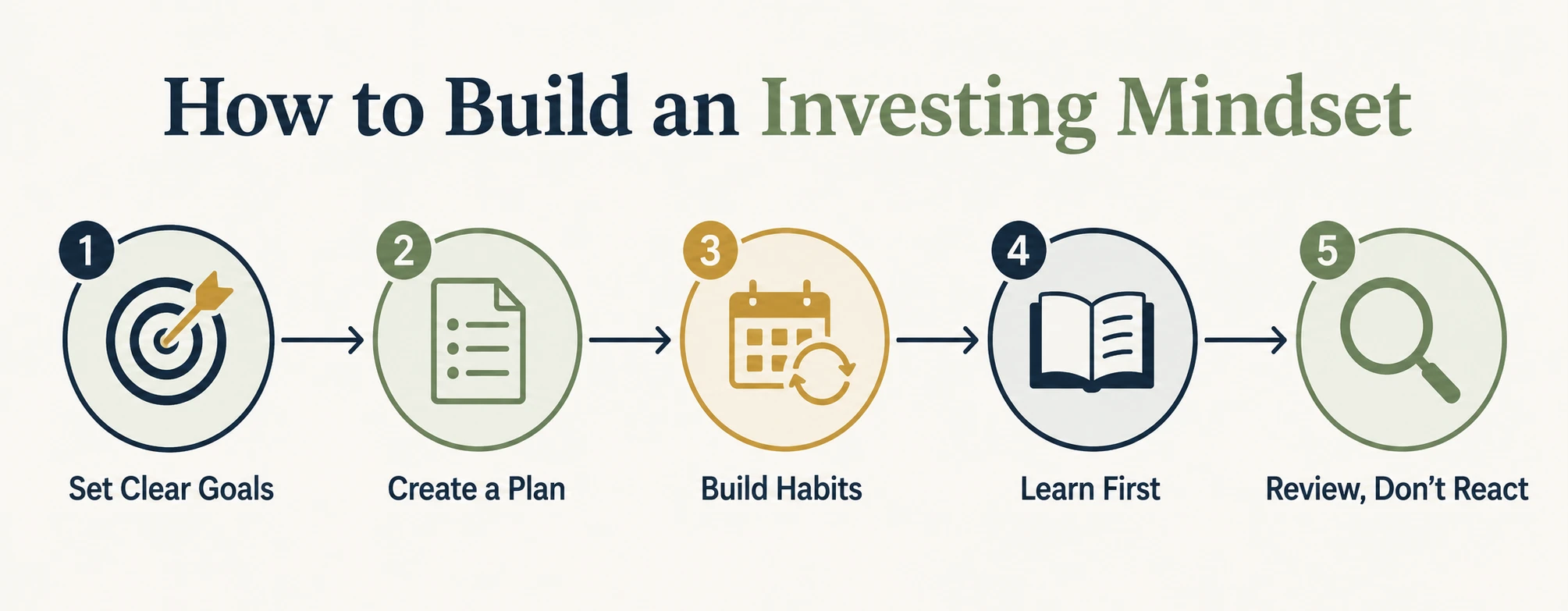
Set Clear Financial Goals
Defining specific, measurable objectives — such as a target amount by a target date — gives investing decisions direction and makes it easier to evaluate progress objectively.
Create an Investment Plan
A written investment plan outlining asset allocation, risk tolerance, and time horizon reduces the likelihood of emotional decisions during uncertain periods.
Build Consistent Investing Habits
Regular contributions, made on a predictable schedule, reinforce discipline and take advantage of compounding over time.
Learn Before Increasing Risk
Expanding into more complex or higher-risk investments should follow a solid understanding of the basics, not precede it.
Review Decisions Instead of Reacting to Headlines
Evaluating a portfolio against its original goals, rather than against daily news cycles, keeps decision-making grounded and intentional.
Habit-Building Framework
- Daily habits: Avoid checking portfolio performance excessively; focus on routine, unemotional monitoring
- Weekly habits: Track spending and savings contributions toward investment goals
- Monthly habits: Review budget alignment and confirm scheduled contributions occurred
- Annual portfolio review: Reassess asset allocation, risk tolerance, and progress toward long-term goals
Beginner Challenges and Practical Solutions
Fear of Losing Money
This happens because losses feel psychologically more significant than equivalent gains. It can be addressed by starting with amounts aligned to personal risk tolerance and by focusing on long-term historical trends rather than daily price movements. Prevention comes from setting realistic expectations before investing begins.
Information Overload
Beginners often face too many sources, opinions, and strategies at once. This is best solved by focusing on a small number of reliable, foundational concepts before exploring advanced material. Prevention involves creating a structured learning plan rather than consuming information randomly.
Comparing Yourself With Other Investors
Comparison often stems from visible success stories that omit risk, timing, or context. Solving this requires focusing on personal goals and timelines rather than others’ results. Prevention comes from defining success in individual, measurable terms from the outset.
Staying Consistent During Market Declines
Declines trigger natural loss-aversion responses. Consistency is maintained by revisiting the original investment plan and reasoning behind it. Prevention involves building an investment plan that already accounts for expected volatility, so declines are not a surprise.
Investing Mindset vs Trading Mindset
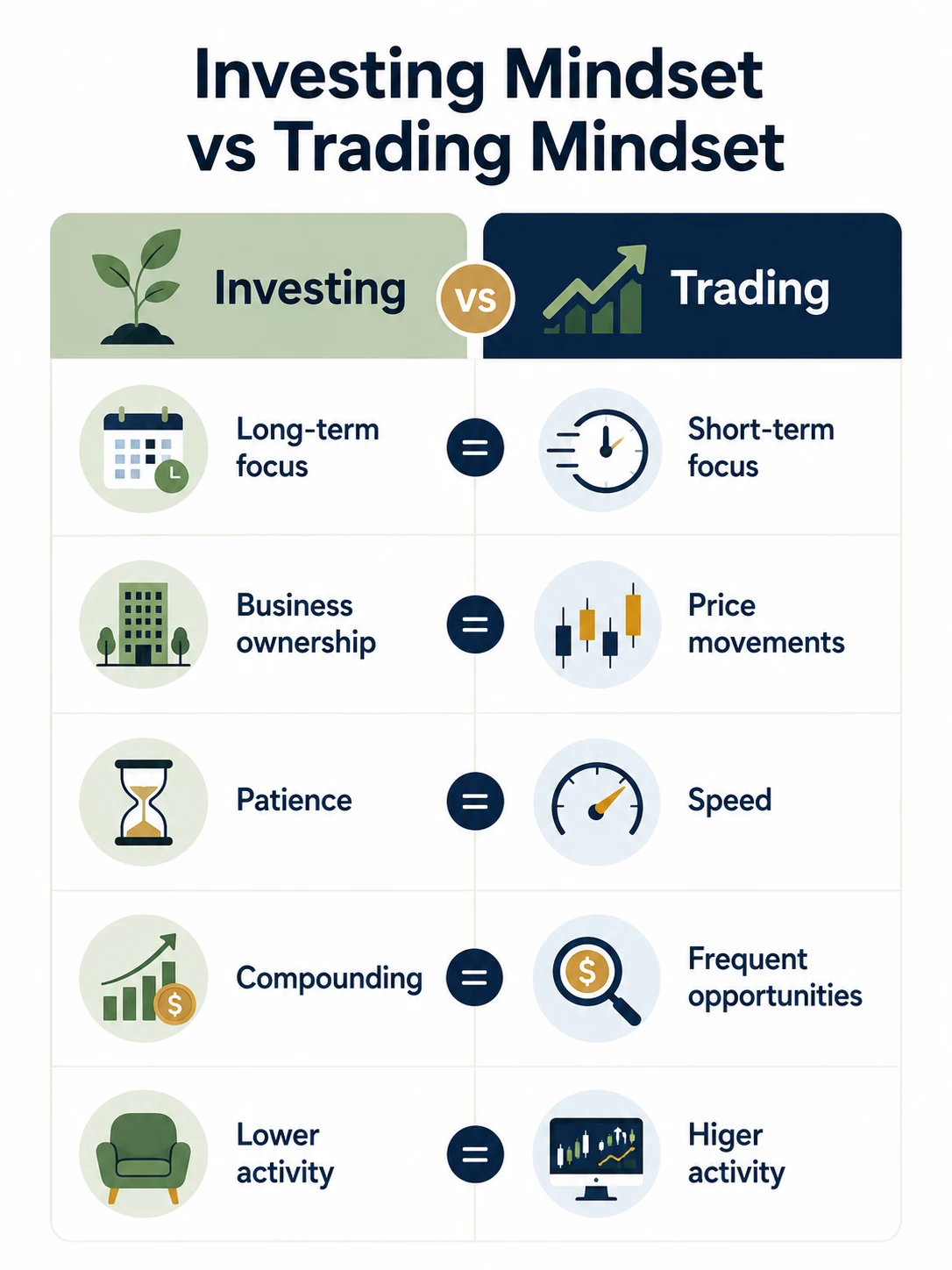
An investing mindset and a trading mindset represent fundamentally different approaches to markets, even though both aim to grow wealth.
| Investing Mindset | Trading Mindset |
|---|---|
| Long-term focus | Short-term focus |
| Business ownership | Price movements |
| Patience | Speed |
| Compounding | Frequent opportunities |
| Lower activity | Higher activity |
The two approaches differ in risk exposure, since frequent trading generally involves higher transaction costs and greater exposure to short-term volatility. Emotional demands also differ significantly: trading requires rapid decision-making under pressure, while investing relies on patience and periodic review. Trading typically demands specialized technical skills, such as chart analysis, while investing relies more on fundamental research and discipline. Each approach suits different situations — trading may fit someone with the time, temperament, and expertise for active markets, while investing suits those pursuing long-term financial goals with less day-to-day involvement.
Learning Resources for Developing an Investing Mindset
Investing Mindset Books
Quality investing mindset books share certain characteristics: they emphasize principles over predictions, use historical evidence to support claims, and focus on behavior and psychology rather than short-term tactics. A strong stock investing mindset book typically explains not just what to buy, but how to think about uncertainty and risk. When evaluating the best books on investing mindset, look for authors with demonstrated long-term track records and content that has remained relevant across different market cycles, rather than material tied to a single trend.
Learning From Experienced Investors
Interviews with experienced investors often reveal decision-making processes that are not visible in performance numbers alone. Annual shareholder letters from established companies provide long-term perspectives on strategy and market conditions. Educational courses can build structured foundational knowledge, while historical case studies illustrate how sound principles held up during past periods of volatility.
Using Quotes as Learning Tools
Investing mindset quotes can reinforce key principles, but only when understood within their original context. A quote about patience or risk is most useful when paired with an understanding of the reasoning and market conditions behind it, rather than treated as a standalone rule.
Online Communities and Shared Learning
Learning From Community Discussions
Communities such as investing mindset Reddit forums offer access to diverse perspectives and real-world experiences from a wide range of investors. However, these platforms also carry risks, including confirmation bias and herd mentality, where popular opinions can overshadow sound analysis. Verifying information independently — cross-referencing community claims with reliable data — helps separate useful insight from speculation.
Frequently Misunderstood Ideas About Investing Mindset
- Mindset is not optimism: a strong investing mindset is grounded in realistic assessment, not blind positivity about outcomes.
- Patience is not inactivity: patience involves actively maintaining a plan, not ignoring a portfolio entirely.
- Risk-taking is not gambling: calculated risk is based on analysis and diversification, while gambling relies on chance.
- Confidence differs from certainty: confidence reflects preparation, while certainty about specific outcomes is rarely justified in unpredictable markets.
- Long-term investing still requires periodic review: a long-term approach does not mean a portfolio should never be reassessed.
Conclusion
An investing mindset is the psychological foundation that determines whether financial knowledge translates into long-term results. Sustainable investing depends less on predicting markets and more on disciplined thinking, continuous learning, and consistent, long-term decision-making. Readers benefit most by focusing on developing sound habits — clear goals, structured plans, and emotional discipline — rather than reacting to short-term market movements. In short: mindset, not market timing, is what separates investors who build lasting wealth from those who struggle to stay the course.
Frequently Asked Questions
What is an investing mindset?
An investing mindset is the set of psychological habits and decision-making patterns that guide how someone approaches risk, time, and money when investing, prioritizing long-term discipline over short-term reactions. The investing mindset meaning goes beyond picking stocks or funds — it overlaps closely with what’s often called an investor mindset, the psychological framework that determines whether someone reacts to market noise or stays committed to a long-term plan.
Why is mindset important for successful investing?
Mindset determines whether an investor sticks to a sound plan during volatility or makes emotional decisions that undermine long-term returns, making it as important as technical financial knowledge.
How can beginners develop a long-term investing mindset?
Beginners can develop a long-term investing mindset by setting clear goals, creating a written investment plan, building consistent contribution habits, and reviewing decisions based on that plan rather than daily news.
What is the difference between an investing mindset and a trading mindset?
An investing mindset focuses on long-term ownership and compounding, while a trading mindset focuses on short-term price movements and requires faster, more frequent decision-making.
What habits help investors make better decisions?
Helpful habits include consistent contributions, periodic portfolio reviews, avoiding excessive monitoring, and evaluating decisions against long-term goals rather than short-term headlines.
How does emotional discipline affect investment performance?
Emotional discipline helps investors avoid panic selling during downturns and impulsive buying during rallies, both of which are common causes of underperformance relative to the market.
Can investing mindset be learned over time?
Yes, an investing mindset can be developed through consistent practice, continuous learning, and reviewing past decisions, similar to how other long-term habits and skills are built.