
Introduction
Mindset book study questions are prompts designed to test comprehension of Carol Dweck’s concepts of fixed and growth mindsets, along with the reasoning behind them. They are used in reading comprehension exercises, classroom discussions, book clubs, personal reflection, and exam preparation. At the center of the book is a core distinction: a fixed mindset treats intelligence and talent as relatively static traits, while a growth mindset frames abilities as things that develop through learning, effort, effective strategies, and feedback. This article walks through the book’s major concepts using structured questions that move from basic definitions to applied analysis.
Quick Summary
- Mindset study questions help readers understand the difference between fixed and growth mindsets and recognize each mindset in real situations.
- The strongest questions examine not only what Dweck argues, but why mindset influences learning, motivation, relationships, leadership, and achievement.
- Application-based questions ask readers to identify mindset patterns and consider how beliefs, strategies, and responses to setbacks can change.
- Good study questions should encourage explanation and reasoning rather than simple memorization.
What Is the Difference Between a Fixed Mindset and a Growth Mindset?
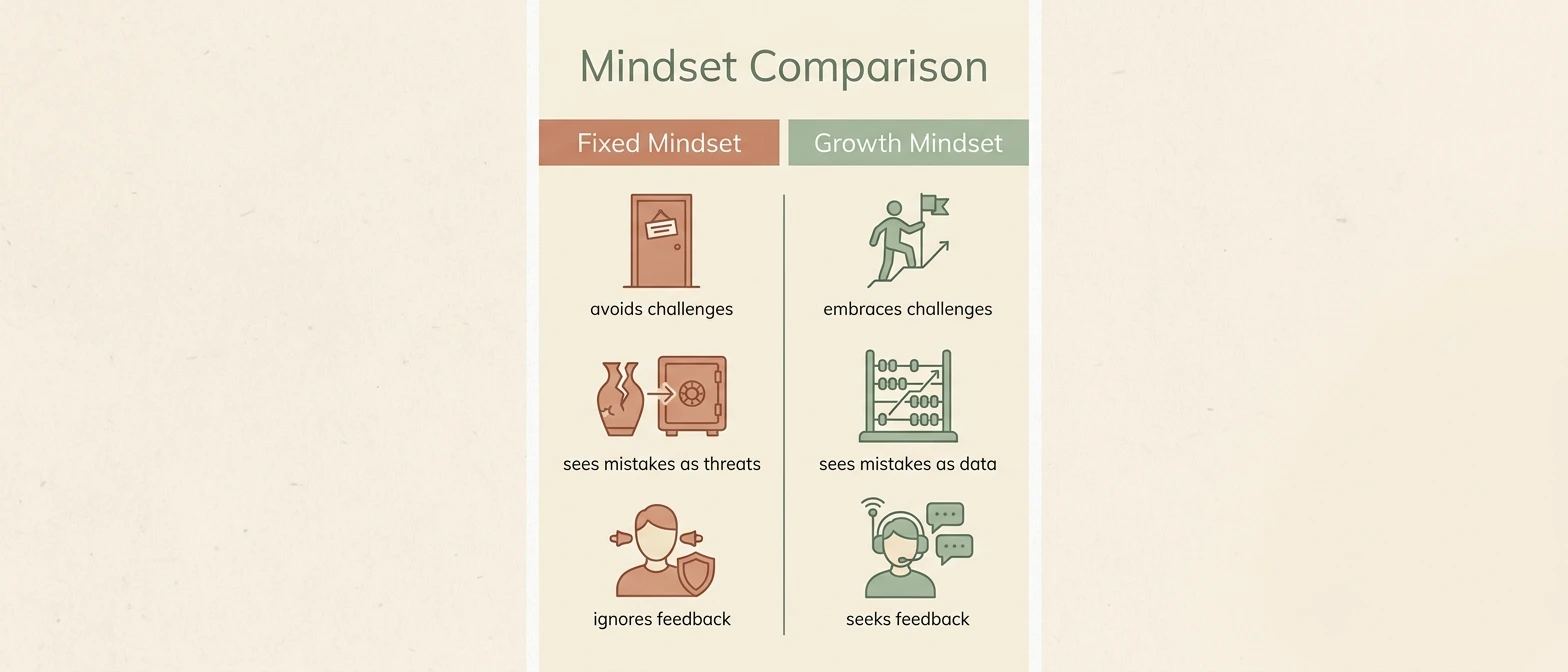
A fixed mindset assumes intelligence and talent are largely stable traits, while a growth mindset holds that abilities can be developed through effort, strategy, and feedback. This distinction shapes how a person interprets challenges, mistakes, criticism, and comparison with others. In a fixed mindset, ability is treated as something to prove; in a growth mindset, ability is treated as something to build.
How Does a Fixed Mindset Influence Behavior?
People operating from a fixed mindset tend to avoid challenges that risk exposing a perceived lack of talent. Common patterns include:
- Preferring tasks that showcase existing ability rather than tasks that require new skills.
- Interpreting mistakes and criticism as personal threats rather than useful information.
- Feeling threatened by comparison, especially when someone else appears to succeed with less effort.
- Avoiding effort in areas where failure feels likely, since visible effort can seem to confirm a lack of natural ability.
How Does a Growth Mindset Change the Response to Challenges?
A growth mindset reframes challenges as opportunities for development rather than tests of fixed ability. Key behaviors include:
- Persisting after setbacks by treating failure as a source of information.
- Actively seeking feedback and adjusting strategy in response to it.
- Valuing the learning process, not only the outcome.
Growth mindset does not simply mean “try harder.” Effort without adjustment or feedback can stall progress just as easily as avoidance can. The distinguishing factor is whether effort is paired with reflection and strategy.
Study-question focus: Effective questions in this section should require readers to explain the underlying differences and apply them to specific examples, rather than restate definitions.
What Are the Most Important Ideas in Mindset?
Dweck’s central arguments extend beyond a simple beliefs-versus-behavior framework. Organizing study questions around these arguments—rather than isolated facts—produces stronger comprehension.
Why Do Beliefs About Ability Matter?
Beliefs about intelligence and talent shape the goals a person sets, the effort they invest, and how they interpret setbacks. Two people can respond very differently to the same challenge depending on whether they view ability as fixed or developable. This is why beliefs, not just outcomes, are a central focus of the book.
What Role Does Effort Play?
Effort is interpreted differently depending on mindset. In a fixed mindset, needing to work hard can feel like evidence of inadequate talent. In a growth mindset, effort is viewed as the mechanism through which skill develops. However, effort alone is not always sufficient—it must be combined with effective strategies to produce meaningful improvement.
Why Are Mistakes and Failure Important?
Failure can be interpreted as information about what to adjust, or as a judgment of one’s underlying ability. How a person responds to a setback often reveals which interpretation they hold. Reflection—examining what went wrong and why—can turn a mistake into a specific, usable learning opportunity rather than a discouraging verdict.
How Does Mindset Affect Learning and Achievement?
Dweck’s theory has direct application to education and academic performance, particularly in how students and teachers respond to difficulty.
How Does Mindset Influence Students?
Mindset shapes several observable academic behaviors:
- Reactions to difficult subjects, ranging from avoidance to engagement.
- Responses to poor grades, from discouragement to problem-solving.
- Attitudes toward studying and practice, including whether they are seen as remedial or developmental.
- Willingness to seek help and accept feedback without treating it as a threat.
How Can Teachers Encourage a Growth-Oriented Learning Environment?
Teachers can reinforce growth-oriented behavior through specific practices:
- Giving feedback focused on process and learning rather than only outcomes.
- Encouraging productive responses to mistakes instead of penalizing them socially.
- Avoiding praise that centers solely on perceived intelligence (“You’re so smart”).
- Supporting effective strategies alongside effort, since effort without direction is inefficient.
| Situation | Fixed Mindset Response | Growth Mindset Response |
|---|---|---|
| Difficult challenge | Avoids or gives up quickly | Engages and adjusts approach |
| Low grade | Feels it reflects fixed ability | Sees it as feedback for improvement |
| Mistake | Interpreted as a threat | Interpreted as information |
| Feedback | Resisted or ignored | Actively sought and applied |
| Difficult task | Avoided to protect self-image | Approached as a learning opportunity |
How Does Mindset Apply to Goals, Motivation, and Personal Growth?
Beyond academics, mindset connects to broader self-improvement themes, including goal setting, resilience, habit formation, and productivity.
What Is the Relationship Between Mindset and Goals?
Performance goals emphasize proving competence, while learning-oriented goals emphasize developing competence. The type of goal a person sets influences how they respond to setbacks—performance goals can make failure feel more threatening, while learning goals frame failure as part of the process.
How Does Mindset Affect Motivation?
A growth mindset tends to support internal motivation and sustained engagement, since progress itself becomes rewarding. A fixed mindset can heighten fear of failure, which discourages experimentation. Perceived progress—seeing tangible movement toward a goal—also plays a significant role in sustaining persistence over time.
How Does Mindset Connect With Habit Formation?
Repeated responses to difficulty can solidify into behavioral patterns over time. In our experience helping readers build better habits, the pattern that forms is often more influential than any single decision. Reflection and adjustment help interrupt unproductive patterns, but it’s important to note that changing a belief does not automatically change behavior—consistent practice is still required to translate a growth-oriented belief into a growth-oriented habit. If you’re ready to put a growth-oriented belief into practice, our guide on how to build good habits in 30 days offers a structured starting point
How Does Mindset Influence Relationships and Communication?
This application is often underdeveloped in basic study guides, yet it plays a meaningful role in how people relate to one another.
How Can Mindset Affect Friendships and Personal Relationships?
Mindset shapes how people respond to disagreement and criticism within relationships. A fixed mindset may lead someone to judge others by static traits (“that’s just who they are”), while a growth mindset allows more room to consider that people—and relationships—can develop over time.
How Can Mindset Affect Reactions to Other People’s Success?
Another person’s achievement can be interpreted as either a threat or a learning opportunity, depending on mindset. A fixed mindset often triggers comparison and competition, while a growth mindset is more likely to treat someone else’s success as a source of useful strategies or inspiration.
What Does Mindset Say About Leadership and Work?
Dweck’s concepts extend into organizational behavior, management style, and workplace culture.
How Does a Leader’s Mindset Affect a Team?
A leader’s mindset shapes expectations about employee ability, how mistakes are handled, and what kind of professional development is prioritized. Organizational culture can reinforce either fixed or growth-oriented behavior depending on whether experimentation and learning are rewarded or penalized.
What Questions Can Readers Use to Analyze Workplace Examples?
Scenario-based prompts can help readers apply the concepts practically:
- How does a manager respond when an employee makes a mistake?
- Why might an employee avoid taking on an unfamiliar responsibility?
- How does a team typically react to critical feedback?
- Does the company reward learning and improvement, or only immediate results?
What Are Common Misunderstandings About Growth Mindset?
Addressing common oversimplifications helps distinguish substantive analysis from generic self-improvement content. Before addressing these misconceptions, it also helps to clarify mindset vs. attitude — two terms readers often use interchangeably but that describe different psychological concepts.
Does Growth Mindset Mean Believing You Can Do Anything?
No. Growth mindset is not the belief that anyone can achieve any outcome purely through belief or effort. It emphasizes that abilities can improve with the right learning, strategy, and resources—not that outcomes are guaranteed regardless of circumstances.
Does Growth Mindset Mean Effort Is Always Enough?
No. Effort must be paired with effective methods to produce meaningful development. Feedback, adaptation, deliberate practice, and support all play a role; effort alone, without adjustment, often produces limited results.
Can Someone Have Both Fixed and Growth Mindset Tendencies?
Yes. Mindset can vary by situation or domain—someone might display a growth mindset in their career while showing more fixed patterns in a personal relationship, for example. Identifying the specific circumstances that trigger a more fixed response is a useful exercise for readers applying the concepts to their own lives.
How Can You Answer Mindset Study Questions Effectively?
A practical framework helps readers move beyond memorized definitions toward genuine understanding.
Use the Concept–Evidence–Application Method
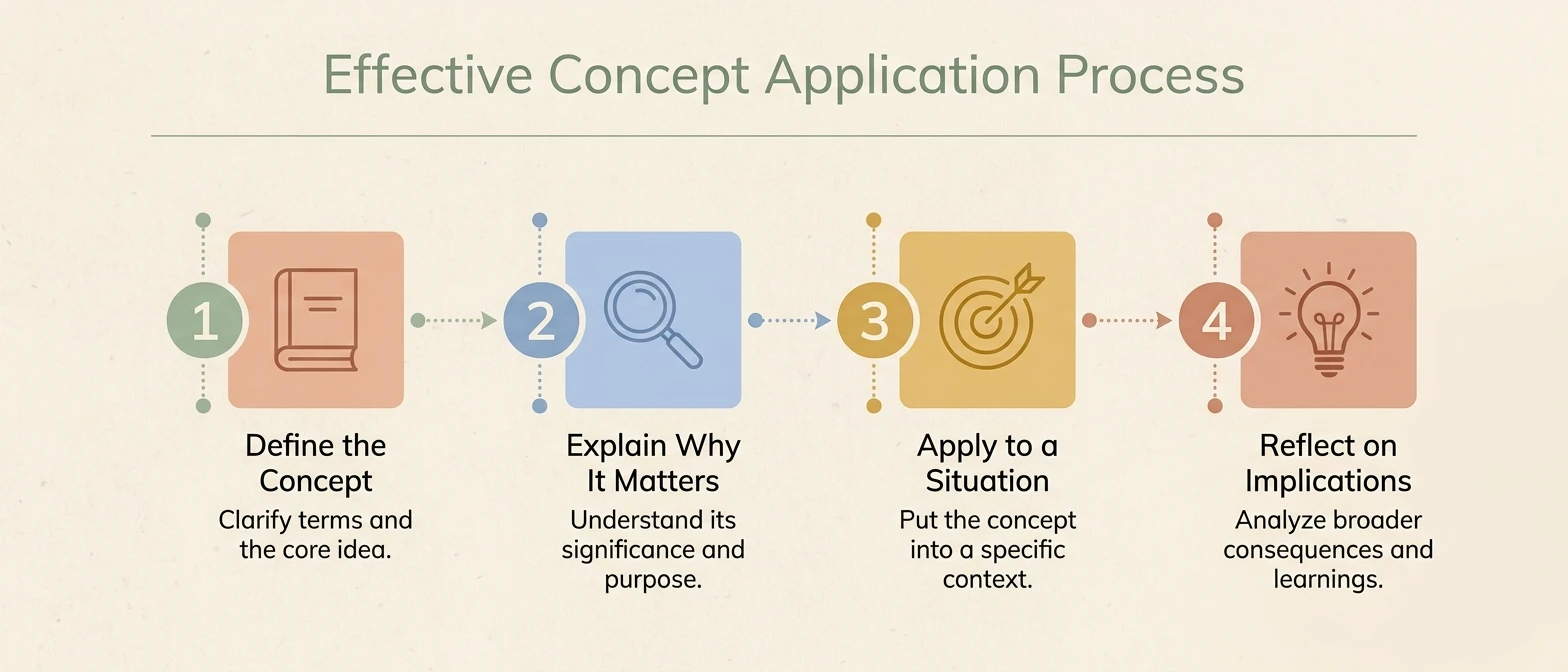
For each response, readers should:
- Define the relevant concept clearly.
- Explain why it matters within the book’s broader argument.
- Apply it to a specific situation or example.
- Reflect on implications or limitations.
How Should You Approach Scenario-Based Questions?
- Identify the belief or mindset being demonstrated in the scenario.
- Point to the specific behavior that supports that interpretation.
- Explain the likely consequence of that behavior.
- Suggest a more productive alternative when appropriate.
How Can You Avoid Weak Study-Question Answers?
Common weaknesses to avoid include:
- Giving only a definition without explanation.
- Repeating the question rather than answering it.
- Treating growth mindset as unlimited positive thinking.
- Ignoring the context or situation described in the question.
- Confusing effort with effective learning.
Mindset Book Study Questions for Deeper Discussion
Your Daily Thrive recommends organizing original questions by difficulty so this section serves students, educators, and book-club readers alike.
Foundational Comprehension Questions
- What distinguishes fixed and growth mindsets?
- How do people with different mindsets respond to challenges?
- What role does feedback play in the development of ability?
- Why can failure produce different reactions in different people?
Analytical Questions
- How are beliefs about ability connected to motivation?
- Why might someone avoid a challenge despite wanting to improve?
- How can praise influence a person’s mindset over time?
- What evidence or reasoning supports the distinction between fixed and growth-oriented responses?
Application and Reflection Questions
- Where might a person demonstrate different mindsets in different areas of life?
- How could someone respond differently to a recent setback?
- What assumptions about ability might be influencing a person’s choices?
- What would need to change for a growth-oriented response to become sustainable? For readers who prefer written reflection over discussion, our collection of journal prompts for growth mindset offers additional prompts built around these same themes.
How Can You Use These Study Questions for Different Purposes?
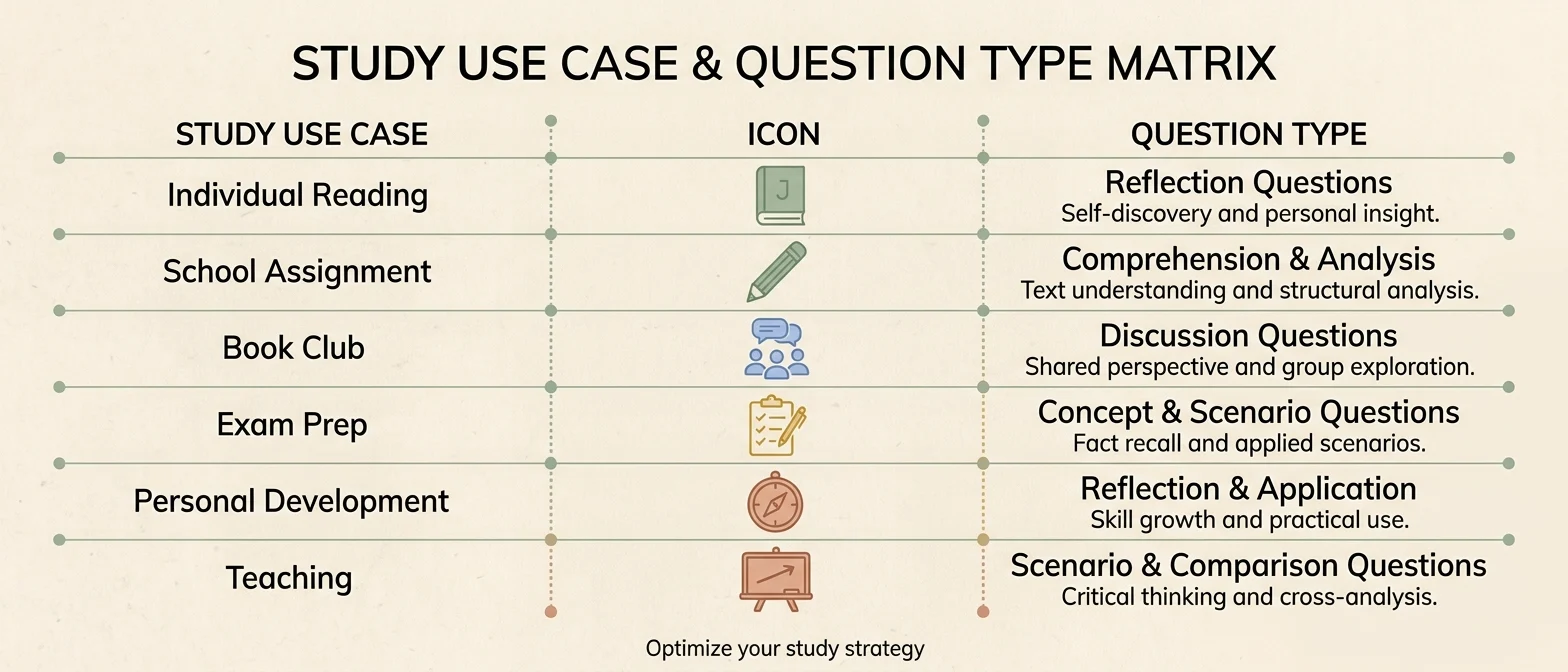
Different readers need different question types depending on their goal.
| Use Case | Best Question Type | Main Goal |
|---|---|---|
| Individual reading | Reflection questions | Personal understanding |
| School assignment | Comprehension and analysis | Demonstrate understanding |
| Book club | Discussion questions | Explore different interpretations |
| Exam preparation | Concept and scenario questions | Recall and application |
| Personal development | Reflection and application | Connect ideas to behavior |
| Teaching | Scenario and comparison questions | Build conceptual understanding |
How Should Students Adapt the Questions for Exam Preparation?
- Prioritize definitions and distinctions first.
- Practice explaining concepts without relying directly on the book’s wording.
- Use scenario questions to test application, not just recall.
- Review misunderstandings rather than simply rereading familiar material.
How Can Book Clubs Use the Questions?
- Begin with comprehension questions to establish a shared understanding.
- Move toward interpretation and areas of disagreement.
- End with real-world application questions.
- Encourage participants to distinguish the author’s claims from their own personal experiences.
Common Problems When Studying Mindset and How to Fix Them
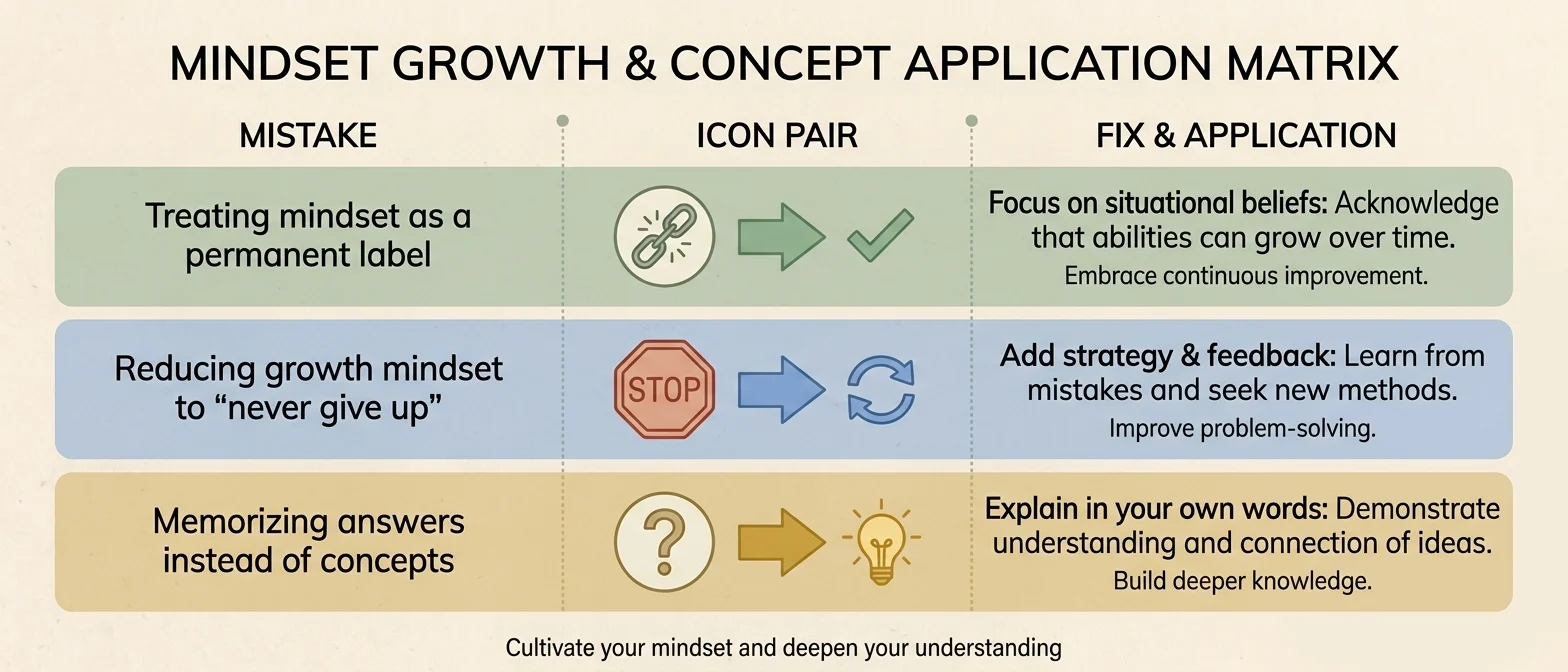
Mistake: Treating Fixed and Growth Mindset as Permanent Labels
Why it happens: Readers may interpret the two mindsets as fixed personality types rather than situational patterns.
How to improve: Focus on beliefs and responses within particular situations and domains, rather than labeling a person entirely as one type or the other.
How to prevent it: Ask what specifically triggered the response and whether the underlying belief can be examined or adjusted.
Mistake: Reducing Growth Mindset to “Never Give Up”
Why it happens: The concept is easily oversimplified into general motivational advice.
How to improve: Consider strategy, feedback, learning, adjustment, and available resources—not persistence alone.
How to prevent it: Ask whether continued effort is actually producing learning, or whether a different approach is needed.
Mistake: Memorizing Answers Instead of Understanding Concepts
Why it happens: Readers may focus on passing an assessment rather than genuinely understanding the material.
How to improve: Explain concepts in your own words and apply them to unfamiliar situations.
How to prevent it: Regularly practice scenario-based and open-ended questions rather than reviewing fixed answers.
What Are the Most Useful Takeaways From Mindset?
- Beliefs about ability can influence the goals a person sets and how they behave.
- Challenges can reveal underlying assumptions about learning and competence.
- Effective growth involves effort combined with strategy, feedback, and adjustment.
- Mistakes can provide useful information rather than serving only as judgments of ability.
- Mindset can vary across different situations and areas of life.
- Sustainable personal development requires consistent behavior and practice alongside changes in belief.
Conclusion
The distinction between fixed and growth mindset centers on how ability is understood: as a static trait to be proven, or as a capacity that develops through effort, strategy, and feedback. This distinction matters because it shapes how people approach learning, respond to setbacks, pursue goals, and interact with others—both personally and professionally. Mindset book study questions serve as a tool for building comprehension, analysis, and real-world application of these ideas, moving readers beyond surface-level definitions. As of 2026, growth mindset research continues to emphasize that belief change alone is insufficient without paired strategy and practice. The clearest takeaway: understanding the ideas behind fixed and growth mindset is more valuable than memorizing isolated answers.
Frequently Asked Questions About Mindset Book Study Questions
What are the main concepts to study in Mindset?
The main concepts include fixed mindset, growth mindset, beliefs about ability, effort, challenges, failure, feedback, goals, and learning. Together, these ideas explain how beliefs about ability shape behavior and long-term development.
What is the difference between a fixed mindset and a growth mindset?
A fixed mindset treats intelligence and talent as static traits, while a growth mindset treats them as capacities that develop through effort, strategy, and feedback. This affects how a person responds to challenges, mistakes, and criticism.
Why is effort important in a growth mindset?
Effort supports skill development, but it works best when combined with effective strategies, feedback, and ongoing adaptation. Effort alone, without adjustment, often produces limited progress.
Can a person have both a fixed mindset and a growth mindset?
Yes. Mindset-related beliefs can vary across different situations, skills, and areas of life, meaning a person can show growth-oriented behavior in one domain and more fixed patterns in another.
How can I use Mindset study questions to prepare for an exam?
Start by learning core concepts, then practice explaining them independently, work through scenario-based questions, review any errors, and apply the concepts to new, unfamiliar examples.
What are good discussion questions for a Mindset book club?
Effective discussion questions move from comprehension to analysis, then to personal application and critical evaluation, encouraging participants to connect the book’s ideas to their own experiences.
Does growth mindset mean that anyone can achieve anything?
No. Growth mindset reflects the belief that abilities can develop through learning and effort, not that effort alone guarantees any desired outcome regardless of circumstances, resources, or context.