

Introduction
The warrior’s mindset is a mental framework built on resilience, discipline, adaptability, and continuous self-improvement — not aggression or combat. It appears across sports psychology, military leadership, martial arts, business strategy, and personal development, and its popularity has grown because people are looking for a repeatable way to perform consistently under pressure. While interpretations vary by field, the underlying idea stays the same: a warrior’s mindset is trained through habits, not inherited through personality, and it prioritizes steady effort over emotional highs. As of 2026, interest in the concept continues to rise as more people seek sustainable alternatives to motivation-driven self-improvement trends.
Quick Summary
- A warrior’s mindset emphasizes discipline over motivation and consistent improvement over perfection.
- It combines resilience, emotional control, responsibility, and purposeful action.
- Anyone can develop a warrior mindset through habits, reflection, and deliberate practice.
- Long-term success comes from continuous learning and adapting to challenges.
- It applies equally to students, professionals, athletes, and entrepreneurs — not just soldiers or fighters. For a deeper breakdown of this shift, see our guide on how to build discipline without motivation.
What Is the Warrior’s Mindset?
Warrior mindset meaning
The warrior mindset is a trained mental approach focused on staying composed, disciplined, and purposeful in the face of difficulty. In practical terms, it means responding to stress with structured action rather than panic or avoidance. Psychologically, it draws on concepts like self-regulation and cognitive reframing — the ability to interpret a setback as information rather than a threat. Unlike personality, which is relatively stable, the warrior mindset is a skill set: it can be built, weakened, and rebuilt depending on daily habits and choices. In our experience helping readers build better habits, the clearest sign of a strengthening warrior mindset is not confidence — it’s consistency during boring, low-motivation days.
Core characteristics of a warrior mindset
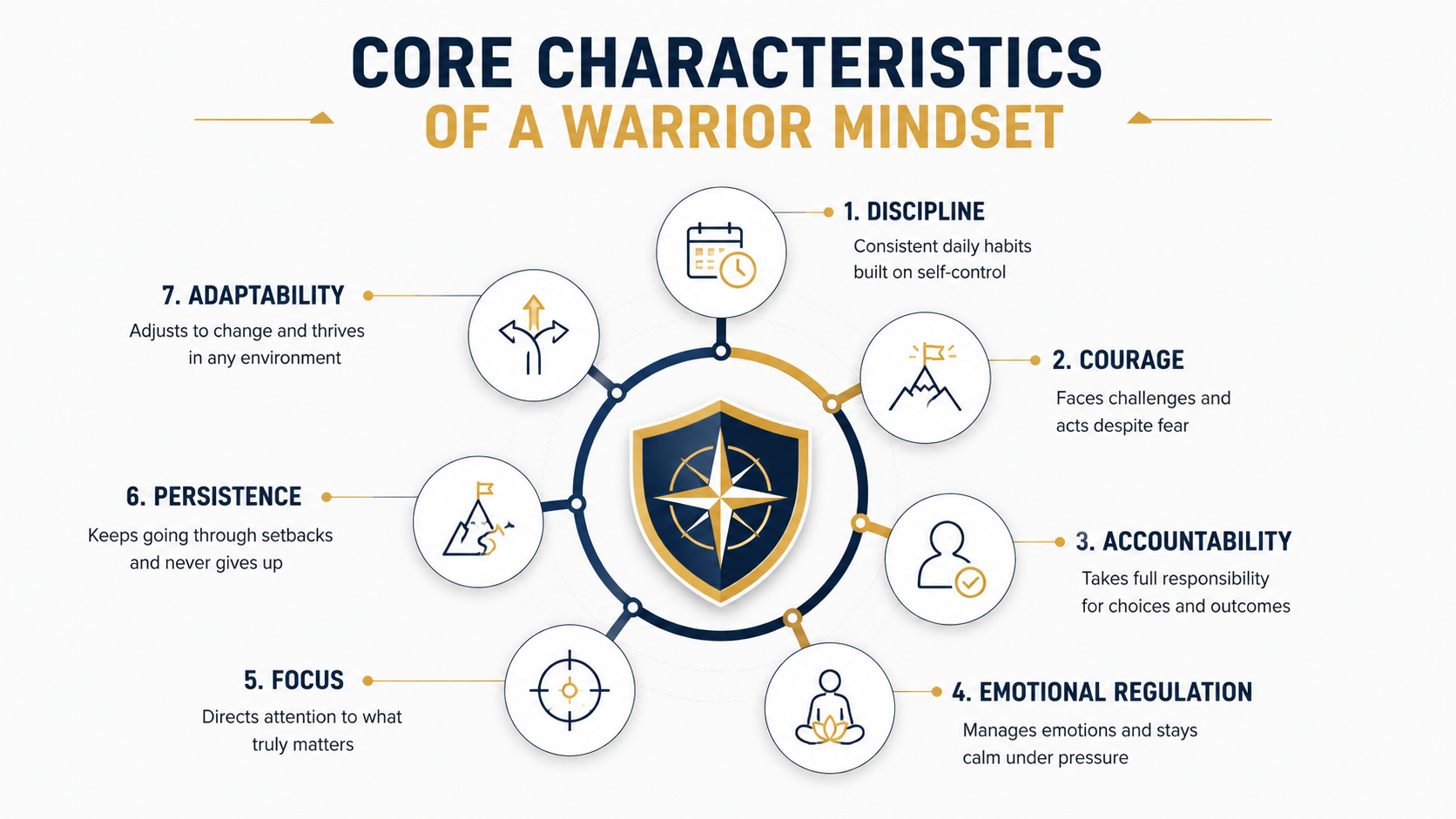
People with a developed warrior mindset tend to share several traits:
- Discipline — acting according to a plan, not a mood
- Courage — moving forward despite fear or uncertainty
- Accountability — owning outcomes instead of assigning blame
- Emotional regulation — managing reactions under pressure
- Focus — protecting attention from distraction
- Persistence — continuing after failure or fatigue
- Adaptability — adjusting strategy when circumstances change
These traits reinforce each other. Discipline supports focus, accountability strengthens persistence, and emotional regulation makes adaptability possible under stress.
Why the Warrior’s Mindset Matters
Benefits in everyday life
A warrior’s mindset improves several practical areas of daily functioning:
- Decision making — clearer thinking under time pressure
- Stress management — faster recovery after setbacks
- Productivity — fewer stalls caused by waiting for motivation
- Confidence — built through evidence of past follow-through, not affirmations
- Relationships — more consistent, accountable behavior with others
- Career growth — reliability and composure under deadlines or conflict
How mindset influences long-term success
Long-term achievement is rarely the result of a single breakthrough; it’s the product of repeated, unremarkable actions compounding over time. The warrior mindset supports this through:
- Consistency — showing up regardless of daily motivation levels
- Habits — automating good decisions so willpower is conserved
- Delayed gratification — prioritizing long-term outcomes over short-term comfort
- Mental resilience — recovering from failure without abandoning the goal
The Core Principles Behind the Warrior’s Mindset
Discipline over motivation
One of the most repeated ideas in modern self-improvement circles is that you can build your dream life without relying on motivation — because motivation is an emotional state, and emotional states are unreliable by nature. Discipline, by contrast, is a decision made in advance and executed regardless of how someone feels that day. Routines outperform motivation because they remove the need for a decision at all: the action becomes automatic, triggered by time, location, or a preceding habit rather than by inspiration.
Personal responsibility
The warrior mindset requires full ownership of choices and outcomes, including the parts influenced by bad luck or other people. This isn’t about self-blame — it’s about identifying which parts of a situation are within personal control and acting on those, rather than spending energy on factors that cannot be changed. This principle connects closely with learning to focus on what you can control, rather than spending energy on outcomes outside your influence.
Continuous learning and adaptation
At its core, the warrior mindset is a continuous cycle of performance improvement: act, assess, adjust, and act again. This continuous cycle treats every outcome — success or failure — as feedback rather than a final verdict. The warrior mindset is a continuous cycle of performance rather than a fixed state that, once achieved, no longer requires maintenance. Structured reflection (weekly reviews, journaling, or coaching feedback) keeps this cycle sustainable instead of chaotic, allowing small corrections before problems compound.
The Warrior’s Mindset Across Different Fields
Military philosophy
Military training develops resilience and discipline primarily through structure, repetition, and controlled exposure to stress — not through combat itself. Recruits build composure under pressure by practicing procedures until they become automatic, reducing the mental load required during high-stakes moments.
Martial arts
Martial arts traditions emphasize humility, technique, patience, and lifelong learning over aggression. Elite practitioners, such as Brazilian Jiu-Jitsu champion Roger Gracie, are frequently cited for demonstrating that technical mastery and calm precision matter more than raw dominance. This reflects the broader martial-arts principle that the warrior mindset is expressed through control, not force.
Sports psychology
In competitive sport, the warrior mindset shows up as mental toughness: the capacity to maintain performance quality despite fatigue, crowd pressure, or a poor start. Sports psychologists often describe this as the ability to keep executing a pre-planned strategy while under acute physiological stress.
Business and leadership
Executives and leaders apply warrior-mindset principles through resilience during market shifts, strategic patience during uncertainty, and accountability when decisions don’t produce expected results. Leadership development programs frequently borrow directly from military and athletic resilience training for this reason.
The Warrior’s Mindset vs Similar Mindsets
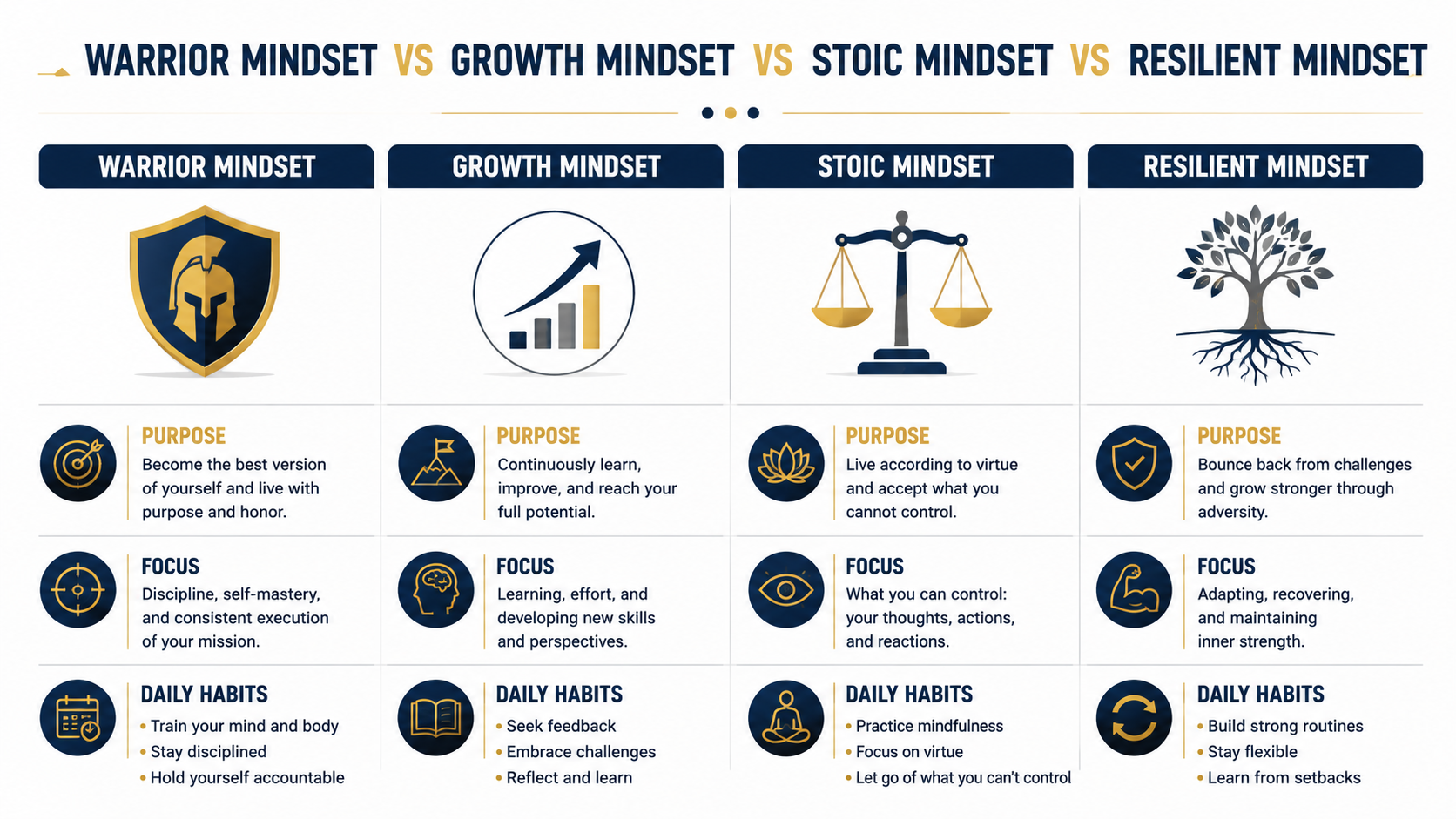
| Factor | Warrior Mindset | Growth Mindset | Stoic Mindset | Resilient Mindset |
|---|---|---|---|---|
| Purpose | Perform consistently under pressure | Improve ability through effort | Maintain inner calm despite externals | Recover quickly from adversity |
| Focus | Action and discipline | Learning and skill development | Perception and judgment | Recovery and adaptation |
| Emotional response | Controlled, purposeful | Curious, open to failure | Detached, unmoved by externals | Steady, adaptive |
| Decision-making | Structured, pre-planned | Experimental | Rational, value-based | Flexible, situational |
| Daily habits | Routines, accountability | Practice and feedback-seeking | Reflection, self-examination | Coping strategies, adjustment |
| Long-term goal | Sustained high performance | Skill mastery | Peace of mind | Sustainable stability |
These mindsets overlap significantly and are often used together rather than in isolation — a warrior mindset, for example, frequently incorporates stoic reflection and growth-mindset feedback loops.
How to Build a Warrior’s Mindset
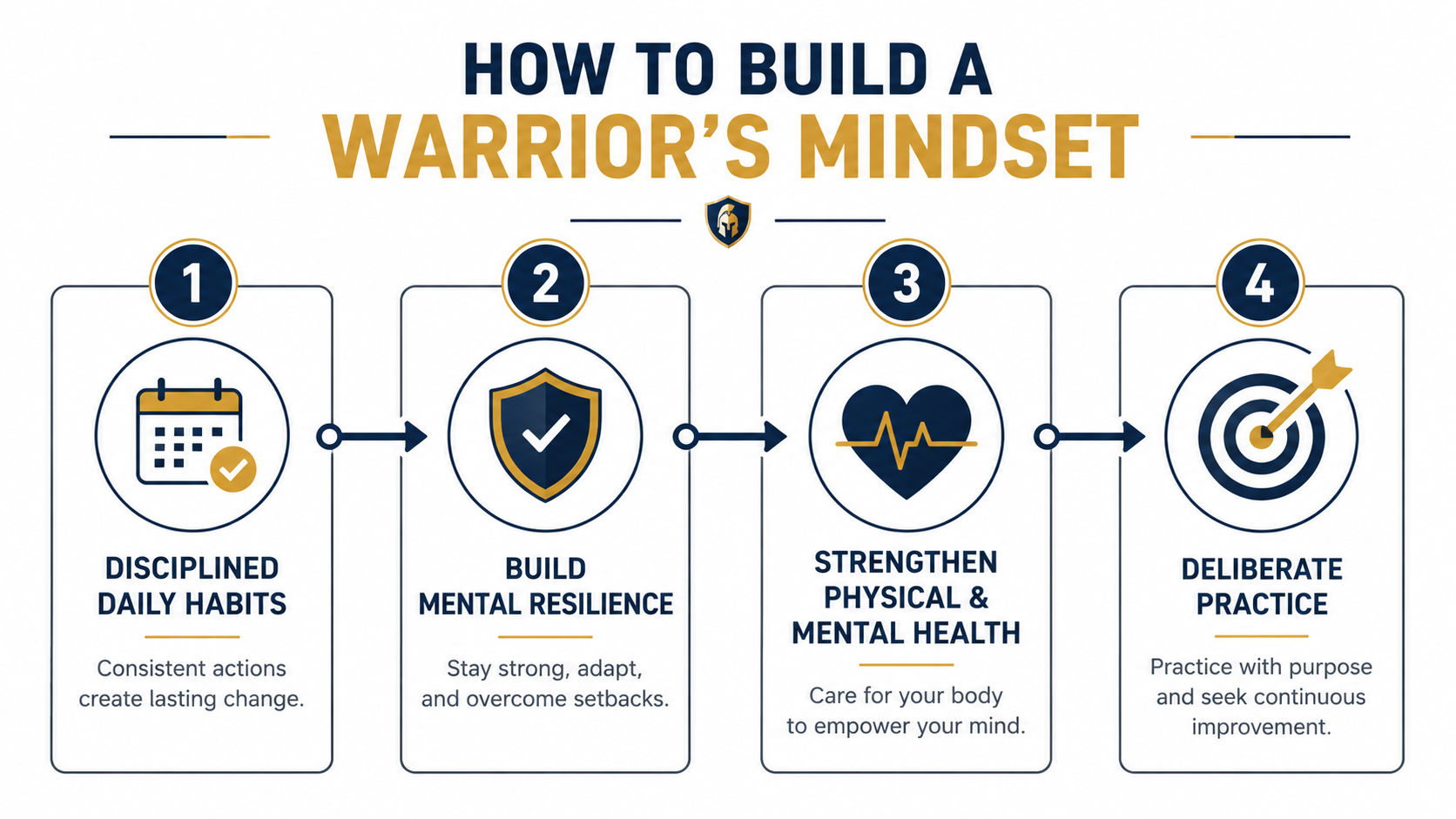
Develop disciplined daily habits
- Establish a consistent morning routine
- Plan the day the night before
- Prioritize consistency over intensity
- Use habit stacking to attach new behaviors to existing ones. If you’re starting from scratch, our guide on how to build good habits in 30 days breaks this process into a simple, structured plan.
Build mental resilience
- Practice reframing setbacks as data, not failure
- Gradually increase exposure to manageable stress
- Train emotional control through breathing or mindfulness techniques
Strengthen physical and mental health
Physical state directly affects mental performance. Key areas include:
- Exercise — builds stress tolerance and discipline
- Sleep — restores emotional regulation and focus
- Nutrition — stabilizes energy and mood
- Recovery — prevents long-term burnout
- Mindfulness — improves present-moment awareness under pressure
Learn through deliberate practice
- Seek specific, actionable feedback
- Reflect after key events or setbacks
- Repeat skills with focused attention, not passive repetition
- Track improvement over time to reinforce the growth cycle
Common Challenges When Developing a Warrior’s Mindset
Depending too much on motivation
Motivation fades because it’s tied to emotion and novelty, both of which are temporary. Systems and routines matter because they don’t require an emotional trigger to function. Replacing motivation with habits means scheduling actions at fixed times so they happen automatically.
Fear of failure
Fear of failure often stems from treating outcomes as identity statements rather than information. A practical solution is separating self-worth from results and defining success by effort and consistency instead of outcome alone.
Perfectionism
Perfectionism delays progress by treating “good enough” as unacceptable, which increases procrastination and decision fatigue. Warrior-mindset training favors imperfect, consistent action over flawless, delayed action.
Burnout from overcommitting
Sustainable performance requires planned recovery, not just intensity. Preventing burnout involves scheduling rest as deliberately as effort, and recognizing early warning signs like declining focus or irritability.
Beginner Mistakes to Avoid
- Confusing toughness with emotional suppression — genuine resilience includes processing emotions, not ignoring them
- Ignoring recovery — treating rest as optional undermines long-term consistency
- Seeking quick results — mindset change happens gradually, not overnight
- Comparing yourself with others — progress is individual and context-dependent
- Chasing motivation instead of discipline — waiting to “feel ready” delays action indefinitely
- Neglecting self-awareness — without reflection, the same mistakes repeat
Practical Ways to Apply the Warrior’s Mindset in Daily Life
Students
Applying discipline to learning means setting fixed study blocks, breaking large assignments into smaller tasks, and treating academic setbacks as feedback rather than failure.
Professionals
Handling workplace pressure involves staying composed during conflict, taking ownership of mistakes, and maintaining consistent output regardless of daily energy levels.
Entrepreneurs
Managing uncertainty and setbacks requires tolerating ambiguity, adjusting strategy quickly, and separating self-worth from short-term business outcomes.
Athletes
Improving performance consistency depends on following structured training plans, managing pre-competition stress, and reviewing performance objectively after each event.
Personal growth
Building healthier habits and stronger relationships comes from applying the same principles — discipline, accountability, and emotional regulation — to everyday interactions and routines, not just high-stakes moments.
Difficulty & Time Investment
Building a warrior’s mindset is beginner-friendly at the habit level but requires ongoing effort to maintain. Typical starting points include establishing one or two consistent daily habits, such as a fixed wake time or a short reflection practice, before adding complexity.
- Beginner-friendly starting points: single daily habit, short reflection routine
- Typical effort required: 15–30 minutes daily for foundational practices
- Daily commitment: consistency matters more than duration
- Factors affecting progress: existing stress levels, support systems, prior habit experience
- Individual differences: people with more established routines often progress faster than those starting from an unstructured lifestyle
Results Timeline
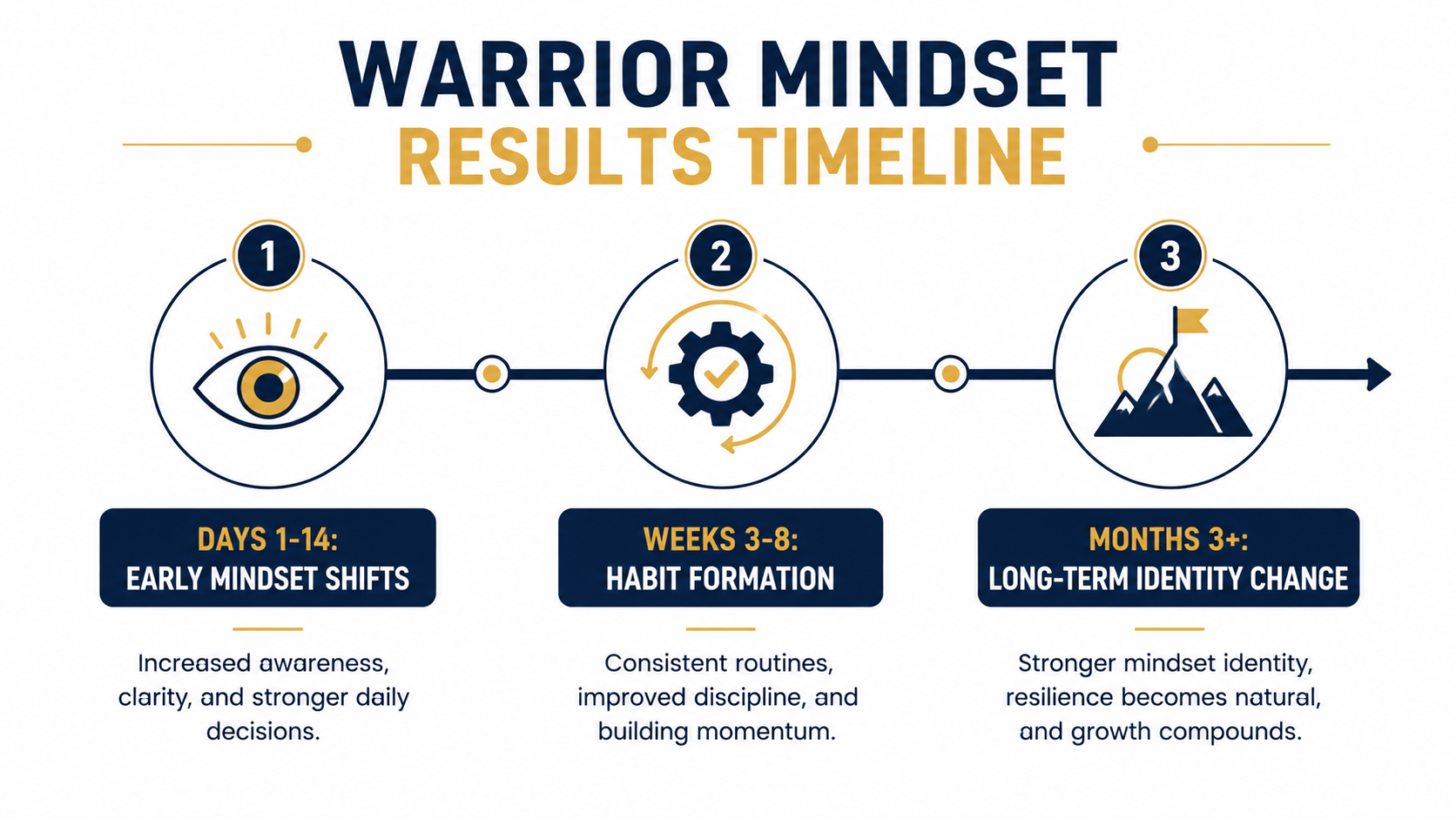
Mindset shifts typically unfold in stages rather than all at once.
- Early mindset shifts (days 1–14): increased self-awareness, more intentional reactions to stress
- Habit formation (weeks 3–8): routines start to feel automatic rather than effortful
- Long-term identity change (months 3+): discipline and resilience become a stable part of self-concept rather than a conscious effort
- Factors influencing speed: consistency, environment, accountability, and the complexity of habits being built
Daily Practice Guide
- Daily routines — fixed wake time, planning session, and a recovery-focused wind-down
- Weekly reflection — reviewing wins, setbacks, and adjustments needed
- Journaling — recording decisions, emotional responses, and lessons learned
- Goal tracking — measuring progress against specific, defined targets
- Accountability — using a coach, mentor, or peer to reinforce follow-through
- Managing setbacks — treating failure as scheduled feedback, not a stopping point
- Maintaining long-term consistency — building in recovery periods to prevent burnout
Common Misconceptions About the Warrior’s Mindset
- It is not about aggression. The core focus is composure and discipline, not dominance.
- It is not only for soldiers or athletes. It applies to students, professionals, and anyone managing daily pressure.
- It is not emotionless living. Emotional regulation is not the same as emotional suppression.
- It is not constant productivity. Recovery and rest are treated as necessary components, not weaknesses.
- It values balance alongside discipline. Sustainable performance requires both structure and recovery.Frequently Referenced Books and Frameworks
Popular books discussing the warrior mindset
Numerous authors, coaches, and psychologists have written about discipline, resilience, and mental performance from different angles — ranging from stoic philosophy and military leadership memoirs to sports psychology and habit-formation research. These works generally converge on similar themes: consistency outperforms intensity, emotional control is trainable, and long-term identity change comes from repeated small actions rather than singular decisions.
Different interpretations of the warrior mindset
Military authors often frame the concept around discipline under extreme stress, while martial artists emphasize humility and lifelong technical mastery. Sports psychologists tend to focus on performance consistency, and business authors typically apply the framework to leadership resilience and strategic patience. Despite these differences, all interpretations share a common foundation: structured habits, emotional regulation, and continuous improvement.
Conclusion
The warrior’s mindset is not a personality trait or a single moment of bravery — it’s a trainable set of habits built on discipline, accountability, resilience, and continuous performance improvement. Across military training, martial arts, sports, and business, the same core pattern holds: sustainable success comes from consistent, structured action rather than short bursts of motivation. Readers looking to build a warrior’s mindset should focus on small, repeatable habits, honest self-reflection, and planned recovery rather than chasing intensity or perfection. Over time, these consistent actions compound into lasting mental strength and long-term success.
Frequently Asked Questions
What is the warrior’s mindset in simple terms?
The warrior’s mindset is a trained mental approach focused on discipline, resilience, and consistent performance under pressure, rather than raw aggression or natural talent.
How is a warrior’s mindset different from a growth mindset?
A warrior’s mindset centers on disciplined action and emotional control under pressure, while a growth mindset centers on the belief that abilities can be developed through effort and learning.
Can anyone develop a warrior’s mindset?
Yes. It’s built through consistent habits, self-reflection, and deliberate practice, not through innate personality traits or specific professions.
Why is discipline more effective than motivation?
Discipline relies on pre-planned action that doesn’t depend on emotional state, while motivation is temporary and fluctuates based on mood, energy, and circumstances.
What daily habits help build a warrior’s mindset?
Consistent wake times, daily planning, reflection or journaling, physical exercise, and structured recovery all support the development of a warrior’s mindset.
Is the warrior’s mindset only for athletes or military professionals?
No. It applies equally to students, professionals, entrepreneurs, and anyone managing everyday pressure or long-term goals.
How long does it take to develop a warrior mindset?
Initial mindset shifts can appear within the first two weeks, habits typically stabilize within two months, and long-term identity change generally develops over several months of consistent practice.
What are the biggest mistakes beginners make when developing a warrior mindset?
Common mistakes include confusing toughness with emotional suppression, ignoring recovery, seeking quick results, comparing progress to others, and relying on motivation instead of discipline.