

Introduction
Abundance mindset dating is the belief that one disappointing interaction, one rejection, or one unavailable person does not determine someone’s entire romantic future. It is not the same as superficial “there are plenty of fish in the sea” advice, which often minimizes real emotional experiences. Healthy abundance connects mindset to self-worth, choice, boundaries, rejection, and emotional resilience. Understanding abundance mindset dating meaning starts with recognizing that romantic opportunity is not fixed to a single outcome — a shift that shapes how people interpret abundance mindset examples throughout everyday dating life. The practical question this article addresses is simple: how can someone become more open and confident in dating without becoming detached or treating relationships as disposable?
Quick Summary
- Abundance mindset dating means believing that a single person or outcome does not determine your chances of finding a fulfilling relationship.
- It encourages openness, self-worth, healthy boundaries, and the ability to accept rejection without interpreting it as proof that you are unlovable.
- A scarcity mindset tends to create fear, overattachment, comparison, and pressure; an abundance mindset supports choice, patience, and emotional flexibility.
- Developing this mindset involves changing unhelpful beliefs, expanding your life beyond dating, and practicing healthier responses to uncertainty and rejection.
What Does an Abundance Mindset Mean in Dating?
An abundance mindset in dating means believing that romantic possibility is not limited to one person or one outcome, while still respecting the reality that not everyone has equal access to dating opportunities. It is a psychological framework centered on personal agency, not an assumption of unlimited romantic options.
What does abundance mindset dating actually mean?
The core belief is that romantic opportunity is not confined to a single person or a single chance. This is different from entitlement, which assumes someone deserves a particular outcome. Abundance is grounded in self-worth: a person’s value does not rise or fall based on whether one specific relationship succeeds. Importantly, abundance does not guarantee a relationship or eliminate the possibility of rejection — it changes how rejection is interpreted, not whether it happens.
What does an abundance mindset look like emotionally?
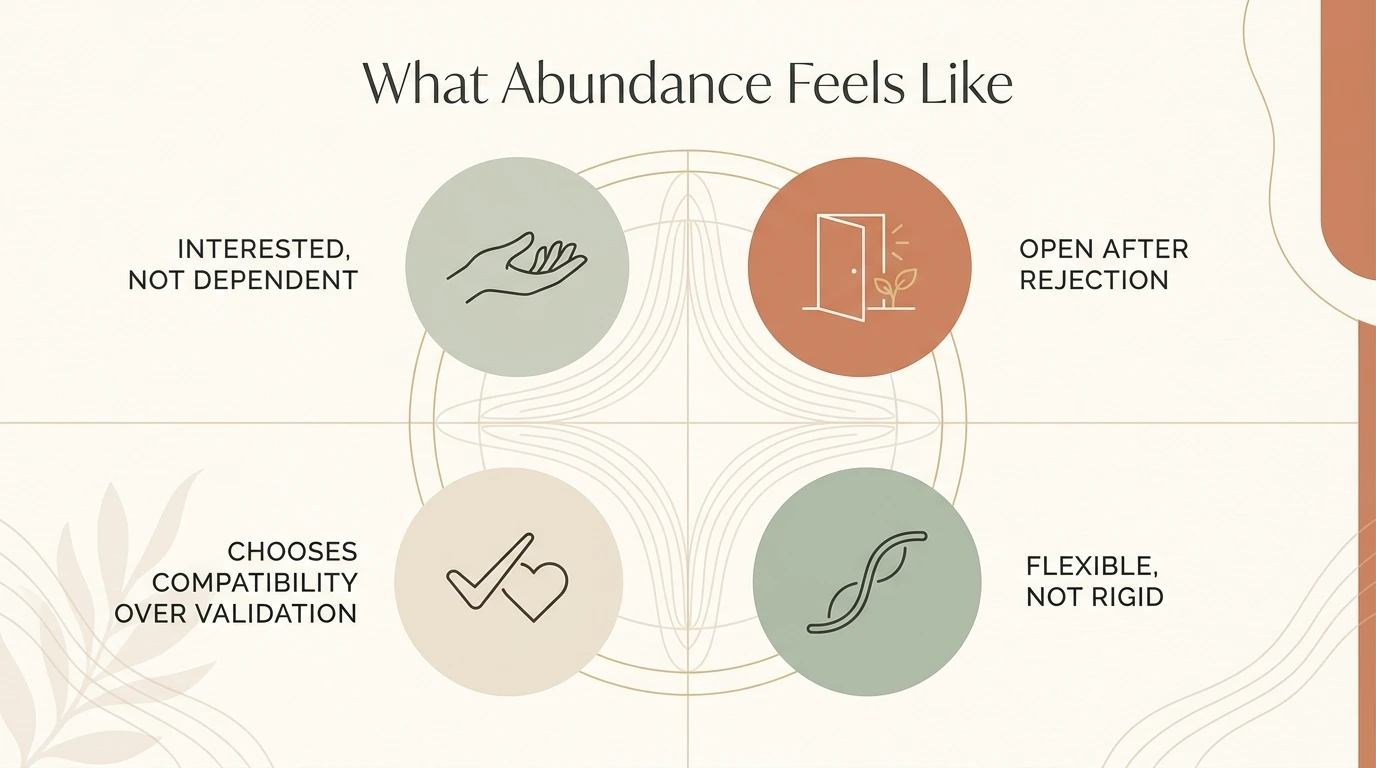
- Being interested in someone without becoming immediately dependent on the outcome.
- Remaining open to connection after experiencing rejection.
- Choosing partners based on compatibility rather than seeking validation.
- Maintaining personal standards while staying flexible about how and where relationships develop.
Abundance mindset vs. toxic positivity
The phrase “there are always more people” can become emotionally dismissive if it is used to bypass genuine disappointment. Realistic optimism differs from pretending rejection does not hurt. A healthy abundance mindset coexists with grief, disappointment, and emotional attachment — it does not require suppressing those feelings to appear unaffected.
Scarcity Mindset vs. Abundance Mindset in Dating
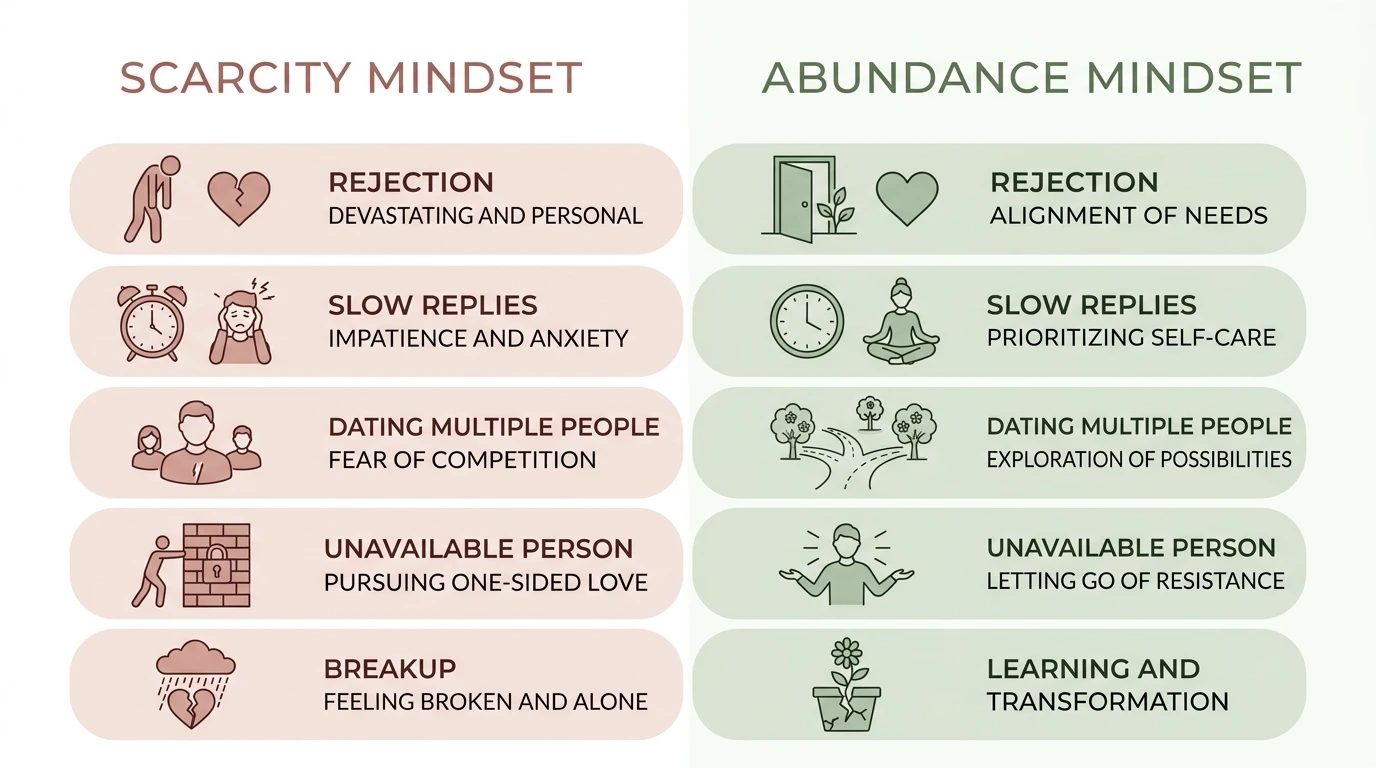
Scarcity mindset in dating is the belief that romantic opportunities are limited, which tends to produce fear-based decision-making. Abundance mindset counters this by supporting evaluation, patience, and self-respect in dating choices.
How scarcity thinking affects dating behavior
- Fear of losing a particular person, even early in the connection.
- Overanalyzing message timing, wording, or delays.
- Accepting poor treatment because alternatives feel unavailable.
- Becoming overly focused on comparison or competition with others.
- Treating rejection as evidence of personal inadequacy. If you recognize these patterns in yourself, our full breakdown of scarcity mindset in dating explains where this fear-based thinking comes from and how it develops.
How abundance thinking changes decision-making
- Evaluating compatibility instead of trying to secure any available relationship.
- Communicating interest clearly without applying excessive pressure.
- Recognizing that attraction is mutual rather than something to be won.
- Walking away from unhealthy dynamics when necessary.
Recommended comparison table
| Dating Situation | Scarcity Mindset | Abundance Mindset |
|---|---|---|
| Rejection | “Something is wrong with me.” | “This connection wasn’t right for both of us.” |
| Slow replies | Immediate fear of losing them | Allowing reasonable space and context |
| Dating multiple people | Competition and comparison | Learning about compatibility while respecting boundaries |
| Unavailable person | Trying harder to change the outcome | Accepting their lack of availability |
| Breakup | “I’ll never find someone again.” | “This relationship mattered, but it isn’t my only possibility.” |
Abundance Mindset Dating Examples in Real-Life Situations
After being rejected
A scarcity response involves obsessing over what went wrong and replaying the interaction repeatedly. An abundance response acknowledges disappointment honestly while continuing daily life and remaining open to meeting people naturally.
When someone stops showing interest
Chasing repeated reassurance rarely resolves genuine disinterest. Mutual interest is necessary for a healthy connection, so attention is better redirected toward compatible connections and personal priorities rather than trying to reignite one-sided interest.
When you really like one person
Staying emotionally grounded does not mean pretending not to care. In our experience helping readers build better relationship habits, the people who navigate strong attraction most successfully are those who maintain friendships, hobbies, work, and routines rather than making one person responsible for their entire emotional future.
When dating feels slow
A temporary lack of opportunities is different from a permanent belief that nobody is interested. Environmental factors — social circle, location, lifestyle, and dating habits — often explain slow periods better than self-worth does. The more useful focus is expanding opportunities rather than forcing outcomes.
After a breakup
Allowing time for emotional recovery matters more than immediately replacing the relationship. One relationship’s failure is not a reliable prediction of future relationships. Extracting lessons from the experience is useful; turning it into a judgment about personal worth is not.
How to Have an Abundance Mindset in Dating
Building an abundance mindset in dating relies on behavior and thought patterns, not affirmations alone. This is closely tied to letting go of expectations — staying present with a connection instead of attaching to a specific future outcome.
Stop treating one romantic outcome as your only opportunity
Identify all-or-nothing thoughts such as “this is my only chance,” and replace them with more realistic possibilities. Separate strong attraction from actual long-term compatibility.
Build a life that is not dependent on romantic validation
Maintaining friendships and social connections, investing in work, learning, and physical activity, and developing sources of meaning outside romantic attention all reduce the pressure placed on any single dating outcome.
Focus on compatibility rather than being chosen
Ask whether you genuinely like the person, not only whether they like you. Assess shared values, communication style, emotional availability, and relationship goals. Dating works best when treated as mutual evaluation rather than a one-sided audition.
Practice healthy emotional detachment
Detachment is different from indifference. Staying present without prematurely predicting the relationship’s future allows connections to develop at an appropriate pace instead of being rushed by anxiety.
Keep standards without becoming rigid
Distinguish non-negotiable values from superficial preferences. Avoid lowering standards out of fear of being alone, but also avoid rejecting potentially compatible people because they do not fit an unrealistic ideal.
How to Develop an Abundance Mindset Over Time
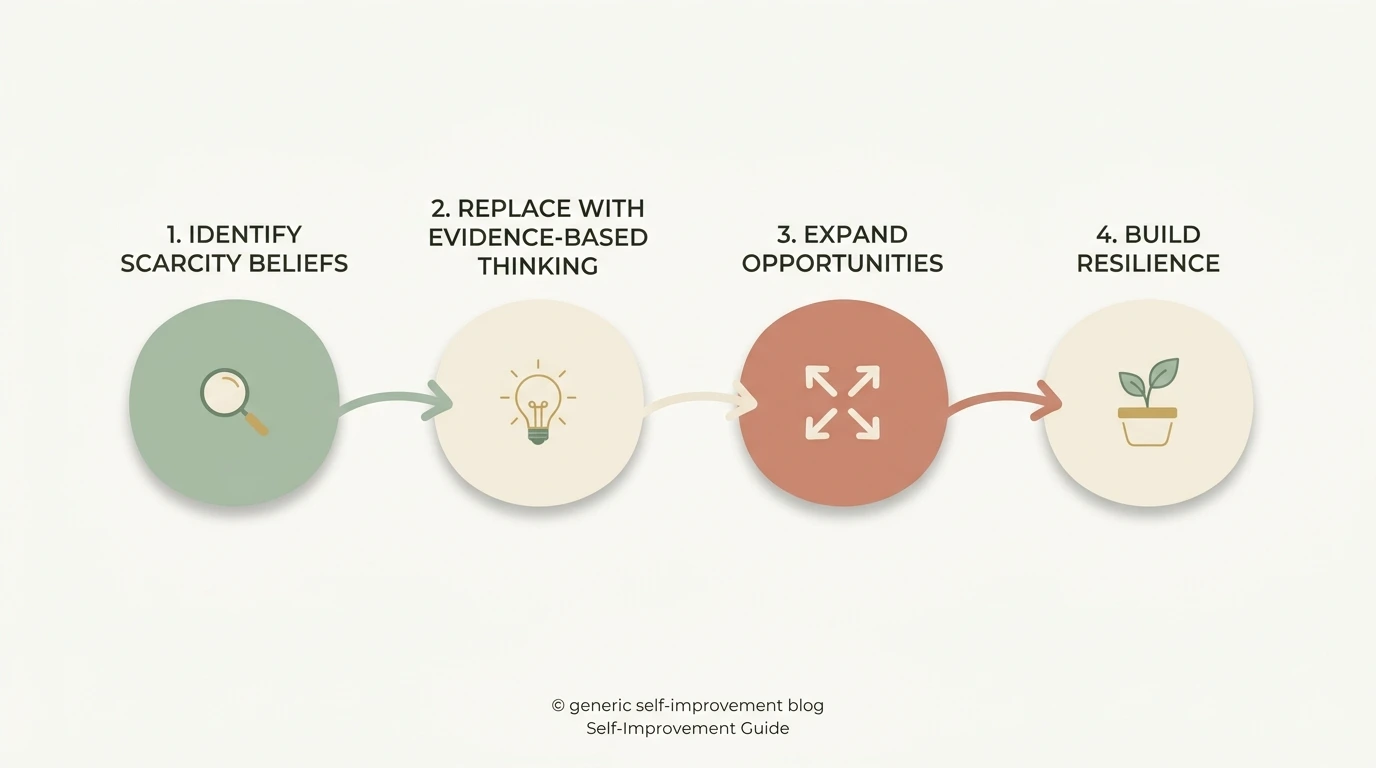
Developing an abundance mindset is a form of self-improvement that builds gradually through habit formation, resilience, and self-awareness rather than a single decision.
Identify scarcity beliefs
Common scarcity beliefs worth examining include:
- “I’ll never find someone like this again.”
- “If this person rejects me, nobody will want me.”
- “I have to make this relationship work.”
- “Everyone else has more options than I do.”
Replace absolute predictions with evidence-based thinking
Separating facts from assumptions helps prevent one interaction from being treated as a permanent pattern. Flexible, realistic statements are more sustainable than forced positive affirmations.
Expand opportunities without turning dating into a numbers game
Strengthening social networks, trying different social environments, pursuing personally meaningful activities, and remaining open to meeting people through varied contexts all support abundance without reducing dating to volume alone.
Build resilience through repeated healthy experiences
Learning from rejection, practicing initiating conversations, and becoming comfortable with uncertainty all build resilience over time. Tracking behavioral patterns is more useful than obsessing over individual outcomes.
Common Mistakes When Trying to Use an Abundance Mindset
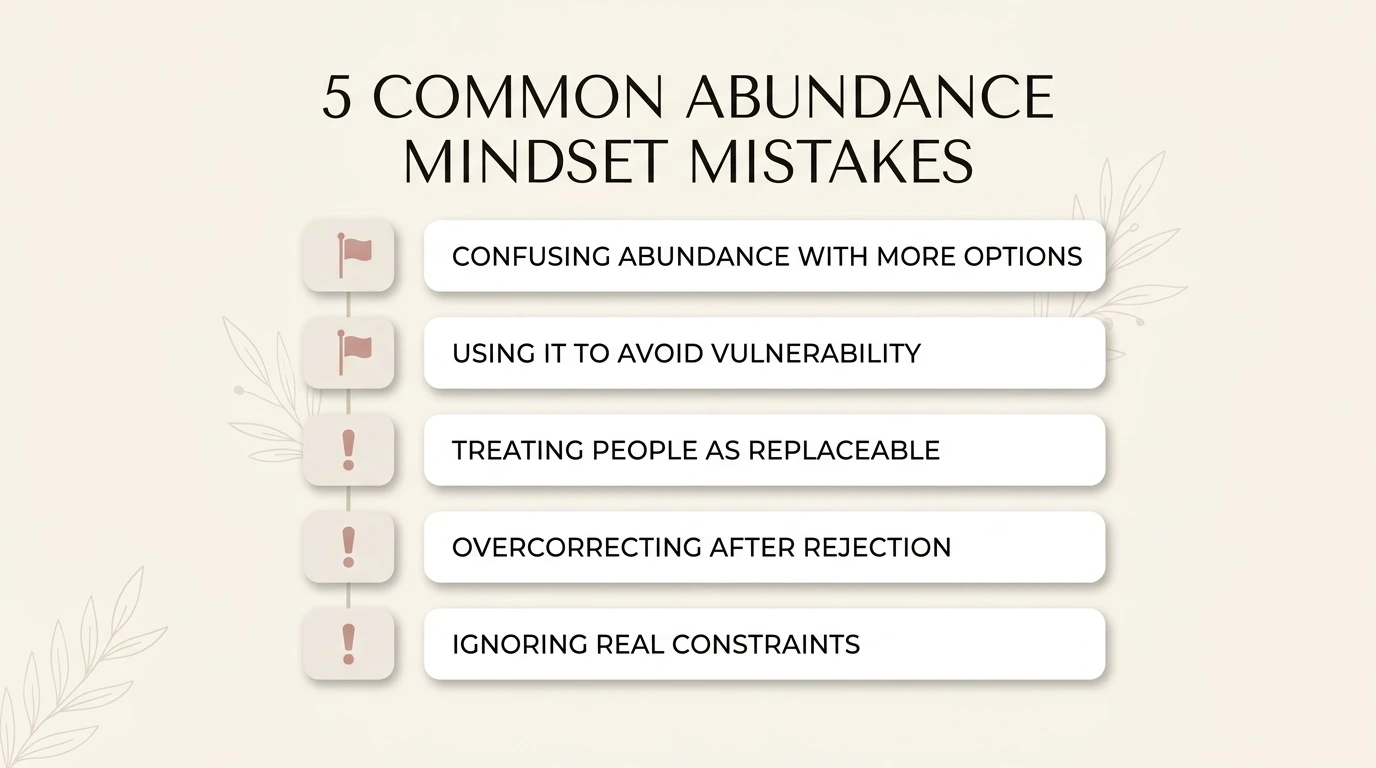
Mistaking abundance for having many dating options
The number of matches or dates someone has does not determine whether they hold an abundance mindset. Quality, compatibility, and autonomy matter more than volume.
Using abundance to avoid emotional vulnerability
The phrase “I don’t need anyone” can become a form of emotional avoidance rather than genuine confidence. Healthy abundance allows real attachment to develop without dependency taking over.
Treating people as replaceable
There is an important ethical difference between recognizing that future possibilities exist and viewing current partners as interchangeable. Abundance mindset dating still requires honesty, respect, and clear communication with the people involved.
Overcorrecting after rejection
Immediately dating someone new does not always resolve the underlying emotional response to a rejection. Appropriate processing and recovery time supports longer-term emotional stability.
Ignoring genuine dating constraints
Age, location, social environment, relationship goals, cultural expectations, and available opportunities are real factors. Mindset can influence behavior and interpretation, but it does not eliminate external limitations.
Does an Abundance Mindset Mean Dating Multiple People?
An abundance mindset is a psychological framework, while dating multiple people is a behavioral choice — the two are not automatically the same thing.
Abundance mindset vs. having multiple dating options
It is possible to hold an abundance mindset while dating only one person at a time. Conversely, someone can date many people while still operating from insecurity or scarcity. The underlying mindset matters more than the number of people someone is dating.
When dating multiple people can become unhealthy
- Using people primarily for validation.
- Creating unnecessary comparison between people.
- Avoiding commitment because alternatives always seem available.
- Failing to communicate expectations or exclusivity clearly.
How Abundance Mindset Affects Rejection, Attachment, and Boundaries
Handling rejection without making it personal
Rejection can reflect compatibility, timing, personal preferences, or circumstances rather than a person’s inherent worth. There is a meaningful difference between experiencing rejection and defining yourself by it. Knowing when to walk away from a relationship is often the clearest sign that abundance, not fear, is guiding the decision.
Avoiding anxious overinvestment
Recognizing early signs of becoming excessively focused on one person — checking their activity repeatedly, canceling other plans, or basing daily mood on their responses — helps preserve balance. Maintaining normal routines and relationships allows reciprocity, rather than anxiety, to guide emotional investment.
Using boundaries to protect self-respect
Inconsistent treatment should not be accepted simply because alternatives feel scarce. Stepping back is sometimes healthier than continuing to pursue a connection. Abundance mindset dating supports both openness and standards at the same time.
Abundance Mindset Dating for Different Situations
For someone who has been single for a long time
A long period of being single is not proof that future relationships are impossible. Identifying realistic ways to expand social and dating opportunities is more productive than treating time alone as a verdict on desirability.
After a difficult breakup
Grief and beliefs about future romantic possibilities are separate things. Recovery should not be rushed simply to prove an abundance mindset is in place.
For someone who becomes attached quickly
Slowing down assumptions about the future, focusing on observed behavior and mutual investment, and preserving independent routines and relationships all help balance quick attachment with realistic pacing.
For someone who struggles with dating opportunities
As of 2026, many readers report that shifting social environments — including local events, interest-based groups, and varied social settings — has a stronger effect on dating opportunities than mindset alone. Distinguishing mindset problems from genuine opportunity constraints, and focusing on controllable actions rather than self-blame, keeps expectations realistic.
Conclusion
Abundance mindset dating is fundamentally about recognizing that one romantic outcome does not determine a person’s worth or entire future. Scarcity thinking narrows decisions through fear, comparison, and overattachment, while abundance thinking supports evaluation, patience, and self-respect. Healthy abundance mindset dating combines openness with standards, vulnerability with boundaries, and optimism with realistic expectations. The goal is not to convince yourself that endless romantic options exist, but to avoid letting fear of scarcity control your dating decisions.
FAQ
What is an abundance mindset in dating? An abundance mindset in dating is the belief that one relationship or outcome does not determine someone’s entire romantic future, distinguished from simply having many dating options by its focus on self-worth and compatibility rather than volume.
How do I know if I have a scarcity mindset in dating? Signs of scarcity thinking include fearing the loss of a specific person, overanalyzing delayed responses, accepting poor treatment due to a lack of perceived alternatives, and interpreting rejection as personal inadequacy.
How can I develop an abundance mindset in dating? Developing this mindset involves identifying scarcity beliefs, replacing absolute predictions with evidence-based thinking, expanding social opportunities, and building resilience through healthy boundaries and repeated positive experiences.
What are some examples of an abundance mindset in dating? Examples include remaining open after rejection instead of obsessing over what went wrong, maintaining routines and friendships when strongly attracted to someone, and viewing a breakup as significant without predicting future relationships will fail.
Is an abundance mindset the same as dating multiple people? No. Mindset and dating behavior are separate concepts — someone can hold an abundance mindset while dating one person, and someone can date multiple people while still operating from scarcity or insecurity.
Can an abundance mindset help with rejection? Yes. It can reduce catastrophic interpretations of rejection, such as assuming personal inadequacy, while still acknowledging that rejection can be genuinely painful and worth processing.
Does an abundance mindset mean I should stop caring about someone? No. Emotional detachment, which involves staying grounded and not prematurely predicting outcomes, is different from emotional indifference, which involves suppressing genuine care or attachment.
How is an abundance mindset different from a scarcity mindset in dating? Abundance mindset supports evaluation, patience, and self-respect based on belief in ongoing possibility, while scarcity mindset drives fear-based decisions, overattachment, and treating rejection as proof of personal inadequacy.