

Introduction
An elevate mindset is a way of thinking that prioritizes continuous learning, resilience, adaptability, and intentional personal growth. Rather than relying on short bursts of motivation, someone who chooses to elevate their mindset builds thought patterns and habits that support steady improvement over time. An elevated mindset shapes how a person interprets setbacks, approaches challenges, and makes decisions in daily life. Understanding the elevate mindset meaning is the first step toward applying it practically. This article explains the concept in depth and outlines specific, actionable ways to strengthen it.
Quick Summary
- An elevate mindset focuses on growth, learning, and responding positively to challenges.
- Developing an elevated mindset involves changing thought patterns, habits, and daily actions over time.
- Small, consistent improvements often produce greater long-term results than occasional motivation.
- Anyone can strengthen their mindset through intentional practice, reflection, and resilience.
What Does “Elevate Mindset” Mean?
Elevate Mindset Meaning
The elevate mindset meaning refers to the deliberate process of shifting how a person thinks, reacts, and grows in response to life’s demands. It is not a single event but an ongoing practice of choosing growth-oriented thoughts over limiting ones. An elevated mindset meaning centers on progress rather than perfection — the goal is consistent improvement, not flawless performance.
This concept differs from temporary motivation in an important way. Motivation is often short-lived and dependent on mood or circumstance, while an elevate your mindset meaning approach is rooted in identity and habit. Mindset influences behavior because the way a person interprets a situation determines the emotional and behavioral response that follows. A person who views a difficult task as a learning opportunity will approach it differently than someone who views the same task as a threat to their self-worth. This is why mindset, more than raw willpower, tends to predict long-term behavior and decision-making patterns.
Elevate Mindset Meaning in Hindi
For readers searching elevate mindset meaning in hindi, the concept translates conceptually to “अपनी सोच को ऊँचा उठाना” — raising or uplifting one’s way of thinking. Rather than a literal word-for-word translation, the elevated mindset meaning in hindi is best understood as a conscious shift toward positive, growth-focused thinking The core idea remains the same across languages: an elevate your mindset meaning approach is about intentionally choosing thoughts and habits that support long-term growth rather than reacting passively to circumstances.
Why an Elevated Mindset Matters
Mindset plays a measurable role in how people experience and respond to everyday life. An elevated mindset influences:
- Personal growth — encourages continuous self-improvement rather than stagnation
- Confidence — builds self-trust through repeated evidence of capability
- Learning ability — supports openness to new information and skills
- Decision-making — reduces impulsive or fear-based choices
- Emotional resilience — helps individuals recover more effectively from setbacks
- Productivity — sustains focus and follow-through on goals
- Long-term success — compounds small daily improvements into significant results over time Mindset plays a measurable role in how people experience and respond to everyday life — which is exactly why growth mindset is considered so important in personal development and psychology
These effects are not isolated; they interact. For example, improved emotional resilience often leads to better decision-making, which in turn strengthens confidence.
Characteristics of an Elevated Mindset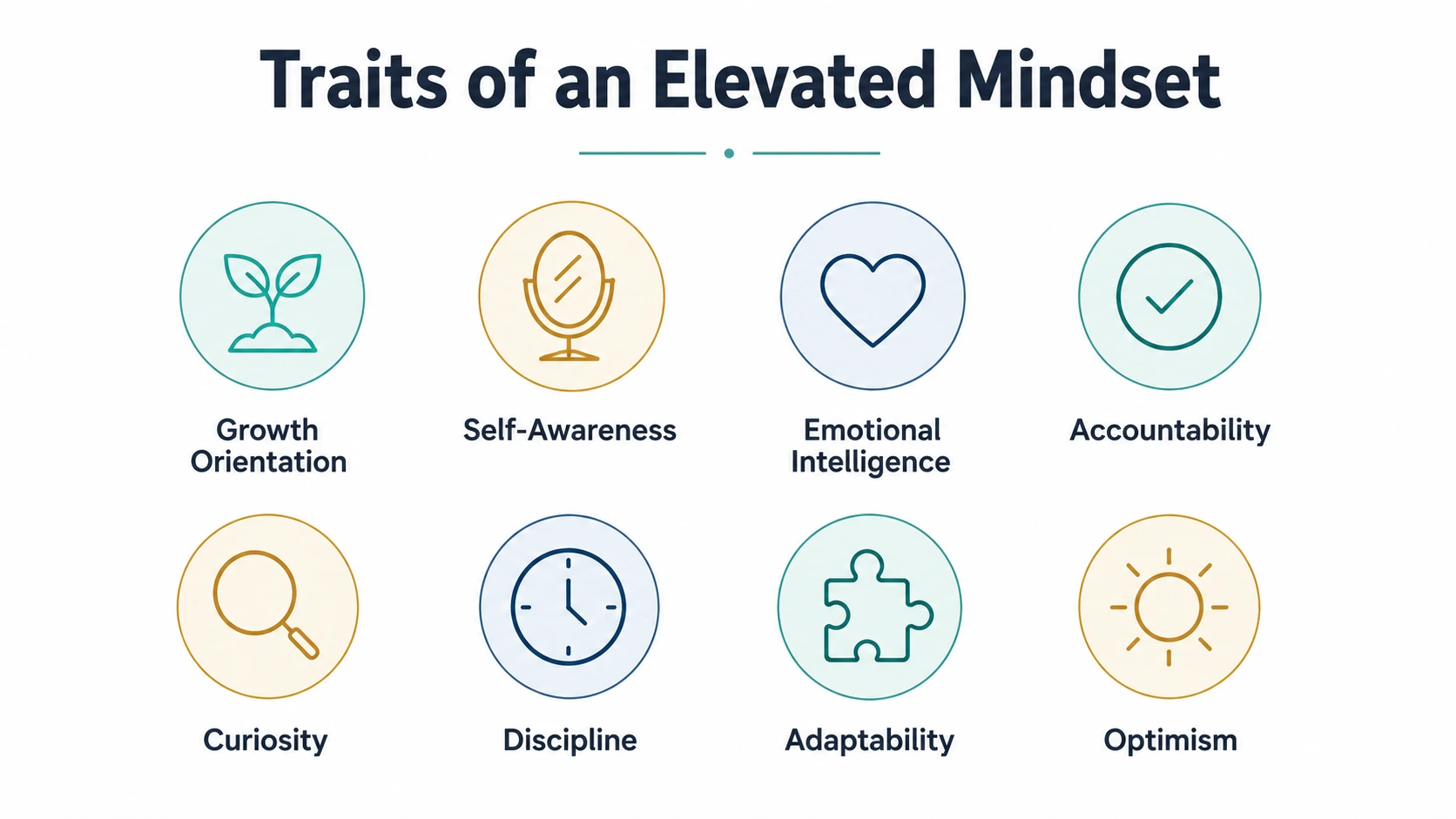
People with an elevated mindset tend to share several observable traits:
- Growth orientation — they see abilities as capable of development through effort
- Self-awareness — they recognize their own thought patterns and triggers
- Emotional intelligence — they manage emotions constructively rather than reactively
- Accountability — they take ownership of outcomes instead of assigning blame
- Curiosity — they actively seek new knowledge and perspectives
- Discipline — they maintain consistency even without external motivation
- Adaptability — they adjust their approach when circumstances change
- Optimism grounded in action — they combine a positive outlook with concrete steps, rather than passive hope
Elevated Mindset vs Fixed Mindset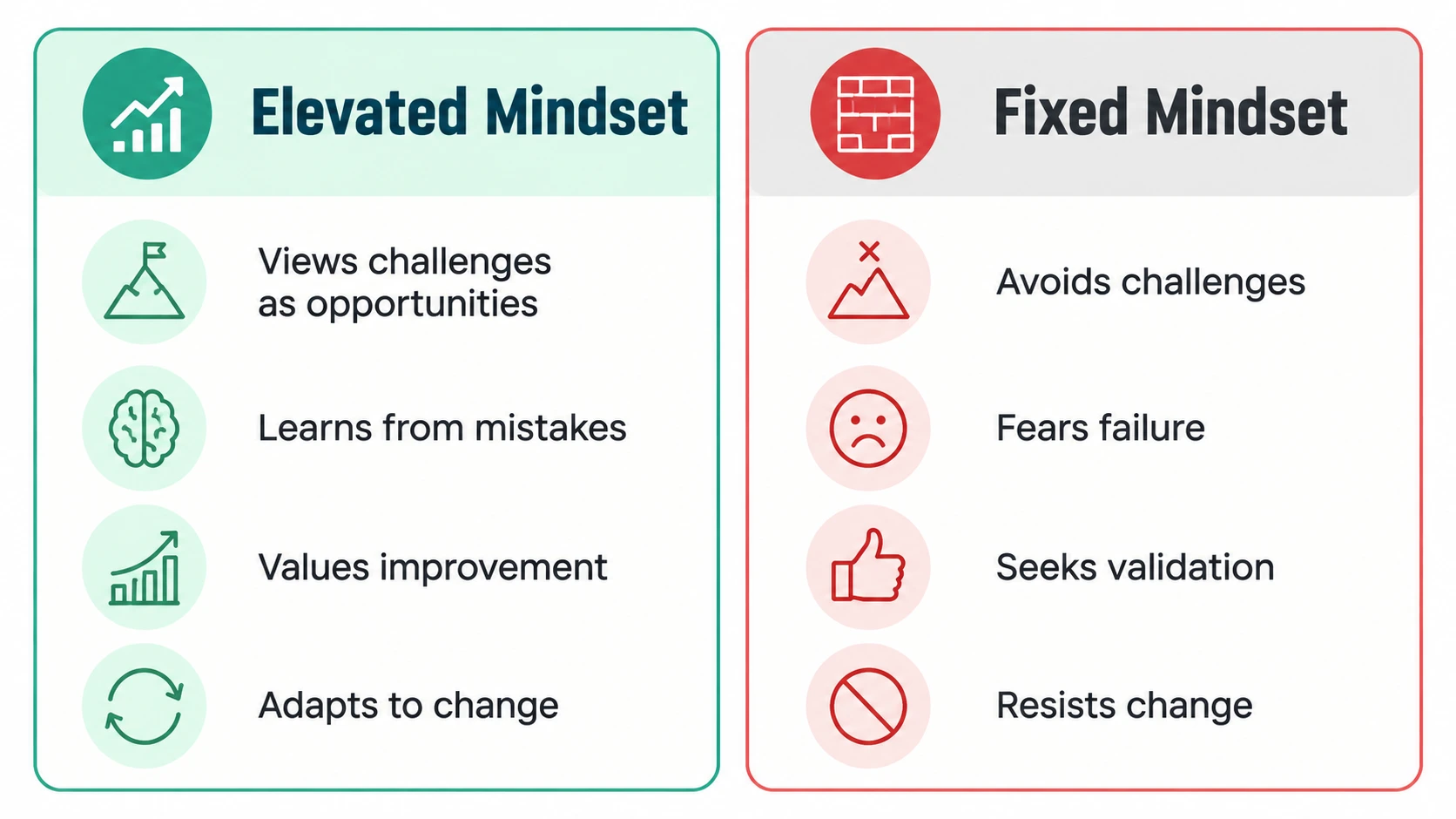
An elevated mindset and a fixed mindset lead to fundamentally different outcomes in how people approach challenges, mistakes, and change.
| Elevated Mindset | Fixed Mindset |
|---|---|
| Views challenges as opportunities | Avoids challenges |
| Learns from mistakes | Fears failure |
| Values improvement | Seeks validation |
| Adapts to change | Resists change |
In practical terms, these differences show up across major life areas. In learning environments, an elevated mindset supports curiosity and persistence, while a fixed mindset can lead to avoidance of difficult material. In careers, an elevated mindset encourages skill-building and adaptability during industry change, whereas a fixed mindset often results in resistance to feedback or new responsibilities. In relationships, an elevated mindset supports open communication and growth through conflict, while a fixed mindset can lead to defensiveness and stalled resolution.
How to Elevate Your Mindset
Develop Self-Awareness
Building an elevated mindset starts with recognizing existing thought patterns. This includes identifying limiting beliefs — such as assuming failure reflects fixed personal inadequacy rather than a normal part of learning — and noticing recurring negative thoughts that influence daily decisions. Journaling or simple daily reflection can help surface these patterns before they can be addressed.
Build Positive Daily Habits
Consistent habits reinforce mindset change more effectively than isolated efforts. Useful daily practices include: Journaling to track thoughts and progress — using structured journal prompts for growth mindset can make this practice easier to start and sustain.
- Journaling to track thoughts and progress
- Reading to expand knowledge and perspective
- Exercise to support mental clarity and discipline
- Meditation to build emotional regulation
- Gratitude practice to shift focus toward growth
- Reflection to reinforce lessons learned
Reframe Challenges
Reframing involves viewing setbacks as feedback rather than failure. This means extracting a specific lesson from a mistake instead of treating it as evidence of inability. Over time, this practice builds resilience, since each challenge becomes an input for improvement rather than a source of discouragement.
Set Meaningful Goals
Goal-setting connects mindset to measurable action. Effective goal-setting includes short-term goals that create immediate momentum, a long-term vision that provides direction, habit tracking to monitor consistency, and steady follow-through even when motivation fluctuates.
Common Obstacles That Prevent Mindset Growth
Several recurring obstacles can prevent mindset development:
- Fear of failure — often stems from associating mistakes with personal inadequacy; overcoming it requires reframing failure as information rather than identity.
- Negative self-talk — reinforces limiting beliefs; addressing it involves noticing and consciously replacing critical internal language.
- Comfort zone — avoiding challenge feels safe short-term but limits growth long-term; small, gradual exposure to discomfort helps build tolerance.
- Perfectionism — sets unrealistic standards that discourage action; shifting focus to progress over perfection reduces this barrier.
- Lack of confidence — often improves through small, repeated wins rather than waiting for confidence to appear first.
- Comparison with others — redirects focus away from personal progress; tracking individual growth instead of external benchmarks helps prevent this.
Beginner Mistakes When Trying to Elevate Your Mindset
Many people encounter setbacks early on due to a few common missteps:
- Expecting instant transformation — mindset shifts happen gradually, not overnight.
- Depending only on motivation — motivation fluctuates, while habits and systems remain consistent.
- Ignoring habits — understanding mindset concepts without applying daily habits limits real change.
- Comparing progress — measuring growth against others rather than personal history distorts perceived progress.
- Consuming information without taking action — learning about mindset is not the same as practicing it consistently.
Daily Practices That Strengthen an Elevated Mindset
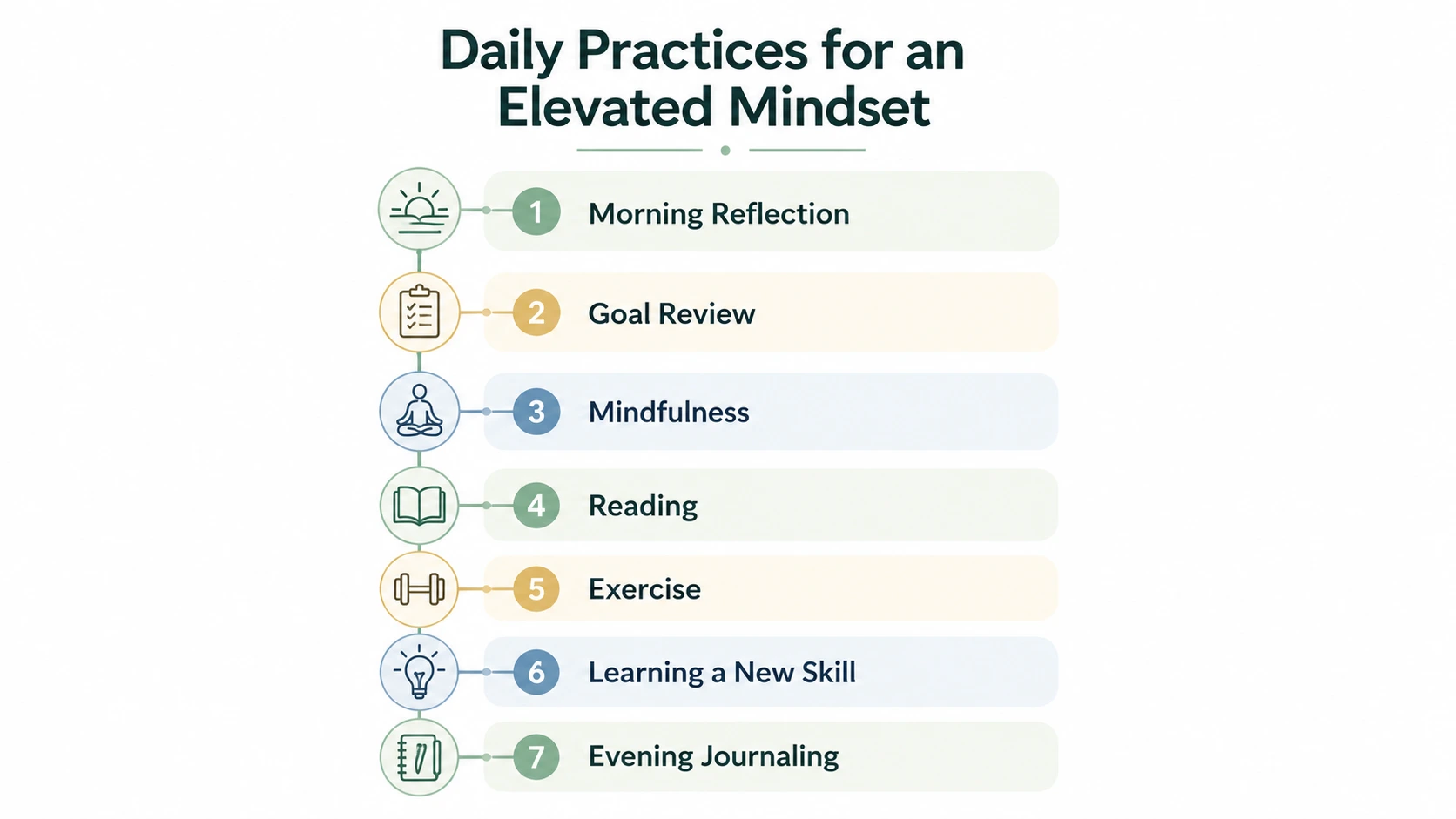
A consistent daily routine helps translate mindset concepts into lasting behavior. Useful practices include:
- Morning reflection to set intentions
- Goal review to maintain direction
- Mindfulness to manage stress and stay present
- Reading to reinforce learning
- Exercise to support mental and physical resilience
- Learning a new skill to reinforce growth orientation
- Evening journaling to process the day and identify lessons
How Long Does It Take to Develop an Elevated Mindset?
Difficulty & Time Investment
The effort required to elevate a mindset varies by individual. Beginners typically need more structured routines and reminders, while those with more experience in self-reflection often adapt more quickly. Lifestyle factors — such as available time, stress levels, and existing habits — influence how much effort mindset development requires. Consistency, more than intensity, tends to determine long-term success.
Results Timeline
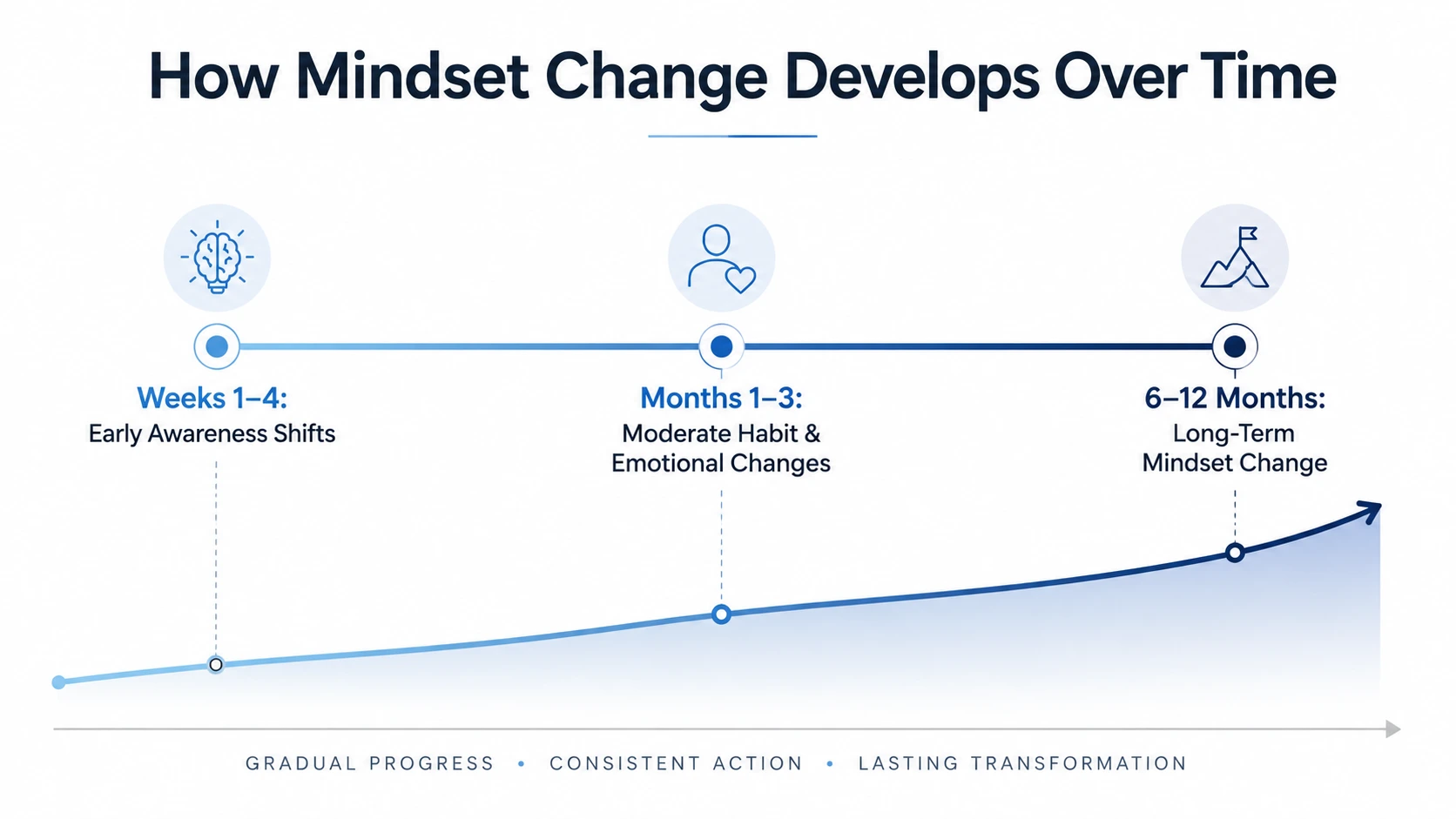
Most people notice small shifts in awareness and reaction within the first few weeks of consistent practice. Moderate improvements in habits and emotional regulation often develop over one to three months. More substantial, long-term changes in mindset and behavior typically take several months to a year of sustained practice. Progress pace is also affected by factors such as environment, stress levels, support systems, and individual consistency.
Practical Guide to Maintaining an Elevated Mindset
Maintaining an elevated mindset long-term requires ongoing structure rather than a one-time effort. Helpful practices include:
- Daily routines — anchoring mindset practices (reflection, gratitude, goal review) to consistent times of day
- Weekly reviews — assessing progress, adjusting goals, and identifying patterns
- Accountability methods — using a journal, tracker, or trusted person to maintain consistency
- Habit tracking — visually monitoring daily actions to reinforce follow-through
- Motivation strategies — relying on systems and routines rather than fluctuating motivation
- Sustainable long-term improvement — pacing changes to avoid burnout
- Adjustments for different lifestyles — modifying routines during busy periods, travel, or major life transitions
In our experience helping readers build better habits, the individuals who sustain an elevated mindset long-term are rarely the ones who start with the most intensity — they are the ones who build small, repeatable systems they can maintain even during difficult weeks.
Real-Life Situations Where an Elevated Mindset Helps
An elevated mindset provides practical advantages across many areas of life, including:
- Career development — supports adaptability during role changes and skill development
- Academic success — encourages persistence through difficult material
- Entrepreneurship — helps navigate uncertainty and repeated setbacks
- Leadership — supports clear decision-making and resilience under pressure
- Relationships — improves communication and constructive conflict resolution
- Health goals — sustains consistency in nutrition, exercise, and recovery routines
- Personal challenges — provides a framework for processing and learning from difficult experiences
Common Myths About Elevating Your Mindset
Several misconceptions can slow mindset development:
- “Positive thinking alone is enough.” Positive thinking supports mindset change but must be paired with consistent action to produce results.
- “Successful people never struggle.” Most successful individuals experience repeated setbacks; their mindset determines how they respond, not whether difficulty occurs.
- “Mindset changes overnight.” Mindset shifts are gradual and built through repeated practice, not a single decision.
- “Motivation is more important than discipline.” Discipline sustains progress during periods when motivation is low, making it a more reliable driver of long-term change. Discipline sustains progress during periods when motivation is low, making it a more reliable driver of long-term change — this is why learning how to build discipline without motivation matters more than chasing bursts of inspiration.
Different Approaches to Developing an Elevated Mindset
Different methods suit different personalities, goals, and starting points. Your Daily Thrive recommends exploring more than one approach to find what fits best.
| Approach | Best For | Main Focus |
|---|---|---|
| Growth mindset practices | Beginners | Learning |
| Reflective journaling | Self-awareness | Thinking patterns |
| Mindfulness | Stress management | Emotional regulation |
| Goal-oriented planning | Productivity | Consistent action |
No single approach works universally. Someone focused on stress management may benefit most from mindfulness practices, while someone working toward a specific goal may find structured, goal-oriented planning more effective.
Frequently Used Quotes About an Elevated Mindset
Inspirational elevate mindset quotes can serve as helpful reminders of growth-oriented thinking, particularly during moments of doubt or difficulty. However, quotes function best as prompts for reflection rather than as substitutes for action. Readers benefit most when they identify the underlying lesson in a quote and apply it to a specific daily habit or decision, rather than simply collecting motivational phrases without follow-through.
Resources for Continued Mindset Growth
Continued mindset development benefits from ongoing learning through varied resources, including:
- Books on psychology, behavioral science, and personal development
- Podcasts covering growth mindset and habit formation
- Educational articles that break down research-backed strategies
- Research studies on motivation, resilience, and behavior change
- Videos, including content available through platforms such as elevate mindset YouTube channels, which can supplement structured learning
As of 2026, many self-improvement resources emphasize evidence-based, small-habit approaches over broad motivational messaging, reflecting a wider shift toward sustainable, research-backed personal growth strategies. The most effective approach typically combines multiple resource types rather than relying on a single source.
Conclusion
An elevate mindset is best understood as an ongoing commitment to learning, resilience, and intentional growth rather than a one-time change. Understanding the elevate mindset meaning provides the foundation, but lasting results come from consistent daily habits, honest self-reflection, and a willingness to reframe setbacks as opportunities for improvement. Anyone can begin to elevate their mindset by choosing one small, consistent practice — such as daily journaling or goal review — and building on it steadily over time. Sustainable growth, not instant transformation, is what ultimately defines an elevated mindset.
Frequently Asked Questions (FAQs)
What does elevate mindset mean?
An elevate mindset refers to intentionally shifting thought patterns and habits toward continuous learning, resilience, and growth, rather than relying on temporary motivation.
How can I elevate my mindset every day?
Daily practices such as reflection, journaling, goal review, mindfulness, and reframing setbacks as learning opportunities help build an elevated mindset consistently over time.
What is the difference between an elevated mindset and a growth mindset?
An elevated mindset is a broader, ongoing approach to personal development that includes resilience and daily habits, while a growth mindset specifically refers to the belief that abilities can be developed through effort.
Can anyone develop an elevated mindset?
Yes, an elevated mindset can be developed by anyone through consistent self-awareness, habit-building, and intentional practice, regardless of starting point.
How long does it take to change your mindset?
Initial shifts in awareness often appear within a few weeks, moderate changes typically develop over one to three months, and substantial long-term change usually takes several months to a year of consistent practice.
Why is mindset important for personal success?
Mindset shapes how individuals interpret challenges and make decisions, which directly influences behavior, resilience, and long-term outcomes across career, health, and relationships.
What daily habits help strengthen an elevated mindset?
Effective daily habits include journaling, reading, exercise, meditation, gratitude practice, and evening reflection, all of which reinforce growth-oriented thinking over time.