

Introduction
A mindset makeover is the intentional process of changing habitual thought patterns, beliefs, and mental habits to improve decision-making, emotional resilience, behavior, and long-term personal growth. While many books, coaching programs, and online courses use this phrase, the underlying concept is grounded in established psychology, habit formation research, and cognitive science rather than any single branded method. A genuine mindset makeover is less about a one-time shift in attitude and more about building repeatable mental habits that hold up under real-life stress, setbacks, and change.
Quick Summary
- A mindset makeover involves replacing limiting beliefs with healthier, more accurate thinking patterns.
- Lasting change requires consistent habits, self-awareness, and behavioral reinforcement — not motivation alone.
- Different mindset makeover approaches focus on areas such as confidence, finances, health, or productivity.
- Sustainable results come from gradual, repeated practice rather than quick fixes or short bursts of willpower.
What Is a Mindset Makeover?
Definition and Meaning
A mindset makeover is the structured process of identifying, challenging, and replacing unhelpful thought patterns with beliefs and habits that better support a person’s goals. In psychology, a mindset refers to the set of beliefs and mental frameworks a person uses to interpret experiences, make decisions, and respond to challenges. From a behavioral perspective, mindset shapes the automatic thoughts that precede emotion and action, which is why changing it tends to produce downstream changes in behavior.
It’s useful to distinguish genuine mindset change from temporary motivation. A burst of enthusiasm after watching a video or reading a quote can shift mood for a day or two, but it rarely changes the underlying beliefs driving behavior. A true mindset makeover involves repeated practice that gradually rewires default thought patterns, which is a slower but far more durable process.
Why People Seek a Mindset Makeover
People typically pursue a mindset makeover in response to a specific area of life where their current thinking feels limiting. Common motivations include:
- Personal growth — wanting to feel more capable, self-aware, or fulfilled
- Career development — overcoming self-doubt, procrastination, or fear of visibility
- Relationships — shifting patterns of insecurity, conflict avoidance, or people-pleasing
- Health improvement — replacing all-or-nothing thinking with sustainable habits
- Financial confidence — addressing scarcity thinking or avoidance around money
- Stress management — reducing reactivity and building emotional regulation skills
How a Mindset Makeover Works
The Psychology Behind Changing Thought Patterns
Mindset change works by interrupting automatic thought-behavior cycles and replacing them with more constructive ones. Several psychological mechanisms are involved:
- Habit loops — the cue-routine-reward cycle that keeps thought and behavior patterns automatic
- Belief systems — the underlying assumptions a person holds about themselves and the world
- Self-talk — the internal narration that shapes mood and motivation
- Emotional triggers — situations that activate strong, often reflexive emotional responses
- Cognitive restructuring — a technique from cognitive behavioral therapy (CBT) used to identify and reframe distorted thinking
- Neuroplasticity — the brain’s ability to form new neural pathways through repeated practice, which explains why consistent mental habits can genuinely change default thinking over time
Why Old Mental Patterns Are Difficult to Change
Old mental patterns persist because they are reinforced, familiar, and often protective in some way. Key reasons change is difficult include:
- Comfort zones — familiar thinking feels safer, even when it’s unhelpful
- Confirmation bias — the tendency to notice information that supports existing beliefs while dismissing contradicting evidence
- Fear of uncertainty — new ways of thinking come with unpredictable outcomes
- Emotional conditioning — past experiences create strong associations that are hard to unlearn
- Environmental influences — surroundings, relationships, and routines can reinforce old patterns
Core Elements of an Effective Mindset Makeover
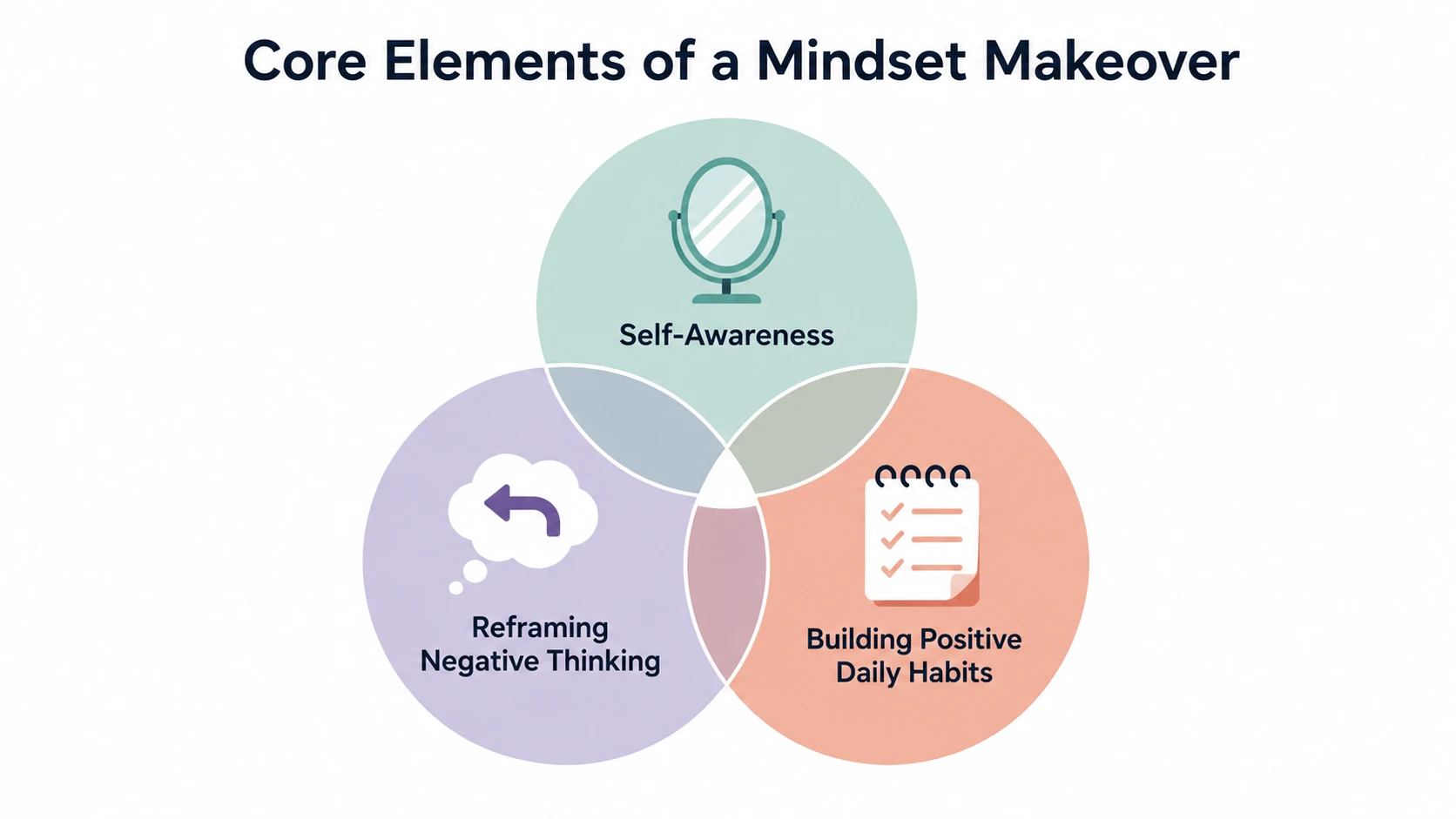
Self-Awareness
Self-awareness is the foundation of any mindset makeover. Without recognizing a thought pattern, it cannot be changed. This involves:
- Identifying limiting beliefs as they arise in daily situations
- Recognizing recurring thought patterns, especially under stress
- Building emotional awareness to notice feelings before they drive automatic reactions
Reframing Negative Thinking
Reframing is the process of examining a thought and constructing a more accurate or constructive alternative. This includes: Reframing is the process of examining a thought and constructing a more accurate or constructive alternative — a skill covered in more depth in our guide on how to change your thoughts.
- Replacing assumptions with questions (“Is this true, or is this a habit of thinking?”)
- Using evidence-based thinking to test whether a belief holds up against facts
- Practicing constructive self-talk that is honest rather than falsely positive
Building Positive Daily Habits
Reframing alone is not enough — it needs to be reinforced through daily practice. Common supporting habits include: Reframing alone is not enough — it needs to be reinforced through daily practice. For inspiration, see small habits that changed my life from readers who’ve applied this consistently.
- Journaling
- Reflection
- Gratitude practice
- Goal review
- Visualization
- Mindfulness
Step-by-Step Mindset Makeover Process
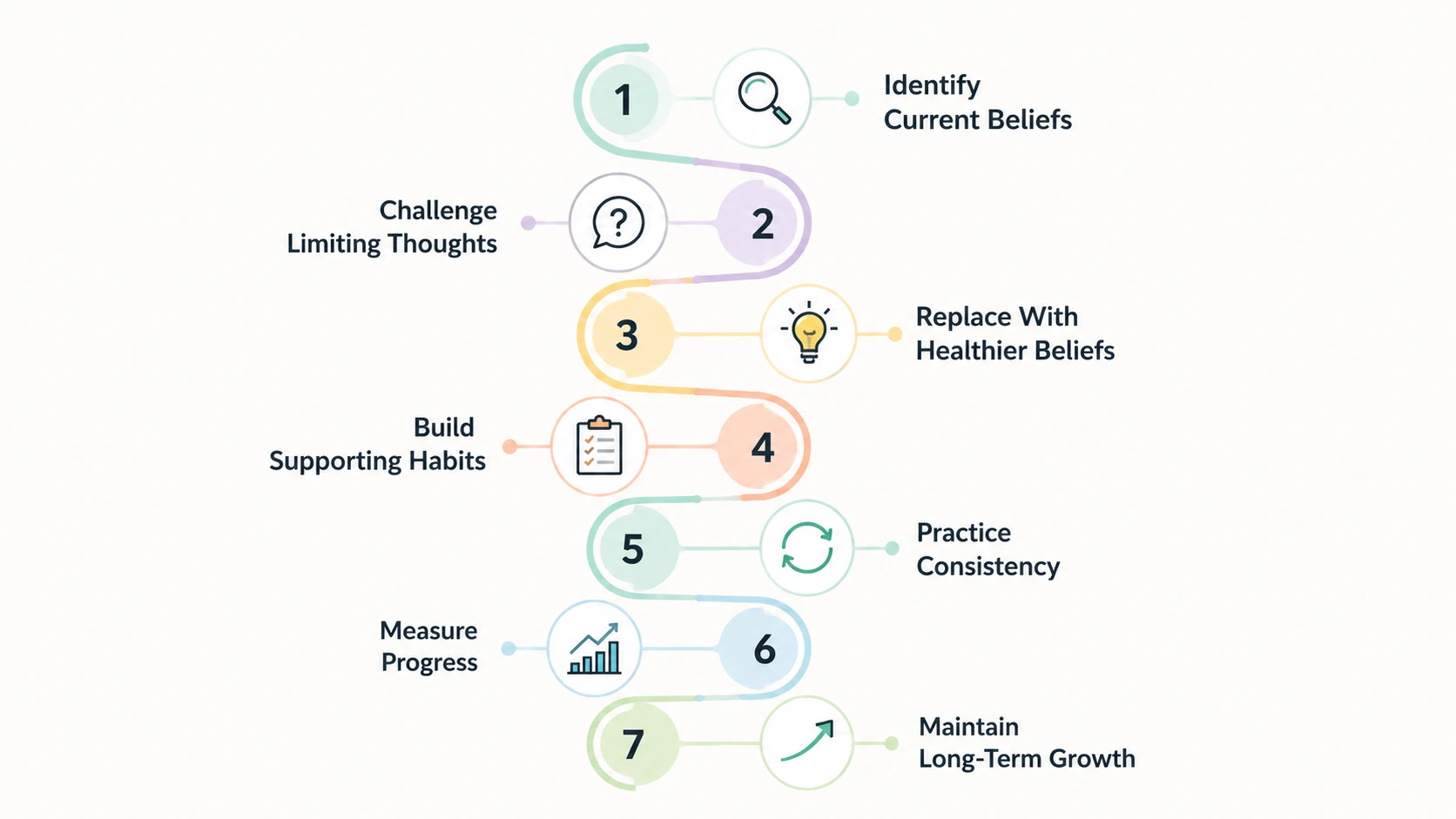
A general, evidence-informed 7 step mindset makeover framework can be used as an educational structure for daily implementation and long-term maintenance:
- Identify Current Beliefs — Write down the specific thoughts and assumptions currently shaping decisions and reactions.
- Challenge Limiting Thoughts — Question whether each belief is accurate, helpful, or simply habitual.
- Replace Them With Healthier Beliefs — Construct alternative thoughts that are realistic and supportive rather than falsely positive.
- Build Supporting Habits — Attach small daily actions (journaling, reflection, planning) that reinforce the new belief.
- Practice Consistency — Repeat the new thought and habit pattern regularly, since consistency drives neurological change more than intensity.
- Measure Progress — Track shifts in behavior, emotional response, and decision-making over time.
- Maintain Long-Term Growth — Continue reviewing and adjusting beliefs and habits as circumstances change.
This framework is a general educational structure rather than a branded or proprietary system, and it can be adapted to virtually any area of life.
Different Types of Mindset Makeovers
Mindset work tends to be most effective when applied to a specific area of life rather than treated as a vague, general goal.
Personal Growth Mindset
This approach focuses on broad self-development: building confidence, self-discipline, and emotional resilience across multiple areas of life. It is often the starting point for people who are new to intentional mindset work.
Money Mindset
A money mindset makeover — sometimes referred to as a mindset money makeover — focuses on identifying and replacing limiting beliefs about earning, saving, spending, and financial security. This is most beneficial for people experiencing avoidance, anxiety, or scarcity-based thinking around finances.
Health and Wellness Mindset
A mindset makeover for lasting weight loss or general wellness focuses on replacing all-or-nothing thinking, guilt-based motivation, and short-term dieting mentality with sustainable, identity-based health habits. This approach tends to produce more durable results than motivation-driven programs alone.
Career and Success Mindset
This type addresses beliefs related to ambition, visibility, risk-taking, and self-worth in professional settings. It’s especially useful for overcoming imposter syndrome, procrastination, or fear of failure at work.
Cognitive Mindset Development
A cognitive mindset makeover centers specifically on thinking skills: reducing cognitive distortions, improving decision-making, and strengthening mental flexibility. This approach draws most directly from cognitive behavioral techniques.
Comparing Different Mindset Makeover Approaches
| Approach | Primary Goal | Best For | Key Practices | Expected Timeline |
|---|---|---|---|---|
| Personal Development | Broad self-improvement | People new to mindset work | Journaling, reflection, goal-setting | 1–3 months for early shifts |
| Cognitive Techniques | Reducing distorted thinking | People with anxious or negative thought loops | Cognitive restructuring, thought tracking | 4–8 weeks with regular practice |
| Habit-Based Approaches | Long-term behavior change | People who struggle with consistency | Habit stacking, tracking, accountability | 2–6 months for stable habits |
| Financial Mindset | Improving money beliefs | People with scarcity or avoidance around money | Belief audits, financial journaling | Ongoing, with early shifts in weeks |
| Wellness-Focused | Sustainable health habits | People stuck in all-or-nothing health cycles | Identity-based habits, mindful eating | 2–4 months for consistency |
Benefits of a Mindset Makeover
A consistent mindset makeover practice is associated with improvements across several areas of life, including:
- Greater confidence in decision-making
- Improved emotional resilience under stress
- Better long-term decision-making
- Increased productivity and follow-through
- Higher likelihood of achieving stated goals
- More effective stress management
- Stronger self-discipline
- Healthier communication in relationships
- Improved long-term wellbeing and life satisfaction
Common Challenges During a Mindset Makeover
Lack of Motivation
Motivation naturally fluctuates, and relying on it alone often leads to inconsistency. This can be addressed by shifting focus from motivation to structured habits and small, repeatable actions that don’t depend on feeling inspired. This can be addressed by shifting focus from motivation to structured habits — see our guide on how to build discipline without motivation for practical strategies.
Negative Self-Talk
Old self-talk patterns are deeply ingrained and can resurface, especially under stress. Overcoming this involves actively noticing the pattern and practicing a more accurate, constructive internal response until it becomes more automatic.
Fear of Failure
Fear of failure often stems from linking self-worth to outcomes. Reframing failure as informative rather than definitive, and setting smaller, lower-stakes goals, can reduce this fear over time.
Unrealistic Expectations
Expecting fast, dramatic change often leads to discouragement and early quitting. Setting realistic, incremental expectations based on how habit change actually works helps prevent this.
Returning to Old Habits
Relapse into old thought patterns is a normal part of the process, not a sign of failure. Preventing relapse involves identifying triggers in advance and having a specific plan for how to respond when old patterns resurface.
Common Mistakes Beginners Make
- Expecting overnight transformation — mindset change is a gradual process, not a single event
- Ignoring habits — focusing only on thoughts while neglecting the daily actions that reinforce them
- Setting vague goals — goals without clear, specific definitions are difficult to track or sustain
- Consuming information without action — reading or watching content without applying it produces little real change
- Comparing progress to others — individual starting points and circumstances vary significantly
- Quitting too early — meaningful mindset shifts typically require weeks or months of consistent practice, not days
In our experience helping readers build better habits, beginners who track just one or two habits consistently tend to see more durable change than those who try to overhaul every area of their thinking at once.
Practical Daily Mindset Makeover Routine
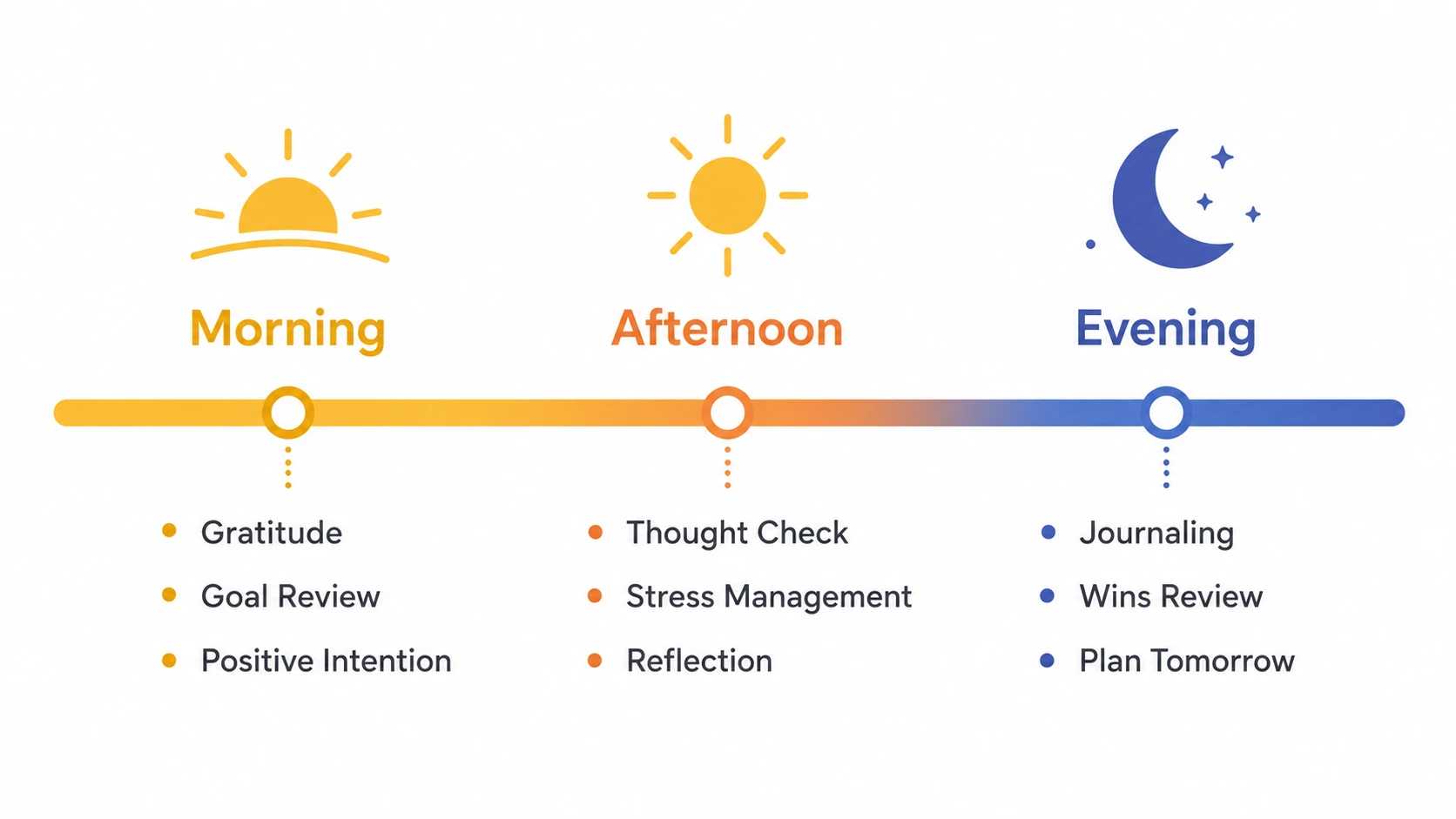
A simple daily structure can help reinforce mindset work consistently:
Morning
- Gratitude practice
- Goal review
- Setting a positive intention for the day
Afternoon
- Quick thought check-in
- Brief stress management practice (breathing, short walk, reset pause)
- Midday reflection on progress
Evening
- Journaling
- Reviewing daily wins
- Planning for tomorrow
Your Daily Thrive recommends keeping each step brief — even two to five minutes per check-in is enough to build the habit without it feeling burdensome.
Difficulty and Time Investment
A mindset makeover is generally beginner-friendly, since it relies on simple daily practices rather than specialized skills. That said, several factors affect how easy or difficult the process feels:
- Learning curve — most people can grasp core techniques like reframing and journaling within the first few days
- Daily commitment — even 10–15 minutes per day is enough to begin building momentum
- Personal factors — prior experience with self-reflection, stress levels, and support systems all affect difficulty
- Lifestyle considerations — busy schedules may require shorter, more flexible practices rather than lengthy routines
Advanced practice, such as deep cognitive restructuring work or addressing long-standing emotional conditioning, typically benefits from additional support, such as therapy or coaching.
Results Timeline
Mindset change tends to follow a gradual, non-linear timeline rather than a fixed schedule:
- First week — increased self-awareness and noticing of thought patterns, but few visible behavior changes yet
- First month — early shifts in self-talk and small, noticeable improvements in specific situations
- Several months — more consistent behavior change and greater emotional resilience under stress
- Long-term maintenance — mindset shifts become more automatic, though ongoing practice is still needed to sustain them
Progress speed is influenced by factors such as consistency of practice, severity of the original thought pattern, environmental support, and whether supporting habits are in place.
Practice Guide for Long-Term Success
Sustaining a mindset makeover over time typically involves:
- Weekly review — checking in on progress, setbacks, and adjustments needed
- Habit tracking — using a journal, app, or simple checklist to monitor consistency
- Accountability — sharing goals with a trusted person, coach, or community
- Environment design — adjusting surroundings to reduce friction for helpful habits and increase friction for unhelpful ones
- Motivation strategies — connecting daily practices to a larger, meaningful goal
- Sustainable routines — choosing practices that fit realistically into daily life rather than requiring major disruption
- Adjusting practices over time — revisiting and updating routines as circumstances, goals, or challenges change
As of mid-2026, behavioral science guidance increasingly emphasizes small, identity-based habits over large one-time goals, since incremental practices tend to produce more durable mindset change.
Mindset Makeover vs Positive Thinking
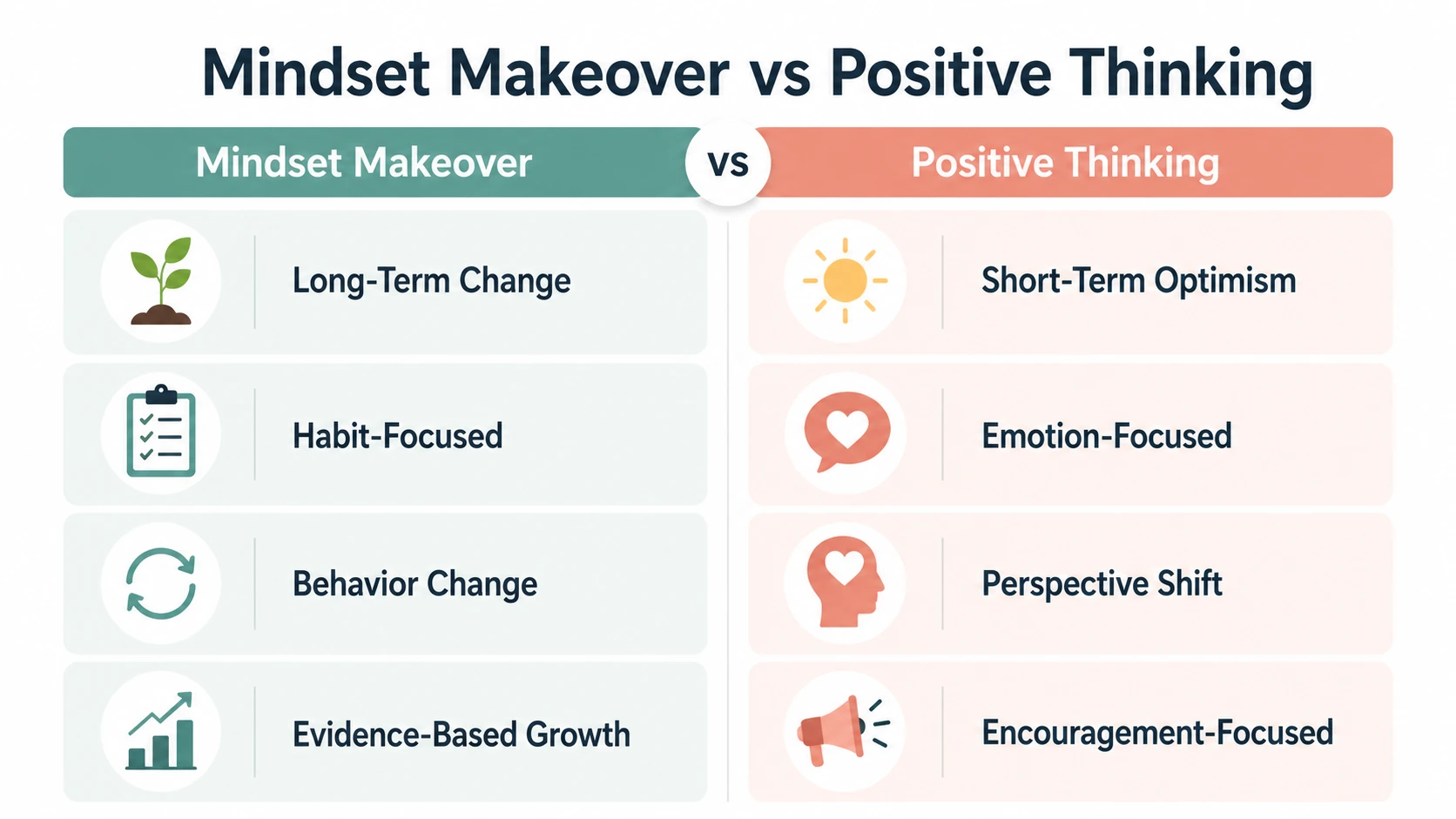
These two concepts are often confused, but they are not the same.
| Mindset Makeover | Positive Thinking |
|---|---|
| Focuses on long-term change | Focuses on short-term optimism |
| Habit-focused | Emotion-focused |
| Aims at behavior change | Aims at perspective shift |
| Grounded in evidence-based growth | Centered on encouragement |
A mindset makeover involves restructuring beliefs and building supporting habits over time, while positive thinking is generally a momentary emotional or attitudinal shift. Positive thinking can be a helpful component of a mindset makeover, but on its own it rarely produces lasting behavioral change.
Frequently Discussed Mindset Makeover Resources and Frameworks
The term “mindset makeover” appears across a range of resources, including a mindset makeover book, the mindset makeover journal, coaching programs, and various personal development frameworks. This article does not promote or review any specific resource. Readers encountering these materials should evaluate them based on whether the guidance is evidence-based, whether it fits their specific goals, and whether the format (book, journal, course, coaching) matches their preferred learning style. No single resource is necessary for a mindset makeover — the core principles of self-awareness, reframing, and consistent habit-building can be applied independently.
Conclusion
A mindset makeover is the structured, ongoing process of identifying limiting beliefs, reframing them, and reinforcing new thought patterns through consistent daily habits. It is grounded in psychology and behavioral science rather than any single method, and it applies across areas such as personal growth, finances, health, and career development. Lasting results depend less on motivation or a single moment of insight and more on repeated practice, self-awareness, and gradual habit-building over weeks and months. Rather than a one-time event, a mindset makeover is best understood as an ongoing process of growth that continues to evolve as circumstances and goals change.
Frequently Asked Questions
What is a mindset makeover?
A mindset makeover is the intentional process of identifying and replacing limiting beliefs and thought patterns with healthier, more constructive ones, reinforced through consistent daily habits.
How long does a mindset makeover usually take?
Early shifts in self-awareness often appear within the first week, noticeable changes in self-talk typically develop over the first month, and more stable behavioral change generally takes several months of consistent practice.
Can a mindset makeover improve confidence?
Yes. Replacing limiting beliefs with evidence-based, constructive thinking is associated with increased self-confidence, particularly in decision-making and handling setbacks.
What habits support lasting mindset change?
Habits such as journaling, gratitude practice, goal review, mindfulness, and regular self-reflection help reinforce new thought patterns and make them more automatic over time.
Is a mindset makeover backed by psychology?
Yes. The process draws on established concepts such as cognitive restructuring, habit formation, neuroplasticity, and behavioral science rather than being a single branded technique.
What is the difference between mindset change and positive thinking?
Mindset change involves long-term restructuring of beliefs and habits, while positive thinking is typically a short-term emotional or attitudinal shift without necessarily changing underlying behavior.
Can mindset changes help with money or career goals?
Yes. A money mindset makeover or career-focused mindset work can help identify and replace limiting beliefs around financial security, risk-taking, and professional self-worth.
What are the biggest mistakes people make during a mindset makeover?
Common mistakes include expecting overnight results, focusing only on thoughts while ignoring habits, setting vague goals, consuming information without applying it, and quitting before consistent practice has had time to produce change.