

Introduction
One mindset meaning refers to a unified way of thinking, interpreting challenges, and directing behavior toward a chosen goal. It shapes how a person makes decisions, forms habits, stays consistent, and recovers from setbacks. Having “the mindset” does not mean thinking identically in every situation — it means maintaining a consistent set of guiding principles while adapting to circumstances as they change. This idea sits behind the popular claim that one mindset can change everything, though the reality is more nuanced. This guide explains what a constructive mindset actually involves, how it develops, and how to build one that supports lasting personal growth.
Quick Summary
- A one mindset approach means intentionally building a consistent mental framework around growth, responsibility, and purposeful action.
- A mindset shift can change how people interpret setbacks, but lasting change usually requires repeated habits and behavior.
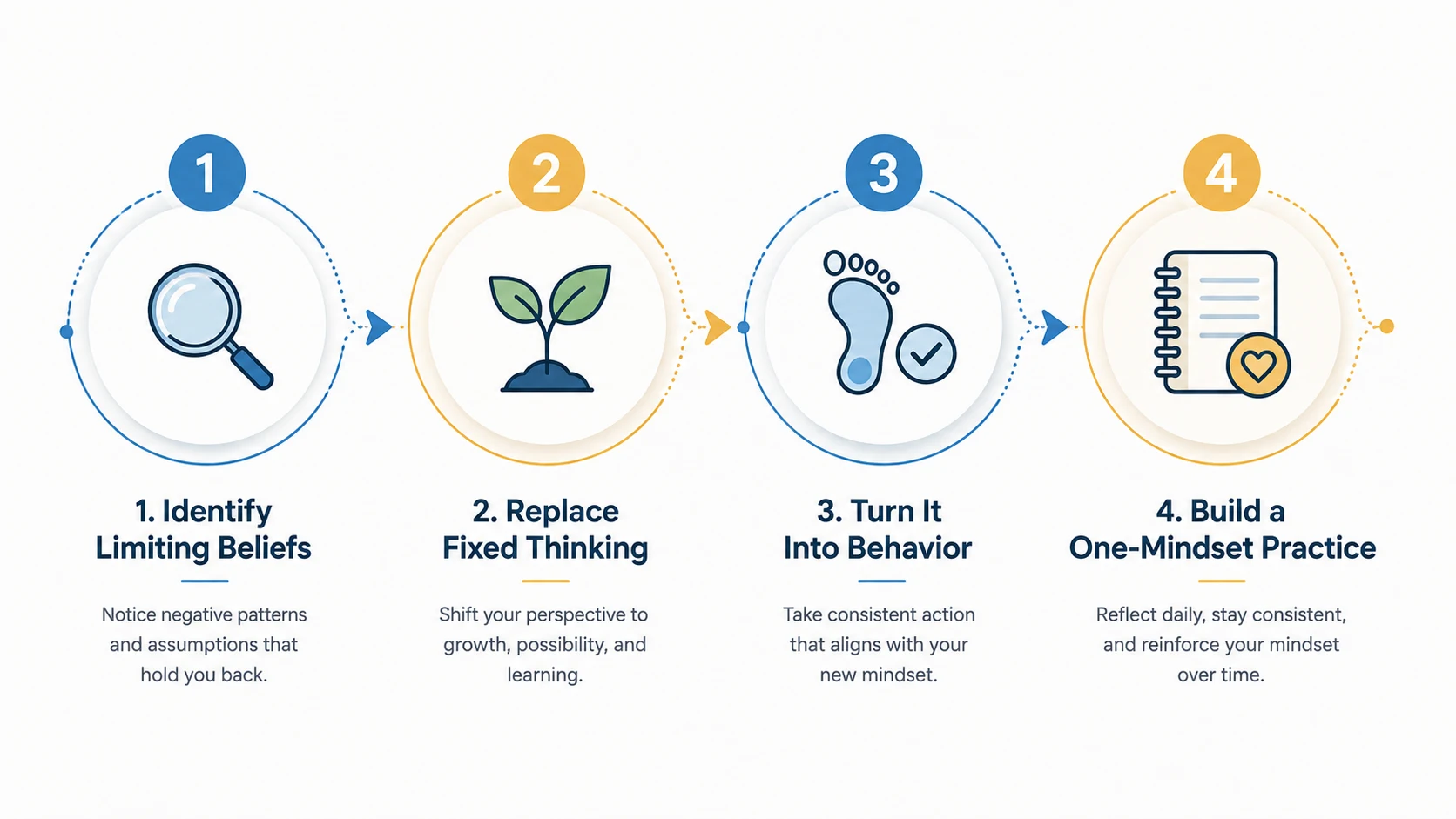
- Learning how to change one’s mindset involves identifying limiting beliefs, reframing thoughts, practicing new behaviors, and maintaining consistency.
- Mindset works best when paired with practical habits rather than relying on motivation or positive thinking alone.
What Is One Mindset and Why Does It Matter?
A mindset is the underlying framework that determines how a person interprets events before they respond to them. It matters because interpretation happens first — before any decision, habit, or action follows. Understanding one mindset meaning in this context helps explain why two people can face the same setback and respond in completely different ways.
One Mindset Meaning in Personal Development
Mindset is often confused with attitude, belief, perspective, and mental habit, but each term describes something slightly different:
- Attitude is a short-term emotional response to a specific situation.
- Belief is an assumption held about oneself, others, or the world.
- Perspective is the vantage point from which a situation is viewed.
- Mindset is the broader, more stable framework that organizes beliefs and shapes ongoing interpretation.
A mindset shapes interpretation before it shapes action. This is why changing surface-level thoughts alone — without addressing the underlying framework — often fails to produce lasting behavioral change. A person can repeat an affirmation daily, but if the deeper interpretive framework has not shifted, old patterns tend to resurface under stress.
How Mindset Influences Daily Decisions
Mindset connects directly to several areas of daily functioning, including goal setting, habit formation, productivity, resilience, consistency, and response to failure.
| Concept | Definition | Function | Effect on Behavior |
|---|---|---|---|
| Mindset | Stable interpretive framework | Shapes how situations are understood | Guides long-term patterns of response |
| Attitude | Short-term emotional stance | Reacts to a specific moment | Influences immediate behavior |
| Belief | Held assumption about self or world | Filters incoming information | Reinforces or limits action |
| Habit | Automatic, repeated behavior | Executes learned routines | Produces consistent outcomes |
| Motivation | Temporary drive toward a goal | Initiates effort | Fluctuates and is often unreliable |
Can One Mindset Really Change Everything?
The claim that one mindset can change everything is popular, but it is more accurate to say that a constructive mindset can meaningfully change outcomes when it is paired with consistent action. A mindset shift alone does not remove real-world limitations.
How a Mindset Shift Changes Behavior
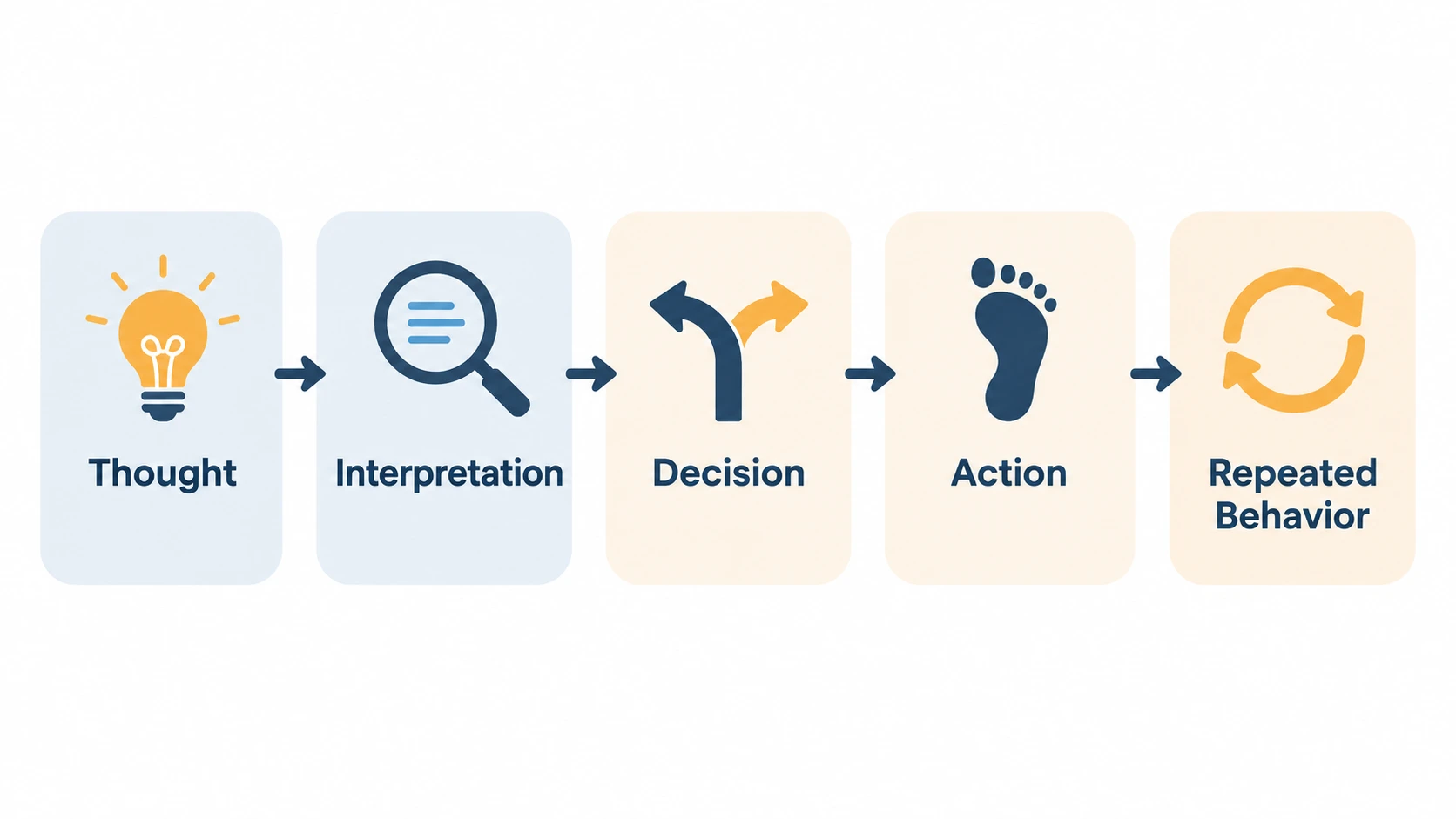
Behavior generally follows a predictable sequence: thought leads to interpretation, interpretation leads to decision, decision leads to action, and repeated action becomes behavior. When someone changes how they interpret failure — for example, viewing it as feedback instead of proof of inability — the decisions and actions that follow tend to shift as well. A genuine mindset shift is distinct from temporary inspiration, which produces a short burst of motivation without changing the underlying interpretive pattern.
Why Mindset Alone Is Not Enough
Several external factors continue to influence outcomes regardless of mindset:
- Environment and circumstances
- Skills and knowledge
- Available resources and support
- Physical and emotional energy
- Consistency of action over time
Key takeaway: A constructive mindset increases the likelihood of productive action; it does not eliminate real-world constraints.
How to Change One’s Mindset
Changing a mindset requires a sequential, practical process rather than a single decision or moment of inspiration.
Identify the Beliefs That Are Holding You Back
Start by noticing recurring negative assumptions and patterns of all-or-nothing thinking. Separate objective facts from personal interpretations, then ask which beliefs are useful, accurate, or changeable.
Replace Fixed Thinking With Growth-Oriented Thinking
A fixed mindset treats abilities as static, while a growth-oriented mindset treats abilities as developable through effort and practice. Mistakes can become feedback rather than proof of inability. In fact, one essential quality of a growth mindset is treating challenges as opportunities to learn rather than as threats to avoid. Understanding why growth mindset is important can make this shift easier to sustain over time.
Turn the New Mindset Into Behavior
Choose one specific behavior that reflects the desired mindset and start with a manageable version of it. Repeat the behavior in predictable situations, and review progress over time rather than expecting instant transformation.
Use a One-Mindset Practice
- Define one or two core principles to guide decisions.
- Create a short daily reflection habit.
- Record setbacks and how each one was addressed.
- Adjust the strategy without abandoning the underlying principle.
What Is the Difference Between a Mindset Shift and Positive Thinking?
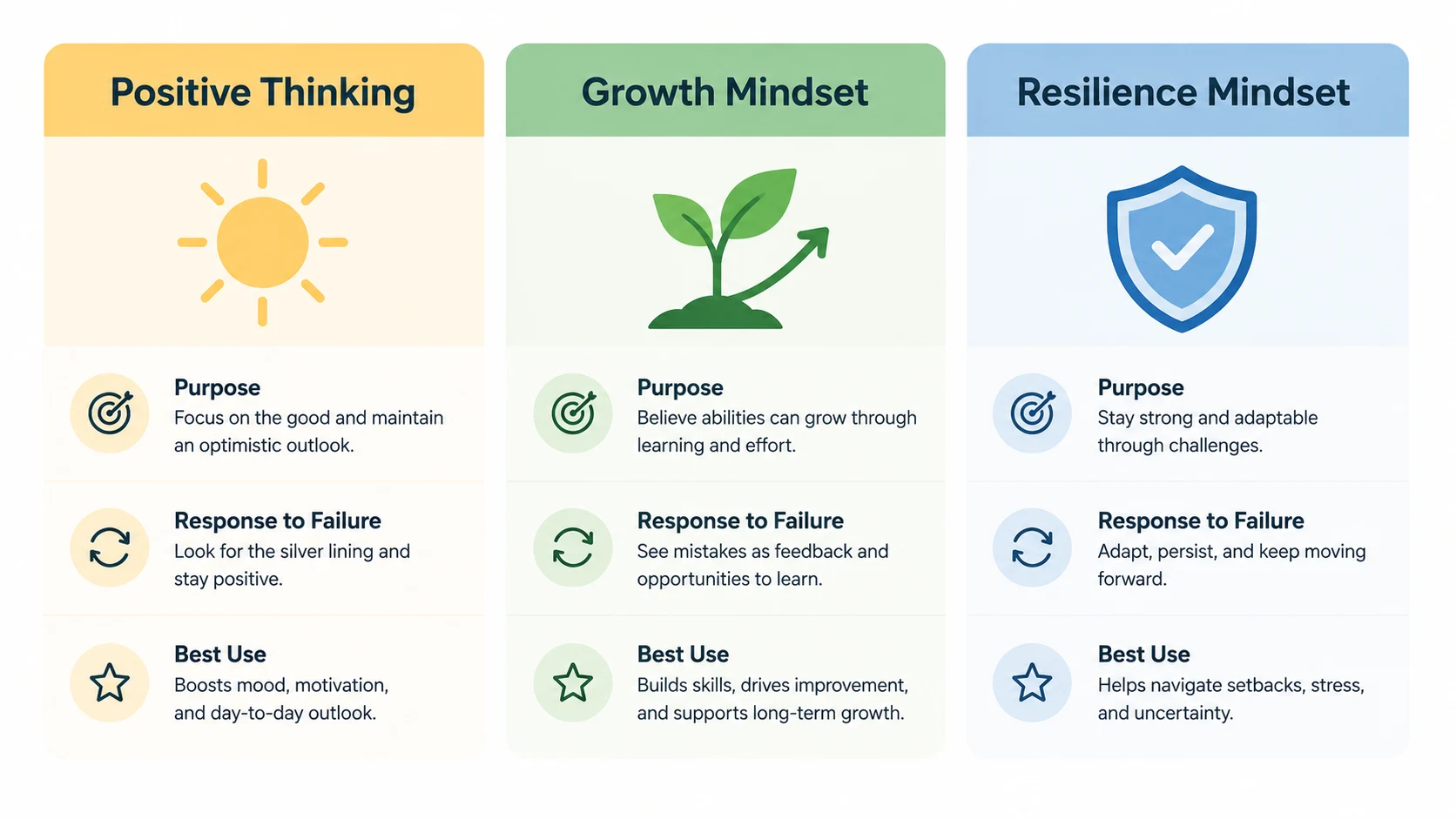
Constructive mindset development is not the same as simply trying to stay optimistic. Positive thinking emphasizes an optimistic interpretation of events, while a growth-oriented mindset emphasizes learning and long-term development. A resilient mindset acknowledges difficulty while focusing on a useful, actionable response.
Positive Thinking vs. Growth-Oriented Mindset
| Framework | Purpose | Response to Failure | Limitations | Practical Use |
|---|---|---|---|---|
| Positive Thinking | Maintain optimistic outlook | May minimize or avoid the issue | Can ignore real problems | Short-term emotional regulation |
| Growth Mindset | Develop abilities through effort | Treats failure as feedback | Requires sustained practice | Long-term skill and habit building |
| Resilience Mindset | Withstand and recover from adversity | Acknowledges difficulty directly | Can be emotionally demanding | Navigating setbacks and stress |
Why Realistic Thinking Can Be More Useful Than Constant Positivity
Acknowledging genuine problems rather than denying them allows optimism to be combined with evidence and action. Forced positivity, when used to avoid confronting real issues, can become counterproductive and delay meaningful problem-solving.
One Mindset Habits That Improve Consistency
A one mindset habit that affects your consistency is any small, repeatable action that reinforces the chosen mental framework over time.
Daily Habits That Reinforce a Constructive Mindset
- Set one clear priority each day.
- Use implementation intentions (specific plans for when and how to act).
- Practice deliberate self-reflection.
- Track completed actions.
- Reframe mistakes as information rather than failure.
- Review progress at the end of the day.
Why Consistency Matters More Than Short-Term Motivation
Motivation naturally fluctuates, while systems and habits reduce dependence on it. Repetition strengthens behavioral patterns over time, and smaller, more manageable actions are easier to sustain than large, sporadic efforts.
How to Build a Habit Without Overcommitting
Start with a single behavior, and attach it to an existing routine to create a natural trigger. Make the desired action easy to begin, then gradually increase its difficulty as consistency builds. For a structured approach, check out our 30-day guide to building good habits
What Can You Learn From a One-Week Mindset Change?
A short-term experiment can build awareness, but it rarely produces the dramatic transformation often implied by claims like “5 habits that changed my life in 1 week.” A more realistic goal is to observe early, measurable shifts in behavior.
Five Habits to Test for Seven Days
- Write one priority each morning.
- Spend a few minutes identifying negative thought patterns.
- Replace one unhelpful interpretation with a constructive alternative.
- Track one behavior rather than relying on how motivated you feel.
- Review what worked and what needs adjustment each evening.
What Can Actually Change in One Week?
Awareness can improve relatively quickly, and a basic routine can begin forming within days. Many people notice early changes in focus or decision-making. However, deeply established beliefs and long-term habits generally require sustained practice well beyond a single week. For real examples of gradual change, read small habits that changed my life.
One Mindset in Different Contexts
The same underlying mental principle can be adapted across different areas of life.
For Students
- Responding constructively to difficult subjects.
- Using mistakes as feedback rather than discouragement.
- Building consistent study routines.
For Professionals
- Handling criticism without disengaging.
- Learning new skills proactively.
- Managing setbacks and shifting priorities.
For People Working Toward Personal Goals
- Maintaining progress when motivation drops.
- Breaking large goals into repeatable actions.
- Balancing ambition with realistic constraints.
| Context | Primary Focus | Common Challenge | Practical Mindset Application |
|---|---|---|---|
| Learning | Building knowledge and skills | Fear of mistakes | Treat errors as feedback |
| Work | Meeting professional demands | Handling criticism | Separate feedback from self-worth |
| Health Habits | Sustaining physical routines | Motivation fluctuation | Rely on systems, not willpower |
| Relationships | Communication and consistency | Reacting emotionally under stress | Pause before responding |
| Personal Goals | Long-term progress | Loss of momentum | Break goals into repeatable steps |
Common Mindset Mistakes and How to Fix Them
Mistaking Motivation for Mindset Change
Why it happens: Inspirational content can create temporary emotional energy. Fix: Translate inspiration into a specific, repeatable behavior. Prevention: Build systems that continue functioning even when motivation is low.
Expecting Immediate Results
Why it happens: Short-form self-improvement content often compresses realistic timelines. Fix: Measure behaviors and track gradual improvement instead of expecting instant change. Prevention: Set realistic review periods, such as monthly check-ins.
Using Positive Thinking to Avoid Problems
Why it happens: People may confuse optimism with denial of real issues. Fix: Acknowledge the problem directly and identify a controllable response. Prevention: Practice realistic, evidence-based reframing rather than avoidance.
Trying to Change Everything at Once
Why it happens: A strong desire for rapid, total transformation. Fix: Select one priority behavior to focus on first. Prevention: Add additional changes gradually, once the first behavior is consistent.
Can Podcasts, Books, and Quotes Help Develop a One Mindset?
Motivational resources such as a motivation podcast, positive mindset podcasts, or positive thinking podcast can support mindset development, but they typically work best as supplementary tools rather than primary drivers of change.
How Motivational Content Can Support Mindset Development
- Reinforces existing concepts.
- Provides different perspectives on familiar challenges.
- Encourages reflection.
- Introduces practical frameworks for thinking and behavior.
The Limitations of Motivational Content
Listening to motivational podcasts is not the same as practicing new behaviors. Repeated consumption of inspirational content, without corresponding action, can become a form of passive procrastination. Inspirational content is most useful when it leads directly to action and reflection.
How to Choose Useful Mindset Content
Look for content with evidence-based explanations rather than exaggerated promises. Prefer material that offers practical frameworks, and check whether the creator clearly distinguishes short-term motivation from sustainable behavior change. Podcasts for motivation can be a helpful starting point, but they work best when paired with a structured practice.
One Mindset, Growth Mindset, and Other Mental Frameworks: How Do They Compare?
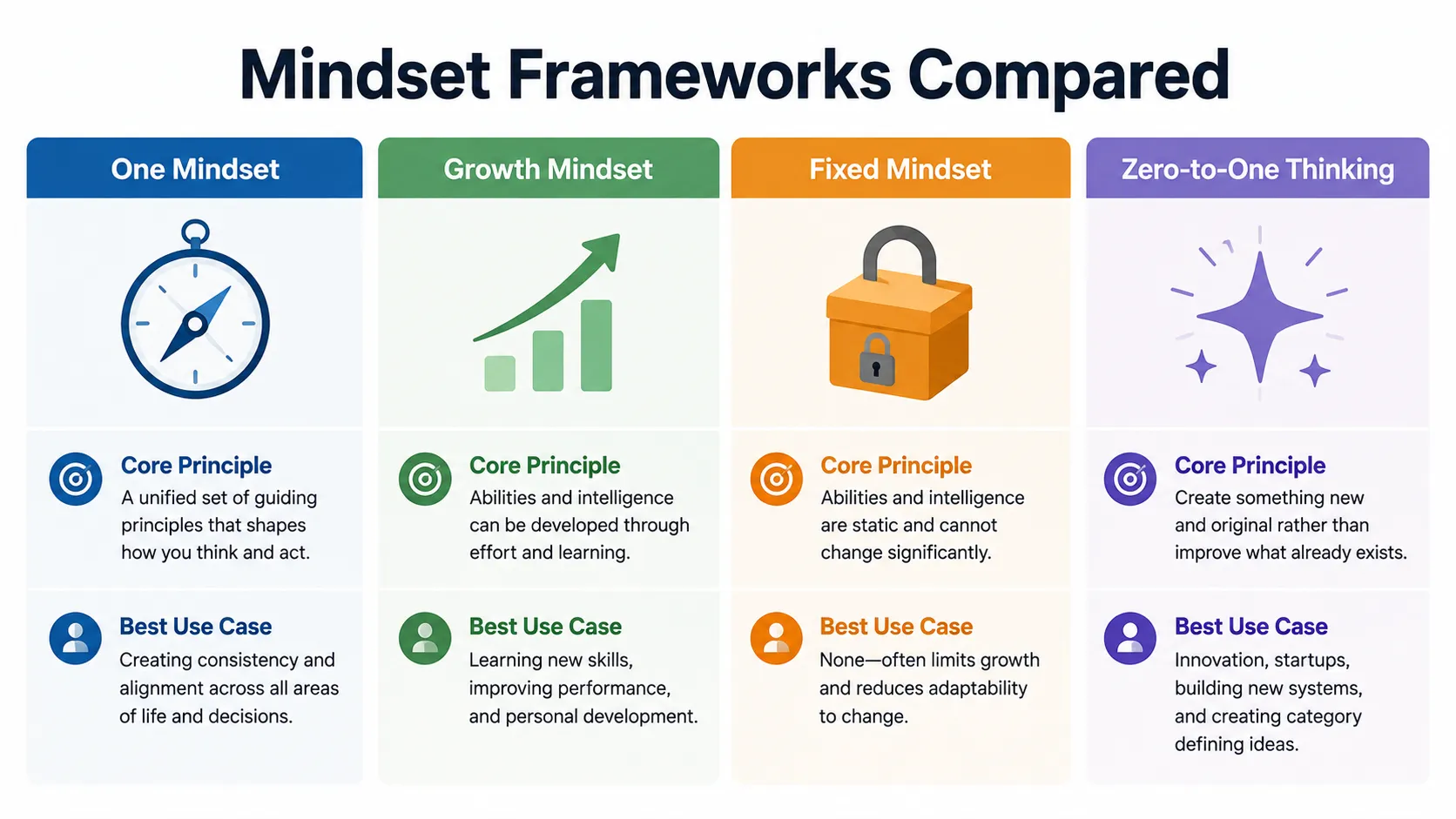
“One mindset” can refer to different frameworks depending on context, and it is useful to distinguish it from related concepts.
One Mindset vs. Growth Mindset
A one mindset approach refers to a unified set of guiding principles applied broadly across situations. A growth mindset is a more specific psychological theory about how abilities and skills develop through effort. The two concepts overlap in that both emphasize consistency and learning, but a growth mindset is narrower in scope.
One Mindset vs. Fixed Mindset
A fixed mindset treats abilities and personal traits as static and unchangeable, which often leads to avoiding challenges and viewing mistakes as evidence of limitation. A flexible, growth-oriented mindset instead treats challenges and mistakes as opportunities for learning, which supports stronger long-term development.
One Mindset vs. “Zero to One” Thinking
“Zero to one” thinking, popularized in innovation and business contexts, focuses on creating something fundamentally new rather than incrementally improving an existing process. A one mindset framework, by contrast, typically emphasizes incremental, consistent improvement. These approaches are not contradictory — incremental mindset habits can support the sustained effort required for genuinely novel work.
| Framework | Core Principle | Typical Behavior | Response to Failure | Best Use Case |
|---|---|---|---|---|
| One Mindset | Consistent guiding principles | Steady, principle-based decisions | Adjust method, keep principle | Long-term personal development |
| Growth Mindset | Abilities develop through effort | Seeks out challenges | Treats failure as feedback | Learning and skill-building |
| Fixed Mindset | Abilities are static | Avoids challenges | Treats failure as limitation | Rarely beneficial long-term |
| Zero-to-One Thinking | Creating something new | Pursues novel solutions | Iterates on the new idea | Innovation and creation |
How to Make a Mindset Change Last
Build Identity Around the Desired Behavior
Focus on repeated actions rather than adopting a label. Using evidence from actual behavior — not intentions — reinforces a genuinely new identity over time.
Create Environmental Support
Reduce friction around desired behaviors and remove unnecessary distractions. Reminders and accountability structures can help maintain consistency, especially during the early stages of change.
Review and Adapt Without Abandoning the Goal
Track progress regularly and identify recurring obstacles. When a specific method stops working, change the method while retaining the broader guiding principle behind it.
Conclusion
A one mindset approach works best as a consistent mental framework for interpreting challenges, forming habits, pursuing goals, and supporting long-term personal growth. Mindset, motivation, positive thinking, and behavior are related but distinct concepts, and confusing them is one of the most common reasons mindset change fails to last. The claim that one mindset can change everything holds up best when a mindset shift is paired with repeated, deliberate practice rather than relying on a single moment of inspiration. The central takeaway: choose a constructive guiding principle, translate it into repeatable behavior, and adjust the method — not the principle — as circumstances change.
FAQ: Common Questions About One Mindset
What does “one mindset” mean? One mindset refers to a consistent mental framework or set of guiding principles that shapes how a person interprets situations and responds to them across different areas of life.
Can one mindset really change your life? A mindset shift can meaningfully influence decisions and habits, but behavior, environment, skills, and external circumstances also continue to affect outcomes.
How do you change your mindset? Identify limiting beliefs, reframe them using more accurate interpretations, practice new behaviors consistently, monitor results, and repeat the process over time.
What is one essential quality of a growth mindset? Viewing abilities as developable through effort, and treating challenges and mistakes as opportunities for learning rather than as evidence of fixed limitation.
How long does it take to change your mindset? There is no universal timeline. Early awareness and small behavioral changes can appear within days or weeks, while deeper, lasting shifts typically require sustained practice over months.
Is positive thinking the same as having a growth mindset? No. Positive thinking emphasizes optimistic interpretation of events, while a growth mindset centers on the belief that abilities and skills can develop through effort and learning.
What habit can improve mindset consistency? A small, repeatable reflection or tracking habit — such as reviewing one priority and one setback each day — helps reinforce a chosen mental framework over time.
Can podcasts help improve your mindset? Motivational and positive-thinking podcasts can offer useful ideas, perspectives, and encouragement, but they work best as a supplement to deliberate practice rather than a substitute for it.