
Introduction
An agility mindset is the ability to adapt, learn, and respond effectively to changing situations rather than sticking rigidly to a single plan or perspective. As workplaces, technologies, and personal circumstances shift faster than ever, this mindset has become a core requirement in leadership, education, and everyday personal development. It is not the same as simply being flexible. Flexibility is a willingness to bend; an agility mindset goes further, combining continuous learning, resilience, and informed decision-making so that a person can act well under uncertainty, not just tolerate it. Understanding an agility mindset also means understanding related concepts such as learning agility and growth mindset, which support and reinforce adaptive thinking in different ways.
Quick Summary
- Agility mindset is the ability to adapt, learn quickly, and respond effectively to change.
- It combines learning agility, resilience, critical thinking, and continuous improvement.
- Individuals and organizations can strengthen an agility mindset through deliberate practice and feedback.
- Although related, agility mindset and growth mindset serve different but complementary purposes.
What Is an Agility Mindset?
Agility Mindset Meaning
The agility mindset meaning centers on one core idea: the capacity to sense change, learn from new information quickly, and adjust behavior or strategy accordingly. Rather than reacting to change with resistance or anxiety, a person with an agility mindset treats uncertainty as a normal condition to be navigated through observation, experimentation, and rapid learning. In some contexts, particularly in Indonesian-language search queries, people search “agility mindset adalah” to ask for a direct definition — the answer is the same: it is the mental capacity to adapt behavior and thinking in response to new or changing circumstances, grounded in ongoing learning rather than fixed routines.
Core Characteristics of an Agile Thinker
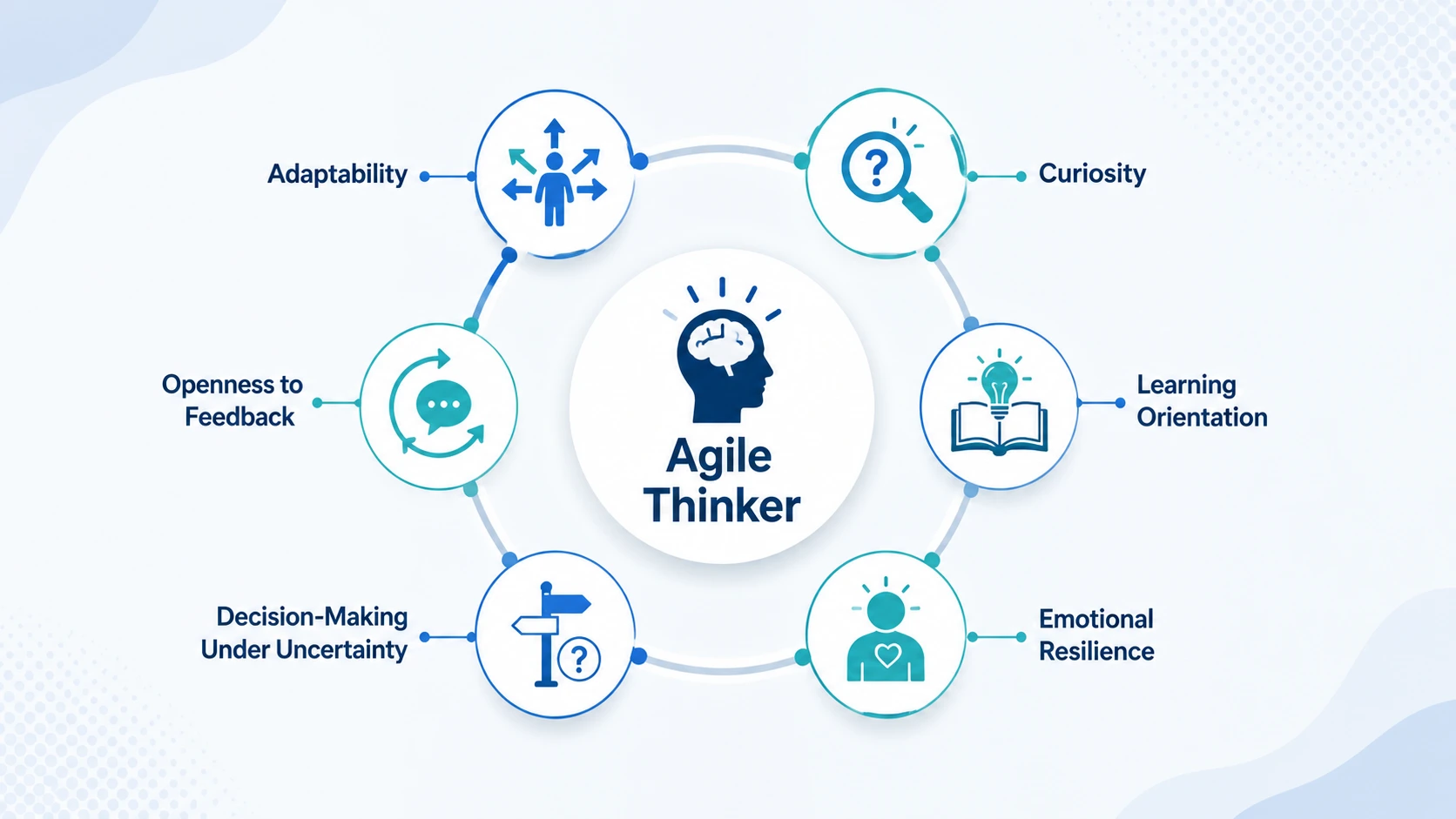
People with a strong agility mindset tend to share a consistent set of traits:
- Adaptability — the ability to shift approach when circumstances change
- Curiosity — an active interest in new information, perspectives, and skills
- Learning orientation — treating challenges as opportunities to acquire knowledge
- Emotional resilience — recovering steadily from setbacks without disengaging
- Decision-making under uncertainty — acting on incomplete information without freezing
- Openness to feedback — using external input to refine thinking rather than defending prior positions
These characteristics work together. Adaptability without resilience tends to produce burnout, while resilience without curiosity can lead to stagnation even in the face of clear opportunities to improve.
Why an Agility Mindset Matters
Benefits in Personal Development
An agility mindset supports personal growth in several concrete ways. It helps people learn new skills faster because they approach unfamiliar material with curiosity instead of avoidance. It improves problem-solving by encouraging multiple approaches rather than a single fixed method. It builds resilience by reframing setbacks as data rather than failure. It supports better management of uncertainty, since ambiguity is treated as a normal part of any process rather than a threat. Finally, it drives continuous improvement, because feedback is actively sought out and applied rather than avoided.
Benefits in the Workplace
In professional settings, an agility mindset is closely tied to effective leadership, since leaders who adapt quickly to new information make better decisions during periods of disruption. It also supports innovation, as employees who are comfortable with uncertainty are more willing to experiment and propose new ideas. Team collaboration improves when members are open to changing their approach based on group input rather than defending fixed positions. Career development benefits as well, since professionals with strong learning agility adjust more easily to new roles, tools, and industries. In our experience helping readers build better habits, the workplace gains from an agility mindset are rarely about working harder — they come from adjusting strategy earlier, before a problem becomes a crisis.
Agility Mindset vs Growth Mindset
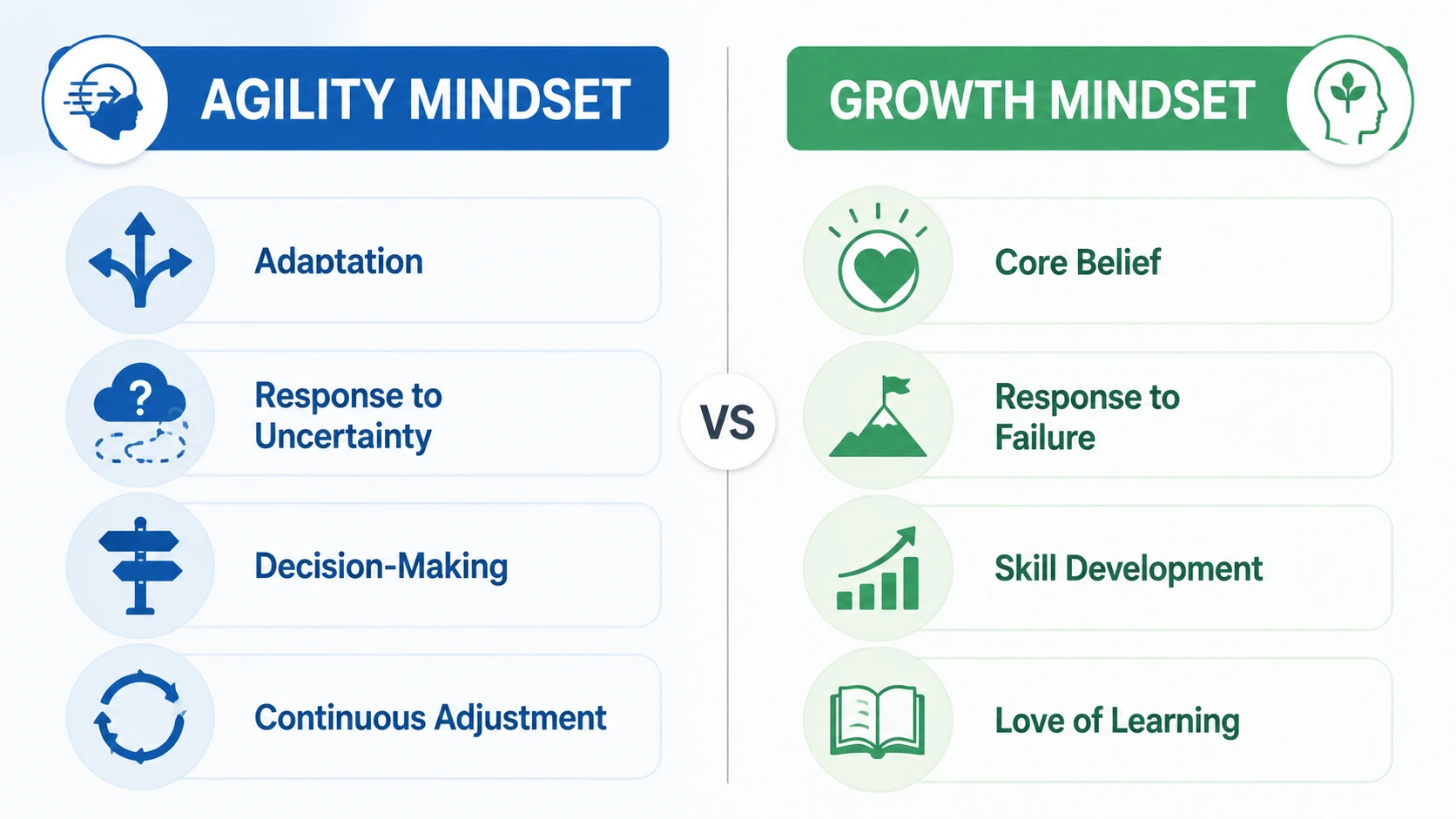
Agility mindset and growth mindset are related but distinct concepts. A growth mindset, a term developed in psychological research on motivation and ability, is the belief that skills and intelligence can be developed through effort. An agility mindset builds on that belief by adding the practical capacity to sense change and act on it quickly.
| Dimension | Agility Mindset | Growth Mindset |
|---|---|---|
| Primary focus | Adaptation to changing conditions | Core belief about ability and intelligence |
| Orientation | Adaptation | Learning |
| Response to uncertainty | Structured, flexible action | Belief that abilities can still develop |
| Trigger | Response to uncertainty | Response to failure |
| Application | Decision-making | Skill development |
How They Complement Each Other
Agility and growth mindset work best together. A growth mindset provides the underlying belief that improvement is possible, while an agility mindset provides the behavioral skill set to act on that belief when conditions change. Learning agility and growth mindset intersect directly here: learning agility is the practical mechanism through which a growth-mindset belief gets converted into faster adaptation and better real-world decisions. Someone can hold a growth mindset without much agility — believing they can improve but struggling to act quickly under pressure — which is why both are typically developed together rather than treated as substitutes. For a closer look at how a growth mindset supports long-term development on its own, see our full breakdown of the concept.
Understanding Learning Agility
What Is Learning Agility?
Learning agility is the ability to learn from experience and apply that learning effectively to new, unfamiliar situations. It is a foundational component of a broader agility mindset, because adapting well to change depends heavily on how quickly and accurately a person can extract useful lessons from prior experience. A learning agility mindset treats every new challenge, including failures, as a source of transferable insight rather than an isolated event.
Key Components of Learning Agility
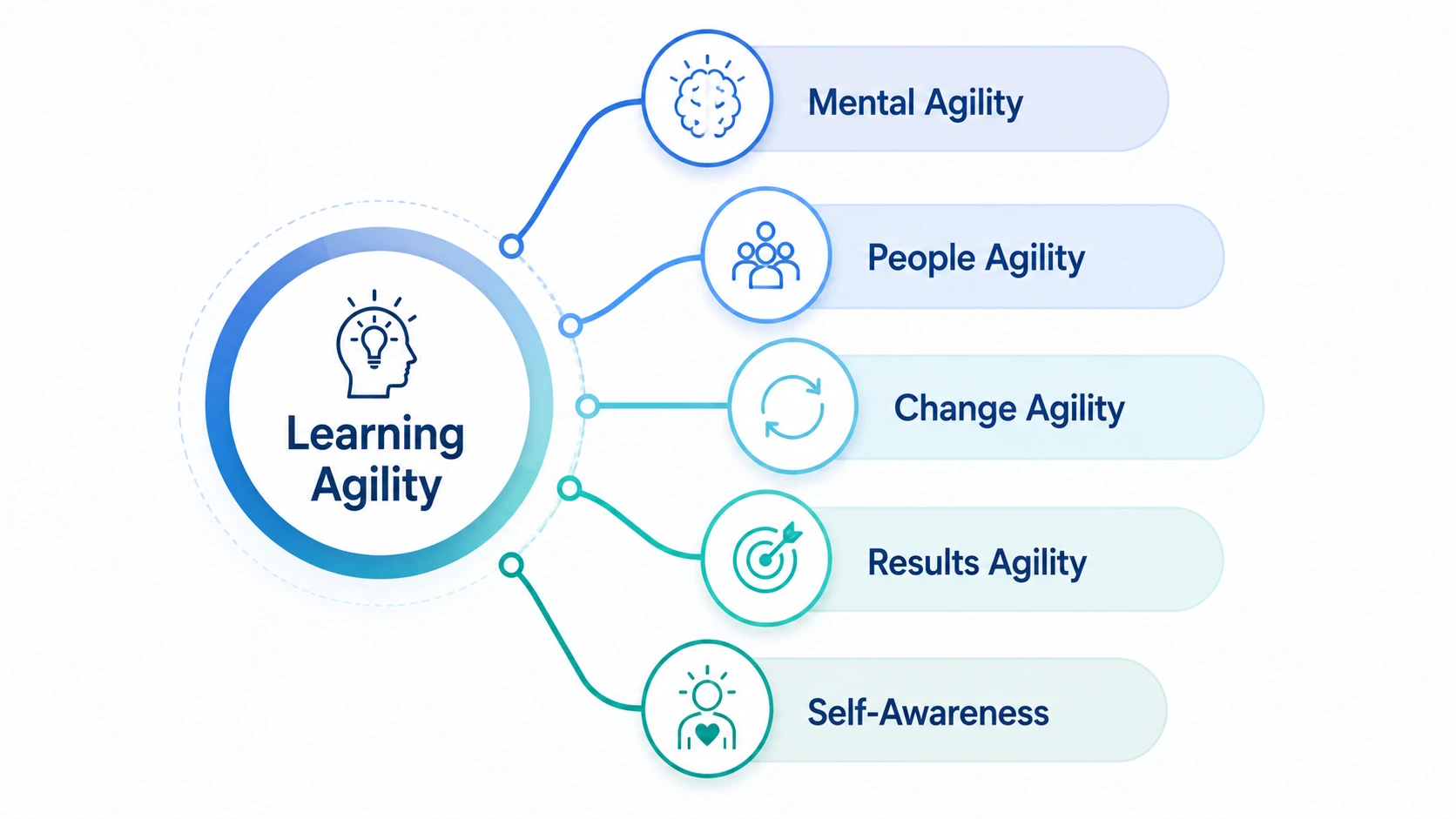
Behavioral science research typically identifies five interconnected components of learning agility:
- Mental agility — thinking through complex or unfamiliar problems from multiple angles
- People agility — working effectively with a wide range of personalities and perspectives
- Change agility — experimenting with new approaches and adjusting course quickly
- Results agility — delivering outcomes even in unfamiliar or high-pressure situations
- Self-awareness — accurately recognizing personal strengths, blind spots, and reactions to change
How to Develop an Agility Mindset
Daily Habits That Build Adaptability
Consistent daily habits build adaptability more reliably than occasional large efforts. Regular reflection helps identify what worked and what didn’t in a given day or decision. Actively seeking feedback closes the gap between self-perception and reality. Continuous learning, even in small increments, keeps mental flexibility active. Deliberate experimentation — trying a new method instead of defaulting to a familiar one — builds comfort with uncertainty. General flexibility in scheduling and problem-solving approaches reinforces the same adaptive muscle over time. Consistent daily habits build adaptability more reliably than occasional large efforts — the same principle behind building good habits over time.
Practical Agility Mindset Exercises
Specific agility mindset exercises can accelerate development when practiced consistently:
- Reflection journaling — recording decisions, outcomes, and lessons learned on a regular basis
- Scenario planning — mentally rehearsing responses to several possible future situations
- Perspective shifting — deliberately considering a problem from another person’s viewpoint
- Learning challenges — setting a goal to learn an unfamiliar skill within a fixed timeframe
- Decision reviews — periodically revisiting past decisions to evaluate reasoning and outcomes
Agility Mindset Games and Interactive Learning
Individual Practice Activities
Structured activities can build adaptive skills in a lower-stakes environment. Problem-solving games that introduce shifting rules or constraints train the brain to adjust strategy mid-task. Simulation exercises recreate realistic decision-making scenarios without real-world consequences. Role reversal, where a person argues from an opposing viewpoint, strengthens perspective-taking. Critical-thinking activities, such as timed logic puzzles, build comfort with rapid problem reassessment.
Team-Based Agility Exercises
Agility mindset games designed for groups typically focus on collaborative adaptability. These activities improve adaptability by requiring teams to change strategy mid-exercise based on new constraints. They strengthen communication by forcing rapid information-sharing under time pressure. They also support innovation, since teams working through unfamiliar, evolving challenges tend to generate more creative solutions than those following a fixed process.
Common Challenges When Building an Agility Mindset
Why People Resist Change
Resistance to change is a well-documented psychological pattern rather than a personal failing. Fear of failure discourages people from trying unfamiliar approaches. Comfort zones create a strong pull toward familiar routines, even when those routines are no longer effective. Cognitive biases, such as confirmation bias, cause people to favor information that supports existing beliefs. A lack of confidence in one’s ability to handle new situations can also stall adaptation before it starts.
How to Overcome These Challenges
Overcoming resistance to change is achievable with consistent, practical strategies:
- Start with small, low-risk changes before attempting larger shifts
- Set specific learning goals rather than vague intentions to “be more adaptable”
- Actively request feedback instead of waiting for it
- Reframe setbacks as data points rather than personal failures
- Track progress over weeks or months, not single days
Common beginner mistakes are worth naming directly. Many people misunderstand adaptability as constant, reactive change rather than thoughtful adjustment. Others try to change too quickly across multiple areas of life at once, which increases the likelihood of burnout. Ignoring feedback, or seeking only feedback that confirms existing beliefs, slows progress considerably. Measuring progress incorrectly — for example, expecting visible results within days — often leads people to abandon the process before meaningful change has had time to occur.
Measuring Progress and Long-Term Development
Signs Your Agility Mindset Is Improving
Progress in building an agility mindset tends to show up as observable, practical changes rather than dramatic shifts. Faster adaptation to new tools, processes, or circumstances is one of the clearest indicators. Better decision-making under incomplete information suggests growing comfort with uncertainty. Improved resilience — recovering from setbacks more quickly and with less disruption — is another reliable marker. Increased curiosity, shown through a greater willingness to explore unfamiliar topics or approaches, often accompanies these other changes.
Long-Term Development Strategies
Sustainable development of an agility mindset relies on ongoing structures rather than one-time effort. Regular reflection keeps learning active over time. Coaching provides external perspective and accountability. Mentoring offers exposure to more experienced decision-making under uncertainty. A continuous learning plan, revisited and adjusted periodically, ensures that development stays aligned with changing goals and circumstances. This is closely tied to building discipline without relying on motivation, since sustainable adaptation depends more on consistent structure than on fluctuating willpower.
Agility Mindset in Different Contexts
Leadership
Leaders benefit from an agility mindset because organizational conditions rarely stay static. Leaders who adapt quickly to new information, market shifts, or team dynamics tend to make more effective decisions and maintain team trust during periods of disruption.
Education
In education, an agility mindset supports both students and lifelong learners by encouraging adaptive study strategies, comfort with unfamiliar subject matter, and the ability to apply feedback from assessments to future learning approaches.
Career Development
Career transitions, whether changing roles, industries, or skill sets, rely heavily on agility. Professionals with strong learning agility tend to acquire new competencies faster and adjust more comfortably to unfamiliar work environments, which supports long-term career resilience.
Books, Resources, and Learning Communities
Popular Books on Agility Mindset
Several published works explore agility mindset concepts in depth, including The Agility Mindset by Christoffer Ellehuus, which examines how individuals and teams can build adaptive capacity in professional environments. These books are useful as structured learning resources rather than promotional material, offering frameworks and case studies that can be applied directly to personal or organizational development.
Finding Learning Communities
An agility mindset community — whether an online forum, professional network, or local group — provides peer learning opportunities that reinforce individual practice. Discussing challenges and strategies with others facing similar adaptation demands often accelerates learning through shared experience and accountability.
Using PDFs, Worksheets, and Study Resources
Downloadable resources, such as an agility mindset pdf or structured worksheet, can reinforce concepts by providing exercises, reflection prompts, and frameworks that support consistent practice outside of reading alone. These materials work best when used regularly rather than as one-time references.
Common Misconceptions About an Agility Mindset
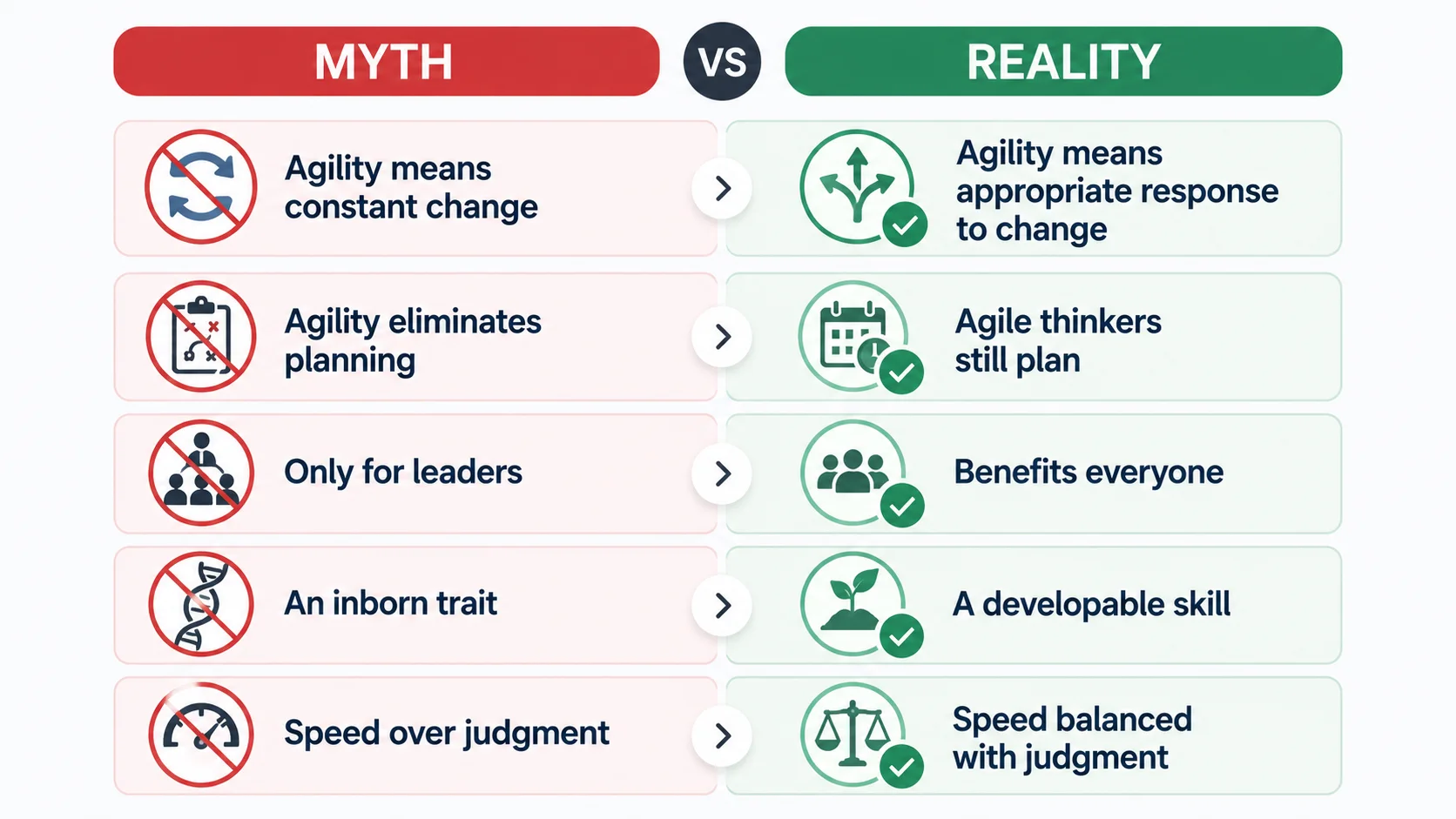
Several persistent myths can distort how people approach agility mindset development:
- Agility means constant change — In reality, agility means responding appropriately to change, not creating change unnecessarily.
- Agility eliminates planning — Agile thinkers still plan; they simply hold plans loosely enough to adjust when conditions shift.
- Agility is only for leaders — Adaptive thinking benefits individuals at every level, in personal life as much as professional roles.
- Agility is an inborn trait — Research in behavioral science indicates that adaptive capacity can be developed through deliberate practice, not just innate temperament.
- Speed is more important than thoughtful adaptation — Fast reactions without reflection often lead to poor decisions; effective agility balances speed with sound judgment.
Conclusion
An agility mindset is the ability to adapt, learn, and respond effectively to change, built on a foundation of learning agility, resilience, and informed decision-making. It matters across personal development, leadership, education, and career growth because static approaches struggle to keep pace with shifting conditions. While closely related to growth mindset, an agility mindset adds the practical, behavioral capacity to act on new information quickly and well. Developing this mindset does not require dramatic transformation — it comes from consistent habits: reflection, feedback, experimentation, and deliberate practice over time. Anyone willing to engage with these habits can strengthen their agility mindset, regardless of starting point.
Frequently Asked Questions
What is an agility mindset?
An agility mindset is the ability to adapt, learn quickly, and respond effectively to changing situations, combining continuous learning, resilience, and informed decision-making rather than simple flexibility.
How is an agility mindset different from a growth mindset?
A growth mindset is the belief that abilities can be developed through effort, while an agility mindset is the practical capacity to sense change and adjust behavior or decisions in response to it.
Can anyone develop an agility mindset?
Yes. Behavioral science indicates that adaptive capacity can be built through deliberate practice, such as reflection, feedback-seeking, and experimentation, rather than being a fixed, inborn trait.
What are the best agility mindset exercises?
Effective exercises include reflection journaling, scenario planning, perspective shifting, timed learning challenges, and structured decision reviews that build comfort with uncertainty and change.
Why is learning agility important?
Learning agility is important because it determines how effectively a person extracts lessons from experience and applies them to new, unfamiliar situations, which directly supports faster and more effective adaptation.
How long does it take to build an agility mindset?
Progress typically appears gradually over weeks to months through consistent practice, with early signs including faster adaptation, better decision-making, and improved resilience rather than immediate transformation.
What are the characteristics of an agile mindset?
Core characteristics include adaptability, curiosity, a learning orientation, emotional resilience, sound decision-making under uncertainty, and openness to feedback.
How can organizations encourage an agility mindset?
Organizations can encourage an agility mindset by supporting continuous learning, providing regular feedback, rewarding thoughtful experimentation, and modeling adaptive decision-making at the leadership level.