Introduction
The millennial mindset refers to a broad set of attitudes, values, expectations, and behaviors commonly associated with people in the Millennial, or Generation Y, cohort. Rather than describing a fixed personality shared by every individual, a generational mindset captures patterns and tendencies shaped by shared historical timing. Millennials grew up during the shift from an offline world to widespread internet and smartphone use, alongside changing education systems, economic disruption, and evolving social norms. These formative experiences influenced generational tendencies, but individual personality remains distinct from any group-level label.
Quick Summary
- The millennial mindset refers to commonly observed attitudes and expectations associated with the Millennial generation, but it does not define every millennial.
- Commonly discussed characteristics include adaptability, digital fluency, an emphasis on experiences, a desire for flexibility, and changing attitudes toward work and success.
- Positive and negative characteristics often depend on context; traits such as independence or a preference for flexibility can be viewed differently across generations.
- Comparing millennials with Gen Z helps explain how different formative experiences produce different expectations around technology, work, communication, and identity.
What Is the Millennial Mindset?
Millennial Mindset Meaning and Definition
The millennial mindset can be defined as the shared set of attitudes, values, and behavioral tendencies that emerged among people born roughly between the early 1980s and the late 1990s, shaped by their common generational experiences. It reflects how this cohort tends to approach work, technology, relationships, and personal success, rather than describing a single psychological profile.
Mindset, in this context, is distinct from personality. A mindset reflects assumptions and attitudes that are learned through shared cultural and economic conditions, while personality traits are shaped by individual psychology, upbringing, and life experience. A generational mindset is best understood as a lens that many people within a cohort tend to view the world through, not a rigid category that every member fits into equally.
Why Millennials Are Also Called Generation Y
Millennials are frequently referred to as Generation Y because they follow Generation X in standard generational sequencing. The terms are generally used interchangeably, though the exact birth-year boundaries can vary slightly depending on the research organization or geographic region cited. Some frameworks place the millennial cohort roughly between 1981 and 1996, while others use slightly different ranges.
This section establishes a core relationship that runs through the rest of the article: millennials, as Generation Y, developed their attitudes and behaviors in response to a specific set of formative experiences — a connection explored in more depth later in this guide.
What Are the Common Characteristics of the Millennial Mindset?
Digital Adaptability and Comfort With Technology
Millennials are often described as a “bridge generation” because many experienced childhood in a largely analog environment before adapting to an internet-connected adulthood. This transition fostered a comfort with adopting new technology, though digital habits vary widely among individuals depending on profession, access, and personal preference. Not all millennials share identical technology use patterns, and generalizing too broadly can overlook meaningful individual differences.
Preference for Flexibility and Autonomy
A commonly discussed millennial trait is a preference for flexible work arrangements, non-linear career paths, and greater personal autonomy in daily decision-making. This preference is often linked to entering the workforce during periods of economic uncertainty, which encouraged many millennials to value adaptability and control over rigid, long-term structures. Flexibility became particularly important as traditional full-time, single-employer career models became less guaranteed.
Focus on Experiences and Personal Meaning
Millennials are frequently associated with prioritizing experiences, purpose, and meaningful activity over the accumulation of material possessions. This tendency should be distinguished from the oversimplified stereotype that millennials avoid traditional markers of success altogether. In many cases, the preference for experiences reflects a broader redefinition of what a fulfilling life includes, rather than a rejection of stability or achievement.
Adaptability and Continuous Learning
Rapid changes in technology, workplace structures, and economic conditions have encouraged many millennials to develop strong adaptability skills. This characteristic is often connected to a broader commitment to lifelong learning, including career pivots, skill retraining, and openness to new industries — behaviors that became increasingly necessary as job markets evolved throughout their working lives. This willingness to keep learning connects closely to how a growth mindset can help you navigate change with greater resilience.
Changing Views of Success
Success, for many millennials, is often described as a combination of financial stability, purpose, flexibility, relationships, and overall quality of life rather than income or job title alone. Traditional single-dimension measures of achievement, such as salary or homeownership timelines, may not fully capture what this generation considers a successful life.
In our experience helping readers build better habits, this multidimensional view of success is one of the most consistent themes millennials describe when discussing personal goals.
What Are Millennials Known For?
Millennials are most commonly known for early adoption of social media and digital communication, adaptability to technological change, a preference for workplace flexibility, and evolving attitudes toward traditional milestones such as marriage and homeownership.
Beyond this direct answer, millennials are frequently associated with:
- Early adoption of social media and digital communication platforms
- Adaptability to fast-changing technology and digital tools
- A strong preference for flexible work schedules and remote or hybrid options
- Interest in experiences, travel, and personal development over material accumulation
- Changing workplace expectations, including demand for purpose-driven work
- Different attitudes toward marriage, homeownership, and other traditional life milestones, often shaped by economic circumstances rather than preference alone
Economic conditions, culture, education level, and socioeconomic background all contribute to major differences within the millennial population. Two millennials from different countries, income levels, or family backgrounds may exhibit very different behaviors despite belonging to the same generational cohort.
Positive and Negative Characteristics Commonly Associated With Millennials
Positive Characteristics
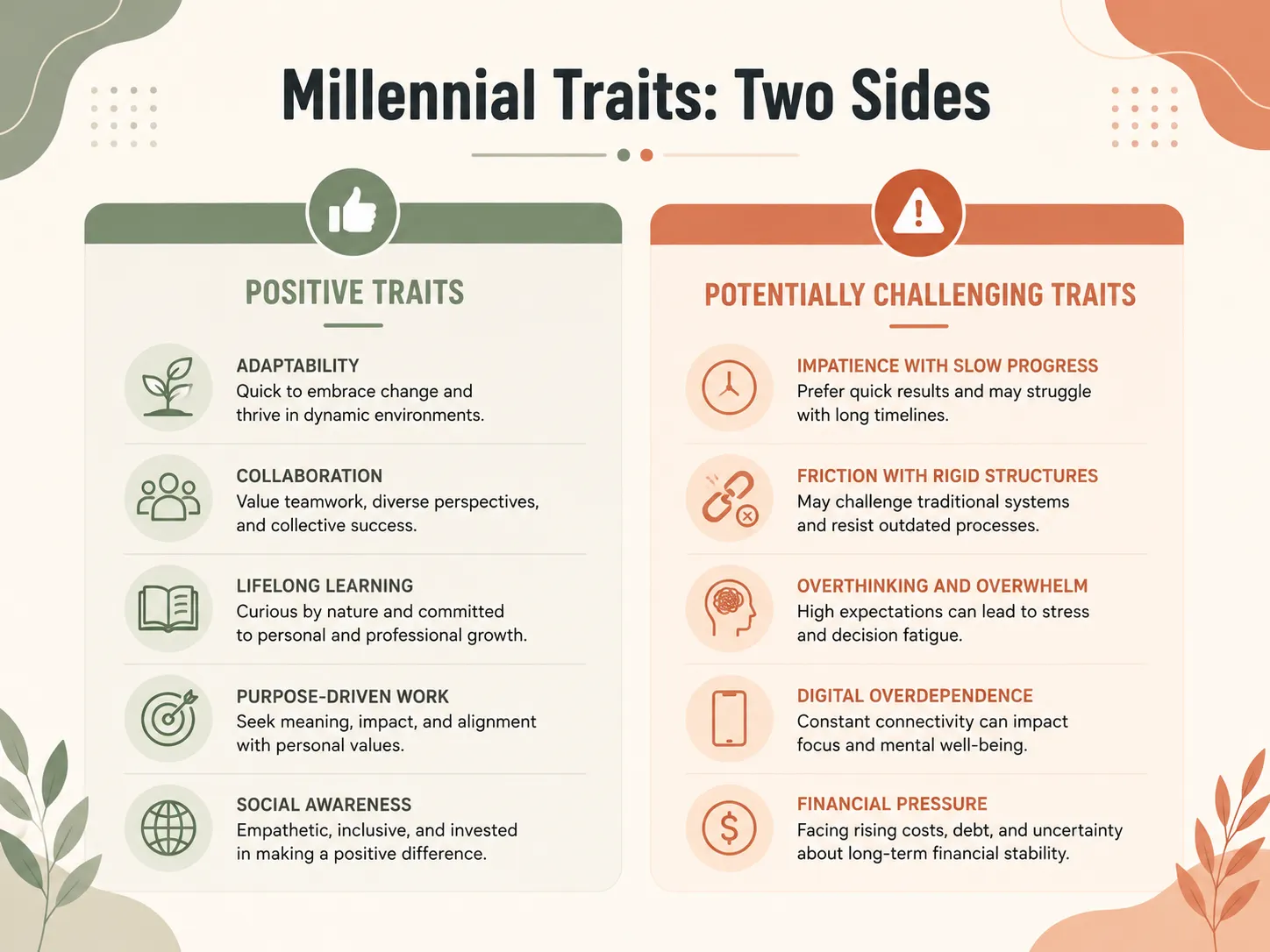
- Adaptability to changing technology, workplaces, and economic conditions
- Technological confidence and comfort learning new digital tools
- Collaboration and communication skills developed through digital and in-person teamwork
- Openness to learning, including career changes and skill development
- Desire for meaningful work that aligns with personal values
- Willingness to question established norms in workplaces and institutions
- Emphasis on experiences and personal development as part of a fulfilling life
Potentially Negative or Challenging Characteristics
- Perceived impatience with slow-moving institutional systems
- High expectations for workplace flexibility, which can create friction in traditional organizations
- Possible difficulty accepting rigid hierarchical structures
- Financial pressures affecting traditional milestones such as homeownership
- Dependence on digital communication in some professional or social contexts
- Risk of being unfairly characterized through broad generational stereotypes
Why the Same Trait Can Be Viewed Positively or Negatively
Traits such as flexibility, independence, and comfort with technology are not inherently positive or negative — their perception depends heavily on context and the observer’s own generational frame of reference. A preference for flexible work, for example, may be viewed as adaptive and efficient by some employers, while others interpret it as a lack of commitment. Recognizing this distinction helps separate genuine generational patterns from exaggerated cultural narratives that oversimplify complex behavior.
Millennial Personality Traits vs. Millennial Generational Characteristics
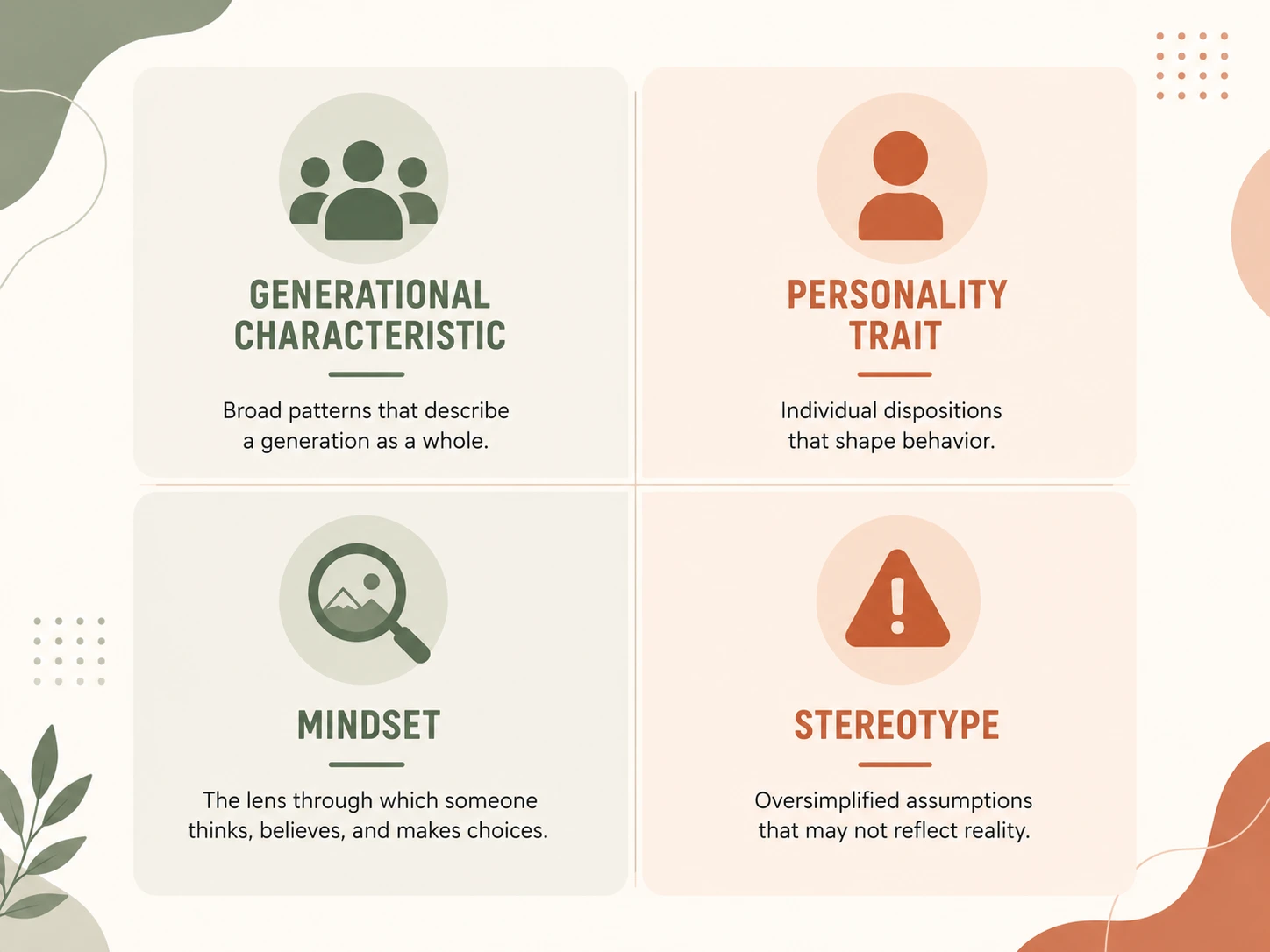
“Personality traits” and “generational characteristics” are related but should not be treated as interchangeable concepts. Personality is shaped by individual psychology, upbringing, culture, environment, and personal life experience. Generational characteristics, by contrast, describe broad patterns observed across a large population that shares similar formative timing.
This distinction explains why two millennials can have very different personalities — one highly structured and risk-averse, another spontaneous and exploratory — while still sharing generational characteristics shaped by common historical context, such as comfort with digital tools or attitudes toward workplace flexibility.
| Concept | What It Describes | Why It Matters |
|---|---|---|
| Generational characteristic | Broad population-level pattern | Helps explain cohort-wide trends |
| Personality trait | Individual tendency | Helps explain personal behavior |
| Mindset | Attitudes and assumptions | Helps explain how people interpret situations |
| Stereotype | Simplified cultural belief | May exaggerate or distort real patterns |
Millennial Stereotypes: What Is True, Exaggerated, or Misleading?
Common Stereotypes About Millennials
Frequently repeated claims about millennials often involve workplace attitudes, technology use, spending habits, housing decisions, and views toward traditional institutions. Some of these claims reflect genuine, evidence-supported patterns, while others are exaggerated generalizations drawn from limited or anecdotal observations.
Why Generational Stereotypes Develop
Generational stereotypes often develop through media narratives, memorable cultural events, viral social media moments, and differences in perspective between age groups. A real, measurable trend — such as delayed homeownership due to economic conditions — can become distorted into an oversimplified stereotype, such as the claim that millennials simply prefer not to own homes.
How to Interpret Millennial Stereotypes Responsibly
Interpreting generational stereotypes responsibly involves avoiding the treatment of cohort-level observations as universal truths. Readers should consider age, income, country, culture, education, family circumstances, and historical timing before applying a generalization to any individual. It is also important to distinguish correlation from causation: a trend appearing alongside a generational label does not necessarily mean the generation caused that trend.
Millennial Mindset vs. Gen Z Mindset: What Are the Main Differences?
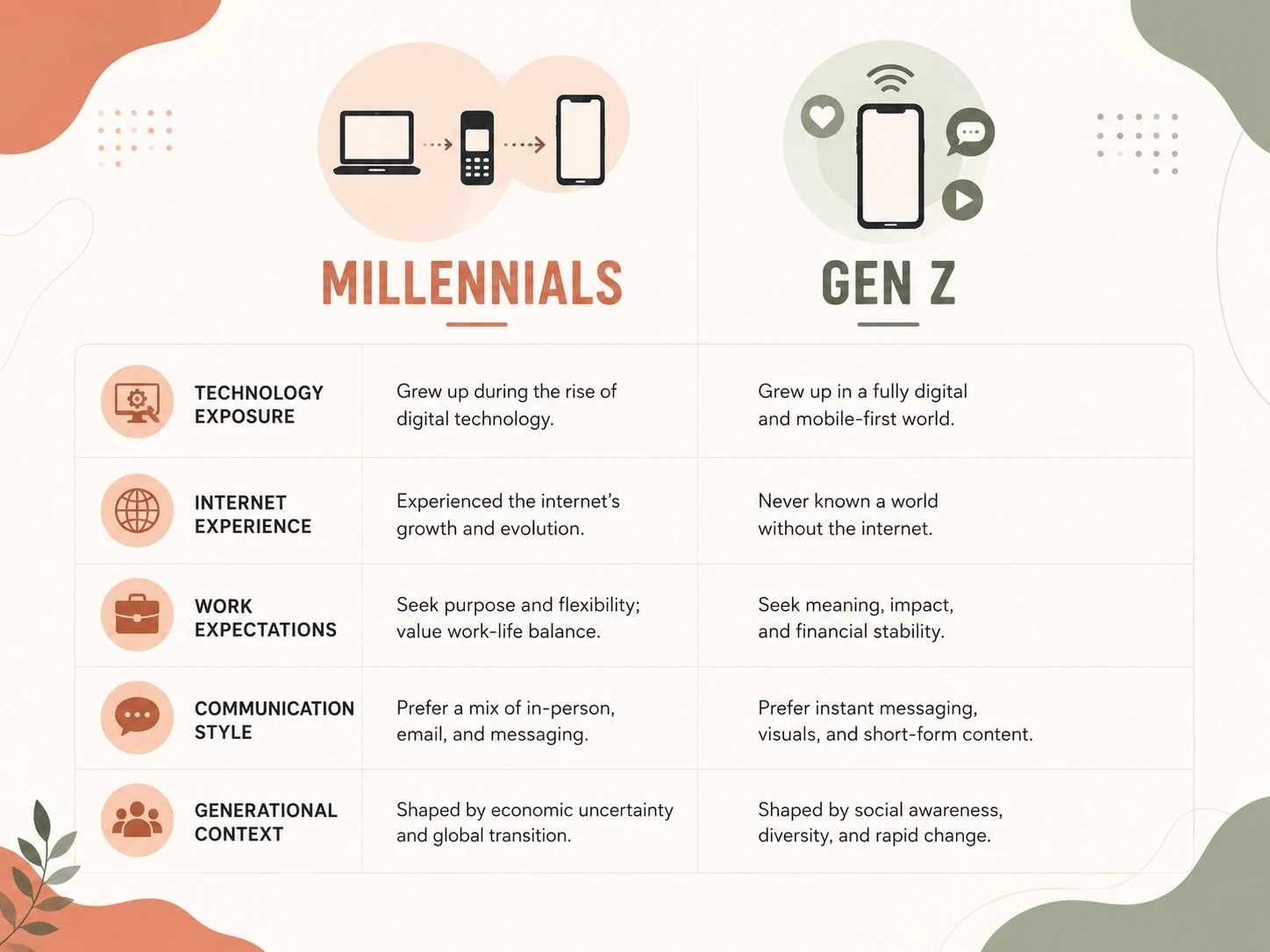
Millennial Traits vs. Gen Z Traits
Comparing millennials and Gen Z is most useful when framed around differing formative experiences rather than presenting the two generations as opposites.
- Technology and internet exposure during childhood and adolescence
- The development stage of social media during each generation’s formative years
- Education and career expectations entering adulthood
- Communication preferences, including reliance on text, social platforms, or video
- Attitudes toward workplace flexibility and wellbeing
- Financial and economic outlook shaped by differing economic conditions
- Attitudes toward identity and broader social issues
Why Millennials and Gen Z Can Have Similar Traits
Despite generational differences, millennials and Gen Z often display overlapping traits because generational boundaries are not absolute. Life stage can sometimes explain behavioral similarities or differences better than generational label alone — for instance, younger millennials and older Gen Z members may share more in common with each other than with the oldest or youngest members of their own respective generations.
| Dimension | Millennials | Gen Z |
|---|---|---|
| Formative technology experience | Transition from offline to digital | Digital-first environment |
| Internet experience | Experienced rapid internet adoption | Grew up with pervasive connectivity |
| Work expectations | Increasing emphasis on flexibility and purpose | Strong emphasis on flexibility, wellbeing, and adaptability |
| Communication | Experienced the shift from email/SMS to social media | Social and mobile communication from an earlier age |
| Generational context | Came of age through major economic and technological shifts | Came of age amid later digital, economic, and social changes |
What Shaped the Millennial Mindset?
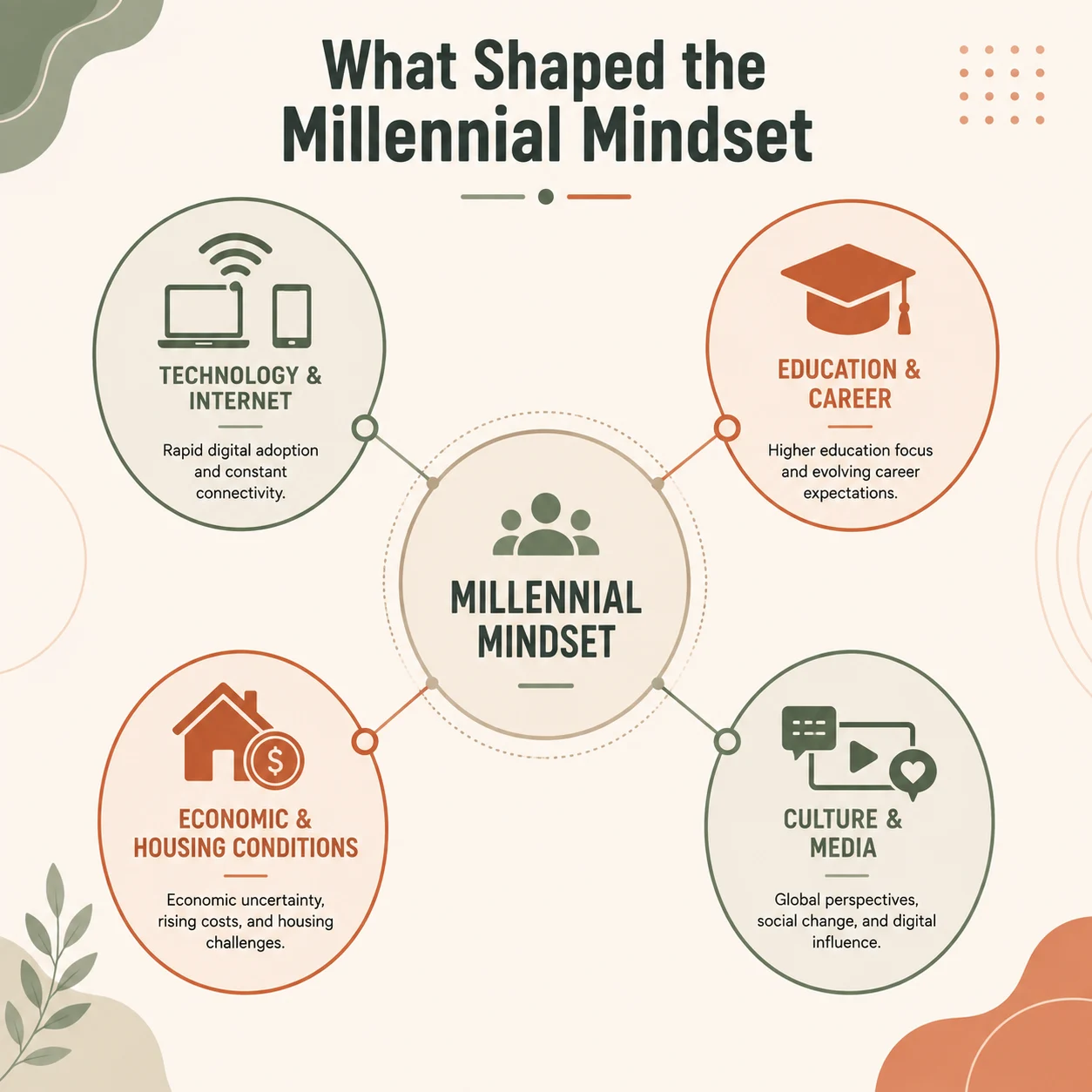
Technology and the Internet
Millennials experienced the transition from early internet access to smartphones and social media platforms during key developmental years. This shift shaped comfort with digital communication, online research, and rapid access to information — habits that carried directly into adult work and personal life.
Education and Career Expectations
Changing educational pathways, rising costs of higher education, and evolving professional expectations influenced how millennials approached career planning. Increased interest in entrepreneurship, career mobility, and workplace flexibility developed partly in response to a job market that looked different from previous generations’ experiences.
Economic and Housing Conditions
Economic uncertainty, shifting employment conditions, student debt, and housing affordability challenges have significantly influenced millennial attitudes toward traditional adult milestones. Delayed homeownership or marriage, for example, is often better explained by economic circumstances than by a generational rejection of those goals.
Culture, Media, and Social Change
Broader cultural and media shifts contributed to evolving expectations around relationships, identity, work, and lifestyle. Exposure to more diverse media narratives and social platforms allowed millennials to encounter a wider range of perspectives than earlier generations typically had access to at the same life stage.
How the Millennial Mindset Has Changed Over Time
Millennials should not be treated as a static group frozen at one life stage. Early-adult millennials navigating first jobs and shared housing often prioritized different things than millennials who are now established in careers, long-term relationships, or parenthood. Shifting priorities at each life stage often starts internally — learn more about how to change your thought patterns as circumstances evolve.
As life stage shifts, priorities commonly evolve across several areas:
- Career: From early exploration toward stability or specialization
- Financial stability: From managing debt toward long-term planning
- Family: From individual focus toward shared household or parenting responsibilities
- Technology: From early adoption toward more selective, purpose-driven use
- Health and wellbeing: From lower prioritization toward increased focus on long-term wellness
- Personal development: From general exploration toward more targeted goals
Major external events — including economic downturns, public health crises, and significant technological shifts — can also reshape attitudes across an entire generation at once, further illustrating that the millennial mindset is not fixed.
Common Misunderstandings About the Millennial Mindset
- Millennials are not a personality type; the label describes a generational cohort, not an individual psychological profile.
- Not every millennial prioritizes experiences over possessions; preferences vary significantly by person and circumstance.
- Digital fluency does not mean every millennial prefers digital communication in every context.
- Workplace preferences vary considerably by profession, industry, and socioeconomic circumstances.
- Generational differences do not automatically imply conflict between generations.
- A stereotype can contain a recognizable cultural pattern while still being inaccurate when applied as a universal claim.
Millennial Mindset in Everyday Life: Work, Relationships, and Personal Goals
At Work
In professional settings, the millennial mindset is often reflected through a preference for flexibility, autonomy, regular feedback, collaborative environments, and purpose-driven work. These preferences can be advantageous in organizations that support adaptive structures, but they may create friction in workplaces built around rigid, traditional hierarchies.
In Relationships and Family Life
Millennials often display changing expectations around partnership, marriage, and shared household responsibilities. These shifts are shaped by economic conditions, evolving cultural norms, and greater emphasis on equitable division of responsibilities, rather than a single universal millennial lifestyle.
In Personal Development
Your Daily Thrive recommends viewing the millennial mindset as a useful lens for understanding broader self-improvement themes such as goal setting, resilience, lifelong learning, and habit formation. Generational context can influence which priorities feel most relevant at a given time, but individual circumstances — including personality, resources, and life stage — remain the more decisive factor in personal growth outcomes. For a deeper look at how you can grow as a person regardless of generational context, individual habits and self-awareness matter most.
Millennial Mindset Books, Podcasts, and Other Learning Resources
What to Look for in a Millennial Mindset Book
When evaluating books that discuss millennials, Generation Y, or generational psychology, readers should consider the author’s expertise, the quality of underlying evidence, the research methods used, and the publication date. A credible resource will clearly distinguish evidence-based generalizations from cultural stereotypes rather than presenting both as equally reliable.
What Makes a Millennial Mindset Podcast Useful?
Podcasts covering the millennial mindset can offer valuable personal experiences, interviews, and cultural commentary that add context to broader research. However, anecdotal experiences shared in podcast formats should not automatically be treated as representative evidence for the entire generation; they are most useful as illustrative perspectives alongside more rigorous sources.
Conclusion
The millennial mindset is best understood as a collection of broad generational tendencies shaped by shared formative experiences, not a fixed personality profile that applies equally to every individual. Technology, economic conditions, education, workplace evolution, and cultural change all played major roles in shaping how this generation approaches success, flexibility, and personal meaning. Recognizing the difference between generational characteristics, individual personality traits, and cultural stereotypes allows for a more accurate and useful understanding of this topic. As of 2026, evolving workplace research continues to refine how experts describe generational attitudes, reinforcing that the millennial mindset is most useful when generational patterns are considered alongside individual circumstances. In short: the millennial mindset is best understood as a product of shared formative experiences, not a universal way of thinking.
Frequently Asked Questions
What is the millennial mindset? The millennial mindset is the set of attitudes, values, and behavioral tendencies commonly associated with the Millennial generation, shaped by shared formative experiences rather than a fixed personality type applied to every individual.
What are the main characteristics of the millennial mindset? Commonly discussed characteristics include digital adaptability, a preference for flexibility, a focus on experiences and personal meaning, continuous learning, and a broader, multidimensional view of success — though generalizing these traits across an entire generation has clear limitations.
What are millennials known for? Millennials are best known for early adoption of social media, adaptability to technological change, a strong preference for workplace flexibility, and evolving attitudes toward traditional milestones such as marriage and homeownership.
What are the positive and negative characteristics of millennials? Positive characteristics often include adaptability, technological confidence, and openness to learning, while challenges can include perceived impatience with rigid systems and financial pressures — the same trait can often be interpreted positively or negatively depending on context.
What are common stereotypes about millennials? Common stereotypes involve workplace attitudes, spending habits, technology dependence, and delayed traditional milestones; some reflect genuine patterns shaped by economic conditions, while others are exaggerated cultural narratives.
How are millennials different from Gen Z? Millennials and Gen Z differ mainly in their formative technology exposure, communication habits, and economic context, with millennials experiencing a transition to digital life and Gen Z growing up in an already digital-first environment.
Are millennials more adaptable than other generations? Adaptability is frequently associated with millennials due to the rapid technological and economic shifts they experienced, but there is no reliable evidence that one generation is inherently more adaptable than another.
Are millennial personality traits the same as millennial characteristics? No — personality traits describe individual tendencies shaped by personal psychology and experience, while generational characteristics describe broad, population-level patterns observed across a shared cohort.
Why did the millennial mindset develop? The millennial mindset developed through a combination of technological change, economic uncertainty, evolving education and career pathways, and shifting cultural and social norms experienced during this generation’s formative years.